


Top 10 Occupations from The Official Handbook of the Marvel Universe, A to Z, v. 2
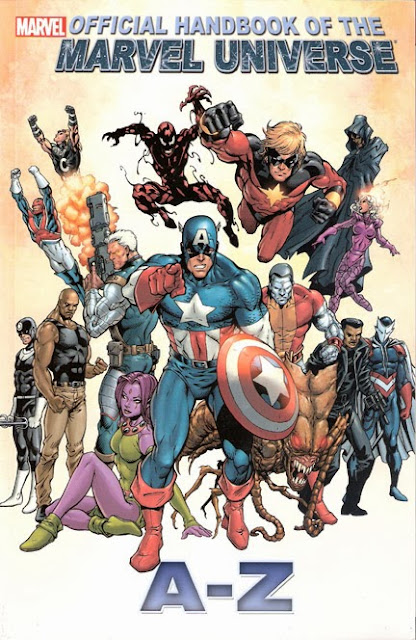 They should have this book in guidance offices in high schools across the country instead of … whatever it is that guidance counselors use to inform kids about their choices. This volume is so full of great careers even “vampire hunter” (Blade) and “monster hunter” (Elsa Bloodstone) don’t make the list.
10. Kalorian (Count Abyss). “Kalorian” is term some writer made up. It has something to do with being in a symbiotic relationship with a very powerful alien. Exactly what it has to do with being a symbiote is left unexplained. It’s probably unpleasant, but I left it on the list because it would certainly allow you to write your own job responsibilities. What does a Kalorian do? Whatever I say.
Still, being a Kalorian is probably better than being an “avatar of Agamotto” (Cadaver). It’s never good when a high muckamuck magical being is telling you what to do.
9. Protector of the Universe (Captain Marvel). The hours are awful, and there’s no retirement plan. But you do get to see, well, everything.
8. Cultist (Betty Brant). I suppose it does take up all your time, but room and board is usually provided. Those perks are what sets “cultist” apart from Panther Cult acolyte (Kasper Cole), because Black Panther is not shelling out money for your extras. You can lift yourself up by finding your own heart-shaped herb (and hoping it doesn’t kill you).
7. Self-declared ruler of the Negative Zone (Blastaar). I think I’m going to list this as my occupation on my 1040 next year. It’s not a perfect job; it requires more responsibility than “self-proclaimed savior of Earth” (Centurius), and it’s harder to establish yourself as a ruler than savior. (Generally, saviors only have die to prove their bona fides, and we all do that.) On the other hand, all you have to do is say you’re either one, and you’re set.
6. Competitor (Champion). Now you’re talking. He’s a competitor! All broadcasters of all sports ever love him. He doesn’t even have to win! Imagine going up to people and challenging them to competition all the time. Because you’re a competitor! That’s what it’s like to be Champion!
On second thought, that sounds depressing.
5. Investigator of reality (Contemplator). Think of the comically large magnifying glass you’d get with this job! Plus, you can confidently say that most things are, in fact, real. You’d rarely be wrong. It’s a better job than “reality traveler” (Blink); I travel through reality every time I walk to the bathroom. I suppose I could start investigating reality too, but that seems like too much of a bother unless I were going to make a career of it.
4. Demonic pawn (Copperhead). This has a retirement plan that is worse than protector of the universe, and your boss calls you into work all the time — weekends, late nights, apocalypses. But supervisors are very clear about what they want, and it’s one of those jobs you go into knowing exactly what you’re in store for. Recommended for those who aren’t self-starters but are good negotiators.
3. Scavenger (Caliban). You do get to set your own hours, and you’re your own boss. You aren’t trapped behind a desk all day, either. However, you do risk someone sticking a knife between your ribs. It’s a little better than “drifter” (Cammi), since being a scavenger implies a little more ambition.
2. Wealthy recluse (Moira Brandon). This is the job for those of us who are lazy but are too inept in social situations to shift blame or work onto co-workers. Wealthy recluse narrowly edges “heiress” (Crimson Cowl), since there’s a touch of entitlement to heiress that raises resentment in others; people usually believe wealthy recluses have done something to earn the wealth that allows them to recluse.
1. Insane menace (Bloodwraith). Insanity has a low bar for qualification; all of us are psychologically abnormal in some way or another. The “menace” part is what gets you the respect similar professions — such as “megalomaniac” (Brothers Grimm [Nathan Dolly]) — are denied.
Additionally, Bloodwraith was a squire before he was an insane menace. It’s a strange career progression that takes you from knight’s assistant to crazy threat to everyone.
Dishonorable mention: Would-be conqueror (Bain, Count Nefaria). Keep trying, guys. Let me know when you accomplish something.
Labels: 2011 November, Marvel, not a review, occupational handbook, Official Handbook of the Marvel Universe A to Z
posted by Raoul | 2:41 AM
|
0 comments

 One thing I forgot to mention as I went through the first volume of the