


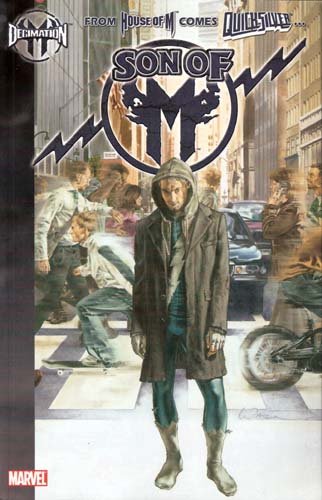
Son of M
Collects: Son of M #1-6 (2006)
Released: August 2006 (Marvel)
Format: 144 pages / color / $13.99 / ISBN: 9780785119708
What is this?: Pietro Maximoff, the former mutant Quicksilver, attempts to regain his lost powers after his sister declares “No more mutants.”
The culprits: Writer David Hine and artist Roy Allan Martinez
Pietro Maximoff — the mutant known as Quicksilver — isn’t exactly a frontline character. He’s been prominent in a few team books: the ‘90s, Peter-David X-Factor and early, Cap’s-Kooky-Quartet Avengers. He even had a short-lived series in the wake of Heroes Reborn in the mid-‘90s. But he was always overshadowed by his sister, the long-time Avenger Scarlet Witch, and his father, mutant despot / liberator Magneto.
But with mutants no longer a force for the world and the Scarlet Witch missing after the “House of M” crossover, Pietro was all that was left. Son of M shows Pietro in the days after the Scarlet Witch’s reality altering leaves the world with fewer than 200 mutants and many more former mutants. Pietro’s one of those former mutants, but unlike the rest of them, who seem to be taking their loss placidly, Pietro not only wants to do something about it, he can do something about it: use his contacts with the Inhumans (his estranged wife, Crystal) to be exposed to the Terrigen Mists, which gives the Inhumans their enhanced powers and physiology.
The mechanics of the plot, however, seem to have left a little less time for the human drama. Crystal goes from worried about Pietro to suspicious and disinterested in him in just a few pages. Crystal and Magneto, who should be major players in the family drama get perhaps less time and characterization than they might deserve. We see little set up for the discontent that allows Pietro to find a collaborator. I think some of the time given to setting up the following miniseries, Silent War, could have been better used for that purpose, but I admit that since I didn’t plot it, I might not appreciate how difficult that would have been. In any event, the Inhumans’ declaration of war was a neat moment.
I do not care for the art of Roy Allan Martinez. He gives everything a worn, ill-fitting look, and the pale palette supplied by colorist Pete Pantazis doesn’t help matters. On the other hand, worn and ill-fitting is a look that’s appropriate for the former mutants, and Martinez’s art does help make the confusing time-travel scenes understandable. So while I really don’t like his work, I can’t say it’s bad.
I didn’t enjoy this book as much as I should have. Hine does a good job telling the story, despite my quibbles, and it’s a story that desperately needed to be told after Marvel’s X-Men staff dropped the ball on the “House of M” fallout. But Martinez’s art … looking at it hurts my eyes. There’s something about his light line and oddly shaped (almost Quitely-shaped) faces that crosses signals in my brain and brings on almost a synesthetic distress. I can’t quite figure it out, and I’m sure most people will not have a similar reaction. I only know I’m probably not going read it again, although I probably will read Silent War.
Rating:  (3 of 5)
Labels: 3, Blue Area of the Moon, David Hine, Inhumans, Marvel, Quicksilver, Roy Allan Martinez, Son of M
posted by Raoul | 10:19 PM
|
0 comments

 In Culture Shock, writer Sean McKeever and artist Matthew Clark build on the end of the Jenkins / Lee Inhumans mini-series, which was an Eisner-winning success for Marvel. But while that series focused on the internal politics of the Inhuman royal family as it tried to deal with humans, McKeever and Clark take five young Inhumans, some of whom were in the Jenkins / Lee series, and make them part of a trial cultural integration in America. Only one of the five, Alaris, is pleased to be sent on the mission, and the others are left looking to make sense of this strange mission with a savage, backward culture.