Reviews of trade paperbacks of comic books (mostly Marvel), along with a few other semi-relevant comments / reviews.

18 November 2016

Black Panther Epic Collection, v. 1: Panther's Rage

Collects: Fantastic Four #52-3 and Jungle Action #6-24 (1966, 1973-6)

Released: September 2016 (Marvel)

Format: 400 pages / color / $34.99 / ISBN: 9781302901905

What is this?: The Black Panther, ruler of the African nation of Wakanda, deals with Erik Killmonger’s rebellion, then goes to America and fights the Ku Klux Klan

The culprits: Writer Don McGregor and artists Rich Buckler and Billy Graham, with help from Jack Kirby and Gil Kane


The ‘70s Black Panther Epic Collection, v. 1: Panther’s Rage was the Black Panther’s first chance to step into the spotlight alone, and the result is simultaneously ahead of its time and firmly of its time period.

Panther’s Rage is ahead of its time because the Jungle Action run is one long story, in which the Black Panther has to deal with a rebellion in Wakanda led by Erik Killmonger, plus the beginning of another. Such long-form stories were uncommon in the ‘70s, although they weren’t unheard of. Also, having the entire cast be people of color was almost unprecedented in a mainstream comic. On the other hand, writer Don McGregor’s narration is very much like some of his more ambitious ‘70s contemporaries: verbose, contemplative, philosophical, and very, very purple.

Black Panther Epic Collection, v. 1: Panther’s Rage coverMost contemporary readers are likely to be struck by the latter rather than the former. When characters can talk to one another, breaking the monotony of a single voice, McGregor’s insistence on making abstract arguments is bearable, even interesting. But when the Panther is on his own, fighting Killmonger’s lieutenants single-handedly, the page is crowded with narrative boxes, making the book a chore to read. Even dialogue doesn’t always help; by the end, McGregor gives newspaper reporter Kevin Trublood long monologues about America and haranguing lectures about racism that drag on and on without advancing the story or McGregor’s theses.

McGregor gives the reader passages like this:
Cruelty. It’s a word you understand like the word pain … You give it a vague definition and file it away, hoping you never have to learn what the word really means. He wishes the torture weren’t so mindless, that it had a point, a reason that would justify such inhumanity. But reasons are scarce … more for fiction than life.” — Jungle Action #15 (p. 205)
That’s two panels on a five-panel page, and it’s a good example of the verbiage that crowds the page. It’s not badly written, and we can argue about how original its insights are; it’s definitely dense, though, and I find it overwritten. (And who bolded “vague definition”? Those are the least interesting words in the quote.) McGregor isn’t interested in subtlety, but when he does opt for that route, it can be effective; for instance, the death of a bird trapped in a substance Killmonger uses to capture dinosaurs is among the most moving moments in the book, even though the bird is in only three panels with minimal narration.

With other writers, this sort of narration might be a sign of the writer’s lack of confidence in the artist, but I think McGregor works well with Rich Buckler and Billy Graham. I think McGregor lacks confidence in art in general, though. (And in Black Panther himself: I’ve never seen Black Panther get defeated as often as he does in this book. I mean, a cop pistol whips Panther in a supermarket, for Priest’s sake.) McGregor wants adjectives and adverbs, intensifiers and modifiers, that the art just can’t provide. Plus, no artist can draw an interior monologue with narrative philosophical digressions, and that’s what McGregor ladles onto the page.

McGregor needed someone to edit his work, to rein in his excesses and focus his story onto more interesting areas. But editor Roy Thomas was not that person, and it wasn’t Marvel’s style at the time to put limits on the writers of its fringe titles.
Among Marvel’s ‘70s output, this sort of writing was the norm, with writers like Steve Gerber and Thomas himself contributing ornate prose and socially relevant scripts. At worst, this crop of writers came across as Stan Lee knockoffs who tried to prop up weak superhero stories with grabs at social relevance that didn’t go far enough or were obvious at the time. At best, they become critical darlings, but it isn’t their prose alone that achieves that reputation; some experimentation in character or format was necessary to set the book or writer apart.

Does the long-form storytelling qualify Panther’s Rage as experimental enough to overcome the similarity to other Marvel writing at the time? I don’t think so. The Panther’s Rage storyline lasts from #6 to #18, more than two years of publishing time. (Jungle Action was bimonthly at the time.) Black Panther often loses sight of the overall picture, so the linked stories feel like more of an attempt to line up new adversaries for Panther rather than constructing a coherent story; Panther battles Killmonger’s lieutenants from #8 to #10 and #12 to 16 rather than addressing the leader of the rebellion or the people’s discontent. Nothing links these henchmen — who have names like Venomm, Malice, Baron Macabre, Karnaj, Sombre, and Salamander K’ruel — to the overall struggle. In only three issues does Black Panther seem willing to engage Killmonger’s forces with resources beyond his own brawn and muscle. In the end, McGregor’s run suffers in comparison to Ta-Nahisi Coates and Brian Stelfreeze’s current Black Panther, which covers similar ground with more coherence and focus.

On the other hand, I can’t deny McGregor is writing a story with a Black protagonist and a nearly completely Black supporting cast, both allies and villains. These supporting characters aren’t just hanging around; McGregor does an excellent job juggling their subplots and developing these new characters. Monica Lynne, the Panther’s African-American girlfriend, has to deal with a culture in which people look like her but she is still an outsider. Taku, the Panther’s communication officer, is a kind soul who even befriends Venomm, reforming the captured villain (to an extent). Two of Killmonger’s henchmen, Tayete and Kazibe, are used for comic relief throughout Panther’s Rage; the humor is not in keeping with the book’s tone, but it is a welcome change of pace. (Also: their scenes have a welcome thinning of narrative boxes.) McGregor also gives us a long (and distracting) subplot in which the head of Panther’s palace security, W’Kabi, and his wife drift apart, which makes me suspect McGregor himself was going through a breakup or he was watching someone close go through one.

The issues between the end of the Panther’s Rage story and the book’s cancellation are as mixed as the rest of the book. The Black Panther vs. the Ku Klux Klan is an intriguing idea, and the mystery over who killed Monica’s sister should drive the book forward. But in its final five issues, the mystery goes nowhere, McGregor adds in a non-Klan group to muddy matters, and an inordinate number of pages are used up by the speechifying Trublood and irrelevancies. On the other hand, watching Panther in a small Southern town has promise, and the issue in which Monica mentally inserts Panther into a Reconstruction-era lynching story is an excellent illustration of what it means to have a hero of color.

The art, provided by Buckler (#6-8) and Graham (#10-22, 24), is solid throughout. I prefer Buckler from an aesthetic viewpoint; his layouts are cleaner and larger, easier to follow, and his linework is much easier on the eyes. (Gil Kane does a fill-in on #9, and his work meshes with Buckler’s much better than his successor’s.) However, Buckler’s work does have its flaws. I can’t help but be distracted by how far apart Buckler draws people’s feet in action shots — their groins must be in constant agony, given how widely their legs are spread. More concerningly, he creates a Wakanda that is much more tribal than is shown later at Marvel. The whole of Wakanda is made up of thatched huts, Black Panther’s palace, and a hospital; no one but the Panther and a few supervillains wear pants, with most of other characters having grass fringes around their legs or waists somewhere. I understand the Wakandans are supposed to be isolated, but some of them have probably heard of trousers and wooden houses and would be curious.

Graham doesn’t have much choice but to follow Buckler’s lead on costuming and setting, unfortunately, and when some sci-fi trappings could be integrated into the art, he mostly misses the chance. Also unfortunate is his propensity for denser, more crowded layouts; McGregor’s words need room, and his art constricts their space. Fortunately, he has more of a chance to show the fantastic (mostly unexplored and undeveloped) areas of Wakanda. The frigid peaks and sultry jungles look good, although incorporating a Lost-World area with dinosaurs is a boring choice. Oh, sure: The Wakandans have no idea dinosaurs are living in their backyard. (That was probably McGregor’s decision, but incorporating dinosaurs into a comic is usually blamed on the artist.) Graham often works issue titles or words into the art; sometimes this works (such as on opening splash pages), and sometimes it’s baffling, like when “Epilogue” appears as a cloud in the closing panels in the final issue of Panther’s Rage.

The bonus material is more interesting than usual for a large collection like this. In addition to the standard unfinished art and previous versions of covers and pages already collected in the book, Panther’s Rage also includes five rough pages of the never-finished Jungle Action #25. McGregor supplied pictures of himself (and one of himself and Graham), which adds an unusually humanizing touch to the work. McGregor also provided pictures of the envelopes he stored material related to each issue in; the exterior of each envelope had notes to himself, including themes, ideas for other stories, and possible dialogue. Collection editor Cory Sedlmeier deserves a great deal of credit for compiling this unusually entertaining package.

On the other hand, I would have preferred a reprint of Avengers #62 (reprinted in Jungle Action #5 and featuring Man-Ape), Daredevil #69 (reprinted in Jungle Action #23), or any of Monica Lynne’s previous appearances. Room for one of those could have been made by dropping the standard sketches and a few other things while keeping most of the material I noted above.

Jungle Action was cancelled to make way for the Jack Kirby version of Black Panther, which could not be more different — Kirby’s version of the character was a cheery, enthusiastic king who went on goofy sci-fi adventures. I much prefer McGregor’s version, even when his prose is at its most turgid.

Panther’s Rage is all over the place — as is this longer-than-usual review, I suppose. For readers who have a high tolerance for ‘70s prose-dense comics, I heartily recommend his book. For those who would like to hear the characters and actions speak louder than the narrator, look elsewhere.

Rating: Black Panther symbol Black Panther symbol Black Panther symbol (3 of 5)

Labels: , , , , , , , , , , , , , ,

04 November 2016

Spider-Man, v. 1: Miles Morales

Collects: Spider-Man v. 2 #1-5 (2016)

Released: September 2016 (Marvel)

Format: 112 pages / color / $15.99 / ISBN: 9780785199618

What is this?: Miles Morales, the Spider-Man of the Ultimate Universe, has to adjust to being a Spider-Man in the regular universe with new villains — in addition to all the problems of being a normal teenage superhero.

The culprits: Writer Brian Michael Bendis and artist Sara Pichelli


I’m not very familiar with writer Brian Michael Bendis’s magnum opus, Ultimate Spider-Man. I read a few of the early trades, killing time when I was bored, but I didn’t fall in love with the character or the universe.

That means I haven’t read any stories featuring the second Ultimate Spider-Man, Miles Morales. I’ve certainly heard of Miles, but other than Fox News-types screaming about “Black Spider-Man,” I didn’t have any information on him going into Spider-Man, v. 1: Miles Morales, which covers Miles’s first series in the main Marvel Universe.

Spider-Man: Miles Morales, v. 1 coverBendis throws the reader into the story immediately, starting with an in media res fight with the demon Blackheart, who has already defeated the Avengers. Before resolving that fight, Bendis then backtracks to a day in the life of Miles Morales, a high-school student who is the new Spider-Man. (He returns to the fight with Blackheart by the end of the issue.) Although the book has no lengthy infodumps, and the recap page is scanty at best, Bendis gradually introduces the information readers need to understand what is going on throughout v. 1. Occasionally, a bit of information will be shoehorned in as if Bendis couldn’t find a way to elegantly introduce it, but overall, the story flows well and didn’t leave me scratching my head.

(As a side note: As well as Bendis does this, I wonder how much my own familiarity with the Marvel Universe and how these stories are supposed to go allows me to follow along with Miles’s story so easily.)

While I am unfamiliar with Miles, I am quite familiar with Bendis. It occurs to me that Bendis is becoming the new Chris Claremont, albeit one who doesn’t let his bondage fantasies play out on comics pages. Like Claremont, Bendis has an authorial voice and narrative tics (danglers and mind control for Claremont, extreme decompression and a fondness for giving favorite — or just single — characters a push in group situations) that may drive off readers who have grown tired of them. (I dropped Powers years ago when I couldn’t take any more of Bendis’s stammered dialogue.) Fortunately, Bendis keeps those problems in check in v. 1; yes, the book sounds like Bendis, and the plot is a little slower than I would like, but the plot moves along and things happen. Bendis does, however, bring in Goldballs, a mutant character Bendis created during his X-Men work; Goldballs is inexplicably popular and immediately finds himself in the thick of the book without working for it.

As I said, v. 1 has action, but I’m not sure I buy it. It’s not the fault of artist Sara Pichelli; her fight scenes are a treat to read, clear and filled with movement. Bendis’s choices, however, don’t make for a compelling whole. The book’s big action piece is Miles’s fight against Blackheart, who has already taken out the Avengers. Without knowing anything about Blackheart, Miles battles the huge demon, even picking up Captain America’s shield during the fight. Symbolically, we know that’s supposed to be important, but Miles does almost nothing with Cap’s shield — he bops Blackheart’s face with the shield a couple of times. Blackheart, for his part, is no match for Miles; he grabs Miles once, but after Miles uses his venom blast, he never touches the teenager again.

What’s the venom blast? Well, with a touch, Miles can make humans feel like they’re having a heart attack. It has an even stronger effect on Blackheart. Miles also appears to become invisible at some point, although he never mentions the power and only uses again it to attempt to fool heat-seeking missiles. Still: Those are some impressive powers that allow Miles to defeat a near-cosmic level threat by himself.

However, Hammerhead and his goons take out Miles by firing a few missiles. Why was Hammerhead after Miles? Because the Black Cat hired him to do so. Why does she want to go after Miles, even though he’s battling Avenger-type threats rather than street-level criminals throughout this book? *shrug* After Miles has been captured, she says she has an instinctual aversion to Spider-Man, any Spider-Man, but seeking out a fight against a superhero isn’t the act of a rational crime boss, which is what Black Cat seeks to be (and is, in Silk).

And then Miles escapes from Hammer head and Black Cat by using some unspecified (and unnamed) power to shatter / repel the chains that bind him. It all feels so … arbitrary. I mean, I know all narrative fiction is arbitrary, and superhero stories even more so, but this seems even more arbitrary than usual.

Other than those unconvincing fights, the main conflicts come between Miles and his grandmother, who is convinced he is on the drugs after his grades slip, and between Miles and his best friend, Ganke, who reveals Miles’s secret identity to Goldballs, on the theory that heroes should share these things. The former is an excellent idea; family is an excellent shaft to mine for teenage hero drama, and grounding someone who can literally punch through walls is a nice irony. Miles’s grandmother toes the lines between an irritating, over-the-top, cartoonish, and out-of-touch old and amusing foil for both Miles and his parents. More often than not, she manages to stay on the right side of that line, but sometimes it’s uncomfortable. (Pichelli draws her as surprisingly young and fashionable granny — too young to have a teenage grandson, unless teen pregnancies run in the family. Which they could!)

Ganke spilling the beans to Goldball is an idiotic betrayal of Miles’s trust. Ganke rationalizes it by saying he wanted to impress a superhero he identified with (both are heavyset or overweight), but it feels contrived — and yes, arbitrary — that Ganke would immediately give up the secret. After trying and failing to connect with Goldballs? Sure, that could make sense. As an opening gambit? No. Is Bendis trying to say Ganke is a horrible friend? Nothing else suggests that. He may be trying to make a point about identity politics and representation, but if he is, it’s simultaneously ham-handed and muddled.

Those sort of representation issues are brought up more ably after Miles’s costume is torn during his fight with Blackheart, revealing that he is a person of color. A vlogger he and Ganke watch is ecstatic about learning the new Spider-Man isn’t another white guy, but Miles rejects her label of the “Black Spider-Man.” First of all, that label doesn’t match his personal identity; he’s only half African-American. Secondly, though, he wants to be known as just plain Spider-Man, which — let’s face it — is an unrealistic expectation as long as Peter Parker is walking around. Maybe there’s more to Miles’s rejection than that, as he stubbornly refuses to see the significance of a Spider-Man who is a person of color. But we don’t see any other components of his reaction in v. 1. I have to wonder, though, how differently this scene would have been written if it had been written by someone whose skin isn’t white.

Pichelli’s art is excellent, and I enjoyed reading her work. Her approach is heavy on double-paged spreads, and although she’s better at alerting the reader to continue from one side of the book to the other than most artists, it still disturbs the reading experience, especially in a book as heavy in conversation scenes as a Bendis comic. Still, Pichelli makes those conversations interesting to look at; she doesn’t reuse headshots over and over. People are moving in those scenes, and their movements feel real. Miles’s face is always in motion as well, although none of his expressions are subtle. Then again, teenagers aren’t subtle, are they?

I am really on the fence about v. 1. I have a feeling Bendis wrote this book as a continuation of his Ultimate Spider-Man book, and if I kept reading the series, then I would get into the rhythm and narrative feel of the book. But reading Bendis has made me leery of putting too much faith into him, so I’m not sure I’m going to pick up the next volume.

Rating: Spider-Man symbol Spider-Man symbol Spider-Man symbol (3 of 5)

Labels: , , , , , , , , , ,

30 September 2016

Conan the Barbarian, v. 32: The Second Coming of Shuma-Gorath and Other Stories

Collects: Conan the Barbarian #250-8 (1991-2)

Released: July 2016 (Dark Horse)

Format: 240 pages / color / $19.99 / ISBN: 9781616558666

What is this?: After losing the princess, Conan is tormented by

The culprits: Writer Roy Thomas and penciler Mike Docherty


In retrospect, it’s obvious Chronicles of Conan, v. 32: The Second Coming of Shuma-Gorath and Other Stories collects stories from a title heading for its end.

Even more than the previous volume, Chronicles of Conan, v. 31: Empire of the Undead and Other Stories, Second Coming uses continuity to give stories more weight and more interest than they would usually have. In fact, Thomas is so invested in using previous Conan stories — usually stories that he himself wrote — that in Conan the Barbarian #254 he completes a Savage Sword of Conan story he wrote in 1979 that never got an ending.

Chronicles of Conan, v. 32: The Second Coming of Shuma-Gorath and Other Stories coverThe continuity Thomas is calling on should be in service of the main story, in which Conan travels back to his home village in Cimmeria to see if it has been destroyed, as he has seen it destroyed in his dreams. Unfortunately, the continuity is of dubious value.

Thomas scatters footnotes throughout the book. Almost every Conan story has some reference to Conan continuity, which, before Thomas took over this time, was rare. But as I said, this is the sign of a title that’s about to wrap things up: As he retraces his path back to Cimmeria, Conan revisits the signposts he encountered when he first journeyed to civilized lands. And that’s a good idea! If the story were more focused, if the overall structure of the Second Coming storyline fit together better, it might work. But it’s hard to see, for instance, how #253 does anything but divert Conan’s journey home momentarily; yes, it reintroduces the wizard Kulan Gath, whom Conan and Elric of Melnibone killed in Conan #15, but surely Thomas could have integrated Gath into the storyline more elegantly, rather than having Conan encounter him while visiting old friends. And why resurrect Kulan Gath at all? He’s not an iconic villain; rather, he’s a magical speedbump in Conan’s early career.

Sometimes these callbacks are necessary; for instance, a brief flashback in #252 to Savage Sword of Conan #2 is used to explain why Conan is no longer a general and secret consort to Yasmela, whom he had been serving since #246. (Both Savage Sword #2 and #248-9 are adaptations of the Robert E. Howard story “Black Colossus,” with SSoC continuing a little farther forward in time.) I’m thankful for the footnotes, even though I’m not sure half these references and flashbacks serve any purpose other than Thomas shouting, “Hey hey hey — these stories are important!” But they aren’t. The purple plague in #255-6 is a distraction easily disposed of, a fillip meant to disguise that the story’s only purpose is to revisit the Lost City of Lanjau from Conan #8. A stopover in Numalia gives Thomas a chance to mention a few characters and places from Conan #7. An old lover (from Conan #48) rescues Conan from the snow and the walking dead in #258; their dead son, who grew to an accelerated adulthood after Conan sired him with an uncanny northern woman, is mentioned, even though he appeared in a non-Thomas story (#145). All these old stories add up to a bunch of distractions bolted onto a plot that needed to be leaner to succeed.

It’s a shame, because the storyline has some entertaining — even chilling — parts. Queen Vammatar of the Hyperboreans, who opposes Conan’s return to Cimmeria, commands the dead and men’s loins; in many ways, she’s the standard sorcerous femme fatale, but Thomas and artist Mike Docherty sell her resurrection power as something truly dangerous and chilling. The creators don’t make the dead as powerful a threat as well as the best zombie tales do, but they can’t, given the Code-approved nature of a serial book. The design of Vammatar’s servitors, the Witchmen of Hyperborea, is almost effective, as their featureless white masks are unnerving, but they seem to be wearing black bodystockings, which makes them look like semi-villainous Mummenschanz.

Cona’s lieutenants, Zula and Red Sonja, exit this story early, having had enough of Conan’s love affairs and desiring more exciting work now that the peace has been won. Thomas evidently agrees with me that Conan works better with a sidekick, though, so he assigns Conan a new one: Hobb of Anuphar, a fat sybarite whose cowardice is supposed to work as comic relief. It doesn’t work, since Hobb’s competence is marginal and his one-note bumbling grows tired quickly. By the end of the story, we don’t know much about Hobb other than he’s Volstagg the Voluminous, except without the charisma or strength.

And we don’t even get the second coming in the title! That doesn’t happen until the next volume, Chronicles of Conan, v. 33: The Mountain Where Crom Dwells and Other Stories. (To be fair, #252-8 are the first seven parts of the Second Coming of Shuma-Gorath storyline.)

Docherty’s art, other than the disappointment of the Witchmen design and the too cartoony skeletal warriors in #255-6, is solid as always. His work looks strongly influenced by John Buscema, although that might be traced to the finishes by long-time Conan inker Ernie Chan. His art is detailed enough to show the rough edges and grime of a time undreamed-of, but it’s never so fussy or confusing that it’s hard to follow. I have gained an appreciation for artists who can draw a clear battle scene, which is a must for Conan; Docherty does a great job with action, and I never have to ask how a character gets from point A to B. If I had to find a flaw with Docherty, other than the occasional design misstep, it would be that his art doesn’t inspire ecstatic praise; he’s solid, not transcendent.

Hoover's cute horrorDale Hoover fills in on #253, and although I’d admire his clean, unfussy work on a number of other titles, it just doesn’t fit with the dirty, blood-stained world of Conan. The depiction of the mutilation of a prince whose life-force was drained, turning his extremities to bone, suffers from being too clean and too neat; the panels have little chance of communicating the horror of seeing someone’s hands and feet reduced to bone. Also, I’m not a fan of the cheesecake design and poses of Imojen, a Kothian rebel leader. Still, his cartoony flashback drawing of the Dweller in the Dark is adorable.

I enjoyed this volume, even if I can see the flaws — the irrelevant fill-in flashback in #251, the Thomas-ian obsession with resurrecting stories and characters that no one finds as interesting as Thomas himself does. But Second Coming does feel like it has a direction and a point, even if that point is to get closer to the end of this series.

Rating: Conan symbol Conan symbol Conan symbol (3 of 5)

Labels: , , , , , , , , , , , , ,

08 July 2016

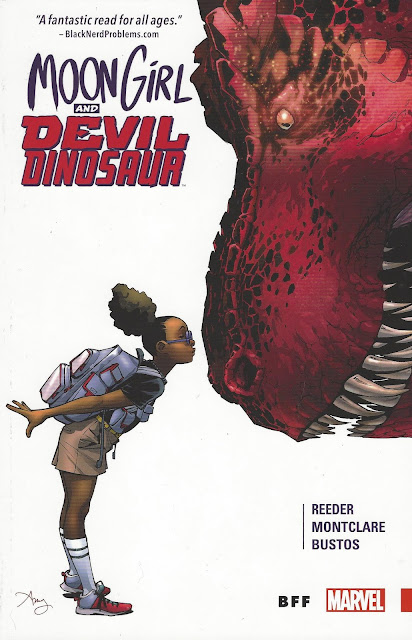
Moon Girl and Devil Dinosaur, v. 1: BFF

Collects: Moon Girl and Devil Dinosaur #1-6 (2016)

Released: June 2016 (Marvel)

Format: 136 pages / color / $17.99 / ISBN: 9781302900052

What is this?: A girl with the Inhuman gene finds a Kree device coveted by time-lost cavemen, who are pursued by Devil Dinosaur, a literal dinosaur.

The culprits: Written by Amy M. Reeder and Brandon Montclare and penciled by Natacha Bustos


I can’t say I’ve ever been enchanted by the idea of Devil Dinosaur.

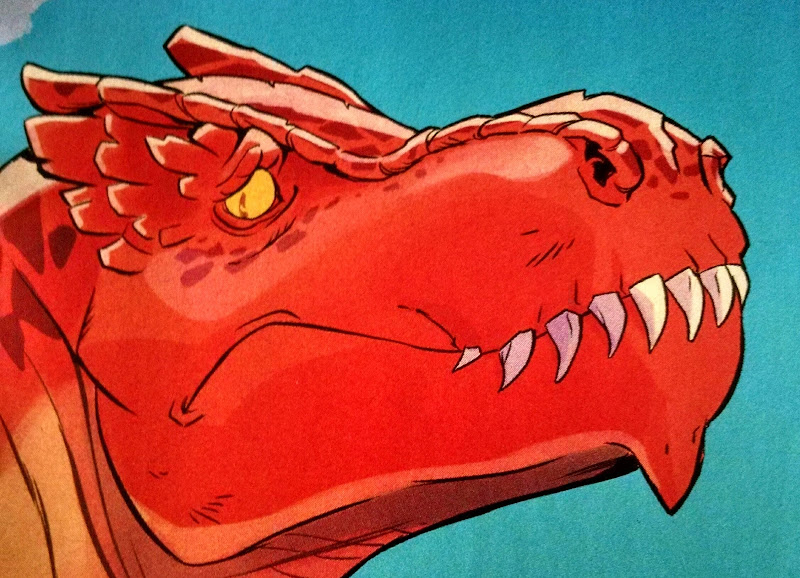
I mean, yes, I get the appeal: giant red T-Rex. But I’m not a big fan of high-concept ideas that go nowhere, and eventually the appeal of what amounts to a giant carnivorous (within the bounds of the Comics Code Authority) horse / dog has to wear thin after a while. It’s not like Devil Dinosaur has a huge range of emotions by himself (herself?).

Moon Girl and Devil Dinosaur, v. 1: BFF coverBut I decided to give Moon Girl and Devil Dinosaur, v. 1: BFF a shot, and I’m glad I did.

Writers Amy Reeder and Brandon Montclare create a sympathetic lead in Lunella Lafayette, a grade-school genius (her age is unclear) who is trying to keep her Inhuman gene from expressing. Unfortunately, she’s surrounded by those not only of lesser intellect but also of much greater obliviousness. Her parents want her to be normal, which she clearly is not; her science teacher (or maybe her only teacher, who knows) teaches the students as if they are half-wits and is not prepared to deal with a gifted child. The token jock, Coach Hrbek, picks up an alien artifact as if it is a basketball.

It’s always easy to make the smart, picked-on kid sympathetic, and Lunella is no different. She has been rejected by the Future Foundation and other gifted schools, showing that while she’s very smart, she’s not considered Marvel Universe elite yet. Those schools would be Lunella’s ticket out of the unfair world she lives in, where she has to endure her underprepared teachers and classmates’ taunts (including the convenient nickname “Moon Girl”) in class. Outside the classroom, she retreats into her own world. It’s all by the book, but damned if I didn’t fall for it.

Lunella’s antagonists, the Killing Folk, are the standouts of the book. The Killing Folk are primitive humans who are the archenemies of Devil Dinosaur’s original sidekick, Moon Boy. In the distant past, Moon Boy manages to send the Killing Folk away, saving his people — the Small Folk — as he himself dies. Moon Boy has only delayed the problem, though, as the Killing Folk appear in the present and continue their dominance displays as soon as they acclimatize to the modern world. They are ridiculous — there’s no way they should dominate the Yancy Street Gang and New York police so quickly — but Reeder and Montclare use that to their benefit. To the people of Lunella’s neighborhood, the Killing Folk are just another gang, and the Killing Folk do their best to fulfill that explanation: after all, they’re terrorizing the Small Folk again, just like they did in their own time, and if that requires wearing hoodies and flashing gang signs, they are up for it.

The Killing Folk are in pursuit of what they call “the Nightstone,” although Lunella, who found it before they arrived, surmises it’s a Kree Omni-Wave Projector. Lunella hopes she’ll be able to use the projector to somehow suppress her Inhuman genes. This quest is a tricky point, literally and figuratively, that the writers don’t engage with. Twenty or more years ago, Lunella would have been afraid her mutant gene would express. That’s an easier metaphor for the reader to parse: as mutant powers come out in adolescence, mutancy goes along with puberty, a general change from child the person was to adult they will become. But the Inhuman gene might not ever express if the bearer doesn’t come in contact with Terrigen mist. Does that make the Inhuman gene more like a gene that triggers cancer, something that should be avoided if possible? Or is it still like the X-gene, a natural part of personal evolution?

How am I supposed to feel about Lunella’s quest? I don’t know. Lunella simply doesn’t want to go through the Inhuman change, which doesn’t clarify matters, and her parents don’t seem that troubled by it. Lunella’s motivations seem reasonable — I don’t know that I would want to be radically changed — but if Inhumans are the 21st-century mutants, then she should make her peace with it. Man, I’m confused, and not in a good way.

Devil Dinosaur makes his appearance pursuing the Killing Folk from the past into the present. Unfortunately, Devil Dinosaur is the book’s weak point. The scenes with Devil are the weakest — except perhaps his fight with the Hulk in #4 — in the book. Nothing is surprising about his meeting with Lunella or their interactions after that; of course Lunella dislikes him at first, and of course they become friends. After the Hulk captures DD, of course she springs him. It’s Buddy Cop 101, and it’s a bit tiresome. DD is at best a friendly dog, but he has little character beyond that.

And despite all the good things in BFF — and they are considerable — the big red doughnut hole in the center of the book holds it back considerably. I want to like the book more, but when Clifford Rex galumphs onto the page, the book’s development grinds to a halt for an action set piece, robbing Lunella’s story of momentum.

It’s not the artist’s fault those action scenes make the book drag, though. Natacha Bustos does a great job: her art is so clear, so precise, so … perfect. Her designs for the Killer Folk are great and make them a treat every time they show up. Occasionally, I find I have questions — how old are Lunella and her classmates, exactly? How did the fire at school start? (After I puzzled out that it was the careless use of matches in the girls’ bathroom, I was left with the question of how a porcelain floor catches fire and burns a classroom some distance away, but that’s a script problem, most likely.) Colorist Tamra Bonvillain gives the book a bright, optimistic color scheme that’s perfect for a young genius.

The brief appearance of the new Hulk in #4 is a separate problem from the rest of the book. Reeder and Montclare do their best to make the Cho Hulk unsympathetic: he’s vain, too cocksure, and learns nothing, which is always a problem for an intelligent protagonist. I realize they were trying to make Cho another adult who won’t listen to or help Lunella, forcing her to rely on her own wits to survive, but I’m also assuming their characterization of the new Hulk is accurate. If so, they considerably dampened my desire to read Totally Awesome Hulk, v. 1: Cho Time. I suppose Cho’s unappealing presence could be seen as a survival strategy for Moon Girl and Devil Dinosaur, driving the audience away from a competing new book.

I want to like Moon Girl and Devil Dinosaur, but I can’t help but think the book would be better off if Lunella was cut loose from the “Moon Girl” nonsense and Devil Dinosaur and left to her own devices. I’ll probably pick up v. 2, but that’s mostly because of the cliffhanger at the end of BFF

Rating: Devil Dinosaur symbol Devil Dinosaur symbol Devil Dinosaur symbol (3 of 5)

Labels: , , , , , , , , , , ,

27 May 2016

Ant-Man, v. 1: Second-Chance Man

Collects: Ant-Man #1-5 (2015)

Released: June 2015 (Marvel)

Format: 120 pages / color / $15.99 / ISBN: 9780785193876

What is this?: Ant-Man moves to Miami, following his ex-wife and daughter, and tries to set up his own security company.

The culprits: Writer Nick Spencer and artist Ramon Rosanas


I enjoyed writer Nick Spencer’s Superior Foes of Spider-Man, which followed the adventures of the new Sinister Six, led by Boomerang. (To get an idea of the group’s competence level, the Sinister SIx had only five members for the entire book.) When Spencer started writing Ant-Man with what promised to be a similar tone, I was eager to try it.

Then I lost track of the book and didn’t pick up a trade until the title morphed into Astonishing Ant-Man. I totally missed that Ant-Man gained an adjective after the latest Secret Wars. Comics!

Ant-Man, v. 1: Second-Chance Man coverAnyway, after I realized my mistake, I went out and bought Ant-Man, v. 1: Second-Chance Man. The reviews were correct: Spencer gives Ant-Man the same sort of cheerfully oblivious voice that he gave Boomerang; each protagonist knows he’s seen as a joke, but he keeps smiling, sure that things will work out. The main difference is that Ant-Man has people who he could disappoint, such as his daughter Cassie, which raises the stakes and makes the trade paperback feel like it has been soaked in Ant-Man’s flop sweat.

I mean, I want to like Ant-Man and this book. It’s funny. It doesn’t take itself too seriously. Despite Ant-Man’s powers and accomplishments, he’s a more down-to-earth character than most Marvel heroes, with his teenage daughter helping to keep him grounded. But it’s hard to like someone with such low self-esteem; he agrees with others’ assessment so often that he doesn’t matter much that the reader begins to believe it.

Ant-Man buys into everyone’s narrative that he has been a failure, which seems like it’s taking modesty much too far. I understand the mockery — I mean, he’s Ant-Man, and not even the original (but he is the best) — but no one, including Scott, seems to remember his successes. He was a real, bona fide Avenger. Before that, he helped install Avengers Mansion’s security system. He was a member of the Fantastic Four a couple of times, and the Fantastic Four is still the most exclusive superteam in the Marvel Universe. He devised and executed a plan that defeated Dr. Doom by delving more deeply into the nature of Pym Particles than anyone else. Before that, he returned from the dead. (OK, he only appeared to be dead. Still!)

And Scott uses his powers well in Second-Chance — he beats Tony Stark’s security, he uses his powers to save rent by living in a toy house, he prevents his daughter from rejecting a transplant, and he defeats a Nazi robot. A Nazi robot, for Byrne’s sake! But whenever anyone heaps abuse onto Scott, he takes it, even implicitly agrees with their assessments. (He doesn’t call Stark on Stark’s accusation that Scott can’t stick with one team for very long; Scott thinks about how much team-hopping Tony’s been doing, but you get the feeling Scott’s inferiority complex would stop him from actually saying it.) It’s infuriating, and at times it’s difficult to read about this sad sack.

Everyone but Cassie takes the opportunity to dump on Ant-Man. That’s understandable for most characters, who have little interest in the man, but it’s difficult when his ex-wife, Peggy, does it. Peggy’s not cartoonishly bad in her interactions with Scott, but she’s still inconsiderate at best and often much worse. She decides to move to Miami with Cassie, and from the narration, it seems that if Scott hadn’t decided to visit the day she packed up, she wouldn’t have told him his daughter was moving more than a thousand miles away. She denigrates Scott for being a loser and a super-hero, which feels contradictory; she thinks Scott’s superheroics will cause Cassie to get wrapped up in the machinations of supervillains, but if he’s a loser, who’s going to pay attention to him? Peggy wants Scott to be “normal,” and no one gets to demand that of another human being, even if they share a child’s visitation rights.

Spencer brings some interesting villains into the book. Grizzly, a strong guy in a bear suit, attacks Scott, but Scott ends up hiring Grizzly for his new security firm. Scott also hires Machinesmith, a robot with the consciousness of a former Mr. Fear, to help his security firm. As you probably guessed from the book’s vibe, these two are pathetic; Grizzly attacked Scott, not knowing Scott wasn’t the Ant-Man who defeated him, and Machinesmith was working as an entertainer at children’s birthday parties after his parole from prison. Fortunately, Spencer brings in the new Beetle from Superior Foes of Spider-Man, and she doesn’t lack for self-confidence.

Scott having no confidence in his accomplishments doesn’t mean that Spencer’s not aware of what Scott’s career. Spencer brings two of Ant-Man’s old rivals into the book: Taskmaster, whom Scott has fought alongside other heroes, and Darren Cross, whose kidnapping of a cardiac surgeon inspired Scott to become Ant-Man in the first place. Taskmaster is a great villain, and his sneering at Scott feels earned: he is out of Scott’s league when Scott hasn’t had a chance to prepare, and Taskmaster’s noseless face is great for conveying contempt. I’m less sure about resurrecting Cross, who died in his first appearance, but I suppose Scott needs an adversary, and Cross’s son’s exuberant pride in his own supervillainy is hilarious.

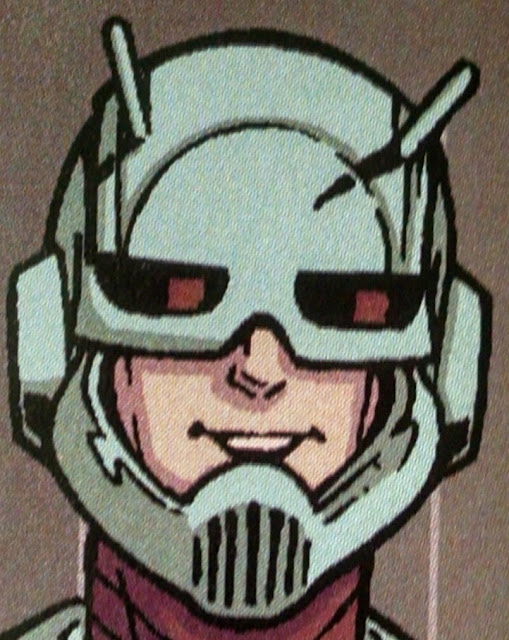
Ramon Rosanas’s art is nice. It’s simple, but it remains evocative. Rosanas manages to convey a lot of emotion from a guy who spends most of book in an ant helmet, which is impressive. Rosanas is able to keep conversation scenes from getting boring, which is vital, given how many conversation scenes Spencer writes. Rosanas knows how to draw battle scenes — mostly, as I’m not sure how Ant-Man foils the assassination attempt — and his pages are filled with nice character touches.

Unfortunately, Rosanas art is marred by the lettering — specifically the lettering of the book’s dialogue. The font is … well, I want to say “ugly,” but “distracting” is probably fairer. It bears a resemblance to Comic Sans, and no one wants that in a font. Pick a new style next time, letterer Travis Lanham.

In the end, what the book needs is more scenes with actual superheroics, the stranger the better. The book’s high point was when Ant-Man defeated the Nazi robot that spewed molten gold, and Scott’s sangfroid during the battle suggests he could handle weirder villains. Actually, the book improved greatly when Scott was actually in action; the rest of the time, when people made fun of this character I was supposed to care about, was uncomfortable.

Rating: Ant-Man symbol Ant-Man symbol Ant-Man symbol (3 of 5)

Labels: , , , , , , , , , ,

20 May 2016

I Hate Fairyland,v. 1: Madly Ever After

Collects: I Hate Fairyland #1-5 (2015-6)

Released: April 2016 (Image)

Format: 128 pages / color / $9.99 / ISBN: 9781632156853

What is this?: A young girl kidnapped by Fairyland tries to find her home for 27 years, trapped physically at the same age and growing increasingly violent.

The culprit: Skottie Young


I don’t know that I’m the right audience for I Hate Fairyland, v. 1: Madly Ever After.

I mean, I thought I was. I Hate Fairyland features Gertrude, a woman in her mid-30s who has been trapped in Fairyland in a child’s unaging body for almost three decades. Unable to find the way out of Fairyland and into her own world again, Gertrude gleefully takes out her frustrations on the pastel-and-spun-sugar world around her. Unremitting violence against all those fairy-tale clichés seemed like something I would enjoy.

I Hate Fairyland coverAs it turns out, the violence gets boring. Writer / artist Skottie Young doesn’t skimp on the blood, bone, or gore as Gertrude destroys anthropomorphic heavenly bodies, anthropomorphic animals, and anthropomorphic plants. (I think she has it in for things that look or act human-like but aren’t.) For variety, she also kills some giants. Gertrude’s violence on the page is mostly perpetrated against those who can’t fight back. Perhaps that’s why the mayhem’s appeal begins to pall after an issue or two. Most of the big fights — the ones against opponents who can fight back — happen between books or off-panel. Some bits of violence don’t grow old, though; I enjoyed Gertrude’s deadly attacks against the book’s narrators, especially once the narrators started to understand the peril they were in.

For many people, Young’s art is going to be the appeal. Young’s work is hyper-cartoony, with expressions and violence amped up to 11. Nothing is too small for him to exaggerate. (Young’s work in I Hate Fairyland is an amusing counterpoint to all his variant covers for Marvel, in which he draws cute versions of characters.) There’s no doubt Young is an outstanding visual storyteller; his art is clear, and he draws admirably clear battle scenes.

So I can’t fault Young as an artist at all. On the other hand, I’m more interested in the story and jokes.

Much like with Rocket Raccoon, v. 2: Storytailer, though, I have my doubts about Young as a writer. Given that I Hate Fairyland is labeled a mature book, I wish Young had done more with Gertrude’s emotional traumas. As written, Gertrude is a shallow character mostly concerned with vengeance against a world she feels wronged her. Shallow characters are fine, if the book is entertaining other ways, but I think developing Gertrude’s character would have served the book much better.

Other than her heartbreaking introduction in #1 and a moment in #2, when it’s revealed Gertrude has the sexual urges of a woman her actual age rather than her body’s apparent age, not much is done with her longings to be normal. (Later in the issue, Gertrude gives her sidekick, Larry, a long list of things she misses from her world, but that list reads as an indictment of Fairyland.) Gertrude’s story is tragic, and I think I Hate Fairyland would be much funnier if that were exploited more than the straight mayhem.

Another concern the book does not address is whether Gertrude can’t find her way home because she is incompetent or because of her attitude. There’s a great deal of difference about how we feel toward Gertrude depending on that answer. If it’s the latter, Gertrude is somewhat justified in her hatred of Fairyland. If she’s stuck in Fairyland because she can’t follow directions or figure out riddles — and that’s the way the text leans ever-so-slightly — then she’s just a violent boob, and her suffering is something she’s earned.

Certainly some of the page space could be repurposed to develop Gertrude more. A running subplot involves Queen Cloudia trying to get rid of Gertrude, who’s making a mess of her Fairyland; since Cloudia is a ho-hum villain, trimming some of those pages would improve the book. Also, Young spends eight pages on a gag where Larry lives an entire life — building a house, getting married, having kids, then getting divorced — while Gertrude is unconscious. It’s not a bad joke, but the amount of time that actually passes is unclear, and certain parts of the gag don’t land (why does Gertrude grow a beard while unconscious? why does Larry’s wife go from happy to angrily leaving him between panels?). I think those pages could have better been used elsewhere.

One joke that does not disappoint is the appearance of Happy, a girl Queen Cloudia brings to Fairyland in issue #4 to find the way out of Fairyland before Gertrude can. (Under the laws of Fairyland, this will allow Cloudia to attack Gertrude openly.) Happy is unremittingly cheerful, and her adventures show both the sickeningly sweet and childishly kind quests Gertrude is homicidally reacting against and also the way the quests should have been approached in the first place: with patience, compassion, and with childlike wonder.

After encountering Happy’s rainbows and cheerfulness, Gertrude decides she has to up her game, which is an argument that Happy (or another competent antagonist) should have appeared earlier in the book. This prompts Gertrude to approach one of the Seven Dooms and ask for his power to confront Happy. The tests he puts Gertrude through aren’t great, but what comes out of it is very satisfying.

Other than Happy and smashing the narrators, the book’s humor is hit and miss. Frequently, the characters substitute “cute” words for obscenities, but the results are more annoying than funny: “muffin-fluffer,” “hug off,” and “plush” are clunky rather than clever curse words. The violence stops amusing after the first issue or so. On the other hand, a few jokes, like Happy’s entire existence and a series of dialogue written as “blah blah blah” (she’s actually saying “blah blah blah,” not just running her mouth), are genuinely funny.

If you’re a fan of Young, you know you want this. If you are undecided about him, I’m torn over whether to recommend the book. On one hand, the plotting and pacing is mediocre, and the humor isn’t strong enough to make up for that. On the other, the book really picks up at the end, which makes for a satisfying conclusion. It’s possible Young is finding his groove, which means the next volume might be an improvement, and the experience of reading v. 1 could be improved by what comes after.

For the moment, though, I’m sticking with a dead-center, neither-approve-or-disapprove rating.

Rating: I Hate Fairyland symbol I Hate Fairyland symbol I Hate Fairyland symbol (3 of 5)

Labels: , , , ,

04 March 2016

Star Wars: Lando

Collects: Lando #1-5 (2015)

Released: January 2016 (Marvel)

Format: 112 pages / color / $16.99 / ISBN: 9780785193197

What is this?: Before The Empire Strikes Back, Lando Calrissian and a small crew steal a ship — and get much more than they bargain for.

The culprits: Writer Charles Soule and artist Alex Maleev


I’m not a fan of continuing a movie or TV series in a print medium, but I made an exception to buy / read Star Wars: Lando.

I have two reasons for picking up Lando: one, I’m a big fan of Lando Calrissian, Star Wars’s other loveable rogue, and b), I’ve enjoyed writer Charles Soule’s work before. But I discovered neither of those reasons were the book’s biggest attraction. Instead, my lasting impression of this book was an admiration for the art of Alex Maleev.

Star Wars: Lando coverMaleev’s work inhabits the Star Wars Universe without becoming subsumed in it. The characters are all recognizably his, drawn in a realistic yet somewhat scratchy technique that synthesizes two styles: Maleev’s and Star Wars. Despite the characters’ and trappings’ recognizability, Maleev’s work never looks like it’s copied or traced. Thankfully, Maleev contributes more than just a “look”; his storytelling and action scenes are graceful and clear.

Maleev’s art is not helped by the coloring, though. Colorist Paul Mounts’s attempts to show scenes lit by red light washes out many panels. The features of Pavol and Aleksin, two cat-like aliens with black fur / clothes, are always difficult to discern because their black coloring of their faces washes out the details, except for their eyes. Actually, no character fares well with the parade of dark backgrounds, and with red or purple backgrounds — neither of which are uncommon — Aleksin and Pavol (and Imperial Guards) almost disappear.

I was satisfied but not overwhelmed by Soule’s story. Lando is set some (undetermined) time before The Empire Strikes Back. Like Han Solo, Lando is a down-on-his-luck scoundrel, owing a lot of money to a scary person (Papa Toren). When a big theft doesn’t pay off his debt, Lando is forced to do one final job for Toren: steal a ship. Lando can have anything on board; Toren wants only the ship.

So it’s to be a heist, it seems: Lando, his buddy Lobot, hired muscle Aleksin and Pavol, and antiquities expert Korin Pers go to a shipyard to swipe the ship. Which goes off without a hitch, really: just a couple of pages, and they’re gone. The problem comes when the reader learns the ship was owned by Emperor Palpatine.

The title character is the Lando you remember from Empire: he’s got an angle, he’s smooth, he’s got a way with the ladies, he’s clever … but nothing seems to work quite right for him. Setting Lando as a prequel takes away some of the drama; Lando isn’t going to die regardless of whether the story is set before or after the original trilogy, but given that we know where he (and Lobot) are going to end up, bodily whole and otherwise intact, it takes away much of the tension. Besides, do we really want prequels?

The conflict Soule exploits for most of the series is between the conspirators, the conflicts they brought with them and what is unlocked by what they find on the ship. Unfortunately, large chunks of issue #2 are concerned with Lando and his new ship outmaneuvering Imperial star destroyers and giving a push to elite bounty hunter Chanath Cha. Neither of these things are important; if all of #2 except for the final page was excised from the collection, not much would be missing.

And that’s a problem for Lando, because it has only five issues (instead of the standard six for a miniseries). Soule has dropped a lot into the series: the five conspirators and their interactions, Chanath Cha pursuing them, the ship’s dangerous cargo. Cha has a history with Lando and Lobot, which promises some interesting interactions, but the fights on board ship and Cha’s pursuit take up most of the book; Cha speaks with them only in the final issue.

Maybe it just seems like the final three issues are too full. Looking back through the book, not much that happens. I mean, things do happen — the book has a plot — but if I explained the events, it wouldn’t take very long. The plot of the last three issues is something Stan Lee and Steve Ditko would have knocked out in a single story, with room left over for a couple of comic digressions; Roger Stern and his contemporaries may have taken two. I understand the Lee / Ditko issues often valued brevity over storytelling and that the rules of comic plots have changed over the years. But I can’t help but feel this story should have more to it.

On the other hand, that might be because of the story’s successes: I want more because I like what I’ve seen so much. If you’ve ever wondered who Lobot, that cyborg / droid looking dude behind Lando in Empire, was, Lando tells you. And it’s interesting: he’s Lando’s friend who has been mentally augmented by hardware, and he has to fight to prevent the implants from taking control of him. If he loses to the implants, he will most likely never regain control, so that fight is at the forefront of Lobot’s scenes. We get tantalizing glimpses at other characters, like Chanath Cha; I want to know about her past with Lando and Lobot. Aleksin, Pavol, and Korin Pers have just the right mix of backstory and intrigue. I’m even interested in Imperial Governor Ssaria, whom Lando is romancing in the cold open.

So is Lando’s only crime (other than the coloring) that it’s too interesting? No. I still believe Soule could have used his page count more efficiently, and Lando has a bit too much fat where it could have used a great deal of lean. But it’s still a worthwhile book for the Star Wars / Lando Calrissian fan.

Rating: 3 of 5

Labels: , , , , , , , ,

23 March 2013

West Coast Avengers: Family Ties

Collects: West Coast Avengers v. 2 #1-9 and Vision and the Scarlet Witch v. 2 #1-2 (1985-6)

Released: July 2012 (Marvel)

Format: 296 pages / color / $29.99 / ISBN: 9780785162162

What is this?: The West Coast Avengers, led by Hawkeye, establish themselves and try to fill out their roster.

The culprits: Writer Steve Englehart and artists Allen Milgrom and Richard Howell


West Coast Avengers: Family Ties is very much a book of its time. It’s a soapy team book, with rivalries and romance sandwiched between slugathons with supervillains. For someone like me who was introduced to comics via X-Men in the ‘90s, the character conflict and long-term plot development has a pleasantly nostalgic feel, especially since it is not accompanied by all that mutant angst.

Characterization is (mostly) a strength for writer Steve Englehart. He adds depths to some one-dimensional characters, such as robot supervillain Ultron and human supervillain Grim Reaper. Ultron (Mark XII) tries to reconcile with his “father,” Hank Pym; although the execution of Mark XII’s story is rushed and Ultron’s upgrades mean this plot probably won’t be referenced again, Ultron’s growth is a great idea with a good payoff. The Grim Reaper’s obsession with his brother, Wonder Man, is the only aspect of his character readers previously saw, but Engelhart gives him another character note: he’s a racist, although he excepts his girlfriend from his prejudice.

West Coast Avengers: Family Ties coverEnglehart also takes up the challenge of making the book’s two married couples interesting, and he succeeds. (Given how difficult many creators find writing husbands and wives, that’s no mean accomplishment.) The Vision and Scarlet Witch and Hawkeye and Mockingbird have two different sorts of relationships; Vision and Scarlet Witch are stable, determined, and about to have a family, while Hawkeye and Mockingbird are high spirited, passionate, and always bickering. It’s no wonder Hawkeye and Mockingbird’s marriage didn’t work out.79

But Englehart is not so successful with Tigra. Englehart spends a lot of time with Tigra, but his character arc for her is decidedly not modern. Tigra is a human who also has a cat soul inside her, which gives her not only a feline shape and superpowers but also feline characteristics — personality elements her human side wants to get rid of. So far, so good; it’s similar to a werewolf story, and Englehart even brings in Morbius the (ex-) Living Vampire and Werewolf by Night to drive home the monster angle. But Tigra’s internal conflicts come from her newfound fear of water, mercurialness, and promiscuity. A male character would not be given promiscuity as a character flaw, then or now, nor would fickleness be considered a sufficient challenge to overcome. I appreciate the lengths Englehart shows Tigra is willing to go to rid herself of her catlike flaws, but there are better cat characteristics he could have used: cruelty, aloofness (definite problem on a team), independence (ditto). Focusing on a female’s character’s sexuality is a cliché; silly fears and a proclivity to change her mind only make the stereotyping worse.

Exploring the problems of Tigra’s powers necessitates devoting several pages to Cat People continuity, which is not worth rehashing. But it’s just one example of Englehart’s reliance on continuity in Family Ties. Sometimes it works, as when he brings back Tigra’s old opponent Kraven for a rematch, but often it falls flat. The Cat People are an odd fit with a superhero story and not very exciting. The Grim Reaper / Wonder Man / Vision story works OK, but Simon's embezzlement — referred to in his origin story — is as exciting as accountancy plotlines tend to be. Englehart’s biggest success is using Secret Wars to explain why there are two Ultrons with differing personalities; the flashbacks with Ultron’s head controlling people are fun and creepy.

Englehart’s continuity mining limits his choice of villains, but fortunately, those villains are heavy hitters: Grim Reaper, Ultron, Kraven. Other villains are offbeat but enjoyable; I have a soft spot for Nekra, Black Talon and his zombies, and the Rangers. But the main villain in Family Ties, one who grows in importance in succeeding volumes, is Master Pandemonium, and he’s … oh, he’s not very good.

Master Pandemonium is just one of a type: the guy who makes a deal with the devil that goes horribly awry. Unlike Johnny Blaze / Ghost Rider, Master Pandemonium becomes evil when Mephisto gives him an opportunity to regain his soul. Until he reclaims his soul, he’s the amazing Fall-Apart Man, who has demons for limbs; they separate from him and fight his enemies, leaving him a floating torso. He can also summon demons from the great sucking star-shaped wound in his chest. Why he doesn’t summon demons rather than lose his limbs isn’t clear. But Master Pandemonium is utterly generic and utterly forgettable were it not for his role in future stories that helped victimize the Scarlet Witch.

Artist Allen Milgrom doesn’t shine on Master Pandemonium either. Milgrom gives Master Pandemonium a sinister, almost Yellow Peril look that clashes with his Anglo ethnicity. The forked Fu Man Chu resembles a stereotypical Asian villain’s facial hair, howevermuch it is supposed to evoke a pentagram, and his robes and cape certainly call to mind the Mandarin. Milgrom also draws standard Marvel Technicolor demons, which I’ve always been bored by. There’s little about them that differentiate them, artistically, from a host of generic monstrous humanoids.

Milgrom’s art is standard for the ‘80s, solid without being flashy. Milgrom tells the story without unnecessary flourishes; I especially like the slightly wall-eyed panels from the view of Ultron’s disembodied head. In #6, Milgrom’s rough pencils are inked by Kyle Baker, whose wider, softer faces works well on Tigra and the Cat People. Most of the rest of the issues are inked by Joe Sinnot, who contributes to the book’s traditional look.

Richard Howell draws the two issues of Vision and the Scarlet Witch included in Family Ties; overall, his work is more detailed and features more close-up shots of characters than Milgrom’s. His Nekra is wonderful, and he seems to enjoy drawing the Scarlet Witch. But there is a certain stiffness to many panels, his zombies aren’t frightening (the colorist's decision to make them dark gray has something to do with this), and his Wonder Man is awful, looking more like Wonder Granny.80

Family Ties has too many continuity-filled soft spots to be great; Tigra’s short-sighted characterization may make it difficult for some readers to enjoy. But Family Ties does hit a nostalgic sweet spot at times, and between Englehart’s high spots and Milgrom’s solid art, Family Ties has a lot to offer, especially to those who wish they were still 10 and buying comics in 1986.

Rating: Avengers symbol Avengers symbol Avengers symbol (3 of 5)

Labels: , , , , , , , , , , , , , , ,

30 November 2012

Penguin: Pain and Prejudice

Collects: Penguin: Pain and Prejudice #1-5, Batman: Joker’s Asylum: Prejudice #1 (2008, 2011-2)

Released: September 2012 (DC)

Format: 144 pages / color / $14.99 / ISBN: 978-1401237325

What is this?: Gotham City crime lord Penguin battles with the law and Batman in his quest for riches, respect, and love.

The culprits: Writer Gregg Hurwitz and artist Szymon Kudranski, with a backup by Jason Aaron and Jason Pearson


I’m usually a fan of including backup material in collections — not just backup stories, but extra stories related to the main story. They give the buyer a little extra value, they get a forgotten story back in print, or they are interesting in some way: funny, illuminating, poignant. Perhaps it fills in a gap in a story or shows a creator’s early work.

Penguin: Pain and Prejudice collects the New 52’s first limited series; to fill out the collection, DC included Batman: Joker’s Asylum: Penguin #1 at the end (after even the rough sketches by Pain and Prejudice’s artist, Szymon Kudranski). I liked Batman: Joker’s Asylum: Penguin; the problem is that after reading it, it became obvious the main story, written by Gregg Hurwitz, is either too derivative or unconsciously imitative of Joker’s Asylum: Penguin, which was written by Jason Aaron.

Penguin: Pain and Prejudice coverAnd once the reader has made that conclusion, he or she can’t help but notice Aaron wraps up many of the same themes Hurwitz explores, except Aaron does it in a single issue rather than five.

I realize the two stories are not exactly the same. But both stories deal with the Penguin, in his modern form as a rich, powerful crime lord, seeking affection while being unable to restrain the evil impulses that make it impossible for him to be loved. Both stories feature the Penguin being tormented by childhood oppressors and his revenge on them; both stories show the Penguin ruining men completely, without physically harming them.

There are differences. Pain and Prejudice features a plot in which the Penguin battles his father and brother for the affection of his mother, the only person he feels has ever loved him. Hurwitz adds more childhood torments. Batman is a full-fledged antagonist, rather than a natural feature of Gotham appearing in the one-page cameo he receives in Joker’s Asylum: Penguin. Penguin is positioned as a master of robotics and mechanics. Pain and Prejudice’s length allows Hurwitz to show Penguin taking the apart the life of someone who was callous to his mother rather than just describing it.

But these features do not justify the four extra issues.

I understand Pain and Prejudice’s remit was to communicate Penguin’s status quo in the New 52, and elements from Joker’s Asylum: Penguin are part of the rebooted character’s personality. But Joker’s Asylum: Penguin shows these elements could have been shown much more quickly. Aaron doesn’t rely on “crappy childhood” as an excuse for villainy. And the lack of Batman as an antagonist works to Joker’s Asylum: Penguin’s advantage; we don’t have to wonder why Batman can’t stop Penguin (or why he won’t), and we’re allowed to view the Penguin’s actions against a more neutral background.

Hurwitz has Penguin, Batman, and Commissioner Gordon briefly discuss the law protecting certain morally suspect people because of their background or looks, but he doesn’t develop the idea. Although Batman does give some credence to the Penguin’s claims that appearances matter when it comes to who gets arrested, Penguin’s arguments ring hollow, considering how many murders he orders / commits in the book and who he and Batman compare him to: a spoiled pop star, an ecstasy dealer, and a philanthropic heiress getting rich off sweatshops. Penguin is a plague of crime; the other three are morally suspect but hardly Public Enemy #1, and none of them deserve what Penguin does to them.

Hurwitz seems to have trouble with the ending as well. He decides to have the Penguin go off the deep end, ordering more and more brazen robberies and launching robotic attacks; each course is completely out keeping with the rest of the book. This causes the Penguin’s undoing at the hands of Batman, of course. I can see how Hurwitz contrasts the fate of Penguin’s lover with those the Penguin destroyed earlier in the book, but the circular fate of his girlfriend in Joker’s Asylum: Penguin is much more satisfying and more in keeping with Penguin’s MO.

The art in both stories is excellent. Kudranksi’s shaded realism is excellent for a dark crime tale, painting a bleak world for a sadistic crime lord to work his violence upon. His work emphasizes the Penguin's short stature and his inferiority complex (or perhaps his infantilism); we never see his parents’ faces, nor do we see Batman’s. Occasionally the Penguin is depicted as a child when interacting with Batman. I was never quite sure what his robotic bombs were supposed to be doing, though — releasing attack birds? Causing wild birds to attack? It doesn’t help that both plans are stupid. Jason Pearson’s art on Joker’s Asylum: Penguin is much different — a cartoonier style, emphasizing Penguin’s deformities through exaggeration. The lighthearted tone fits most of the story, which focuses much more on romance than Pain and Prejudice. Pearson is still able to pull off the story’s darker parts, though.

So: go get the Batman: Joker’s Asylum: Penguin back issue rather than this collection. Pain and Prejudice is a bit overdramatic, a bit pop psychological — J.M. DeMatteis for the 21st century, perhaps — but it’s not a bad story … my favorite Bat title of the New 52, actually. But it can’t complete with the succinct story in Batman: Joker’s Asylum: Penguin.

Rating: Batman symbol Batman symbol Batman symbol (3 of 5)

Labels: , , , , , , , , ,

11 May 2012

Showcase Presents Batman, v. 5

Collects: Detective Comics #391-407 and Batman #216-227 (1969-70)

Released: December 2011 (DC)

Format: 448 pages / black and white / $19.99 / ISBN: 9781401232368

What is this?: Batman starts swinging into the Bronze Age, packing his sidekick off to college and hitting the mean streets of downtown Gotham.

The culprits: Writers Frank Robbins, Denny O’Neil, and Mike Friedrich and artists Bob Brown, Neal Adams, and Irv Novick


I read Showcase Presents Batman v. 1 and v. 2, but I had to give up reading the series. Unlike some, I have little tolerance for Silver Age stories from the DC Universe; I don’t care that the original writers and artists knew they were creating comics for kids or that the stories were unapologetically goofy. The stories are still goofy, and that does not amuse or entertain me.

So I decided to hop back on bard the Showcase train only when it hit Denny O’Neil Station, which it did in Showcase Presents Batman, v. 5. Not all of these issues are written by O’Neil (his first is Detective Comics #395), and Frank Robbins wrote more, by a 2-to-1 margin. (Mike Friedrich contributed three back-ups.) O’Neil does pen the most lasting contribution to Bat-lore in this volume — the creation of the League of Assassins in Detective Comics #405 — but I was surprised to discover Robbins co-created the Man-Bat (in Detective #400).

Showcase Presents Batman, v. 5 coverO’Neil’s writing … it’s hard to call it “realistic,” but his stories are less prone to the Silver Age flourishes that characterize the previous volumes in the series. O’Neil’s writing will occasionally indulge in asides to the reader, asking if she has spotted the key clue to a mystery, but his stories feel more modern. On the other hand, Robbins opens the volume with “The Girl Most Likely to Be — Batman’s Widow” (Detective #391) and “I Died … a Thousand Deaths!” (Detective #392). Those titles would have fit right into Showcase Presents Batman, v. 1, although the stories aren’t as hokey as their titles (or their punctuation) would lead you to believe. By the end of the volume, O’Neil and Robbins aren’t aping each other’s style, but there isn’t a tonal clash between their stories either — Robbins drifts toward the science-fictional, O’Neil toward the supernatural, but they generally restrict themselves to one major speculative element per issue.

The stories in v. 5 are obviously Batman stories, but they disdain a lot of the Batman trappings. Readers will probably be surprised that none of Batman’s impressive rogue’s gallery makes an appearance in this book. There’s no Joker, no Two-Face, Catwoman, Riddler … Even Robin leaves for college in the fourth story (Detective #393) after seemingly aging three years between issues. Batman abandons Wayne Manor for a downtown penthouse, the flashy Batmobile for a less noticeable muscle car. Bruce Wayne gets involved in victim services, helping those affected by crime with philanthropy and Bat-punches. The only freaks he encounters are Man-Bat (the scientist who turns himself into a man / bat hybrid) and the Man with Ten Eyes (a veteran whose ocular nerves are re-routed through his fingers). Both are good men driven toward bad deeds by madness or false information — very much in the Marvel vein of this time. Batman’s opponents are generally grandiose tugs, blackmailers, kidnappers, and thieves graduating to murder or attempted murder. All these gangsters give the book slight blandness, which makes the occasional note of goofiness a welcome bit of flavor. Had this been another, less-popular hero’s adventures, I doubt the stories here would have saved him from cancellation, let alone have supported two titles.

Still, there are some points of interest, even beyond assassins and Man-Bat appearances. O’Neil uses the ghostly Enemy Ace in Detective #404, which must have thrilled literally tens of readers. The Muertos, an immortal husband-and-wife team of villains, clearly presage O’Neil’s later (and much more important) Ra's al Ghul. Robbins’s most interesting story comes from his twist (ha!) on the “Paul is dead” hoax in Batman #322, in which Batman and Robin try to discover whether Saul Cartwright, a member of the Beatles stand-ins Oliver Twists, is an imposter.

The art in this book is top-notch. Bob Brown provides the art for early issues, and those stories have a stagy, first-generation Silver-Age style to them. But when pencilers Neal Adams and Irv Novick join the art rotation, his style gradually becomes more like theirs. And theirs … there are many valid complaints you can make about the Bronze Age — quality control for story content being foremost — but the emergence of the first generation of artists who were inspired by Kirby and other Silver Age greats make up for all of them. Adams is foremost among this group, and his art is wonderful: shadowy, evocative, action packed, pretty to look at. He also draws the majority of the covers in this book, and it’s jarring to see Silver Age copy on Adams’s more modern, hipper art. I was surprised how good Novick’s work was; not as graceful as Adams’s, but it’s an excellent complement: realistic while still allowing for some stylistic embellishments. He’s not someone who’s going to get much attention — today everyone remembers Adams, but no one talks about Novick — but his work is always enjoyable.

I enjoyed this far more than v. 1 or v. 2. Are these stories great? No; as I said, there is an unavoidable feeling of blandness throughout. Even Man-Bat, who alleviates this feeling in his appearances, is a somewhat bland (and obvious) idea. But given the art, the changes in the status quo, and O’Neil’s assassin stories, I get the feeling this series is on the brink of something exciting.

Rating: Batman symbol Batman symbol Batman symbol (3 of 5)

Labels: , , , , , , , , , , ,

02 March 2012

Invincible: Ultimate Collection, v. 6

Collects: Invincible #60-70, Invincible Returns #1 (2009-10)

Released: March 2011 (Image)

Format: 336 pages / color / $34.99 / ISBN: 9781607063605

What is this?: The hero Invincible battles alternate versions of himself, a powerful alien, and Martian parasites while dating Atom Eve and exploring his moral limits.

The culprits: Writer Robert Kirkman and artists Ryan Ottley and Cory Walker


I like reading Invincible, although not enough to buy the hardcovers or trade paperbacks. Instead, I have been catching up on the series by using interlibrary loan. There’s a fee involved at my local library — typically about $3 — so I’ve passed up the trades and requested the “Ultimate Collection” hardcovers instead, to get more story per loan.

Invincible: Ultimate Collection, v. 6 coverIn Invincible: Ultimate Collection, v. 6, writer Robert Kirkman promises a lot of story featuring his half-alien superhero, Mark “Invincible” Grayson: a war against alternate versions of himself, further conflict with his archenemy, conflict with the Viltrumites (his father’s alien race), and the plotting of the Martian parasites known as Sequids … if there’s one thing Kirkman knows how to do, it’s keep subplots moving forward until he’s ready to make one of them the main plot. He even manages to fake out readers by briefly hinting that the Sequid invasion, which has a definite ending in v. 6, will continue as a subplot instead. Not all of these subplots are gold — I’m mystified why I need to care about crime boss Titan’s battles for control of the underworld — but the number of them means there is a lot of treasure in them thar pages. By the end of v. 6, several subplots are ready to be brought to the fore: the Viltrumite War, the Reanimators, and main plots from v. 6 that Kirkman shuffled back the background without tying off. He’s a bit like Chris Claremont, except he’s not so good with female characters, and he has more control over loose ends.

Volume 6 is all about loose ends, actually, with many of his villains repeating in this book. In the twelve issues in this collection, Invincible battles only two villains who have not been used before, and one of those is a throwaway villain named Dinosaurus, whose main purpose is to show Invincible’s state of mind. To be fair, that's not counting the alternate reality Invincibles, who were teased in the previous collection, as new. But they are weapons of Invincible’s archenemy, Angstrom Levy, and they are variants of the title character — there’s not much innovation there. Kirkman has an entire universe to himself, if he wants it. Six years is too soon to keep recycling old villains.

Not having to share a universe illustrates what’s wrong with the “Invincible War” (#60), which at times seems more concerned with showing other Image heroes battling alternate versions of Invincible than anything else. It feels like product placement for other Image houses; with a lot of space to fill, since the original Invincible was out of the fight, Kirkman and Ottley skipped creating their own off-brand heroes for the name-brand stuff. (Well, the RC of heroes, I suppose.) It might have been too much design work to create unique looks for a bunch of throwaway characters, but they could have been developed more fully later. (One Invincible’s comment to Spawn, “I've killed you before, and I’ll do it again!,” would have immediately given weight to whatever character it was addressed to.)

There’s a lot of fighting to this book — four of the first five issues are nearly non-stop slugfests — but Kirkman manages to pack in a lot of the soap-opera elements key to a story about a teenage hero. Mark as to deal with the difficulties of a relationship with fellow superhero Atom Eve, including her horrible father; his relationship with his own father and brother; the loss of a fellow hero; making a living; and learning his moral boundaries. This territory has been explored before, but Kirkman’s breathless plotting and Mark’s personality make Invincible’s journey interesting. I’m still not convinced by Invincible’s money-making plans (not without more help, either from his brother or Atom Eve), but there’s still time to convince me. Many of the quiet moments between Mark and Eve feel picture perfect, thanks in no small part to artists Ryan Ottley and Cory Walker, and the direction of the main characters’ relationship at the end of v. 6 is a relatively unexplored area, especially since Eve isn’t a throwaway character. Invincible changes his stance on killing a couple of times during v. 6, which feels abrupt, but I can believe the rapid turnaround for someone still developing their personality.

After all the fighting and death, Kirkman probably felt he needed a breather for #66. I agree, but two issues with Invincible’s father, Omni-Man, and Allen the Alien seems a bad choice, at least in the collected form. Issue #68 is the decompression story needed after all the sturm und drang — Mark having dinner with Eve and her parents — but two issues in deep space, with few appearances by the book’s hero, stops the book’s momentum in its tracks, and it doesn’t really get going again before the book ends.

Ottley, who has penciled Invincible since #8, drew #60-5, 68-70, and the main story in Invincible Returns. Kirkman calls for a lot of blood and fighting in v. 6, and Ottley gives Kirkman what he wants. Unlike most superhero books, you never get the feeling with Ottley that superhero fights are graceful, sanitized affairs. The combatants hit hard and leave marks — not necessarily permanent marks, since the toughest characters are usually fast healers — that show they’ve been through combat like pork goes through industrial meat grinders. The images in #60-4 are somewhere between horrifying and sickening, appropriate for the level of violence the characters visit upon each other and the landscape. But Ottley can still do the quieter moments — many of the scenes between Eve and Mark seem spot on, and he does a good job with Mark’s teenage-ish, slacker-y brother.

Walker, the series co-creator and original penciler, returned for #66-7 and the backup story in Invincible Returns. The former is a good choice for Walker’s return; the two-issue story prevents comparisons between the current and former artists by restricting the setting and characters to deep space. It also features Omni-Man and Allen the Alien, two characters Walker co-created. Deep space gives Walker a chance to draw all sorts of outlandish creatures and alien landscapes; I’m not sure I’d buy an 8x10 print of his work or air brush it on the side of my van, but it’s pretty good. His work on Invincible Returns, however, suffers in comparison to Ottley. His thick line and posing of characters makes his art look blockier, less fluid than Ottley’s, and Eve’s inexplicable hairstyle is distracting.

The less said of the supplementary material, in which Kirkman, Walker, and Ottley discuss the art process for the book, the better.

Volume 6 was somewhat disappointing compared to other Invincible: Ultimate Collection volumes; its plot is bloody and straightforward, with a heavy death toll for a relatively lighthearted book. Invincible himself is in danger of being a bit too grim. Still, the subplots, characters, and art lift this volume above the average comic collection.

Rating: Image symbol Image symbol Image symbol (3 of 5)

Labels: , , , , , , ,

24 February 2012

Avengers Academy, v. 1: Permanent Record

Collects: Avengers Academy #1-6, story from Enter the Heroic Age #1 (2010-1)

Released: January 2011 (Marvel)

Format: 168 pages / color / $24.99 (hardcover) / ISBN: 9780785144946

What is this?: Some of the more troubled Avengers try to surreptitiously steer some of Norman Osborn’s more volatile test subjects toward heroism.

The culprits: Writer Christos Gage and penciler Mike McKone (with help from Jorge Molina)


There are a lot of people who complain about the dearth of prominent new characters being created by the Big Two comics companies. For example, look at Marvel: the last important, popular new character to headline a title, Deadpool, first appeared in 1991. That’s more than twenty years ago. This realization leads to two questions: whose fault is this, and what can be done about it?

I don’t know the answer to the second question, but I’m pretty sure the blame for the first lies with comics readers, or at least those who read superhero comics. In the last ten years or so — since the Bill Jemas years — Marvel has not been shy about tossing new, young characters at their audience, both singly and on teams: Spider-Girl. Araña (or Spider-Girl, Part Deux). Gravity. Amadeus Cho. The second New Mutants / second New X-Men. The Hood. X-23. Hope and her mutant team. The Young Avengers. Runaways. Young Allies. Slingers, if you want to go back to the ‘90s. Many characters from Avengers: The Initiative — and I’m sure there are others I’m missing. But none of them survived very long, except Spider-Girl, who limped along for about 130 issues at the bottom of the sales charts. The next most successful is The Initiative, and it lasted about three years.

Avengers Academy, v. 1: Permanent Record coverAll of this is a roundabout way to bring up Avengers Academy, v. 1: Permanent Record. In Academy, some of the Avengers set out to teach young heroes how to use their powers safely, using a school environment —

Yes, I know you’ve heard that setup before. And just like in The Initiative, King Screw-Up himself (Hank Pym) is in charge of molding young minds into please-don’t-be-a-morally-ambiguous-part-time-mentally-ill spouse abuser. But this time, that’s part of the point: All of the students at Avengers Academy have been flagged as possible problems. All were abused by Norman Osborn and his HAMMER goons, and their psychological evaluations raised concerns. So no one is sure what these kids are going to do, left to their own devices. To show the kids they don’t have to give in to destructive impulses and can rebound from wrong decisions, Pym gathered a “bad choices” teaching staff: Quicksilver, a part-time villain who is possibly the only Avenger less stable than Pym; Justice, who killed his father; Speedball, who was crucified by Brian Michael Bendis for the sake of Civil War; and Tigra.

At least it gives writers something more interesting to do with the characters when this book is cancelled. Unlike in one of the X-Men spinoffs, they don’t have to be “random background figure in team crowd scene #2” — they can be a hero or a misguided villain.

Writer Cristos Gage makes each character the focus of one issue in Permanent Record. It’s a good choice, and even though only half of them seem to be the threats the story wants us to believe they are, each is given a chance to be seen as human, with some good and some bad within them. Finesse, who has a natural aptitude for everything but human interactions, is the most intriguing of the group; it’s easy to see her slipping to either side of the hero / villain divide. Her relationship with Quicksilver, the most morally ambiguous of the teachers, is fascinating, especially given her missing moral compass and Quicksilver’s inability to find the ethical North Pole. Finesse seeks knowledge and doesn’t care about moral implications. Implications of any sort elude her, as seen in her relationship with Reptil: she attaches no emotional component to their physical liaisons, and her lack of emotional connection means she doesn’t consider Reptil’s feelings. But she’s surprisingly introspective about her blind spots. Of course, lack of understanding of actions and their consequences is a perfect issue to explore in a comic about teenagers.

The rest of the characters are, if not clichéd, then at least a bit predictable. Striker is the brash glory hog. Veil is the ingénue. Mettle is the good-natured brick who hides his tortured feelings beneath an invulnerable surface. Hazmat is the one with the sour disposition; at least the loss of her formerly perfect life, combined with her now-isolating powers, gives her an excuse for being surly. The issue featuring Reptil, the wannabe leader who has always wanted to be a hero, is the weakest of the book; I didn’t get the character’s disillusionment, but my inability to comprehend may extend from not having read the character’s appearances in The Initiative. It may be part of the “leadership” character trait he’s been given, 63 although given his desire to be a hero, we’re fortunate Gage didn’t make him the stereotypical star-struck rookie.

Of course there’s teenage drama. Of course some of the kids want to go after their tormenter, Osborn, as soon as they can. Some of them want fame, exposure. There’s the usual drama with hormones, both appropriate and inappropriate, with Hazmat — whose touch is poison — having the Rogue drama64 of not being able to touch others. The team seems like an actual group of teenagers, for the most part.

Gage tries to make the teachers relevant as well. He doesn’t have anything for Tigra to do in the book, but the others all get some time. Some of Gage’s decisions, like making Speedball a cutter, is a bit questionable, and Pym is such a screw-up you have to wonder why the Avengers would let him do this again. Justice is the good-hearted guy who attracts inappropriate crushes, just like in The Initiative. Quicksilver, as mentioned above, is always interesting, especially when Finesse makes him confront his time as a villain and his relationship with Magneto. Gage has an uphill battle rehabilitating the character after the heel turn he took between Decimation and Civil War, and he still has work to do. But I’m willing to go along with it for now, which is a credit to Gage’s writing.

The story structure allows for plenty of guest instructors, both heroes and villains. Some of the guest heroes are predictable; Steve Rogers comes by to teach the newbies not to underestimate unpowered opponents, and Iron Fist beats up Finesse to show the difference between mastering technique and knowing when to use it. But Hawkeye’s suggestion of a media day is a good use of the character, and it prompts Pym’s priceless line, “I think I see why Janet left me for you.” Others make the most of brief appearances. Moonstone is hilarious in her cameo, as is the paranoid Ghost. Valkyrie is funny as a militant feminist, but that doesn’t seem in character for her. Even Moon Boy and Devil Dinosaur sneak into the background of Reptil’s story. Gage makes some nice choices of creepy villains, such as Mandrill and Crossbones, for background flavor at the Raft.

I’m not sure about McKone’s art. For the most part, I like the style, but occasionally I find something annoying about it. There are times I can’t figure out what exactly is supposed to be going on. Sometimes I don’t know whether it’s the art, writing, or a deliberate mystery that’s confusing me: how did those prisoners get out of their cells in the Raft, for instance? If it was because of the blackout, why didn’t the kids run across any escapees on their way to Osborn’s cell? And did Striker and his mother engineer the supervillain attack on the team to get Striker publicity?

Is it a kiss?Other times, though, I’m sure it’s McKone. He seems to have problems with perspective when two characters are close together, such as Greg and Jenny in #3 and Finesse and Quicksilver at the end of #2 — is Finesse expecting to kiss Quicksilver? Am I supposed to take Veil’s tears in #4 seriously? Why does Powderkeg look so much like a helmetless Juggernaut? His female figures seem to pose too much — even the one wearing a hazmat suit.

More importantly, McKone’s character designs leave something to be desired. Perhaps we’re supposed to see their simplicity as a reflection of our lack of knowledge of the characters or of their lack of experience. Or perhaps it’s just what McKone thinks inexperienced people would design. But Finesse’s costume is horribly boring, a rip-off of the old Mockingbird costume that exchanges the bell sleeves (thankfully) for a pair distracting stripes on her legs. Veil looks like something John Romita, Jr., would have created during his late ‘80s Daredevil run. The rest are unexpired — a superstrong copy of the Red Skull, a guy with a black costume with lightning effects, a very slightly modified hazmat suit, for Kirby’s sake. Ugh.

Getting back to the idea I started this review with: Academy is a good title. Perhaps not great, but there’s still time for that … probably. But how long will it have to get there? And would it matter if they did? All those other titles (except perhaps Araña) were good, and one or two of them reached some pretty impressive heights. But they all were low selling, and quality didn’t keep them from succumbing to superhero fans’ apathy to new ideas.

Rating: Avengers symbol Avengers symbol Avengers symbol (3 of 5, although that’s not giving any credit for potential)

Labels: , , , , , , , , , , , , , , , ,