Reviews of trade paperbacks of comic books (mostly Marvel), along with a few other semi-relevant comments / reviews.

30 April 2016

Showcase Presents Batman, v. 6

Collects: Detective Comics #408-26 and Batman #229-44 (1971-2)

Released: January 2016 (DC)

Format: 584 pages / black and white / $19.99 / ISBN: 9781401251536

What is this?: A chunk of early ‘70s Batman stories, mixing the first appearance of Ra’s al-Ghul and the League of Assassins with forgettable stories.

The culprits: Writers Dennis O’Neil, Frank Robbins, and others and pencilers Neal Adams, Bob Brown, Irv Novick, and others


When I reviewed Showcase Presents Batman, v. 5, I said the Bat-titles of the era were on the brink of something exciting. Batman and Detective Comics had shaken off the lingering funk of the Silver Age and were heading toward something much greater. So I was eager to read DC Showcase Presents Batman, v. 6 — well, as eager as a person can get for a book after four years when you thought the book line was cancelled.

And — good news! — v. 6 is better than v. 5. But it’s only an incremental improvement, and the Bat-titles reprinted in this volume still feel like they are poised to become something different, something greater. They just aren’t quite there yet.

Showcase Presents Batman, v. 6 coverYes, the Ra's al Ghul / Legion of Assassins story is sprinkled throughout the volume, but few other members of Batman’s rogue’s gallery appear in the thirty-plus issues. Man-Bat and Two-Face each appear in one issue — with Two-Face beautifully drawn by Neal Adams — but each gets only as many issues as the embarrassing Ten-Eyed Man. Most of the stories are single-issue mysteries, often with a supernatural tinge, that go nowhere.

Those mysteries, whether they have a supernatural element or not, are v. 6’s biggest problem. Some of them (mostly those with occult touches) are set in exotic locations, like Waynemoor Castle in northern England; some of them are set in the gritty streets of Gotham. Unfortunately, whether Batman is taking on circus freaks, hicks, or Shakespearean actors in Gotham or elsewhere, these stories become monotonous. Despite being solidly constructed mysteries, their flaws become more readily apparent than their virtues after the third or fourth in a row. All the ghosts and haunted castles Batman investigates have as much real supernatural content as the average Scooby-Doo episode, which takes some of the suspense out of the story. Issues that try to be socially relevant, dealing with youth gangs and urban crime, devolve into over-the-top action sequences, like when a group of teenagers threaten to blow up an apartment tower to get their demands listened to.

As a side note, O’Neil’s frequent asides asking readers whether they picked up on whatever clues Batman used to solve the crime annoyed me — not because of the device itself but because the clues are so rarely available to the reader. If your mysteries aren’t fair play, you don’t get to taunt readers that they aren’t as smart as the detective.

That being said, the Ra's al Ghul stories are classics for a reason. Beautifully drawn by Adams and full of menace, Ra's is the one villain who seems to worry Batman, the only adversary who requires the World’s Greatest Detective to have long-term plans. Adding a new dimension to the stories is Talia al-Ghul, Ra's’s daughter, a love interest who presents a puzzle Batman can’t solve; despite his undeniable attraction to her, she is the daughter of the Demon as well as being ruthless and a remorseless killer herself. Additionally, these stories knock the Batman canon of this era out of its unmoving, unchanging placidity. Although the League of Assassins stories don’t affect the continuity of the rest of the book, the storyline’s progression gives the book a sense of passing time the stories don’t have otherwise.

Of course, it would be helpful if the cliffhangers in the League of Assassins storyline were followed immediately by their conclusions, but those issues are usually followed by unrelated issues from the other Batman title. I understand chronological order is important, but in a book like this, story coherence is more vital.

The art in v. 6 is outstanding. Adams provides covers for almost all the issues, and he draws about a quarter of the stories. This is Adams’s work at its finest: perhaps not as explosive as his work on X-Men a few years earlier, but each panel is beautiful, fully adapted to Batman’s world of shadows. The concessions he makes to Batman’s more grounded world makes his artwork tighter, more focused. Most of the remaining issues are drawn by Bob Brown and Irv Novick, both of whom worked with Adams on the previous volume. Neither is Adams’s equal, but both are solid artists with outstanding storytelling and an ability to fit the story into a many panel layout.

 coverScattered among the work by Adams, Brown, and Novick, the three issues drawn by writer Frank Robbins stand out, and not in a good way. Robbins is a good artist for a writer, but that’s as far as I’m willing to go. (Robbins was primarily an artist in his career, but he splits the writing chores in v. 6 with O’Neil.) His style has a thick line and lacks the fluidity of the rest of the artists; even if he were a better artist, his work wouldn’t fit in v. 6.

One warning about this book: although it says it contains sixteen issues of Batman, that’s misleading. Two of the issues, #233 and #238, have only the cover reprinted because their contents are reprints. The covers of other issues of Batman and Detective promise back-up stories featuring Batgirl, Robin, or some other hero, but those aren’t included even though at least some of them are original stories.

On average, v. 6’s quality is only incrementally greater than v. 5. However, it contains so many iconic and important moments that it feels a great deal better at times. Nothing in v. 5 compares to shirtless Batman dueling Ra's al-Ghul, the first appearances of Ra's and his daughter, the first time Ra's is resurrected by the Lazarus Pit. I’ve read these issues before, in color, in Batman: Tales of the Demon, which was superior to v. 6 — and not just because Tales of the Demon was in color. Learning the context in which those Ra's stories initially appeared makes them more impressive, since the League of Assassins stories are nothing like the rest of the era. But actually reading those non-Assassin stories makes reading v. 6 feel like a chore at times, a bit of self-education that is unnecessary.

Still: shirtless Batman vs. Ra's al-Ghul. That fight was pretty awesome.

Rating: Batman symbol Batman symbol Batman symbol Batman symbol (4 of 5)

Labels: , , , , , , , , , , ,

11 May 2012

Showcase Presents Batman, v. 5

Collects: Detective Comics #391-407 and Batman #216-227 (1969-70)

Released: December 2011 (DC)

Format: 448 pages / black and white / $19.99 / ISBN: 9781401232368

What is this?: Batman starts swinging into the Bronze Age, packing his sidekick off to college and hitting the mean streets of downtown Gotham.

The culprits: Writers Frank Robbins, Denny O’Neil, and Mike Friedrich and artists Bob Brown, Neal Adams, and Irv Novick


I read Showcase Presents Batman v. 1 and v. 2, but I had to give up reading the series. Unlike some, I have little tolerance for Silver Age stories from the DC Universe; I don’t care that the original writers and artists knew they were creating comics for kids or that the stories were unapologetically goofy. The stories are still goofy, and that does not amuse or entertain me.

So I decided to hop back on bard the Showcase train only when it hit Denny O’Neil Station, which it did in Showcase Presents Batman, v. 5. Not all of these issues are written by O’Neil (his first is Detective Comics #395), and Frank Robbins wrote more, by a 2-to-1 margin. (Mike Friedrich contributed three back-ups.) O’Neil does pen the most lasting contribution to Bat-lore in this volume — the creation of the League of Assassins in Detective Comics #405 — but I was surprised to discover Robbins co-created the Man-Bat (in Detective #400).

Showcase Presents Batman, v. 5 coverO’Neil’s writing … it’s hard to call it “realistic,” but his stories are less prone to the Silver Age flourishes that characterize the previous volumes in the series. O’Neil’s writing will occasionally indulge in asides to the reader, asking if she has spotted the key clue to a mystery, but his stories feel more modern. On the other hand, Robbins opens the volume with “The Girl Most Likely to Be — Batman’s Widow” (Detective #391) and “I Died … a Thousand Deaths!” (Detective #392). Those titles would have fit right into Showcase Presents Batman, v. 1, although the stories aren’t as hokey as their titles (or their punctuation) would lead you to believe. By the end of the volume, O’Neil and Robbins aren’t aping each other’s style, but there isn’t a tonal clash between their stories either — Robbins drifts toward the science-fictional, O’Neil toward the supernatural, but they generally restrict themselves to one major speculative element per issue.

The stories in v. 5 are obviously Batman stories, but they disdain a lot of the Batman trappings. Readers will probably be surprised that none of Batman’s impressive rogue’s gallery makes an appearance in this book. There’s no Joker, no Two-Face, Catwoman, Riddler … Even Robin leaves for college in the fourth story (Detective #393) after seemingly aging three years between issues. Batman abandons Wayne Manor for a downtown penthouse, the flashy Batmobile for a less noticeable muscle car. Bruce Wayne gets involved in victim services, helping those affected by crime with philanthropy and Bat-punches. The only freaks he encounters are Man-Bat (the scientist who turns himself into a man / bat hybrid) and the Man with Ten Eyes (a veteran whose ocular nerves are re-routed through his fingers). Both are good men driven toward bad deeds by madness or false information — very much in the Marvel vein of this time. Batman’s opponents are generally grandiose tugs, blackmailers, kidnappers, and thieves graduating to murder or attempted murder. All these gangsters give the book slight blandness, which makes the occasional note of goofiness a welcome bit of flavor. Had this been another, less-popular hero’s adventures, I doubt the stories here would have saved him from cancellation, let alone have supported two titles.

Still, there are some points of interest, even beyond assassins and Man-Bat appearances. O’Neil uses the ghostly Enemy Ace in Detective #404, which must have thrilled literally tens of readers. The Muertos, an immortal husband-and-wife team of villains, clearly presage O’Neil’s later (and much more important) Ra's al Ghul. Robbins’s most interesting story comes from his twist (ha!) on the “Paul is dead” hoax in Batman #322, in which Batman and Robin try to discover whether Saul Cartwright, a member of the Beatles stand-ins Oliver Twists, is an imposter.

The art in this book is top-notch. Bob Brown provides the art for early issues, and those stories have a stagy, first-generation Silver-Age style to them. But when pencilers Neal Adams and Irv Novick join the art rotation, his style gradually becomes more like theirs. And theirs … there are many valid complaints you can make about the Bronze Age — quality control for story content being foremost — but the emergence of the first generation of artists who were inspired by Kirby and other Silver Age greats make up for all of them. Adams is foremost among this group, and his art is wonderful: shadowy, evocative, action packed, pretty to look at. He also draws the majority of the covers in this book, and it’s jarring to see Silver Age copy on Adams’s more modern, hipper art. I was surprised how good Novick’s work was; not as graceful as Adams’s, but it’s an excellent complement: realistic while still allowing for some stylistic embellishments. He’s not someone who’s going to get much attention — today everyone remembers Adams, but no one talks about Novick — but his work is always enjoyable.

I enjoyed this far more than v. 1 or v. 2. Are these stories great? No; as I said, there is an unavoidable feeling of blandness throughout. Even Man-Bat, who alleviates this feeling in his appearances, is a somewhat bland (and obvious) idea. But given the art, the changes in the status quo, and O’Neil’s assassin stories, I get the feeling this series is on the brink of something exciting.

Rating: Batman symbol Batman symbol Batman symbol (3 of 5)

Labels: , , , , , , , , , , ,

18 March 2011

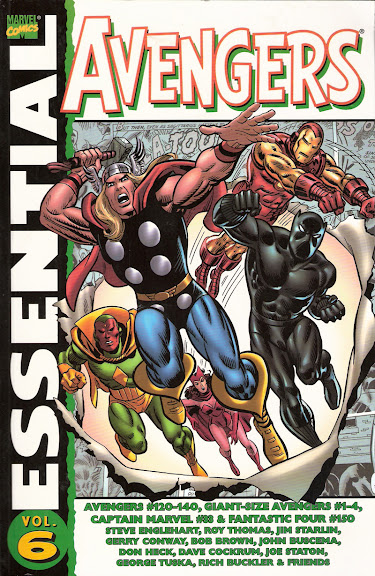
Essential Avengers, v. 6

Collects: Avengers #120-40, Giant-Size Avengers #1-4, Captain Marvel #33, and Fantastic Four #150 (1974-5)

Released: February 2008 (Marvel)

Format: 576 pages / black and white / $19.99 / ISBN: 9780785130581

What is this?: Kang tries to decide who the Celestial Madonna is; Mantis, the Vision, and the Scarlet Witch learn their origins; Zodiac and Thanos attack.

The culprits: Writer Steve Engelhart (with help from Roy Thomas and Gerry Conway) and art by Sal and John Buscema, Bob Brown, George Tuska, Rich Buckler, Don Heck, Dave Cockrum, and Tom Sutton

Having bought GIT Corp’s DVD-Roms of several Marvel series — Fantastic Four, Uncanny X-Men, Captain America, Amazing Spider-Man — I don’t have much use for Essentials featuring these characters. Which is fortunate, because Marvel seems like it isn’t all that interested in putting out new Essentials.

Unfortunately, these DVD collections, which have more than 40 years of comics and annuals, have one major flaw: they don’t include the Giant-Size series Marvel put out in the ‘70s. Now, I’ve read most of the Giant-Size Spider-Man, and there’s nothing that essential in them (although they can be enjoyable). And all you really miss in the Giant-Size Fantastic Four is Madrox the Multiple Man’s origin in #4. Fortunately, Giant-Size X-Men #1, which has the debut of the All-New, All-Different X-Men and is probably the most important Giant-Size issue, is included with the X-Men DVD-Rom. But the Giant-Size Avengers are important too, and they are left out of 40 Years of the Avengers.

Essential Avengers, v. 6 coverSo I purchased Essential Avengers, v. 6, which included all four issues of Giant-Size Avengers. Avengers, v. 6, also has another distinction among Essentials that makes it, if not unique, then very unusual: the issues collected in this book make up one storyline. That is, Essential Avengers, v. 6, makes an acceptable alternative to the Celestial Madonna Saga trade paperback, and it gives almost a year’s worth of issues that precede Celestial Madonna and a half year’s worth that follow the storyline. For these extra issues, you sacrifice color, but that’s a small price to pay.

One would expect a story that features the “Celestial Madonna” to have a long-lasting effect on the Marvel Universe — or at least the Avengers. But the most important event is the marriage of the Scarlet Witch and Vision; admittedly, that’s a pretty important moment, but neither of them are the Celestial Madonna. That honor goes to Mantis, a Vietnamese orphan who is trained by pacifist Kree monks after her uncle kills her mother and blinds her father. As with most storylines that revolve around the birth of a child unconceived, there has been little to no payoff from Mantis’s role. Mostly, the Celestial Madonna story is a time war vs. Kang, who returns again and again to kidnap Mantis and mate with her.

Oh, Kang. It doesn’t take much to get bored with Kang in this volume, despite writer Steve Englehart’s efforts. Why? Because Kang is the master of time, and his answer on how to use this temporal advantage is to steal dead heroes and villains out of the time stream and bring them to Limbo. Why use dead people? Who knows? Since he gains mental control of his new warriors, he could choose anyone — he could even steal future or past versions of the Avengers out of the time stream, which would at least make it an even fight. But no, he decides to create his Legion of the Unliving, none of whom, strangely, had died in their personal timelines yet. Kang’s other gambit include superrobots, Avenger-powered superrobots, and invading the present from several different points of his personal timeline simultaneously. This last is, at least, a good use of his advantages, but since his other versions seemed to have invaded from his Girl Scout days, anyone can beat them.

Once you get past a baby that won’t be born until after the book ends and a Kang who literally cannot even beat himself in a fight (and how could he, since he was outnumbered by himself two to one?), what do you have? Well, Giant-Size Avengers #4 has one of the oddest endings of any Avengers story outside Avengers #200: a half-Vietnamese, half-German girl who always talks of herself in the third person marries an alien tree who’s taking the form of her dead boyfriend, which takes her into space and will later impregnate her with the universal Messiah. Meanwhile, in the background, a mutant marries an android in a double marriage ceremony officiated by the future version of the supervillain the team just defeated (who also does not seem to have any real credentials that would allow him to perform marriages).

I wish I could say there were other parts of the story that rose to those heights, but that’s it — it’s hard to get that strange consistently, but other than the Legion of the Unliving, Essential Avengers doesn’t consistently rise to any notable level of insanity, nor does it get that exciting. “Celestial Madonna” is not exactly a disappointment, but it’s not a seminal Avengers story, despite its memorable name. The romantic tangle between Vision, Scarlet Witch, Swordsman, and Mantis is predictably resolved. This volume is also notable for the beginning of Vision’s confusing backstory; his body is that of the World War II android the Human Torch, a revelation that utterly fails to be interesting. The Scarlet Witch has an odd subplot with developing her “magical powers.” The Avengers have no problem operating in South Vietnam, which is a bit disorienting, but the issue was published just before North Vietnam won the war and unified the country under Communist rule.

The material that precedes the Celestial Madonna story is interesting as a snapshot of early Bronze-Age Avengers. The stories feature Zodiac, the revelation of who the parents of the Scarlet Witch and Quicksilver are (later revealed as false), the marriage of Quicksilver and the Inhuman Crystal, and the bizarre beginning of the Scarlet Witch’s training in witchcraft by Agatha Harkess (based, apparently, solely on the Scarlet Witch’s name). A battle with Thanos is a distraction —Captain Marvel #33 includes literally three pages of dense recap on Thanos’s history, which isn’t conducive to narrative flow — that comes to nothing, especially since it doesn’t end Thanos’s story as definitively as it pretends. And what comes after the Celestial Madonna heads into space is interesting as well; the introduction of new members Beast and Moondragon gives the team exciting new dynamics, despite the return of the slappingest, insanest Avenger, Hank Pym.

The art in Essential Avengers, v. 6, is top notch. The Buscema brothers provide the plurality of the art, with Sal penciling more than his brother John. Other pencilers include George Tuska, Dave Cockrum, Bob Brown, Don Heck, Rich Buckler, and Tom Sutton — a distinguished roster that needs no praise from me, however much it deserves it.

Despite the many interesting parts of Essential Avengers, v. 6, I think the main appeal is getting all four Giant-Size Avengers issues in one volume. There are other attractions — and I have to emphasize, the book is drawn by a lot of great artists who do not clash in style — but Marvel’s Giant-Size line is sadly neglected in reprint form. Englehart fans will find much to enjoy, as will those who like comic-book weddings — three in one volume, none of whom are married today!

Oh, and those who enjoy the thought of alien plants having consensual sex with human women will also find this appealing. You know who you are.

Rating:  symbol  symbol  symbol  symbol (3.5 of 5)

Labels: , , , , , , , , , , , , , , , ,

02 July 2010

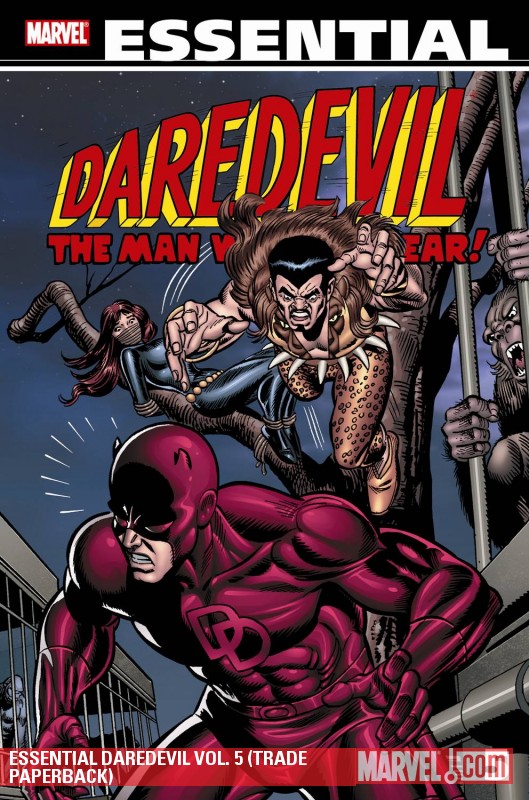
Essential Daredevil, v. 5

Collects: Daredevil #102-25, Marvel Two-in-One #3 (1973-5)

Released: February 2010 (Marvel)

Format: 496 pages / black and white / $19.99 / ISBN: 9780785144540

What is this?: Daredevil loves and loses the Black Widow and battles Hydra, Thanos’s goons, Mandrill, and a few others

The culprits: Writers Steve Gerber, Chris Claremont, Tony Isabella, and Marv Wolfman; pencilers Don Heck, Bob Brown, and Gene Colan, with some others

Essential Daredevil, v. 5, comes from a sort of forgotten era in Daredevil’s career. Daredevil has a lot of forgotten eras; everything between Stan Lee’s last Silver Age issue of Daredevil and Frank Miller’s first issue is generally unremembered, as is most of what falls between Ann Nocenti’s “Typhoid Mary” storyline and the Kevin Smith late ‘90s reboot. For the most part, forgetting is the best course of action for those issues.

However, that’s not true of v. 5 — this stuff deserves to be remembered. That may, in part, be because there’s more continuity of creators than usual for an early Bronze Age Essential. The book has a long run from writer Steve Gerber and penciler Bob Brown, and writer Tony Isabella and penciler / inker Don Heck have shorter runs.

Essential Daredevil 5 coverAs you might expect from Gerber’s involvement, this isn’t Daredevil’s usual kind of stories, resembling neither what came before or after. He’s in San Francisco, playing Marvel Team-Up with the Black Widow; both changes were set up by Gerry Conway in the previous Essential Daredevil. But Gerber takes that and runs with it, having Daredevil battle large crises by himself. Daredevil fights the minions of Thanos, and Gerber puts Moondragon (who introduces herself as “Madame MacEvil”) and Angar the Screamer to good use. He uses two of my favorite characters, Mandrill and Nekra — they’re both goofy and menacing, especially Mandrill’s telepathic control of women. Gerber’s not afraid to have Daredevil lose fights, as the Beetle beats him and Kraven the Hunter defeats both him and the Black Widow. He shows an occasional flair for the Black Widow’s dialogue, especially when she snarks with society ladies in #104. And there’s something charming about having the Owl try to steal Daredevil’s brain.

Although some of the pieces of Gerber’s run are fascinating, the overall picture feels warped. There’s no denying that Thanos, Captain Marvel, and Moondragon are poor fits for Daredevil, and Mandrill’s nationwide revolution doesn’t quite work as a Daredevil story. Shanna the She-Devil and her story don’t exactly feel at home either, and meeting Man-Thing in his swamp really feels like something Spider-Man or the Thing would do rather than Daredevil. Perhaps most damningly, Gerber draws a hamfisted line under Black Widow and Daredevil’s relationship — Moondragon as a romantic foil for the Black Widow? Really? — as well as the entire San Francisco experiment.

Isabella’s five-issue run is more tightly focused, and it holds together much better. It involves Daredevil, the Black Widow, and SHIELD vs. Hydra, with the life of Foggy Nelson at stake. I’m a sucker for a good Hydra story, and this one is just that — a good Hydra story, rather than a great one. It has Silvermane and his son trying to guide the Hydra to a new resurgence, backed by several second-string villains — El Jaguar, Man-Killer, Mentallo, Blackwing. It’s a good idea, with the ousted Maggia leader presumably having the organizational capability to mold a splinter of Hydra into something more, and I wouldn’t mind seeing that sort of plot again.45

The art is especially solid for the Bronze Age but not spectacular, except for isolated issues. Heck doesn’t get as much respect as some of his Silver Age contemporaries at Marvel. But he does an excellent job here in his five issues as penciler (he also inked some issues); he’s outstanding in the non-action scenes, with extremely expressive faces. His action scenes can be a little stiff, however. Brown is the real surprise. I’d never heard of him before — or maybe I didn’t remember him. His action scenes are a real step up from Heck, and even if he isn’t quite the equal of Sal Buscema (who drew the Marvel Two-in-One issue included) or Gene Colan (who did a couple of Daredevil issues), he’s still pretty impressive. He can get across emotion through the faces and bodies of the characters as well as Heck, although sometimes his conceptions of the characters — especially Black Widow — seem a little off compared to Heck. Then again, Heck did co-create the Black Widow, so he’s got a slight advantage here.

There are more than a few things that aren’t quite right about Essential Daredevil, v. 5. But that’s what happens when a writer tries hard to do different things with a title — big things, in the case of Gerber. Sometimes it doesn’t quite work, but that doesn’t mean it’s not worth reading. It’s different from just about everything else with Daredevil in it, which isn’t nothing.

Rating: Marvel symbol Marvel symbol Marvel symbol Half Marvel symbol

Labels: , , , , , , , , , , ,