


Omega the Unknown
Collects: Omega the Unknown v. 2 #1-10 (2008)
Released: September 2008 (Marvel)
Format: 256 pages / color / $29.99 / ISBN: 9780785130529
What is this?: A remake of the ‘70s series, complete with the same mysterious robot-fighting alien, orphan boy raised by robots, and weird images.
The culprits: Writers Jonathan Lethem and Karl Rusnak and artist Farel Dalrymple
I have no idea what to make of Omega the Unknown. I really don’t.
The original Omega the Unknown from the ‘70s lasted for ten issues. The concept was co-created by Steve Gerber, and Gerber in the ‘70s was one of the more manic and impressive idea men comics had to offer. Really, when it came to creativity, Gerber picked up where Jack Kirby left off. Both men, when they were at their peak, were wildly inventive; unfortunately for Gerber, his ideas never caught on the way Kirby’s did.
 Howard the Duck is of course Gerber’s most famous creation, but Omega is probably (a distant) second to Howard and his supporting cast. Omega is known for being a riddle, a series with a lot of intriguing mysteries and clues but no resolution; the story was completed by another writer in the pages of the Defenders, and man, I don’t know any more disappointing way for a story to fizzle out. In short, there was a mute alien who fought crime on earth while wearing an omega-shaped headband and firing blasts that left omega-shaped scars on his hands; he had some undefined connection to a young boy, also able to fire blasts from his hands, who had been homeschooled by his robot parents until they died while taking him to live in the city. Looking back on my review of the original series, Gerber and co-writer Mary Skrenes (and artist Jim Mooney) created a series that combined Gerber’s stark, bleak worldview with the Marvel Universe. Jonathan Lethem, writer of the newer Omega, says in an afterword that Gerber’s Omega was a “metatextual self-deconstruction of the super-hero genre,” a sort of precursor to Watchmen. Perhaps so, but the Marvel Universe intrusions shot the effect Gerber was aiming for to hell and gone.
 In Lethem and co-writer Karl Rusnak’s Omega, the story begins much the same; Lethem admits to “slavishly” following some elements of the first issue, such as the scene with the young protagonist (renamed “Alex”) talking to the head of his robot mother after the car crash. In fact, other than substituting a corrupt, publicity-seeking “hero” called the Mink for the Marvel Universe trappings, the first three or so issues don’t significantly change Gerber and Skrenes’s story. When things start deviating from the 30-year-old tale, it’s to make Omega into a story about villainous nanotechnology vs. dysfunctional heroes. It’s hard to see how Omega and Alex are supposed to stop this robotic conspiracy, although of course they are successful. They just don’t seem to put in as much work on it as the villains do.
Omega distinguishes itself from its predecessor by its odd touches: the amputated hand that grows legs and becomes human sized, sneaking around the city; Omega’s gustatory predilection for birds, be they chickens or eagles; the Mink’s entire persona, corrupt and cowardly and vainglorious and amoral; Verth the Overthinker, a cut-rate Watcher. There are dozens of these ideas, and most of them deserve better than serving as ornaments for a rehash of an interesting but terrifically flawed Bronze Age series. They could have been intriguing parts of a new series. Instead, they’re bolted onto a remake that is part ‘70s Gerber, part 21st century Lethem. They’re both modernist takes on superheroics, but they’re miles apart on the details, and when the stories are put together like this, it’s like watching a half Ford Taurus, half Mercedes M class drive down the road. Both are popular cars, but no one wants a Forcedes Maurus.
The modern Omega is a better story because it is allowed to be its own story; it doesn’t have cameos by the Hulk or Electro, and it won’t be finished up years later in the Defenders by another writer. That said, what made the original Omega an interesting — and occasionally maddeningly fascinating — story was the newness and originality of the ideas. Remaking Omega to give coherence to the entire story is like unto remaking the TV series Lost just because you didn’t like the last two seasons. It’s not like the new Omega gives all the answers either: neither Alex’s robotic parents nor Omega’s power outages are ever explained, and Omega gives his origin in a wordless, crudely drawn comic that leaves considerable latitude for interpretation. The story is left open at the end as well; whereas the original Omegas, young and old, were killed in the Defenders, this story ends with them out of the conflict, while the nano-robots haven’t stopped. The struggle continues, with the heroes seemingly disinterested or unable to help humanity.
Art comes from Farel Dalrymple, whose style is more indy than Marvel or DC. Dalrymple eschews the slick look of modern comics (or even Silver or Bronze Age comics) art for a sketchy style that homes in on the necessary details. Despite the art’s lack of polish, Dalrymple is a better storyteller than most, and he does a better job with facial expressions than many artists who will be considered for Amazing Spider-Man or Superman. He shows some range, too: the crude comic Omega draws to show his own origin is a different style than the Silver-Agey Mink comic Omega is forced to read or the rest of the book.
Should you read this? I really don’t know. I think most comics readers should read an Omega story, and I feel bad recommending Gerber and Skrenes’s messy, discombobulated, all-mystery-and-no-resulution Omega to Lethem and Rusnak’s streamlined and coherent Omega. But creation is a messy process, and with all its flaws, the original is still a more remarkable accomplishment.
Rating:

 (2.5 of 5)
 Labels: 2.5, 2008 September, Farel Dalrymple, Jonathan Lethem, Karl Rusnak, Marvel, Omega the Unknown, Steve Gerber
posted by Raoul | 11:16 PM
|
0 comments

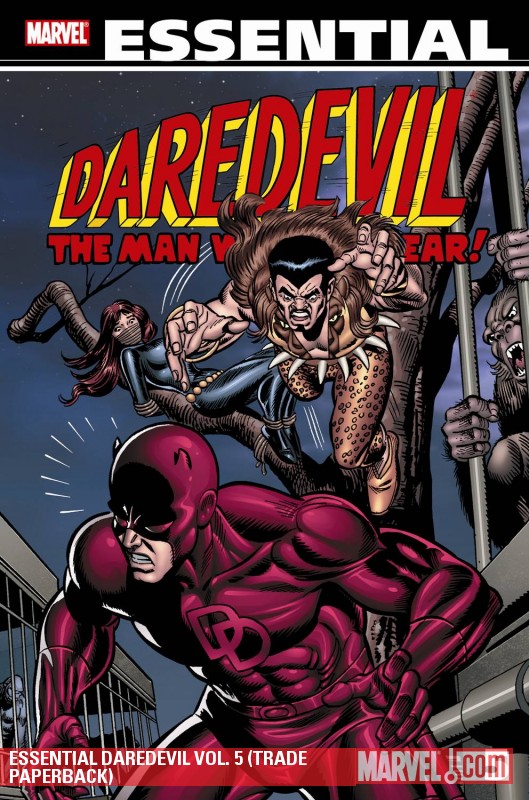 As you might expect from Gerber’s involvement, this isn’t Daredevil’s usual kind of stories, resembling neither what came before or after. He’s in San Francisco, playing Marvel Team-Up with the Black Widow; both changes were set up by Gerry Conway in the previous Essential Daredevil. But Gerber takes that and runs with it, having Daredevil battle large crises by himself. Daredevil fights the minions of Thanos, and Gerber puts Moondragon (who introduces herself as “Madame MacEvil”) and Angar the Screamer to good use. He uses two of my favorite characters, Mandrill and Nekra — they’re both goofy and menacing, especially Mandrill’s telepathic control of women. Gerber’s not afraid to have Daredevil lose fights, as the Beetle beats him and Kraven the Hunter defeats both him and the Black Widow. He shows an occasional flair for the Black Widow’s dialogue, especially when she snarks with society ladies in #104. And there’s something charming about having the Owl try to steal Daredevil’s brain.
 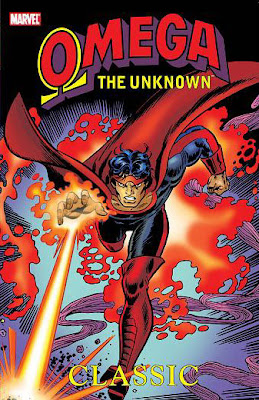 Most of the weirdness is encapsulated in the concept, which makes it hard to sum up. There are two narrative threads: James-Michael Starling, a child who suddenly becomes orphaned, and an unnamed superhero who escapes from his devastated planet. James-Michael, who is far more analytical and unemotional than most adults, has to survive school and life in Hell’s Kitchen, which he is singularly unsuited to do. His half-attentive caretakers don’t help, and neither do the strange fits and occasional powers he exhibits. Both are seemingly linked to the hero, who comes to Hell’s Kitchen himself and gains the name “Omega” after his headband, which is in the shape of the Greek letter. Omega, mute and taken in by an elderly shopkeeper, becomes a superhero, although he struggles with our alien morality.
  Hellstrom is a rarity: an academic hero. (Ray Palmer is a professor; are there other superheroes who work for a university?) In his Marvel Spotlight series, he battles his father’s forces in St. Louis while being affiliated with Gateway University; in his Son of Satan series, he goes to work for the University of the District of Columbia. I prefer the Spotlight issues, written by Steve Gerber; they were consciously superheroic, with Hellstrom fighting a new supernatural menace each month and trying to keep the squares in St. Louis from learning about it. Why St. Louis? I don’t know, but it’s no goofier than fighting demons in New York City.
 But any character that has been good once is begging to be reused, and into this breach steps writer Ty Templeton and penciller Juan Bobillo. In