Reviews of trade paperbacks of comic books (mostly Marvel), along with a few other semi-relevant comments / reviews.

26 August 2011

Essential Killraven, v. 1

Collects: Amazing Adventures #18-39, Marvel Team-Up #45, Marvel Graphic Novel #7, and Killraven #1 (1973-6, 1983, 2001)

Released: July 2005 (Marvel)

Format: 504 pages / black and white / $16.99 / ISBN: 9780785117773

What is this?: A former gladiator and his companions fight against the Martians who have enslaved Earth.

The culprits: Writer Don McGregor and others and artists P. Craig Russell, Herb Trimpe, and others

The setup for Killraven is one of those sci-fi concepts Marvel came up with in the ‘70s that didn’t survive beyond the Bronze Age. Created by writer Roy Thomas and artist Neal Adams, it has a simple hook: the Martians, after losing the original War of the Worlds, won the rematch in 2001 and subjugated humanity, and only an ex-gladiator named Killraven and his band of Freemen oppose them.

If you’ve ever seen Thundarr the Barbarian — and if you haven’t, I pity you — Essential Killraven, v. 1, might be a little familiar. Killraven fights the Martians (wizards for Thundarr) and lots of monsters. He visits American cities that, despite being ruins, have one distinguishing feature from the pre-war days. Humans have been shaped into weird forms and given superpowers. And then there are the aliens who eat babies …
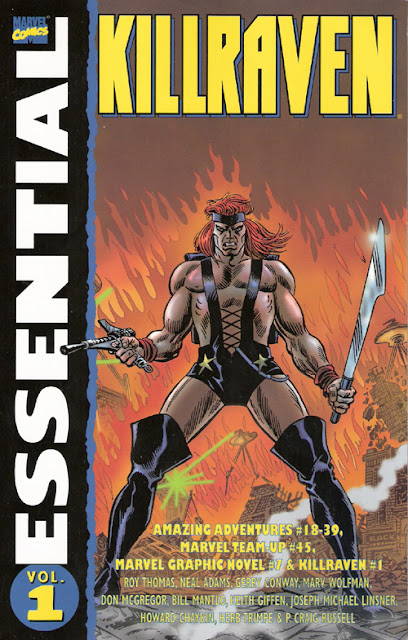
Essential Killraven, v. 1 coverWait. That last one wasn’t on TV. And that’s where writer Don McGregor, who took over with Amazing Adventures #21, makes Killraven something other than a needless continuation of a sci-fi classic. His stories have babies eaten as delicacies, forced breeding, and humans tortured, warped, and killed for no real reason. Yes, the casualty rate for Killraven’s band of Freemen is absurdly low, but even they are touched by loss, and why are you complaining? This was a comic book meant for kids, and they’re talking about eating babies because they’re yummy.

The major flaw in Killraven is that the setup lends itself to a lot of repetition. The Freemen head to a new town, fight the weird menace, and then find themselves in a new place at the beginning of the next issue. McGregor does his best to play with that, especially at the end, when he has Freeman Old Skull tell the others his origin story (#37) or has the group run into a fairy-like creature named Mourning Prey in a butterfly-filled Florida swamp (#39), an issue that has the slight tinge of a fever dream about it. But he can’t disguise that repetition, and his comic-booky “man who lives for only one day and must mate” plot (#35) certainly gives that issue the feel of just another Marvel book, despite its trappings. (Bill Mantlo’s fill-in on #33 and his Marvel Team-Up Killraven story only compound the feeling.) Still, McGregor is good for some surprises; when Carmilla Frost joins the Freemen, for instance, it’s Killraven’s friend M’Shulla, not Killraven, who gets the girl.

Additionally, there’s something completely endearing about a comic in which the hero gets so lost that while heading to Yellowstone National Park to find his brother that he travels instead from Indianapolis to Michigan to Chicago to Tennessee to Georgia to Florida. Killraven has no sense of direction, and it appears his cohorts have no desire (or ability) to correct him. To be fair to Killraven, he can’t exactly ask the mutants, collaborators, monsters, and Martians directions on the way, and everyone else they meet is even more clueless than they are. Even more entertaining is that Yellowstone is obviously a trap, and the Martians get so impatient they move the trap to where Killraven is wandering (Cape Canaveral) and don’t bother to disguise it at all. The amusing cherry on top of it all is that Killraven doesn’t question meeting his brother thousands of miles from where each is supposed to be at all. “My brother’s supposed to be in Yellowstone and just runs into me in Florida? Sure, why not?”

That happens in Marvel Graphic Novel #7, and without that issue, this wouldn’t be half as good a book. Without the MGN, Killraven is a meandering story in which McGregor takes his heroes across the eastern U.S. Sure, that gets better as the book goes on, but the story just sort of peters out in Amazing Adventures #39 when the Freemen encounter Mourning Prey. But MGN #7 puts paid to the big motivation for the Freemen’s journey: finding Killraven’s brother. It doesn’t go very well for the characters, but it does end the plot, something that needed to be done.

The obvious way to end the series in MGN #7 would have been with Killraven and the Freemen fighting back against the Martians, leading a revolution. Unfortunately, while that might be a definitive ending, that sort of ending is rarely satisfying: not enough buildup, too many characters, too improbable a plot, or a hundred other problems. Instead, McGregor and artist P. Craig Russell give the readers one reveal, but they do so in a plot much like previous stories. Oh, their ally for the story is more developed and relatable than most of those in the Amazing Adventures run, but it tonally fits with the rest of the story. McGregor even develops Carmilla and M’Shulla’s relationship, as if he expected to write more stories Killraven. (According to McGregor in this interview with Richard Arndt, 50 or so pages of Killraven: Final Lies, Final Truths, Final Battles was written in the late ‘80s, but it was scuttled when Russell couldn’t get assurances it would be published in Marvel’s best format.)

And the art …

Much like Bill Sienkiewicz and Moon Knight, Russell’s art is the biggest selling point for Killraven, and the MGN is where Russell gets the opportunity to show off the most. It’s unfortunate that the size of the art had to be reduced for the Essential’s page dimensions, and for some reason the art isn’t reproduced in the pure black-and-white pencils and inks the rest of the book features. But even the slight muddying can’t hide Russell’s skill or maturation; he was excellent in issues #27-32 and 34-9, but in the years between Amazing Adventures and MGN #7, he’s become something else. The art is polished, fluid, and expressive. His figures all have a litheness about them — even some who shouldn’t, like Old Skull — but his monsters are bizarre, horrific, and most important alien.

Russell wasn’t the first artist on the title. Adams did the first half of the first issue and was followed by one and a half issue by Howard Chaykin; both do good, if brief, work, but we have Adams to blame for the horrible, horrible costume designs. (What the hell did they think the future would be like back then? This is one Essential I was glad had no color, fearing that a ‘70s palette on those ridiculous costumes would sear my eyes.) Although a mismatch of genres, Gene Colan did his usual atmospheric work on one issue (#26). Herb Trimpe (#20-4 and 33) and Rich Buckler (#25) round out the art duties, both doing solid work. Trimpe’s work is similar to the art he produced for the Hulk; Buckler’s work is interesting, more subtle and clear than the other artists.

The book concludes with the Killraven one-shot written and drawn by Joe Lindsor. To call it missable is an understatement of grand proportions; if I had paid for the single issue when it came out in 2001, I would have wanted my money back. There’s nothing in the issue for Killraven fans, except that it advances the timeline without incident by a half year or so. The actual plot, in which Killraven counsels a hippy chick who woke from a cryogenic tube and then promptly wants to go back to sleep when she sees what a hellhole 2020 is, is so light I was afraid it might blow off the page. It was included to fill out the page count, I imagine, but 20 blank pages might have been a better choice.

Essential Killraven is often silly (it is a product of the ‘70s), frequently repetitive, and occasionally stupid (as when McGregor tries to convince us “mud brother” is a term of endearment that Killraven has given M’Shulla instead of the racial slur it so obviously seems to be). But Killraven is worth a glance for some of the details and the P. Craig Russell art.

Rating: Marvel symbol Marvel symbol Marvel symbol (3 of 5)

Labels: , , , , , , , , , , , , , , ,

23 June 2009

Omega the Unknown Classic

Collects: Omega the Unknown #1-10, Defenders #76-7 (1976-9)

Released: December 2005 (Marvel)

Format: 224 pages / color / $29.99 / ISBN: 9780785120094

What is this?: Reluctant superhero has strange connection to orphan boy, who’s trying to survive in Hell’s Kitchen with the worst foster parents ever.

The culprits: Writers Steve Gerber, Mary Skrenes, and Steven Grant and penciler Jim Mooney and a little Herb Trimpe

My admiration for Steve Gerber’s imagination and occasional weirdness is vast; he is among the greatest imaginative talents (with Jack Kirby) to ever be part of the comics universe.

Howard the Duck is his signature character, but one that is emblematic of his career, in some ways, is Omega the Unknown. Its description by readers is so uniform it might as well be part of the name: weird. So when I found an inexpensive copy of Omega the Unknown Classic at a Charlottesville comics store, I was all over it.

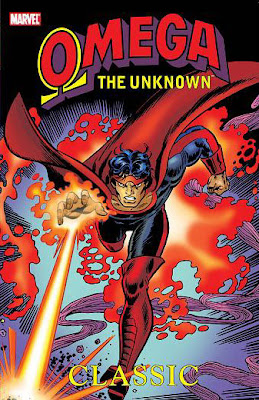
Omega the Unknown Classic coverMost of the weirdness is encapsulated in the concept, which makes it hard to sum up. There are two narrative threads: James-Michael Starling, a child who suddenly becomes orphaned, and an unnamed superhero who escapes from his devastated planet. James-Michael, who is far more analytical and unemotional than most adults, has to survive school and life in Hell’s Kitchen, which he is singularly unsuited to do. His half-attentive caretakers don’t help, and neither do the strange fits and occasional powers he exhibits. Both are seemingly linked to the hero, who comes to Hell’s Kitchen himself and gains the name “Omega” after his headband, which is in the shape of the Greek letter. Omega, mute and taken in by an elderly shopkeeper, becomes a superhero, although he struggles with our alien morality.
It’s interesting that for such an odd concept, the book is firmly ensconced in the Marvel Universe: Omega fights the Hulk and Electro, for instance, and battles minor villains like Nitro and Blockbuster. Perhaps it was Marvel editorial policy. Still, other than a villain revealed to be Ruby Thursday by a later writer, there aren’t any of the strange villains Gerber could and often did create.

Omega is largely follows the themes Gerber emphasized in works like Howard the Duck and Man-Thing: alienation, being an outsider, the senselessness of much of human endeavor. Sometimes I think it must have been a very lonely and frustrating existence to be Steve Gerber. His protagonists are rarely happy and can’t find even the minor victories that, say, Spider-Man indulges in.

It’s no different in Omega, although there’s none of the leavening of humor that you find in Howard. Everything is played deadly serious, as deadly serious as young James-Michael always is. I don’t know if this is because of the influence of co-writer Mary Skenes or because Gerber thought Omega was a more serious creation; perhaps there’s another reason. The school scenes with James-Michael are depressing criticisms of urban education; the extraneous elements of the school experience realistically overwhelm the classroom parts, which is puzzling and disturbing for a scholar like James-Michael, and that gets across to the reader quite well.

Steven Grant has the unenviable task of wrapping up the story; I don’t know if the idea to do so was his or Marvel’s. It certainly wasn’t Skenes and Gerber’s, who didn’t like Grant’s ending at all. (As far as I know, Gerber never revealed his ideas for the series after its final issue.) It’s not a horrible ending in the “any-ending-you-can-walk-away-from” sense. But it certainly doesn’t match Omega’s tone; it’s a bit too optimistic and striving to match any Gerber story, whose cynicism stared back at the reader from the page like a third eye. Interestingly, Grant doesn’t skimp on the weirdness, although he does it in a more modern sense: characters like Ruby Thursday and Moondragon, plus invading aliens.

Jim Mooney provides the art for the Omega run. This was the ‘70s, you see, and Mooney gives the effort a workman-like edge. There’s little memorable about the art; it looks like most of the rest of the decade. There’s nothing that matches the imagination of the concept; I have the idea Mooney probably approached Omega as just another job, perhaps one more baffling than others. There’s nothing wrong with that, and I don’t want to come across as criticizing him. But if an artist with a distinctive style had worked with Gerber and Skenes, Omega might be a hidden classic rather than a curiosity. Herb Trimpe pencils the two Defenders issues and does a fine job.

Even after reading Omega, I’m still not sure what to make of it. It’s not as bizarre as I had expected, although it’s certainly different. It’s worth reading for two reasons: because it’s always worthwhile to explore Gerber’s body of work, and because it’s just interesting enough that a comic fan should have an opinion about it.

Rating: Marvel symbol Marvel symbol Marvel symbol (3 of 5)

Labels: , , , , , , ,

24 February 2009

Essential Hulk, v. 5

Collects: Incredible Hulk #171-200, Incredible Hulk Annual #5 (1974-6)

Released: November 2008 (Marvel)

Format: 616 pages / black and white / $16.99 / ISBN: 9780785130659

What is this?: Hulk smash! as usual, all around the world, vs. supervillains, Commies, and puny Banner.

The culprits: Writer Len Wein (and others) and pencilers Herb Trimpe and Sal Buscema

The Marvel Essentials line concentrated, in its early years, on the company’s Silver Age core and a few later classic titles, such as Uncanny X-Men and Wolverine. (Yes, I know Wolverine’s not really classic, but work with me here.)

Most of those Silver Age titles have wandered into the ‘70s. Overall, the ‘70s were a fallow time for Marvel; yes, X-Men were picking up steam with Chris Claremont and Captain America had some well received stories, like the Secret Empire, but the big titles — Fantastic Four, Amazing Spider-Man, Avengers — were not at the creative peaks that preceded and followed the Me Decade.

Essential Hulk, v. 5 coverWhich brings us to Essential Hulk, v. 5. For most people, Incredible Hulk didn’t really get memorable — from a story perspective, at least — until Peter David took over the title in the ‘80s; it’s the TV show, with Bill Bixby and Lou Ferrigno, that draws the attention before that. But I admit to a fondness for the Hulk title. As I mentioned in my review for the previous volume, all that mediocrity really doesn’t matter.

The Hulk fights supervillains. He travels the world. He gains friends, loses friends. He’s always wandering, getting out of stuffy New York to see the world. The only thing casual readers have heard of from this volume is the debut of Wolverine in #180-2, but the Hulk is not just doing the same things over and over again.

Roy Thomas wrote #171-5 (and plots #176), followed by Gerry Conway for three issues. Thomas, being Thomas, couldn’t resist bringing back forgotten or stranded characters, like the Juggernaut and the Cobalt Man. Conway got to write the results of the first time a group with Black Bolt shot the Hulk into space for his good and the good of society; it didn’t work either, but it was a lot less destructive to society than Planet Hulk and World War Hulk. (The first outer space exile is a boring story set on Counter-Earth, where Adam Warlock gets to play a very obvious golden-skinned Jesus. Don’t ask. Just … don’t, OK?)

Then Len Wein settled in for a long run, running through the end of the volume. Wein introduced Wolverine, which is one of the most significant moments in Marvel history, but most of the book is uneventful. I am fond of some bits. I enjoyed the return of Glenn Talbot, which included saving a nonplussed President Ford from a bomb and a breakout from a Soviet prison that featured a talking, rhyming orange dinosaur named Droogi. The Russians aren’t paper enemies; they manage to deal the imperial running dogs a good deal of damage, even taking out the Hulkbuster base and its commander. The story with the Shaper of Worlds, in which he and his protégé create a paradise for the Hulk that is ruined by the Toad Men and the Hulk’s own demands that “if paradise is not real … then it is not paradise!”, is touching.

The less said of Hulk vs. the Loch Ness (sorry, Loch Fear) Monster, the better. The same holds true of the two-issue story featuring Man-Thing and the Collector. Yes, calm down, form a line — there are copies enough for everyone.

The art comes from iconic Hulk pencilers Herb Trimpe and Sal Buscema, with Trimpe providing the work for all the stories up to #193 and Buscema doing the rest. Personally, I prefer Buscema, who is my favorite Hulk artist and one of my favorite comic artists of all time. There’s something about his ability to get across the Hulk’s power and frustration with a world that makes no sense. Trimpe, though, has a memorable Hulk, even if he does have a fondness for oddly shaped heads. As I mentioned in the review for v. 4, you can see a big difference in Trimpe’s work depending on the inker. I prefer the inking of Jack Abel, who worked on #171-81.

My recommendation for this title is the same as the previous volume: I like this volume because I like this style of Hulk. It’s occasionally strange, not infrequently boring … but it’s rarely the same for more than two issues. It’s like the weather; if you don’t like it, wait a while. That being said, I’m deducting a half point because of the “Adam Warlock as Messiah” thing.

Rating: Hulk head Hulk head Half of a Hulk head (2.5 of 5)

Labels: , , , , , , , , , , ,

05 September 2008

Essential Defenders, v. 4

Collects: Defenders #61-91 (1978-81)

Released: July 2008 (Marvel)

Format: 584 pages / black and white / $16.99 / ISBN: 9780785130611

It’s probably safe to say that the Essential Defenders, v. 4 is not the Defenders you remember.

There’s none of the inspired Steve Gerber madness, the stuff that made Gerber and the comics he worked on intensely interesting and occasionally baffling in the ‘70s. It never has the Big 4 — Silver Surfer, Namor, Dr. Strange, and the Hulk — together at once, although it does have the latter three a few times. But Namor shows up only reluctantly, it seems, and Dr. Strange appears in less than half the book. Heck, his apprentice / lover Clea seems to be around as much. And it’s not quite what it would become, with a full cast of B-level heroes (Son of Satan, Gargoyle, Demon Slayer, Beast, etc.).

Essential Defenders 4 coverSo for the most part, you have Nighthawk, Valkyrie, Hellcat, and the Hulk. These are great characters,although the modern Marvel Universe seems to do just fine without them. (The Hulk in this era of The Defenders — simple, touchy, and bean-loving — is not the current incarnation of the Jade Giant.) But they are all seemingly supporting characters, none of whom can support a title. I mean, the Hulk had his own comic, so he could obviously drive a plot, but when he goes, he goes alone. There’s no one stable on this non-team, perhaps by desire, and there’s no one for the team to rally around or be the leader in tough times. (Nighthawk pointedly shoves that obligation away repeatedly.) There’s a reason the X-Men have almost always had either Cyclops or Colossus, despite both of them being as dull as Point Barrow in January.

Writers Ed Hannigan and David Anthony Kraft hatch some good ideas here — excellent ideas, actually. The Mandrill storyline is the best, stretching throughout the volume. Mandrill, the mutant man-ape who can control any female who breathes his pheromones, is a creepy villain who is underplayed (and underused); I can’t tell whether this is because going all out with his powers would be too unsettling for kids (or adults, really) or would have violated the Comics Code. In any event, it’s fascinating to watch Valkyrie’s struggle against a villain simple biology has made an easy target for male heroes but near impossible for her to defeat. Her rage and frustration are nicely played.

A confrontation between Black Panther and Namor is interesting, for no other reason than I don’t think the two rulers had ever clashed before, but the near war between their two nations gets overlooked in the Marvel Universe proper because it happened in Defenders. The “Defenders for a Day” story, in which hanger-on Dollar Bill throws open Defenders membership to anyone, starts off with the chaos of a dozen or two unaffiliated superheroes showing up at Defenders HQ but disappointingly ends with an ineffectual fight against supervillains and petulant heroes.

Unfortunately, there’s a lot of ideas that fall flat. I don’t care about the Defenders battling the Unnameable, although I am interested in what Hannigan has against — or for — Houghton-Mifflin. (He uses the company’s name, written backwards, as a foreign language.) When Lunatik went from some weird vigilante to fragments of an interstellar pirate prince, I stopped caring. Foolkiller just doesn’t quite work in the Defenders framework — should a guy with a ray gun really be such a challenge? — and although I’m sure Omega the Unknown’s story deserved to be finished, I wish it hadn’t been dragged into Defenders, even if Ruby Thursday was used to help finish it up. Nighthawk’s millionaire playboy identity is investigated by federal agents, but that story has already been done in Defenders. I don’t care about Valkyrie’s duties in Valhalla; although her interactions with our world are interesting, I don’t care about the war among the Asgardians, especially since it seems to be between Hela (the good guy!) and some upstart. A war in Asgard without Thor or Odin or Loki is pointless.

And there’s only so much of Hellcat’s “golly-whillikers-gee-whiz-shucks” dialogue I can take before I just pray someone beats the cornball right out of her.

The art comes mainly from Herb Trimpe and Don Perlin. Trimpe’s art is good, and as one of the definitive Hulk artists, he’s a good fit for the title. However, his run is marred by multiple inkers and is a good study in the effect different inkers can have on the same penciller. Perlin is a solid ‘70s / ‘80s artist, although perhaps not quite the equal of Trimpe. There’s also a few issues by Sal Buscema, and any chance to see him draw the Hulk is always a bonus.

I want to recommend this book, but I feel it’s missing something. It feels ragged, sometimes; the transitions between status quos aren’t quite as smooth as they should be. It also feels like it’s still having a bit of a hangover from Gerber’s days. It has big ideas that it can’t quite deliver on. To be fair, however, this book was quite forward thinking for its day, featuring strong, independent female leads in the ‘70s. (Not quite as strong as Chris Claremont women — there is such a thing as going too far, after all.)

Still, it falls short of being excellent.

Rating: Defenders symbol Defenders symbol (2 of 5)

Labels: , , , , , , , , , , , ,

24 May 2008

Essential Hulk, v. 4

Collects: Incredible Hulk #143-70 (1971-3)

Released: September 2006 (Marvel)

Format: 608 pages / black and white / $16.99 / ISBN: 0785121935

More than any other of the mainstay, stalwart titles at DC and Marvel, the Incredible Hulk can withstand mediocre runs.

Essential Hulk 4 coverPerhaps it’s just me. But even though I know the stories in Essential Hulk, v. 4 aren’t classic or iconic, they have a certain appeal that non-Hulk stories do not. The Hulk can go anywhere — the scope of his stories is immense, sprawling. He arrives like a meteor strike, his movements formed only by chance and villainy. In Essential Hulk, v. 4, he ranges from Canada to Latveria to the ocean floor and Jarella’s subatomic world. When most of the Marvel Universe is stuck in New York, this is refreshing.

If that doesn’t rock your socks, the highlight of this volume is the art of Herb Trimpe. Perhaps the artist most closely associated with the Hulk, Trimpe begins his long association with the Hulk in this volume. His work is good — more comfortable than standout, as gross exaggeration of the Hulk’s physique over the years has made his Hulk seem a little small in comparison. But for those who don’t pay attention to such things usually, this book shows the difference an inker (and reproduction, I fear) can have on a penciller’s work. Lines go from scratchy to clean and back again, heavy to light, etc. It’s not Trimpe’s fault, but it doesn’t bring out the best in his pencils.

Bi-Beast! The Hulk has a few of his B-grade villains created in this book: Bi-Beast, Zzzax, Harpy, the Wendigo. The creation of the Bi-Beast is bizarre and wonderful, something truly worthy of Jack Kirby’s fertile imagination. Instead, he was created by Steve Englehart and Trimpe.4 The thought of a comic with both Bi-Beast and MODOK but without the participation of Kirby makes me doubt Stan Lee’s all-encompassing wisdom.

As for the plots … well, they’re provided by a bunch of Marvel’s best in the ‘70s, but that doesn’t make the plots great. Roy Thomas, Gerry Conway, Archie Goodwin, Gary Friederich, and Englehart combined on the 28 stories in this volume, although few are memorable. (A side effect of the sprawling nature of the Hulk’s travels is that it often leaves a disconnect between stories.) Perhaps the worst of the stories is the “marry in haste, repent at leisure” wedding of longtime leading lady Betty to the man who had held a torch for her for years, Glen Talbot. The stories occasionally gain traction — the Hulk’s foray into Canada, for instance, when he first battles Wendigo — but mostly they’re as aimless as the hulk.

I liked this volume. But then again, I like this style of the Hulk.

Rating: Hulk head Hulk head Hulk head (3 of 5)

Labels: , , , , , , , , , , , , , ,