


Luke Cage: Second Chances, v. 1
Collects: Cage #1-12, story from Marvel Comic Presents #82 (1992-3)
Released: September 2015 (Marvel)
Format: 320 pages / color / $34.99 / ISBN: 9780785192985
What is this?: Luke Cage takes his solo Hero for Hire business to the Windy City, where he allows a newspaper access to his cases.
The culprits: Writer Marcus McLaurin and penciler Dwayne Turner
Luke Cage, v. 1: Second Chances, v. 1 is 320 pages long, but it easily feels double that length. Reading each page is the equivalent of watching the minute hand on the clock in algebra class: You know you’re getting closer to the end, but you swear to Yeenoghu that you saw that hand move backwards at least once.
Cage, which premiered in 1992, returned Luke Cage to circulation for the first time since Power Man & Iron Fist ended in 1986. That absence is a crime; Luke Cage is too good a character to languish for more than half a decade, and returning Cage to the Marvel Universe is by far Cage’s greatest achievement.
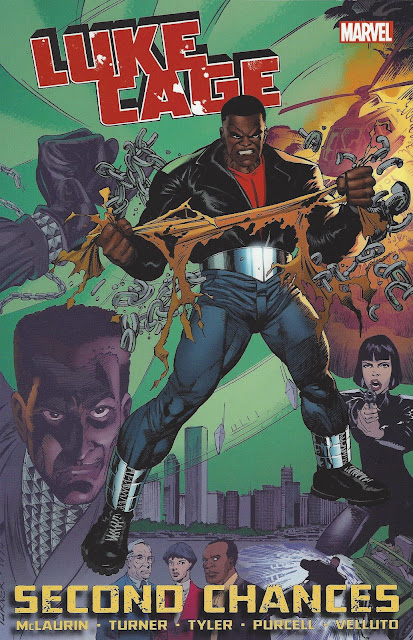 Writer Marcus McLaurin and artist Dwayne Turner decided to update Cage for the ‘90s, which is a good idea. Turner’s modifications are largely successful. Turner gets rid of the afro, yellow shirt, tiara, and chain belt; the new Cage has close-cropped hair, no headgear of any sort, a tucked-in jacket that’s open in a deep V across the chest, and a large metal belt. It’s a good look overall, although the belt looks a lot like an upscaled version of Cage’s old tiara, hung around his waist. But McLaurin’s changes are just as dated today as Cage’s original trappings. The exclamation “Sweet Christmas!” is gone, although other characters use the not-at-all stupid minced oath “Dag!” Cage confronts evil rappers and street gangs, has an “attitude,” and uses ‘90s slang. The book is peppered with random references to mutants. In the end, the book could not be more ‘90s if it tried.
Another part of Cage’s ‘70s past that is jettisoned is his sleazy Times Square environs. Cage is primarily set in Chicago, which should make me like the book more. I’m a sucker for Marvel stories set somewhere other than New York; that’s one reason I enjoy Hulk stories. But as cartoonish as Luke Cage sometimes was in previous series, his setting was important and had an effect on the character. Cage, on the other hand, might as well be set in Minneapolis or Salt Lake City or Portland or any city with a few large buildings downtown. Chicago is a non-entity in this book, and neither the writing nor the art gives any indication Cage has set up shop in the US’s third-largest city.
During Second Chances, Cage is repeatedly harassed by Hardcore, a new villain created by Turner and McLaurin for this series. Unfortunately, Hardcore is an inadequate foil for Cage. He is, essentially, a middle manager, hampered by his boss’s restrictions and his underlings’ incompetence. Hardcore’s only offensive capability — a taser chain — is no threat to Cage. His personality, encapsulated by the occasional familiar quotation he flings at his adversaries and a Southern accent he often forgets to use, is not worth discussing.
Who is Hardcore working for? I’m going to spoil it for you, because it doesn’t matter: Cruz Bushmaster, son of Cage’s old enemy, Bushmaster. Why doesn’t it matter? Cruz appears only in #12, when his plan comes to fruition. He gains Cage’s powers, only to have them sucked dry by his apparently reborn father, who himself seems to die a few pages later in a fight with Cage and Iron Fist. It’s a pointless ending: second-rate villains disposed of in a second-rate story.
Turner and McLaurin made the excellent choice to use Dakota North, a private investigator who had made only a few appearances previous to Cage. Cage has no formal investigatory experience and no time for subtlety, so a character who can actually figure things out is a welcome addition to the cast. However, most of North’s investigations are about Cage himself and his family; she doesn’t help Cage much, and her investigations have little to do with the overall plot. Unfortunately, Turner draws her as an anatomical freak: impssibly thin but busty, long-legged, and wearing tight clothing. I realize that’s sadly not unusual for comics, but Turner also draws her clothes as dark, tight, and otherwise boring. Given that North was once a fashion model, she should never wear boring clothes.
The rest of the supporting cast is dull. Jeryn Hogarth, Heroes for Hire’s attorney, pops up but does nothing interesting. Analisa Medina, editor of the newspaper that follows Cage, is a nonentity. Mickey Hamilton, a photographer, follows Cage around, drops hints about Cage’s father, and serves as someone for Cage to rescue. We learn nothing about Mickey’s personal life or why he makes the choices he does. Troop, an orphan Cage takes in, has a character arc, but it’s a predictable one: he depends on Cage, Cage fails him, and then he joins a gang to get revenge on Cage. Given how much sympathy the book has for Troop, you can probably guess what he does when the gang sets a trap for Cage.
Even characters making guest appearances are dull. Cage’s last interesting client is in #2. The last interesting villain (Kickback) is in #4, and he’s not that interesting; his ability to time travel three minutes into the past or future allows for some interesting causal loops, but Kickback himself gets a complete character change between issues #3 and #4. Many innocents are subjected to the Power Man process, which eventually kills them, but they come and go like mayflies while Hardcase lingers on …
Some of the blame must fall on how Cage himself acts. He makes no strong attachments, other than Troop, pushing everyone else away. When Troop leaves, Cage is alone, with only his brash attitude and surliness for companionship despite living in the metropolis of Chicago. Despite having little trouble romantically in his previous series, he doesn’t date, and his only flirtation is with Medina. (That relationship goes nowhere.) Cage even bristles at the presence of Iron Fist, showing no interest in teaming up — or even being friendly to him.
I had planned on buying Second Chances, v. 2, but now I fear that book’s release. I realize Marvel wants more material featuring Cage out before his Netflix series is released, but it would be better to bury this series. Reading Second Chances, v. 1 is like being afflicted with a cold that won’t go away, one that doesn’t even give you entertaining fever dreams.
Rating: 0.5 of 5
Labels: 0.5, 2015 September, Chicago, Dwayne Turner, Hardcore, Marcus McLaurin, Marvel, Power Man, Troop
posted by Raoul | 5:21 PM
|
0 comments

 Wait. That last one wasn’t on TV. And that’s where writer Don McGregor, who took over with Amazing Adventures #21, makes Killraven something other than a needless continuation of a sci-fi classic. His stories have babies eaten as delicacies, forced breeding, and humans tortured, warped, and killed for no real reason. Yes, the casualty rate for Killraven’s band of Freemen is absurdly low, but even they are touched by loss, and why are you complaining? This was a comic book meant for kids, and they’re talking about eating babies because they’re yummy.