


Black Panther Epic Collection, v. 1: Panther's Rage
Collects: Fantastic Four #52-3 and Jungle Action #6-24 (1966, 1973-6)
Released: September 2016 (Marvel)
Format: 400 pages / color / $34.99 / ISBN: 9781302901905
What is this?: The Black Panther, ruler of the African nation of Wakanda, deals with Erik Killmonger’s rebellion, then goes to America and fights the Ku Klux Klan
The culprits: Writer Don McGregor and artists Rich Buckler and Billy Graham, with help from Jack Kirby and Gil Kane
The ‘70s Black Panther Epic Collection, v. 1: Panther’s Rage was the Black Panther’s first chance to step into the spotlight alone, and the result is simultaneously ahead of its time and firmly of its time period.
Panther’s Rage is ahead of its time because the Jungle Action run is one long story, in which the Black Panther has to deal with a rebellion in Wakanda led by Erik Killmonger, plus the beginning of another. Such long-form stories were uncommon in the ‘70s, although they weren’t unheard of. Also, having the entire cast be people of color was almost unprecedented in a mainstream comic. On the other hand, writer Don McGregor’s narration is very much like some of his more ambitious ‘70s contemporaries: verbose, contemplative, philosophical, and very, very purple.
McGregor gives the reader passages like this:
“Cruelty. It’s a word you understand like the word pain … You give it a vague definition and file it away, hoping you never have to learn what the word really means. He wishes the torture weren’t so mindless, that it had a point, a reason that would justify such inhumanity. But reasons are scarce … more for fiction than life.” — Jungle Action #15 (p. 205)That’s two panels on a five-panel page, and it’s a good example of the verbiage that crowds the page. It’s not badly written, and we can argue about how original its insights are; it’s definitely dense, though, and I find it overwritten. (And who bolded “vague definition”? Those are the least interesting words in the quote.) McGregor isn’t interested in subtlety, but when he does opt for that route, it can be effective; for instance, the death of a bird trapped in a substance Killmonger uses to capture dinosaurs is among the most moving moments in the book, even though the bird is in only three panels with minimal narration.
With other writers, this sort of narration might be a sign of the writer’s lack of confidence in the artist, but I think McGregor works well with Rich Buckler and Billy Graham. I think McGregor lacks confidence in art in general, though. (And in Black Panther himself: I’ve never seen Black Panther get defeated as often as he does in this book. I mean, a cop pistol whips Panther in a supermarket, for Priest’s sake.) McGregor wants adjectives and adverbs, intensifiers and modifiers, that the art just can’t provide. Plus, no artist can draw an interior monologue with narrative philosophical digressions, and that’s what McGregor ladles onto the page.
McGregor needed someone to edit his work, to rein in his excesses and focus his story onto more interesting areas. But editor Roy Thomas was not that person, and it wasn’t Marvel’s style at the time to put limits on the writers of its fringe titles.
Among Marvel’s ‘70s output, this sort of writing was the norm, with writers like Steve Gerber and Thomas himself contributing ornate prose and socially relevant scripts. At worst, this crop of writers came across as Stan Lee knockoffs who tried to prop up weak superhero stories with grabs at social relevance that didn’t go far enough or were obvious at the time. At best, they become critical darlings, but it isn’t their prose alone that achieves that reputation; some experimentation in character or format was necessary to set the book or writer apart.
Does the long-form storytelling qualify Panther’s Rage as experimental enough to overcome the similarity to other Marvel writing at the time? I don’t think so. The Panther’s Rage storyline lasts from #6 to #18, more than two years of publishing time. (Jungle Action was bimonthly at the time.) Black Panther often loses sight of the overall picture, so the linked stories feel like more of an attempt to line up new adversaries for Panther rather than constructing a coherent story; Panther battles Killmonger’s lieutenants from #8 to #10 and #12 to 16 rather than addressing the leader of the rebellion or the people’s discontent. Nothing links these henchmen — who have names like Venomm, Malice, Baron Macabre, Karnaj, Sombre, and Salamander K’ruel — to the overall struggle. In only three issues does Black Panther seem willing to engage Killmonger’s forces with resources beyond his own brawn and muscle. In the end, McGregor’s run suffers in comparison to Ta-Nahisi Coates and Brian Stelfreeze’s current Black Panther, which covers similar ground with more coherence and focus.
On the other hand, I can’t deny McGregor is writing a story with a Black protagonist and a nearly completely Black supporting cast, both allies and villains. These supporting characters aren’t just hanging around; McGregor does an excellent job juggling their subplots and developing these new characters. Monica Lynne, the Panther’s African-American girlfriend, has to deal with a culture in which people look like her but she is still an outsider. Taku, the Panther’s communication officer, is a kind soul who even befriends Venomm, reforming the captured villain (to an extent). Two of Killmonger’s henchmen, Tayete and Kazibe, are used for comic relief throughout Panther’s Rage; the humor is not in keeping with the book’s tone, but it is a welcome change of pace. (Also: their scenes have a welcome thinning of narrative boxes.) McGregor also gives us a long (and distracting) subplot in which the head of Panther’s palace security, W’Kabi, and his wife drift apart, which makes me suspect McGregor himself was going through a breakup or he was watching someone close go through one.
The issues between the end of the Panther’s Rage story and the book’s cancellation are as mixed as the rest of the book. The Black Panther vs. the Ku Klux Klan is an intriguing idea, and the mystery over who killed Monica’s sister should drive the book forward. But in its final five issues, the mystery goes nowhere, McGregor adds in a non-Klan group to muddy matters, and an inordinate number of pages are used up by the speechifying Trublood and irrelevancies. On the other hand, watching Panther in a small Southern town has promise, and the issue in which Monica mentally inserts Panther into a Reconstruction-era lynching story is an excellent illustration of what it means to have a hero of color.
The art, provided by Buckler (#6-8) and Graham (#10-22, 24), is solid throughout. I prefer Buckler from an aesthetic viewpoint; his layouts are cleaner and larger, easier to follow, and his linework is much easier on the eyes. (Gil Kane does a fill-in on #9, and his work meshes with Buckler’s much better than his successor’s.) However, Buckler’s work does have its flaws. I can’t help but be distracted by how far apart Buckler draws people’s feet in action shots — their groins must be in constant agony, given how widely their legs are spread. More concerningly, he creates a Wakanda that is much more tribal than is shown later at Marvel. The whole of Wakanda is made up of thatched huts, Black Panther’s palace, and a hospital; no one but the Panther and a few supervillains wear pants, with most of other characters having grass fringes around their legs or waists somewhere. I understand the Wakandans are supposed to be isolated, but some of them have probably heard of trousers and wooden houses and would be curious.
Graham doesn’t have much choice but to follow Buckler’s lead on costuming and setting, unfortunately, and when some sci-fi trappings could be integrated into the art, he mostly misses the chance. Also unfortunate is his propensity for denser, more crowded layouts; McGregor’s words need room, and his art constricts their space. Fortunately, he has more of a chance to show the fantastic (mostly unexplored and undeveloped) areas of Wakanda. The frigid peaks and sultry jungles look good, although incorporating a Lost-World area with dinosaurs is a boring choice. Oh, sure: The Wakandans have no idea dinosaurs are living in their backyard. (That was probably McGregor’s decision, but incorporating dinosaurs into a comic is usually blamed on the artist.) Graham often works issue titles or words into the art; sometimes this works (such as on opening splash pages), and sometimes it’s baffling, like when “Epilogue” appears as a cloud in the closing panels in the final issue of Panther’s Rage.
The bonus material is more interesting than usual for a large collection like this. In addition to the standard unfinished art and previous versions of covers and pages already collected in the book, Panther’s Rage also includes five rough pages of the never-finished Jungle Action #25. McGregor supplied pictures of himself (and one of himself and Graham), which adds an unusually humanizing touch to the work. McGregor also provided pictures of the envelopes he stored material related to each issue in; the exterior of each envelope had notes to himself, including themes, ideas for other stories, and possible dialogue. Collection editor Cory Sedlmeier deserves a great deal of credit for compiling this unusually entertaining package.
On the other hand, I would have preferred a reprint of Avengers #62 (reprinted in Jungle Action #5 and featuring Man-Ape), Daredevil #69 (reprinted in Jungle Action #23), or any of Monica Lynne’s previous appearances. Room for one of those could have been made by dropping the standard sketches and a few other things while keeping most of the material I noted above.
Jungle Action was cancelled to make way for the Jack Kirby version of Black Panther, which could not be more different — Kirby’s version of the character was a cheery, enthusiastic king who went on goofy sci-fi adventures. I much prefer McGregor’s version, even when his prose is at its most turgid.
Panther’s Rage is all over the place — as is this longer-than-usual review, I suppose. For readers who have a high tolerance for ‘70s prose-dense comics, I heartily recommend his book. For those who would like to hear the characters and actions speak louder than the narrator, look elsewhere.
Rating:
 (3 of 5)
Labels: 2016 September, 3, Billy Graham, Black Panther, Cory Sedlmeier, Don McGregor, Erik Killmonger, Georgia, Gil Kane, Ku Klux Klan, Marvel, Monica Lynne, Rich Buckler, Roy Thomas, Wakanda
posted by Raoul | 2:06 PM
|
1 comments

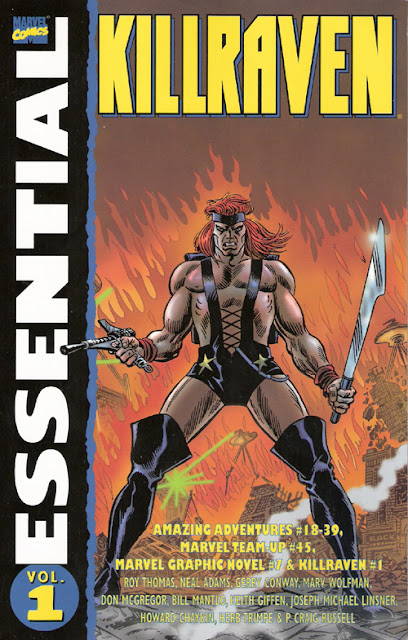 Wait. That last one wasn’t on TV. And that’s where writer Don McGregor, who took over with Amazing Adventures #21, makes Killraven something other than a needless continuation of a sci-fi classic. His stories have babies eaten as delicacies, forced breeding, and humans tortured, warped, and killed for no real reason. Yes, the casualty rate for Killraven’s band of Freemen is absurdly low, but even they are touched by loss, and why are you complaining? This was a comic book meant for kids, and they’re talking about eating babies because they’re yummy.