Reviews of trade paperbacks of comic books (mostly Marvel), along with a few other semi-relevant comments / reviews.

18 November 2016

Black Panther Epic Collection, v. 1: Panther's Rage

Collects: Fantastic Four #52-3 and Jungle Action #6-24 (1966, 1973-6)

Released: September 2016 (Marvel)

Format: 400 pages / color / $34.99 / ISBN: 9781302901905

What is this?: The Black Panther, ruler of the African nation of Wakanda, deals with Erik Killmonger’s rebellion, then goes to America and fights the Ku Klux Klan

The culprits: Writer Don McGregor and artists Rich Buckler and Billy Graham, with help from Jack Kirby and Gil Kane


The ‘70s Black Panther Epic Collection, v. 1: Panther’s Rage was the Black Panther’s first chance to step into the spotlight alone, and the result is simultaneously ahead of its time and firmly of its time period.

Panther’s Rage is ahead of its time because the Jungle Action run is one long story, in which the Black Panther has to deal with a rebellion in Wakanda led by Erik Killmonger, plus the beginning of another. Such long-form stories were uncommon in the ‘70s, although they weren’t unheard of. Also, having the entire cast be people of color was almost unprecedented in a mainstream comic. On the other hand, writer Don McGregor’s narration is very much like some of his more ambitious ‘70s contemporaries: verbose, contemplative, philosophical, and very, very purple.

Black Panther Epic Collection, v. 1: Panther’s Rage coverMost contemporary readers are likely to be struck by the latter rather than the former. When characters can talk to one another, breaking the monotony of a single voice, McGregor’s insistence on making abstract arguments is bearable, even interesting. But when the Panther is on his own, fighting Killmonger’s lieutenants single-handedly, the page is crowded with narrative boxes, making the book a chore to read. Even dialogue doesn’t always help; by the end, McGregor gives newspaper reporter Kevin Trublood long monologues about America and haranguing lectures about racism that drag on and on without advancing the story or McGregor’s theses.

McGregor gives the reader passages like this:
Cruelty. It’s a word you understand like the word pain … You give it a vague definition and file it away, hoping you never have to learn what the word really means. He wishes the torture weren’t so mindless, that it had a point, a reason that would justify such inhumanity. But reasons are scarce … more for fiction than life.” — Jungle Action #15 (p. 205)
That’s two panels on a five-panel page, and it’s a good example of the verbiage that crowds the page. It’s not badly written, and we can argue about how original its insights are; it’s definitely dense, though, and I find it overwritten. (And who bolded “vague definition”? Those are the least interesting words in the quote.) McGregor isn’t interested in subtlety, but when he does opt for that route, it can be effective; for instance, the death of a bird trapped in a substance Killmonger uses to capture dinosaurs is among the most moving moments in the book, even though the bird is in only three panels with minimal narration.

With other writers, this sort of narration might be a sign of the writer’s lack of confidence in the artist, but I think McGregor works well with Rich Buckler and Billy Graham. I think McGregor lacks confidence in art in general, though. (And in Black Panther himself: I’ve never seen Black Panther get defeated as often as he does in this book. I mean, a cop pistol whips Panther in a supermarket, for Priest’s sake.) McGregor wants adjectives and adverbs, intensifiers and modifiers, that the art just can’t provide. Plus, no artist can draw an interior monologue with narrative philosophical digressions, and that’s what McGregor ladles onto the page.

McGregor needed someone to edit his work, to rein in his excesses and focus his story onto more interesting areas. But editor Roy Thomas was not that person, and it wasn’t Marvel’s style at the time to put limits on the writers of its fringe titles.
Among Marvel’s ‘70s output, this sort of writing was the norm, with writers like Steve Gerber and Thomas himself contributing ornate prose and socially relevant scripts. At worst, this crop of writers came across as Stan Lee knockoffs who tried to prop up weak superhero stories with grabs at social relevance that didn’t go far enough or were obvious at the time. At best, they become critical darlings, but it isn’t their prose alone that achieves that reputation; some experimentation in character or format was necessary to set the book or writer apart.

Does the long-form storytelling qualify Panther’s Rage as experimental enough to overcome the similarity to other Marvel writing at the time? I don’t think so. The Panther’s Rage storyline lasts from #6 to #18, more than two years of publishing time. (Jungle Action was bimonthly at the time.) Black Panther often loses sight of the overall picture, so the linked stories feel like more of an attempt to line up new adversaries for Panther rather than constructing a coherent story; Panther battles Killmonger’s lieutenants from #8 to #10 and #12 to 16 rather than addressing the leader of the rebellion or the people’s discontent. Nothing links these henchmen — who have names like Venomm, Malice, Baron Macabre, Karnaj, Sombre, and Salamander K’ruel — to the overall struggle. In only three issues does Black Panther seem willing to engage Killmonger’s forces with resources beyond his own brawn and muscle. In the end, McGregor’s run suffers in comparison to Ta-Nahisi Coates and Brian Stelfreeze’s current Black Panther, which covers similar ground with more coherence and focus.

On the other hand, I can’t deny McGregor is writing a story with a Black protagonist and a nearly completely Black supporting cast, both allies and villains. These supporting characters aren’t just hanging around; McGregor does an excellent job juggling their subplots and developing these new characters. Monica Lynne, the Panther’s African-American girlfriend, has to deal with a culture in which people look like her but she is still an outsider. Taku, the Panther’s communication officer, is a kind soul who even befriends Venomm, reforming the captured villain (to an extent). Two of Killmonger’s henchmen, Tayete and Kazibe, are used for comic relief throughout Panther’s Rage; the humor is not in keeping with the book’s tone, but it is a welcome change of pace. (Also: their scenes have a welcome thinning of narrative boxes.) McGregor also gives us a long (and distracting) subplot in which the head of Panther’s palace security, W’Kabi, and his wife drift apart, which makes me suspect McGregor himself was going through a breakup or he was watching someone close go through one.

The issues between the end of the Panther’s Rage story and the book’s cancellation are as mixed as the rest of the book. The Black Panther vs. the Ku Klux Klan is an intriguing idea, and the mystery over who killed Monica’s sister should drive the book forward. But in its final five issues, the mystery goes nowhere, McGregor adds in a non-Klan group to muddy matters, and an inordinate number of pages are used up by the speechifying Trublood and irrelevancies. On the other hand, watching Panther in a small Southern town has promise, and the issue in which Monica mentally inserts Panther into a Reconstruction-era lynching story is an excellent illustration of what it means to have a hero of color.

The art, provided by Buckler (#6-8) and Graham (#10-22, 24), is solid throughout. I prefer Buckler from an aesthetic viewpoint; his layouts are cleaner and larger, easier to follow, and his linework is much easier on the eyes. (Gil Kane does a fill-in on #9, and his work meshes with Buckler’s much better than his successor’s.) However, Buckler’s work does have its flaws. I can’t help but be distracted by how far apart Buckler draws people’s feet in action shots — their groins must be in constant agony, given how widely their legs are spread. More concerningly, he creates a Wakanda that is much more tribal than is shown later at Marvel. The whole of Wakanda is made up of thatched huts, Black Panther’s palace, and a hospital; no one but the Panther and a few supervillains wear pants, with most of other characters having grass fringes around their legs or waists somewhere. I understand the Wakandans are supposed to be isolated, but some of them have probably heard of trousers and wooden houses and would be curious.

Graham doesn’t have much choice but to follow Buckler’s lead on costuming and setting, unfortunately, and when some sci-fi trappings could be integrated into the art, he mostly misses the chance. Also unfortunate is his propensity for denser, more crowded layouts; McGregor’s words need room, and his art constricts their space. Fortunately, he has more of a chance to show the fantastic (mostly unexplored and undeveloped) areas of Wakanda. The frigid peaks and sultry jungles look good, although incorporating a Lost-World area with dinosaurs is a boring choice. Oh, sure: The Wakandans have no idea dinosaurs are living in their backyard. (That was probably McGregor’s decision, but incorporating dinosaurs into a comic is usually blamed on the artist.) Graham often works issue titles or words into the art; sometimes this works (such as on opening splash pages), and sometimes it’s baffling, like when “Epilogue” appears as a cloud in the closing panels in the final issue of Panther’s Rage.

The bonus material is more interesting than usual for a large collection like this. In addition to the standard unfinished art and previous versions of covers and pages already collected in the book, Panther’s Rage also includes five rough pages of the never-finished Jungle Action #25. McGregor supplied pictures of himself (and one of himself and Graham), which adds an unusually humanizing touch to the work. McGregor also provided pictures of the envelopes he stored material related to each issue in; the exterior of each envelope had notes to himself, including themes, ideas for other stories, and possible dialogue. Collection editor Cory Sedlmeier deserves a great deal of credit for compiling this unusually entertaining package.

On the other hand, I would have preferred a reprint of Avengers #62 (reprinted in Jungle Action #5 and featuring Man-Ape), Daredevil #69 (reprinted in Jungle Action #23), or any of Monica Lynne’s previous appearances. Room for one of those could have been made by dropping the standard sketches and a few other things while keeping most of the material I noted above.

Jungle Action was cancelled to make way for the Jack Kirby version of Black Panther, which could not be more different — Kirby’s version of the character was a cheery, enthusiastic king who went on goofy sci-fi adventures. I much prefer McGregor’s version, even when his prose is at its most turgid.

Panther’s Rage is all over the place — as is this longer-than-usual review, I suppose. For readers who have a high tolerance for ‘70s prose-dense comics, I heartily recommend his book. For those who would like to hear the characters and actions speak louder than the narrator, look elsewhere.

Rating: Black Panther symbol Black Panther symbol Black Panther symbol (3 of 5)

Labels: , , , , , , , , , , , , , ,

30 September 2016

Conan the Barbarian, v. 32: The Second Coming of Shuma-Gorath and Other Stories

Collects: Conan the Barbarian #250-8 (1991-2)

Released: July 2016 (Dark Horse)

Format: 240 pages / color / $19.99 / ISBN: 9781616558666

What is this?: After losing the princess, Conan is tormented by

The culprits: Writer Roy Thomas and penciler Mike Docherty


In retrospect, it’s obvious Chronicles of Conan, v. 32: The Second Coming of Shuma-Gorath and Other Stories collects stories from a title heading for its end.

Even more than the previous volume, Chronicles of Conan, v. 31: Empire of the Undead and Other Stories, Second Coming uses continuity to give stories more weight and more interest than they would usually have. In fact, Thomas is so invested in using previous Conan stories — usually stories that he himself wrote — that in Conan the Barbarian #254 he completes a Savage Sword of Conan story he wrote in 1979 that never got an ending.

Chronicles of Conan, v. 32: The Second Coming of Shuma-Gorath and Other Stories coverThe continuity Thomas is calling on should be in service of the main story, in which Conan travels back to his home village in Cimmeria to see if it has been destroyed, as he has seen it destroyed in his dreams. Unfortunately, the continuity is of dubious value.

Thomas scatters footnotes throughout the book. Almost every Conan story has some reference to Conan continuity, which, before Thomas took over this time, was rare. But as I said, this is the sign of a title that’s about to wrap things up: As he retraces his path back to Cimmeria, Conan revisits the signposts he encountered when he first journeyed to civilized lands. And that’s a good idea! If the story were more focused, if the overall structure of the Second Coming storyline fit together better, it might work. But it’s hard to see, for instance, how #253 does anything but divert Conan’s journey home momentarily; yes, it reintroduces the wizard Kulan Gath, whom Conan and Elric of Melnibone killed in Conan #15, but surely Thomas could have integrated Gath into the storyline more elegantly, rather than having Conan encounter him while visiting old friends. And why resurrect Kulan Gath at all? He’s not an iconic villain; rather, he’s a magical speedbump in Conan’s early career.

Sometimes these callbacks are necessary; for instance, a brief flashback in #252 to Savage Sword of Conan #2 is used to explain why Conan is no longer a general and secret consort to Yasmela, whom he had been serving since #246. (Both Savage Sword #2 and #248-9 are adaptations of the Robert E. Howard story “Black Colossus,” with SSoC continuing a little farther forward in time.) I’m thankful for the footnotes, even though I’m not sure half these references and flashbacks serve any purpose other than Thomas shouting, “Hey hey hey — these stories are important!” But they aren’t. The purple plague in #255-6 is a distraction easily disposed of, a fillip meant to disguise that the story’s only purpose is to revisit the Lost City of Lanjau from Conan #8. A stopover in Numalia gives Thomas a chance to mention a few characters and places from Conan #7. An old lover (from Conan #48) rescues Conan from the snow and the walking dead in #258; their dead son, who grew to an accelerated adulthood after Conan sired him with an uncanny northern woman, is mentioned, even though he appeared in a non-Thomas story (#145). All these old stories add up to a bunch of distractions bolted onto a plot that needed to be leaner to succeed.

It’s a shame, because the storyline has some entertaining — even chilling — parts. Queen Vammatar of the Hyperboreans, who opposes Conan’s return to Cimmeria, commands the dead and men’s loins; in many ways, she’s the standard sorcerous femme fatale, but Thomas and artist Mike Docherty sell her resurrection power as something truly dangerous and chilling. The creators don’t make the dead as powerful a threat as well as the best zombie tales do, but they can’t, given the Code-approved nature of a serial book. The design of Vammatar’s servitors, the Witchmen of Hyperborea, is almost effective, as their featureless white masks are unnerving, but they seem to be wearing black bodystockings, which makes them look like semi-villainous Mummenschanz.

Cona’s lieutenants, Zula and Red Sonja, exit this story early, having had enough of Conan’s love affairs and desiring more exciting work now that the peace has been won. Thomas evidently agrees with me that Conan works better with a sidekick, though, so he assigns Conan a new one: Hobb of Anuphar, a fat sybarite whose cowardice is supposed to work as comic relief. It doesn’t work, since Hobb’s competence is marginal and his one-note bumbling grows tired quickly. By the end of the story, we don’t know much about Hobb other than he’s Volstagg the Voluminous, except without the charisma or strength.

And we don’t even get the second coming in the title! That doesn’t happen until the next volume, Chronicles of Conan, v. 33: The Mountain Where Crom Dwells and Other Stories. (To be fair, #252-8 are the first seven parts of the Second Coming of Shuma-Gorath storyline.)

Docherty’s art, other than the disappointment of the Witchmen design and the too cartoony skeletal warriors in #255-6, is solid as always. His work looks strongly influenced by John Buscema, although that might be traced to the finishes by long-time Conan inker Ernie Chan. His art is detailed enough to show the rough edges and grime of a time undreamed-of, but it’s never so fussy or confusing that it’s hard to follow. I have gained an appreciation for artists who can draw a clear battle scene, which is a must for Conan; Docherty does a great job with action, and I never have to ask how a character gets from point A to B. If I had to find a flaw with Docherty, other than the occasional design misstep, it would be that his art doesn’t inspire ecstatic praise; he’s solid, not transcendent.

Hoover's cute horrorDale Hoover fills in on #253, and although I’d admire his clean, unfussy work on a number of other titles, it just doesn’t fit with the dirty, blood-stained world of Conan. The depiction of the mutilation of a prince whose life-force was drained, turning his extremities to bone, suffers from being too clean and too neat; the panels have little chance of communicating the horror of seeing someone’s hands and feet reduced to bone. Also, I’m not a fan of the cheesecake design and poses of Imojen, a Kothian rebel leader. Still, his cartoony flashback drawing of the Dweller in the Dark is adorable.

I enjoyed this volume, even if I can see the flaws — the irrelevant fill-in flashback in #251, the Thomas-ian obsession with resurrecting stories and characters that no one finds as interesting as Thomas himself does. But Second Coming does feel like it has a direction and a point, even if that point is to get closer to the end of this series.

Rating: Conan symbol Conan symbol Conan symbol (3 of 5)

Labels: , , , , , , , , , , , , ,

15 July 2016

Chronicles of Conan, v. 31: Empire of the Undead and Other Stories

Collects: Conan the Barbarian #241-9 (1991)

Released: March 2016 (Dark Horse)

Format: 224 pages / color / $19.99 / ISBN: 9781616558659

What is this?: After avoiding a demigod’s son’s revenge plot, Conan and his cohorts join the Khorajan army.

The culprits: Written by Roy Thomas and drawn by Gary Hartle and Mike Docherty


Since the next volume of the Chronicles of ConanChronicles of Conan, v. 32: The Second Coming of Shuma-Gorath and Other Stories — is scheduled to come out next week, I thought I’d review the most recent volume as a warm-up.

Is Chronicles of Conan, v. 31: Empire of the Undead and Other Stories better than the preceding volume? Oh, Crom, yes — it would be almost impossible for Roy Thomas, Conan’s first writer, to conceive of anything as dire as The Death of Conan and Other Stories.

Chronicles of Conan, v. 31: Empire of the Undead and Other Stories coverWith that low bar cleared, it’s time to look at whether Empire of the Undead is good. That question is a bit more complicated …

Those who know Thomas by his superhero work probably realize Rascally Roy never met a bit of continuity he didn’t think he could mine for a story. That’s the case with Empire of the Undead, where Thomas follows Michael Higgins’s continuity-ignoring implant with a storyline that brings back old friends and old rivals. Red Sonja returns, but that’s not so unusual: she pops up every now and then. Thomas also reunites the surly Cimmerian with Zula, one of the pirates who sailed with Conan and Bêlit in Conan the Barbarian #84-94 — a deep cut, to be sure.

Zula is a welcome addition — I’ve said before that Conan works better in the long term when he has allies to work with. But the returning villains … I’m not sure. Thomas introduces El-Ron, the son of Zukala, whom Conan fought in #5 and #115 and allied with in #14, and reintroduces the bat-like Afterlings, which appeared in #43, Stygian wizard Shu-Onoru, Zula’s old master who appeared in #85-6, and Stygian prince Katuman, who appeared in Savage Sword of Conan #2 and 3. (Other characters from the past also pop up, but I’m not going to list them all.) Thomas also uses Varnae the Vampire, who has long been established as the most ancient vampire lord in the Marvel Universe, as a villain for the second storyline in Empire.

These villains fall flat, though. The returning characters don’t serve much narrative purpose, as each of them — save for Shu-Onoru, who has a strong connection to Zula — could have been a new character without sacrificing any effect on the plot. Varnae is particularly out of place, as the story he’s in has none of the traditional vampire trappings, and he’s defeated by the clichéd “one thing that can defeat him” — a magic spell that Zula reads, in this case. Also, the Conan editorial staff was lying down on the job; other than Zula, the book contained few footnotes stating which issues these characters came from. Strictly speaking, they aren’t necessary, but it would have been nice to give readers some context.

Despite Thomas’s determination to link everything in his latest run to something he did more than a decade before, the book largely succeeds. The first story, a three-parter called “The Sorcerer and the She-Devil,” is fine, with Red Sonja’s feisty return mostly managing to hide the plot’s unwillingness to let either her or Conan affect it. (Does Thomas have something against Scientology? Naming the villain El-Ron tends suggest he does, but I can’t find anything online about it.) The following two-parter with Varnae the Vampire is notable only for the return of Zula; otherwise, #244 and 245 is a series of fights, usually with the heroes losing, interrupted by monologues.

The book finally gets into gear with #246, when Conan, Sonja, and Zula arrive in besieged Khoraja. Conan begins to ascend the Khorajan military ladder, as he has done in many other cities and states, and helps the Khorajans defeat the desert nomad wizard who threatens the city. Thomas gives the story a little nuance, showing the Khorajans are not completely innocent: their high command is just as stupid as the generals Conan usually serves under, and the city has an oppressed minority that Sonja is ambivalent toward, even when they try to kill her. I also appreciate that Thomas ignores Conan’s final fight with the uncanny leader of the nomads — we all know Conan’s going to win, right? — and instead concentrates on Zula and Sonja’s battle with demonic underlings. I admit laughing out loud when after the battle Sonja and Zula found Conan in post-coital bliss with the Khorajan princess.

Additionally, Thomas gives more depth to Sonja than I anticipated he would. At first, Sonja displays her customary rivalry with Conan, although she lacks the usual camaraderie she usually has with him. (It turns out Sonja was hired to assassinate El-Ron, and Conan kept getting in the way of her plan.) But as the book goes on and she continues to adventure with Conan, her rivalry continues, although Conan is mystified at why she’s so angry about his successes. When Conan quickly becomes a captain in the Khorajan army, Sonja bristles. It’s easy to see why: in Empire, Sonja is every bit the warrior Conan is, but it’s always Conan who gets credit for being the superior warrior. Her resentment cools a bit at the end when Conan, elevated to general, promotes her to captain. Overall, Sonja is more insecure than usual, but I can live with that, given how difficult it must be to live, even for a while, in Conan’s shadow.

Artists Gary Hartle (#241-7) and Mike Docherty (#248-9) are solid artists, and I have no complaints about them. They aren’t superlative stylists like Barry Windsor-Smith or John Buscema, but both know how to draw Conan and his world, telling comprehensible stories. More importantly, in my eyes, they give Sonja more clothing than a chainmail bikini. Hartle’s one-piece swimsuit with lapels and a fur-trimmed cape is only a moderate improvement, but Docherty gets rid of the lapels (and cleavage) as soon as he can, adding leather armor around the neck and shoulders and a loincloth. It’s not practical, but it’s nice to see someone moving her in a more sartorially useful direction.

More amusing than Sonja’s clothing is the contrast between Conan’s interior and cover artists. Hartle and Docherty, as I mentioned, are good, but they never were considered “hot” artists; on the other hand, the covers are contributed by artists who were the most sought-after pencilers of the day. Todd McFarlane, Jim Lee, and Whilce Portacio, a trio that would help found Image Comics the following year, contributed the covers for #241-3, and Art Adams drew #247-9. Those are impressive artists to line up for a title that was aimlessly wasting readers’ time in the previous collection.

No one’s going to pick up Empire if they haven’t been reading Chronicles of Conan for a long time. But if you made it through Death of Conan without your interest in Conan being extinguished, then you might as well pick up Empire, especially since Thomas seems to be adding a little more depth than he has to to the stories.

Rating: Conan symbol Conan symbol Half Conan symbol (2.5 of 5)

Labels: , , , , , , , , , , , , , , , , ,

08 April 2016

Avengers West Coast: The Death of Mockingbird

Collects: Avengers West Coast #92-100, 102, Spider-Woman #1-4, and selections from Marvel Comics Presents #143-4 (1993-4)

Released: January 2016 (Marvel)

Format: 384 pages / color / $34.99 / ISBN: 9780785196891

What is this?: The Avengers West Coast fight Dr. Demonicus, the Lethal Legion, and the Power Platoon before disbanding; Spider-Woman learns the machinations behind her acquisition of powers.

The culprits: Writers Roy and Dann Thomas and artists David Ross, Andrew Currie, John Czop, Steven Ellis, and others


The first thing you need to know about Avengers: The Death of Mockingbird is that the title is a lie, a total lie, and Marvel knows it. Heck, by now, everyone knows it.

I suppose you can pull the Obi Wan route and say it’s true, from a certain point of view. But people who say that are, generally speaking, liars or weasels. It wasn’t Bobbi Morse, whom the Marvel Universe knew as Mockingbird, who died in Avengers West Coast #100; it was a Skrull taking her place. (As revealed years later, Bobbi was replaced during Avengers West Coast #91, which is reprinted in the Avengers: Ultron Unbound collection.)

Avengers: The Death of Mockingbird coverAnyway, that’s for the best, because Mockingbird’s death is unsatisfying. A long-time Marvel character who was getting back together with her husband, Hawkeye, Mockingbird was killed saving him from a stray spitball tossed by Mephisto. The death seems random, something in the “kill someone for shock value” line of superhero deaths — it was an anniversary issue, after all. Mockingbird had just saved Scarlet Witch and Hawkeye, but her death seems more random than heroic; Mephisto didn’t have any specific hatred for her, didn’t even seem to be aiming at her. Anyone could have died. It just turned out to be Mockingbird.

The whole book feels of random — no, “unsettled” is a better way of putting it. Death begins with U.S. Agent and Hawkeye (calling himself Goliath at the time — just another bit of evidence that something is off) squabbling among the ruins of their headquarters; Scarlet Witch and Spider-Woman each go off to find less destroyed housing, and the Living Lightning leaves the team. The AWC doesn’t even have a quinjet, having to beg one from Stark Industries a few issues later. Everything feels like it is falling apart; ten issues later, the West Coast HQ is still rubble, and team has been officially ended.

The stories in Death don’t help; they’re not very good, first off, and the team never seems to regroup. The Demonicus storyline takes a previous story, in which the not-at-all-suspiciously-named Dr. Demonicus created an island nation in the Pacific, and removes any sense of complexity from it. Demonicus and his super-followers are mind controlled by the demon Raksasa, start acting evil, import a population of foreign criminals, and even hijack a passenger plane while waiting for Raksasa to enter the world. If they hadn’t drawn attention to themselves with the hijacking or breaking Klaw out of jail, they might have gotten away with their plans (whatever they are), but instead Demonica is sunk. Literally.

The Spider-Woman issues are standard for a mid-’90s limited series: inconsequential and forgettable. The mini lasts only four issues, and one of those issues is devoted to retconning her origin story. The villains (Deathweb) are forgettable, even if they shouldn’t be, and the story combines ‘50s monster movie science with post-Watergate antigovernment paranoia in predictable ways.

In #98-100, Avengers West Coast reaches a nadir. The team is opposed by the Lethal Legion, four evil souls brought back from the dead to kill them. The AWC lose every time, which is bad enough, but the worst part is that writer Roy Thomas makes the members of the Lethal Legion real people — not based on real people, but actual historical personages. Axe of Violence, a woman with an axe for a hand, is Lizzie Borden; Cyana, who emits poison, is Lucretia Borgia; Coldsteel, a giant powerhouse all in steel, is Josef Stalin; and Zyklon, who flies in a suit of armor and emits poison, is Heinrich Himmler.

Yes, that’s right: the Avengers fight a real Nazi, named after the gas the Nazis used to kill a million people during the Holocaust. Making Stalin, a man who killed millions of his own countrymen, into a comic-book villain is questionable, although I admit comics do this with Hitler all the time. “Zyklon,” a name that evokes the Holocaust, goes over the line. Also, equating Stalin and Himmler with Borgia, who probably played politics a bit hard but probably didn’t engage in mass poisonings, and Borden, who may not have killed anyone and killed two people at most, is a tone-deaf mismatch.

That unsettled feeling that saturates Death was planned, I think. In a narrative sense, it leads to the main Avengers team trying to get rid of the West Coast branch. The East Coast branch’s dissatisfaction with the West Coasters isn’t foreshadowed at all, so the decision to shut down the West Coast branch comes out of nowhere. But the dissolution of the team is a natural consequence of the poor planning and shoddy superheroics that led up to it. In a corporate sense, Marvel used the closure as part of their push to cancel Avengers West Coast and replace it with Force Works. Unfortunately, Force Works was a downgrade, and about a year later, that title was still drawn into The Crossing, Marvel’s worst storyline ever. The title never recovered, sputtering to a halt a couple of issues later.

Death does have a few positive attributes. I enjoyed the Power Platoon, a group of solar-powered aliens who can’t speak any Earth language. They show up during the Infinity Crusade, when most of the team is off dealing with that crossover’s foolishness, and battle Hawkeye, Mockingbird, and War Machine. The eight members of the Power Platoon look similar, but each has a different power; their alien language allows them communication the heroes can’t understand, and their teamwork is excellent. The story ends with a sputter — the Power Platoon achieves its goal and then wanders off, while the Avengers decline to pursue — but it’s an enjoyable issue up until then.

RaksasaI also like the art of David Ross, who drew #93-5, 98-100, and 102. He shows excellent attention to detail, and action scenes are easy to follow. Unlike many of his contemporaries, his females aren’t gratuitous sex objects. Most impressively, he draws excellent demons; his Mephisto is nice, his Satannish is intimidating, and Raksasa — the only one of the three he designed — is truly impressive. In an era when Marvel’s demons tended toward Technicolor goblins of varying sizes, Raksasa is an alien, frightening, insectoid presence. With this facility for monsters, Ross would have been great on Conan, Marvel’s other Roy Thomas title. (He would have been wasted there, but he was wasted on AWC as well.)

The rest of the art — well, the less said, the better. You remember the ‘90s, and while none of this is as bad as the decade got, most of what is in Death looks like artists who weren’t quite ready for a big title. (To be fair, those artists drew a second-tier limited series, Marvel Comics Presents, backups, and fill-ins.) I’m sure they all did better work, in comics or out, and I’ll let it go at that.

Why reprint these issues? For completists. For those who want to see how a title that started so well finally ended, curling up on itself in a corner and dying. For those who like Ross’s art. But the resurrection of Mockingbird put an end to whatever emotional impact this book might have had, and it’s not recommended for non-Avengers fans.

And for Heimdall’s sake, don’t pick up the Force Works book. Death is the nadir of Avengers West Coast, but Force Works is even worse — and then it leads to The Crossing, which is the worst. Stop now. I beg you …

… although I admit if the price for a used copy drops low enough, I’ll eventually pick up Force Works. Completionism is my weakness, and I know it.

Rating: Avengers symbol (1 of 5)

Labels: , , , , , , , , , , , , , ,

01 April 2016

Chronicles of Conan, v. 30: The Death of Conan and Other Stories

Collects: Conan the Barbarian #233-40 (1990-1)

Released: December 2015 (Dark Horse)

Format: 200 pages / color / $19.99 / ISBN: 9781616555894

What is this?: The adventures of Teenage Mutant Ninja Conan, his first girlfriend, and his best friend as they are stalked by a sorceress who wants to avert a prophecy.

The culprits: Writer Michael Higgins and pencilers Ron Lim, Gary Hartle, and Rodney Ramos


A collection with a name like Chronicles of Conan, v. 30: The Death of Conan and Other Stories demands an impressive story. The Death of Conan should require a struggle against something huge, perhaps insurmountable — against an unbeatable monster, an undefeatable army, or even a struggle against the greatest enemy of all: fate itself. Ideally, The Death of Conan would feature an older Conan, one who has the maturity to see the stakes of his struggle, perhaps even doubting himself, if only for a moment. In other words, The Death of Conan should be more than just a shock to the reader; it should be a summation or at least an examination of the character.

None of this is true, of course. Chronicles of Conan, v. 30 gets its name from a single story in the collection (issue #238); the other seven issues are the “other stories.” Conan’s brief death is set in motion by a queen who is gone almost as soon as she proclaims Conan as a regicide. Although Conan heroically resists torture before his death, he has no agency beyond gritting his teeth at the lash. Perhaps worst of all, the story does not present an older Conan, whose death might have been presented as an event that will stick.

Chronicles of Conan, v. 30: The Death of Conan and Other Stories coverNo, it’s only teenage Conan. Oh, yeah — these issues are all wasted. In fact, Death shows Conan’s first adventures, an origin story for a character who doesn’t need an origin story. Who’s going to believe a character is going to die in his origin story?

Even when the deceptive “Death” in the title is forgotten, the storyline is problematic. No one ever wanted the stories of Conan’s youth before “The Tower of the Elephant,” a Robert E. Howard short story set when Conan was a young thief. (That story was adapted in Conan the Barbarian #4.) Writer Michael Higgins does incorporate an earlier story Howard alluded to — the raid on Venarium — into Death. In Howard’s version, Conan is a young but fearsome warrior, leading the charge over the fortress’s walls. In Higgins’s version, he’s a young warrior who manages to convince a party of older raiders into waiting until his friend opens the gates from the inside. It’s a small difference, but it weakens Conan; why weaken Conan to build up his friend?

We all know Jorrma, Conan’s first friend, and his first love, Melanie (a Hyborean name if I ever heard one), are going to die. If Higgins is going to waste time with them, he has to go all out: he has to make sure they are as important as they can be, given that Conan never mentions them in the 230 issues leading up to this story. But Higgins doesn’t. His characterization is scant, at best. Melanie could be any bar wench, as she’s blandly accepting of Conan’s demand that she take third place behind his plundering career and Jorrma. Late in the storyline, Higgins hints she might fancy Jorrma instead of Conan, but that hint goes nowhere. Jorrma is used as a tool by Acegra, a witch who has manipulated his and Conan’s families for generations and who killed both men’s parents. Jorrma fears harming his best friend, but he’s jealous of Conan’s relationship with Melanie. He falls in love — love at first sight, a love that requires some psychic manipulation of the young girl — while a captive in Venarium; his love is killed opening the fortress’s gates, and then she is mostly forgotten, as is his mental tampering.

Even Conan doesn’t seem so impressed by Jorrma and Melanie. Conan isn’t broken up by the death of either. By the story’s climax, he’s fed up with Jorrma’s incompetence, which gets them captured more than once, and his betrayals. Perhaps by the end, he realizes he was better off without Jorrma, and top-heavy bar maidens like Melanie are not that uncommon. Or maybe he stoically kept his grief over Melanie to himself, seeking out a succession of bland wenches over the years because they remind him of Melanie.

The one-issue prelude to this storyline, #232, was collected in Chronicles of Conan, v. 29: The Shape in the Shadow. In that story, Conan’s grandfather had a lifelong rivalry with the ancestor of Conan’s future best friend; this eventually deadly rivalry was provoked by Acegra, a Ron Lim-designed sorceress. (I’m a fan of Lim, but if you know his art, you know exactly how this woman looked, and you’ll know it’s a bad fit for Conan.) Acegra drives most of the action in this book, creating pawns to kill Conan and his family. Despite her power, she gets involved in combat only once, and that is to kill Conan’s mother. If she had only killed Conan when he was a baby, then she would have been victorious.

But there was a prophecy. There’s always a prophecy, I suppose; in this case, Acegra and her brother, who is possessed by a demon, have a vision of a 30-year-old Conan standing over their dead bodies. But none of that comes to pass; Conan’s victory comes much earlier and looks nothing like what it did in the vision. Conan doesn’t kill them, either: it’s their catspaw, Jorrma, who slays them.

But that’s just one of the sloppy storytelling problems in Death. Higgins keeps lobbing goons into the story, random soldiers Acegra has implanted with a grudge against Conan and Jorrma. These are supposed to be people Conan and Jorrma have a friendly history with, but readers never see any of them before they begin their grudge matches … I think. It’s hard to tell. Using characters we’ve seen before would make their attacks on Conan more significant. In fact, Higgins could have re-used Dryden, a Cimmerian rival to Conan, or Balthus, a guard who blamed Jorrma for the fall of Venarium. The reappearance of either would have meant something. Instead, all the other non-Conans in the book mean nothing — we have nothing invested in them, and they fail to elicit the slightest emotion for their successes and failures.

The artists are somewhat at fault for my confusion about whether villains have reappeared, although I suppose the number of ways sweaty, disheveled thugs can be drawn is somewhat limited. Lim (#233-5) is a poor match for Conan, with his smooth lines and streamlined designs; the grime and grit of the Hyborean Age can’t stick to his characters. Gary Hartle (#237-40) and Rodney Ramos (#236) are much better matches with the source material, but neither of them are standouts. I can imagine either having a successful run on the title, but being saddled with Higgins’s run is a recipe for forgettability. (Hartle continues with Roy Thomas, who will write Conan until its cancellation, after this arc.)

In #240, the story mercifully ends, with Justin Arthur (Thomas’s pseudonym) wrapping up the story with a climactic battle. Thomas also provides a framing sequence in which King Conan and his wife discuss how much of the story Conan, who was telling the tale to his son, was exaggerating or just lying about. Less obvious ways for a writer to denigrate his predecessor’s work exist, but given how bad Higgins’s run is, I can’t blame Thomas for telling readers to forget about it. I wish I could too.

Rating: Half Conan symbol (0.5 of 5)

Labels: , , , , , , , , , , , ,

15 June 2012

Chronicles of Conan, v. 21: Blood of the Titan and Other Stories

Collects: Conan the Barbarian #160-7, Conan the Barbarian Annual #7 (1982, 1984-5)

Released: August 2011 (Dark Horse)

Format: 200 pages / color / $18.99 / ISBN: 9781595827043

What is this?: More Conan, although this time he starts adventuring with an old comrade long thought dead.

The culprits: Writers Michael Fleisher, Roy Thomas, and Larry Yakata and artists John Buscema


Chronicles of Conan, v. 21: Blood of the Titan and Other Stories coverI’m heading out on vacation, so I’m a little short on time this week. That’s fortunate, because there’s no reason to give a full-length review of Chronicles of Conan, v. 21: Blood of the Titan and Other Stories; most of what I said about v. 20: Night of the Wolf and Other Stories, holds true again. That being said:

John Buscema is still awesome, even if he still dresses Conan in a blue sleeveless T-shirt and a fur bikini.

— Giving Conan a sidekick — or partner — is a great idea by writer Michael Fleisher. Fafnir, left for dead in Conan the Barbarian #20, reappears in #161 without his left arm. His impetuousness frequently gives the stories an impetus they wouldn’t otherwise have, and he has a character arc — an obvious one, but at least it’s an arc, and it helps get rid of the aimless feeling Conan has had for quite a while.

— A character named “Gurneg” appears in three issues: Conan #160, 161, and 163. It’s a different character each time, and Gurneg always dies. What does Fleisher have against Gurneg? And why, after killing him three times, does he stop killing him?

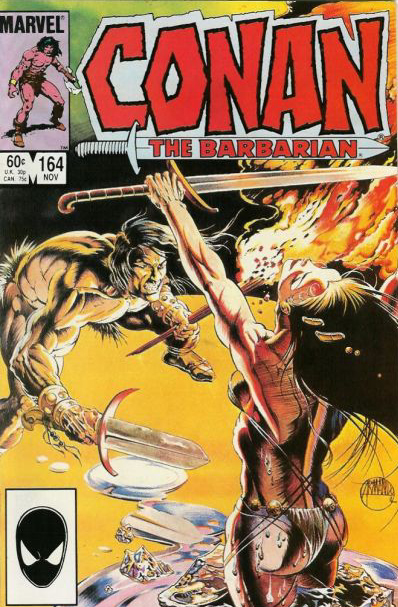
— A fill-in issue (#164) is dropped into the middle of the Fafnir arc without explanation, which goes about as well as would be expected. Larry Yakata writes a surprisingly hard-hearted, battle-weary Conan that is more in line with creator Robert E. Howard’s barbarian than Marvel writer Roy Thomas’s Code-approved interpretation. Yakata’s Conan is just as stupid as Thomas’s, though.

Conan the Barbarian #164 cover— The most interesting part of the fill-in issue is trying to figure out the engineering of the woman on the cover’s top. It’s an exotic design I’ve never seen in the real world, and I’m at a loss for how it could work. At first, I was confused about where the two straps on each side went after crossing her bottom, but I see one strap on each side goes down a leg and presumably is tied around her foot or calf. But then I realized there should be something pulling her top up — looping behind her neck, perhaps? — but there’s no evidence of that. How does it work?

— Ending the book on a cliffhanger — two, actually — is an intriguing idea. It gives readers a reason to return for The Chronicles of Conan, v. 22: Reavers in the Borderland and Other Stories, and it helps distinguish v. 21 from all the other Chronicles of Conan volumes. I think I will know what will happen between Conan, Fafnir, and Noirelle in Conan #168, but I’m not sure.

— Well, I think there are two cliffhangers; Conan the Barbarian Annual #7 ends abruptly, without resolving the plot. There’s no indication of where Thomas’s adaption of L. Sprague de Camp and Lin Carter’s novel Conan of the Isles will be continued. Based on Annual #7, the story probably shouldn’t be continued; the story has 33 pages, but it has only one moment of excitement and is notable only for Buscema’s best artwork in the book.

Rating: Conan symbol Conan symbol Half Conan symbol (2.5 of 5)

Labels: , , , , , , , , , ,

28 April 2012

Marvel Firsts: The 1970s, v. 1

Collects: Amazing Adventures #1, 11, and 18; Savage Tales #1; Marvel Spotlight #1-2 and 5; Marvel Feature #1, Marvel Premiere #1; Tomb of Dracula #1; Hero for Hire #1; Combat Kelly & the Deadly Dozen #1; Outlaw Kid #10; Gunhawks #1; The Cat #1; Shanna the She-Devil #1; and Monster of Frankenstein #1 (1970-3)

Released: January 2012 (Marvel)

Format: 392 pages / color (except one b-&-w story) / $29.99 / ISBN: 9780785163800

What is this?: The first issues of the hottest new comic books that early 1970s Marvel has to offer.

The culprits: Too many to list, but writers Roy Thomas and Gary Friedrich show up a lot, as does artist Mike Ploog.


Grab-bag books, like Marvel Firsts: The 1970s, v. 1, are a tough sell. I think most readers are looking for a book united by plot rather than looser themes, such as date or character. Still, I was looking forward to reading the stories included in Marvel Firsts.

I have read many of the stories before in the first volumes of Essential series: Killraven (Amazing Adventures #18), Tomb of Dracula (#1), Power Man (Hero for Hire #1), Ghost Rider (Marvel Spotlight #5), Defenders (Marvel Feature #1). Still, the other stories held some interest. The book, I hoped, would give a glimpse into how Marvel was trying to expand its line in the first few years of the 1970s.

The collection kicks off with Amazing Adventures #1, which seems as natural an idea as there could have been in the Marvel Universe at the time: a book with a Black Widow story and an Inhumans story. It’s a good start, too, with the Inhumans story written by Stan Lee and drawn by Jack Kirby; the Black Widow story is drawn by John Buscema. But from there, Marvel goes in a different direction; there are only three more straightforward superhero stories included: the Defenders in Marvel Feature #1, the Cat in The Cat #1, and Power Man in Hero for Hire #1, and even Hero for Hire isn’t a pure superhero title, as tinged as it is by the Blaxploitation genre.

Marvel Firsts: The 1970s, v. 1 coverThe two major genres Marvel was pushing into at the time were horror and westerns. On the horror side, Tomb of Dracula #1 started a long-running title, and it is the best story in the book; it’s hard to read the tale, with Gene Colan‘s atmospheric pencils, and not want to know what comes next. Monster of Frankenstein #1 is a less successful attempt to revive a 19th-century classic monster; whereas Tomb of Dracula leaps from the end of Stoker’s novel to the ‘70s, with Dracula being an active character in the book, Monster of Frankenstein is set at the end of the 1800s, and the monster is inanimate throughout. A quicker start would have helped generate interest. Rounding out the Universal movie monster troika is the Wolfman — well, “Werewolf by Night,” in Marvel Spotlight #2. It’s a competent story, playing on themes of family, curses, and the animal inside, but unlike Tomb of Dracula, it doesn’t have Colan’s art to balance its typically ‘70s wordiness.

Some might consider Ghost Rider a superhero (all right, he is), but his origin in Marvel Spotlight #5 is definitely a horror story — horrific deaths, Satanic rituals, a flawed deal with the devil, a curse … yep, that’s horror, no matter how nonsensical the plot is. I’m lukewarm on Mike Ploog‘s art, but the visuals are striking. Savage Tales #1 is a simple but satisfying black-and-white story featuring the first appearance of Man-Thing, written by Roy Thomas and Gerry Conway. (They also collaborated on Tomb of Dracula #1.) Marvel used the magazine format to get impressive art from Gray Morrow; I was familiar with Colan, but Morrow’s art caught me pleasantly by surprise. Conway so liked the idea of a scientist using a formula on himself to keep it from falling into the wrong hands that he used it again in Amazing Adventures #11, in which the X-Men’s Beast transforms himself into a hairy monster. Beast was a hero before his solo stories and a hero after he embraced his transformation, but this is a horror story — right down to a “what have I done?” moment.

The Western was back in the early ‘70s, but there was less variety in the content than there were in the horror stories. Your options were a conflicted Native American (Red Wolf in Marvel Spotlight #1), a former slave and slave owner teaming up (Gunhawks in Gunhawks #1), or a young white guy (Outlaw Kid in Outlaw Kid #10). As you might guess, the books with non-white protagonists are painfully earnest and at times a bit uncomfortable. For instance, Marvel Spotlight #1 is full of pseudo-Indian mysticism, with little to recommend it but the race of Red Wolf, its protagonist. I don’t doubt that some slaves, like Reno Jones in Gunhawks, were treated well enough they might fight against their own interests and hold no ill will against their former masters. But in the long term, it’s problematic — Reno is atypical, and his own self-image eventually has to reflect that. Still, the story of young gunslingers Reno and Kid Cassidy is the most entertaining of the Westerns, with some nice banter between the leads, and Reno and Kid are treated as equals. Outlaw Kid #10’s cover promises a “Western Spider-Man,” and it delivers: the young Outlaw Kid takes on corruption in his home town in a mask, making him seem like a criminal, against the wishes of his blind, pacifist father. It doesn’t catch the magic of Spider-Man, but that’s a high standard, and Outlaw Kid is mostly inoffensive.

Other genres in the book include war, jungle, and sci-fi comics. Combat Kelly and the Deadly Dozen, a Sgt. Fury spinoff, shows why war comics were on the way out, despite the cast’s racial diversity and the inclusion of a female soldier. (Of course, the cast is much too large, and the woman ties her uniform shirt at her sternum to expose her midriff.) Shanna the She-Devil is fine but seems mostly an excuse for George Tuska to draw exotic animals and a woman wearing a leopard skin swimsuit. (Shanna made the outfit herself from a leopard massacred in her zoo so that she could gain “sight-scent recognitions with [the leopard’s] cubs.” Grisly.) Marvel Premiere #1 is nearly as exciting as you would expect a sci-fi story featuring Adam Warlock and the High Evolutionary gabbing to be. Amazing Adventures #18 sets up Killraven’s War of the Words backstory with remarkable efficiency and imagination, although some of its trappings come across as ridiculous today (and I suspect did in 1973, as well).

You would think Marvel would hardly need an excuse to praise their diversity in genre, gender, and race. But they don’t, and that’s my biggest disappointment with Marvel Firsts. I wanted introductory essays. I wanted context. I wanted timelines, charts, figures — something to pull this disparate set of comics together. It didn’t have to be elaborate; it just needed to exist. There is a little provided; each issue gets a flat sentence or two about the title, date, and character (“Amazing Adventures #11, published in December 1970, switched focus from Black Widow and the Inhumans, becoming the first ongoing series for a heavily revamped Beast, formerly of the X-Men”). Between the chronologically ordered issues are pages showing the covers of Marvel’s contemporary new series, with a brief sentence about each (usually, genre, title, date, and whether it was a reprint series). Still, I would like to know more. When did these series end? How many issues did they last? Was there anything interesting about them — I mean, is there a good reason the cover of humor comic Harvey #1 looked like Archie with Marvel trade dress pasted on it? I’d be willing to pay a bit more for this, or Amazing Adventures #18 could have been shifted to Marvel Firsts: The 1970s, v. 2.

As a random slice of Marvel at one of its most diverse times, Marvel Firsts: The 1970s, v. 1, is pretty impressive. I haven’t harped on it, but it’s remarkable how many of the protagonists aren’t just the same old white guys; Black Widow was an established character who got her own series, and the Cat (later Tigra), Power Man, and Shanna the She-Devil were created for their series. At least three members of the Deadly Dozen were not white (and one was not male), and Reno Jones of Gunhawks and Red Wolf weren’t white either. Most of these characters fell flat on their faces — only Power Man kept his series for very long — but you have to applaud Marvel for trying.

It’s unfortunate that most of the art and writing in Marvel Firsts cannot match the best of Marvel at the time, but given that many of these titles shifted their emphasis frequently or were second-tier to begin with, it’s understandable the top talent weren’t assigned to these stories, and those who were weren’t inspired to turn in their top work. It’s also sad that Conan the Barbarian #1 couldn’t be included because of legal reasons (not that the book mentioned this). And I wish there would have been more context. But it’s not wise to focus on what isn’t here; what is here is a collection of frequently enjoyable stories — although occasionally that enjoyment comes from how badly the stories have aged (or how badly they were told in the first place).

Rating: 2.5 of 5 Marvel symbol Marvel symbol Half Marvel symbol

Labels: , , , , , , , , , , , , , , , , ,

05 August 2011

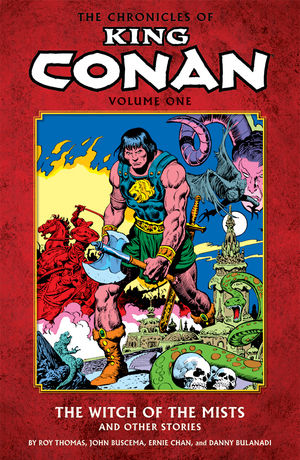
Chronicles of King Conan, v. 1: The Witch of the Mists and Other Stories

Collects: King Conan #1-5 (1980-1)

Released: August 2010 (Dark Horse)

Format: 192 pages / color / $18.99 / ISBN: 9781593074777

What is this?: Conan the barbarian is now the older Conan the king.

The culprits: Writer Roy Thomas and artist John Buscema

As we grow older, we learn things about ourselves. That we have an unexpected talent for cooking, perhaps, or that we’re never going to make it as a major-league shortstop, or if nothing else, that our abilities peak at some point during our youth, and only hard work will keep them from deteriorating in an alarming fashion. It’s a hard lesson to learn but a necessary one as we make the transition from youth to maturity.

In The Chronicles of King Conan, v. 1: The Witch of the Mists and Other Stories, however, writer Roy Thomas informs us that Conan never has to learn that lesson. He will always be at the top of his game, and he never truly reaches that mental maturity. Readers have been following Conan for 80 years — about 50 by the time the issues collected in King Conan came out — and in that time, the barbarian hero has changed little. You might expect that becoming king, with the responsibilities that entails, would change mighty Conan.

Chronicles of King Conan, v. 1: The Witch of the Mists and Other Stories coverYou would be wrong. Conan the King is the exact same character as Conan the Barbarian. True, Conan has an army behind him, and he has a son, but it has remarkably little effect on his behavior. And Thomas should know; forty years after Conan the Barbarian #1, v. 1, and Thomas is still the definitive Conan comic book writer.
King Conan begins with Conan’s son, Prince Conn, being kidnapped by a Hyperborean witch; King Conan decides to rescue his son alone. Fine; I understand that. But after the rescue and a battle in Zingara, Conan decides to take the fight and his army to Stygia, where Thoth-Amon, the architect of the kidnapping and unrest in Zingara, is hiding. That makes a modicum of sense, although Conan has always shown that a lone hero is better than an army when it comes to defeating wizards and monsters.

But Conan goes himself, and he takes along his heir, Conn. This, of course, is idiotic, as a non-dynastic king like Conan should return home to find his throne occupied and his wife (at best) exiled. Instead, Conan follows Thoth-Amon to the ends of the earth, heading farther and farther from his kingdom, each mile being one more he’ll have to travel on the way back. This is the way of the American action hero, I realize, to take care of such things by himself, but it’s not one of that archetype’s more endearing attributes. There is no cunning to this Conan, and less intelligence. He has no real plan, blundering farther and farther south and endangering his son and his men. I think the idea is that Conan is a pre-historic Alexander, putting the world under his boot, but there’s nothing to support that idea other than Conan’s continuing but illogical success and an inexhaustible supply of willing soldiers.

Conan, as a king, should be confronted with different problems than when he was an adventurer. But there’s no statecraft here or even large-scale battles, no intrigues or imperial entanglements. For some reason, no one engages his army or presents any challenge to them other than their intended adversaries; the countries he invades to fight these wizards don’t protest at all. Why should they? It’s Conan! There are a surfeit of wizards to kill, strange places to visit, usurpers to depose, and monsters to fight — just like before. Such a static world for a character like Conan.

Part of the problem is Thomas’s mania for adapting stories. Issues #1-4 are adapted from stories by L. Sprague de Camp and Lin Carter: “The Witch of the Mists,” “The Black Sphinx of Nebthu,” “Red Moon of Zembabwei,” and “Shadows in the Skull,” which were originally published in the ‘70s and collected in Conan of Aquilonia. Issue #5 starts retelling 1957’s Conan the Avenger, by Björn Nyberg and de Camp, in flashback. It seems odd that Thomas would let other authors choose his opening arc, especially an arc so problematic as those in Conan the Aquilonia. That’s not to say Thomas slavishly followed the original stories or that adapting stories is a bad idea; for instance, Thomas’s creation of Red Sonja was a result of adapting a non-Conan story by Robert E. Howard, “The Shadow of the Vulture.” And I understand that those four stories had the setup that Thomas wanted to start with. But I think using those stories at a later point would have been a better idea.

There are two redeeming points to King Conan. One is the book shows the maturation of Conn. His father is an impossible role model to live up to, but he tries anyway. He kills his first man in this book, and he gets a glimpse of true evil in Thoth-Amon. If Conan had sent Conn on a military campaign while Conan stayed at home, to get the boy some seasoning, this might have been a fascinating story, although it would have made it into Conan: The Next Generation. (Not that I would have minded.) The idea of telling the story of this prince maturing into a man is a good one; it’s just not what the book is about.

The second highlight is John Buscema’s art. Thomas is Conan’s definitive writer, and Buscema is one of the two most celebrated Conan artists. His Conan is much the same as it was in Conan the Barbarian — he has crow’s feet, and his hair is grayer, but he’s still strong as ever. His Conn is more realistic, strong for a teenager but obviously not Conan. Since the material is much the same as Conan the Barbarian, he gets to draw monsters and wizards and … well, not many scantily clad women, but there are some. Fans of Buscema’s Conan work will likely not be disappointed.

But they won’t be surprised, either. And that’s the problem with King Conan. Despite the change in premise, there is little to discover that you can’t find in Dark Horse’s Chronicles of Conan series.

Rating: Conan symbol Half Conan symbol (1.5 of 5)

Labels: , , , , , , , ,

31 May 2011

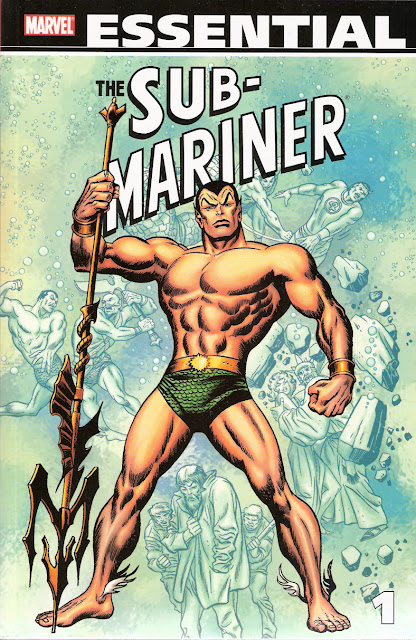
Essential Sub-Mariner, v. 1

Collects: Tales to Astonish (Namor stories only) #70-101, Daredevil #7, Tales of Suspense #80, Iron Man & Sub-Mariner (Namor story only) #1, and Sub-Mariner #1 (1965-8)

Released: September 2009 (Marvel)

Format: 504 pages / black and white / $19.99 / ISBN: 9780785130758

What is this?: Prince Namor deals with love and challenges to his oft-neglected throne. Imperious Rex!

The culprits: Writers Stan Lee, Roy Thomas, and others and artists Gene Colan, Bill Everett, and others

I picked up Essential Sub-Mariner, v. 1 because I had a big old Namor-shaped hole in the middle of the heart of my Silver Age library, and I was excited to fill it. Turns out, I would have been better off having open-Silver Age surgery.

Namor the Sub-Mariner, prince of Atlantis, is not a Silver Age creation of Stan Lee and his talented group of co-creators; Namor was created in the Golden Age, back in 1939 by Bill Everett. Lee, never one to let a good idea go fallow, picked up Namor in Fantastic Four #4 (not reprinted here) and plopped him into the new Marvel Universe as a major player, giving him his own kingdom (Atlantis) and an unrequited romance with Sue Storm. Both Namor’s desires to conquer the surface world and / or bed Sue Storm were both pushed to the side after a few years, about the time Namor got his own feature in Tales to Astonish.

Essential Namor, v. 1 coverWhat Essential Sub-Mariner collects is the Namor stories from Tales to Astonish; the title had formerly been an anthology series and had been converted, like Strange Tales and Tales of Suspense, into superhero comics featuring two different heroes in their own tales. Namor shared Astonish with another headstrong brute, the Hulk, but the two never met in the title they cohabited. If they had, they would have made Tales to Astonish the most redundant title of redundancy.
Hulk and Namor are surprisingly similar characters. Namor might not be a green, gamma-irradiated brute, but he is a hot-headed thug whose answer to most problems of statecraft is to punch something. This is not a problem — Sir Punch-a-Lot is a character note that a lot of superheroes have carried off gracefully — but it doesn’t do a lot of favors to the character either, since it doesn’t set him apart from the pack.

What is interesting and unique about Namor? The Atlantean setting is the only unique part of Namor stories, although he shares the weight-of-leadership character note with Black Panther. To me, the latter is the more interesting, as “Atlantean” is generally portrayed as “fighting sharks and submarine monsters,” and Namor also has the burden of being a half-blood prince. He is half human, half Atlantean, and it would be understandable if many of his subjects found a prince of “impure” blood unacceptable.

But that’s not goes on Sub-Mariner; instead, Namor is nominally the ruler of Atlantis, while he spends almost as much time on dry land as he does in Atlantis. He is overthrown by Warlord Krang and Byrrah; he is challenged by the barbarian leader Attuma. He turns into a tyrant on one of the occasions he is returned to the throne. Does he have to politick? Do the people have any say about who rules them? (Well, they do when Byrrah takes over, and Namor’s lack of empathy with his people is brought out.) But mostly Atlantis is a waterlogged Banana Republic, with revolutions and counter-revolutions happening almost daily. It’s almost enough to make one’s head spin.

One gets the feeling that Lee is plotting by the seat of his pants and not doing as well as he usually did. The twelve-page stories don’t help, but the stories switch between multi-part stories (as in Namor’s pursuit of Krang and his estranged love, Dorma) and throwaway stories — insults from the surface world, another challenger for his kingdom, etc. Without a prolonged emphasis on what makes Namor different, it all runs together. Roy Thomas’s attempt to build some interest in Namor by exploring his origin, which serves as a cliffhanger for the book, isn’t enough to to hook me. (So to speak.)

The art is an interesting mix, although none of them get across the underwater element of Atlantis very well. Bill Everett, who created Namor in the Golden Age, drew several issues, and his art, although updated, resembles comics from World War II more than those of his younger colleagues. An issue or two from Jack Kirby, king of the Silver Age (and, to some, all comics), shows a contemporary look for the prince of Atlantis. About half the issues are drawn by Gene Colan, though, and that’s a welcome sight. Colan isn’t the artist he would be later in his career when he drew Daredevil and Tomb of Dracula with such a shadowy flair, but he’s very good, and and his work here is a harbinger of the Bronze Age to come. Whether it’s right for Namor is another question, but by the end of Essential Sub-Mariner, it’s certainly very pretty to look at.

The timing of the Essential Sub-Mariner’s release is almost assuredly a sign it is regarded by Marvel as a book for completists. While the almost all the other prominent Silver Age titles (with the exception of Nick Fury, Agent of SHIELD and Howling Commandos have at least one volume out and usually many more, Namor is bringing up the rear — trailing behind the Human Torch and Ant-Man, for Heaven’s sake. The forgettable contents of Essential Sub-Mariner do nothing to dispel that impression.

Rating: Marvel symbol Half Marvel symbol (1.5 of 5)

Labels: , , , , , , ,

18 March 2011

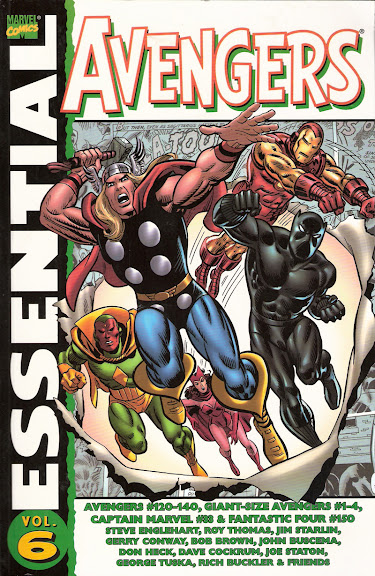
Essential Avengers, v. 6

Collects: Avengers #120-40, Giant-Size Avengers #1-4, Captain Marvel #33, and Fantastic Four #150 (1974-5)

Released: February 2008 (Marvel)

Format: 576 pages / black and white / $19.99 / ISBN: 9780785130581

What is this?: Kang tries to decide who the Celestial Madonna is; Mantis, the Vision, and the Scarlet Witch learn their origins; Zodiac and Thanos attack.

The culprits: Writer Steve Engelhart (with help from Roy Thomas and Gerry Conway) and art by Sal and John Buscema, Bob Brown, George Tuska, Rich Buckler, Don Heck, Dave Cockrum, and Tom Sutton

Having bought GIT Corp’s DVD-Roms of several Marvel series — Fantastic Four, Uncanny X-Men, Captain America, Amazing Spider-Man — I don’t have much use for Essentials featuring these characters. Which is fortunate, because Marvel seems like it isn’t all that interested in putting out new Essentials.

Unfortunately, these DVD collections, which have more than 40 years of comics and annuals, have one major flaw: they don’t include the Giant-Size series Marvel put out in the ‘70s. Now, I’ve read most of the Giant-Size Spider-Man, and there’s nothing that essential in them (although they can be enjoyable). And all you really miss in the Giant-Size Fantastic Four is Madrox the Multiple Man’s origin in #4. Fortunately, Giant-Size X-Men #1, which has the debut of the All-New, All-Different X-Men and is probably the most important Giant-Size issue, is included with the X-Men DVD-Rom. But the Giant-Size Avengers are important too, and they are left out of 40 Years of the Avengers.

Essential Avengers, v. 6 coverSo I purchased Essential Avengers, v. 6, which included all four issues of Giant-Size Avengers. Avengers, v. 6, also has another distinction among Essentials that makes it, if not unique, then very unusual: the issues collected in this book make up one storyline. That is, Essential Avengers, v. 6, makes an acceptable alternative to the Celestial Madonna Saga trade paperback, and it gives almost a year’s worth of issues that precede Celestial Madonna and a half year’s worth that follow the storyline. For these extra issues, you sacrifice color, but that’s a small price to pay.

One would expect a story that features the “Celestial Madonna” to have a long-lasting effect on the Marvel Universe — or at least the Avengers. But the most important event is the marriage of the Scarlet Witch and Vision; admittedly, that’s a pretty important moment, but neither of them are the Celestial Madonna. That honor goes to Mantis, a Vietnamese orphan who is trained by pacifist Kree monks after her uncle kills her mother and blinds her father. As with most storylines that revolve around the birth of a child unconceived, there has been little to no payoff from Mantis’s role. Mostly, the Celestial Madonna story is a time war vs. Kang, who returns again and again to kidnap Mantis and mate with her.

Oh, Kang. It doesn’t take much to get bored with Kang in this volume, despite writer Steve Englehart’s efforts. Why? Because Kang is the master of time, and his answer on how to use this temporal advantage is to steal dead heroes and villains out of the time stream and bring them to Limbo. Why use dead people? Who knows? Since he gains mental control of his new warriors, he could choose anyone — he could even steal future or past versions of the Avengers out of the time stream, which would at least make it an even fight. But no, he decides to create his Legion of the Unliving, none of whom, strangely, had died in their personal timelines yet. Kang’s other gambit include superrobots, Avenger-powered superrobots, and invading the present from several different points of his personal timeline simultaneously. This last is, at least, a good use of his advantages, but since his other versions seemed to have invaded from his Girl Scout days, anyone can beat them.

Once you get past a baby that won’t be born until after the book ends and a Kang who literally cannot even beat himself in a fight (and how could he, since he was outnumbered by himself two to one?), what do you have? Well, Giant-Size Avengers #4 has one of the oddest endings of any Avengers story outside Avengers #200: a half-Vietnamese, half-German girl who always talks of herself in the third person marries an alien tree who’s taking the form of her dead boyfriend, which takes her into space and will later impregnate her with the universal Messiah. Meanwhile, in the background, a mutant marries an android in a double marriage ceremony officiated by the future version of the supervillain the team just defeated (who also does not seem to have any real credentials that would allow him to perform marriages).

I wish I could say there were other parts of the story that rose to those heights, but that’s it — it’s hard to get that strange consistently, but other than the Legion of the Unliving, Essential Avengers doesn’t consistently rise to any notable level of insanity, nor does it get that exciting. “Celestial Madonna” is not exactly a disappointment, but it’s not a seminal Avengers story, despite its memorable name. The romantic tangle between Vision, Scarlet Witch, Swordsman, and Mantis is predictably resolved. This volume is also notable for the beginning of Vision’s confusing backstory; his body is that of the World War II android the Human Torch, a revelation that utterly fails to be interesting. The Scarlet Witch has an odd subplot with developing her “magical powers.” The Avengers have no problem operating in South Vietnam, which is a bit disorienting, but the issue was published just before North Vietnam won the war and unified the country under Communist rule.

The material that precedes the Celestial Madonna story is interesting as a snapshot of early Bronze-Age Avengers. The stories feature Zodiac, the revelation of who the parents of the Scarlet Witch and Quicksilver are (later revealed as false), the marriage of Quicksilver and the Inhuman Crystal, and the bizarre beginning of the Scarlet Witch’s training in witchcraft by Agatha Harkess (based, apparently, solely on the Scarlet Witch’s name). A battle with Thanos is a distraction —Captain Marvel #33 includes literally three pages of dense recap on Thanos’s history, which isn’t conducive to narrative flow — that comes to nothing, especially since it doesn’t end Thanos’s story as definitively as it pretends. And what comes after the Celestial Madonna heads into space is interesting as well; the introduction of new members Beast and Moondragon gives the team exciting new dynamics, despite the return of the slappingest, insanest Avenger, Hank Pym.

The art in Essential Avengers, v. 6, is top notch. The Buscema brothers provide the plurality of the art, with Sal penciling more than his brother John. Other pencilers include George Tuska, Dave Cockrum, Bob Brown, Don Heck, Rich Buckler, and Tom Sutton — a distinguished roster that needs no praise from me, however much it deserves it.

Despite the many interesting parts of Essential Avengers, v. 6, I think the main appeal is getting all four Giant-Size Avengers issues in one volume. There are other attractions — and I have to emphasize, the book is drawn by a lot of great artists who do not clash in style — but Marvel’s Giant-Size line is sadly neglected in reprint form. Englehart fans will find much to enjoy, as will those who like comic-book weddings — three in one volume, none of whom are married today!

Oh, and those who enjoy the thought of alien plants having consensual sex with human women will also find this appealing. You know who you are.

Rating:  symbol  symbol  symbol  symbol (3.5 of 5)

Labels: , , , , , , , , , , , , , , , ,

30 July 2010

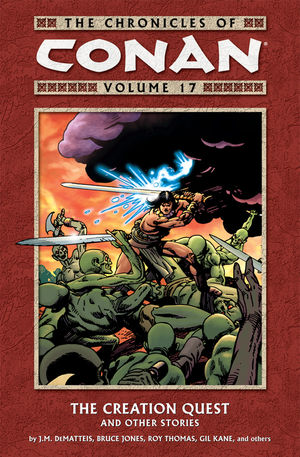
Chronicles of Conan, v. 17: The Creation Quest and Other Stories

Collects: Conan the Barbarian #127-34, Conan Annual #6 (1981-2)

Released: April 2009 (Dark Horse)

Format: 240 pages / color / $17.95 / ISBN: 9781595821775

What is this?: Conan wanders through a world filled with magic, evil men, and scantily clad women.

The culprits: Writers J.M. DeMatteis, Bruce Jones, and Roy Thomas and penciler Gil Kane

The Chronicles of Conan, v. 17: The Creation Quest and Other Stories is significant in a negative way: it’s the first volume of the Chronicles of Conan series without an issue of Conan the Barbarian written by Roy Thomas or dawn by either Barry Windsor-Smith or John Buscema.

Instead, we get J.M. DeMatteis wrapping up his run, which started in v. 15 , Bruce Jones starting his run, which lasts until v. 19, and art by Gil Kane.

Chronicles of Conan, v. 17: The Creation Quest and Other Stories coverThis lineup does not exactly inspire confidence. DeMatteis’s introduction, in which he says, “I finally realized … the kinds of stories I wanted to tell were best suited to other venues,” doesn’t help matters either, nor does his admission that he was unable to deliver stories that pleased Buscema — they didn’t meet Buscema’s ideal of what Conan stories should have in them. Now, Buscema is just one man, and he didn't own the character, but I think he does have a pretty good handle on what makes Conan tick.

Although he doesn’t contribute to this issue, Buscema’s indictment of DeMatteis’s Conan writing seem to be borne out here. The first issue, #127, feels like a half-baked reversal of Robert E. Howard’s Conan story “The Frost Giant’s Daughter” (adapted in Conan the Barbarian #16); a magic spell animates snow and ice into a magical totem for a village, but the spell has human form, forgets it’s a spell, and escapes to find love with Conan. And it has the dumb name of Xean. I admit, the reversal is nice — the cold woman of snow flees from her protectors and toward Conan — but the idea of the sentient, amnesiac spell is never developed, buried beneath action sequences: Conan fighting a polar bear! Conan fighting Vanirmen (as he did in “Frost Giant’s Daughter”)! Conan fighting Vanirmen again! And then it ends, with a priest telling Conan why the story ends, not that either he or we could have figured it out.

DeMatteis does try a more traditional Conan story in #128-130, a quest story in which Conan must pay an old friend’s ransom with treasures stolen from around the world. It’s a bit lackluster, however; the old friend’s wife teleports Conan into and out of danger, removing a good deal of tension, and the resolution of the story is a superhero cliché transported into Hyboria for the amusement of the locals. The end revelation that the friend, his wife, and their kid are essentially gods doesn’t help either, although it does give Conan a chance to repudiate his friend’s power creep: “I find … I have unleashed yet another god upon a world that has seen too many gods already. … I will long remember what you were — and try to forget what it is you’ve become!” It seems a rare true and original character note for Conan in DeMatteis’s work in this volume that he would distrust a friend, even a childhood one, once he learns the friend is more than human — because he is above the simple pleasures of mankind.

Jones’s work, on the other hand, is in keeping with the spirit of Conan; Buscema would later work with Jones on Conan. Issue #131 is a smart adventure story with a cursed ring, and even though the ending is contrived, it does signal a return back to direct stories with a sharper edge. The next issue’s setup isn’t exactly in keeping with Conan’s usual endeavors — he competes in deadly Olympic-style events to win a valuable sword — but even though Conan doesn’t really think much during the story, it does give him a chance to show his sense of fair play and his appetite for drink. The final two Jones issues are CSI: Hyboria, in which Conan solves the mystery of who cursed the princess, the gypsy’s true identity, and how to save an innocent woman from a death trap. In the latter, Conan’s helped by a bit of deus ex serpentia, but it is Hyboria: gods do occasionally pop out of the woodwork to help. Although you shouldn’t be able to have lunch with them.

When I said Roy Thomas doesn’t write any issues of Conan the Barbarian for this volume, that’s only technically true: Thomas does contribute Conan Annual #6. It’s Thomas nearing the end of his Conan stories, with a padded story that shows it was probably for the best he stopped writing Conan for most of the ‘80s. The story has a normal-length, single-issue kernel at its center: a man thinks he’s a conqueror reincarnated, and megalomania ensues. Thomas adds in giant spiders (who disappear early), a mistress and a wife (not as exciting as they sound), and Technicolor demons, but they all fall flat. With an artist like Buscema or Windsor-Smith going nuts on the art, perhaps it could have been something; instead, the art is drawn and inked by Gil Kane.

Kane was a very good artist who did a lot of superhero work for Marvel and DC; he even did a few fill-ins on Conan the Barbarian for Buscema and Windsor-Smith. Unfortunately, Kane is not Buscema or Windsor-Smith. That’s not a crime on most titles, especially on superhero titles that change artists regularly. But this is Conan; the title had, for more than a decade, been drawn with attention to detail and dynamic characters. Kane falls short on both of these counts. He inks himself on the DeMatteis issues and the annuals and comes across as an unfinished imitation of Windsor-Smith; when inked by others, there’s a marked improvement, although there’s still something lacking. Issue #134 was his last Conan for a while, and I think that was for the best. Like DeMatteis, his best work — which is pretty good — is elsewhere.

I have to give Dark Horse a great deal of credit: they’ve made a reprint series run for twenty volumes (Chronicles of Conan, v. 20: Night of the Wolf and Other Stories, which amusingly features Conan riding a giant dragonfly on the cover, is due out October 13). They don’t skip bad issues; they reprint all the issues they have the rights to without prejudice. The completists in me loves that, but in a practical sense, that means there are the occasional volumes like The Creation Quest. Buscema is back for v. 18 (Isle of the Dead and Other Stories), so anyone reading this volume can write it off as lackluster and buy the next one with optimism.

But for anyone but completists or Bruce Jones fans: skip this volume.

Rating: Conan symbol Half Conan symbol (1.5 of 5)

Labels: , , , , , , , , , ,