


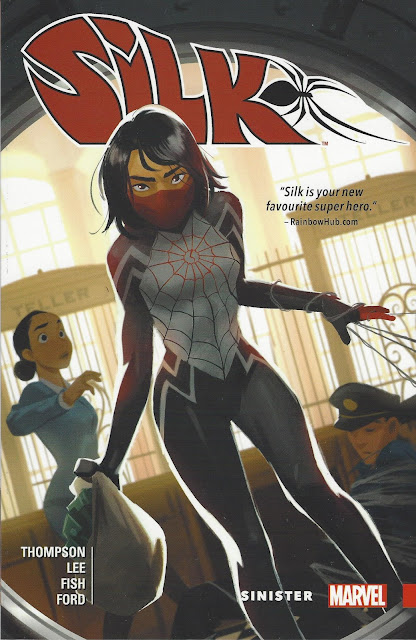
Silk, v. 1: Sinister
Collects: Silk #1-6, story from Amazing Spider-Man v. 4 #1 (2015-6)
Released: April 2016 (Marvel)
Format: 144 pages / color / $19.99 / ISBN: 9780785199571
What is this?: Silk goes undercover for SHIELD inside Black Cat’s organization as the Black Cat accumulates technology and battles against Goblin Nation while she also works for the Fact Channel and looks for her parents.
The culprits: Writer Robbie Thompson and artists Stacey Lee, Tana Ford, and Veronica Fish
I’ve been trying to write this review for a few weeks now, and I just haven’t been able to put my thoughts down. But now that I’ve published my review for Spider-Gwen, v. 1: Greater Power, I feel I have to review the latest title from the other female-led new-character series that came out of Spider-verse: Silk, v. 1: Sinister.
The review hasn’t been hard for me to write because I don’t know what I thought of the book. I enjoyed Sinster, just as I enjoyed the first volume of Silk (confusingly numbered v. 0). Silk is a solid series; it’s a series I’ll continue to read, although I’m not sure I’ll be excited about it.
 Silk … I don’t know. Silk has lost its new car smell, but it’s reliable and can still surprise me at times . I expect to have Silk for a long time, and I expect to remain satisfied by it. But it’s a little disconcerting how quickly how quickly it’s gone from invigorating to a solid performer.
Sinister picks up eight months after v. 0. I was concerned Silk would abandon some of the changes made at the end of The Life and Times of Cindy Moon because of Secret Wars, but I needn’t have worried. Cindy Moon has been promoted at the Fact Channel, where she works for the gruff-but-caring J. Jonah Jameson. Cindy is still looking for her parents, but she has found her brother, who’s seeking treatment after his memory loss. Cindy’s heroic identity, Silk, appears to be working for crime boss Black Cat, but that is revealed (in the first issue, so no real spoilers) to be an undercover gig for SHIELD. Since Cindy’s brother was previously affiliated with Goblin Nation, Silk has a vendetta against the green-faced tribe of kids and young punks.
Writer Robbie Thompson has established a status quo that is nearly ideal — a classic Spider-Man status quo without being obvious about it. The balance between Cindy’s personal life and work life and between Silk’s heroism and her selfish desires are fascinating. Cindy is obviously trying to fit too much into her life, but that’s what heroes do, right? And Thompson does as good job of showing that Cindy’s suffering from her attempts to run in four different ways at once; her behavior, her friends’ reactions, and her sessions with her psychiatrist all show someone who is beginning to fray.
The supporting cast is excellent, with Cindy’s work friends serving as a nice counterweight to Silk’s allies and rivals. Jameson’s faith in Silk is as touching as it is surprising. Peter Parker returns to offer his ten cents of advice; a wise choice, as Peter’s appearance serves to link the book’s continuity to the pre-Secret Wars stories and shows why Peter probably won’t be showing up very often going forward. Thompson even uses Killer Shrike, who works for Black Cat. Killer Shrike! Silk also has a mystery ally, Spectro (named only in the sketches at the back of the book), who seems primed to be the Angel to Cindy’s Buffy.
I’m not sure about Spectro; he’s mysterious without having a character. I’m really not sure about using Spider-Woman (Jessica Drew), though. Jessica presents herself as a mentor figure to Silk — they have regular brunches — but Cindy already has more effective adults she can work out her issues with: Mockingbird, who is her SHIELD partner / handler, and her psychiatrist. My resistance to Jessica’s presence may be because the two characters met in the Spider-Verse crossover, and I’m opposed to anything that reminds me of that crossover. It may also be because Jessica serves as mentor to Spider-Gwen, and I think Silk and Spider-Gwen should be differentiated as much as possible. Mostly, though, it’s the redundancy that bothers me.
I like Silk being a superhero who visits a psychiatrist, and every panel with Jessica is one that can’t be used on one of Cindy’s sessions with Dr. Sinclair. In an era in which thought bubbles and narrative text boxes have gone out of style, it’s nice that Thompson has given Cindy someone to whom she can admit her darker thoughts, her true thoughts, without fear of repercussions. (Well, there could be repercussions, but Cindy doesn’t think there will be.) That doesn’t mean she blurts out what she thinks to Dr. Sinclair; she’s still concerned about what her feelings say about her true character, as anyone would be.
I’m not convinced by Black Cat’s full transformation to ultra crime boss. Thompson has set her up as a major crime lord, one who has the resources to create an antidote to the Goblin serum. Even given that Cat has been back to being a criminal for maybe a year, Marvel time, that’s not really believable. The Goblin serum is a hard nut to crack; Spider-Man had a great deal of difficulty doing that. But Black Cat’s scientists — seen only on one page — manage to not only come up with a cure with no side effects but to aerosolize it. I’m not sure how Black Cat, a character who was a lone operator for so long, gets to build an organization like that. I can see her intimidating a small crew, but a large operation … ? Well, I suppose this is a small quibble, and my skepticism might be unfounded. After all, a year seems like a short time to build what Black Cat has, but it’s a long time in the Marvel Universe.
I love Stacey Lee’s art, and I’m sad she doesn’t do more than the first issue (plus the story from ASM). Lee’s art is fluid and clear; she has no trouble making Cindy stereotypically cute while making the Goblin Nation thugs creepy. She even (almost) makes Mockingbird’s mask look normal, which is something that Giuseppe Camuncoli completely failed to do in Spider-Man: Worldwide, v. 1. What causes a goblin glider to fail during Silk’s battle with Goblin Nation could be clearer, though.
Tana Ford’s art doesn’t match the tone Lee established in #1 and in Life and Times. Everyone Ford draws looks disheveled; everything feels unpolished and rough. Her wobbly faces look like their features are all going to start rolling away in opposite directions. (Also, Ford’s Mockingbird at the beginning of #6 looks incredibly like Songbird from Thunderbolts, which caused me to do a double-take.) Ford’s style could work for a different title, but Lee has established Silk’s look as the complete opposite. If I knew Ford was taking the title over full-time, I could get used to that — I’d have to, I suppose — but Ford draws only three issues (#2-3 and #6). Issues #4 and 5 are drawn by Veronica Fish, whose style fits wonderfully with Lee’s.
Silk is a title with a lot to like, although I admit I have to sit down and make myself write my thoughts out for me to really see it all. I have a feeling my enthusiasm for each future volumes will have a lot to do with who the artist is and how much the stories involve other Spider-women.
Rating:

 (3.5 of 5)
 Labels: 2016 April, 3.5, Black Cat, Killer Shrike, Marvel, Mockingbird, Robbie Thompson, Silk, Spider-Woman, Stacey Lee, Tana Ford, Veronica Fish
posted by Raoul | 7:03 PM
|
0 comments


 I also like the art of David Ross, who drew #93-5, 98-100, and 102. He shows excellent attention to detail, and action scenes are easy to follow. Unlike many of his contemporaries, his females aren’t gratuitous sex objects. Most impressively, he draws excellent demons; his Mephisto is nice, his Satannish is intimidating, and Raksasa — the only one of the three he designed — is truly impressive. In an era when Marvel’s demons tended toward Technicolor goblins of varying sizes, Raksasa is an alien, frightening, insectoid presence. With this facility for monsters, Ross would have been great on Conan, Marvel’s other Roy Thomas title. (He would have been wasted there, but he was wasted on AWC as well.)
 (1 of 5)