Reviews of trade paperbacks of comic books (mostly Marvel), along with a few other semi-relevant comments / reviews.

30 July 2016

Avengers: Scarlet Witch by Dan Abnett and Andy Lanning

Collects: Scarlet Witch #1-4, Avengers Origins: The Scarlet Witch & Quicksilver #1, and stories from Marvel Team-Up #125, Solo Avengers #1, Marvel Comics Presents #60-3 and 143-4, and Mystic Arcana: Scarlet Witch #1 (1994, 2012; 1983, 1988, 1990, 1993-4, 2007)

Released: April 2015 (Marvel)

Format: 232 pages / color / $24.99 / ISBN: 9780785193357

What is this?: Wanda battles a counterpart from an alternate world in the main story, then encounters a bunch of forgettable obstacles in the rest.

The culprits: Writer Andy Lanning, Dan Abnett, and many others; artist John Higgins and others


I’m a little behind on my reading, so I’m going to dig into my reading history and bring up Avengers: Scarlet Witch by Dan Abnett and Andy Lanning. And just to be clear: that’s a metaphorical digging, not a literal one. Scarlet Witch isn’t so bad that I’d literally bury it in the earth to protect myself and others from its contents.

I mean, it’s not Luke Cage: Second Chances.
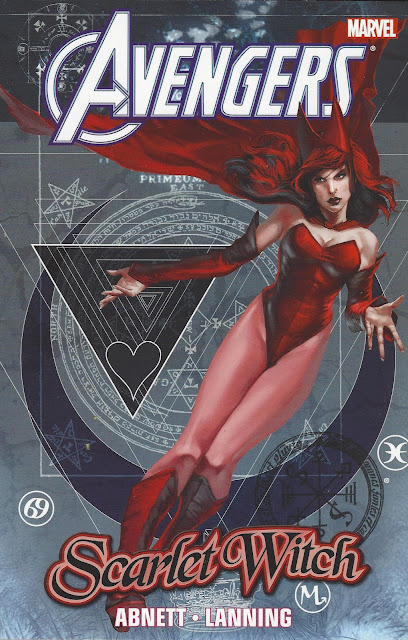
Avengers: Scarlet Witch coverScarlet Witch is a bit of a mess, though. The Scarlet Witch — Wanda Maximoff to her friends — is a character with a complex history, but this volume addresses little of it. The collection is built around the Scarlet Witch limited series from 1994, but “limited series from 1994” gives you a good idea of that title’s level of quality. The rest of the book is made up of non-feature stories from a couple of ‘80s titles, Marvel Comics Presents serials, a continuity implant focusing on Wanda’s mysticism, and a story that tries to present a coherent origin story for Wanda and her brother.

Let’s start, then, with the Scarlet Witch limited series; the book does, after all. Despite the title, the four issues are writers Dan Abnett and Andy Lanning’s only contribution to the book, and it’s not their best work. The Scarlet Witch has to battle Lore, an alternate version of herself. Like Wanda, Lore is a Nexus Being, someone who serves as the anchor of their reality. Each Nexus Being has a different flavor of power; while Wanda uses her hex powers, Lore is a necromancer. After exhausting her world, she went to other dimensions, using their nexus beings to exhaust that dimension’s resources. When Lore fixes her attention upon the 616 Universe, she frees Master Pandemonium, who has become “romantically” fixated on (read: stalkerishly obsessed with) Wanda, to help her defeat the Scarlet Witch.

What results is standard ‘90s chaff. The plot has no lasting consequences, which is a bit of a shame: of all the interdimensional meddling the Marvel Universe has had over the years, this one would help explain Wanda’s more destructive forays over the past two decades. The issue count is padded, and the story is more confusing that it has to be. The art by John Higgins is occasionally slick but often soulless, with plastic figures standing around. (As this was a ‘90s limited series, it will not surprise you that the women’s poses accentuate their, ah, assets.) Higgins does do a decent job with Wanda’s Avengers West Coast teammates, whom Lore transformed into monsters to battle Wanda.

Are Abnett and Lanning trying to elevate the limited series above the standard Marvel miniseries? The plot is inconsequential, and as a character exploration, it’s thin. But the story hints at something more consequential than an interdimensional madwoman behind this nonsense. The abandoned town of Unity and the catacombs under them in #1 and 2 have definite Lovecraftian touches, but those elements are abandoned in later issues for a Marvel Universe superhero battle with slight horror touches. I can’t decide whether Abnett and Lanning tossed the Lovecraft hints or whether they tried to develop them further, but either they or Higgins failed to make them more obvious.

So the limited series is, at best, a missed opportunity. The rest of the collection is an opportunity to take a nap.

The two stories that follow Scarlet Witch seem randomly chosen. The one from Marvel Team-Up #125 is a six-page back-up in which Dr. Strange could have literally teamed up with anyone, since Strange does all the work. Solo Avengers is a story more about death than Wanda, who briefly battles an incarnation of death until the person for whom she’s fighting decides she loves the current incarnation. (The story references Marvel Fanfare #6, which might have been a better choice to reprint than some of the others.)

The Marvel Comics Presents stories are forgettable. In MCP #60-3, an anti-mutant scholar catches Wanda off-guard and sends her spirit back in time to the body of her 16th-century pirate ancestor, Red Lucy Keough. (Does Lucy look exactly like Wanda? Of course she does!) Although a pirate tale could be interesting, the story doesn’t have enough room to do anything innovative, exciting, or unusual. MCP #143-4 was also reprinted in Avengers: The Death of Mockingbird, which is a curious decision, given that the murkily drawn story of demons and computers didn’t deserve to be reprinted once.

The last two stories are better fits (and better stories) than what came before. Mystic Arcana: Scarlet Witch tells the story of Wanda’s first encounter with magic: she’s introduced to a scantily clad coven of witches that features Margali Szardos, Nightcrawler’s not-yet stepmother; Maria Russoff, Werewolf-by-Night’s wife; and Lilia Calderu, witch-queen of the gypsies. The story is a continuity implant, of course, with Wanda getting a brief glimpse at the mystic life that she would eventually dabble in. The story is full of mystic doodads like the Serpent Crown, Darkhold, and the Book of Cagliostro, and the witches battle sorcerers Damballah and Taboo. Frankly, the story does more to set up Werewolf-by-Night’s origin than the Scarlet Witch’s. It does establish the dark god Chthon’s interest in Wanda, though, if you’re interested in that.

The collection is capped by Avengers Origins: Scarlet Witch & Quicksilver. It retells the story of the Maximoff twins from the day they were almost murdered by an angry mob but rescued by Magneto to the day they joined the Avengers. The issue does a good job of recapping the story for readers don’t know it, but it’s inessential if you are familiar with the bare bones of the story.

Oh! And if you miss the ‘90s, the book includes a bunch of Scarlet Witch pin-ups from the Marvel Swimsuit specials from the early part of that decade. You’re welcome.

I can appreciate that organizing the book is a bit difficult for the reprint editor, Mark D. Beazley. The Scarlet Witch limited series is the most coherent, longest story in the collection, so it’s logical that it leads off the book. On the other hand, readers would probably benefit from putting the limited series last: it’s the last story in continuity, and it’s nearly the last in publication order, with the two stories published later than the limited series (Mystic Arcana and Avengers Origins) being set much earlier in continuity. But if the limited series were at the end, who would read through the filler in the middle to get to it?

I can appreciate why Marvel might have thought to publish this book, but in retrospect, the decision seems like a poor one. Even if they’d renamed it to something to suggest the obscurity of some of these pieces — Scarlet Witch Rarities, or Scarlet Witch Archives — and de-emphasize writers who provide less than half the page content, only the limited series really has any reason to be reprinted. Cutting the price and including only the limited series and one other story — I’d choose Avengers Origins — would have made the book more attractive and would have made the title more accurate. Adding more material and keeping the price commensurate with the page count has made the collection much less appealing.

Rating: Avengers symbol (1 of 5)

Labels: , , , , , , , , , ,

08 April 2016

Avengers West Coast: The Death of Mockingbird

Collects: Avengers West Coast #92-100, 102, Spider-Woman #1-4, and selections from Marvel Comics Presents #143-4 (1993-4)

Released: January 2016 (Marvel)

Format: 384 pages / color / $34.99 / ISBN: 9780785196891

What is this?: The Avengers West Coast fight Dr. Demonicus, the Lethal Legion, and the Power Platoon before disbanding; Spider-Woman learns the machinations behind her acquisition of powers.

The culprits: Writers Roy and Dann Thomas and artists David Ross, Andrew Currie, John Czop, Steven Ellis, and others


The first thing you need to know about Avengers: The Death of Mockingbird is that the title is a lie, a total lie, and Marvel knows it. Heck, by now, everyone knows it.

I suppose you can pull the Obi Wan route and say it’s true, from a certain point of view. But people who say that are, generally speaking, liars or weasels. It wasn’t Bobbi Morse, whom the Marvel Universe knew as Mockingbird, who died in Avengers West Coast #100; it was a Skrull taking her place. (As revealed years later, Bobbi was replaced during Avengers West Coast #91, which is reprinted in the Avengers: Ultron Unbound collection.)

Avengers: The Death of Mockingbird coverAnyway, that’s for the best, because Mockingbird’s death is unsatisfying. A long-time Marvel character who was getting back together with her husband, Hawkeye, Mockingbird was killed saving him from a stray spitball tossed by Mephisto. The death seems random, something in the “kill someone for shock value” line of superhero deaths — it was an anniversary issue, after all. Mockingbird had just saved Scarlet Witch and Hawkeye, but her death seems more random than heroic; Mephisto didn’t have any specific hatred for her, didn’t even seem to be aiming at her. Anyone could have died. It just turned out to be Mockingbird.

The whole book feels of random — no, “unsettled” is a better way of putting it. Death begins with U.S. Agent and Hawkeye (calling himself Goliath at the time — just another bit of evidence that something is off) squabbling among the ruins of their headquarters; Scarlet Witch and Spider-Woman each go off to find less destroyed housing, and the Living Lightning leaves the team. The AWC doesn’t even have a quinjet, having to beg one from Stark Industries a few issues later. Everything feels like it is falling apart; ten issues later, the West Coast HQ is still rubble, and team has been officially ended.

The stories in Death don’t help; they’re not very good, first off, and the team never seems to regroup. The Demonicus storyline takes a previous story, in which the not-at-all-suspiciously-named Dr. Demonicus created an island nation in the Pacific, and removes any sense of complexity from it. Demonicus and his super-followers are mind controlled by the demon Raksasa, start acting evil, import a population of foreign criminals, and even hijack a passenger plane while waiting for Raksasa to enter the world. If they hadn’t drawn attention to themselves with the hijacking or breaking Klaw out of jail, they might have gotten away with their plans (whatever they are), but instead Demonica is sunk. Literally.

The Spider-Woman issues are standard for a mid-’90s limited series: inconsequential and forgettable. The mini lasts only four issues, and one of those issues is devoted to retconning her origin story. The villains (Deathweb) are forgettable, even if they shouldn’t be, and the story combines ‘50s monster movie science with post-Watergate antigovernment paranoia in predictable ways.

In #98-100, Avengers West Coast reaches a nadir. The team is opposed by the Lethal Legion, four evil souls brought back from the dead to kill them. The AWC lose every time, which is bad enough, but the worst part is that writer Roy Thomas makes the members of the Lethal Legion real people — not based on real people, but actual historical personages. Axe of Violence, a woman with an axe for a hand, is Lizzie Borden; Cyana, who emits poison, is Lucretia Borgia; Coldsteel, a giant powerhouse all in steel, is Josef Stalin; and Zyklon, who flies in a suit of armor and emits poison, is Heinrich Himmler.

Yes, that’s right: the Avengers fight a real Nazi, named after the gas the Nazis used to kill a million people during the Holocaust. Making Stalin, a man who killed millions of his own countrymen, into a comic-book villain is questionable, although I admit comics do this with Hitler all the time. “Zyklon,” a name that evokes the Holocaust, goes over the line. Also, equating Stalin and Himmler with Borgia, who probably played politics a bit hard but probably didn’t engage in mass poisonings, and Borden, who may not have killed anyone and killed two people at most, is a tone-deaf mismatch.

That unsettled feeling that saturates Death was planned, I think. In a narrative sense, it leads to the main Avengers team trying to get rid of the West Coast branch. The East Coast branch’s dissatisfaction with the West Coasters isn’t foreshadowed at all, so the decision to shut down the West Coast branch comes out of nowhere. But the dissolution of the team is a natural consequence of the poor planning and shoddy superheroics that led up to it. In a corporate sense, Marvel used the closure as part of their push to cancel Avengers West Coast and replace it with Force Works. Unfortunately, Force Works was a downgrade, and about a year later, that title was still drawn into The Crossing, Marvel’s worst storyline ever. The title never recovered, sputtering to a halt a couple of issues later.

Death does have a few positive attributes. I enjoyed the Power Platoon, a group of solar-powered aliens who can’t speak any Earth language. They show up during the Infinity Crusade, when most of the team is off dealing with that crossover’s foolishness, and battle Hawkeye, Mockingbird, and War Machine. The eight members of the Power Platoon look similar, but each has a different power; their alien language allows them communication the heroes can’t understand, and their teamwork is excellent. The story ends with a sputter — the Power Platoon achieves its goal and then wanders off, while the Avengers decline to pursue — but it’s an enjoyable issue up until then.

RaksasaI also like the art of David Ross, who drew #93-5, 98-100, and 102. He shows excellent attention to detail, and action scenes are easy to follow. Unlike many of his contemporaries, his females aren’t gratuitous sex objects. Most impressively, he draws excellent demons; his Mephisto is nice, his Satannish is intimidating, and Raksasa — the only one of the three he designed — is truly impressive. In an era when Marvel’s demons tended toward Technicolor goblins of varying sizes, Raksasa is an alien, frightening, insectoid presence. With this facility for monsters, Ross would have been great on Conan, Marvel’s other Roy Thomas title. (He would have been wasted there, but he was wasted on AWC as well.)


The rest of the art — well, the less said, the better. You remember the ‘90s, and while none of this is as bad as the decade got, most of what is in Death looks like artists who weren’t quite ready for a big title. (To be fair, those artists drew a second-tier limited series, Marvel Comics Presents, backups, and fill-ins.) I’m sure they all did better work, in comics or out, and I’ll let it go at that.

Why reprint these issues? For completists. For those who want to see how a title that started so well finally ended, curling up on itself in a corner and dying. For those who like Ross’s art. But the resurrection of Mockingbird put an end to whatever emotional impact this book might have had, and it’s not recommended for non-Avengers fans.

And for Heimdall’s sake, don’t pick up the Force Works book. Death is the nadir of Avengers West Coast, but Force Works is even worse — and then it leads to The Crossing, which is the worst. Stop now. I beg you …

… although I admit if the price for a used copy drops low enough, I’ll eventually pick up Force Works. Completionism is my weakness, and I know it.

Rating: Avengers symbol (1 of 5)

Labels: , , , , , , , , , , , , , ,

06 July 2013

X-Men Forever, v. 3: Come to Mother ... Russia! and v. 4: Devil in a White Dress

Collects: X-Men Forever #11-5 (v. 3) and 16-20 and X-Men Forever Annual #1 (v. 4) (2010)

Released: May 2010 (v. 3) and August 2010 (v. 4) (Marvel)

Format: 120 and 152 pages respectively / color / $16.99 each / ISBN: 9780785136811 and 9780785144359

What is this?: Chris Claremont continues to play with his X-Men action figures in his own private sandbox, thank you very much.

The culprits: Writer Chris Claremont and artists Tom Grummett, Graham Nolan, Sana Takeda, and Peter Vale


X-Men Forever, v. 3: Come to Mother … Russia! cover I thought about writing separate reviews for
X-Men Forever, v. 3: Come to Mother...Russia! and X-Men Forever, v. 4: Devil in a White Dress, but I just couldn’t do it. The two books resolved into an undifferentiated mush into my mind, and I didn’t have the patience to repeat my criticisms. The books are largely the same in quality, so instead, I’ll tell you what I liked about Russia and Devil:
  • Colossus and Black Widow have joined the Winter Guard, the Russian national superhero force, in Russia. Since the Soviet Union is not the Evil Empire any more, it makes sense that Russian heroes would return to the Motherland occasionally, and an out-of-continuity series like X-Men Forever is a perfect place to explore that.

  • … hmm …
  • It amuses me that the Amazon listing says Nightcrawler and Rogue head to New Orleans, not Jackson. One Southern city is pretty much like another, right? To be fair, Graham Nolan’s Jackson and Mississippi resembles New Orleans and Louisiana. Also, Amazon listings also have George Lucas’s credits in Chris Claremont’s author biography.
  • Grudgingly, I will admit I liked the idea of the Summerses acting like a real family. I found the execution off, but the idea is good.

X-Men Forever, v. 4: Devil in a White Dress coverAnd what I disliked about Russia and Devil:
  • Claremont dialogue. Good grief. It’s the same phrases and rhythms Claremont has been using for decades. Don’t the X-Men ever use an original turn of phrase? I would speak far less often if I sounded like a Claremont character. I’d be too embarrassed to say much.
  • That cover for Come to Mother … Russia. Who is the Black Widow trying to sex with that pose? Is she trying to seduce me? Am I an enemy agent, whom she will mate with and kill? Oh my god … I am, aren’t I? I knew it! This is the greatest / worst day of my life!
  • Reuse of tired plots. Claremont sends Magik to Limbo again, but this time her journey to the Dark Side is completed — so of course that means “teenaged female in scanty costume.” (Thank Odin it’s not bondage gear.) Rogue and Nightcrawler switch powers, just like Psylocke and Jean Grey did at the beginning of Claremont’s return in X-Men #100. SHIELD once again has to deal with a group of traitors in their ranks.
  • On-the-nose codenames: Black Magik? Firecat? Perfect Storm? Ye gods.
  • Dredging up past “romances.” Kitty and Colossus were done a long time ago — they broke up in Uncanny #183, almost 100 issues before the end of Claremont’s run — and bringing it up again to shoot it down again is pointless. (Besides, their romance was never especially convincing; Kitty was extreme jail bait during their relationship, and the thought that an older, wiser Kitty would want to resume that relationship is a little disturbing.) Black Panther and Storm rekindling their romance is no more believable in X-Men Forever than it was in the X-books’ regular continuity, but thankfully it is over quite a bit more quickly.
  • Stupidity. A relationship between Jean and Beast begins with little warning; after all those years together on the X-Men and X-Factor, it seems like the platonic coating on their relationship should be too thick to penetrate. (Perhaps her attraction to him is based on his body hair: he’s the only one who can compare in that department to the dead Wolverine.) Nightcrawler and Rogue run into a trap in Jackson, not questioning why jetsetting stewardess Amanda Sefton would be in the capital of Mississippi long enough to investigate before blundering in.

So, in short, unless you’re looking for Claremont nostalgia accompanied by art that ranges from *ugh* to uh-cceptable, then don’t waste your time with these books. Discounts on the TPBs drew me into X-Men Forever, but I don’t think I’d read the rest of the series even if the books were free.

Rating: Russia: X-Men symbol Half X-Men symbol (1.5 of 5 )

Devil: X-Men symbol (1 of 5)

Labels: , , , , , , , , , , , ,

21 September 2012

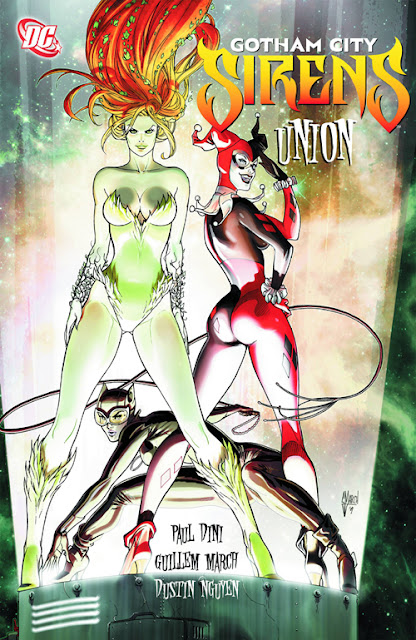
Gotham City Sirens, v. 1: Union

Collects: Gotham City Sirens #1-7 (2009-10)

Released: April 2010 (DC)

Format: 176 pages / color / $19.99 / ISBN: 9781401225704

What is this?: Villainesses Harley Quinn and Poison Ivy move in with Catwoman; wackiness ensues.

The culprits: Writer Paul Dini (and Scott Lobdell) and artist Guillem March (and penciler David Lopez)


Writers and artists are not automatons. Their output varies in quality, quantity, and style, even when conditions seemed close to the ideal. For instance, sometimes when Paul Didn writes about Batman villains Harley Quinn and Poison Ivy, you get Batman: Mad Love, which many readers and critics love. And sometimes you get Gotham City Sirens, v. 1: Union.

Gotham City Sirens is ostensibly a comedy with wacky roommates — Batman villainesses Harley, Ivy, and Catwoman — or perhaps it’s a reality show without cameras. In any event, the three criminals move in together for almost nonexistent reasons and try to live noncriminal lives. Dini’s stories are action-oriented, with very little character development … or motivation, really.

Gotham City Sirens, v. 1: Union coverThere are three interesting moments in Union:

1) The girlfriends of Batman, Catwoman and Talia al-Ghul, once met to figure out how to protect Batman’s secret ID.
2) Harley visits her dysfunctional family.
3) The Riddler, as a private investigator, takes a case.

The last is the best part of Union, taking up most of issue #3. That shouldn’t be a surprise; sometimes, when a creator revisits a character he or she had success with, you do get the same level of quality, and Riddler as a PI was my favorite part of Dini’s Batman: Detective. (Also my favorite thing done with the Riddler ever and my favorite little Batman idea.) Unfortunately for that theory, though, the writer for #3 is Scott Lobdell, but Lobdell does do a good job with Dini’s idea. In #3, Riddler teams up with the replacement Batman to solve some faked suicides; with Dick Grayson as Batman, it’s possible Riddler will outthink him. (Not likely, but possible.) Riddler narrates #3 with good but edged humor, and his rivalry with Batman adds a little spice to the team-up.

But it’s unsurprising that switching to a number of the book’s secondary cast is necessary to get a good story, as Dini seems unable to get much entertainment out of the relatively amiable main trio. Harley and Ivy try to drag Batman’s identity out of Catwoman early on, but after that, the three untrustworthy women are pretty chummy — somehow without even showing a spark of friendship that would make them interesting.

So unless you were hoping to see the return of Gagsworth A. Gagsworthy, the Joker’s Silver Age sidekick, or more of Hush forced to impersonate Bruce Wayne, there’s nothing here … and I wasn’t wanting to see either. I admit, there’s something to be said about contrasting Silver Age Joker with the more modern, psychotic version, but spreading “Gaggy’s” story over two issues is a waste of pages. As for Hush, I found it hard to discern his motivation, other than a near-pathological need to murder. If there was a hint he wanted to use Harley to escape his Bat captors, there might be something interesting.

Pander, young man, panderI wanted to start this review by saying something about breasts and (women’s) butts, but glancing through Union again, I decided artist Guillem March’s work wasn’t as full of cheesecake as I had originally thought. Oh, make no mistake: there’s a lot of art showing how shapely and well endowed Harley Quinn, Poison Ivy, and Catwoman are. But almost all artists draw them like that, and despite some questionable choices (Harley Quinn in Daisy Dukes? Really?), March saves his over-the-top work for Gotham City Sirens covers and one character in #3, an issue in which the three main pin-ups — sorry, characters — are mainly absent; March draws a bookstore clerk in a see-through mesh top, pleated microskirt, visible panties, and torn fishnets. Yes, the bookstore is The Heart of Poe — possibly more Goth-friendly than most — but I know pandering when I see it.

Other than how he draws women’s bodies — not to brush the topic aside — I liked March’s style. I can see the manga influence, especially in certain characters’ faces, but March has a heavier line and less androgyny than most manga I’ve read. The little manga-esque touches — the giant sweat droplets on Hush when he things Harley has found him out or the flower petals drifting past Harley and Hush in an intimate moment — are nicely matched with the book’s light tone. I also liked David Lopez’s fill-in work on #7: it had strong, expressive character work (although sometimes the expressions are a bit broad) and much less exploitative female drawings.

The book’s main appeal is the female form, and Dini doesn’t give a reason for Gotham City Sirens to exist beyond that. I’d buy a Riddler solo book, but given that his PI work seems to have been scrubbed by the New 52, there’s little chance of that. Union is Supervillain Team-Up with T&A, and that’s not worth reading.

Rating: Batman symbol (1 of 5)

Labels: , , , , , , , , , , , ,

25 June 2010

Gigantic

Collects: Gigantic #1-5 (2008-10)

Released: April 2010 (Dark Horse)

Format: 128 pages / color / $17.99 / ISBN: 9781595823267

What is this?: A giant, exploding robot appears in San Francisco and, well, explodes, part of an alien reality show.

The culprits: Writer Rick Remender and penciler Eric Nguyen

I’m not sure what got me excited about Gigantic, but I wrote myself a note before the first issue came out in November 2008 to pick it up when it came out in trade paperback. Remarkably, I remembered to do so when the trade came out a year and a half later.

Gigantic — which seems to be designed to appeal to fans of kaiju (those giant monsters who often fight in Japanese movies) — features a giant robot that appears in San Francisco, crushing innocent passerby. Then, in the resulting fight, the eponymous robot seems to explode, killing more people. It turns out that the person in the robot suit is actually an Earthman, and Earth is just a giant reality show for some feckless aliens. … Kane Blake, the man inside Gigantic, was kidnapped by the aliens as a child; his family was the focus of one of the reality programs, and in space, he entered gladiatorial combats and became more famous. Now he’s escaped and come back home.

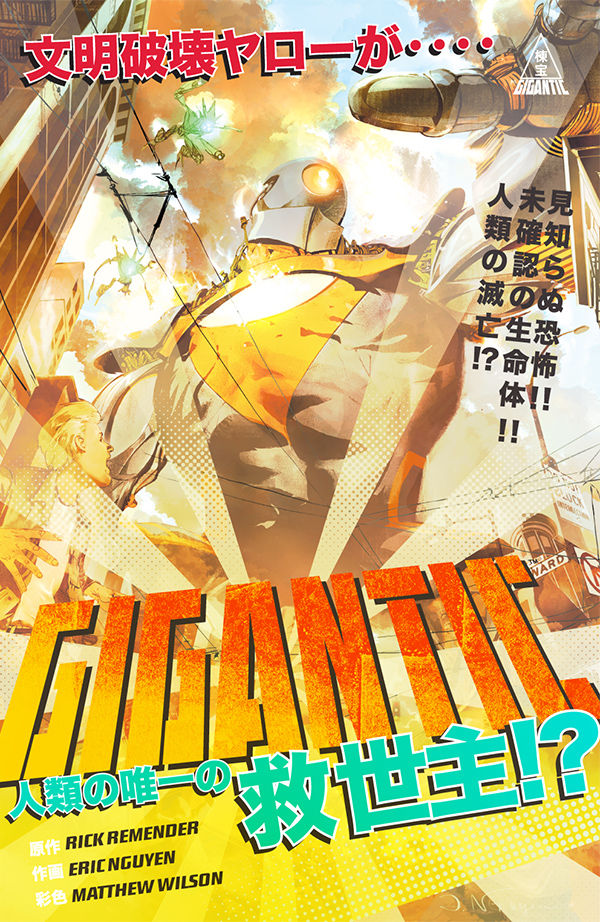
Gigantic coverI think the log line I read for Gigantic was more brief. I certainly can’t remember what it was that interested me.

The rest of the plot is hitting spliced with less interesting developments. The villains of the piece are stereotypical television corporations; the aliens behind these corporations are more telegenic than Mojo from the original Longshot miniseries, but they aren’t anywhere near as interesting. The aliens curse, of course, and not very well — “farge” for the other f-word (probably), “glorking,” etc. Although sometimes they curse in good English as well. For some reason, alien weaponry has no visible effect on Gigantic’s armor, but a chainsaw — which I’ve seen defeated by wires inside trees — rips right through it. Kane’s brother, Scott, should take medication to control his emotions, which swing wildly with every shocking revelation and tend to drive most of the plot the aliens don’t. About two-thirds of the way through the book, writer Rick Remender uses the plot twist from Total Recall, and somehow Kane isn’t quite as convincing as a heel as Arnold Schwarzenegger. And for some reason, the evil mastermind thinks making an Earthling into the Leader is a good idea.

I know I nitpick about plot; it’s a flaw hardwired into my body. I can’t help it. The little things I pick out about the plot, while annoying, aren’t the book’s major flaw (well, the Total Recall and stereotypical evil television execs might be).

The problem is Kane — Gigantic — isn’t a very good hero. His presence kills dozens if not hundreds, making him a mass murderer. He cries about it. When Earth needs saving from its own self-destruct sequence, he can’t save it, and he doesn’t seem to care about preserving the life of the person who does stop the countdown. He’s manipulated by his employers at every turn; his true self is supposed to be as big a villain as his employers. His final victory comes when he explodes once again, with the actual heroism being done by his brother and the kid with the big green head.

Gigantic does punch things, and he does provoke a panic by revealing the presence of the aliens. But that’s not enough to make a good hero.

There are some good things. I liked the Iconoclast, another fighter who claims to be highbrow in his style when actually he is only a bombastic gladiator whose popularity is fading. The scene in which the flying saucers around Earth were revealed was a nice one. But those nice moments were few and far between.

The art from penciler Eric Nguyen occasionally had me scratching my head during the fight scenes. There was a problem of distance as well. For instance, when Gigantic’s brother bursts through a barn … door, I think (I hope to hell it’s not a wall), Nguyen has the tractor covering too much ground and running over an attacker; if the attacker wasn’t paralyzed, it should have been able to sidestep the tractor easily. Also, sometimes the brother’s farm seems near the San Francisco Bay and occasionally seemed far away from the city. Ironically, Nguyen’s art does have a sense of scale when it comes to the size of the robots and monsters scrapping with each other; the destruction is appropriately large, and the punches look large and powerful.

I don’t know whether to blame Nguyen for the Japanese writing on the covers or not; given that very little of the book takes place in Japan, it seems misleading and an attempt to make readers believe Gigantic is more kaiju than it is.

Gigantic begins with a senseless slaughter and ends with a sappy ending we’re supposed to feel good about. But both feel arbitrary, and I never really felt engaged with the book, its plot, or its hero.

Rating: Dark Horse symbol

Labels: , , , , , , ,

28 July 2009

Runaways (v. 9): Dead Wrong

Collects: Runaways v. 3 #1-6 (2008-9)

Released: June 2009 (Marvel)

Format: pages / color / $15.99 / ISBN: 9780785129400

What is this?: The Runaways head back to LA and find a new set of adversaries waiting for them, while Chase has to find a job.

The culprits: Writer Terry Moore and penciler Humberto Ramos

When Joss Whedon took over for Brian K. Vaughn as Runaways writer, the choice was logical, and it worked out — Whedon was different, but he brought his own strengths to the title. When Terry Moore was chosen to succeed the glacially paced Whedon, the choice was also logical. But whatever Moore brought to Runaways, it sure as hell wasn’t his strengths.

Runaways: Dead Wrong coverRunaways: Dead Wrong is easily the weakest volume of the series so far. (Also: For those keeping count, this is the ninth volume. Just because Marvel stops counting doesn’t mean you have to.) In Dead Wrong, one of the Runaways, Karolina, finds the remnants of her race, the Majesdanians, waiting to deal out retribution for her parents’ betrayal of their race. This is not immediately evident because Moore takes a long time to remind the reader that Karolina is a member of the same race as these Majesdanians; the logic is also a bit opaque because despite being a logical, law-abiding race, the Majesdanians believe in the child being punished for the sin of the parent. Except when they don’t, at the end — because bloodthirsty remnants of a decimated race often have 180 degree changes of heart in the middle of fights.

But put that aside for a moment. Moore has the team acting out of character for most of the book. It’s intentional, or so we’re supposed to believe: a spell gone awry. Leaving alone for a moment that the spell that caused the problem for the Runaways had a completely different effect on their opponents, I believe making established characters act out of character is a bad choice for a writer in his first assignment on a new title. It doesn’t instill any confidence, and it certainly doesn’t get the writer into a rhythm with the new characters. But more importantly, the characters don’t feel right, and the characters are what make Runaways important.

There’s a lot that doesn’t feel right. The Runaways find one of their parents’ hidden safehouses, but they don’t think to search for a cache of money and supplies? What kind of criminal masterminds don’t have emergency cash lying around? Why does the house have, instead of normal-but-lethal safeguards that won’t attract much attention, big fuzzy automated demons that destroy all sorts of stuff and practically scream for attention? Given how concerned the neighbors turn out to be, that would be a problem. And why does Moore think I’ll be entertained by radio shock jock Val Rhymin? To get across the characterization, penciler Humberto Ramos draws him as a younger, cut-rate Howard Stern; it’s also painfully obvious he has mind-control powers that Chase is somehow immune to. (And if he’s really so popular, how did Chase get hired so easily by him?) And haven’t I seen the ending to Dead Wrong before? Oh, yes, I did — right here. Didn’t even have the courtesy to change the age range of the characters.

Lesson here, boys and girls, is that heroes will likely be stupid. But aliens will likely be even more dense, so it’s OK.

I enjoyed Ramos’s work with Paul Jenkins when they were teamed up on various Spider-titles; Ramos’s distorted, exaggerated style works with a character as kinetic as Spider-Man, combined with the lack of expressiveness of his mask. However, Ramos feels all wrong for Runaways. In large scenes, the action looks muddled and confused; in the opening fight with the Majesdanians, I had no idea what was going on half the time. Xavin’s frequent transformations meant I had trouble figuring out who he was supposed to be most of the time. When it came down to it, I rarely could tell the difference between Ramos’s Carolina and Chase — and they’re not even the same gender, just the same hair color. It’s just a big mess full of undifferentiated hipsterwear and unkempt hair.

I am a big fan of Runaways, but I’m not such a big fan that I’m going to try to push this fragrant flower on you. Give this a pass. I’d advise doing the same with the next Runaways trade — featuring the shocking secret of Val Rhymin! Gosh! How exciting! — but I’m a big enough of a glutton I might not be able to help myself. I don’t know if I’m going to justify spending some majority fraction of $15 for it, though.

Rating: Marvel symbol (1 of 5)

Labels: , , , , ,

10 July 2009

Hulk, v. 1: Red Hulk

Collects: Hulk (v. 2) #1-6, stories from Wolverine #50 and Mini Marvels (2007-8)

Released: February 2009 (Marvel)

Format: 176 pages / color / $19.99 / ISBN: 9780785128823

What is this?: Who is the Red Hulk? And who will he beat up / shoot next?

The culprits: Writer Jeph Loeb and penciler Ed McGuinness

We finish our fortnight of Hulk reviews with Hulk, v. 1: Red Hulk. If you have any hopes of this troika of reviews ending on a high note, please wad those hopes up and drop them in the nearest recycling bins now. 36

After World War Hulk, Bruce Banner is imprisoned, but a new Red Hulk stalks the land, pummeling and shooting the Hulk’s enemies … or anyone else who gets in his way, or meets, for that matter. Writer Jeph Loeb asks the question, “Who is the Red Hulk?” The follow-up question is, “Who the hell cares?” The Red Hulk is a snarling force of nature that only destroys and doesn’t have the magnetism or even simple charm of the “Hulk-Smash!” Hulk. An earthquake would have been more efficient and has more character. He uses guns, for heaven’s sake; Hulk punches harder than guns! Even the best SHIELD tech can’t compete with the Hulk’s punches.

Hulk: Red Hulk coverThe trouble is, I am curious who the Red Hulk is. God help me, I want to know. Loeb is blatant about not revealing who the Hulk is, having people knocked over the head or whisked off stage just as the Red Hulk’s identity is revealed. The Red Hulk’s identity can’t be withheld forever; it isn’t revealed here and hasn’t been revealed yet, and there’s only so long a writer can keep the mystery alive without alienating the audience. This sort of obvious dangler (Who is Stryfe?) is simultaneously what kept the X-Men at the top of the comics heap for so long and caused its popularity to dip in the new millennium.

When it comes down to it, the Red Hulk is stupid. He punches (and shoots) everybody: Iron Man, She-Hulk, Thor, even Uatu the Watcher. (Why? Since when has punching the Watcher been a mark of might?) He rages throughout the story without betraying any emotion other than smug vindictiveness. That’s not a character: that’s a character note, something the writer reminds himself to work in or refer back to while doing more worthwhile things with the character. I’m not about to get into “A-Bomb,” the new gamma-spawned halfwit monster who’s really Rick Jones, but rest assured the idea is even less rewarding than you’re thinking. And who thought, “The madder Red Hulk gets, the hotter he gets” was a bright idea? And why would overheating be a problem for the Red Hulk?

I don’t know. But plotting isn’t an important consideration for Loeb. He wastes most of the first issue with a pointless “investigation” into the Abomination’s death and a fight with the Winter Guard, Russia’s superheroes. Space is wasted on heroes trying to shore up San Francisco and save its residents while the Hulks fight; I can do without that. Loeb could have used that space for … something interesting, if he could find it. Uatu shows up out of nowhere just to get punched. So does Thor, for that matter. And I don’t believe for a second that Red Hulk can pick up Thor’s hammer.

There are a few bits of dialogue that are amusing, and the extra touches on the Gamma Base are interesting — robot guards and robot harpies that look like Betty Banner as the Harpy — but mostly it’s smashing and dumb Hulk (and dumb A-Bomb) talking in broken sentences while the Red Hulk is insufferable. It gets irritating quickly.

Penciler Ed McGuinness is better than the material he’s given. His work is larger than life, gleefully dynamic, and fun to look at. Really, he’s almost the perfect fit for this storyline, and there’s not much negative to say about his pencils. However, I will anyway: either he has a dental fetish or he really enjoys drawing teeth; the Hulks look like supersized PSAs for dental care. I’m not sure what emotion the final panel is supposed to inspire: the incapacitated Red Hulk grits his teeth and glares at the reader in front of a featureless background after he’s been berated by puny humans. Fear? Amusement? It actually managed to confuse me, so that’s an emotion right there. There’s also a small error in that he draws the Red Hulk’s gun in two different ways: humongous revolver and ginormous automatic. Well, I say it’s an error; it could be Loeb doubling his idiotic idea by having the Red Hulk steal two Hulk-sized guns. (Why would SHIELD even make one? What possible advantage could that give them?)

There are also some interesting extras at the end of the book. The three Red / Green / Blue Hulk Mini Marvels strips, by Audrey Loeb and Chris Giarrusso, are reprinted from the second Mini Marvels collection. They’re fun, as is anything Mini Marvel related. Loeb and McGuinness’s backup from Wolverine (v. 3) #50, “Puny Little Man,” is also included; it retells the story of Wolverine’s first confrontation with the Hulk, although Wolverine admits he doesn’t quite know what’s true and what’s story (and for good measure, the Hulk tearing Wolverine in half from Ultimate Hulk vs. Wolverine is included to muddy the waters). Decent backup, although it’s more Wolverine related than Hulk.

Still, neither McGuinness nor the extra features should be enough to induce buyers to pick this up. Stay away, save your money, and keep watching comic-book news sites and Wikipedia for the revelation of who the Red Hulk is.

Rating: Hulk head (1 of 5)

Labels: , , , , , , ,

15 May 2009

X-Men: The Complete Onslaught Epic, Book 1

Collects: X-Men #53-4, Uncanny X-Men #334-5, Fantastic Four #415, Avengers #401, Onslaught: X-Men, Cable #34, and Incredible Hulk #444 (1996)

Released: February 2008 (Marvel)

Format: 256 pages / color / $29.99 / ISBN: 9780785128236

What is this?: Behold my mighty hand! Onslaught’s true name is revealed, and he begins his slow, ponderous march across the Marvel Universe.

The culprits: Too many to name or punish.

X-Men: The Complete Onslaught Epic coverI remember the Onslaught “Epic”; although I did not behold his mighty hand first hand until years later, I watched the story unfold from the safety of Usenet in 1996. There was some excitement at the time, since the identity of the X-Traitor would finally be revealed and a big summer crossover would sprawl before the reading public. I don’t know that anyone was expecting it to be any good, though.

That was fortunate, since the crossover was widely panned at the time. But how does it stack up more than a decade later?

About as badly as you might expect. Wisely, the setup for the Onslaught storyline is omitted in X-Men: The Complete Onslaught Epic, Book 1. It was too large and too confusing; the writers admitted they changed the direction of the storyline and at times were working blind. But it’s helpfully referenced in footnotes (when you can read the footnotes, which are often the same color as the text-box background).

The text balloons! They’re everewhere!The plot has the X-Men discovering the identity of the ultra-powerful psychic entity Onslaught, who happens to be one of their own; once he’s flushed out, Onslaught starts gathering his power by collecting Franklin Richards and brainwashing the Hulk. There’s unrealized menace and handwringing and angst and oh God text balloons everywhere. You might expect better from writer Mark Waid; keep right on expecting, because you’re not going to find it here. Waid wasn’t happy with the direction of the X-books or the freedom he was given; that probably explains the wretched pile of X-cess he and fellow writer Scott Lobdell handed in to editor Bob Harras — or maybe Harras ordered them to give him that. I don’t know.

Here’s what happens over 250+ pages and eight issues (plus a larger special issue):

  • Buildup to the revelation (Onslaught taunts Jean, Juggernaut punchy-punchies his way into the Mansion) (X-Men #53-4 and Uncanny #334)
  • Revelation — which was completely obvious by this time — plus fight (Onslaught: X-Men)
  • Yak with the Avengers, during which nothing happens (Uncanny #335)
  • Cable and a mind-controlled Hulk punch each other (Cable #34 and Incredible Hulk #444)
  • Joseph (who was thought to be Magneto) introduced to the plot, for non-obvious reasons (Avengers #401)
  • Onslaught kidnaps Franklin Richards (Fantastic Four #414)

The pacing is appalling. Interestingly, the ancillary titles actually have a decent pace — well, all right, two issues for a Cable / Hulk fight is excessive, but I’ll blame that on Cable. None of them stand out as particularly good examples of the comic book arts; even Hulk, written by Peter David, is sapped of all its individuality by the crossover. They’re either padded or unremarkable large-scale fight scenes.

Orange milkThe art is all over the place, but fortunately, since it’s the X-titles of the mid-‘90s, Marvel had a lot of their best working on this crossover. The two X-Men issues feature the flashy if a bit underdeveloped early Andy Kubert, while the Uncanny pencils are from the manga-influenced Joe Madureira. These work together about as well as you might expect. Kubert and Dan Green get the important X-Men: Onslaught issue; Green’s work resembled John Romita Jr. at the time, and Green had been an X-Men artist earlier in the decade. Interestingly, there are parts that look like the work of neither, but whyever that is, I’m sure the orange milk isn’t either’s fault.

But with the crossover issues, you have the early Mike Deodato on Avengers, which I didn’t care for, and Carlos Pacheco’s early American work on Fantastic Four. Then to end it you have the pretty-but-stiff Ian Churchill on Cable and the hideously unattractive work of Angel Medina on Incredible Hulk. (Those last two are one hell of a whiplash, I can tell you, since they are linked and back to back in the collection.) It’s a real mishmash with the ancillary issues added in. There’s nothing that can be done about it now, and it doesn’t detract from the readability (except for Medina’s work), but it’s a real range of styles.

Behold my mighty hand!The back cover and indicia claim Book 1 contains Fantastic Four #414 and Avengers #400; it doesn’t. There’s only a page from each of these comics in this book, and it’s deceptive to claim otherwise. (It’s the same practice that allows retailers to claim X-Men Visionaries: Jim Lee TPB has Uncanny X-Men #252, 254, 260-1, 264, 280, and 286 when in fact the book contains only the covers from those issues.) On the other hand, it’s better information than you can get on the Internet. The usually reliable (and invaluable) Unofficial Handbook of Marvel Comics Creators claims X-Force #57 and X-Man #18 are included as well; they are not. Marvel.com makes the same claim, as does Amazon. In fact, wherever you look on the Internet, the listed contents of the four volumes in the series are contradictory or overlapping. (If anyone knows the true contents of these volumes, leave them in the comments.)

Much as you’d expect, the Onslaught crossover is best experienced through Wikipedia. Read X-Men: The Complete Onslaught Epic, Book 1, at your own risk.

Rating: X-Men symbol (1 of 5)

Labels: , , , , , , , ,

13 February 2009

Essential Silver Surfer, v. 1

Collects: Silver Surfer (v. 1) #1-18, back up from Fantastic Four Annual #5 (1967-70)

Released: 1998 (Marvel)

Format: 528 pages / black and white / $16.99 / ISBN: 9780785120087

What is this?: After Galactus imprisons him on Earth, the Silver Surfer tries to escape to get home to his love.

The culprits: Writer Stan Lee and pencilers John Buscema and Jack Kirby

I’ve never found the Silver Surfer all that interesting.

Noble? Yes. Powerful? One of the heavyweight heroes of the Marvel Universe (and Heroclix). But he has the personality of a head of cauliflower. He started his existence as a plot device, and he hasn’t advanced much since then.

Essential Silver Surfer, v. 1, does not do much to change my opinion of the Sentinel of the Skyways.

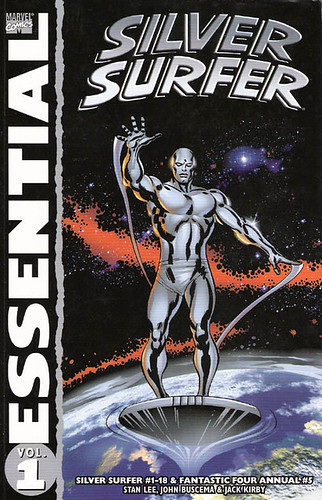
Essential Silver Surfer, v. 1 coverThe Surfer was a personal favorite of co-creators Stan Lee and Jack Kirby, with Stan jealously guarding the Surfer. When he finally relented and decided to have a Surfer ongoing series, he pulled rank and wrote the series himself, assigning John Buscema penciling duties. Kirby was, understandably, a little miffed. This is very nearly the last interesting thing to happen with Silver Surfer, v. 1.
Lee used Silver Surfer as his platform for social idealism, and like most soapboxes, it is inherently uninteresting. Stupidity and silly misunderstandings abound, and the Surfer is repeatedly used as a pawn. The plots are simple and formulaic. There is a lot of bizarre pairings in this volume — the Silver Surfer vs. Mephisto (essentially the Devil), vs. the Flying Dutchman, vs. the most recent Baron Frankenstein, vs. an incompetent witches’ coven. But instead of being examples of those moments readers smile and think, “Only in comics!” these are dull confrontations of cardboard villains (except Mephisto) with elaborate costuming.

It is entirely possible, I think, to sum up a Silver Surfer plot by using the following, mixed and matched as necessary:

    *SPUMMM!* The Silver Surfer hits an invisible space wall
  1. I must escape Earth!
  2. I must see my true love, Shalla Bal!
  3. When will you humans give up your violence?
  4. I must help the humans! (Usually immediately after the preceding line.)
  5. I won’t give up my soul, Mephisto!
  6. *smack!* (This is the sound of the Silver Surfer colliding with Galactus’s invisible barrier, which keeps him from leaving Earth.)
You may think I’m joking about that last one, but the Surfer, time and again, in ignorance and in frustration, literally beats his head against that barrier. If you had a dollar for every time it happens in this book, you could probably pick up the Essential Silver Surfer for free. I had to pay a bit more for it, but not much more.

On the positive side, the book does feature the creation of Mephisto, who is at least an interesting enemy for the Surfer — the Devil vs. alien was probably an original pairing at the time. I’d be lying if the Surfer doesn’t grow as a character; his naiveté is completely worn away by the end of the book, although that doesn’t mean he can’t be fooled for plot purposes. I also admire Buscema’s beautiful art, smooth and sleek while suggesting the immense power at the same time. He can also capture the absurdity of the Surfer’s attempts to blend in with human society.

Kirby arrives the issue before cancellation to ugly everybody up. I’ve never been a fan of Kirby’s art, and compared to Buscema’s work, his Surfer (and everyone else) looks squat and homely. The true shame is that Kirby, one of the few people who could match Lee for imagination, would have been a perfect fit as writer — if there is one thing you could never call Kirby, it’s boring. (Or formulaic, although that’s a second thing you couldn’t call him.) Kirby left for DC soon after his work on Silver Surfer #18, where he created the Fourth World.

Essential Silver Surfer ranges from the boring to the absurd, and even the absurd doesn’t provoke laughter — or any reaction at all, really. The first five issues, which are all double sized, are nearly impossible to choke down. It gets easier after that, but Essential Silver Surfer never gets better than bland.

Rating: Silver Surfer head (1 of 5)

Labels: , , , , ,

07 November 2008

X-Men: Deadly Genesis

Collects: X-Men: Deadly Genesis #1-6 (2006)

Released: December 2006 (Marvel)

Format: 200 pages / color / $19.99 / ISBN: 0785118306

What is this?: In this miniseries, the X-Men are under physical and mental assault by a powerful mutant with a mysterious grudge.

The culprits: Written by Ed Brubaker with pencils by Trevor Hairsine

I expected to dislike X-Men: Deadly Genesis intensely, and unsurprisingly, I did. I don’t blame Ed Brubaker’s scripting or Trevor Hairsine’s pencils; Hairsine does an excellent job in this waste of a cause. No, I blame whoever came up with this misconceived project, whether it’s Brubaker or editor Mark Paniccia or someone else farther up the chain of command at Marvel.

The plot reveals that years ago X-Men mentor Professor Xavier sent a heretofore unknown group to the island of Krakoa to rescue the missing X-Men. That group died, and Xavier wiped the memory of that group from everyone’s minds before sending another group — including Storm, Wolverine, Nightcrawler, and Colossus — to rescue the original X-Men. Now a member of that missing team — Vulcan, who is by just by coincidence the brother of first X-Man Cyclops and Havok — has been revived, and he’s tormenting the X-Men to get Xavier to confront him.

X-Men: Deadly Genesis cover This is the worst kind of retcon, one that hits the big three no-nos:

1) Tells you everything you know is wrong, while it
2) Reveals a powerful character (or conspiracy) hidden for years and
3) Radically changes how readers must view a long-term character.

This is pointless. And it doesn’t matter how well the story is told, because the central idea of the story is crap. Thirty years after Giant Size X-Men #1 is a little late to be revising the story, don’t you think? Brubaker’s story takes the fun, light story of the All-New, All-Different X-Men and makes it deadly serious and deadly dull. Xavier’s behavior in Deadly Genesis is near unforgiveable, and it makes a mockery of the idea of the unreliable narrator. Surely something so monstrous would have leaked into one of Xavier’s thought bubbles over the years.

There are essentially no heroes here. By not only sending a group of young mutants to their deaths but also wiping their lives from the record, Brubaker’s Xavier is a poor excuse for a human being, good intentions be damned. Vulcan is a monumental dillweed as well, even needlessly torturing the current X-Men for reasons I can’t fathom. Brubaker wants to make Vulcan look good, so he makes him nigh all-powerful, meaning the X-Men can’t stop him. The X-Men do nothing: not only does Vulcan master them easily, but they can’t find Xavier either. Deadly Genesis is a six-issue exercise in wallowing in misery, because nothing happens except making everyone involved look bad.

It’s even more aggravating when Brubaker pulls down the original plot in order to make the new one look better. Vulcan mocks Cyclops for thinking Krakoa released him in order to gather more mutants, but Krakoa killing Vulcan’s team after losing Cyclops is even less credible. Why not capture them as well? This sniping comes across as petty, and if you can’t play nicely with someone else’s toys, then maybe you shouldn’t be playing with them at all. Maybe Brubaker has a fetish for gratuitous retcons; he did, after all, bring Captain America’s sidekick Bucky back from the dead as the Winter Soldier.

There’s nothing wrong with Vulcan being a Summers brother, although the missing third Summers brother is not a dangling plot that had been crying for resolution. Moira studying and training a group of mutants is interesting as well, although a little difficult to shoehorn into continuity without the mindwipes and whatnot. And the backup with Xavier and Moira offering a young Emma Frost entry into the X-Men is interesting, although Xavier too quickly comes to the conclusion Emma won’t join the X-Men regardless of how he coaxes her.

The plot is my main problem, although not my only one. Marc Silvestri’s covers, especially the ones used for Deadly Genesis’s front and back covers, are irritating. I have no idea why all the characters on the homage to cover of Giant Size X-Men #1 are skeletal; none of them die. The back cover is no better; I had a hell of a time figuring out who Marvel Girl was supposed to be (Marrow and Rogue were my first thoughts), Cyclops is vastly overmuscled, and Wolverine’s face looks decidedly feminine, beard notwithstanding. The backup stories about the forgotten X-Men sent to Krakoa are essentially useless — I don’t care about them, and I have no reason to care about them as they’re not only disposable but already disposed of.

I admit I put a great deal of emphasis on continuity — perhaps too much. But because of the way this book chews up previous stories and characterizations and vomits them into the stewpot that is the Marvel Universe, this book is useless to me. I could sell it, but I got this book cheaply in part because the cover is creased. I don’t want to give it away because I don’t want to inflict it on anyone else.

One last note: the rating for Deadly Genesis is based entirely how much Hairsine’s art lifts this wreck above no value whatsoever.

Rating: Marvel symbol (1 of 5)

Labels: , , , , , ,

26 August 2008

Jinx

Collects: Jinx v. 1 #1-7, Jinx v. 2 #1-5, various one shots and specials (1996-8)

Released: February 2001 (Image)

Format: 480 pages / black and white / $24.95 / ISBN: 9781582401799

Once there was a time when the millennium was new and shining, when all foreign and domestic policies didn’t begin with “9” and end in “/11,” when Brian Michael Bendis didn’t dictate the direction of all Marvel’s titles. During that time, Bendis wrote and drew Jinx

Jinx cover Jinx is the story of the eponymous female bounty hunter, who runs into a pair of small-time con men named Goldfish (who Bendis also featured in Goldfish) and Columbia. Goldfish and Columbia themselves have stumbled into The Good, the Bad, and the Ugly: while Columbia is savagely beating Goldfish for abandoning their life of crime and for being better than him, a severely injured criminal crashes his car nearby, then gives half the location of a $3 million to each before conveniently dying.

Hey, it happens.

Coumbia is paranoid after Goldfish hooks up with Jinx in a wholly unconvincing romance made up of violence, vocalized pauses, and sex. Their attempts to get the Confederate gold — no, wait, stolen cash — drives the “realistic dialogue” and flashbacks … er, plot.

Bendis’s art is surprisingly good for someone who’s never had much cause to use it with the Big Two. Not that I particularly enjoy looking at it; 50 percent of the art is filled with shadow, and 40 percent is word balloons. This makes it frequently difficult to tell what’s going on. It is interesting artwork, though. Bendis admits to using models, including himself (as Columbia). It’s a valid approach, and for the most part, Bendis avoids making his subjects look stiff or posed. However, when he adds photorealistic elements — what looks like photocopied $20 bills atop his art, for instance — it’s offputting, because it looks like badly photocopied $20 bills atop comic art.

Readers’ enjoyment of Jinx is largely going to depend on their evaluation of Bendis’s dialogue. If you find starts and stops, vocalized pauses, and occasional explosive profanities realistic and engrossing, you’ll love Jinx. It is Bendis’s trademark, and it sounds like no one else. This is earlier Bendis, without much restraint or refinement, though; if you don’t really appreciate Bendis’s style, you’ll likely find the dialogue tedious and the story padded. Myself, I don’t think it would have been so bad if Bendis had hired a copy editor; missing and misplaced punctuation and misspellings changed the tedious to aggravating.

Despite the killer hook — female bounty hunter — the story fails to grab. Jinx is too abrasive to be compelling. The romance doesn’t sizzle; rather, it lies there and slowly rises to room temperature. The plot, as I said, is derivative. And f*&k Bendis for taking Lauren Bacall’s name in vain.

As a side note, David Mack’s introduction is one of the worst pieces of text I’ve ever read.

Rating: Image symbol (1 of 5)

Labels: , , , ,

12 August 2008

What If?: Civil War

Collects: What If?: Civil War, What If?: Planet Hulk, What If?: Annihilation, What If?: Rise and Fall of the Shi'ar Empire, What If?: Spider-Man vs. Wolverine (2007-8)

Released: June 2008 (Marvel)

Format: 168 pages / color / $16.99 / ISBN: 9780785130369

First of all, What If?: Civil War is a misleading title. A more accurate title would be What If?: Recent Events / Crossovers. An even more accurate title would be What If?: We Changed Recent Events to Kill More Heroes.

Second: merely asking What If? isn’t good enough. You have to have an interesting answer.

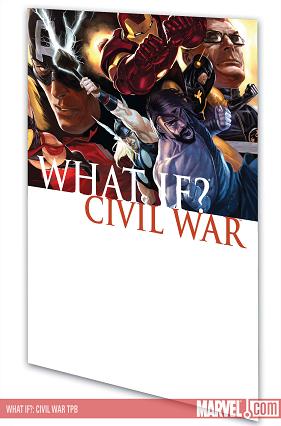
What If?: Civil War cover To be fair, I have not read most of the events this book uses as springboards. I didn’t care enough about Civil War, Annihilation, Planet Hulk, or (especially) The Rise and Fall of the Shi’ar Empire to read the originals, but I know enough about them that only Shi’ar Empire was slightly confusing. I have read Spider-Man vs. Wolverine, but that was from the mid ‘80s.
So I’m not the ideal audience. Still, I’ve read enough comics to know good ones when I’m given one for free, and this isn’t it. (Although it was free. Thanks, Diamond!) The main Civil War and Planet Hulk stories feature one of the most common What If? tropes: one thing changes, everybody dies. The body count in Annihilation is much lower, but so much is crammed into the story that it stops being a story — it’s more a retelling of fictional history. I’m not objective about Shi'ar Empire; the extension of Ed Brubaker’s massive retcon (no, the other one, the one without Bucky) leaves me cold. Suffice to say, there’s a lot of bloodshed in that one, with heroes dying (and Polaris being reduced to a pile of green hair) in a consequence-free environment.

The best of the lot was Spider-Man vs. Wolverine. I don’t believe Spider-Man would drift into the spy world, but at least it’s a full story, a real story, with a beginning, middle, and end. It’s competently told, with recognizeable motivations and characters. It works, in What If? terms, and writers Jeff Parker and Paul Tobin deserve a lot of credit for not succumbing to the temptation to ramp up the body count and change everything.

The backups are also not bad; the Civil War one works for no other reason than it serves as a rebuke to the stupidity of Civil War. Greg Pak — who wrote all the Planet Hulk stories — does well with his two low-key backups. The first has Banner and Hulk squabbling over the peaceful planet the Hulk was supposed to land upon; the second, a one-page joke with Fred Hembeck art, made me chuckle.

As for the whole package, it’s less than the sum of its parts. Different writers, different artists, characterizations (intentionally, to be fair) all over the place … I don’t think this could satisfy the casual reader. I’m not sure a casual reader would even pick this up, though.

Rating: Marvel symbol (1 of 5)

Labels: , , , , , , , , , , ,

18 July 2008

Showcase Presents Batman, v. 2

Collects: Detective Comics #343-58 and Batman #175-88 (1965-6)

Released: May 2007 (DC)

Format: 512 pages / black and white / $16.99 / ISBN: 9781401213626

Silver Age DC … I’m not sure why I bother. It’s so bizarre, so nonsensical, it’s as if the writers fed hallucinogens to mentally handicapped kids, then used their ramblings as springboards to write stories.

Actually, that’s not right; that makes the stories seem too interesting. The stories careen between boring and bad pseudoscience, then takes a left turn into camp with Batman #179 and Detective Comics #349, when the “go-go checks” begin. There are two extremes: crappy hoods with weak gimmicks and ludicrous sci-fi gimmicks that detract from the relatively grounded nature of Batman. None of it is particularly interesting.

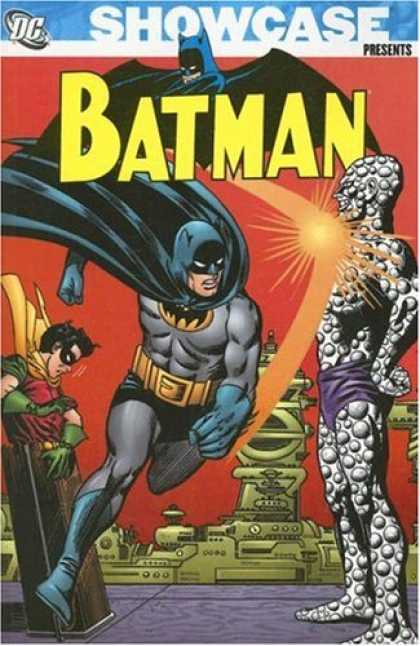
Showcase Presents Batman, v. 2 cover Few of the iconic Bat villains show up Showcase Presents: Batman, v. 2. In nearly 30 issues, the Joker and Riddler show up once apiece. Poison Ivy makes her debut, with two appearances; the back cover also trumpets Blockbuster’s first appearance as well, which should give you some of the star power involved. A villain called the Outsider, who lurked in the shadows of v. 1, steps into the light and turns Robin into a coffin. Batman defeats him because the Outsider makes his machines too simple.
All the good parts of v. 1 are missing. The Outsider makes only a couple appearances before his secret identity is revealed. The Mystery Analysts of Gotham make only one appearance, which — sadly — is the high point of v. 2, outside of the Poison Ivy stories. Alfred returns from the dead in a spectacularly stupid way.

As I said, maybe it’s just that I don’t get Silver Age DC. They seem to be targeting a younger age than Marvel was going after at the same time, and it shows decades later. But the stories don’t seem to have any spark — except for the exotic temptress Poison Ivy, it’s just a dreary succession of people who Batman and Robin beat up. Without much continuity, the stories are just one damn thing after another.

I can’t recommend the book, and I doubt v. 3’s going to be much better. But it’s Batman — I might still buy it.

Rating: Batman symbol (1 of 5)

Labels: , , , , ,

15 July 2008

Irredeemable Ant-Man, v. 1: Low Life

Collects: Irredeemable Ant-Man #1-6 (2006-7)

Released: June 2007 (Marvel)

Format: 144 pages / color digest / $9.99 / ISBN: 9780785119623

Ant-Man has always been a bit of a loser. The original Ant-Man went from a founder of the Avengers and the Marvel Universe to wife-beating wreck, heading through several identities and mental illnesses along the way. The second, working from that base, was a punchline for jokes about obscure heroes. (Now, thanks to Avengers Disassembled, he’s a punchline for jokes about obscure dead heroes.)

In The Irredeemable Ant-Man, v. 1: Low Life, Eric O’Grady becomes the third Ant-Man. Somehow, he manages to disgrace even the undistinguished name of Ant-Man.

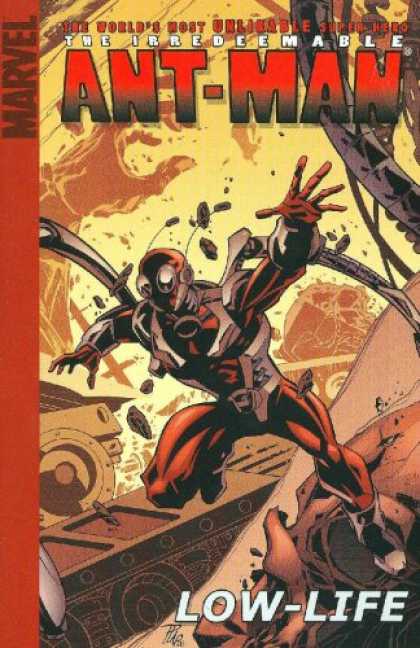
Irredeemable Ant-Man cover In short, Eric is an awful hero — he would probably deny being a hero, but there is a legacy that comes with the name. He’s an even worse human being. He lies to his best friend’s girlfriend, telling her her boyfriend has a girl on the side. He steals the Ant-Man suit from his friend’s dead body, then puts the moves on the girlfriend, leading to a one-night stand and a pregnancy. He uses his new-found powers to spy on naked women. He even invites a woman he saves from a mugger out to an expensive restaurant, then sticks her with the check.
If writer Robert Kirkman is going for thoroughly unlikable, then he has nailed it perfectly. Now, you can get away with this approach; making the bastard a victim of physical comedy or insults or comeuppance is the most common way. Making Eric charismatic or witty could also work, but Eric has neither charisma or wit. At times, reading about Eric is uncomfortable. Eric deserves some sort of comeuppance for being so awful, but he doesn’t really get it. His friend dies, but from Eric’s actions, he doesn’t seem too broken up about it. Eric goes through life causing misery and pain to those closes to him, and he gets away with it. It is unsatisfying to say the least.

Artist Phil Hester does a good job, although the reduction in size to digest doesn’t really do his artwork any favors. (Does it help anyone, I wonder? I suppose John Byrne’s clean pencils in the slightly larger Avengers: Nights of Wundagore were fine, but I can’t remember anyone else doing extremely well.) Hester’s storytelling is strong, and the characters — despite most of them being in identical SHIELD uniforms — are easily identifiable. But good artwork can’t save a story as unlikable as this one.

Frankly, there’s little to recommend the Irredeemable Ant-Man. It’s painful to read about such a horrible person who stars in a story with no moral grounding. Kirkman hits what he’s aiming for, but that’s not a story worth reading.

Rating: Marvel symbol (1 of 5)

Labels: , , , , ,

01 July 2008

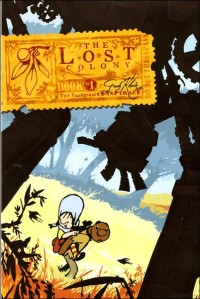
The Lost Colony, v. 1: The Snodgrass Conspiracy

Collects: OGN

Released: May 2006 (1st Second)

Format: 118 pages / color / $14.95 / ISBN: 9781596430976

I convinced myself to buy The Last Colony, v. 1: The Snodgrass Conspiracy by accident. The last time I was at the Green Valley Book Fair, I saw The Last Colony on the shelves, and something about it seemed familiar. I convinced myself I had read positive reviews about the book on the Internet, so I decided to give it a chance. It was only when I got home that I realized that faint familiarity had come from seeing The Last Colony on the shelves the previous time I had been to the Book Fair.

Anyway.

The Lost Colony, v. 1: The Snodgrass Conspiracy coverGrady Klein has constructed an odd story, one with several convergent threads. It’s set in the pre-Civil War South on a “secret” island where people of several different races — white, Black, American Indian, Chinese — live together in one community. But when a slave trader form the mainland wanders onto the island, it sets several plots in motion. The governor’s daughter wants a slave to do his chores; the governor, Snodgrass, and Chinese doctor / herbalist, Pepe Wong, want to get the slave trader off the island while keeping him from returning, both of them working at cross purposes. The blacks and Indians are afraid slaves will be brought to the island along with the evils of slavery.

That doesn’t sound very complicated, but when you add in magical potions, an addleminded servant, a “mechanical slave” (a robot), strange rock creatures, a wealthy plantation owner, a ferryman who’s bad at keeping secrets as he is at playing the violin, it gets more confusing. And Klein’s cartoony, simplified art style doesn’t help in this regard; I found it difficult to tell the difference between several male characters, especially one who was seen in a flashback before he’s introduced in the story. Combine this with the unpredictable effects of Pepe Wong’s potions, and it can be near impossible to tell what the hell’s going on.

Despite the occasionally bizarre trappings, I found The Snodgrass Conspiracy unengaging. There seems to be no real tension, just a series of weird incidents. The main conflicts about keeping the island secret, but seeing how awful the island’s inhabitants seem to be at maintaining that secret, it’s hard to take that plot seriously. Most of the time, the plot’s too silly for me to care about the many characters, but it’s not funny or coherent enough for me to care about the plot. When your big villain is named “Puffhead” and the story is resolved through the combination of chewing gum, magic drinks, and an exploding robot, you’ve either got a mess or a big pile of high-concept awesomeness.

The Snodgrass Conspiracy is a bit of a mess.

Rating: First Second symbol (1 of 5)

Labels: , , ,

17 April 2008

The Loners: The Secret Lives of Superheroes

Collects: Loners #1-6 (2007-8)

Released: February 2008 (Marvel)

Format: 144 pages / color / $14.99 / ISBN: 078512215X

When I bought The Loners: The Secret Lives of Superheroes, I had high hopes. Even halfway through, I thought, This could still work. But in the end, it all fell apart. Or maybe never came together. Either way, I wish there were more positives here.

The Loners: The Secret Lives of Superheroes cover The characters in The Loners (originally named "Excelsior") were brought together in the pages of Runaways, where they were the counterpoint to the Runaways: a group of young people with powers who had given up superheroing and were trying to get other young people to do the same. There are many ways you can go with this idea; trying to actively evangelize to different young heroes would have been my choice. (A "prison ministry" sort of thing might have been hilarious in the right hands.) Writer C.B. Cebulski went with the "superheroing as an addiction," and I can't deny that's a valid option. As shown in Season 6 of Buffy the Vampire Slayer, it's perhaps a difficult one, but it could be done.

Or perhaps not; Cebulski doesn't succeed at all. Since addiction is an internal conflict, most of the group's fights are internal as well. Without an external threat, though, it makes the characters all look weak. Any temptation at all makes them fall off the normalcy wagon, except for Phil Urich (the heroic Green Goblin) and Mickey Musashi (Turbo), who are the leaders. (Neither has any powers without his equipment, and Phil's were destroyed during Onslaught.) Admittedly, there are a few fights with goons connected to a Fujikawa lab, but whenever that's going to get interesting, it's shuffled off stage.

I do like the characters. Most of them were assembled by Brian K. Vaughan, but that's all right. Phil, Mickey, Julie Power (Lightspeed of Power Pack), Chris Powell (Darkhawk), and Johnny Gallo (Ricochet) are B-list teen heroes from the Marvel stable, at least a decade removed from their heydays. Rick Jones, Marvel's ultimate sidekick and the group's putative sponsor and mentor, is nowhere to be seen, but Cebulski adds Mattie Franklin, the third Spider-Woman, which is a nice addition: when last seen, she had been drugged and abused by a bunch of punks, which should have colored her impression of the appropriateness of superheroics for teens. The mutant formerly known at Penance and a new Red Ronin are also dropped in, but they don't make much of an impression.

Despite knowing he had only six issues to work with, Cebulski resolutely refuses to wrap up any of his dangling plotlines, and with the series' relatively low sales, it's unlikely he'll get a chance. There's a couple of deals made with the Fujikawa goons that aren't revealed, and there's no indication what the lab's purpose was in the first place. Julie Powers's unregistered status and hinted at homosexuality are mere titillations, and the new characters are sort of vomited onto the page and are clarified only with great reluctance. Ricochet's motivation — guilt over not helping a friend on the mission that took his life — is brought up and dropped in the same issue. Mattie's mission within the group is resolved, but only if you know enough about the Marvel Universe to remember the last name of a hero in an ensemble book based on a forgotten Spider-Man crossover and canceled after 12 issues (Slingers).

The point the plot twists on — Phil's unresolved romantic feelings — aren't even hinted at, not even in the issue he narrates, until #5, when it springs fully grown from his imaginary goblin mask. Cebulski's mainly at fault here; I think he's aiming at a specific, new manifestation of Phil's Goblin madness, but it's impossible to tell, and Phil doesn't regain enough lucidity to let us know.

Artist Karl Moline can't escape blame completely, but there's only so much one person can do, and I suspect he might have been as surprised as the rest of us at Phil's change (especially after Phil had feelings for Penance — er, Hollow). I do like Moline's work, though, especially working with former Generation X character Penance. He manages to get a sense of Bachalo's cartoony style while grounding the rest of the characters in more realism. He does a good job with both conversation and action scenes, although I do have a complaint about the slight tarting up of Julie Power. (It just doesn't seem right to do that to a member of Power Pack.) Cover artist Jason Pearson gets on my nerves, however; his thick-lipped, mascara'd, and flat nosed (just Ricochet in his mask, on that one) style offends my aesthetic sensibilities, and I have no idea why he based the covers on posters from John Hughes movies (a connection I never would have gotten without Wikipedia).

There won't be a The Loners, v. 2. I might have wished for it to wrap up these plotlines, but I wouldn't have bought it anyway.

Rating: (1 of 5)

Labels: , , , , , , , , , , , , , ,