Reviews of trade paperbacks of comic books (mostly Marvel), along with a few other semi-relevant comments / reviews.

27 March 2010

Excalibur Visionaries: Alan Davis, v. 2

Collects: Excalibur #51-8, Excalibur: XX Crossing (1992)

Released: January 2010 (Marvel)

Format: 240 pages / color / $24.99 / ISBN: 9780785144557

What is this?: Alan Davis continues his second run on Excalibur with a little help from the Marvel staff.

The culprits: Alan Davis, writing and drawing, along with writer Scott Lobdell, penciler Joe Madureira, and others

Excalibur was a spinoff of X-Men that launched in the late ‘80s, featuring three ex-X-Men (Shadowcat, Nightcrawler, and Phoenix II), Captain Britain, and his girlfriend, Meggan. The book was written by Chris Claremont, drawn by Alan Davis, and set in the U.K., and it had some humor and some alternate reality plots that were a legacy of earlier Captain Britain stories. Pretty straightforward, really. By the time the stories in Excalibur Visionaries: Alan Davis, v. 2, came around, however, things were a little muddled.
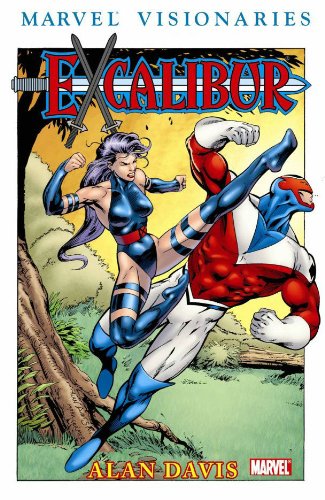
Excalibur Visionaries: Alan Davis, v. 2 coverPlotwise, this one’s all over the place. You start out with a serviceable cross-time / alternate Earth story, then dive into the confusing backwater of Phoenix continuity, before making a sidetrek into a non-Davis (and very ’90s) story of Captain Britain and Spider-Man fighting a group of foreign-exchange students who transform into various ethnic varieties of dogs and call themselves “the Litter.” (Is there a Eurotrash joke there? I can’t be sure.) After Davis returns to do a Crazy Gang story, readers would be well served to ignore XX Crossing — a pointless story where an assassin with time powers tries to prove himself to Dr. Doom by trying to kill Excalibur in one of the most convoluted ways possible. To finish out the book, there’s two two-part stories: one, a very dark story featuring Captain Britain and Psylocke’s flesh-warping brother, and the second, in which Excalibur fights very stupid trolls, guest starring the X-Men.

Is this a humor book, as it started out? Is it a satellite X-book, which is what it becomes? Is it a waste of time? I can’t be sure. Is Davis sure?

One point the reader has to keep in mind is that there are a few non-Alan Davis issues interspersed throughout the volume — #53 and XX Crossing most prominently, but #57-8 are only plotted by Davis. That’s both a drawback and a blessing; the volume is titled Alan Davis, v. 2, after all, and presumably the book is geared more at Davis fans than Excalibur completists. But it’s also good to keep telling the story; even though #53 is missable (it’s a fill-in flashback story about how Peter Parker made Captain Britain a better hero), leaving it out would create a hole in the sequence that readers would wonder about. On the other hand, XX Crossing isn’t in the sequence, it’s not a story you ever hear about, and it’s not that good, so it could have been omitted for … well, Davis didn’t work on #59-60 at all, but at least you could get it out of the way before Alan Davis, v. 3, collects #61-7.

So, when it comes to the Davis stories, what do we have? Well, there’s the silliness of the dino-Excalibur, then comes the Phoenix exposition, the Crazy Gang, and the very serious Jamie Braddock story, in which Excalibur finally discovers that A Big Secret. Other than the dino story in #51, this book feels like Davis is using his limited schedule to wrap up plotlines. He tries to explain Phoenix as best as he can; he puts the Crazy Gang, who was one of Excalibur’s first adversaries, off the board but somewhere where they can be called in again; and he not only brings back Jamie for the first time since #27 but he also allows Excalibur to discover something that happened in #4 — that Sat-Yr-9 has killed Captain Britain’s old girlfriend and replaced her, working against Excalibur and Meggan, Captain Britain’s new girlfriend. Davis then leaves other writers and artists to tell other stories.

But it doesn’t completely work. First of all, those stories are not up to Davis’s standards. Secondly, they make the stories’ subject matter feel haphazard — yanked in one direction by Davis, another by Scott Lobdell, then back to Davis, etc. Thirdly, the revelations feel sudden; Excalibur was going through roster changes at the time, and Davis’s plot-heavy revelations don’t allow new characters such as Cerise or Feron to express themselves. The seriousness and sadness of #55-6 is moving, but Davis doesn’t have the time to follow it up and make the consequences stick or register the emotional fallout.

Fortunately, Davis’s artwork is beautiful, as always. So crisp, so elegant — it’s a pleasure to read. He provides the art for #54-6 only, though. The cover of the book — taken from the cover of #55 — is ill-chosen, I think. It’s a nice Alan Davis image, but it makes it look like this is Excalibur Visionaries: Alan Davis, v. 2, guest starring Psylocke’s legs and breasts (and all territories in between). The cover for #52, which is used on the back cover, probably would have been better.

Most of the rest of the art is provided by competent artists who come up short when put next to Davis in a volume named after Davis. Joe Madureira, however, stands out with his pencils in #57-8, although his work doesn’t show his manga influences as much as his later efforts do.

This is an up-and-down book that never seems to find its level. Having not read v. 1, I can’t say that reading v. 1 makes a difference. I suspect it doesn’t, although that book is completely written and drawn by Davis. More Davis is exactly what this book needs — the art, if nothing else. As it stands, there’s more disappointment than panels drawn by Davis.

Rating: X-Men symbol Half X-Men symbol (1.5 of 5)

Labels: , , , , , , , ,

15 May 2009

X-Men: The Complete Onslaught Epic, Book 1

Collects: X-Men #53-4, Uncanny X-Men #334-5, Fantastic Four #415, Avengers #401, Onslaught: X-Men, Cable #34, and Incredible Hulk #444 (1996)

Released: February 2008 (Marvel)

Format: 256 pages / color / $29.99 / ISBN: 9780785128236

What is this?: Behold my mighty hand! Onslaught’s true name is revealed, and he begins his slow, ponderous march across the Marvel Universe.

The culprits: Too many to name or punish.

X-Men: The Complete Onslaught Epic coverI remember the Onslaught “Epic”; although I did not behold his mighty hand first hand until years later, I watched the story unfold from the safety of Usenet in 1996. There was some excitement at the time, since the identity of the X-Traitor would finally be revealed and a big summer crossover would sprawl before the reading public. I don’t know that anyone was expecting it to be any good, though.

That was fortunate, since the crossover was widely panned at the time. But how does it stack up more than a decade later?

About as badly as you might expect. Wisely, the setup for the Onslaught storyline is omitted in X-Men: The Complete Onslaught Epic, Book 1. It was too large and too confusing; the writers admitted they changed the direction of the storyline and at times were working blind. But it’s helpfully referenced in footnotes (when you can read the footnotes, which are often the same color as the text-box background).

The text balloons! They’re everewhere!The plot has the X-Men discovering the identity of the ultra-powerful psychic entity Onslaught, who happens to be one of their own; once he’s flushed out, Onslaught starts gathering his power by collecting Franklin Richards and brainwashing the Hulk. There’s unrealized menace and handwringing and angst and oh God text balloons everywhere. You might expect better from writer Mark Waid; keep right on expecting, because you’re not going to find it here. Waid wasn’t happy with the direction of the X-books or the freedom he was given; that probably explains the wretched pile of X-cess he and fellow writer Scott Lobdell handed in to editor Bob Harras — or maybe Harras ordered them to give him that. I don’t know.

Here’s what happens over 250+ pages and eight issues (plus a larger special issue):

  • Buildup to the revelation (Onslaught taunts Jean, Juggernaut punchy-punchies his way into the Mansion) (X-Men #53-4 and Uncanny #334)
  • Revelation — which was completely obvious by this time — plus fight (Onslaught: X-Men)
  • Yak with the Avengers, during which nothing happens (Uncanny #335)
  • Cable and a mind-controlled Hulk punch each other (Cable #34 and Incredible Hulk #444)
  • Joseph (who was thought to be Magneto) introduced to the plot, for non-obvious reasons (Avengers #401)
  • Onslaught kidnaps Franklin Richards (Fantastic Four #414)

The pacing is appalling. Interestingly, the ancillary titles actually have a decent pace — well, all right, two issues for a Cable / Hulk fight is excessive, but I’ll blame that on Cable. None of them stand out as particularly good examples of the comic book arts; even Hulk, written by Peter David, is sapped of all its individuality by the crossover. They’re either padded or unremarkable large-scale fight scenes.

Orange milkThe art is all over the place, but fortunately, since it’s the X-titles of the mid-‘90s, Marvel had a lot of their best working on this crossover. The two X-Men issues feature the flashy if a bit underdeveloped early Andy Kubert, while the Uncanny pencils are from the manga-influenced Joe Madureira. These work together about as well as you might expect. Kubert and Dan Green get the important X-Men: Onslaught issue; Green’s work resembled John Romita Jr. at the time, and Green had been an X-Men artist earlier in the decade. Interestingly, there are parts that look like the work of neither, but whyever that is, I’m sure the orange milk isn’t either’s fault.

But with the crossover issues, you have the early Mike Deodato on Avengers, which I didn’t care for, and Carlos Pacheco’s early American work on Fantastic Four. Then to end it you have the pretty-but-stiff Ian Churchill on Cable and the hideously unattractive work of Angel Medina on Incredible Hulk. (Those last two are one hell of a whiplash, I can tell you, since they are linked and back to back in the collection.) It’s a real mishmash with the ancillary issues added in. There’s nothing that can be done about it now, and it doesn’t detract from the readability (except for Medina’s work), but it’s a real range of styles.

Behold my mighty hand!The back cover and indicia claim Book 1 contains Fantastic Four #414 and Avengers #400; it doesn’t. There’s only a page from each of these comics in this book, and it’s deceptive to claim otherwise. (It’s the same practice that allows retailers to claim X-Men Visionaries: Jim Lee TPB has Uncanny X-Men #252, 254, 260-1, 264, 280, and 286 when in fact the book contains only the covers from those issues.) On the other hand, it’s better information than you can get on the Internet. The usually reliable (and invaluable) Unofficial Handbook of Marvel Comics Creators claims X-Force #57 and X-Man #18 are included as well; they are not. Marvel.com makes the same claim, as does Amazon. In fact, wherever you look on the Internet, the listed contents of the four volumes in the series are contradictory or overlapping. (If anyone knows the true contents of these volumes, leave them in the comments.)

Much as you’d expect, the Onslaught crossover is best experienced through Wikipedia. Read X-Men: The Complete Onslaught Epic, Book 1, at your own risk.

Rating: X-Men symbol (1 of 5)

Labels: , , , , , , , ,

30 September 2008

Deadpool Classic, v. 1

Collects: New Mutants #98, Deadpool: The Circle Chase #1-4, Deadpool v. 1 #1-4, Deadpool v. 1 #1 (1991, 1993, 1994, 1997)

Released: April 2008 (Marvel)

Format: 264 pages / color / $29.99 / ISBN: 9780785131243

Deadpool Classic, v. 1, is a different kind of collection, one of those character-centric books that don’t have a single storyline (or like the last two books, two related stories). Deadpool has two complete miniseries plus two stories that aren’t related to anything else in the book. This gives the book the appearance of being suited for those obsessed with Deadpool or continuity. But is that true?

Deadpool Classic, v. 1 coverWell, it is more than slightly disjointed. One story doesn’t really flow into another; Deadpool lurks around the fringes of X-Force between his first appearance and his first mini. The two miniseries are marginally connected, though, and there doesn’t really seem to be any missing information between the two stories. But writer Joe Kelly doesn’t feel obligated to tack the Deadpool ongoing directly onto anything that came before. So it’s a mixed bag in that aspect. They are all representative stories, though, each embodying the insane loudmouth who likes to hurt people for money. (Or as Marvel says, “Merc with a Mouth.”)

The issue of New Mutants is mostly a New Mutants story, with Deadpool showing up to harass the heroes for less than half an issue. It’s really an inauspicious debut for a character who became as important as Deadpool did; he fails in his mission, is used by Cannonball for training purposes, and is completely humiliated by Cable. Scripter Fabian Nicieza and plotter / artist Rob Liefeld had Cable punk an awful lot of people, so it wasn’t that unusual.

The first miniseries, The Circle Chase, was written by co-creator Nicieza, with art by ’90s hot artist Joe Madureira. While you might think having a writer so familiar with Deadpool would be a plus, it actually acts as a detriment at points. Yes, Nicieza gets the dialogue right, and his Deadpool is true to the original mercenary, villainous Deadpool, but the book gets bogged down with X-Force continuity. The grudge between Kane and Deadpool, Copycat’s past, Black Tom’s affliction and connection to Deadpool, Tolliver’s death, and the very existence of Weasel and Courier are uncommented upon and unfootnoted. Given that Deadpool helped deliver Black Tom to his horrible fate, it would make sense that the book would make some note of it, but no — and since Black Tom doesn’t seem too worked up in the first mini, maybe that’s OK. But the continuity, Nicieza’s love for MacGuffins, and a convoluted plot — what purpose do the assassins sent after Deadpool serve? — make this little miniseries a bit more complicated than necessary.

Mark Waid wrote the second miniseries, Sins of the Past, with art from Ian Churchill, Lee Weeks, and Ken Lashley. Waid built upon the heroic possibilities from Circle Chase and downplays the character’s violent, sociopathic tendencies. He also links Sins more strongly to the most profitable franchise of the day, X-Men, by adding mutants Banshee and Siryn to the cast. Waid, despite some distaste for the character, manages to write convincing dialogue even as he takes a little of the edge off the character. The plot works more smoothly than Circle Chase; it’s simpler, although eliminating treacherous Interpol agent Peyer would have improved the story even more. I’m also not sure about the malfunctioning healing factor he gave Deadpool for the story, since Wolverine was going through a similar trial at the same time.

The gem of the volume is the double-sized first issue of Deadpool’s first ongoing series. Kelly and artist Ed McGuinness defined Deadpool, and although their run was low selling, it was extremely critically well received. Kelly unites the “Merc with a Mouth” personality with “Deadpool as a reluctant hero” in a way that is both more satisfying and convincing than either Waid or Nicieza (who arguably wasn’t trying for reluctant hero). He even gives Deadpool a new status quo that simultaneously humanizes and distances him from the reader. Kelly quickly established himself as the master of Deadpool’s dialogue with this (and subsequent) issues, joining a pop-culture sensibility with insanity, bad jokes, and murderous tendencies. Interestingly, Deadpool doesn’t have a monopoly on the funny lines, with the unsuspecting and befuddled characters who interact with him occasionally being more funny than the title character.

McGuiness also is the best of the Deadpool artists in my opinion, with art that is kinetic and slightly exaggerated when necessary to get the action or a joke across. He’s able to go quickly from comedy to action and back to comedy again. Although his heavy lines aren’t as graceful as the other artists, it’s arguably more appropriate: given Deadpool’s penchant for gunfire and loud explosions, he needs a more emphatic line.

I’ve never cared much for the exaggerated style of Madureira, whose art essentially screams “’90s!” over and over again. It certainly seems a bit dated today. On the other hand, it is appropriate for extended limbs Slayback and Black Tom, and his storytelling abilities are still very good. The art team for Sins — Churchill, Lashley, and Weeks — are similarly dated as a ‘90s look, but they avoid the obvious distortions featured by Madureira. Their battle scenes are often a bit confusing, though, which is a problem: the book seems to be one running fight scene. I will admit to liking the flashback scene at the beginning of #2 quite a bit, however.

The work of Liefeld calls out for many jokes, but I’ll restrict myself to one: he made an interesting choice in drawing Deadpool as a pinheaded woman with giant breasts on the cover the book.

There is a slight reproduction problem in my copy. It’s nothing major; it’s just that the Kelly / McGuinness issue and some of the Sins miniseries look a bit off — like it’s been photocopied rather than printed. It’s not a major problem, as those parts of the book are just as readable as the rest of the book, but once you notice that the quality doesn’t quite match the rest, it’s a little distracting.

I’m looking forward to Deadpool Classic, v. 2, although in a practical sense, I’m not sure it will ever be released. I have most of the issues that would be collected, but the Kelly / McGuinness run that would be collected next is excellent, easily the character’s creative high point. And I don’t have the Deadpool / Daredevil Annual ’97, and given its price, I would just as soon have it collected with other Deadpool stories in one nice, neat trade paperback.

Rating: Marvel symbol Marvel symbol Marvel symbol Half Marvel symbol (3.5 of 5)

Labels: , , , , , , , , , ,