Reviews of trade paperbacks of comic books (mostly Marvel), along with a few other semi-relevant comments / reviews.

09 September 2011

X-Men: Onslaught: The Complete Epic, v. 3

Collects: X-Men #55, Uncanny X-Men #336, Cable #35, X-Force #58, X-Man #19, Incredible Hulk #445, Iron Man #332, Avengers #402, Thor #502, Wolverine #105 (1996)

Released: August 2008 (Marvel)

Format: 248 pages / color / $29.99 / ISBN: 9780785128250

What is this?: The penultimate volume of the Onslaught story, a “Mutants Gone Wild” cautionary tale.

The culprits: Too many to name, not enough to blame

Completism is a hell of a drug.

It’s one nearly every comic-book fan has felt the pull of. There are steps, gradations, but they’re all rationalizations and symptoms that don’t lead to an understanding of why completism has such a firm hold on our souls. It’s common to all sorts of collecting, and when you cross collecting with serial literature … well, like I said: a hell of a drug, although not without its highs.

We live in a Golden Age for completists, a time when we can go out and buy trade paperbacks of storylines that would be too Godawful or tedious to collect issue by issue but are relatively painless to swallow in one gulp — as long as we hold our noses. For us Gen Xers, it’s truly wonderful, with Marvel releasing compilations of ‘90s stories that seemed too horrible to contemplate at the beginning of the decade; the House of Ideas has released the hell out of the Clone Saga and has kept the Onslaught “Saga” in print, so all that remains is for someone at Marvel to find the unmitigated gall (or suffer the crushing brain damage) to complete the trifecta of crap by releasing a collection of The Crossing.

X-Men: Onslaught: The Complete Epic, v. 3 cover*ahem* Anyway. X-Men: Onslaught: The Complete Epic, Book 3, is indisputably part of the Onslaught crossover, which is indisputably an X-Men story. Well, you could dispute that, since it did end v. 1 of Fantastic Four, Avengers, Thor, and Iron Man (the last issues of the latter three are collected here), but the number of ancillary X-titles is convincing. What is disputable is whether anyone should buy it.

Despite the reputation of the Onslaught crossover, I’m not saying this book is bad. No, far from it; there’s nothing of the offensive stench of, say, Ghost Rider: Danny Ketch Classic, v. 1, or Captain America & the Falcon, v. 1: Two Americas. The skill involved in the individual issues is even better than Gambit Classic, although admittedly that’s setting the bar low.

Still, I’d advise reading any of those books before Onslaught, v. 3. Why? Because they are interesting in their awfulness. Nothing happens in the 248 pages of Onslaught, v. 3. Well, nothing happens except Onslaught loses Professor X as a prisoner and gains X-Man, which is more of a rearrangement of Scrabble tiles than a plot development. Oh, and Teen Tony Iron Man makes very ‘90s headpieces out of vibranium. But that’s really it, unless you like crowd control, attacks that achieve nothing but also lose nothing, illusory telepathic landscapes, and mutant mutant angst angst. And I suppose if you like catchphrases, Onslaught screams, “Behold my mighty hand!” several times, but as a catchphrase that ranks just below “Around the survivors a perimeter create.”

The blame for this doughnut hole of a collection has to be placed on the editors — four different editors, according to the title page: Mark Gruenwald (Iron Man and Avengers), Bobbie Chase (Hulk and Thor), Mark Powers (Cable), and Jaye Gardner (X-Man). Interestingly, Bob Harras — Marvel’s editor in chief and chief X-titles editor at the time — is listed in the credits of the remaining titles’ individual issues, but he isn’t credited on the title page. Which is a shame, because the buck has to stop with him, as both a book editor and editor in chief … I mean, who else can you blame for this an entire collection devoted to marking time, waiting for something or other — Iron Man and his party hats, I guess.

But much as I’m loathe to do it, maybe Gruenwald has to share some of the blame. While he has Terry Kavanagh and Joe Bennett actually contributing to the plot in Iron Man, Mark Waid and Mike Deodato are filling space in Avengers #402 — the last issue of Avengers, v. 1 — with a pointless fight. It’s bad enough the Avengers are going to bite it in an X-Men one-shot (fifteen-year-old spoilers!), but there’s nothing here that hints at the momentousness of the plot or the title’s history. This was when renumbering meant something! Marvel was licensing the Avenger titles to non-Marvel creators! There had to be a better way for the title to go out.

To be fair, Bill Messner-Loebs and Deodato do better with Thor. It’s cute they think there’s a purpose to continuing their subplots, like the Enchantress’s amnesia and captivity and Odin’s loss of his divinity and mind, and insisting Red Norvell is important. But there’s a sense of the title’s history included in the final issue. Thor runs into Jane Foster, Don Blake’s first love, and he remembers his history and an early adventure with his foster brother; the frogs from Thor’s days as the Frog of Thunder stop by. Messner-Loebs even has Hela, in a truly ridiculous Asgardian outfit, offer to make Thor her king if he wishes to avoid his death the following day. It gives the issue import and a sense of doom as it rolls into the inevitable, and I appreciate that. I think it could have been done better, by laying on the prophecy and references to Ragnarok, but the effort is there, and it’s more than we see in the other two dying Avengers titles.

I’m not going to single out any other individual writing or art, except to say that I have always disliked Angel Medina’s overly cartoony and grotesque work on Hulk There’s just too little to say about these issues; they fit together, I can see the skill there, but they’re not saying anything. Instead, I’m going to make two points that probably would be better in a footnote:

  • First, it would be a rarity to see all those high issue numbers in a trade paperback collecting comics from the last decade. Sure, Marvel’s big on reinstalling the old numbering, but Marvel switches to new #1s so often it’s uncommon to have many comics with their original numbering at the same time.
  • Secondly, there is some confusion on the Internet as to what is collected in Onslaught, v. 3. The Amazon listing includes Punisher (v. God knows what) #11, (Peter Parker:) Spider-Man #72, Fantastic Four #416, and Green Goblin #12; it leaves out the issues of X-Men, Uncanny X-Men, Cable, X-Force, and Thor. Even the impressive Unofficial Handbook of Marvel Comics Creators has it wrong; it makes the same mistake as the Amazon listing plus it adds Amazing Spider-Man #415.
In any event: This is one boring book. The plot goes nowhere. Art from Joe Madureira, Andy Kubert, and Deodato is not going to change that at all. I think you’d be better off jumping from the awful Onslaught, v. 1, to v. 4. You’re not going to miss anything important. But that’s not why people buy this book — they buy it because the drug that is completism has them in its claws.

In this case, though, completism is very much like a sleeping pill.

Rating: Zzz … (You can read that as either I was too bored by this book to rate it or that I graded it Triple-Z. Either one is fine by me.)

Labels: , , , , , , , , , , , , , ,

15 May 2010

Strange: The Doctor Is Out!

Collects: Strange #1-4 (2010)

Released: April 2010 (Marvel)

Format: 96 pages / color / $14.99 / ISBN: 9780785144250

What is this?: Stephen Strange, stripped of most of his magical might, muddles his way through the arcane world and meets a natural adept named Casey

The culprits: Writer Mark Waid and artist Emma Rios

I have a compulsion to buy new Dr. Strange material. I don’t know why; I’m often disappointed. (According to the ads inside the front cover, I managed to miss the Staczynski Strange mini somehow. Huh.) Anyway, this time the compulsion led me to Strange: The Doctor Is Out!.

Written by the veteran and reliable Mark Waid, Strange follows the former Sorcerer Supreme as he adjusts to not having (much) magic at his command. But while putting out a crisis, he runs into Casey, a plucky teenager girl who’s a natural adept. You can see where this is going — no, no, this isn’t a Clea situation.

Strange: The Doctor Is Out! coverThe pacing on this four-issue miniseries feels off. The first issue has Strange and Casey meeting and solving a crisis; Casey has to find him again in #2, which is followed by a satire of children’s beauty pageants in #3, and then a cataclysm in #4. (Isn’t that always the way? First Little Miss contests, then the magical apocalypse.) The beginning dwells too long on a plot that hardly needs to be given a quarter of the page total, and at the end, Silver Dagger comes out of nowhere to be a minor annoyance rather than the more serious threat the character deserves. The magical crisis in #4 seems all out of proportion to what came before it; it ramps up the tension from, say, a 4 to 11 and expects readers to go along with it. It doesn’t work, though; it takes more than a thinly veiled Wall Street malfeasance reference for me to believe all of magic is in such danger that Shaky Hands McStrange has to perform surgery on Eternity.

Along with being powerless, Strange seems brainless at times. With souls on the line in a baseball game vs. demons, Shaky decides to bat instead of a professional hitter. Strange doesn’t consider that giving an enchanted item and teaching a spell to a natural adept might have consequences if he isn’t there to guide her. He decides he’s the best candidate to operate on Eternity, despite his coordination and magical problems. He’s even outwitted by a not very subtle demon. That last wouldn’t be a problem alone, but combined with the others, it doesn’t make Strange look good.

There are a lot of different ways this could have gone that would have been better. I like the character of Casey, and I liked her interactions with Strange. A more down-to-Earth series, with Strange teaching her and dealing with her problems, would have been excellent. Or having Casey help Strange deal with his new status quo — without allies or magic — might have been entertaining. Instead, it’s a lot of fireworks and not enough character.

Strange and CaseyAs I mentioned in my review of Runways: Homeschooling, I’m not much for manga-influenced artists, and Emma Rios is no exception. Again, that’s a personal preference. But there are times when Rios’s storytelling is muddled — I’m a baseball fan, and I can’t tell what’s going on in the 2 ½ pages following the dropped third strike in #1, for instance. Rios’s design for Strange seems a bit stereotypical for manga / anime; I’m sure I’ve seen something very similar to Strange’s appearance on the title page in some anime, but it’s just escaping me. The glasses, hair, and fashion for Casey seem a bit stereotypical as well, although it’s as much an American stereotype as anything. On the other hand, Rios’s demons are creative and much more horrifying that the Technicolor goblins Marvel has used in the past, and those demons are a major part of the book.

Still, unless you’re a big fan of Rios’s work, there’s no reason to get Strange —unless Casey becomes an important character somewhere down the line.

Rating: Sanctum Sanctorum window symbol Half Sanctum Sanctorum  symbol (1.5 of 5)

Labels: , , , , , ,

23 January 2010

Fantastic Four, v. 3 (hardcover)

Collects: Fantastic Four #514-24 (2004-5)

Released: November 2005 (Marvel)

Format: 256 pages / color / $29.99 / ISBN: 9780785120117

What is this?: A pair of trade paperbacks — Disassembled and Rising Storm — showing the FF fighting villains and bad PR thrown together in one hardback.

The culprits: Writer Mark Waid and pencilers Mike Wieringo and Paco Medina

I swear I read Fantastic Four, v. 3 (hardcover), but looking through the book days later, not much is jogging the ol’ memory.

Something about Fantastic Four since John Byrne’s run makes all the major plot developments slide through the skull without making contact with more than a couple of synapses. Oh, there are plot developments that grab the attention briefly, but then they fade from the memory until they kill Sue again and you realize you haven’t thought much about what’s happening with Fantastic Four lately. (Or until Reed has an extended run as Mr. Fan-Fascist or the creative team brings back an extra kid or whatever shiny object grabs someone in editorial’s attention.) Other Marvel teams can have drastic roster changes, and the status quo can change for years at a time on titles like X-Men and Avengers. But the Fantastic Four are a family — a static, unchangeable family that won’t let anyone escape.

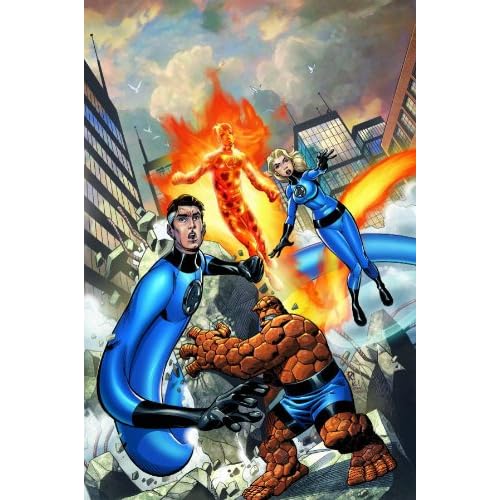
Fantastic Four, v. 3 cover -- minus the words Fantastic FourSo that’s what writer Mark Waid is up against here. Poor Waid, I would think; but that’s sort of his strong point. He’s steady. Give him a superhero setup, and he’ll give you a half dozen stories on it. Sometimes they’ll be great, like his Captain America and Flash runs. He’ll rarely have a dud run. The worst that will happen is that he’ll play with the company’s toys in a largely humdrum way, then put them back where he found them. And frankly, comics will always need a lot of those guys, even though they’re not in fashion now.

Waid plays with the standard tropes of the Fantastic Four in a couple of ways. In the first arc, “Dysfunctional” (#514-6), the team fights the Wizard and his new — new, I say! — Frightful Four. New lineups haven’t worked for the Wizard in the past, and they won’t work in the future. It’s not really a spoiler to say they don’t work here, especially since the Frightful Four meets their downfall the way they often do: betrayed by a woman. Wizard does the evil mastermind thing and throws away a loyal minion for no reason. A girl Johnny is interested in has surprise powers (like Frankie Raye!). It all feels done before, which isn’t surprising. Waid and co-writer for the arc Karl Kesel’s big, most original idea seems to be to position the Frightful Four as a kind of family, a dark reflection of the Fantastic Four, but that just feels forced, with family dynamics worse than the original Brotherhood of Evil Mutants.

In “Fourtitude” (#517-9) and “Rising Storm” (#520-4), however, it gets better. Aliens show up to kill Sue, Johnny and Sue switch powers, and then Galactus shows up to use Johnny as a herald. A very crappy herald, but that’s not anyone’s fault. It’s actually kinda amusing, with general dimbulb Johnny trying to get a handle of Galactus, cosmic powers, and trying not to commit genocide. Waid even gets to work in Quasar, which is nice — it’s always pleasing to see a minor character used in an appropriate role, giving the Marvel Universe some coherency. It even leads to some interesting characterization for Sue and Johnny, although it’s the kind that can easily never be referenced again.

The pencils come from Paco Medina (“Dysfunctional”) and the late Mike Wieringo (“Rising Storm” and “Fourtitude”). I like Weiringo’s art; he certainly could draw some mean monsters and aliens, and his Galactus is sufficiently imposing, if conventional. His depictions of the alien incursion during “Rising Storm” is underwhelming, however; it looks more like someone built tall, fancy pilings than an alien ship wreaking havoc. I never really adjusted to Medina’s pencils, though; his faces and females seemed a little … geometrically off. The inking is strangely heavy at points in his last issue as well, giving it the look of bad reproductions in a few panels.

Still, there’s too much of a feeling of … inconsequentiality. These are relatively interesting stories — well, “Rising Storm” and “Fourtitude,” at least — but when the day is done, the toys are neatly back in their box, and the day’s fun is forgotten.

Rating: Fantastic Four symbol Fantastic Four symbol Fantastic Four symbol (3 of 5)

Labels: , , , , , , , ,

15 May 2009

X-Men: The Complete Onslaught Epic, Book 1

Collects: X-Men #53-4, Uncanny X-Men #334-5, Fantastic Four #415, Avengers #401, Onslaught: X-Men, Cable #34, and Incredible Hulk #444 (1996)

Released: February 2008 (Marvel)

Format: 256 pages / color / $29.99 / ISBN: 9780785128236

What is this?: Behold my mighty hand! Onslaught’s true name is revealed, and he begins his slow, ponderous march across the Marvel Universe.

The culprits: Too many to name or punish.

X-Men: The Complete Onslaught Epic coverI remember the Onslaught “Epic”; although I did not behold his mighty hand first hand until years later, I watched the story unfold from the safety of Usenet in 1996. There was some excitement at the time, since the identity of the X-Traitor would finally be revealed and a big summer crossover would sprawl before the reading public. I don’t know that anyone was expecting it to be any good, though.

That was fortunate, since the crossover was widely panned at the time. But how does it stack up more than a decade later?

About as badly as you might expect. Wisely, the setup for the Onslaught storyline is omitted in X-Men: The Complete Onslaught Epic, Book 1. It was too large and too confusing; the writers admitted they changed the direction of the storyline and at times were working blind. But it’s helpfully referenced in footnotes (when you can read the footnotes, which are often the same color as the text-box background).

The text balloons! They’re everewhere!The plot has the X-Men discovering the identity of the ultra-powerful psychic entity Onslaught, who happens to be one of their own; once he’s flushed out, Onslaught starts gathering his power by collecting Franklin Richards and brainwashing the Hulk. There’s unrealized menace and handwringing and angst and oh God text balloons everywhere. You might expect better from writer Mark Waid; keep right on expecting, because you’re not going to find it here. Waid wasn’t happy with the direction of the X-books or the freedom he was given; that probably explains the wretched pile of X-cess he and fellow writer Scott Lobdell handed in to editor Bob Harras — or maybe Harras ordered them to give him that. I don’t know.

Here’s what happens over 250+ pages and eight issues (plus a larger special issue):

  • Buildup to the revelation (Onslaught taunts Jean, Juggernaut punchy-punchies his way into the Mansion) (X-Men #53-4 and Uncanny #334)
  • Revelation — which was completely obvious by this time — plus fight (Onslaught: X-Men)
  • Yak with the Avengers, during which nothing happens (Uncanny #335)
  • Cable and a mind-controlled Hulk punch each other (Cable #34 and Incredible Hulk #444)
  • Joseph (who was thought to be Magneto) introduced to the plot, for non-obvious reasons (Avengers #401)
  • Onslaught kidnaps Franklin Richards (Fantastic Four #414)

The pacing is appalling. Interestingly, the ancillary titles actually have a decent pace — well, all right, two issues for a Cable / Hulk fight is excessive, but I’ll blame that on Cable. None of them stand out as particularly good examples of the comic book arts; even Hulk, written by Peter David, is sapped of all its individuality by the crossover. They’re either padded or unremarkable large-scale fight scenes.

Orange milkThe art is all over the place, but fortunately, since it’s the X-titles of the mid-‘90s, Marvel had a lot of their best working on this crossover. The two X-Men issues feature the flashy if a bit underdeveloped early Andy Kubert, while the Uncanny pencils are from the manga-influenced Joe Madureira. These work together about as well as you might expect. Kubert and Dan Green get the important X-Men: Onslaught issue; Green’s work resembled John Romita Jr. at the time, and Green had been an X-Men artist earlier in the decade. Interestingly, there are parts that look like the work of neither, but whyever that is, I’m sure the orange milk isn’t either’s fault.

But with the crossover issues, you have the early Mike Deodato on Avengers, which I didn’t care for, and Carlos Pacheco’s early American work on Fantastic Four. Then to end it you have the pretty-but-stiff Ian Churchill on Cable and the hideously unattractive work of Angel Medina on Incredible Hulk. (Those last two are one hell of a whiplash, I can tell you, since they are linked and back to back in the collection.) It’s a real mishmash with the ancillary issues added in. There’s nothing that can be done about it now, and it doesn’t detract from the readability (except for Medina’s work), but it’s a real range of styles.

Behold my mighty hand!The back cover and indicia claim Book 1 contains Fantastic Four #414 and Avengers #400; it doesn’t. There’s only a page from each of these comics in this book, and it’s deceptive to claim otherwise. (It’s the same practice that allows retailers to claim X-Men Visionaries: Jim Lee TPB has Uncanny X-Men #252, 254, 260-1, 264, 280, and 286 when in fact the book contains only the covers from those issues.) On the other hand, it’s better information than you can get on the Internet. The usually reliable (and invaluable) Unofficial Handbook of Marvel Comics Creators claims X-Force #57 and X-Man #18 are included as well; they are not. Marvel.com makes the same claim, as does Amazon. In fact, wherever you look on the Internet, the listed contents of the four volumes in the series are contradictory or overlapping. (If anyone knows the true contents of these volumes, leave them in the comments.)

Much as you’d expect, the Onslaught crossover is best experienced through Wikipedia. Read X-Men: The Complete Onslaught Epic, Book 1, at your own risk.

Rating: X-Men symbol (1 of 5)

Labels: , , , , , , , ,

30 September 2008

Deadpool Classic, v. 1

Collects: New Mutants #98, Deadpool: The Circle Chase #1-4, Deadpool v. 1 #1-4, Deadpool v. 1 #1 (1991, 1993, 1994, 1997)

Released: April 2008 (Marvel)

Format: 264 pages / color / $29.99 / ISBN: 9780785131243

Deadpool Classic, v. 1, is a different kind of collection, one of those character-centric books that don’t have a single storyline (or like the last two books, two related stories). Deadpool has two complete miniseries plus two stories that aren’t related to anything else in the book. This gives the book the appearance of being suited for those obsessed with Deadpool or continuity. But is that true?

Deadpool Classic, v. 1 coverWell, it is more than slightly disjointed. One story doesn’t really flow into another; Deadpool lurks around the fringes of X-Force between his first appearance and his first mini. The two miniseries are marginally connected, though, and there doesn’t really seem to be any missing information between the two stories. But writer Joe Kelly doesn’t feel obligated to tack the Deadpool ongoing directly onto anything that came before. So it’s a mixed bag in that aspect. They are all representative stories, though, each embodying the insane loudmouth who likes to hurt people for money. (Or as Marvel says, “Merc with a Mouth.”)

The issue of New Mutants is mostly a New Mutants story, with Deadpool showing up to harass the heroes for less than half an issue. It’s really an inauspicious debut for a character who became as important as Deadpool did; he fails in his mission, is used by Cannonball for training purposes, and is completely humiliated by Cable. Scripter Fabian Nicieza and plotter / artist Rob Liefeld had Cable punk an awful lot of people, so it wasn’t that unusual.

The first miniseries, The Circle Chase, was written by co-creator Nicieza, with art by ’90s hot artist Joe Madureira. While you might think having a writer so familiar with Deadpool would be a plus, it actually acts as a detriment at points. Yes, Nicieza gets the dialogue right, and his Deadpool is true to the original mercenary, villainous Deadpool, but the book gets bogged down with X-Force continuity. The grudge between Kane and Deadpool, Copycat’s past, Black Tom’s affliction and connection to Deadpool, Tolliver’s death, and the very existence of Weasel and Courier are uncommented upon and unfootnoted. Given that Deadpool helped deliver Black Tom to his horrible fate, it would make sense that the book would make some note of it, but no — and since Black Tom doesn’t seem too worked up in the first mini, maybe that’s OK. But the continuity, Nicieza’s love for MacGuffins, and a convoluted plot — what purpose do the assassins sent after Deadpool serve? — make this little miniseries a bit more complicated than necessary.

Mark Waid wrote the second miniseries, Sins of the Past, with art from Ian Churchill, Lee Weeks, and Ken Lashley. Waid built upon the heroic possibilities from Circle Chase and downplays the character’s violent, sociopathic tendencies. He also links Sins more strongly to the most profitable franchise of the day, X-Men, by adding mutants Banshee and Siryn to the cast. Waid, despite some distaste for the character, manages to write convincing dialogue even as he takes a little of the edge off the character. The plot works more smoothly than Circle Chase; it’s simpler, although eliminating treacherous Interpol agent Peyer would have improved the story even more. I’m also not sure about the malfunctioning healing factor he gave Deadpool for the story, since Wolverine was going through a similar trial at the same time.

The gem of the volume is the double-sized first issue of Deadpool’s first ongoing series. Kelly and artist Ed McGuinness defined Deadpool, and although their run was low selling, it was extremely critically well received. Kelly unites the “Merc with a Mouth” personality with “Deadpool as a reluctant hero” in a way that is both more satisfying and convincing than either Waid or Nicieza (who arguably wasn’t trying for reluctant hero). He even gives Deadpool a new status quo that simultaneously humanizes and distances him from the reader. Kelly quickly established himself as the master of Deadpool’s dialogue with this (and subsequent) issues, joining a pop-culture sensibility with insanity, bad jokes, and murderous tendencies. Interestingly, Deadpool doesn’t have a monopoly on the funny lines, with the unsuspecting and befuddled characters who interact with him occasionally being more funny than the title character.

McGuiness also is the best of the Deadpool artists in my opinion, with art that is kinetic and slightly exaggerated when necessary to get the action or a joke across. He’s able to go quickly from comedy to action and back to comedy again. Although his heavy lines aren’t as graceful as the other artists, it’s arguably more appropriate: given Deadpool’s penchant for gunfire and loud explosions, he needs a more emphatic line.

I’ve never cared much for the exaggerated style of Madureira, whose art essentially screams “’90s!” over and over again. It certainly seems a bit dated today. On the other hand, it is appropriate for extended limbs Slayback and Black Tom, and his storytelling abilities are still very good. The art team for Sins — Churchill, Lashley, and Weeks — are similarly dated as a ‘90s look, but they avoid the obvious distortions featured by Madureira. Their battle scenes are often a bit confusing, though, which is a problem: the book seems to be one running fight scene. I will admit to liking the flashback scene at the beginning of #2 quite a bit, however.

The work of Liefeld calls out for many jokes, but I’ll restrict myself to one: he made an interesting choice in drawing Deadpool as a pinheaded woman with giant breasts on the cover the book.

There is a slight reproduction problem in my copy. It’s nothing major; it’s just that the Kelly / McGuinness issue and some of the Sins miniseries look a bit off — like it’s been photocopied rather than printed. It’s not a major problem, as those parts of the book are just as readable as the rest of the book, but once you notice that the quality doesn’t quite match the rest, it’s a little distracting.

I’m looking forward to Deadpool Classic, v. 2, although in a practical sense, I’m not sure it will ever be released. I have most of the issues that would be collected, but the Kelly / McGuinness run that would be collected next is excellent, easily the character’s creative high point. And I don’t have the Deadpool / Daredevil Annual ’97, and given its price, I would just as soon have it collected with other Deadpool stories in one nice, neat trade paperback.

Rating: Marvel symbol Marvel symbol Marvel symbol Half Marvel symbol (3.5 of 5)

Labels: , , , , , , , , , ,