Reviews of trade paperbacks of comic books (mostly Marvel), along with a few other semi-relevant comments / reviews.

21 September 2012

Gotham City Sirens, v. 1: Union

Collects: Gotham City Sirens #1-7 (2009-10)

Released: April 2010 (DC)

Format: 176 pages / color / $19.99 / ISBN: 9781401225704

What is this?: Villainesses Harley Quinn and Poison Ivy move in with Catwoman; wackiness ensues.

The culprits: Writer Paul Dini (and Scott Lobdell) and artist Guillem March (and penciler David Lopez)


Writers and artists are not automatons. Their output varies in quality, quantity, and style, even when conditions seemed close to the ideal. For instance, sometimes when Paul Didn writes about Batman villains Harley Quinn and Poison Ivy, you get Batman: Mad Love, which many readers and critics love. And sometimes you get Gotham City Sirens, v. 1: Union.

Gotham City Sirens is ostensibly a comedy with wacky roommates — Batman villainesses Harley, Ivy, and Catwoman — or perhaps it’s a reality show without cameras. In any event, the three criminals move in together for almost nonexistent reasons and try to live noncriminal lives. Dini’s stories are action-oriented, with very little character development … or motivation, really.
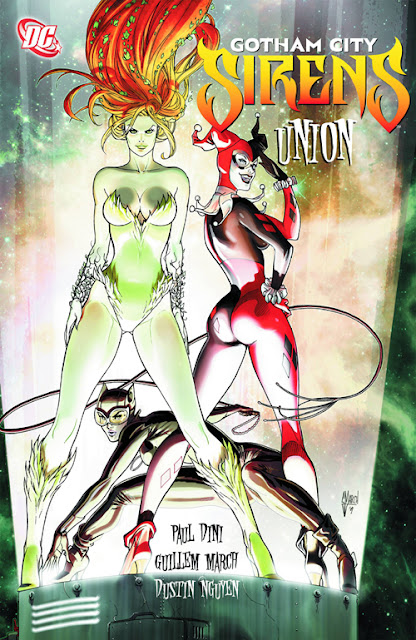
Gotham City Sirens, v. 1: Union coverThere are three interesting moments in Union:

1) The girlfriends of Batman, Catwoman and Talia al-Ghul, once met to figure out how to protect Batman’s secret ID.
2) Harley visits her dysfunctional family.
3) The Riddler, as a private investigator, takes a case.

The last is the best part of Union, taking up most of issue #3. That shouldn’t be a surprise; sometimes, when a creator revisits a character he or she had success with, you do get the same level of quality, and Riddler as a PI was my favorite part of Dini’s Batman: Detective. (Also my favorite thing done with the Riddler ever and my favorite little Batman idea.) Unfortunately for that theory, though, the writer for #3 is Scott Lobdell, but Lobdell does do a good job with Dini’s idea. In #3, Riddler teams up with the replacement Batman to solve some faked suicides; with Dick Grayson as Batman, it’s possible Riddler will outthink him. (Not likely, but possible.) Riddler narrates #3 with good but edged humor, and his rivalry with Batman adds a little spice to the team-up.

But it’s unsurprising that switching to a number of the book’s secondary cast is necessary to get a good story, as Dini seems unable to get much entertainment out of the relatively amiable main trio. Harley and Ivy try to drag Batman’s identity out of Catwoman early on, but after that, the three untrustworthy women are pretty chummy — somehow without even showing a spark of friendship that would make them interesting.

So unless you were hoping to see the return of Gagsworth A. Gagsworthy, the Joker’s Silver Age sidekick, or more of Hush forced to impersonate Bruce Wayne, there’s nothing here … and I wasn’t wanting to see either. I admit, there’s something to be said about contrasting Silver Age Joker with the more modern, psychotic version, but spreading “Gaggy’s” story over two issues is a waste of pages. As for Hush, I found it hard to discern his motivation, other than a near-pathological need to murder. If there was a hint he wanted to use Harley to escape his Bat captors, there might be something interesting.

Pander, young man, panderI wanted to start this review by saying something about breasts and (women’s) butts, but glancing through Union again, I decided artist Guillem March’s work wasn’t as full of cheesecake as I had originally thought. Oh, make no mistake: there’s a lot of art showing how shapely and well endowed Harley Quinn, Poison Ivy, and Catwoman are. But almost all artists draw them like that, and despite some questionable choices (Harley Quinn in Daisy Dukes? Really?), March saves his over-the-top work for Gotham City Sirens covers and one character in #3, an issue in which the three main pin-ups — sorry, characters — are mainly absent; March draws a bookstore clerk in a see-through mesh top, pleated microskirt, visible panties, and torn fishnets. Yes, the bookstore is The Heart of Poe — possibly more Goth-friendly than most — but I know pandering when I see it.

Other than how he draws women’s bodies — not to brush the topic aside — I liked March’s style. I can see the manga influence, especially in certain characters’ faces, but March has a heavier line and less androgyny than most manga I’ve read. The little manga-esque touches — the giant sweat droplets on Hush when he things Harley has found him out or the flower petals drifting past Harley and Hush in an intimate moment — are nicely matched with the book’s light tone. I also liked David Lopez’s fill-in work on #7: it had strong, expressive character work (although sometimes the expressions are a bit broad) and much less exploitative female drawings.

The book’s main appeal is the female form, and Dini doesn’t give a reason for Gotham City Sirens to exist beyond that. I’d buy a Riddler solo book, but given that his PI work seems to have been scrubbed by the New 52, there’s little chance of that. Union is Supervillain Team-Up with T&A, and that’s not worth reading.

Rating: Batman symbol (1 of 5)

Labels: , , , , , , , , , , , ,

22 April 2011

X-Factor, v. 8: Overtime

Collects: X-Factor #46-50 and X-Factor Special: Layla Miller (2008, 2009)

Released: April 2010 (Marvel)

Format: 168 pages / color / $19.99 / ISBN: 9780785138372

What is this?: Madrox’s sojourn in the Summers Rebellion ends, and the present-day team deals with the mysterious Cortex.

The culprits: Writer Peter David and penciler Valentine de Landro

The third volume of X-Factor is a title that has changed a great deal from its original concept. In the beginning, writer Peter David made the X-Factor into the name of a detective agency helping those in Mutant Town, a sort of mutant noir book. And then Mutant Town went away when Scarlet Witch made mutants go away. And then even dealing with former mutants and whatever crap was going on with Sentinels and the like in other X-titles wasn’t part of the book either.

So I’m up to X-Factor, v. 8: Overtime, and what do we have? Time travel. Layla Miller. A dystopic future. The Summers Rebellion — a plot idea dropped by Bishop in the early ‘90s, for Magneto’s sake. As Madrox might say, time travel isn’t very noir.

X-Factor, v. 8: Overtime coverOvertime’s story is spread over two threads in two different time frames. In the future, Madrox tries to find out why one of Scott Summer’s soldiers vanished from time and space for a few seconds. This is quickly forgotten once Madrox enlists the help of the near-senile Victor von Doom; Doom tinkers and the interpersonal dynamics mark time until the climactic fight scene. In the present, an assassin from the future toys with the team during a big fight scene … until the fight scene in the future needs one of the participants.

I’m selling the present-day fight scene short, actually. It features David’s usual wit, and it gives each character something to do against Cortex, an assassin who annoyingly is invulnerable to physical damage. These kinds of fights tend to have unimpressive resolutions — there’s a scientific device that works against the villain’s weaknesses or the heroes eventually punch the villain enough or there’s some sort of cheat. In this case, David combines the first and last of these in a way that doesn’t feel like a cheat or a cheap resolution. Cortex’s invulnerability does give the fight scene a reason to continue through four issues, and it allows some great character moments from M and Siryn. On the other hand, the revelation of Cortex’s identity, while unexpected, isn’t one of the top reveals I’ve ever seen; it feels like a clichéd resolution, even if it isn’t. I’m also not too wild about giving Shatterstar a new power — teleportation doesn’t fit too well into the power set of an otherdimensional gladiator, but these things happen in comics all the time.

The future storyline feels padded, although there are a few parts that are affecting. The reader feels Madrox’s frustration after he realizes he’s meeting mass murderer Trevor Fitzroy before he became evil yet can do nothing to stop Fitzroy’s dark future. Watching Victor von Doom slide into and out of senility was both sad and amusing, but fortunately, David elevated his appearance above that of a one-note joke. The romantic scenes between Layla and Madrox mostly worked from Layla’s point of view, but it seems a little soon after Jamie accepted Siryn’s marriage proposal (which, to be fair, was implicitly rescinded) for another romance. I sympathized with Layla’s frustration at watching events play out as she remembered them, feeling helpless to change anything.

When you have a character like Layla, who “knows stuff,” you have to make sure everything fits together at the end. And it does — the villain’s motivation is tied up with his origin, Fitzroy has a reason for the terrible things he does, and Layla’s knowledge and abilities are explained. The Layla Miller one shot takes her story from when she made Madrox abandon her in a mutant concentration camp during Messiah CompleX until she shows up at the end of X-Factor, v. 7: Time and a Half. I’m surprised how this issue ties everything together; looking back over the character's history, it’s amazing how David has managed to take Layla Miller from a plot device in House of M into an actual, breathing character. Now, if he could only do the same with some of the adversaries he comes up with …

The art comes from Valentine de Landro, who has been the title’s regular artist since the end of v. 6: Secret Invasion. I find it hard to get worked up about de Landro’s work. It’s good, professional quality work, and it generally tells the story well. On the other hand, it frequently makes Madrox’s dupes unrecognizable as dupes. In a couple of scenes, his “angry M” looks more like “middle-aged M.” Still, I have no overall complaints about his work, and any artist I don’t have a few nitpicks about probably doesn’t have a style.

I’m still not convinced by this direction — this time travel and Summers Rebellion stuff — but parts of it were dictated by line-wide crossovers, and most of it ends with this book. (Unless you count the Layla Miller plotlines.) David has done a good job with what he has been given — especially the Layla part — and now we can shuffle it into the background and not have to worry about it again.

Rating: X-Men symbol X-Men symbol X-Men symbol (3 of 5)

Labels: , , , ,

25 March 2011

Incredible Hercules, v. 5: The Mighty Thorcules

Collects: Incredible Hercules #132-7 (2009)

Released: April 2010 (Marvel)

Format: 152 pages / color / $14.99 / ISBN: 9780785136774

What is this?: For the good of Asgard, Hercules is asked to impersonate the Mighty Thor; Amadeus Cho, seventh-smartest person on the planet, investigates the mystery of the town of Excello.

The culprits: Writers Greg Pak and Fred van Lente and art by Reilly Brown and Rodney Buchemi

When I started reading Incredible Hercules, Incredible Hercules, v. 5: The Mighty Thorcules was what I was expecting.

Mighty Thorcules is, first and foremost, funny. At times, it’s hilarious, as when Hercules mocks the origin story of Thor or gives Thor a purple nurple (complete with the sound effect “NURP” in purple letters) during their fight. But it also continues the story of boy genius Amadeus Cho, confronting the architects of his woes, coming to grips with his parents’ deaths, and trying to get answers about where his sister is. However, writers Greg Pak and Fred van Lente manage to leaven Cho’s emotional adventure with humor, and there is a serious side to Hercules’s impersonation of Thor.

Incredible Hercules, v. 5: The Mighty Thorcules coverThe issues in Mighty Thorcules alternate between Hercules’s masquerade in Svartalfheim and Cho’s investigations in the soap-company town of Excello, Utah. Hercules’s story is far more enjoyable and lighthearted; with his father Zeus (reverted to a pre-teen appearance and without his memory) in tow and without the wise advice of Cho or Athena, Hercules moves through the plot with his usual straightforward, stupid, lusty verve. He shrugs off his father’s insults as best he can, despite how obvious it is that Zeus prefers the god Hercules impersonates. Zeus’s amnesia and disgust at Hercules’s “ingenious” plans — such as his answering the challenge of three-dimensional chess by simply knocking the board over, rather than actually trying to figure out the answer — allows the boy-god to serve as a comic foil for the Lion of Olympus.

I missed volumes 3 and 4 of Incredible Hercules, but it’s easy to understand the dramatic elements to this humorous story — Hercules’s battle for parental approval. Cho’s story suffers, however, from the lacuna; his quest is interrupted in my mind, and his character development is more dramatically affected. His final confrontation with Dupree and his coming to grips with his parents’ death are sapped of some of their emotional impact because I’ve missed some of the stories. Still, Pak and van Lente can’t be blamed for that, and I had no trouble following the story. The writers can only be concerned with the coherence of each individual story and the emotional impact of total story they have written.

To bring Cho’s story to a head, then, Pak and van Lente have to write the mental confrontation of Cho and Pythagoras Dupree, the six-smartest person in the world, in a way that isn’t dull, and they succeed. They also give artist Rodney Buchemi the opportunity to draw something more interesting than talking heads. Using a role-playing game as a way of expressing the confrontation between Cho and Dupree in the middle of Cho’s story was an excellent idea as well.

(One word about the Mastermind Excello RPG: I could not figure out what the mechanics are for dice rolls. Are you supposed to roll high? Low? Given the artwork, it could be a callback to the charming but confusing mechanics of 1st edition D&D, where the desirable outcome varied depending on the type of roll.)

Whoever is putting in the sound effects for the battle between Hercules and Thor — most likely either van Lente and Pak or letterer Simon Bowland — obviously was having a lot of fun. Besides the purple “NURP” when Herc gives Thor a double tittie twister, Thor’s boot to Herc’s groin is labeled with the sound “NUHHKRACK,” and his follow-up wedgie is labeled “HWWWWEDGIE.” Other sound effects include “SHOKKAKAAAAAN” (thunder); “WHATTAMANNNN,” “THORRRRULZ,” and “BACKATCHA” (Thor’s punches); and “SUKKKAPUNCH,” “GODDATHUNDAAA,” and “GOTCHAGAAAIN” (Hercules’s). The battle is ended when Zeus dispatches Malekith’s minion with a resounding “MALEKRUNCH.”

Each storyline has its own artist. Herc’s story is penciled by Reilly Brown, and I have to say I love his art. Brown is great with comedy; his characters are expressive, with the humorous story allowing each character broad reactions to the situation. His style is clean and extremely attractive — I’ll admit, it’s exactly the comic art style I have a great fondness for. His fight scenes are clear, and the battle between Thor and Hercules is outstanding: he manages to balance the humor with the power the two combatants throw at one another. Buchemi is also very good, and his style, although obviously different from Brown’s, goes well with his fellow artist’s. Buchemi gets the better design challenges, with the bifurcated nature of Dr. Japanazi and his servants and the Boltzmann brains, and he makes them very memorable. The RPG materials he draws also look like old RPGS (mostly by aping 1st edition D&D, as I mentioned), and there are occasional nice details I didn’t pick up on the first time I read Mighty Thorcules (the “0” and “1” on the different halves of Dr. Japanazi’s skull, the dead member of the Junior Genius Brigade from the RPG adventure lying outside Dupree’s real lair). I didn’t like his work as well as Brown’s, however; his art seems less consistent than Brown’s, and when he draws Cho and Dupree as young children, they look roughly the same (other than glasses and a slight difference in hairstyle) despite their different ethnicities.

Mighty Thorcules is an outstanding book, and not only is it worth reading, it was worth reading the first two volumes of Incredible Hercules to get to it. (And now I’m going to have to track down Love and War and Dark Reign; I’m eager to read v. 6, Assault on New Olympus, which was set up in Thorcules by promising a scuffle between Spider-Man and Hercules over Herc’s ex-wife, Hebe.) Mighty Thorcules is even a great value — six issues for $14.99 is a good deal at Marvel these days.

I find it hard to recommend Mighty Thorcules enough.

Rating: Marvel symbol Marvel symbol Marvel symbol Marvel symbol Half Marvel symbol (4.5 of 5)

Labels: , , , , , , , , , , ,

25 June 2010

Gigantic

Collects: Gigantic #1-5 (2008-10)

Released: April 2010 (Dark Horse)

Format: 128 pages / color / $17.99 / ISBN: 9781595823267

What is this?: A giant, exploding robot appears in San Francisco and, well, explodes, part of an alien reality show.

The culprits: Writer Rick Remender and penciler Eric Nguyen

I’m not sure what got me excited about Gigantic, but I wrote myself a note before the first issue came out in November 2008 to pick it up when it came out in trade paperback. Remarkably, I remembered to do so when the trade came out a year and a half later.

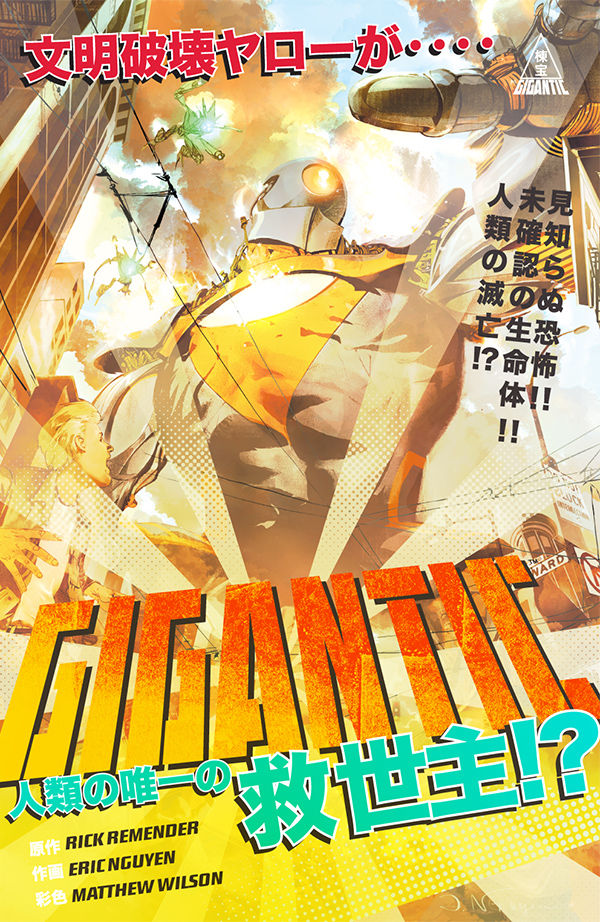
Gigantic — which seems to be designed to appeal to fans of kaiju (those giant monsters who often fight in Japanese movies) — features a giant robot that appears in San Francisco, crushing innocent passerby. Then, in the resulting fight, the eponymous robot seems to explode, killing more people. It turns out that the person in the robot suit is actually an Earthman, and Earth is just a giant reality show for some feckless aliens. … Kane Blake, the man inside Gigantic, was kidnapped by the aliens as a child; his family was the focus of one of the reality programs, and in space, he entered gladiatorial combats and became more famous. Now he’s escaped and come back home.

Gigantic coverI think the log line I read for Gigantic was more brief. I certainly can’t remember what it was that interested me.

The rest of the plot is hitting spliced with less interesting developments. The villains of the piece are stereotypical television corporations; the aliens behind these corporations are more telegenic than Mojo from the original Longshot miniseries, but they aren’t anywhere near as interesting. The aliens curse, of course, and not very well — “farge” for the other f-word (probably), “glorking,” etc. Although sometimes they curse in good English as well. For some reason, alien weaponry has no visible effect on Gigantic’s armor, but a chainsaw — which I’ve seen defeated by wires inside trees — rips right through it. Kane’s brother, Scott, should take medication to control his emotions, which swing wildly with every shocking revelation and tend to drive most of the plot the aliens don’t. About two-thirds of the way through the book, writer Rick Remender uses the plot twist from Total Recall, and somehow Kane isn’t quite as convincing as a heel as Arnold Schwarzenegger. And for some reason, the evil mastermind thinks making an Earthling into the Leader is a good idea.

I know I nitpick about plot; it’s a flaw hardwired into my body. I can’t help it. The little things I pick out about the plot, while annoying, aren’t the book’s major flaw (well, the Total Recall and stereotypical evil television execs might be).

The problem is Kane — Gigantic — isn’t a very good hero. His presence kills dozens if not hundreds, making him a mass murderer. He cries about it. When Earth needs saving from its own self-destruct sequence, he can’t save it, and he doesn’t seem to care about preserving the life of the person who does stop the countdown. He’s manipulated by his employers at every turn; his true self is supposed to be as big a villain as his employers. His final victory comes when he explodes once again, with the actual heroism being done by his brother and the kid with the big green head.

Gigantic does punch things, and he does provoke a panic by revealing the presence of the aliens. But that’s not enough to make a good hero.

There are some good things. I liked the Iconoclast, another fighter who claims to be highbrow in his style when actually he is only a bombastic gladiator whose popularity is fading. The scene in which the flying saucers around Earth were revealed was a nice one. But those nice moments were few and far between.

The art from penciler Eric Nguyen occasionally had me scratching my head during the fight scenes. There was a problem of distance as well. For instance, when Gigantic’s brother bursts through a barn … door, I think (I hope to hell it’s not a wall), Nguyen has the tractor covering too much ground and running over an attacker; if the attacker wasn’t paralyzed, it should have been able to sidestep the tractor easily. Also, sometimes the brother’s farm seems near the San Francisco Bay and occasionally seemed far away from the city. Ironically, Nguyen’s art does have a sense of scale when it comes to the size of the robots and monsters scrapping with each other; the destruction is appropriately large, and the punches look large and powerful.

I don’t know whether to blame Nguyen for the Japanese writing on the covers or not; given that very little of the book takes place in Japan, it seems misleading and an attempt to make readers believe Gigantic is more kaiju than it is.

Gigantic begins with a senseless slaughter and ends with a sappy ending we’re supposed to feel good about. But both feel arbitrary, and I never really felt engaged with the book, its plot, or its hero.

Rating: Dark Horse symbol

Labels: , , , , , , ,

15 May 2010

Strange: The Doctor Is Out!

Collects: Strange #1-4 (2010)

Released: April 2010 (Marvel)

Format: 96 pages / color / $14.99 / ISBN: 9780785144250

What is this?: Stephen Strange, stripped of most of his magical might, muddles his way through the arcane world and meets a natural adept named Casey

The culprits: Writer Mark Waid and artist Emma Rios

I have a compulsion to buy new Dr. Strange material. I don’t know why; I’m often disappointed. (According to the ads inside the front cover, I managed to miss the Staczynski Strange mini somehow. Huh.) Anyway, this time the compulsion led me to Strange: The Doctor Is Out!.

Written by the veteran and reliable Mark Waid, Strange follows the former Sorcerer Supreme as he adjusts to not having (much) magic at his command. But while putting out a crisis, he runs into Casey, a plucky teenager girl who’s a natural adept. You can see where this is going — no, no, this isn’t a Clea situation.

Strange: The Doctor Is Out! coverThe pacing on this four-issue miniseries feels off. The first issue has Strange and Casey meeting and solving a crisis; Casey has to find him again in #2, which is followed by a satire of children’s beauty pageants in #3, and then a cataclysm in #4. (Isn’t that always the way? First Little Miss contests, then the magical apocalypse.) The beginning dwells too long on a plot that hardly needs to be given a quarter of the page total, and at the end, Silver Dagger comes out of nowhere to be a minor annoyance rather than the more serious threat the character deserves. The magical crisis in #4 seems all out of proportion to what came before it; it ramps up the tension from, say, a 4 to 11 and expects readers to go along with it. It doesn’t work, though; it takes more than a thinly veiled Wall Street malfeasance reference for me to believe all of magic is in such danger that Shaky Hands McStrange has to perform surgery on Eternity.

Along with being powerless, Strange seems brainless at times. With souls on the line in a baseball game vs. demons, Shaky decides to bat instead of a professional hitter. Strange doesn’t consider that giving an enchanted item and teaching a spell to a natural adept might have consequences if he isn’t there to guide her. He decides he’s the best candidate to operate on Eternity, despite his coordination and magical problems. He’s even outwitted by a not very subtle demon. That last wouldn’t be a problem alone, but combined with the others, it doesn’t make Strange look good.

There are a lot of different ways this could have gone that would have been better. I like the character of Casey, and I liked her interactions with Strange. A more down-to-Earth series, with Strange teaching her and dealing with her problems, would have been excellent. Or having Casey help Strange deal with his new status quo — without allies or magic — might have been entertaining. Instead, it’s a lot of fireworks and not enough character.

Strange and CaseyAs I mentioned in my review of Runways: Homeschooling, I’m not much for manga-influenced artists, and Emma Rios is no exception. Again, that’s a personal preference. But there are times when Rios’s storytelling is muddled — I’m a baseball fan, and I can’t tell what’s going on in the 2 ½ pages following the dropped third strike in #1, for instance. Rios’s design for Strange seems a bit stereotypical for manga / anime; I’m sure I’ve seen something very similar to Strange’s appearance on the title page in some anime, but it’s just escaping me. The glasses, hair, and fashion for Casey seem a bit stereotypical as well, although it’s as much an American stereotype as anything. On the other hand, Rios’s demons are creative and much more horrifying that the Technicolor goblins Marvel has used in the past, and those demons are a major part of the book.

Still, unless you’re a big fan of Rios’s work, there’s no reason to get Strange —unless Casey becomes an important character somewhere down the line.

Rating: Sanctum Sanctorum window symbol Half Sanctum Sanctorum  symbol (1.5 of 5)

Labels: , , , , , ,