Reviews of trade paperbacks of comic books (mostly Marvel), along with a few other semi-relevant comments / reviews.

15 March 2013

X-Factor Visionaries: Peter David, v. 1

Collects: X-Factor v. 1 #71-5 (1991-2)

Released: November 2005 (Marvel)

Format: 144 pages / color / $15.99 / ISBN: 9780785118725

What is this?: The U.S. government forms a new mutant team: X-Factor.

The culprits: Writer Peter David and artist Larry Stroman


Peter David’s run on X-Factor is much beloved, and in X-Factor Visionaries: Peter David, v. 1, Marvel’s first trade paperback reprinting David’s run, it’s easy to see why. It isn’t a masterpiece, as some would have it; however, it’s a very good example of a comedy / superheroic mashup.

Before David took over X-Factor with #70, the book had concentrated on the adventures of the original five X-Men, who had distanced themselves from the team after team founder Professor Xavier left for space and the X-Men welcomed former archvillain Magneto into their ranks. When Xavier returned, Magneto fell out of the picture, and longtime Uncanny X-Men writer Chris Claremont was ousted from the book, the line was reorganized. New Mutants had already become X-Force; the members of X-Factor returned to Uncanny X-Men, which spun off the adjectiveless X-Men title to handle all the mutants. Wolverine remained Wolverine. That left only X-Factor to be dealt with.77 To his great credit, editor Bob Harras turned the title over to David, who made it a humor title.

 coverDespite David’s success on Incredible Hulk, David’s direction on the higher-selling X-Factor must have felt like a terrible risk. Not only did David take the mickey out of the X-books’ traditional heavy-handed angst, he did it with a lineup of second stringers: a pair of B-list X-Men (Havok and Polaris), a former New Mutant (Wolfsbane), a B-list Avenger (Quicksilver), a guy who had been hanging around the fringes of the X-books for almost two decades (Madrox the Multiple Man), and a guy who was a bodyguard to C-lister Lila Cheney (Guido, who gets his “Strong Guy” name here). You can get less star power in a team book published by Marvel or DC, but I can’t figure out how, exactly.

But David’s humor is top notch. The breadth of David’s humor is incredible78: wordplay, throwaway references to pop culture (liaison Val Cooper mentions her FBI agent brother, Dale — Dale Cooper being the protagonist of the then-current Twin Peaks), running gags, physical humor, funny dialogue … he even uses puns in a way that won’t make you want to strangle him. Every issue is funny, and every character is funny in his or her own way.

That’s not to say there aren’t serious moments; David’s run would not have been so fondly remembered if it had only been an outlet for David’s particular brand of humor. Characters face their own traumas and hang-ups, overcome their crises. When a reporter mentions mutants keep returning from the dead, Wolfsbane retorts that her “first love” is in the grave. Over several incidents, Madrox is forced to admit the duplicates he makes of himself aren’t just cannon fodder to be discarded whenever he wants. Although it’s early days for the title, David gives warning that he is willing to put his character though the wringer and examine their heads afterwards — all while maintaining that sense of humor.

I have few quibbles about the writing. David begins the gathering of the team already in progress in #71, and I don’t think that works very well; it feels as if something’s missing or being taken for granted. Professor Xavier’s insistence that Havok take the job as X-Factor’s leader for political and public-relations reasons is laughable, given how poorly he and the X-Men have always fared on that front. (No matter what Havok does, he can’t make a shovelful of difference in the hole the X-Men have dug fur themselves.) The Nasty Boys and their political backer are extremely forgettable villains for the first arc, especially given how little X-Factor does on their government jobs in five issues.

For real objections, though, I have to turn to the art. X-Factor’s pencils are by Larry Stroman, and he’s … he’s not my favorite artist, to say the least. I had hoped Stroman’s art would grow on me like Bill Sienkiewicz’s New Mutants work did, transforming my opinion from “horrid” to “acceptable” to “fantastic.” But it was not to be: I can’t stand his exaggerated style with lumpy heads and Muppet mouths and bulbous bodies. His fight scenes — which David gives him few of, admittedly — are weak, at best. At times I find it tough to look at his pencils.

And if I have one more protest — one not related to the content — it’s the price. Sixteen dollars for 144 pages? That’s a dime a page, more than double what the original issues went for. Five issues for $16 comes out to more than $3 per issue, triple the original price, although #75 is a double issue. You can pick up used copies of Peter David, v. 1, cheaply, but still: that’s a steep asking price.

Peter David, v. 1, isn’t perfect; no book is. But despite its flaws, it should be part of every X-fan’s library.

Rating: 4.5 of 5 X-Men symbol X-Men symbol X-Men symbol X-Men symbol Half X-Men symbol

Labels: , , , , , , , , , , ,

22 April 2011

X-Factor, v. 8: Overtime

Collects: X-Factor #46-50 and X-Factor Special: Layla Miller (2008, 2009)

Released: April 2010 (Marvel)

Format: 168 pages / color / $19.99 / ISBN: 9780785138372

What is this?: Madrox’s sojourn in the Summers Rebellion ends, and the present-day team deals with the mysterious Cortex.

The culprits: Writer Peter David and penciler Valentine de Landro

The third volume of X-Factor is a title that has changed a great deal from its original concept. In the beginning, writer Peter David made the X-Factor into the name of a detective agency helping those in Mutant Town, a sort of mutant noir book. And then Mutant Town went away when Scarlet Witch made mutants go away. And then even dealing with former mutants and whatever crap was going on with Sentinels and the like in other X-titles wasn’t part of the book either.

So I’m up to X-Factor, v. 8: Overtime, and what do we have? Time travel. Layla Miller. A dystopic future. The Summers Rebellion — a plot idea dropped by Bishop in the early ‘90s, for Magneto’s sake. As Madrox might say, time travel isn’t very noir.

X-Factor, v. 8: Overtime coverOvertime’s story is spread over two threads in two different time frames. In the future, Madrox tries to find out why one of Scott Summer’s soldiers vanished from time and space for a few seconds. This is quickly forgotten once Madrox enlists the help of the near-senile Victor von Doom; Doom tinkers and the interpersonal dynamics mark time until the climactic fight scene. In the present, an assassin from the future toys with the team during a big fight scene … until the fight scene in the future needs one of the participants.

I’m selling the present-day fight scene short, actually. It features David’s usual wit, and it gives each character something to do against Cortex, an assassin who annoyingly is invulnerable to physical damage. These kinds of fights tend to have unimpressive resolutions — there’s a scientific device that works against the villain’s weaknesses or the heroes eventually punch the villain enough or there’s some sort of cheat. In this case, David combines the first and last of these in a way that doesn’t feel like a cheat or a cheap resolution. Cortex’s invulnerability does give the fight scene a reason to continue through four issues, and it allows some great character moments from M and Siryn. On the other hand, the revelation of Cortex’s identity, while unexpected, isn’t one of the top reveals I’ve ever seen; it feels like a clichéd resolution, even if it isn’t. I’m also not too wild about giving Shatterstar a new power — teleportation doesn’t fit too well into the power set of an otherdimensional gladiator, but these things happen in comics all the time.

The future storyline feels padded, although there are a few parts that are affecting. The reader feels Madrox’s frustration after he realizes he’s meeting mass murderer Trevor Fitzroy before he became evil yet can do nothing to stop Fitzroy’s dark future. Watching Victor von Doom slide into and out of senility was both sad and amusing, but fortunately, David elevated his appearance above that of a one-note joke. The romantic scenes between Layla and Madrox mostly worked from Layla’s point of view, but it seems a little soon after Jamie accepted Siryn’s marriage proposal (which, to be fair, was implicitly rescinded) for another romance. I sympathized with Layla’s frustration at watching events play out as she remembered them, feeling helpless to change anything.

When you have a character like Layla, who “knows stuff,” you have to make sure everything fits together at the end. And it does — the villain’s motivation is tied up with his origin, Fitzroy has a reason for the terrible things he does, and Layla’s knowledge and abilities are explained. The Layla Miller one shot takes her story from when she made Madrox abandon her in a mutant concentration camp during Messiah CompleX until she shows up at the end of X-Factor, v. 7: Time and a Half. I’m surprised how this issue ties everything together; looking back over the character's history, it’s amazing how David has managed to take Layla Miller from a plot device in House of M into an actual, breathing character. Now, if he could only do the same with some of the adversaries he comes up with …

The art comes from Valentine de Landro, who has been the title’s regular artist since the end of v. 6: Secret Invasion. I find it hard to get worked up about de Landro’s work. It’s good, professional quality work, and it generally tells the story well. On the other hand, it frequently makes Madrox’s dupes unrecognizable as dupes. In a couple of scenes, his “angry M” looks more like “middle-aged M.” Still, I have no overall complaints about his work, and any artist I don’t have a few nitpicks about probably doesn’t have a style.

I’m still not convinced by this direction — this time travel and Summers Rebellion stuff — but parts of it were dictated by line-wide crossovers, and most of it ends with this book. (Unless you count the Layla Miller plotlines.) David has done a good job with what he has been given — especially the Layla part — and now we can shuffle it into the background and not have to worry about it again.

Rating: X-Men symbol X-Men symbol X-Men symbol (3 of 5)

Labels: , , , ,

20 June 2009

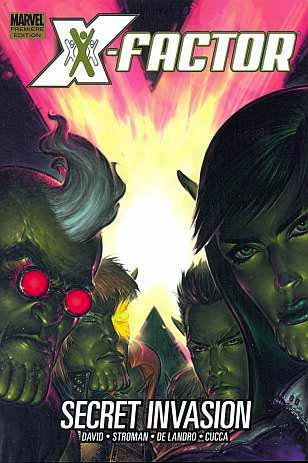
X-Factor, v. 6: Secret Invasion

Collects: X-Factor v. 3 #33-8 and She-Hulk v. 2 #31 (2008-9)

Released: May 2009 (Marvel)

Format: 168 pages / color / $19.99 / ISBN: 9780785128656

What is this?: X-Factor! She-Hulk! Skrulls! Darwin! Longshot! Try and contain yourself.

The culprits: Writer Peter David and penciler Larry Stroman (along with three others)

The math, at least, makes sense: She-Hulk is a second-tier title that had a reason to do a Secret Invasion (a subtle invasion by the shape-shifting aliens, the Skrulls) tie-in despite having little connection to the main plot. She-Hulk is written by Peter David. David also writes X-Factor. Since neither sell phenomenally well (She-Hulk has since been cancelled), make them cross over!

It makes sense, but the final answer, X-Factor, v. 6: Secret Invasion, doesn’t quite come out right. It’s a shame, really.

Jazinda, a Skrull, is She-Hulk’s sidekick. She and She-Hulk bull their way into Detroit (X-Factor’s new home town!), where the talisman of Skrull victory, a figure just below the Skrull gods, is hanging out, waiting for the war to begin (or end, perhaps). Why Detroit? you might ask. Why not Detroit? Not everything has to happen in New York … admittedly, everything does have to happen in America or within 100 miles of its northern border.

X-Factor, v. 6: Secret Invasion coverWhat’s amazing is what David manages to get out of the crossover. Admittedly, I expected nothing good to come of it, and he’s writing both ends of the story. But given how his story seems shoehorned into the cracks of the Secret Invasion event, it’s very readable. Not the plot, so much; that feels as if David said, “Plot? Who’s concerned about plot at this late stage in Secret Invasion?” No, it’s the characters that make the story readable and fun. The characterization of the X-Factor members doesn’t feel forced: it feels like a normal issue. The same goes for She-Hulk and Jazinda, although I’m not a big fan of Jazinda, and She-Hulk is in a “not playing well with others” stage. Darwin, introduced in Ed Brubaker’s wretched X-Men: Deadly Genesis, seems to flail around, but that seems to be his role: the person confused by everything as the plot revolves around them, and unable to do much about it.

What doesn’t help is Larry Stroman. He teamed up with David on his acclaimed ’90s X-Factor run. Unfortunately, it’s not the ‘90s any more, and his distorted style makes the characters look more like refugees from Marvel Apes, at times, than humans or Skrulls. It’s … not good, not good at all. Figures are distorted, exaggerated, twisted, and stripped of their differences, and not in a good way. It’s impossible for me to evaluate the work of Valentine de Landro, Nelson, and Vincenzo Cucca, who each contribute an issue; after Stroman’s work, anything looks good.

The second half of Secret Invasion is much better. The real Longshot, from Chris Claremont’s long X-Men run, is dropped into the cast, and the team’s reactions are both funny and spot on. The story is mainly an excuse to drop him and Darwin into the cast and see what happens; meanwhile, subplots aplenty advance satisfactorily, and there’s an unexpected twist at the end. Madrox’s development in particular is going in directions I didn’t expect.

Secret Invasion is a poor jumping-on point for new readers, not so much because it would leave them confused but because they would be put off by Stroman’s art or grow attached characters who might not be around for much longer (Darwin and Longshot). Even She-Hulk readers are unlikely, I think, to jump over to X-Factor, even if it’s continuing after She-Hulk has been cancelled. But it’s another of those books that reward the readers, the ones who are watching the development of the characters and appreciate all those character jokes.

The value of Secret Invasion lies not so much in its intrinsic qualities as it does in how Peter David manages to get excellent returns on a cast and idea I wouldn’t have bet would last a year. And that’s so amazing we lose track of how amazing it is.

Rating: X-Men symbol X-Men symbol X-Men symbol (3 of 5)

Labels: , , , , , , , , , , ,

19 May 2009

X-Men: Messiah CompleX

Collects: X-Men: Messiah CompleX, Uncanny X-Men #492-4, X-Men # 205-7, New X-Men v. 2 #44-6, and X-Factor #25-7 (2007-8)

Released: October 2008 (Marvel)

Format: 352 pages / color / $29.99 / ISBN: 9780785123200

What is this?: A massive X-Men crossover in which the X-Men, Marauders, Cable, Bishop, and the Purifiers all fight over the first mutant baby born since M-Day.

The culprits: An accomplished crossover crew, including writers Ed Brubaker, Mike Carey, Peter David, Chris Yost, and Craig Kyle and pencilers Billy Tan, Chris Bachalo, Humberto Ramos, and Scot Eaton

I haven’t read much of the X-Men titles since the “House of M” event — haven’t read anything other than X-Factor and Astonishing X-Men, really, since Grant Morrison left New X-Men. (Also: X-Men: Deadly Genesis, which left me less than eager to read anything else with Ed Brubaker’s fingerprints on it.) But my local library’s getting in all sorts of titles, and this gives me a chance to read X-Men: Messiah CompleX and feel like a Usenet dino.

X-Men was better in the old days! Well, I’ve got that out of my system now.

X-Men: Messiah CompleX cover For those of us who have been away, Messiah CompleX (man, do I hate that terminal capital “X”) is not a jumping on point. It sets up plots for the foreseeable future, yes, but it’s an exercise in clearing out the old. If you’re coming in with no knowledge of the X-Men — or if your knowledge is out of date — you’re going to be a little confused. Who are these New X-Men, and what can they do? Why are they so angry? Why do they die so easily? And why was Cable thought dead? Why does Bishop have a superplane? What happened to Cyclops’s father? There really aren’t any footnotes, although some of the information is given in context (eventually) and some of it doesn’t matter. Still, the New X-Men seem bolted onto the crossover awkwardly, and they aren’t very well explained, despite playing an important part in the crossover.

If you’re looking for action, Messiah CompleX has it. A new mutant baby is born —the first since the Scarlet Witch decreed “No more mutants” — and all the groups concerned with mutants want the baby: the X-Men to protect it, Mr. Sinister’s Marauders to control it, the Purifiers to kill it, the intensely stupid “Predator X” to eat it, and Cable to take it to the future. This gives rise to an intense level of action: the fighting is nearly non-stop, with numerous casualties. By the end, there’s a very real possibility the reader will be numb to the carnage; the number of mutants who are dead, dying, or deactivated is astonishing, given the restricted number of mutants at today’s Marvel.

The coordination of the crossover is a cut above what I’m used to; perhaps Marvel learned something about how to make the edges more seamless during the past decade. Writers Ed Brubaker, Peter David, and Mike Carey and New X-Men co-writers Craig Kyle and Chris Yost do an admirable job writing a story in which the chapters and characterizations don’t contradict each other. This is partly because the big revelations from the ancillary titles, X-Factor and New X-Men, largely happen in those titles. Still, everyone seems to do at least a passable job with the other writers’ characters, and that’s a real accomplishment.

I never thought I’d see the day when Chris Bachalo and Humberto Ramos would be penciling half a major X-Men crossover. Both are good artists but decidedly non-standard; I don’t think either is particularly “hot,” the kind of sought-after artist who makes the lists on Wizard. I’m not sure whether this represents a changing aesthetic on the X-titles or if it’s attributable to the X-titles’ loss of prestige over the years.27 As I said, both are decent artists, with Bachalo keeping his more eccentric tics under control this time around. I can’t tell whether Xavier disappearing at the end is an art mistake by Bachalo or a plot point, though. Ramos … Ramos is an artist who divides fans, and with good reason. I think his exaggerated figures are better suited for a more lighthearted title — I think he was a good fit for Paul Jenkins’s Spider-Man work a few years ago — but Messiah CompleX is not lighthearted at all. I believe Ramos can do serious stuff, but there are times his characters look more comically panicked than stressed, and his tough guys (and gals) will never look as tough as a more realistic artist’s.

The other half of the art is from Scot Eaton, who draws Forge as Robert Downey, Jr., and Billy Tan. The contrast between the two halves is extreme. Tan and Eaton draw a shiny, glossy world where everyone is pretty and even the dirt is attractive, and Bachalo and Ramos create a misshapen setting where even the bondage models are strangely offputting. All of them do a good job — well, except perhaps Marc Silvestri, who’s even more pretty and streamlined than Tan or Eaton in the Messiah CompleX one shot and manages to draw Wolverine with a hint of androgyny — but the differences are startling. Personally, for this crossover, I think I prefer Bachalo and Ramos’s side of the divide, since this is a gritty, not pretty, story. This flies in the face of my usual preference for attractive, clean art, but I realize that’s not appropriate for every comic book.

The blurb on the back cover quotes IGN as saying Messiah CompleX is “easily the best X-Men crossover in a decade.” Assuming the quote is in context — and Marvel has a bit of history of using out-of-context quotes — they’re not exactly setting the bar very high, are they? They’re competing against “Endangered Species,” which ran as backups in the books in 2007; “Eve of Destruction,” which led to the Morrison / Casey reign on the X-Titles; “Dream’s End,” the swan song to Chris Claremont redux; the Apocalypse crossovers of 1999; and various late ‘90s forgettables such as “Hunt for Xavier” and “Magneto War” and various two-parters. “Operation: Zero Tolerance” sneaks in as well; “O:ZT” is one of the few major crossovers during that span, and it’s one of the prime reasons the X-titles shied away from the megacrossovers. None of them will ever be held up against “Mutant Massacre” or “Fall of the Mutants” as a high point of the X-Men. Hell, I wouldn’t say any of them were any better than “X-Cutioner’s Song” of ’92-3, although I admit I haven’t read “Endangered Species.”

As a volume, Messiah CompleX is mediocre — it misses the sweet spot between ultraviolence and story development by a decent margin. It does, however, deliver violent action until you can’t stand it no more. As a statement, a manifesto, it’s much better. It puts a violent, definite end to the past and says the future will be different, something at odds with the directionless wandering of the last few years or the warmed-over Claremont that marked the ‘90s. Whether that future will be better (or even readable) remains to be seen.

Rating: X-Men symbol X-Men symbol X-Men symbol (3 of 5)

Labels: , , , , , , , , , , , ,

17 April 2009

X-Factor, v. 5: The Only Game in Town

Collects: X-Factor #28-32 and X-Factor: The Quick and the Dead (2008)

Released: February 2009 (Marvel)

Format: 144 pages / color / $15.99 / ISBN: 9780785128632

What is this?: X-Factor deals with losing Layla and Rahne as Mutant Town becomes the Middle East Side.

The culprits: Writer Peter David and pencilers Pablo Raimondi and Valentine de Landro

See, this is more like it.

I said in the previous review I generally like writer Peter David’s work, and then I proceeded to point to more negative than positive reviews. But X-Factor, v. 5: The Only Game in Town shows the form I enjoyed from David.

Despite David’s conflicts with editorial in his first X-Factor run, he plays well with continuity. When Marvel gives him a lemon of a storyline like M-Day — the number of mutants is reduced to 198, and no more are being born — David takes the idea and does something with it while other writers decide, you know, that’s not a very interesting idea.

X-Factor, v. 5: The Only Game in Town coverBut there is an interesting idea there, and David, who set X-Factor in the heart of the mutant population explosion, is ideally positioned to explore it. As the team tries to figure out how to get Layla back and Rahne is sent to X-Force by editorial (she leaves without explaining, both because X-Force is supposed to be secret and her joining is probably not a logical idea), the characters are forced to accept that the Grant Morrison-era “mutants are everywhere” stories are over, and Mutant Town dissolves into the Middle East Side. As everything falls apart, the team pulls together and battles … um, Arcade, which shows David still has a subtle touch with the absurd.

There’s humor aplenty, even as things get serious; I particularly enjoyed M’s remark about Three’s Company as a way to defuse an obvious misunderstanding between Siryn and Madrox. It never gets too silly, even with Arcade as a villain; the danger feels real throughout — and even at the end. The characters are sharp, well defined, and never confused with each other. There’s little decompression, and there’s enough action to keep the story from being a five-minute dash through talking heads. The subplots move forward and are dealt with as necessary; no one is forgotten, not even the dead.

Really, it’s pretty much what you want from a superhero comic. No, you’re not going to forget Alan Moore, but it’s good enough to inspire touchiness when someone says the phrase “just a superhero story.”

Two minor quibbles: First, I don’t like the cover for this one at all; M is almost unrecognizable, and Strong Guy looks like Zombie Guy. And two, the Quick and the Dead issue feels … not inconsequential, not padded — well, maybe padded or maybe oddly paced. After I read it, it seemed like a ten-page backup story, but re-reading it and counting the pages, it’s clearly a full-length story. An important one, as well, as Quicksilver’s story comes full circle.

Pablo Raimondi and Valentine de Landro each provide about half the art: Raimondi pencils and inks #28, 31, and Quick and the Dead, while de Landro pencils the rest. I slightly prefer Raimondi, but both are good despite the occasional shortcomings. Raimondi has a bit of stiffness to his figures that hampers the action scenes, but that’s not a major problem, and de Landro has a few twisted limbs and overexaggerated features in his art as well. I have to give editors Aubrey Sitterson and Will Panzo credit for teaming two artists whose work, while not exact duplicates, are similar enough not to clash in the collection.

Game holds the excitement of continuity handled well. (Perhaps that’s the problem with his run on She-Hulk; it’s largely separated from most of the Marvel Universe.) At the end, David seems to have freed himself of the baggage Marvel editorial has saddled him with, and the decks are mainly clear. But even if they aren’t, I’m sure David will be able to make fun new X-Factor stories. And I look forward to them.

Rating: X-Men symbol X-Men symbol X-Men symbol X-Men symbol (4 of 5)

Labels: , , , , ,

26 September 2008

X-Factor, v. 4: Heart of Ice

Collects: X-Factor #18-24 (2007)

Released: March 2008 (Marvel)

Format: 168 pages / color / $17.99 / ISBN: 9780785123606

X-Factor gives me hope for the future of She-Hulk.

Peter David writes both titles, and although there’s a great deal of difference between the two — solo book vs. team, title that’s new to David vs. a return to an old critical triumph — X-Factor is yet another example of what David is capable of. X-Factor, v. 4: Heart of Ice shows off the wit, plotting, and long-term thought that made David’s decade-long run on Incredible Hulk so enjoyable.

X-Factor, v. 4: Heart of Ice coverThe first part of Heart of Ice is top-notch stuff. Spinning out of the virtually ignored consequences of House of M / Decimation, a group of depowered mutants called X-Cell are using terrorism to get answers, revenge, and power. Jamie Madrox’s X-Factor, self-proclaimed guardians of New York’s Mutant Town, set out to stop X-Cell. Not only does David shape a plot that logically flows from ideas other Marvel writers created but were unwilling to touch, but he manages to further his own plots and characterizations with it. The banter is sharp, especially between arch teammates M and Siryn. The reaction of Layla Miller, whose only power is to “know stuff,” upon discovering something she doesn’t know is hilarious, and it makes the year and a half suffering through the smug character worthwhile. Rahne wars with her instinctual wolfen side, and Richter deals with another beating he could have prevented if he had his powers and a romantic subplot that is almost 20 years old (just after X-Tinction Agenda, although if you don’t know about that loose end, it won’t affect your enjoyment of the scene).

The main plot for #21-4 is less successful, revolving around Huber, a man who can hear the thoughts of all mutants and has all their powers. When there were thousands, the cacophany of thoughts in his head drove him mad. Now that there are fewer than 200 mutants, his plan is to draw them all together and eliminate them all, ending his torment. Although his plan is interesting, I never warmed to the character — it seems like a cheat for a character as afflicted and powerful as Huber to pop up out of nowhere, and his design is somewhat lackluster. In the end, Huber seems like a distraction for more interesting things: the essential wrap up of Quicksilver’s and Layla’s stories, a pregnancy scare, a pair of anti-mutant child vocalists called the Purity Singers, and a child-custody investigation. The dialogue is good, the action keeps the story moving, and the revelations keep coming, but in the end, Huber seems too much deus ex machina and too little personality or wit to carry the story.

I’m not sure what to make of Siryn getting shot, making this at least the third time she’s been severely injured since X-Factor’s relaunch (and the second time in this volume). I don’t know what David has against her, although if you were to pick a target to hurt repeatedly, you’d have to choose between her and Wolfsbane (Richter is human and thus too fragile, Madrox’s duplicates do get killed frequently, Layla’s a child, and M and Guido are too resistant to small-arms fire).

Art duties are split between Koi Pham, who pencils #18-20, and Pablo Raimondi, who draws #19-23. (It’s unclear who’s responsible for #24; it looks like Raimondi but the credits say “art assists” were given by Valentine de Landro and Drew Hennessy.) Both do good work, and although their styles are distinct, they mesh well enough Heart of Ice avoids the usual penciller-switch whiplash. Pham’s style is rougher and not as detailed, but his flabby, depowered Blob is especially memorable. Raimondi has a smoother style that takes advantage of shadow with excellent effect, although at times the shadow seems a little too pronounced. As I mentioned above, I think he could have established a more striking visual for Huber; Colossus with a cloak and one of Cyclops’s eyes doesn’t seem as quite as interesting as it could be.

I enjoyed this volume, and though I’m looking forward to more X-Factor, I know it won’t be this team; Messiah CompleX put an end to that. But I’m sure it will still be entertaining.

Rating: X-Men symbol X-Men symbol X-Men symbol (3 of 5)

Labels: , , , , ,

16 September 2008

December Marvel Solicits

Speaking of Marvel’s December solicitations, here are the books I’m thinking of getting, which means that these books will probably be reviewed on the site:

  • The aforementioned Runaways, v. 8: Dead End Kids, although they don’t call it v. 8. How long has it been since v. 7? Forever? (Actually since April 2007. Somehow it took more than a year and a half to publish six issues.) I suppose getting Dr. Horrible’s Singalong Blog was worth some of that wait, but geez, Whedon — have you heard of a deadline, or is that something that only the other Marvel writers have to deal with?
  • X-Factor, v. 5: The Only Game in Town. Peter David is doing quite well with this title, and I’m eager for another volume. My review of v. 4 is coming up in a few weeks. I’m a little peeved there seems to be no plan to reprint X-Factor #25-7 — or if there is, I don’t know what it is. [EDITED: I see now it’s part of the X-Men: Messiah CompleX TPB. I thought TPB was entirely made of backup stories, but I see now I was thinking of Endangered Species.] Once there was a time when it would have been unthinkable that I would have been so out of touch with the status quo of the X-Books, but now, there’s nothing strange about it at all.
  • Amazing Spider-Girl, v. 4: Brand New May. I keep buying the TPBs from the Amazing Spider-Girl, but I can’t read them until I catch up on the original Spider Girl series, so there won’t be a review for quite a while. Marvel hasn’t published a digest in a year. They will have published three of Amazing TPBs in that time. From June 2006 to October 2007, they published four Spider-Girl digests. Don’t leave me hanging, Marvel!
  • Powers, v. 12: The 25 Coolest Dead Superheroes of All Time. Another volume of Powers. I’m assuming this one will be published as scheduled; other collections from this series keep getting delayed because Oeming and Bendis can’t be bothered.

What about you readers out there in the Sub-Etha Network? What will you buy? Do you have recommendations for reviews? I can’t promise I’ll actually buy them, but I might find a way to get the books to review it (interlibrary loan is a wonderful tool).

Labels: , , , , , ,

04 July 2008

X-Factor, v. 1: The Longest Night

Collects: X-Factor #1-6 (2006)

Released: February 2007 (Marvel)

Format: 144 pages / color / $14.99 / ISBN: 9780785118176

The germ of the latest X-Factor series was the Madrox miniseries, in which Jamie Madrox, the Multiple Man, ran a detective agency using the skills gained through his many duplicates.

But X-Factor, v. 1: The Longest Night is a different beast altogether. Between Madrox and X-Factor was the Decimation, reducing mutant numbers to about 200, and X-Factor picks up the plot — the only title to do so, really. Former mutants are angry and afraid; anti-mutant bigots come into Mutant Town to kick some of the mutant butt. Rictor, a former member of X-Force and the New Mutants, contemplates suicide before Madrox and his colleagues take him in.

 coverThe core of this X-Factor is from Peter David’s run on the original X-Factor: Madrox, Wolfsbane, and Strong Guy. Also part of the team are M, of Generation X, former X-Forcers Siryn and Rictor, and Layla Miller, a kid who “knows things.” They are opposed by the mysterious and well-heeled Singularity Investigations.

David’s plots are grim, with riots, savage beatings, and murders, although the most horrifying thing might be Layla constantly wandering around saying she knows things. David keeps things from getting too grim, using his customary wisecracking dialogue. And that’s the appeal of any David comic: the dialogue and the characters. He picks up Strong Guy, Wolfsbane, and Madrox as if his X-Factor run was only a few months ago rather than 15 years ago. M’s arrogance comes across well, although it cracks a bit too often for the first storyline; Rictor mainly mopes along. I’m not fond of Siryn’s new persuasion powers, and I’m not convinced by David’s handling of the character. Layla is annoying, but I’m sure she’s supposed to be.

I’m not a big fan of the art, supplied by Ryan Sook and Dennis Calero. They use a heavy line for outlines but are often sketchy with the details. This gives the characters a somewhat blank look, which with all the violence, death, and weirdness is not the right approach. I also don’t like their take on Wolfsbane, who looks more bestial than previously. There’s also a social worker who has a wide-eyed, unfocused look about her that makes her appear as if she took a big gulp of the joy juice.

Despite the art — and its not that bad, not really — this is much better than the previous book by David that I read. It’s well worth your time.

Rating: X-Men symbol X-Men symbol X-Men symbol X-Men symbol 4 of 5

Labels: , , , , ,