Reviews of trade paperbacks of comic books (mostly Marvel), along with a few other semi-relevant comments / reviews.

15 March 2013

X-Factor Visionaries: Peter David, v. 1

Collects: X-Factor v. 1 #71-5 (1991-2)

Released: November 2005 (Marvel)

Format: 144 pages / color / $15.99 / ISBN: 9780785118725

What is this?: The U.S. government forms a new mutant team: X-Factor.

The culprits: Writer Peter David and artist Larry Stroman


Peter David’s run on X-Factor is much beloved, and in X-Factor Visionaries: Peter David, v. 1, Marvel’s first trade paperback reprinting David’s run, it’s easy to see why. It isn’t a masterpiece, as some would have it; however, it’s a very good example of a comedy / superheroic mashup.

Before David took over X-Factor with #70, the book had concentrated on the adventures of the original five X-Men, who had distanced themselves from the team after team founder Professor Xavier left for space and the X-Men welcomed former archvillain Magneto into their ranks. When Xavier returned, Magneto fell out of the picture, and longtime Uncanny X-Men writer Chris Claremont was ousted from the book, the line was reorganized. New Mutants had already become X-Force; the members of X-Factor returned to Uncanny X-Men, which spun off the adjectiveless X-Men title to handle all the mutants. Wolverine remained Wolverine. That left only X-Factor to be dealt with.77 To his great credit, editor Bob Harras turned the title over to David, who made it a humor title.

 coverDespite David’s success on Incredible Hulk, David’s direction on the higher-selling X-Factor must have felt like a terrible risk. Not only did David take the mickey out of the X-books’ traditional heavy-handed angst, he did it with a lineup of second stringers: a pair of B-list X-Men (Havok and Polaris), a former New Mutant (Wolfsbane), a B-list Avenger (Quicksilver), a guy who had been hanging around the fringes of the X-books for almost two decades (Madrox the Multiple Man), and a guy who was a bodyguard to C-lister Lila Cheney (Guido, who gets his “Strong Guy” name here). You can get less star power in a team book published by Marvel or DC, but I can’t figure out how, exactly.

But David’s humor is top notch. The breadth of David’s humor is incredible78: wordplay, throwaway references to pop culture (liaison Val Cooper mentions her FBI agent brother, Dale — Dale Cooper being the protagonist of the then-current Twin Peaks), running gags, physical humor, funny dialogue … he even uses puns in a way that won’t make you want to strangle him. Every issue is funny, and every character is funny in his or her own way.

That’s not to say there aren’t serious moments; David’s run would not have been so fondly remembered if it had only been an outlet for David’s particular brand of humor. Characters face their own traumas and hang-ups, overcome their crises. When a reporter mentions mutants keep returning from the dead, Wolfsbane retorts that her “first love” is in the grave. Over several incidents, Madrox is forced to admit the duplicates he makes of himself aren’t just cannon fodder to be discarded whenever he wants. Although it’s early days for the title, David gives warning that he is willing to put his character though the wringer and examine their heads afterwards — all while maintaining that sense of humor.

I have few quibbles about the writing. David begins the gathering of the team already in progress in #71, and I don’t think that works very well; it feels as if something’s missing or being taken for granted. Professor Xavier’s insistence that Havok take the job as X-Factor’s leader for political and public-relations reasons is laughable, given how poorly he and the X-Men have always fared on that front. (No matter what Havok does, he can’t make a shovelful of difference in the hole the X-Men have dug fur themselves.) The Nasty Boys and their political backer are extremely forgettable villains for the first arc, especially given how little X-Factor does on their government jobs in five issues.

For real objections, though, I have to turn to the art. X-Factor’s pencils are by Larry Stroman, and he’s … he’s not my favorite artist, to say the least. I had hoped Stroman’s art would grow on me like Bill Sienkiewicz’s New Mutants work did, transforming my opinion from “horrid” to “acceptable” to “fantastic.” But it was not to be: I can’t stand his exaggerated style with lumpy heads and Muppet mouths and bulbous bodies. His fight scenes — which David gives him few of, admittedly — are weak, at best. At times I find it tough to look at his pencils.

And if I have one more protest — one not related to the content — it’s the price. Sixteen dollars for 144 pages? That’s a dime a page, more than double what the original issues went for. Five issues for $16 comes out to more than $3 per issue, triple the original price, although #75 is a double issue. You can pick up used copies of Peter David, v. 1, cheaply, but still: that’s a steep asking price.

Peter David, v. 1, isn’t perfect; no book is. But despite its flaws, it should be part of every X-fan’s library.

Rating: 4.5 of 5 X-Men symbol X-Men symbol X-Men symbol X-Men symbol Half X-Men symbol

Labels: , , , , , , , , , , ,

31 October 2008

Essential Marvel Horror, v. 1

Collects: Ghost Rider #1-2, Marvel Spotlight #12-24, Son of Satan #1-8, Marvel Two-in-One #14, Marvel Team-Up #32 and 80-1, Vampire Tales #2-3, Haunt of Horror #2 and 4-5, Marvel Premiere #27, Marvel Preview #7 (1973-7, 1979)

Released: November 2006 (Marvel)

Format: 608 pages / black and white / $16.99 / ISBN: 078512196x

Essential Marvel Horror, v. 1 gained its name, I was convinced when it was released, because Marvel was too squeamish to publish Essential Son of Satan (or Children of Satan).18

Marvel Horror features two protagonists: Daimon Hellstrom, Son of Satan, and his sister, Satana. Hellstrom, being a square who sides with “humanity” over “the forces of evil,” gets the bulk of the book, but his darker sister gets her share at the end. Unfortunately, the shift in tone and style between these two is likely to spin the reader’s head around like that girl’s in The Exorcist.

Essential Marvel Horror, v. 1 coverHellstrom is a rarity: an academic hero. (Ray Palmer is a professor; are there other superheroes who work for a university?) In his Marvel Spotlight series, he battles his father’s forces in St. Louis while being affiliated with Gateway University; in his Son of Satan series, he goes to work for the University of the District of Columbia. I prefer the Spotlight issues, written by Steve Gerber; they were consciously superheroic, with Hellstrom fighting a new supernatural menace each month and trying to keep the squares in St. Louis from learning about it. Why St. Louis? I don’t know, but it’s no goofier than fighting demons in New York City.

(Plus, Hellstrom transforms into his demonic alter ego by raising both hands with three fingers pointed upward, making the sign of his demonic trident. Yeah, right — laziest transformation ever.)

The eponymous title, which was mostly written by John Warner, seemed more crowded and more blatantly supernatural, treading ground already trammeled. Thematically, yes, it’s appropriate, but it’s less enjoyable, trying to tread the ground between the superheroes and Marvel horror mags.

And then there are issues of Marvel Team-Up and Marvel Two-in-One, the superheroist of the Marvel superhero comics. Hellstrom got his start in Ghost Rider, which wasn’t a straight superhero comic but was never incredibly far from it.

Gene Colan is perfect for this subject matter; unfortunately, he only does two issues. The other superhero artists … not so much. Not even one of my favorite superhero artists, Sal Buscema, really does the subject justice. On the other hand, they draw demons better than later artists, especially those involved in the Inferno crossover, who believed evil was best represented in Technicolor.

Satana, Daimon’s sister, was featured mainly in Marvel horror magazines. These stand out against the crowd; they are serious, drawn for a mature audience who doesn’t want to see superheroes. The plots are dark, and while they might not match the top of the horror market, they have a unified goal and show us the horror of a child of Satan gone wrong (or right, from Satan’s point of view). Not bound by the Comics Code or its usual kiddie audience, Marvel let the creators have free rein in subject matter and format, occasionally publishing illustrated texts that described Satana’s deeds.

I’m not entirely sure Chris Claremont, who wrote the bulk of the Satana stuff, was the right person for the job, for two reasons. One, his overwrought writing style, which was only beginning here, is more suited to the less serious and self-conscious superhero comics. And two, this is dangerous for him; Claremont loved writing powerful women, and in his later days, became obsessed with certain … well, let’s say tropes, because “fetishes” is a loaded word.

I won’t say the art in these issues are better, but I will say they are striking, while the Comics Code constrained the others so they were quite forgettable. Straying outside their usual bullpen for Satana’s stories, Marvel published contributions from international artists. Their work is moody, dark, vivid even in black and white. These issues really make the volume, and it’s a shame the rest of the book contrasts so sharply with it.

Since it’s Halloween, I’m legally required to answer this question: Is it scary? Well, the Hellstrom parts are decidedly not so. Marvel has neutered most of its dread evil Lords of the Afterlife and all of its demons so superheroes can fight them. The Satana parts? Let’s just say they feel nothing like a superhero story, with a definite sense that evil might win. That’s not enough to rescue the volume as a whole, however.

Rating: Angry pumpkin symbol Angry pumpkin symbol (2 of 5)

Labels: , , , , , , , , , , ,

29 April 2008

Wonder Woman, v. 2: Love and War

Collects: Wonder Woman v. 3 #6-10 (2007)

Released: September 2007 (DC)

Format: 128 pages / hardback, color / $19.99 / ISBN: 9781401214876

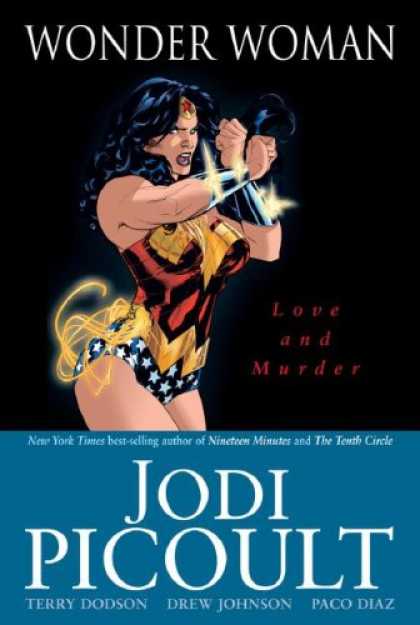
This is the second Wonder Woman book I checked out from the Carrier Library. The big draw for Wonder Woman, v. 2: Love and Murder, judging from the cover, is that it is written by New York Times bestselling author Jodi Picoult. The name means nothing to me; more interesting is that Picoult claims in her introduction to be only the second woman to write Wonder Woman.

That can't be right, can it? But I guess it is. Strange. Well, how does this woman put her feminine mark on Wonder Woman?

 cover That's difficult to say. (Picoult tried to get rid of Wonder Woman's traditional bustier, but DC nixed that.) I'm not scholar enough or in touch with my feminine side to definitely say what's feminine or not. There's romance of a sort. A central conflict is between Wonder Woman and her mother; another is between Wonder Woman, the good girl, and Circe, the wicked wanton.

But it's also a story that has been firmly — and somewhat awkwardly — shoehorned into DC continuity, as a lead-in to the Amazons Attack miniseries. I have heard nothing good about that storyline, and from what I see here, that's not surprising.

Love and Murder starts with Wonder Woman as Diana Prince, agent of the Department of Metahuman Affairs. She's teamed with the shapeshifter Nemesis on an assignment to capture Wonder Woman, but something's fishy with Nemesis and Diana's boss, and Circe brings Wonder Woman's mother, Hippolyta, back from the dead while tormenting Wonder Woman in Washington, D.C., for some reason. And then there's a lot of fighting.

(I have to ask, do all Wonder Woman storylines end with a nuke pointed at Themiscyra? Because this is the second Wonder Woman book I've read, and it's the second time someone's tried to bomb the Amazons' island back into the Stone Age.)

There's a lot to like in this book. The government conspiracy angle is nicely done, although it's slightly abbreviated. The flirting between Nemesis and Wonder Woman / Diana Prince is fun to watch, but I'm not sure I believe it between these two characters; Wonder Woman is a pillar of goodness but slightly reserved, from all the indications I've received; Nemesis is morally gray at best, and shapeshifters are rarely trustworthy. Still, these elements make the first three issues enjoyable enough.

And then the emphasis shifts to the resurrected Hippolyta going nuts and attacking Washington, D.C., and all my interest goes out the window. The attack seems so arbitrary; Hippolyta's reasons for attacking Man's World against the advice of Athena (that tells you something there) are never fully brought out, making her a baffling (and uninteresting) cypher. Circe's plan seems so ... overinvolved, and it goes for naught — or seems to — when she monologues in front of the wrong people. Somehow, Love and Murder was transformed from a simple, enjoyable little story into a mess.

The art is from three different teams; Terry and Rachel Dodson are the featured team, but they only provide the art for issues #3 and 4. The Dodsons deliver what they always deliver: clear art and characters with prominent noselines and breastlines. Drew Johnson and Ray Snider, with the help of Rodney Ramos, do a credible Dodson imitation for #1 and 2 -- or I should say their art, while being distinct from the Dodsons', does mesh very well. Paco Diaz, who does the art chores for #5, is a departure from the rest of the book. On one hand, that doesn't matter, since by that point the story has devolved into a fight scene completely separate from the rest of the story, but Diaz doesn't do the best work with the fighting. Diaz does well with the battle royale scenes, giving a sense of the scale of the conflict away from the main players, but in the individual scenes, his bodies are often awkwardly positioned.

Perhaps it's my lack of knowledge of DC that makes me dislike this story, but the whiplash nature of the mid-book story change means I really can't recommend it to anyone.

Rating: Wonder Woman symbol Half of a Wonder Woman symbol (1.5 of 5)

Labels: , , , ,