Reviews of trade paperbacks of comic books (mostly Marvel), along with a few other semi-relevant comments / reviews.

28 April 2012

Marvel Firsts: The 1970s, v. 1

Collects: Amazing Adventures #1, 11, and 18; Savage Tales #1; Marvel Spotlight #1-2 and 5; Marvel Feature #1, Marvel Premiere #1; Tomb of Dracula #1; Hero for Hire #1; Combat Kelly & the Deadly Dozen #1; Outlaw Kid #10; Gunhawks #1; The Cat #1; Shanna the She-Devil #1; and Monster of Frankenstein #1 (1970-3)

Released: January 2012 (Marvel)

Format: 392 pages / color (except one b-&-w story) / $29.99 / ISBN: 9780785163800

What is this?: The first issues of the hottest new comic books that early 1970s Marvel has to offer.

The culprits: Too many to list, but writers Roy Thomas and Gary Friedrich show up a lot, as does artist Mike Ploog.


Grab-bag books, like Marvel Firsts: The 1970s, v. 1, are a tough sell. I think most readers are looking for a book united by plot rather than looser themes, such as date or character. Still, I was looking forward to reading the stories included in Marvel Firsts.

I have read many of the stories before in the first volumes of Essential series: Killraven (Amazing Adventures #18), Tomb of Dracula (#1), Power Man (Hero for Hire #1), Ghost Rider (Marvel Spotlight #5), Defenders (Marvel Feature #1). Still, the other stories held some interest. The book, I hoped, would give a glimpse into how Marvel was trying to expand its line in the first few years of the 1970s.

The collection kicks off with Amazing Adventures #1, which seems as natural an idea as there could have been in the Marvel Universe at the time: a book with a Black Widow story and an Inhumans story. It’s a good start, too, with the Inhumans story written by Stan Lee and drawn by Jack Kirby; the Black Widow story is drawn by John Buscema. But from there, Marvel goes in a different direction; there are only three more straightforward superhero stories included: the Defenders in Marvel Feature #1, the Cat in The Cat #1, and Power Man in Hero for Hire #1, and even Hero for Hire isn’t a pure superhero title, as tinged as it is by the Blaxploitation genre.

Marvel Firsts: The 1970s, v. 1 coverThe two major genres Marvel was pushing into at the time were horror and westerns. On the horror side, Tomb of Dracula #1 started a long-running title, and it is the best story in the book; it’s hard to read the tale, with Gene Colan‘s atmospheric pencils, and not want to know what comes next. Monster of Frankenstein #1 is a less successful attempt to revive a 19th-century classic monster; whereas Tomb of Dracula leaps from the end of Stoker’s novel to the ‘70s, with Dracula being an active character in the book, Monster of Frankenstein is set at the end of the 1800s, and the monster is inanimate throughout. A quicker start would have helped generate interest. Rounding out the Universal movie monster troika is the Wolfman — well, “Werewolf by Night,” in Marvel Spotlight #2. It’s a competent story, playing on themes of family, curses, and the animal inside, but unlike Tomb of Dracula, it doesn’t have Colan’s art to balance its typically ‘70s wordiness.

Some might consider Ghost Rider a superhero (all right, he is), but his origin in Marvel Spotlight #5 is definitely a horror story — horrific deaths, Satanic rituals, a flawed deal with the devil, a curse … yep, that’s horror, no matter how nonsensical the plot is. I’m lukewarm on Mike Ploog‘s art, but the visuals are striking. Savage Tales #1 is a simple but satisfying black-and-white story featuring the first appearance of Man-Thing, written by Roy Thomas and Gerry Conway. (They also collaborated on Tomb of Dracula #1.) Marvel used the magazine format to get impressive art from Gray Morrow; I was familiar with Colan, but Morrow’s art caught me pleasantly by surprise. Conway so liked the idea of a scientist using a formula on himself to keep it from falling into the wrong hands that he used it again in Amazing Adventures #11, in which the X-Men’s Beast transforms himself into a hairy monster. Beast was a hero before his solo stories and a hero after he embraced his transformation, but this is a horror story — right down to a “what have I done?” moment.

The Western was back in the early ‘70s, but there was less variety in the content than there were in the horror stories. Your options were a conflicted Native American (Red Wolf in Marvel Spotlight #1), a former slave and slave owner teaming up (Gunhawks in Gunhawks #1), or a young white guy (Outlaw Kid in Outlaw Kid #10). As you might guess, the books with non-white protagonists are painfully earnest and at times a bit uncomfortable. For instance, Marvel Spotlight #1 is full of pseudo-Indian mysticism, with little to recommend it but the race of Red Wolf, its protagonist. I don’t doubt that some slaves, like Reno Jones in Gunhawks, were treated well enough they might fight against their own interests and hold no ill will against their former masters. But in the long term, it’s problematic — Reno is atypical, and his own self-image eventually has to reflect that. Still, the story of young gunslingers Reno and Kid Cassidy is the most entertaining of the Westerns, with some nice banter between the leads, and Reno and Kid are treated as equals. Outlaw Kid #10’s cover promises a “Western Spider-Man,” and it delivers: the young Outlaw Kid takes on corruption in his home town in a mask, making him seem like a criminal, against the wishes of his blind, pacifist father. It doesn’t catch the magic of Spider-Man, but that’s a high standard, and Outlaw Kid is mostly inoffensive.

Other genres in the book include war, jungle, and sci-fi comics. Combat Kelly and the Deadly Dozen, a Sgt. Fury spinoff, shows why war comics were on the way out, despite the cast’s racial diversity and the inclusion of a female soldier. (Of course, the cast is much too large, and the woman ties her uniform shirt at her sternum to expose her midriff.) Shanna the She-Devil is fine but seems mostly an excuse for George Tuska to draw exotic animals and a woman wearing a leopard skin swimsuit. (Shanna made the outfit herself from a leopard massacred in her zoo so that she could gain “sight-scent recognitions with [the leopard’s] cubs.” Grisly.) Marvel Premiere #1 is nearly as exciting as you would expect a sci-fi story featuring Adam Warlock and the High Evolutionary gabbing to be. Amazing Adventures #18 sets up Killraven’s War of the Words backstory with remarkable efficiency and imagination, although some of its trappings come across as ridiculous today (and I suspect did in 1973, as well).

You would think Marvel would hardly need an excuse to praise their diversity in genre, gender, and race. But they don’t, and that’s my biggest disappointment with Marvel Firsts. I wanted introductory essays. I wanted context. I wanted timelines, charts, figures — something to pull this disparate set of comics together. It didn’t have to be elaborate; it just needed to exist. There is a little provided; each issue gets a flat sentence or two about the title, date, and character (“Amazing Adventures #11, published in December 1970, switched focus from Black Widow and the Inhumans, becoming the first ongoing series for a heavily revamped Beast, formerly of the X-Men”). Between the chronologically ordered issues are pages showing the covers of Marvel’s contemporary new series, with a brief sentence about each (usually, genre, title, date, and whether it was a reprint series). Still, I would like to know more. When did these series end? How many issues did they last? Was there anything interesting about them — I mean, is there a good reason the cover of humor comic Harvey #1 looked like Archie with Marvel trade dress pasted on it? I’d be willing to pay a bit more for this, or Amazing Adventures #18 could have been shifted to Marvel Firsts: The 1970s, v. 2.

As a random slice of Marvel at one of its most diverse times, Marvel Firsts: The 1970s, v. 1, is pretty impressive. I haven’t harped on it, but it’s remarkable how many of the protagonists aren’t just the same old white guys; Black Widow was an established character who got her own series, and the Cat (later Tigra), Power Man, and Shanna the She-Devil were created for their series. At least three members of the Deadly Dozen were not white (and one was not male), and Reno Jones of Gunhawks and Red Wolf weren’t white either. Most of these characters fell flat on their faces — only Power Man kept his series for very long — but you have to applaud Marvel for trying.

It’s unfortunate that most of the art and writing in Marvel Firsts cannot match the best of Marvel at the time, but given that many of these titles shifted their emphasis frequently or were second-tier to begin with, it’s understandable the top talent weren’t assigned to these stories, and those who were weren’t inspired to turn in their top work. It’s also sad that Conan the Barbarian #1 couldn’t be included because of legal reasons (not that the book mentioned this). And I wish there would have been more context. But it’s not wise to focus on what isn’t here; what is here is a collection of frequently enjoyable stories — although occasionally that enjoyment comes from how badly the stories have aged (or how badly they were told in the first place).

Rating: 2.5 of 5 Marvel symbol Marvel symbol Half Marvel symbol

Labels: , , , , , , , , , , , , , , , , ,

31 May 2011

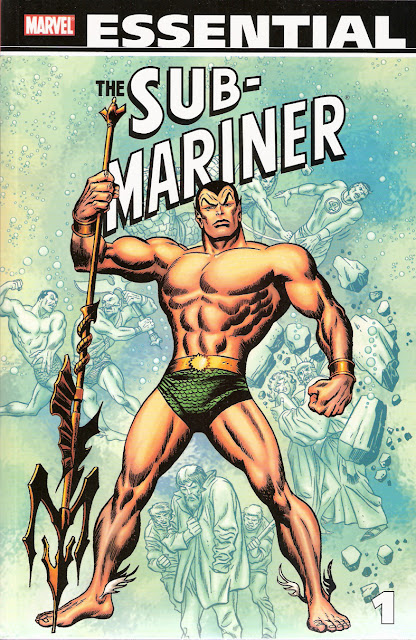
Essential Sub-Mariner, v. 1

Collects: Tales to Astonish (Namor stories only) #70-101, Daredevil #7, Tales of Suspense #80, Iron Man & Sub-Mariner (Namor story only) #1, and Sub-Mariner #1 (1965-8)

Released: September 2009 (Marvel)

Format: 504 pages / black and white / $19.99 / ISBN: 9780785130758

What is this?: Prince Namor deals with love and challenges to his oft-neglected throne. Imperious Rex!

The culprits: Writers Stan Lee, Roy Thomas, and others and artists Gene Colan, Bill Everett, and others

I picked up Essential Sub-Mariner, v. 1 because I had a big old Namor-shaped hole in the middle of the heart of my Silver Age library, and I was excited to fill it. Turns out, I would have been better off having open-Silver Age surgery.

Namor the Sub-Mariner, prince of Atlantis, is not a Silver Age creation of Stan Lee and his talented group of co-creators; Namor was created in the Golden Age, back in 1939 by Bill Everett. Lee, never one to let a good idea go fallow, picked up Namor in Fantastic Four #4 (not reprinted here) and plopped him into the new Marvel Universe as a major player, giving him his own kingdom (Atlantis) and an unrequited romance with Sue Storm. Both Namor’s desires to conquer the surface world and / or bed Sue Storm were both pushed to the side after a few years, about the time Namor got his own feature in Tales to Astonish.

Essential Namor, v. 1 coverWhat Essential Sub-Mariner collects is the Namor stories from Tales to Astonish; the title had formerly been an anthology series and had been converted, like Strange Tales and Tales of Suspense, into superhero comics featuring two different heroes in their own tales. Namor shared Astonish with another headstrong brute, the Hulk, but the two never met in the title they cohabited. If they had, they would have made Tales to Astonish the most redundant title of redundancy.

Hulk and Namor are surprisingly similar characters. Namor might not be a green, gamma-irradiated brute, but he is a hot-headed thug whose answer to most problems of statecraft is to punch something. This is not a problem — Sir Punch-a-Lot is a character note that a lot of superheroes have carried off gracefully — but it doesn’t do a lot of favors to the character either, since it doesn’t set him apart from the pack.

What is interesting and unique about Namor? The Atlantean setting is the only unique part of Namor stories, although he shares the weight-of-leadership character note with Black Panther. To me, the latter is the more interesting, as “Atlantean” is generally portrayed as “fighting sharks and submarine monsters,” and Namor also has the burden of being a half-blood prince. He is half human, half Atlantean, and it would be understandable if many of his subjects found a prince of “impure” blood unacceptable.

But that’s not goes on Sub-Mariner; instead, Namor is nominally the ruler of Atlantis, while he spends almost as much time on dry land as he does in Atlantis. He is overthrown by Warlord Krang and Byrrah; he is challenged by the barbarian leader Attuma. He turns into a tyrant on one of the occasions he is returned to the throne. Does he have to politick? Do the people have any say about who rules them? (Well, they do when Byrrah takes over, and Namor’s lack of empathy with his people is brought out.) But mostly Atlantis is a waterlogged Banana Republic, with revolutions and counter-revolutions happening almost daily. It’s almost enough to make one’s head spin.

One gets the feeling that Lee is plotting by the seat of his pants and not doing as well as he usually did. The twelve-page stories don’t help, but the stories switch between multi-part stories (as in Namor’s pursuit of Krang and his estranged love, Dorma) and throwaway stories — insults from the surface world, another challenger for his kingdom, etc. Without a prolonged emphasis on what makes Namor different, it all runs together. Roy Thomas’s attempt to build some interest in Namor by exploring his origin, which serves as a cliffhanger for the book, isn’t enough to to hook me. (So to speak.)

The art is an interesting mix, although none of them get across the underwater element of Atlantis very well. Bill Everett, who created Namor in the Golden Age, drew several issues, and his art, although updated, resembles comics from World War II more than those of his younger colleagues. An issue or two from Jack Kirby, king of the Silver Age (and, to some, all comics), shows a contemporary look for the prince of Atlantis. About half the issues are drawn by Gene Colan, though, and that’s a welcome sight. Colan isn’t the artist he would be later in his career when he drew Daredevil and Tomb of Dracula with such a shadowy flair, but he’s very good, and and his work here is a harbinger of the Bronze Age to come. Whether it’s right for Namor is another question, but by the end of Essential Sub-Mariner, it’s certainly very pretty to look at.

The timing of the Essential Sub-Mariner’s release is almost assuredly a sign it is regarded by Marvel as a book for completists. While the almost all the other prominent Silver Age titles (with the exception of Nick Fury, Agent of SHIELD and Howling Commandos have at least one volume out and usually many more, Namor is bringing up the rear — trailing behind the Human Torch and Ant-Man, for Heaven’s sake. The forgettable contents of Essential Sub-Mariner do nothing to dispel that impression.

Rating: Marvel symbol Half Marvel symbol (1.5 of 5)

Labels: , , , , , , ,

07 August 2010

Essential Tomb of Dracula, v. 4

Collects: Stories from Tomb of Dracula Magazine #2-6 and Dracula Lives! #1-13 and Frankenstein’s Monster #7-9 (1973-5, 1979-80)

Released: March 2005 (Marvel)

Format: 576 pages / black and white / $16.99 / ISBN: 9780785117094

What is this?: A chronological retelling of Dracula’s life, from Marvel’s pre-1980 stories (except Tomb of Dracula)

The culprits: Too many to list; includes Marv Wolfman, Mike Friedrich, John Buscema, Gene Colan, and Gerry Conway

The release of Essential Tomb of Dracula, v. 4, was a bit of a surprise, given that the previous three volumes had completely collected the comic book series. But Marvel still had some vampire material lying around — mostly from black and white magazines it published in the ‘70s — so they bundled those stories together into another, presumably final, volume.

One aspect of v. 4 that sets it apart from other Essentials is that rather than reprinting the stories in the order they were published, Marvel ordered them by when they occurred in the life of Dracula, the central character. After reading through the stories, this is not only the better way to organize the stories but really the only way; Dracula Lives, for instance, published stories of Dracula’s past as one feature and a continuing serial of his present as another in the same issue. To publish those in periodical order would have split the present-day stories, ruining the flow.

Essential Tomb of Dracula, v. 4, coverOrdering the stories this way works best if there is a narrative flow to them. Other than that present day feature, however, there is none. Worse yet, there seems to be no real plan behind Dracula’s reign of Euroterror. Dracula attacks and attacks and attacks; occasionally, he is attacked. Despite his claims to nobility and character, Dracula is constantly at the mercy of his animal nature. However, Dracula never seems to own up to this, and there is really no one to call him on it. Worse, there seems to be no consequence to the stories. New vampires are created and disappear before the next story. Dracula is staked and returns to unlife for the next tale.
After going through Dracula’s first few centuries, it’s easy to feel there’s no point to his stories — it’s just rehashing the same plot points over and over. There are few horror-comic plot twists or really cruel endings for Dracula’s victims, as if the writers feared making Dracula too awful.

Then there are the slips on vampire lore. Chirping about continuity problems on most comics can be seen as nitpicking, but the weaknesses and restrictions on Dracula and other vampires are part of popular culture. Does Dracula need to be invited inside a home? Sometimes, but not always. How long does it take for a vampire to rise from the grave? Everyone, including Dracula, says three days, but frequently they arise the next night. How effective are crosses — can Dracula attack someone with a cross, or does he need to have a proxy attack? Sources vary. Running water poses no problems; occasionally, no thought is given to the coffin filled with earth Dracula needs to rest in. How much power does daylight have — does it destroy a vampire, like decapitation, or does it merely immobilize the vampire, like a stake? Dunno. And this is putting aside things like Dracula not using his hypnotism or turning into mist or other errors in tactics.

But I don’t want to dwell on the negative, because I’m a negative person and have truly impressive negative dwelling skills. “Bounty for a Vampire,” by Tony Isabella and Tony DeZuniga, is an effective and nuanced Weird Western from Dracula Lives #13, with a former marshal who has seen weird things hunting vampires in Transylvania. Peter Gillis and John Buscema’s story of a ballet dancer who loses her humanity and empathy (“Pavanne from an Undead Princess,” Tomb of Dracula Magazine #5) is the most moving story in the collection. “A Death in the Chapel” from Dracula Lives #6 features the final combat of Dracula and Father Montesi, the discoverer of the vampire-destroying Montesi Formula. The continuity and continuing stories in Frankenstein’s Monster #7-9 (by Mike Friedrich and Buscema) and the modern tales in Dracula Lives! was a welcome respite from the episodic stories that dominate the collection. And although the story in “The Pit of Death” by Doug Moench and DeZuniga (Dracula Lives #10-1) didn’t make much of an impression on me, the protagonist’s revenge on Dracula was nicely innovative.

Also, Marvel does include some supplementary material to the collection. There is a prose recap of Dracula’s history near the beginning of v. 4, and there is an extensive cover and promotional image gallery near the end. Gene Colan’s original pencils from unused pages of Tomb of Dracula #70-2, which were collapsed into #70 when the title was canceled, are included for those who wondered how the story might have ended up had Colan and Wolfman been allowed a little more space for the stories.

The art, overall, is uneven, but Dracula art from Colan is always welcome. Colan contributed seven stories that appear in the collection, most of them in the book’s second half, and they are uniformly highlights — shadowy, evocative, with a Dracula who is simultaneously bestial and suave. Buscema drew the three issues of Frankenstein’s Monster, and although those issues are not going to go down as his greatest, they are John Buscema drawing Dracula, Frankenstein’s Monster, and shapely gypsy women, and there’s nothing wrong with that; his pencils on other stories in the collection, such as “Death Vow” (inks by Klaus Janson) from Tomb of Dracula Magazine #4, are more impressive, evocative and as shadowy as Colan’s work. Other artists who manage to convey more than a modicum of horror or menace include DeZuniga and Vicente Alcazar in “Here Comes the Death Man” in Dracula Lives #7.

Still, those enjoyable parts can’t really save the book. There’s a lot of repetition and stories that just aren’t worth the time. Also, the reproduction on v. 4 is strangely murky, making it difficult to read. I would have thought that since the original material was originally from black-and-white magazines, that wouldn’t have been a problem, but I was wrong.

The question you have to ask yourself is: how much do you want Gene Colan and John Buscema stories? If the answer is a lot … well, you might want to buy the original magazines. But if that isn’t an option and you still want to see them and are willing to wade through a lot of forgettable Marvel vampire stories, buy this book. Otherwise … borrow it from a vampire fanatic and skim it.

Rating: Marvel symbol Half Marvel symbol (1.5 of 5)

Labels: , , , , , , , , , , , , , ,

28 August 2009

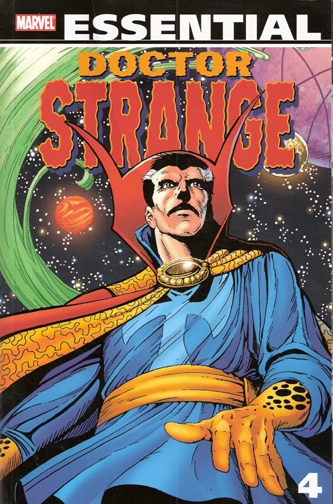
Essential Dr. Strange, v. 4

Collects: Dr. Strange (v. 2) #30-56 (1978-82)

Released: June 2009 (Marvel)

Format: 584 pages / black and white / $19.99 / ISBN: 9780785130628

What is this?: Dr. Strange battles foes old and new and deals with Clea actually getting a personality

The culprits: Writers Roger Stern, Chris Claremont, and others; artists Gene Colan, Marshall Rogers, and others

I expected to be underwhelmed by Essential Doctor Strange, v. 4. I usually am underwhelmed by Dr. Strange stories, despite being a fan of the character. I think most Marvel fans are underwhelmed by Strange; it’s why everyone thinks a Dr. Strange series is a good idea but no one buys them .

But v. 4 surprised me, after a rough start. The book certainly has the pedigree to succeed; Roger Stern, who was at his peak with early ‘80s Marvel, writes most of the book, while Chris Claremont writes eight stories (#38-45) and the included Man-Thing story. Stern feels like the better fit. He’s remembered for writing Spider-Man, who’s a solo hero, like Strange. Claremont is known for his legendary X-Men run, which doesn’t seem to have much in common with Dr. Strange at all. But it’s Claremont, who wrote #38-45, who really gets things going in v. 4.

Essential Dr. Strange, v. 4 coverIt’s through a typical Claremontian concern for female characters. Under Claremont’s pen, Clea, Strange’s lover and disciple, realizes she has learned somewhere between jack and squat from Strange, despite being raised in a more magical dimension. She draws the wrong conclusion from this — that she’s a bad student, rather than Strange being an indifferent-to-incompetent teacher — but at least it breaks the status quo and gives us a reason for Clea’s relative insignificance in magical battles. Claremont also develops Wong a little — well, mainly his forebears, but it’s something.

Claremont also introduces new magical enemies who look like Native Americans and gives Strange a business manager, Sara Wolfe, who’s both a woman AND a Native American. This reminds us that even when Claremont was at the height of his powers, not all his ideas were winners.

Stern gets the beginning (#30-7) and end (#47-56) of the book. His first run is a running battle between Strange and the Dweller in Darkness’s goons, and Strange never does figure out who is behind his assailants. The story ends abruptly, with the Dweller making a unilateral declaration of a nebulous, non-physical victory, as Stern leaves. His exit was probably the reason for the sudden stop — Stern had already switched to plotter (Ralph Macchio scripts) with #33 — but frankly, it had become dull even before then. Stern’s exit was a mercy killing. The only interesting bit is Stern reusing a character from a minor story from an issue of Chamber of Chills, but even that was done haphazardly.

When Stern returns, though, he picks up with Claremont’s disaffected Clea (and drops almost everything else). He introduces a romantic rival for Clea, which finally gives movement to Strange’s static personal life. He also brings back Mordo, one of the go-to villains for strange. Really, Mordo’s just there for credibility; the magician could have been anyone. But Mordo (and eventually Dormammu) lead Strange back through time on a great series of stories (#50-3) that brings in Sgt. Fury and his commandos, Nazis, the Fantastic Four, and Rama-Tut and ends with Clea leaving Strange. Another story has D’Spayre trying to convince Strange he’s a fictional character, even introducing him to Stan Lee and Steve Ditko analogues. In the final issue, Strange plays with former minions of Mordo who thought they were being clever. It’s a strong finish to the book, and it makes me eager for v. 5.

On the other hand, having such expectations of consistent quality is a recipe for disappointment. On the other other hand, the Unofficial Handbook of the Marvel Universe says the next 20 or so issues are Stern teamed up with artists Paul Smith (who did a great job on #54 and 56) and Dan Green with a few others.

Adding even more to the plus side, Stern also has Strange and Clea engage in a rather suggestive “tantric exercise,” which Clea describes as “wonderful” and one she wants to try “more often.” So points to Stern for that. On the other hand, Stern kills a cat. So no perfect score for him either.

The pencils are primarily from Gene Colan and Marshall Rogers. Both are excellent choices. Few artists in Marvel’s stable did shadowy and spooky like Colan, who excelled at it on Tomb of Dracula and Daredevil. (To be fair, Marvel’s bright spandex world didn’t need it so often.) But he does an excellent job here (#36-45, 47), atmospheric and moody and occasionally frightening. His Strange frequently looks a bit too much like his Dracula for my tastes, but they don’t cross over so there’s no confusion, and they’re both imposing, handsome figures, so that’s OK. He uses darkness effectively, so that the reader always suspects something horrible is about to come from the shadows. That expectation is frequently greater than any actual horror inspired by the creatures on the page, but I blame that on the rather plain demons and adversaries Stern and Claremont give him. The black-and-white reproduction doesn’t help him either; with no color to help the shading, his work occasionally looks blotchy.

I am shocked that I enjoy Rogers’s pencils, given how unimpressed I was with his work in Batman: Strange Apparitions. His run (#48-53) is shorter than Colan’s, which is a shame. His style is completely different than Colan’s; while Colan eschews clear lines and his characters look like they can find shadow in a desert at noon, Rogers’s work is clear and bright, even in black and white. His art looks more modern than his contemporaries’, and some of the panels in this look like something that could have been created in the ‘90s, except Marshall has a command of anatomy and exaggerates physical attributes only slightly. Rogers’s Mordo is impressive, full of menace. His work in #53, in which Strange breaks down after Clea announces she’s leaving, is heartbreaking.

I didn’t expect to enjoy Essential Dr. Strange, v. 4. After the first ten issues, I really didn’t, despite the beginning of Colan’s run. But the story grew on me, and the art, more than the writing, won me over. By the end, though, Stern was putting together an impressive run, and I’m looking forward to finding out if he continued it.

Rating: Dr. Strange symbol Dr. Strange symbol Dr. Strange symbol Half Strange symbol

Labels: , , , , , , , ,

31 October 2008

Essential Marvel Horror, v. 1

Collects: Ghost Rider #1-2, Marvel Spotlight #12-24, Son of Satan #1-8, Marvel Two-in-One #14, Marvel Team-Up #32 and 80-1, Vampire Tales #2-3, Haunt of Horror #2 and 4-5, Marvel Premiere #27, Marvel Preview #7 (1973-7, 1979)

Released: November 2006 (Marvel)

Format: 608 pages / black and white / $16.99 / ISBN: 078512196x

Essential Marvel Horror, v. 1 gained its name, I was convinced when it was released, because Marvel was too squeamish to publish Essential Son of Satan (or Children of Satan).18

Marvel Horror features two protagonists: Daimon Hellstrom, Son of Satan, and his sister, Satana. Hellstrom, being a square who sides with “humanity” over “the forces of evil,” gets the bulk of the book, but his darker sister gets her share at the end. Unfortunately, the shift in tone and style between these two is likely to spin the reader’s head around like that girl’s in The Exorcist.

Essential Marvel Horror, v. 1 coverHellstrom is a rarity: an academic hero. (Ray Palmer is a professor; are there other superheroes who work for a university?) In his Marvel Spotlight series, he battles his father’s forces in St. Louis while being affiliated with Gateway University; in his Son of Satan series, he goes to work for the University of the District of Columbia. I prefer the Spotlight issues, written by Steve Gerber; they were consciously superheroic, with Hellstrom fighting a new supernatural menace each month and trying to keep the squares in St. Louis from learning about it. Why St. Louis? I don’t know, but it’s no goofier than fighting demons in New York City.

(Plus, Hellstrom transforms into his demonic alter ego by raising both hands with three fingers pointed upward, making the sign of his demonic trident. Yeah, right — laziest transformation ever.)

The eponymous title, which was mostly written by John Warner, seemed more crowded and more blatantly supernatural, treading ground already trammeled. Thematically, yes, it’s appropriate, but it’s less enjoyable, trying to tread the ground between the superheroes and Marvel horror mags.

And then there are issues of Marvel Team-Up and Marvel Two-in-One, the superheroist of the Marvel superhero comics. Hellstrom got his start in Ghost Rider, which wasn’t a straight superhero comic but was never incredibly far from it.

Gene Colan is perfect for this subject matter; unfortunately, he only does two issues. The other superhero artists … not so much. Not even one of my favorite superhero artists, Sal Buscema, really does the subject justice. On the other hand, they draw demons better than later artists, especially those involved in the Inferno crossover, who believed evil was best represented in Technicolor.

Satana, Daimon’s sister, was featured mainly in Marvel horror magazines. These stand out against the crowd; they are serious, drawn for a mature audience who doesn’t want to see superheroes. The plots are dark, and while they might not match the top of the horror market, they have a unified goal and show us the horror of a child of Satan gone wrong (or right, from Satan’s point of view). Not bound by the Comics Code or its usual kiddie audience, Marvel let the creators have free rein in subject matter and format, occasionally publishing illustrated texts that described Satana’s deeds.

I’m not entirely sure Chris Claremont, who wrote the bulk of the Satana stuff, was the right person for the job, for two reasons. One, his overwrought writing style, which was only beginning here, is more suited to the less serious and self-conscious superhero comics. And two, this is dangerous for him; Claremont loved writing powerful women, and in his later days, became obsessed with certain … well, let’s say tropes, because “fetishes” is a loaded word.

I won’t say the art in these issues are better, but I will say they are striking, while the Comics Code constrained the others so they were quite forgettable. Straying outside their usual bullpen for Satana’s stories, Marvel published contributions from international artists. Their work is moody, dark, vivid even in black and white. These issues really make the volume, and it’s a shame the rest of the book contrasts so sharply with it.

Since it’s Halloween, I’m legally required to answer this question: Is it scary? Well, the Hellstrom parts are decidedly not so. Marvel has neutered most of its dread evil Lords of the Afterlife and all of its demons so superheroes can fight them. The Satana parts? Let’s just say they feel nothing like a superhero story, with a definite sense that evil might win. That’s not enough to rescue the volume as a whole, however.

Rating: Angry pumpkin symbol Angry pumpkin symbol (2 of 5)

Labels: , , , , , , , , , , ,

02 April 2006

Essential Dr. Strange, v. 2

Collects: Doctor Strange v. 1 #169-178 and 180-183, Avengers #61, Sub-Mariner #22, Marvel Feature #1, Incredible Hulk #126, Marvel Premiere #3-14 (1968-74)

Released: March 2005 (Marvel)

We are blessed to live in a time when Marvel reprints so much of its material, from both its current output and its back catalog. The Essential program is especially impressive, reprinting:

  1. The A-List Talent. Seven volumes of the Amazing Spider-Man, for instance, and five volumes of Fantastic Four, as well as five Essential Avengers and … well, I could go on.
  2. The Second Stringers. Those who can sustain several series for a little bit or one for a long time. Power Man, who’s getting a second volume soon, or the Defenders, who are due.
  3. The No Hopers. Or classic runs, if you prefer. (I don’t prefer.) These guys can’t hold down a book to save their lives: Killraven, Iron Fist, Monster of Frankenstein, Ant Man.

Dr. Strange fits firmly in the second list. The Sorcerer Supreme of Marvel Earth, battling magicians, extradimensional horrors, and gods, he’s been around since the Silver Age, had several series (and had several series cancelled), and is an integral part of the Marvel Universe. But how did he achieve that status? Other than being created by Stan Lee and Steve Ditko, of course.

The Essential Doctor Strange, v. 2, keeps Strange’s status as a Marvel mainstay a mystery.

Volume 2, logically enough, picks up where volume 1 left off: Strange Tales morphs into the first volume of the eponymous Dr. Strange comic. Volume 2 contains Dr. Strange #169-178 and 180-3 (#179 was a reprint), Avengers #61, Sub-Mariner #22, part of Marvel Feature #1, Incredible Hulk #126, and Marvel Premiere #3-14. There are two things that scream a warning in this listing: one, that there are so many guest appearances / crossovers included, and two, that Dr. Strange headlined Marvel Premiere. No good can come from either.

The first volume was the first Essential that I missed the color: the trippy Steve Ditko art missed something without the psychedelics, but it was still very enjoyable. I still believe Dr. Strange needs color like Ringo needs John, Paul, and George, but I didn’t miss it as much in v. 2 because the stories themselves were so lifeless and difficult to struggle through.

The Essential can be divided into three parts: The Dr. Strange beginnings, the run-up to the creation of the Defenders in the middle, and the Marvel Premiere at the end. The Dr. Strange issues are unremarkable, with Strange fighting the same cosmic entities (Dormammu, Nightmare, even the obscure Tiboro) and new crappy mages (Lord Nekron, the Sons of Satannish) as he did in Strange Tales, and without Ditko’s outstanding and inimitable art, there’s no spark. Gene Colan’s atmospheric pencils should be perfect for Strange, but for some reason, they don’t quite seem to click; perhaps the title needs someone who can pull out the Ditko acid trips every once and a while as showstoppers, and Colan doesn’t do that here. The only positive is that Clea, Strange’s future lover and student, is rescued from extradimensional exile and finally brought into the regular cast. Even that isn’t an unqualified success; Clea and Strange’s attraction seems forced and acted out by rote, and the attempt at a love triangle with an Englishwoman who is attracted to Strange goes nowhere.

The middle segment is the only one that’s very good, although unlike the Essential Defenders, the creation of the Defenders isn’t the focus of those issues — they merely cover what happened while Strange was not headlining a book. The Sub-Mariner issue leads out of the last Dr. Strange issue, Hulk #126 takes over from Sub-Mariner, and the back-up from Marvel Feature #1 leads into the Marvel Premiere (ugh) issues.

Marvel Premiere … ugh. #11-4 are entertaining, with Strange going back in time to fight Baron Mordo and finding a magician greater than either of them. But #3-10 are a listless Lovecraft pastiche that is gutted to be suitable for kiddies and turns into a horrible mess. “The Shadow over Innsmouth” becomes #4-6, the very Lovecraftian name “Shuma-Gorath” is the extradimensional being (read: Elder God) who is manipulating everything, and the cosmic horror Strange fights seems incredibly mundane. “The Living Buddha” even shows up as a villain, and that’s a high point.

The book plummets to a nadir at Marvel Premiere #4-6, the three-part Lovecraftian storyline. (The credits claim to feature “concepts created by Robert E. Howard,” which is bizarre, given Howard got the concepts from Lovecraft.) The issues feature writing from Gardner Fox, not at his best, and art by three different pencillers — Barry Windsor-Smith, Irv Wesley, and Frank Brunner (with help from Sal Buscema). To say the art is inconsistent is a severe understatement; going from Windsor-Smith, a legend (also not at his best, though), to the serviceable Wesley is like hitting a brick wall at 100 mph.

Most jarring is the depiction of the people of Starkesboro; they are described as having the Starkesboro look, which is supposed to inspire unease or revulsion in spectators. Windsor-Smith chooses to give the residents a scaly look that makes them appear part reptile, while Wesley chooses to make them look half-Muppet.

Marvel Premiere must be among the worst Marvel Universe comics of all time. It starts out with two issues of Adam Warlock and goes only downhill from there. Twelve mostly subpar issues with Dr. Strange are followed by 11 painful Iron Fist issues. Then it features a bunch of mostly single-issue heroes that will almost certainly never be reprinted. Looking over a summary of the issues, the only interesting bits seem to be #51-3 — the finale of a Black Panther storyline that stretches over four years and three different titles — and #50, an Alice Cooper story.

(Admittedly, I’ve never read anything other than the Iron Fist / Dr. Strange issues. And if you’re a sci-fi fan, there might be something in the Dr. Who, Weirdworld, Star-Lord, and Seeker 3000 stories. But if the quality of those 23 issues are anything to judge by, the series has more value in the recycle bin than in a long box.)

Anyway, back on task: There’s nothing in the Essential Dr. Strange v. 2 for anyone — except for completists, the curious, and Dr. Strange fanatics (you know who you are, all three of you). Otherwise, give this a miss. It’s not the worst Essential I’ve read — that would be Essential Super-Villain Team-Up — but it’s a chore to read. Grade: D+

Labels: , , , ,