Reviews of trade paperbacks of comic books (mostly Marvel), along with a few other semi-relevant comments / reviews.

12 February 2016

Skull the Slayer

Collects: Skull the Slayer #1-8 and Marvel Two-in-One #35-6 (1975-6, 1978)

Released: April 2015 (Marvel)

Format: pages / color / $24.99 / ISBN: 9780785193975

What is this?: After surviving a plane crash in the Bermuda triangle, a Vietnam vet, a physicist, his assistant, and a wealthy white teenager encounter a weird world with dinosaurs and aliens.

The culprits: Writers Marv Wolfman, Steve Engelhart, and Bill Mantlo and artists Steve Gan, Sal Buscema, and Ernie Chan


In 1975, Marv Wolfman finally persuaded Marvel to publish a series that he’d had simmering in his mind for years, a series with a bold premise: readers would hate every character, but to distract them, the artist would include dinosaurs.

That wasn’t really the premise. Wolfman’s idea has a former soldier leading a group of plane-crash survivors around a mysterious island in the Bermuda Triangle, where they have to deal with dinosaurs, aliens, and all manner of strange mysteries. But the characters’ unlikeability will remain my lasting memory of Skull the Slayer, a mid-’70s Marvel series with more ambition than continuity or ability, long after I forget everything else but the dinosaurs.

Skull the Slayer coverThe unlikeable roll call starts with Vietnam vet Jim “Skull” Scully. He’s had a hard time of it: years spent in a POW camp, where his jailors tortured him for information he didn’t have, followed by a sour homecoming where he found his wife shacked up with another man, his parents dead from their worry about him, and his brother strung out. Almost immediately, his brother attacks Scull with a knife, and in the scuffle, his brother is killed. Scully goes on the run, and his arrest in Bermuda leads to him being on the plane that crashes in the Bermuda Triangle.

All that should build a lot of sympathy for Scully, but as soon as he meets the other survivors of the crash, his arrogance comes to the fore. He’s always scuffling with Dr. Raymond Corey, the physicist, over dominance in the group. He scorns the peacemaking of Ann Reynolds, Corey’s assistant, and Jeff Turner, the son of a wealthy Ohio senator. He won’t compromise; all his dialogue is bluster, convinced the entire world, down its smallest molecule, is against him. This is the Marvel template: a hero with ability (Scully kills a dinosaur in #1) but brashness that drives everyone away. In the Marvel style, the hero eventually comes to an understanding with (most of) his supporting cast, toning down his rough edges, but before that happens, he abandons Corey, Reynolds, and Turner to their deaths in #4.

Since Scully is the protagonist, the other characters are supposed to irritate Scully and the readers, by extension. The supporting cast mainly gets broad-stroke characterization, and the writers aren’t afraid to lean on stereotypes when they have to. Corey is highly educated and scorns Scully as a murderer; he’s also African-American, and he admits his frustration with racism that has held him back. Corey’s bitterness drips from every word of dialogue, but he lacks any empathy or vulnerability. Sexism has held back Ann Reynolds, but she often assumes female stereotypes — an obsession for clothes, an injury while running that prevents the others from escaping, etc. Turner is a load with a bad haircut.

Wolfman left the series after #3, so it’s possible he could have planned to soften the characters some. Steve Engelhart, however, took over for #4, and he torpedoed any chance Scully had for likeability by having him abandon his comrades during an escape attempt. This was part of a plan to dump Scully’s supporting cast for a more in-depth investigation of the world Scully found himself in, but #4 was Engelhart’s only issue. Bill Mantlo, who guided the series to its limping end, wrenched the series back in the direction Wolfman had aimed it in by resurrecting and reinstating the supporting cast the next issue. Oops!

Knowing someone abandoned you in the hour of your direst need, and that you actually died because of what they did, would put a crimp in any relationship. Reynolds, Corey, and Turner forgive Scully unimaginably quickly, although they do spend #5 trying to kill him.

Given the characters’ lack of charisma, Skull needed intriguing plots and / or great art to succeed. Skull had a very strong similarity to the TV series Lost: in each, the survivors of a mysterious plane crash find themselves on a weird island with little chance of rescue. (I would pay cash money for a sequel to Skull, with Scully tearfully crying, “We have to go back to the island!”) After the plane crash, the mysteries Skull and his crew uncover on the island include:
  • Dinosaurs (#1)?
  • Why are there prehistoric men (#2)? They didn’t exist at the same time as dinosaurs.
  • Where did that dead alien come from (#2)?
  • And why did he have a magic power belt (#2)?
  • Why were all those human and alien pilots (now skeletons) tied to stakes in one place (#3)?
  • What’s the deal with the tower that has different time periods on each level (#3), all populated with robots?

Those are Wolfman’s plots, with Marv piling weird stuff into the pages without seeming to have an idea of how to resolve them or what the survivors should be doing, other than not being eaten by dinosaurs. Perhaps three issues is too little time to be seeing movement in those areas, although the lack of a plan shows why Scully should not have been the group’s leader.

Engelhart wraps up the last plot in that list — aliens built the tower as part of a plot to conquer Earth at all time periods simultaneously — but then Mantlo ends that plot in #6 with the destruction of the tower. It’s unclear whether the aliens are responsible for the non-tower weirdness on the island — why do aliens care about dinosaurs? — but Mantlo moves on to a faux-Aztec society, another pilot from our world, and societal civil war. Wolfman returns to wrap up everything in two issues of Marvel Two-in-One, but it’s clear he’s sweeping up the pieces in case another writer sees something he likes. Most of those pieces ended up in the trash, though. Wolfman didn’t even bother to salvage (or mention) the pilot from our world that Mantlo introduced.

For readers who like drawings of dinosaurs, though, Skull might be something to investigate. (Evidently not enough of those existed in the mid-’70s.) Steve Gan gets the bulk of the dinosaur duty, drawing #1-3 and #6. His dinosaurs are massive, powerful creatures. Sal Buscema’s arc (#4-8) concentrates on different eras of human history; his work is harmed by the bright colors, but his design for the alien Slitherogue is satisfyingly sinister. (Sure, Slitherogue looks like he’s a Yellow Peril villain, but he’s purple, and from outer space, so it’s OK, right?) Buscema’s less-detailed style suffers compared to Gan’s work; Gan’s linework, especially with its emphasis on the hair and sinew of the figures he draws, is more in keeping with the dirty, more animalistic world the book inhabits. Gan’s Scully is a more vicious, feral man than Buscema’s version, giving the impression that Scully might be a man who fits the island better than he does modern society. Ernie Chan draws the MTiO issues like they are, well, MTiO issues, and the more superheroic look is jarring. The rushed plot does Chan no favors, though.

The series is a brief flash of muddled creativity that never clicks. Readers can probably find bits and pieces that entertain them or that they’d love to see repurposed in something more coherent, and the series’ failure shows how difficult it must have been to keep the mélange of character and mystery plotlines going for so long on Lost. Skull the Slayer is an artifact of the fecund ‘70s, but like a lot of the high-concept ideas that came out of that time, its execution means it isn’t worth reading.

Rating: Marvel symbol Half Marvel symbol (1.5 of 5)

Labels: , , , , , , , , , ,

13 November 2015

Nova Classic, v. 3

Collects: Nova #20-25 and Fantastic Four #204-6 and 208-14 (1978-80)

Released: June 2014 (Marvel)

Format: 304 pages / color / $34.99 / ISBN: 9780785185529

What is this?: The last storyline of Nova’s solo title is diverted into a Fantastic Four plot, then forgotten in favor of something more interesting.

The culprits: Writer Marv Wolfman and artists Carmine Infantino, Keith Pollard, and John Byrne


One of the first superhero comic books I can remember reading is Fantastic Four #208. It was the early ‘80s, and a relative on my mother’s side gave me a stripped copy, without the cover.

The issue didn’t make me a Fantastic Four fan, although years later I was surprised to find the issue was penciled by Sal Buscema, which might account for my affection for his art. What the comic really introduced me to was the Marvel style of story: if you pick up a random issue, you’re likely to be dropped into the middle of an ongoing story that picks up threads from the previous issue and leaves others to be wrapped up by later issues.

Nova Classic, v. 3 coverFantastic Four #208 left me with so many questions. First, who the hell were these people who weren’t the Fantastic Four? Will they save Xandar from the Skrulls? Will the Fantastic Four survive their execution by old age? Can they stop the Sphinx? Is Dr. Sun as awesome as he appears?

So I bought Nova Classic, v. 3, to find the answer to those questions. (I would say that last one deserves a definite “yes,” although I needed to consult Tomb of Dracula to answer it.) Despite the name, Nova Classic, v. 3, is not a Nova book, not really; the last five issues of Nova introduce this trade, but Nova (and his supporting cast) appear in only one of the ten issues of Fantastic Four that close out the book.

To back up a bit: Nova is Richard Rider, a character introduced in his own short-lived ‘70s series (collected in the Essential Nova, one of my earliest reviews). He was created by Marv Wolfman and John Buscema (Sal’s brother) as a Spider-Man / Green Lantern hybrid: a teenager, with real teenage problems, who becomes a superhero by getting the powers of a dying space cop. The series lasted 25 issues and was cancelled mid-storyline in 1979. Fortunately, Wolfman, who was still the writer and editor of Nova, was also the writer and editor of Fantastic Four, so he inserted Nova and his cast in the middle of the then-current Fantastic Four storyline — #208, to bring this review back to the beginning.

In #204 through #206, the Fantastic Four had gone to Xandar to help defend it from the Fantastic Four’s old enemies, the shape-shifting Skrulls. The Sphinx, the villain who gathered Nova and his allies and enemies together for a space trip, wanted to use the computers of Xandar to help him end his immortality. Unfortunately, the Xandarian computers showed him how to gain immense power instead, so he headed to Earth to gain vengeance on his home planet. The Fantastic Four switched adversaries with Nova and his allies.

So Nova Classic, v. 3, is split into two halves, which touch in #208. The Nova plotline sputters out after that. Nova disappears from the book, and the story of the Champions of Xandar, as Nova and his allies are called, defending Xandar is taken over in Rom the Spaceknight (#24). Since Rom is a licensed character, that story has never been reprinted, although IDW recently acquired the comics rights to the character and probably nothing will happen in the reprint realm but we can hope?

Nova itself was not a very good series, and #20-25 are representative in that regard. The issues included have Nova outing himself to his family, which is a nice touch — Richard can’t hide it any more, and we see a brief scene of him dealing with his family’s reactions. But after that, he’s quickly roped into the Sphinx’s shenanigans, and then he’s back to fighting forgettable villains, just like the issues preceding this book. (You don’t see Nova villains other than Sphinx very often, and there’s a reason for that. Marvel also killed the rest of the Champions of Xandar — and Xandar — off panel in Avengers #260.) The only interesting bits in Nova other than Richard and his family dealing with his costumed identity are Dr. Sun facing off against the Sphinx, but that’s a brief scene without a real resolution.

The other half of Nova Classic, v. 3, on the other hand, is a decent-to-good Fantastic Four story. The Fantastic Four are called to aid the Xandarians against the Skrulls. This time, the Skrulls gain the upper hand, and three members of the Fantastic Four are captured and executed — in a sense. The Skrulls subject them to an aging ray, which will kill them in three days. It’s a needlessly cruel way to kill, but it fits the Skrulls and their hatred of the Fantastic Four. The executed heroes then escape and meet up with the Champions of Xandar on Xandar.

Once the Fantastic Four starts pursuing the Sphinx, the storyline gets a little flabby; #209 reads like a well-chosen, well-written fill-in, with the team rounding up escaped space convicts in a spaceship graveyard. It has little to do with the ongoing plot, and it introduces Reed’s idiotic robot HERBIE into the comics. After the Fantastic Four reaches Galactus and tries to convince him to fight the Sphinx, Galactus makes them spend an issue fetching him a herald, which should give the Sphinx time to destroy the Earth a few times over. Still, the individual issues are exciting, and they ramp up the tension nicely. (Except for #209.)

The ending of the storyline is a little weak. Galactus uses an ability I’ve never heard of him using to battle the Sphinx, and the solution to solving Reed, Sue, and Ben’s aging problem is to have Reed solve it after Reed has been declared too weak to do anything. The story does introduce Terrax, though, and it also has a nice Terrax-vs.-the-old-FF fight.

The art improves markedly throughout, going from Carmine Infantino’s scratchy, static drawing to the smooth lines of Keith Pollard (#204-6) and the first Fantastic Four issues drawn by John Byrne (#209-14). (Byrne and Pollard match up pretty well, in fact.) Pollard’s a little weak on the chaotic, hand-to-hand battle royales between the Fantastic Four and the Skrulls, but Byrne shows why he would be associated with Fantastic Four for years; his old versions of the team actually look like they are elderly (albeit elderly people with superpowers), and the Sphinx looks like a credible threat to Galactus. Their fight lacks any cosmic touches, but that’s OK, I suppose.

I think the best way to look at Nova Classic, v. 3, is as a Fantastic Four trade paperback with six issues of Nova bolted on. Unfortunately, $35 for a reprint of a bunch of ‘70s Fantastic Four issues is a bit steep, even if those issues do reprint the first appearance of Terrax and some nice Byrne work.

(And the book is even missing a Fantastic Four issue! In #207, Johnny Storm enrolls in New York’s dumbest college — appropriate, given that Johnny’s pretty dumb himself — and is used by the Monocle, the college’s dean who has used his advanced degree to come up with an imbecilic name, to steal Mr. Fantastic’s inventions. With all that stupidity in evidence, it’s Spider-Man who handily saves the day.)

Despite my affection for Nova Classic, v. 3, I really can’t recommend it unless you’re hunting for a Fantastic Four story that you haven’t read. In that case, it’s going to be a pleasant surprise.

Rating: Fantastic Four symbol Fantastic Four symbol Half Fantastic Four symbol (2.5 of 5)

Labels: , , , , , , , , , , ,

07 August 2010

Essential Tomb of Dracula, v. 4

Collects: Stories from Tomb of Dracula Magazine #2-6 and Dracula Lives! #1-13 and Frankenstein’s Monster #7-9 (1973-5, 1979-80)

Released: March 2005 (Marvel)

Format: 576 pages / black and white / $16.99 / ISBN: 9780785117094

What is this?: A chronological retelling of Dracula’s life, from Marvel’s pre-1980 stories (except Tomb of Dracula)

The culprits: Too many to list; includes Marv Wolfman, Mike Friedrich, John Buscema, Gene Colan, and Gerry Conway

The release of Essential Tomb of Dracula, v. 4, was a bit of a surprise, given that the previous three volumes had completely collected the comic book series. But Marvel still had some vampire material lying around — mostly from black and white magazines it published in the ‘70s — so they bundled those stories together into another, presumably final, volume.

One aspect of v. 4 that sets it apart from other Essentials is that rather than reprinting the stories in the order they were published, Marvel ordered them by when they occurred in the life of Dracula, the central character. After reading through the stories, this is not only the better way to organize the stories but really the only way; Dracula Lives, for instance, published stories of Dracula’s past as one feature and a continuing serial of his present as another in the same issue. To publish those in periodical order would have split the present-day stories, ruining the flow.

Essential Tomb of Dracula, v. 4, coverOrdering the stories this way works best if there is a narrative flow to them. Other than that present day feature, however, there is none. Worse yet, there seems to be no real plan behind Dracula’s reign of Euroterror. Dracula attacks and attacks and attacks; occasionally, he is attacked. Despite his claims to nobility and character, Dracula is constantly at the mercy of his animal nature. However, Dracula never seems to own up to this, and there is really no one to call him on it. Worse, there seems to be no consequence to the stories. New vampires are created and disappear before the next story. Dracula is staked and returns to unlife for the next tale.
After going through Dracula’s first few centuries, it’s easy to feel there’s no point to his stories — it’s just rehashing the same plot points over and over. There are few horror-comic plot twists or really cruel endings for Dracula’s victims, as if the writers feared making Dracula too awful.

Then there are the slips on vampire lore. Chirping about continuity problems on most comics can be seen as nitpicking, but the weaknesses and restrictions on Dracula and other vampires are part of popular culture. Does Dracula need to be invited inside a home? Sometimes, but not always. How long does it take for a vampire to rise from the grave? Everyone, including Dracula, says three days, but frequently they arise the next night. How effective are crosses — can Dracula attack someone with a cross, or does he need to have a proxy attack? Sources vary. Running water poses no problems; occasionally, no thought is given to the coffin filled with earth Dracula needs to rest in. How much power does daylight have — does it destroy a vampire, like decapitation, or does it merely immobilize the vampire, like a stake? Dunno. And this is putting aside things like Dracula not using his hypnotism or turning into mist or other errors in tactics.

But I don’t want to dwell on the negative, because I’m a negative person and have truly impressive negative dwelling skills. “Bounty for a Vampire,” by Tony Isabella and Tony DeZuniga, is an effective and nuanced Weird Western from Dracula Lives #13, with a former marshal who has seen weird things hunting vampires in Transylvania. Peter Gillis and John Buscema’s story of a ballet dancer who loses her humanity and empathy (“Pavanne from an Undead Princess,” Tomb of Dracula Magazine #5) is the most moving story in the collection. “A Death in the Chapel” from Dracula Lives #6 features the final combat of Dracula and Father Montesi, the discoverer of the vampire-destroying Montesi Formula. The continuity and continuing stories in Frankenstein’s Monster #7-9 (by Mike Friedrich and Buscema) and the modern tales in Dracula Lives! was a welcome respite from the episodic stories that dominate the collection. And although the story in “The Pit of Death” by Doug Moench and DeZuniga (Dracula Lives #10-1) didn’t make much of an impression on me, the protagonist’s revenge on Dracula was nicely innovative.

Also, Marvel does include some supplementary material to the collection. There is a prose recap of Dracula’s history near the beginning of v. 4, and there is an extensive cover and promotional image gallery near the end. Gene Colan’s original pencils from unused pages of Tomb of Dracula #70-2, which were collapsed into #70 when the title was canceled, are included for those who wondered how the story might have ended up had Colan and Wolfman been allowed a little more space for the stories.

The art, overall, is uneven, but Dracula art from Colan is always welcome. Colan contributed seven stories that appear in the collection, most of them in the book’s second half, and they are uniformly highlights — shadowy, evocative, with a Dracula who is simultaneously bestial and suave. Buscema drew the three issues of Frankenstein’s Monster, and although those issues are not going to go down as his greatest, they are John Buscema drawing Dracula, Frankenstein’s Monster, and shapely gypsy women, and there’s nothing wrong with that; his pencils on other stories in the collection, such as “Death Vow” (inks by Klaus Janson) from Tomb of Dracula Magazine #4, are more impressive, evocative and as shadowy as Colan’s work. Other artists who manage to convey more than a modicum of horror or menace include DeZuniga and Vicente Alcazar in “Here Comes the Death Man” in Dracula Lives #7.

Still, those enjoyable parts can’t really save the book. There’s a lot of repetition and stories that just aren’t worth the time. Also, the reproduction on v. 4 is strangely murky, making it difficult to read. I would have thought that since the original material was originally from black-and-white magazines, that wouldn’t have been a problem, but I was wrong.

The question you have to ask yourself is: how much do you want Gene Colan and John Buscema stories? If the answer is a lot … well, you might want to buy the original magazines. But if that isn’t an option and you still want to see them and are willing to wade through a lot of forgettable Marvel vampire stories, buy this book. Otherwise … borrow it from a vampire fanatic and skim it.

Rating: Marvel symbol Half Marvel symbol (1.5 of 5)

Labels: , , , , , , , , , , , , , ,

10 June 2009

Essential Spider-Man, v. 9

Collects: Amazing Spider-Man #186-210, Amazing Spider-Man Annual #13-4, and Spectacular Spider-Man Annual #1 (1978-80)

Released: May 2009 (Marvel)

Format: 600 pages / black and white / $19.99 / ISBN: 9780785130741

What is this?: A slice of late ‘70s / early ‘80s Spider-Man that introduced the Black Cat and features the return of the Burglar who killed Uncle Ben.

The culprits: Writers Marv Wolfman and others and artists Keith Pollard, John Byrne, and others

Can you have nostalgia for something you never experienced?

Marvel sure wants you to. The Brand New Day continuity is a direct throwback to the Spider-Man you can find in Essential Spider-Man, v. 9, which reprints Amazing Spider-Man issues from 1978-80. Some readers will remember those days, and long for their return, but most of us only have second-hand evidence those days ever occurred.

The parallels between Brand New Day and v. 9 are striking. In each, there’s no MJ or other steady girlfriends, but there is poverty aplenty, Harry Osborn (and the rest of the supporting cast) hanging around, and a non-J. Jonah Jameson boss supporting Peter’s photography. Other than a healthier Aunt May and no Black Cat in BND, it almost feels like BND writer Dan Slott or editor Tom Brevoort gave pre-publication copies of Essential Spider-Man, v. 9, to the other writers and said, “This is what we’re looking for.”

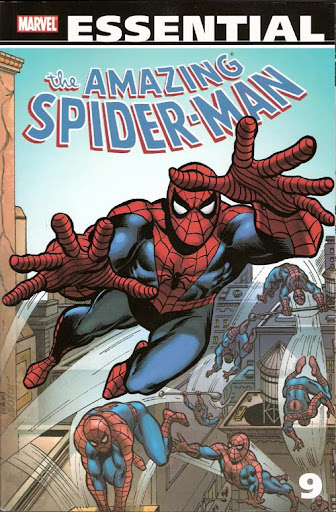
Essential Spider-Man, v. 9 coverAnd v. 9 is at a level of quality the Spider-titles haven’t seen for years, so that would be good, even though I just made that anecdote up. Marv Wolfman, who wrote #186-204, was in a sweet spot in Spider-Man lore here: after the doldrums following Gwen Stacy’s death and leading into the revitalizing run of Roger Stern (who wrote #206). Wolfman brings back the Burglar and gives him a reason to have killed Ben Parker. In an interesting story that shouldn’t work but does, Wolfman slips in an unnecessary retcon, uses Mysterio and the Kingpin as blocking figures, and still writes a story that hits all the important Spider-Man notes, managing to be moving while both using past continuity and advancing the characters.

This is not an empowering book for any female readers. (Any out there? And how can I tell if those chirping crickets are female or not?) Wolfman creates the Black Cat in this volume, which is a mixed blessing; she’s a big part of the ‘80s, but although she comes across as level headed and capable in her first arc, he and David Michelinie portray her as a crazy stalker in the second. Given the way Wolfman writes Betty Brant, as a clingy ex-girlfriend who has to have a man after leaving her husband, no one was going to be giving him any awards for positive portrayals of women. Denny O’Neil, who wrote #206-10 and Annual #14, balances things (a little) by introducing Madame Web, a criminally underused supporting character. But back on the other hand, Peter also treats Deb Whitman, departmental secretary at his graduate college and occasional date, like crap no matter who was writing him.

The villains are among Spider-Man’s best: Electro, Dr. Octopus, Kraven (with Calypso!), Chameleon, the last appearance of Alistair Smythe, Man-Wolf, and the aforementioned Kingpin and Mysterio. Smythe’s attempts to kill Spider-Man and Jameson are especially good; his final plan, which involves strapping both to a bomb, is one of the better Spider-Man stories, and his attempts to use John Jameson to do his dirty work show a man who’s thought about his revenge and decided to make it as cruel as possible. (The strapping Spider-Man and Jameson show a man who has not thought things through completely.)

The long-term subplots in this book lack a satisfying end. Betty Brant’s attempts to win back Peter were wrongheaded to begin with, and Peter’s attempt at getting her to go away was cruel and almost villainous. The resolution to Jameson’s long-running bout of insanity feels … well, stupid, really, but I’ll settle for “rushed.” And Peter’s entire employment at the Globe is contained in this volume; I thought his employment at the Bugle’s competition was cut too short, as his smarmy boss at the Globe offered a nice contrast to Jameson’s fury.

(One more thing: The linked annuals — Amazing #13 and Spectacular #1 — tell a story about Dr. Octopus’s plot to steal a nuclear sub. Wolfman wrote the first part in Amazing Annual, while Bill Mantlo wrote the second. God bless Mantlo — and he should, at least once more — but seeing the two parts juxtaposed like this reveals some … stylistic excesses in Mantlo’s approach.)

Keith Pollard isn’t going to be listed among the top Spider-artists of all time, but he takes the torch handed to him by the likes of Ditko, Romita, and Andru and carries it admirably. His work looks a little like a modified version of Ross Andru’s; if there were an early house style for Spider-Man, Pollard would be an excellent example of it. His Spider-Man is athletic and flexible without being distorted or overstylized, and his supporting characters are all distinct and recognizable. (Of course, most artists could do that in those days.) Pollard also created the Black Cat’s signature costume, which you can take as a criticism or compliment.

John Byrne does a few fill in and annuals, and his work is outstanding — although I enjoyed Pollard, I would have really enjoyed seeing Byrne on Amazing rather than on Marvel Team-Up, where he had worked a little earlier. Byrne’s work in v. 9 is everything his early work was — beautiful, imaginative, stylish. Sal Buscema, Frank Miller, and John Romita, Jr., also contribute excellent work to the volume, as do Jim Starlin, Al Milgrom, Alan Weiss and Richard Buckler. Really, if you weren’t one of the best, Marvel wasn’t going to let you near Amazing Spider-Man (although technically Buckler worked on the Spectacular Annual).

There’s a lot to like in Essential Spider-Man, v. 9. And there’s a decent amount that comes across as lacking. Although I enjoyed the book throughout, I couldn’t shake a nagging feeling that it just missed being great. So it has to settle for good.

Rating: Spider-Man symbol Spider-Man symbol Spider-Man symbol Half Spider symbol (3.5 of 5)

Labels: , , , , , , , , ,

08 August 2008

Essential Spider-Man, v. 8

Collects: Amazing Spider-Man #161-85, Amazing Spider-Man Annual #11, Giant-Size Spider-Man #6, Nova #12 (1976-8)

Released: April 2007 (Marvel)

Format: 512 pages / black and white / $16.99 / ISBN: 9780785125006

I really enjoy older Spider-Man stories — and by that, I mean stories before 1990. Back when Spider-Man’s simple life was very complicated, when the supporting cast was regularly used, when Norman Osborn was dead, when Spider-Man’s rogues gallery cold be taken seriously (even if everyone knew how ridiculous they were) without making them dark and gritty.

Essential Spider-Man, v. 8 cover So I have been a supporter of Marvel’s Essential Spider-Man series (as well as the Essential Spectacular Spider-Man and Essential Marvel Team-Up). The series has now reached Essential Spider-Man, v. 8, a landmark of sorts; this volume markes then end of Amazing Spider-Man runs for writer / editor Len Wein (with #180) and artist Ross Andru (with #185). Andru’s style is almost the epitome of Spider-Man art; like Romita, his Spider-Man is streamlined, sleek but muscled, with no distracting, unnecessary details (like Ditko’s underarm webs — which I like — and McFarlane’s many eccentricities — which I don’t). Andru is best known for his Spider-Man work; this is, in many ways, the apex of his career.

Too bad the stories aren’t quite worthy of him. Spider-Man is always judged by his villains, and there’s a decided lack of quality villainy here. There’s Jigsaw, essentially someone to be the Punisher’s foil; the Lizard-knockoff Stegron; the ephemeral Will o’ the Wisp; the forgettable Dr. Faustus; and a host of even lesser lights. Wein did pull the Kingpin and Molten Man back from obscurity, but I’m not sure making Molten Man Liz Allen’s stepbrother was a wise idea at the time, since he serves more as a complication than a character. Kingpin’s return is welcome, but he’s put out of commission again immediately, and the whole “draining life-force” plot is a little out of place in Spider-Man. (Fine for the Fantastic Four or Superman, though; each is more high-concept sci-fi than Spider-Man.)

Wein succeeds in the subplots. He gives Aunt May a purpose beyond Peter, making her a militant Gray Panther; this doesn’t go very far for later writers. Jameson becomes suspicious about Peter’s secret ID in the aftermath of the Clone Saga; Peter dissuades him distressingly easily. In building another Spider Slayer, Jameson meets Marla, his true love. This is probably most lasting legacy, humanizing Jameson.

Wein’s lone excellent job is a Green Goblin story that introduces the third version of the villain. It’s filled with suspense, drama, and ethical dilemma’s for Spider-Man; it ends with a Green Goblin vs. Green Goblin fight. This was really the last hurrah10 for the Goblin, upstaged by the Hobgoblin a few years later, but Wein and Andru give him a hell of a sendoff.

After a fill-in issue by Bill Mantlo, Marv Wolfman takes over for Wein, and his four issues … well, they ain’t exactly masterworks — Rocket Racer, the Big Wheel, and the somewhat less-than-sociopolitically-correct White Dragon. It isn’t really fair to expect greatness in just four stories, but they don’t help the volume. Wolfman also has Peter fail to graduate for not completing a gym credit — incredibly stupid, I’ve always felt — and writes Mary Jane out of the book before having the married Betty Brant throw herself at Peter.

Compared to a modern comic, there’s a lot going on in this background: Peter and his supporting cast are changing, usually in an interesting way. But Spider-Man … His stories, other than the Green Goblin arc, are nothing exceptional. Spider-Man is reduced to being a co-star for Nova in a crossover, for heaven’s sake. 11

Amazing Spider-Man is going into the doldrums here and in v. 9. It won’t stop me from buying the next volume, but I can’t recommend v. 8 for the non-Amazing Spider-Man fan.

Rating: Spider-Man symbol Spider-Man symbol Half-Spider symbol (2.5 of 5)

Labels: , , , , , ,

16 July 2006

Essential Nova, v. 1

Collects: Nova #1-25, Amazing Spider-Man #171, and Marvel Two-in-One Annual #3 (1976-9)

Released: March 2006 (Marvel)

The character of Nova has been described — or derided — as “Peter Parker as Green Lantern.” That’s not exactly fair: Nova actually does very little in outer space, as Green Lantern does, and he’s not as likeable as Peter Parker.

That being said, his origin is the Green Lantern’s, with an alien policeman giving high-school student Richard Rider his powers as he dies. And just like Peter Parker, Richard has to balance school, family, a social life, and his new heroic life as Nova. Unfortunately for Richard, he’s a dud at school, his family is mostly uninteresting (although nowhere near as annoying as Aunt May in early Spider-Man), his friends are weird, and his girlfriend is no Gwen Stacy or Mary Jane. (Or even Betty Brant, as far as that goes.)

Nova is typical Marvel ‘70s output — solid superhero stories. Although these feel right to me, many readers who do not get the warm fuzzies while contemplating post-Stan Lee and pre-Jim Shooter Marvel may find this book dull. Writer Marv Wolfman does all he can, twisting and turning the plot with as many behind-the-scenes masterminds as he thinks he can get away with: the Sphinx, the Corruptor and the Inner Circle, the Yellow Claw, Dr. Sun. The Sphinx is the only one that can be used without laughter or disgust today (although I like Dr. Sun, a villain of the brain-in-a-jar variety).

But it’s the other villains and heroes that Nova runs into that make this book for me. I have no idea why, but villains like Diamondhead and heroes like the Crimebuster, the Comet, and Powerhouse just seem right. They’re lightweights, sure, but they seem of the Marvel Universe without needing to intrude into other titles. You can well imagine a Crimebuster in Marvel New York without Spider-Man ever having run into him. I suppose what I’m saying is that Wolfman and his artists invented the perfect superpowered second stringers for what ended up as a dead-end book.

The switch from artist John Buscema to Carmen Infantino after #14 was disappointing. Buscema has a lighter pencil and a much cleaner line that works better than Infantino’s work in black and white. Also, the Buscema brothers’ work seems to exemplify ‘70s Marvel to me.

It’s also disappointing that Marvel couldn’t include Fantastic Four #206 and #208-9, an outer-space epic against the Skrulls that wrapped up the stories of Nova and the Sphinx. It’s understandable, given that there isn’t room for those stories; the book is already crammed full, with 26 regular-sized issues and an annual. However, given my druthers, I would rather have had a scaled-down Fantastic Four #206 that had the Nova-related story and #208-9. I’m not sure that would have fit, but it would have been a more satisfying inclusion than the Marvel Two-in-One Annual that featured Nova and the Thing fighting generic outer-space despots.

Overall, though, this was mostly fun, even if it is mediocre. Wolfman manages to wring a good deal of fun out of a character whose origins aren't the most creative.

Grade: C

Labels: , , , , ,