Reviews of trade paperbacks of comic books (mostly Marvel), along with a few other semi-relevant comments / reviews.

12 February 2016

Skull the Slayer

Collects: Skull the Slayer #1-8 and Marvel Two-in-One #35-6 (1975-6, 1978)

Released: April 2015 (Marvel)

Format: pages / color / $24.99 / ISBN: 9780785193975

What is this?: After surviving a plane crash in the Bermuda triangle, a Vietnam vet, a physicist, his assistant, and a wealthy white teenager encounter a weird world with dinosaurs and aliens.

The culprits: Writers Marv Wolfman, Steve Engelhart, and Bill Mantlo and artists Steve Gan, Sal Buscema, and Ernie Chan


In 1975, Marv Wolfman finally persuaded Marvel to publish a series that he’d had simmering in his mind for years, a series with a bold premise: readers would hate every character, but to distract them, the artist would include dinosaurs.

That wasn’t really the premise. Wolfman’s idea has a former soldier leading a group of plane-crash survivors around a mysterious island in the Bermuda Triangle, where they have to deal with dinosaurs, aliens, and all manner of strange mysteries. But the characters’ unlikeability will remain my lasting memory of Skull the Slayer, a mid-’70s Marvel series with more ambition than continuity or ability, long after I forget everything else but the dinosaurs.

Skull the Slayer coverThe unlikeable roll call starts with Vietnam vet Jim “Skull” Scully. He’s had a hard time of it: years spent in a POW camp, where his jailors tortured him for information he didn’t have, followed by a sour homecoming where he found his wife shacked up with another man, his parents dead from their worry about him, and his brother strung out. Almost immediately, his brother attacks Scull with a knife, and in the scuffle, his brother is killed. Scully goes on the run, and his arrest in Bermuda leads to him being on the plane that crashes in the Bermuda Triangle.

All that should build a lot of sympathy for Scully, but as soon as he meets the other survivors of the crash, his arrogance comes to the fore. He’s always scuffling with Dr. Raymond Corey, the physicist, over dominance in the group. He scorns the peacemaking of Ann Reynolds, Corey’s assistant, and Jeff Turner, the son of a wealthy Ohio senator. He won’t compromise; all his dialogue is bluster, convinced the entire world, down its smallest molecule, is against him. This is the Marvel template: a hero with ability (Scully kills a dinosaur in #1) but brashness that drives everyone away. In the Marvel style, the hero eventually comes to an understanding with (most of) his supporting cast, toning down his rough edges, but before that happens, he abandons Corey, Reynolds, and Turner to their deaths in #4.

Since Scully is the protagonist, the other characters are supposed to irritate Scully and the readers, by extension. The supporting cast mainly gets broad-stroke characterization, and the writers aren’t afraid to lean on stereotypes when they have to. Corey is highly educated and scorns Scully as a murderer; he’s also African-American, and he admits his frustration with racism that has held him back. Corey’s bitterness drips from every word of dialogue, but he lacks any empathy or vulnerability. Sexism has held back Ann Reynolds, but she often assumes female stereotypes — an obsession for clothes, an injury while running that prevents the others from escaping, etc. Turner is a load with a bad haircut.

Wolfman left the series after #3, so it’s possible he could have planned to soften the characters some. Steve Engelhart, however, took over for #4, and he torpedoed any chance Scully had for likeability by having him abandon his comrades during an escape attempt. This was part of a plan to dump Scully’s supporting cast for a more in-depth investigation of the world Scully found himself in, but #4 was Engelhart’s only issue. Bill Mantlo, who guided the series to its limping end, wrenched the series back in the direction Wolfman had aimed it in by resurrecting and reinstating the supporting cast the next issue. Oops!

Knowing someone abandoned you in the hour of your direst need, and that you actually died because of what they did, would put a crimp in any relationship. Reynolds, Corey, and Turner forgive Scully unimaginably quickly, although they do spend #5 trying to kill him.

Given the characters’ lack of charisma, Skull needed intriguing plots and / or great art to succeed. Skull had a very strong similarity to the TV series Lost: in each, the survivors of a mysterious plane crash find themselves on a weird island with little chance of rescue. (I would pay cash money for a sequel to Skull, with Scully tearfully crying, “We have to go back to the island!”) After the plane crash, the mysteries Skull and his crew uncover on the island include:
  • Dinosaurs (#1)?
  • Why are there prehistoric men (#2)? They didn’t exist at the same time as dinosaurs.
  • Where did that dead alien come from (#2)?
  • And why did he have a magic power belt (#2)?
  • Why were all those human and alien pilots (now skeletons) tied to stakes in one place (#3)?
  • What’s the deal with the tower that has different time periods on each level (#3), all populated with robots?

Those are Wolfman’s plots, with Marv piling weird stuff into the pages without seeming to have an idea of how to resolve them or what the survivors should be doing, other than not being eaten by dinosaurs. Perhaps three issues is too little time to be seeing movement in those areas, although the lack of a plan shows why Scully should not have been the group’s leader.

Engelhart wraps up the last plot in that list — aliens built the tower as part of a plot to conquer Earth at all time periods simultaneously — but then Mantlo ends that plot in #6 with the destruction of the tower. It’s unclear whether the aliens are responsible for the non-tower weirdness on the island — why do aliens care about dinosaurs? — but Mantlo moves on to a faux-Aztec society, another pilot from our world, and societal civil war. Wolfman returns to wrap up everything in two issues of Marvel Two-in-One, but it’s clear he’s sweeping up the pieces in case another writer sees something he likes. Most of those pieces ended up in the trash, though. Wolfman didn’t even bother to salvage (or mention) the pilot from our world that Mantlo introduced.

For readers who like drawings of dinosaurs, though, Skull might be something to investigate. (Evidently not enough of those existed in the mid-’70s.) Steve Gan gets the bulk of the dinosaur duty, drawing #1-3 and #6. His dinosaurs are massive, powerful creatures. Sal Buscema’s arc (#4-8) concentrates on different eras of human history; his work is harmed by the bright colors, but his design for the alien Slitherogue is satisfyingly sinister. (Sure, Slitherogue looks like he’s a Yellow Peril villain, but he’s purple, and from outer space, so it’s OK, right?) Buscema’s less-detailed style suffers compared to Gan’s work; Gan’s linework, especially with its emphasis on the hair and sinew of the figures he draws, is more in keeping with the dirty, more animalistic world the book inhabits. Gan’s Scully is a more vicious, feral man than Buscema’s version, giving the impression that Scully might be a man who fits the island better than he does modern society. Ernie Chan draws the MTiO issues like they are, well, MTiO issues, and the more superheroic look is jarring. The rushed plot does Chan no favors, though.

The series is a brief flash of muddled creativity that never clicks. Readers can probably find bits and pieces that entertain them or that they’d love to see repurposed in something more coherent, and the series’ failure shows how difficult it must have been to keep the mélange of character and mystery plotlines going for so long on Lost. Skull the Slayer is an artifact of the fecund ‘70s, but like a lot of the high-concept ideas that came out of that time, its execution means it isn’t worth reading.

Rating: Marvel symbol Half Marvel symbol (1.5 of 5)

Labels: , , , , , , , , , ,

01 February 2013

Incredible Hulk: Pardoned

Collects: Incredible Hulk #269-85 (1982-3)

Released: April 2012 (Marvel)

Format: 400 pages / color / $39.99 / ISBN: 9780785162087

What is this?: The mind of scientist Bruce Banner gains control of the Hulk’s monstrous body.

The culprits: Writer Bill Mantlo and artist Sal Buscema


Even though I had all the issues collected, I was looking forward to Incredible Hulk: Pardoned. The book collects one of the best writer / artist teams in Hulk’s history: writer Bill Mantlo and artist Sal Buscema.

Mantlo isn’t the greatest Hulk writer; that honor belongs to Peter David, whose almost universally praised run on Incredible Hulk lasted for more than a decade. But some of Mantlo’s nearly seventy-issue run presaged and inspired David’s, and David never worked with an artist like Buscema. To me, Buscema will always be the Hulk artist, with his knack for imbuing brutes with human expression and humans with almost monstrous expressions.

Incredible Hulk: Pardoned coverIn Pardoned, Bruce Banner finally gets control of his Hulk persona after massive doses of gamma rays. (One might think Banner had futzed around with gamma rays so often that they wouldn’t have much effect, but that’s what Mantlo has chosen, so roll with it.) After that, Banner / the Hulk seeks a pardon and acceptance; with the help of the Avengers, he fights his old enemy, the Leader. The Hulk having the mind of Banner is interesting — and it’s hard to believe it two decades for Marvel to publish such a storyline — but it’s the implications, studded among the slugathons, that are the reward in this story.

You might think, as Banner does, that the fusion of brawn and brilliance will make life easy, especially after the pardon and support of the superhero community. But the change presents a new set of challenges. When longtime girlfriend Betty learns Banner wants to remain the Hulk, whom she hates, she rejects Banner. Former sidekick Rick Jones, who helped the scientist and his alter ego interface with humanity, feels useless now that the Hulk can function within society. Banner realizes the Hulk’s savage mind had an advantage to his more reasoning one: the Hulk was too stupid to fear danger, which made him furious and stronger. Banner also fares poorly under the media’s fawning attention. Fortunately, there is some compensation: the Avengers accept the new Hulk without reservation, and She-Hulk is happy her cousin is now, like her, in control of his gamma form.

So overall, it’s an action story with some exploration of how personal growth changes life. But this is also an early ‘80s comic story, and that means certain tropes that seem outdated appear. A couple of unnecessary fights break out because of miscommunication. Three alien Hulk foes appear, calling themselves “Hulk Hunters,” and wonder why the Hulk won’t go with them; alien insects devour a Canadian town’s wheat crop without a word of explanation, then blame the Hulk when he strikes back at them and ruins the boon they were going to give humanity. Of course, some hoary old story holes are eternal: the Leader refuses to kill the Hulk after defeating him, and the herald for the cosmic threat the Hulk Hunters want to Hulk to deal with is, of course, Hulk’s old foe, the Abomination.

(That last story ends with the Hulk punching a giant space mouth, though, so that makes it OK.)

Although Pardoned is a recognizable character arc, it obviously wasn’t written for the trade paperback form. Bereet, an alien filmmaker, plays an important role early on, but after a liaison70 with the Hulk about two-thirds the way through, she almost entirely disappears. 71 The pun-filled issue with funny animal Rocket Raccoon sticks out like a stalk of broccoli in a jelly bean jar. Rick Jones’s radiation poisoning is mostly pointless, and the fight vs. Galaxy Master and Abomination serves only to deliver an extra dose of gamma radiation to the Hulk — not much of a payoff for two issues. The Hulk fights a great deal of villains without much purpose, but as the stories in Pardoned were written around the Hulk’s 20th anniversary, that’s no bad thing. Besides, most of the villains are a threat — the Leader is the most important, but Pardoned also has Abomination, Wendigo, Zzzax, the U-Foes, and a cameo from the U.S. Army.

As I mentioned, I think Buscema is the greatest Hulk artist, based both on the quality of his work and his longevity (he came onto the title well before Mantlo and left a few issues before, with #309). Pardoned gives him a chance to do something few artists get to do: humanize Hulk. Buscema succeeds admirably, and he also keeps the savage Hulk in his back pocket for when he needs him. Writer and editor Mark Gruenwald is credited with the art on #279, and he does a fine job on an issue without action and full of crowd shots — an excellent job, really, for someone with no reputation as an artist.

Pardoned, at times, reads like Mantlo was plotting by the seat of his pants; the first three issues have little to do with the rest of the story, and they feel as if Mantlo was trying to figure out how to start the story. But Mantlo and Buscema combine for a story that is surprisingly nuanced and innovative. My enthusiasm for Pardoned was not misplaced … although it was dampened by those first three issues.

Rating: Hulk head Hulk head Hulk head Hulk head (4 of 5)

Labels: , , , , ,

10 June 2009

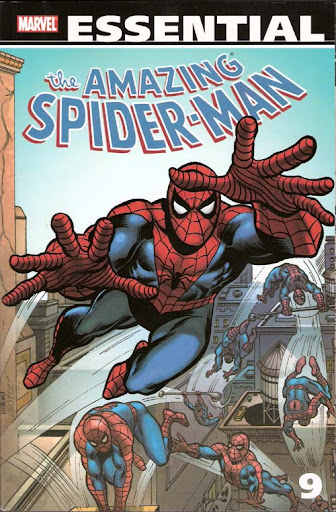
Essential Spider-Man, v. 9

Collects: Amazing Spider-Man #186-210, Amazing Spider-Man Annual #13-4, and Spectacular Spider-Man Annual #1 (1978-80)

Released: May 2009 (Marvel)

Format: 600 pages / black and white / $19.99 / ISBN: 9780785130741

What is this?: A slice of late ‘70s / early ‘80s Spider-Man that introduced the Black Cat and features the return of the Burglar who killed Uncle Ben.

The culprits: Writers Marv Wolfman and others and artists Keith Pollard, John Byrne, and others

Can you have nostalgia for something you never experienced?

Marvel sure wants you to. The Brand New Day continuity is a direct throwback to the Spider-Man you can find in Essential Spider-Man, v. 9, which reprints Amazing Spider-Man issues from 1978-80. Some readers will remember those days, and long for their return, but most of us only have second-hand evidence those days ever occurred.

The parallels between Brand New Day and v. 9 are striking. In each, there’s no MJ or other steady girlfriends, but there is poverty aplenty, Harry Osborn (and the rest of the supporting cast) hanging around, and a non-J. Jonah Jameson boss supporting Peter’s photography. Other than a healthier Aunt May and no Black Cat in BND, it almost feels like BND writer Dan Slott or editor Tom Brevoort gave pre-publication copies of Essential Spider-Man, v. 9, to the other writers and said, “This is what we’re looking for.”

Essential Spider-Man, v. 9 coverAnd v. 9 is at a level of quality the Spider-titles haven’t seen for years, so that would be good, even though I just made that anecdote up. Marv Wolfman, who wrote #186-204, was in a sweet spot in Spider-Man lore here: after the doldrums following Gwen Stacy’s death and leading into the revitalizing run of Roger Stern (who wrote #206). Wolfman brings back the Burglar and gives him a reason to have killed Ben Parker. In an interesting story that shouldn’t work but does, Wolfman slips in an unnecessary retcon, uses Mysterio and the Kingpin as blocking figures, and still writes a story that hits all the important Spider-Man notes, managing to be moving while both using past continuity and advancing the characters.

This is not an empowering book for any female readers. (Any out there? And how can I tell if those chirping crickets are female or not?) Wolfman creates the Black Cat in this volume, which is a mixed blessing; she’s a big part of the ‘80s, but although she comes across as level headed and capable in her first arc, he and David Michelinie portray her as a crazy stalker in the second. Given the way Wolfman writes Betty Brant, as a clingy ex-girlfriend who has to have a man after leaving her husband, no one was going to be giving him any awards for positive portrayals of women. Denny O’Neil, who wrote #206-10 and Annual #14, balances things (a little) by introducing Madame Web, a criminally underused supporting character. But back on the other hand, Peter also treats Deb Whitman, departmental secretary at his graduate college and occasional date, like crap no matter who was writing him.

The villains are among Spider-Man’s best: Electro, Dr. Octopus, Kraven (with Calypso!), Chameleon, the last appearance of Alistair Smythe, Man-Wolf, and the aforementioned Kingpin and Mysterio. Smythe’s attempts to kill Spider-Man and Jameson are especially good; his final plan, which involves strapping both to a bomb, is one of the better Spider-Man stories, and his attempts to use John Jameson to do his dirty work show a man who’s thought about his revenge and decided to make it as cruel as possible. (The strapping Spider-Man and Jameson show a man who has not thought things through completely.)

The long-term subplots in this book lack a satisfying end. Betty Brant’s attempts to win back Peter were wrongheaded to begin with, and Peter’s attempt at getting her to go away was cruel and almost villainous. The resolution to Jameson’s long-running bout of insanity feels … well, stupid, really, but I’ll settle for “rushed.” And Peter’s entire employment at the Globe is contained in this volume; I thought his employment at the Bugle’s competition was cut too short, as his smarmy boss at the Globe offered a nice contrast to Jameson’s fury.

(One more thing: The linked annuals — Amazing #13 and Spectacular #1 — tell a story about Dr. Octopus’s plot to steal a nuclear sub. Wolfman wrote the first part in Amazing Annual, while Bill Mantlo wrote the second. God bless Mantlo — and he should, at least once more — but seeing the two parts juxtaposed like this reveals some … stylistic excesses in Mantlo’s approach.)

Keith Pollard isn’t going to be listed among the top Spider-artists of all time, but he takes the torch handed to him by the likes of Ditko, Romita, and Andru and carries it admirably. His work looks a little like a modified version of Ross Andru’s; if there were an early house style for Spider-Man, Pollard would be an excellent example of it. His Spider-Man is athletic and flexible without being distorted or overstylized, and his supporting characters are all distinct and recognizable. (Of course, most artists could do that in those days.) Pollard also created the Black Cat’s signature costume, which you can take as a criticism or compliment.

John Byrne does a few fill in and annuals, and his work is outstanding — although I enjoyed Pollard, I would have really enjoyed seeing Byrne on Amazing rather than on Marvel Team-Up, where he had worked a little earlier. Byrne’s work in v. 9 is everything his early work was — beautiful, imaginative, stylish. Sal Buscema, Frank Miller, and John Romita, Jr., also contribute excellent work to the volume, as do Jim Starlin, Al Milgrom, Alan Weiss and Richard Buckler. Really, if you weren’t one of the best, Marvel wasn’t going to let you near Amazing Spider-Man (although technically Buckler worked on the Spectacular Annual).

There’s a lot to like in Essential Spider-Man, v. 9. And there’s a decent amount that comes across as lacking. Although I enjoyed the book throughout, I couldn’t shake a nagging feeling that it just missed being great. So it has to settle for good.

Rating: Spider-Man symbol Spider-Man symbol Spider-Man symbol Half Spider symbol (3.5 of 5)

Labels: , , , , , , , , ,

10 July 2008

Essential Peter Parker, the Spectacular Spider-Man, v. 3

Collects: Spectacular Spider-Man #54-74 and Spectacular Spider-Man Annual #3 (1981-4)

Released: February 2007 (Marvel)

Format: 536 pages / black and white / $16.99 / ISBN: 9780785125013

There’s not much to say about the Essential Peter Parker, the Spectacular Spider-Man, v. 3. Well, I suppose there is, but it’s mostly repeating how much I like the Essential Spectacular Spider-Man.

In v. 3, Spider-Man swings into his ‘80s heyday, with stories by two of the best Spider-writers from that time: Roger Stern (#54-61) and Bill Mantlo (#62-74). Stern has received a great deal of praise for his Spider-work, and although this isn’t the equal of his long run on Amazing Spider-Man, it has a lot of fun stuff with B-villains like the Jack o’ Lantern, Nitro, Will o’ the Wisp, the Ringer, and the Gibbon. He also throws in stories with three future Thunderbolts: the Beetle, Moonstone, and the Smuggler (Atlas / Goliath).

Essential Peter Parker, the Spectacular Spider-Man, v. 3 cover Mantlo’s run is more distinguished, creating Cloak and Dagger and introducing the Owl / Octopus War. Mantlo concentrated on “classic” villains — Electro, the Molten Man, Doc Ock — and brought back older villains with strong connections to Spider-Man: the aforementioned Molten Man, Robot Master, Silvermane. He treated the Kingpin as he had been treated in Daredevil: a force within the city who could be reluctantly used but had his own agenda. He also gave Kraven his mania for “honor” that would lead to his destruction.

Words can’t express how much fun these stories are. Few — Cloak and Dagger being the exception — are groundbreaking, but they’re solid superhero stories. There are some disappointments — the weak resolution to the Deb Whitman story stands out there — but overall, it’s a lot of fun.

The art isn’t going to make anyone forget Steve Ditko or John Romita, Sr., but there are echoes of both throughout. Pencillers and inkers come and go with regularity — editor-in-chief Jim Shooter did the layouts for three issues — but it’s all high-quality work that surprisingly works despite the number of different contributors. Jim Mooney and Ed Hannigan did the lion’s share of the work, with Luke McDonnell, Bob Hall, and Al Milgrom making significant contributions. Many others, like John Byrne and Rick Leonardi, pitch in an issue or two.

These issues represent a high level of quality and nostalgia for many collectors. They stand up well to time, and they don’t disappoint, a quarter century later.

Rating: Spider-Man symbol Spider-Man symbol Spider-Man symbol Spider-Man symbol (4 of 5)

Labels: , , , , , , , ,

20 February 2007

Champions Classic, v. 2

Collects: Champions #12-7, Iron Man Annual #4, Avengers #163, Super-Villain Team-Up #14, Spectacular Spider-Man #17-8 (1977-8)

Released: January 2006 (Marvel)

Format: 214 pages / color / $19.99 / ISBN: 078512098X

My wife will often point out that many titles in Marvel’s Essential line are not, by any means of the imagination, essential. Essential Ghost Rider, v. 1, is her prime example, at least until she sees me reading v. 2.

Another line of Marvel TPBs that generates the occasional misnomer is the Classics line, which reprints older Marvel titles in full color. While some might argue the forthcoming Alpha Flight Classic is a prime example of misleading advertising, I must protest on two counts: one, that Alpha Flight is a prime example of Marvel being the shizzle in the ‘80s, and two, the worst example of “Classic” is clearly the Champions (Classic). Which is, surprisingly, on its second volume.

Champions Classic v. 2 cover The first volume of Champions (Classic!) ended with the Stilt-Man fighting Black Goliath. Where I’m from, that spells awesome, but unfortunately, the Stilt-Man can’t even last one issue in the second volume. He’s barely even a distraction, and the Champions can’t even be bothered to take him out — he’s beaten up by third-stringer Black Goliath. (Such is Stilt-Man’s lot in life.)

The Champions aren’t that impressive a team. Sure, they have Hercules and Ghost Rider, but they have a pair of castoff X-Men (Iceman and Angel) and are led by the non-powered Black Widow. Yes, I know there are some Avengers teams these guys could have taken, but once the villain has tricked Hercules, there’s not much opposition there. Plus there’s little reason for them to stay together; what do the five of them have in common? They are as far away from the common man they are supposed to protect as Hercules is from sobriety or Iceman is from being interesting. (If you think I’m being harsh, let me remind you Iceman’s an accountant when he isn’t a hero.)

Although the first volume of Champions (Classic?) was plagued by the original run’s tendency to switch creators, the second has at least half the problem solved. The underrated Bill Mantlo is the writer for most of v. 2, even writing the crossover issues (except for Avengers #163, which was written by Jim Shooter). The art gets off to a roaring start as well, with John Byrne drawing #12-15. This won’t work won’t be featured in his obituary, but it’s solid enough, drawn back when Byrne was working second-string titles like Champions and Iron Fist and turning in work far exceeding the title’s worth. There’s something about his Darkstar that seems to epitomize this — she’s a minor character marked indelibly with his style, which elevates her just a little.

The rest of the art is provided by industry stalwarts: George Tuska pencils the Iron Man Annual and Avengers as well as the final issue of the Champions, Bob Hall does the Supervillain Team-Up / Champions crossover, and one of my favorites, Sal Buscema finishes the team off in a two parter in Spectacular Spider-Man.

Yet despite some very solid talent, this book never clicks. You can’t blame the crossovers because of the continuity of the creators. I hate to blame Mantlo, but you look at the book, and all the bad ink seems to lead back to him. The two-part story against Swarm, the sentient communal bee colony merged with a Nazi war criminal, is the only effective story in the book. The Iron Man Annual is a bland battle against faceless thugs, despite the presence of MODOK. (If you can’t make MODOK creepy and / or memorable, you’re doing something wrong.) The Dr. Doom / Magneto battle in Supervillain Team-Up and Champions #16 is fondly remembered in some quarters, but it is superceded by the better Emperor Doom graphic novel, and in any event, the ending doesn’t make sense. (Not to mention it has very little to do with the Champions, who are mind controlled while they’re in the story.)

The rest of the stories are forgettable. Not bad … just forgettable. The team doesn’t even get a decent sendoff; they disband off-panel after Champions #17, so Angel has to tell Peter Parker how it happens in Spectacular Spider-Man. Was cancellation a surprise? It certainly seems that way, but you’d think the writing would be on the wall. On the other hand, there was certainly a lot of guest appearances late in the title’s run, so maybe the creative team hoped that would float the title along a little farther.

Maybe it isn’t really Mantlo’s fault. Maybe it’s just time catching up with a very bad idea.

The Champions were anything but classic. The stories in Champions (Classic*) are anything but memorable.

Rating: (2 of 5)

Labels: , , , , , , , , , , ,

29 October 2006

Essential Marvel Team-Up, v. 2

Collects: Marvel Team-Up #25-51, Marvel Two-in-One #17 (1974-6)

Released: July 2006 (Marvel)

Format: 528 pages / black and white / $16.99 / ISBN: 0785121633

Marvel Team-Up is a title that doesn’t get much respect. It’s noted more for being a de facto second Spider-Man title — the first Marvel character to get a second solo title — rather than for being a medium for quality stories. Most of what passed through Marvel Team-Up is seen as either forgettable or silly, and the stories in Essential Marvel Team-Up, v. 2 is no exception.

But that’s not to say the stories aren’t enjoyable, even if they didn’t have a long-term effect on the Spider-mythos. (Three of the 27 stories in this volume are expressly forgotten by the protagonists at the end.) There is often a forgotten charm in these ‘70s stories, when Spidey was still in his salad days and some team-ups still hadn’t been tried.

These stories aren’t — or perhaps can’t — be told in the 21st century, but there’s no reason not to enjoy them here. The stories told by Gerry Conway and Len Wein at the beginning of Essential Marvel Team-Up tend toward the silly, with the silliest (or most mythic, if you’re charitable) being #28, in which Hercules tows the stolen island of Manhattan (roughly) back to its correct place. This story is rightly hooted at by modern fans, but it was a product of its times. That doesn’t make the stories good, but it does explain a few things.

The writing improves greatly when Bill Mantlo takes over. Mantlo is a writer who was the backbone of the marvel Universe in the ‘70s and ‘80s — he wrote nearly every character Marvel has at one time or another. Some of his work is reviled (his Alpha Flight comes to mind, and there may come a time when his name is much more associated with “Cloak and Dagger created by”), but you don’t write so many titles unless you have something on the ball. Mantlo certainly did.

After taking over this title, Mantlo wrote a series of connected storylines — difficult to do when Spidey’s supposed to have a new guest star every month. But Mantlo pulled it off, most impressively with a six-part time travel story that takes Spider-Man and a host of associates back to the witch trials at Salem. By the end, the team-up concept is showing its weaknesses (Moondragon? Really?), but overall, the story works — and it has Doom!, which can never be a bad thing. His two-part Big Man / Crimemaster story is surprisingly effective, if a little convenient. A later four-part storyline that introduces the Wraith and Jean DeWolff dispenses with adding guest stars, keeping Iron Man as the featured guest for three issues.

If Mantlo was the backbone of Marvel writing in the ‘70s and ‘80s, Sal Buscema is the apex of Marvel art between the end of the Silver Age and the beginning of the Image Age. In Essential Marvel Team-Up, he was frequently aided by Mike Esposito, but the result is still classic Buscema: excellent storytelling and a style that is nearly invisible until a few signature moments.8 Buscema’s work adapts to the black-and-white format of the Essential as well as any artist I’ve seen.

All right: despite my deep admiration for the work of Buscema and Mantlo, this is Marvel Team-Up. Even at its best, it was the “other” Spider-Man title — until Spectacular Spider-Man came along, when it became the third title. Nothing groundbreaking happens here, no chances in Peter Parker’s life and no world-shattering villains. The mandate for Marvel Team-Up seemed to be to tell entertaining stories that didn’t rock the boat. And that’s just what happens in Essential Marvel Team-Up, v. 2.

Rating: (3 of 5)

Labels: , , , , , , , , ,

01 August 2006

Champions Classic, v. 1

Collects: Champions #1-11 (1975-7)

Released: June 2006 (Marvel)

Because you didn’t demand it, Marvel released the Champions in the 1970s. It was sort of the rock supergroup concept applied to superheroes: recognizeable heroes at loose ends tossed together to see what happens.

Just like with supergroups, the musicians aren’t usually the best, but they are credible. So in Champions Classic, v. 1, we get the Angel and Iceman at loose ends (they don’t like the All-New, All-Different X-Men all that much), occasional active Avengers Black Widow and Hercules, and relatively new hero Ghost Rider. I know what you’re saying to yourself: They put those people on a team? Yes. Yes, they did, and it worked about as well as you might expect.

The character concepts are almost completely incompatible, and all the characters have in common is that they are in Los Angeles. Ghost Rider fits with supernatural tales, Angel and Iceman to mutant rights, the Widow to espionage, and Hercules … well, he’s just larger than life. Despite the writers’ attempts, only Hercules strengths come across. The Widow doesn’t get to spy much, nor does she lead well; Angel doesn’t seem a very good business and is unable to keep the team focused on the raison d’etre he established; Ghost Rider is about as otherworldly as a club to the face; and Iceman doesn’t do much but complain that he’s leaving (until a pretty face comes along).

These problems aren’t insurmountable; they can be used as excellent plot devices. But by the time you get to #11, it’s difficult to think these are plots rather than just inherent difficulties with the team.

Just look at the cover: Herc in his gaudy leather and loincloth ensemble, Angel in his gaudy and Godawful costume, Iceman in his ice form, Ghost Rider in his leathers and motorcycle, and the Black Widow in her slinky black stealth suit. You can find two of these heroes that visually go together with no problem, but linking three is difficult, and five is impossible.

Tony Isabella and Bill Mantlo try their best, heaven knows. They give each hero a plot suited to their expertise: an Olympian plot for Herc in #1-3, a businessman goes bad in #5-6, a Russian four-parter for the Widow and her handler / trainer / sidekick Ivan in #7-10, and Wild West action vs. shadows for Ghost Rider in #11. But the rest of the Champions seem out of place in Herc’s and the Widow’s stories, and no one shines in the other two. It just doesn’t work.

The best storyline is that of Rampage, a genius inventor whose business is about to go bankrupt. The inventor dons the Rampage armor and tries to steal the money to get his business out of hock: sort of an evil Tony Stark. The team works well, the villain has a simple motivation and a reason for fighting the team as a whole, and his arc comes to an end satisfactorily. But there’s little satisfaction to be found elsewhere.

The writing seems to get a spark when Mantlo takes over for Isabella in #8. There seems to be an energy and a plan that had been absent in the first issues, but that could be just because I don’t see what’s coming up. Don Heck draws the first six issues, but it’s not his best work — too scratchy and shadowed for the brightly lit tales, and his line looks a little ragged compared to his best work. That could be the inker’s fault, and in any event Heck is still strong in storytelling and action, but it was a slight relief to my line when George Tuska (#7) and Bob Hall (#8-10). John Byrne, at the top of his game, is a treat in #11.

I’m not sure it’s the artists’ faults, but the costumes are pure ‘70s. The Olympian gods seem colorblind. The Black Widow wears a purple checked skirt over her suit in #1, an ensemble I have never seen before and hope never to see again. And then there’s the Angel’s monstrosity; Rampage destroys it in #8, earning my gratitude. (Also, there’s a scene where Hercules runs through the defense of UCLA’s football team, colored by someone who has never seen their uniforms.)

Now, I have to admit: If there’s a second volume, I will probably pick it up. The final page of v. 1 has the Stilt-Man announcing he’s about to become the Master of the World. If that ain’t a hook, I don’t know what is. (Besides, the team falls apart in v. 2, and that’s believable.)

Rating: (2 of 5)

Labels: , , , , , , , , ,

03 April 2006

Essential Peter Parker, the Spectacular Spider-Man, v. 2

Collects: Spectacular Spider-Man (v. 1) #32-53, Spectacular Spider-Man Annual #1-2, Amazing Spider-Man Annual #13, Fantastic Four #218 (1979-81)

Released: February 2006 (Marvel)

There was a time when things were simpler, and comic books had longer names. The Essential Peter Parker, the Spectacular Spider-Man takes you back to that time.

The Essential reprints, in glorious black and white, issues #32-53 and the first two annuals of Peter Parker, the Spectacular Spider-Man (the title was shortened to Spectacular Spider-Man in 1988), along with a couple of associated stories. If you’ve seen the Essential format before, you know whether you think $16.95 for more than 500 monochrome reprint pages is worth it. If you haven’t seen Essentials before, I’ll tell you it’s worth it ... if the stories are any good.

Are they? Well, the majority are written by Bill Mantlo, who did a lot of Spider-Man at the time and did it pretty well. There are a few odd stories in this volume, but it’s absolutely nothing like Lightmaster or Razorback in the first volume, so if your tolerance for men in giant pig hats is low, then this one’s safe. And Roger Stern, who did an exellent job on Amazing Spider-Man in the ’80s, does a few stories as well, including the introduction of the man who would eventually become the first Hobgoblin. So it’s got that going for it. The art comes from a wide range of creators, including John Byrne, John Romita Jr., Jim Mooney, and Mike Zeck — good stuff, for the most part, from creators who have done a lot of Spider-Man.

But really all you need to know is that this is quintessential ’70s Spider-Man: you have classic villains, goofy villains, and newer villains trying to make classic status. That, along with money trouble and the constant sacrifice of his personal life, is all Spider-Man truly needs. (Are you listening, Straczynski?) Dr. Octopus, Vulture, and the Lizard — the Mindworm and Swarm — Belladonna, Morbius, and the Tinkerer. Not to mention (yet another) Lizard knockoff, the Iguana, and the Spider-Lizard. But hey, it’s all in good fun, even if Peter Parker isn’t having fun.

There are two oddities about this volume that have nothing to do with supervillains and deathtraps. The first is that the Essential actually contains one more issue than is listed on the front cover: Fantastic Four #218, the second part of a two-part Frightful Four story. (This time the Frightful Four says nuts to girls and chooses Electro as its final member. The next time they show up, they’ve decided Electro isn’t the answer but a woman of another humanoid species might be, adding Llyra.) So you get an extra issue for your money.

The other is a downside: three issues (#40, #43, Annual #2) have atrocious reproduction, so instead of the tight line that marks most of the volume (and most of the Essentials series), the art is blotchy, muddied, and overall difficult to make sense of. Marvel must have made the reproduction from a different kind of source on those three issues — or perhaps it was just a printer’s mistake, one that might show up only in my copy.

Even with those problems, this is another of the quality reprints Marvel has been producing in the last decade. It’s well worth your time — as are the other Spider-Man Essentials (Essential Spider-Man #1-7, Essential Peter Parker ... #1, and Essential Marvel Team-Up #1). I’m just looking forward to the next volume in all three series.

Grade: A

Labels: , , , , ,