Reviews of trade paperbacks of comic books (mostly Marvel), along with a few other semi-relevant comments / reviews.

12 February 2016

Skull the Slayer

Collects: Skull the Slayer #1-8 and Marvel Two-in-One #35-6 (1975-6, 1978)

Released: April 2015 (Marvel)

Format: pages / color / $24.99 / ISBN: 9780785193975

What is this?: After surviving a plane crash in the Bermuda triangle, a Vietnam vet, a physicist, his assistant, and a wealthy white teenager encounter a weird world with dinosaurs and aliens.

The culprits: Writers Marv Wolfman, Steve Engelhart, and Bill Mantlo and artists Steve Gan, Sal Buscema, and Ernie Chan


In 1975, Marv Wolfman finally persuaded Marvel to publish a series that he’d had simmering in his mind for years, a series with a bold premise: readers would hate every character, but to distract them, the artist would include dinosaurs.

That wasn’t really the premise. Wolfman’s idea has a former soldier leading a group of plane-crash survivors around a mysterious island in the Bermuda Triangle, where they have to deal with dinosaurs, aliens, and all manner of strange mysteries. But the characters’ unlikeability will remain my lasting memory of Skull the Slayer, a mid-’70s Marvel series with more ambition than continuity or ability, long after I forget everything else but the dinosaurs.

Skull the Slayer coverThe unlikeable roll call starts with Vietnam vet Jim “Skull” Scully. He’s had a hard time of it: years spent in a POW camp, where his jailors tortured him for information he didn’t have, followed by a sour homecoming where he found his wife shacked up with another man, his parents dead from their worry about him, and his brother strung out. Almost immediately, his brother attacks Scull with a knife, and in the scuffle, his brother is killed. Scully goes on the run, and his arrest in Bermuda leads to him being on the plane that crashes in the Bermuda Triangle.

All that should build a lot of sympathy for Scully, but as soon as he meets the other survivors of the crash, his arrogance comes to the fore. He’s always scuffling with Dr. Raymond Corey, the physicist, over dominance in the group. He scorns the peacemaking of Ann Reynolds, Corey’s assistant, and Jeff Turner, the son of a wealthy Ohio senator. He won’t compromise; all his dialogue is bluster, convinced the entire world, down its smallest molecule, is against him. This is the Marvel template: a hero with ability (Scully kills a dinosaur in #1) but brashness that drives everyone away. In the Marvel style, the hero eventually comes to an understanding with (most of) his supporting cast, toning down his rough edges, but before that happens, he abandons Corey, Reynolds, and Turner to their deaths in #4.

Since Scully is the protagonist, the other characters are supposed to irritate Scully and the readers, by extension. The supporting cast mainly gets broad-stroke characterization, and the writers aren’t afraid to lean on stereotypes when they have to. Corey is highly educated and scorns Scully as a murderer; he’s also African-American, and he admits his frustration with racism that has held him back. Corey’s bitterness drips from every word of dialogue, but he lacks any empathy or vulnerability. Sexism has held back Ann Reynolds, but she often assumes female stereotypes — an obsession for clothes, an injury while running that prevents the others from escaping, etc. Turner is a load with a bad haircut.

Wolfman left the series after #3, so it’s possible he could have planned to soften the characters some. Steve Engelhart, however, took over for #4, and he torpedoed any chance Scully had for likeability by having him abandon his comrades during an escape attempt. This was part of a plan to dump Scully’s supporting cast for a more in-depth investigation of the world Scully found himself in, but #4 was Engelhart’s only issue. Bill Mantlo, who guided the series to its limping end, wrenched the series back in the direction Wolfman had aimed it in by resurrecting and reinstating the supporting cast the next issue. Oops!

Knowing someone abandoned you in the hour of your direst need, and that you actually died because of what they did, would put a crimp in any relationship. Reynolds, Corey, and Turner forgive Scully unimaginably quickly, although they do spend #5 trying to kill him.

Given the characters’ lack of charisma, Skull needed intriguing plots and / or great art to succeed. Skull had a very strong similarity to the TV series Lost: in each, the survivors of a mysterious plane crash find themselves on a weird island with little chance of rescue. (I would pay cash money for a sequel to Skull, with Scully tearfully crying, “We have to go back to the island!”) After the plane crash, the mysteries Skull and his crew uncover on the island include:
  • Dinosaurs (#1)?
  • Why are there prehistoric men (#2)? They didn’t exist at the same time as dinosaurs.
  • Where did that dead alien come from (#2)?
  • And why did he have a magic power belt (#2)?
  • Why were all those human and alien pilots (now skeletons) tied to stakes in one place (#3)?
  • What’s the deal with the tower that has different time periods on each level (#3), all populated with robots?

Those are Wolfman’s plots, with Marv piling weird stuff into the pages without seeming to have an idea of how to resolve them or what the survivors should be doing, other than not being eaten by dinosaurs. Perhaps three issues is too little time to be seeing movement in those areas, although the lack of a plan shows why Scully should not have been the group’s leader.

Engelhart wraps up the last plot in that list — aliens built the tower as part of a plot to conquer Earth at all time periods simultaneously — but then Mantlo ends that plot in #6 with the destruction of the tower. It’s unclear whether the aliens are responsible for the non-tower weirdness on the island — why do aliens care about dinosaurs? — but Mantlo moves on to a faux-Aztec society, another pilot from our world, and societal civil war. Wolfman returns to wrap up everything in two issues of Marvel Two-in-One, but it’s clear he’s sweeping up the pieces in case another writer sees something he likes. Most of those pieces ended up in the trash, though. Wolfman didn’t even bother to salvage (or mention) the pilot from our world that Mantlo introduced.

For readers who like drawings of dinosaurs, though, Skull might be something to investigate. (Evidently not enough of those existed in the mid-’70s.) Steve Gan gets the bulk of the dinosaur duty, drawing #1-3 and #6. His dinosaurs are massive, powerful creatures. Sal Buscema’s arc (#4-8) concentrates on different eras of human history; his work is harmed by the bright colors, but his design for the alien Slitherogue is satisfyingly sinister. (Sure, Slitherogue looks like he’s a Yellow Peril villain, but he’s purple, and from outer space, so it’s OK, right?) Buscema’s less-detailed style suffers compared to Gan’s work; Gan’s linework, especially with its emphasis on the hair and sinew of the figures he draws, is more in keeping with the dirty, more animalistic world the book inhabits. Gan’s Scully is a more vicious, feral man than Buscema’s version, giving the impression that Scully might be a man who fits the island better than he does modern society. Ernie Chan draws the MTiO issues like they are, well, MTiO issues, and the more superheroic look is jarring. The rushed plot does Chan no favors, though.

The series is a brief flash of muddled creativity that never clicks. Readers can probably find bits and pieces that entertain them or that they’d love to see repurposed in something more coherent, and the series’ failure shows how difficult it must have been to keep the mélange of character and mystery plotlines going for so long on Lost. Skull the Slayer is an artifact of the fecund ‘70s, but like a lot of the high-concept ideas that came out of that time, its execution means it isn’t worth reading.

Rating: Marvel symbol Half Marvel symbol (1.5 of 5)

Labels: , , , , , , , , , ,

23 March 2013

West Coast Avengers: Family Ties

Collects: West Coast Avengers v. 2 #1-9 and Vision and the Scarlet Witch v. 2 #1-2 (1985-6)

Released: July 2012 (Marvel)

Format: 296 pages / color / $29.99 / ISBN: 9780785162162

What is this?: The West Coast Avengers, led by Hawkeye, establish themselves and try to fill out their roster.

The culprits: Writer Steve Englehart and artists Allen Milgrom and Richard Howell


West Coast Avengers: Family Ties is very much a book of its time. It’s a soapy team book, with rivalries and romance sandwiched between slugathons with supervillains. For someone like me who was introduced to comics via X-Men in the ‘90s, the character conflict and long-term plot development has a pleasantly nostalgic feel, especially since it is not accompanied by all that mutant angst.

Characterization is (mostly) a strength for writer Steve Englehart. He adds depths to some one-dimensional characters, such as robot supervillain Ultron and human supervillain Grim Reaper. Ultron (Mark XII) tries to reconcile with his “father,” Hank Pym; although the execution of Mark XII’s story is rushed and Ultron’s upgrades mean this plot probably won’t be referenced again, Ultron’s growth is a great idea with a good payoff. The Grim Reaper’s obsession with his brother, Wonder Man, is the only aspect of his character readers previously saw, but Engelhart gives him another character note: he’s a racist, although he excepts his girlfriend from his prejudice.

West Coast Avengers: Family Ties coverEnglehart also takes up the challenge of making the book’s two married couples interesting, and he succeeds. (Given how difficult many creators find writing husbands and wives, that’s no mean accomplishment.) The Vision and Scarlet Witch and Hawkeye and Mockingbird have two different sorts of relationships; Vision and Scarlet Witch are stable, determined, and about to have a family, while Hawkeye and Mockingbird are high spirited, passionate, and always bickering. It’s no wonder Hawkeye and Mockingbird’s marriage didn’t work out.79

But Englehart is not so successful with Tigra. Englehart spends a lot of time with Tigra, but his character arc for her is decidedly not modern. Tigra is a human who also has a cat soul inside her, which gives her not only a feline shape and superpowers but also feline characteristics — personality elements her human side wants to get rid of. So far, so good; it’s similar to a werewolf story, and Englehart even brings in Morbius the (ex-) Living Vampire and Werewolf by Night to drive home the monster angle. But Tigra’s internal conflicts come from her newfound fear of water, mercurialness, and promiscuity. A male character would not be given promiscuity as a character flaw, then or now, nor would fickleness be considered a sufficient challenge to overcome. I appreciate the lengths Englehart shows Tigra is willing to go to rid herself of her catlike flaws, but there are better cat characteristics he could have used: cruelty, aloofness (definite problem on a team), independence (ditto). Focusing on a female’s character’s sexuality is a cliché; silly fears and a proclivity to change her mind only make the stereotyping worse.

Exploring the problems of Tigra’s powers necessitates devoting several pages to Cat People continuity, which is not worth rehashing. But it’s just one example of Englehart’s reliance on continuity in Family Ties. Sometimes it works, as when he brings back Tigra’s old opponent Kraven for a rematch, but often it falls flat. The Cat People are an odd fit with a superhero story and not very exciting. The Grim Reaper / Wonder Man / Vision story works OK, but Simon's embezzlement — referred to in his origin story — is as exciting as accountancy plotlines tend to be. Englehart’s biggest success is using Secret Wars to explain why there are two Ultrons with differing personalities; the flashbacks with Ultron’s head controlling people are fun and creepy.

Englehart’s continuity mining limits his choice of villains, but fortunately, those villains are heavy hitters: Grim Reaper, Ultron, Kraven. Other villains are offbeat but enjoyable; I have a soft spot for Nekra, Black Talon and his zombies, and the Rangers. But the main villain in Family Ties, one who grows in importance in succeeding volumes, is Master Pandemonium, and he’s … oh, he’s not very good.

Master Pandemonium is just one of a type: the guy who makes a deal with the devil that goes horribly awry. Unlike Johnny Blaze / Ghost Rider, Master Pandemonium becomes evil when Mephisto gives him an opportunity to regain his soul. Until he reclaims his soul, he’s the amazing Fall-Apart Man, who has demons for limbs; they separate from him and fight his enemies, leaving him a floating torso. He can also summon demons from the great sucking star-shaped wound in his chest. Why he doesn’t summon demons rather than lose his limbs isn’t clear. But Master Pandemonium is utterly generic and utterly forgettable were it not for his role in future stories that helped victimize the Scarlet Witch.

Artist Allen Milgrom doesn’t shine on Master Pandemonium either. Milgrom gives Master Pandemonium a sinister, almost Yellow Peril look that clashes with his Anglo ethnicity. The forked Fu Man Chu resembles a stereotypical Asian villain’s facial hair, howevermuch it is supposed to evoke a pentagram, and his robes and cape certainly call to mind the Mandarin. Milgrom also draws standard Marvel Technicolor demons, which I’ve always been bored by. There’s little about them that differentiate them, artistically, from a host of generic monstrous humanoids.

Milgrom’s art is standard for the ‘80s, solid without being flashy. Milgrom tells the story without unnecessary flourishes; I especially like the slightly wall-eyed panels from the view of Ultron’s disembodied head. In #6, Milgrom’s rough pencils are inked by Kyle Baker, whose wider, softer faces works well on Tigra and the Cat People. Most of the rest of the issues are inked by Joe Sinnot, who contributes to the book’s traditional look.

Richard Howell draws the two issues of Vision and the Scarlet Witch included in Family Ties; overall, his work is more detailed and features more close-up shots of characters than Milgrom’s. His Nekra is wonderful, and he seems to enjoy drawing the Scarlet Witch. But there is a certain stiffness to many panels, his zombies aren’t frightening (the colorist's decision to make them dark gray has something to do with this), and his Wonder Man is awful, looking more like Wonder Granny.80

Family Ties has too many continuity-filled soft spots to be great; Tigra’s short-sighted characterization may make it difficult for some readers to enjoy. But Family Ties does hit a nostalgic sweet spot at times, and between Englehart’s high spots and Milgrom’s solid art, Family Ties has a lot to offer, especially to those who wish they were still 10 and buying comics in 1986.

Rating: Avengers symbol Avengers symbol Avengers symbol (3 of 5)

Labels: , , , , , , , , , , , , , , ,

22 July 2011

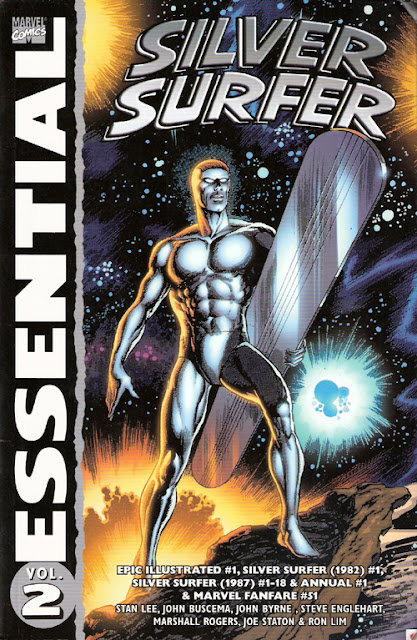
Essential Silver Surfer, v. 2

Collects: Silver Surfer (v. 2) # 1 and (v. 3) #1-18, Silver Surfer Annual #1, Epic Illustrated #1, and Marvel Fanfare #51 (1980, 1982, 1987-8, 1990)

Released: June 2007 (Marvel)

Format: 600 pages / black and white / $16.99 / ISBN: 9780785127000

What is this?: The Silver Surfer slips the surly bonds of earth and gets involved in interstellar war.

The culprits: Writers Stan Lee and Steve Englehart and artists Marshall Rogers, Joe Staton, Ron Lim, and others

I’m not a fan of the Silver Surfer. It’s not that I dislike the character, it’s just that I have the same problem with him that many people have with Superman: he’s dull, nigh indestructible (without raising the stakes ridiculously high), and a bit too much of a goody two-shoes.58

So why did I buy Essential Silver Surfer, v. 2? Mostly because I picked it up for $3 or $4. But also partially because it was an unusual choice to be made into an Essential in the first place. It’s not a legendary run. The issues included aren’t from the Silver Age, nor are they some Bronze Age genre mashup or weirdness. It isn’t yet another volume of a title that started in the Silver Age. It doesn’t feature a female lead. And it doesn’t star mutants, which accounts for most of the more modern series. There just aren’t that many Essentials that don’t meet those standards: Punisher, Moon Knight, NovaPower Man, if you don’t consider Blaxploitation a genre, plus the reference books.

Essential Silver Surfer, v. 2 coverIs Silver Surfer something different, though? The Surfer is a Silver Age construct, and arguably by the mid-‘80s, he was the least changed from his Silver Age roots of any of Marvel’s major characters, given his inflexible personality and his status as the near-exclusive domain of Stan Lee.
Stan is the writer for the first two stories in this book. The first, a rather forgettable short from Epic Illustrated #1, has the Surfer confronting the concept that there are some answers beyond himself and his master, Galactus. The second, a 1982 one-shot drawn by John Byrne, pits the Silver Surfer against his incongruous archenemy, Mephisto — because what’s a more appropriate opposite for a cosmic-powered servitor of a planet predator than the Devil? It advances the Surfer’s story somewhat, but in the end, Lee puts all the pieces back where they started.

And then Steve Englehart takes over for the ongoing series, and everything changes. The Surfer is freed of Earth in a way that reads like Englehart wanted it done as quickly as possible so he and Marshall Rogers could go on to the space stuff. Then Shalla-Bal and Zenn-La are dealt with, zip zoom. Suddenly, Silver Surfer becomes Marvel’s first cosmic title in a long time, dealing with the Kree, the Skrulls, Galactus and his herald Nova, and the Elders of the Universe.

Once the book stops being about the Silver Surfer, it gets a lot more interesting. Or, I suppose I should say, it gets more interesting when the book stops being solely about the Silver Surfer and concentrates on the opportunities outer space gives the book. There is a large part of the Marvel Universe that can be settings for interesting stories, and whether that’s San Francisco, Sydney, or Kree-Lar, any book that can take advantage of those creative vacuums is worth supporting.

Englehart picks up several loose threads and characters, from the disintegration of the Skrull Empire and the loss of the Skrulls’ shapeshifting powers to what the various Elders of the Universe, Celestial Madonnas, and Soul Gems are up to. The machinations of the Kree and Skrulls in the new Kree-Skrull war are interesting, and the war is allowed to escalate in background scenes that are nice cutaways from the main plot. The Elders of the Universe’s plan to kill Galactus is what drives most of the book, and while I can’t say I’m greatly interested in the Elders, I can’t deny they are a great set of adversaries for the Silver Surfer and are an interesting part of the cosmic side of the Marvel Universe. (Such high-power characters do lead to a lot of “not really dead” moments, but that’s comics, I suppose.)

As for the Silver Surfer, he becomes a completely different person once Shalla-Bal is written out of his love life. In his previous quarter century, he had shown little desire for romantic attachments, but in the space of a few issues, he manages to pick up two “loves”: Mantis and Nova (Galactus’s herald, not Richard Ryder). It seems so alien for him to be portrayed as amorous — I suppose it’s Englehart trying to grow the character from the spotless, emotionless paragon he previously was, but the change is a little swift. The Surfer seems surprisingly weak, as well; he’s captured and helpless three times, and none of those captors are beings who should have the power to capture him. (I mean, Cap’n Reptyl? Honestly.)

The final issue in Essential Silver Surfer, v. 2, Marvel Fanfare #51, is not in continuity; it’s the original #1 for Silver Surfer v. 3, with beautiful art from v. 1 artist John Buscema. It’s an interesting look at what Englehart originally had planned for the character; the escape from Earth in Silver Surfer v. 3 #1 seems even more last-minute than I expected, and the interaction with Mantis makes more sense after we see Englehart’s original plans.

Art from this book comes mainly from Marshall Rogers, who drew #1-10 and #12. I’m more familiar with his art from his run on Detective Comics in the ‘70s, so it’s a little jarring seeing Rogers’ work here. (He collaborated with Englehart on that run as well.) His Surfer is more rounded and streamlined than most artists’, reminding me of Kevin Maguire’s Surfer in Defenders: Indefensible. I’m also not a fan of his design of some of the lesser-known Elders — there’s little distinctive about the Runner, and the Obliterator looks more mentally handicapped than murderous or alien. There are also a few storytelling lapses where it’s difficult to distinguish what’s happening. On the other hand, Rogers does have a flair for Marvel’s more established aliens — his Celestials are imposing, if not quite Kirby-esque (the same goes for some of the huge alien machines), and I like his Skrulls, as Rogers is able to both vary the Skrull template and show emotion on Skrull faces.

Joe Staton does a few issues as well, excelling when the action is on Cap’n Reptyl’s ship: Reptyl is intimidating, and the background aliens in his crew are suitably alien. Ron Lim, in some of his first Marvel work, drew #15-8; it looks like Ron Lim work — especially the Elder called the Possessor, who seems the most Lim character in the book, even before Lim starts drawing him — and you probably already know how you feel about Lim’s art.

I didn’t especially expect to enjoy Essential Silver Surfer, v. 2, but I was pleasantly surprised. If you’ve ever been interested in what was happening in outer space beyond those ‘80s Fantastic Four and Avengers stories you’ve probably read, then you really should read this book.

Rating: Silver Surfer head Silver Surfer head Silver Surfer head (3 of 5)

Labels: , , , , , , , , , ,

18 March 2011

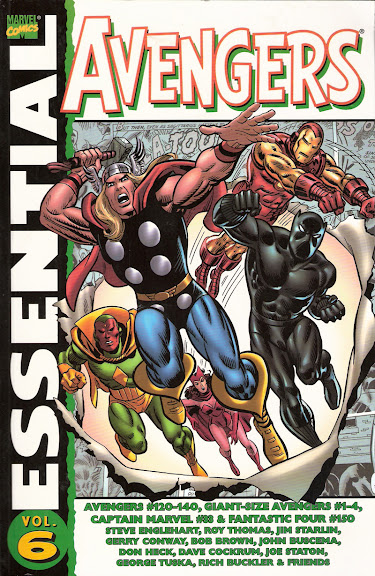
Essential Avengers, v. 6

Collects: Avengers #120-40, Giant-Size Avengers #1-4, Captain Marvel #33, and Fantastic Four #150 (1974-5)

Released: February 2008 (Marvel)

Format: 576 pages / black and white / $19.99 / ISBN: 9780785130581

What is this?: Kang tries to decide who the Celestial Madonna is; Mantis, the Vision, and the Scarlet Witch learn their origins; Zodiac and Thanos attack.

The culprits: Writer Steve Engelhart (with help from Roy Thomas and Gerry Conway) and art by Sal and John Buscema, Bob Brown, George Tuska, Rich Buckler, Don Heck, Dave Cockrum, and Tom Sutton

Having bought GIT Corp’s DVD-Roms of several Marvel series — Fantastic Four, Uncanny X-Men, Captain America, Amazing Spider-Man — I don’t have much use for Essentials featuring these characters. Which is fortunate, because Marvel seems like it isn’t all that interested in putting out new Essentials.

Unfortunately, these DVD collections, which have more than 40 years of comics and annuals, have one major flaw: they don’t include the Giant-Size series Marvel put out in the ‘70s. Now, I’ve read most of the Giant-Size Spider-Man, and there’s nothing that essential in them (although they can be enjoyable). And all you really miss in the Giant-Size Fantastic Four is Madrox the Multiple Man’s origin in #4. Fortunately, Giant-Size X-Men #1, which has the debut of the All-New, All-Different X-Men and is probably the most important Giant-Size issue, is included with the X-Men DVD-Rom. But the Giant-Size Avengers are important too, and they are left out of 40 Years of the Avengers.

Essential Avengers, v. 6 coverSo I purchased Essential Avengers, v. 6, which included all four issues of Giant-Size Avengers. Avengers, v. 6, also has another distinction among Essentials that makes it, if not unique, then very unusual: the issues collected in this book make up one storyline. That is, Essential Avengers, v. 6, makes an acceptable alternative to the Celestial Madonna Saga trade paperback, and it gives almost a year’s worth of issues that precede Celestial Madonna and a half year’s worth that follow the storyline. For these extra issues, you sacrifice color, but that’s a small price to pay.

One would expect a story that features the “Celestial Madonna” to have a long-lasting effect on the Marvel Universe — or at least the Avengers. But the most important event is the marriage of the Scarlet Witch and Vision; admittedly, that’s a pretty important moment, but neither of them are the Celestial Madonna. That honor goes to Mantis, a Vietnamese orphan who is trained by pacifist Kree monks after her uncle kills her mother and blinds her father. As with most storylines that revolve around the birth of a child unconceived, there has been little to no payoff from Mantis’s role. Mostly, the Celestial Madonna story is a time war vs. Kang, who returns again and again to kidnap Mantis and mate with her.

Oh, Kang. It doesn’t take much to get bored with Kang in this volume, despite writer Steve Englehart’s efforts. Why? Because Kang is the master of time, and his answer on how to use this temporal advantage is to steal dead heroes and villains out of the time stream and bring them to Limbo. Why use dead people? Who knows? Since he gains mental control of his new warriors, he could choose anyone — he could even steal future or past versions of the Avengers out of the time stream, which would at least make it an even fight. But no, he decides to create his Legion of the Unliving, none of whom, strangely, had died in their personal timelines yet. Kang’s other gambit include superrobots, Avenger-powered superrobots, and invading the present from several different points of his personal timeline simultaneously. This last is, at least, a good use of his advantages, but since his other versions seemed to have invaded from his Girl Scout days, anyone can beat them.

Once you get past a baby that won’t be born until after the book ends and a Kang who literally cannot even beat himself in a fight (and how could he, since he was outnumbered by himself two to one?), what do you have? Well, Giant-Size Avengers #4 has one of the oddest endings of any Avengers story outside Avengers #200: a half-Vietnamese, half-German girl who always talks of herself in the third person marries an alien tree who’s taking the form of her dead boyfriend, which takes her into space and will later impregnate her with the universal Messiah. Meanwhile, in the background, a mutant marries an android in a double marriage ceremony officiated by the future version of the supervillain the team just defeated (who also does not seem to have any real credentials that would allow him to perform marriages).

I wish I could say there were other parts of the story that rose to those heights, but that’s it — it’s hard to get that strange consistently, but other than the Legion of the Unliving, Essential Avengers doesn’t consistently rise to any notable level of insanity, nor does it get that exciting. “Celestial Madonna” is not exactly a disappointment, but it’s not a seminal Avengers story, despite its memorable name. The romantic tangle between Vision, Scarlet Witch, Swordsman, and Mantis is predictably resolved. This volume is also notable for the beginning of Vision’s confusing backstory; his body is that of the World War II android the Human Torch, a revelation that utterly fails to be interesting. The Scarlet Witch has an odd subplot with developing her “magical powers.” The Avengers have no problem operating in South Vietnam, which is a bit disorienting, but the issue was published just before North Vietnam won the war and unified the country under Communist rule.

The material that precedes the Celestial Madonna story is interesting as a snapshot of early Bronze-Age Avengers. The stories feature Zodiac, the revelation of who the parents of the Scarlet Witch and Quicksilver are (later revealed as false), the marriage of Quicksilver and the Inhuman Crystal, and the bizarre beginning of the Scarlet Witch’s training in witchcraft by Agatha Harkess (based, apparently, solely on the Scarlet Witch’s name). A battle with Thanos is a distraction —Captain Marvel #33 includes literally three pages of dense recap on Thanos’s history, which isn’t conducive to narrative flow — that comes to nothing, especially since it doesn’t end Thanos’s story as definitively as it pretends. And what comes after the Celestial Madonna heads into space is interesting as well; the introduction of new members Beast and Moondragon gives the team exciting new dynamics, despite the return of the slappingest, insanest Avenger, Hank Pym.

The art in Essential Avengers, v. 6, is top notch. The Buscema brothers provide the plurality of the art, with Sal penciling more than his brother John. Other pencilers include George Tuska, Dave Cockrum, Bob Brown, Don Heck, Rich Buckler, and Tom Sutton — a distinguished roster that needs no praise from me, however much it deserves it.

Despite the many interesting parts of Essential Avengers, v. 6, I think the main appeal is getting all four Giant-Size Avengers issues in one volume. There are other attractions — and I have to emphasize, the book is drawn by a lot of great artists who do not clash in style — but Marvel’s Giant-Size line is sadly neglected in reprint form. Englehart fans will find much to enjoy, as will those who like comic-book weddings — three in one volume, none of whom are married today!

Oh, and those who enjoy the thought of alien plants having consensual sex with human women will also find this appealing. You know who you are.

Rating:  symbol  symbol  symbol  symbol (3.5 of 5)

Labels: , , , , , , , , , , , , , , , ,

28 February 2009

Batman: Strange Apparitions

Collects: Detective Comics #469-79 (1977-8)

Released: November 1999 (DC)

Format: 176 pages / color / $12.95 / ISBN: 9781563895005

What is this?: A memorable — or so they say — Batman run of the ‘70s.

The culprits: Writers Steven Englehart and Len Wein and pencilers Marshall Rogers and Walt Simonson

Batman: Strange Apparitions is a seemingly random slice of late ‘70s Batman stories — more than a year’s worth of Detective Comics in one volume.

Ostensibly, it’s a showcase of writer Steve Englehart’s Detective run. According to the book’s introduction by Englehart, after he was hired away from Marvel, Englehart had planned to make this run his comics swan song. With penciler Walt Simonson, Englehart planned to tell a story involving Dr. Hugo Strange, Boss Rupert Thorne, and Silver St. Cloud. Simonson bowed out after two issues, so Marshall Rogers was brought in.

Batman: Strange Apparitions coverEnglehart thinks pretty highly of his work, which he says formed a bit of the basis of the first Batman movie. (I don’t see it, even if Vicky Vale is supposed to be a proxy for Silver St. Cloud, but I’ll take his word for it.) But is it really that good?

There are definitely some iconic Batman stories here. The Joker’s battle to patent his Joker Fish (fish chemically treated to have the Joker’s grotesque smile) is one of the great Batman stories, rightly reprinted in “Best of” anthologies and the origin of one of the best Batman: The Animated Series episodes. The battle with Hugo Strange is nothing special, but its aftermath is exciting: Strange, who has discovered Batman’s secret identity, dies rather than give it to Rupert Thorne, then haunts Thorne until he confesses his crimes.

But the Penguin and Dr. Phosphorus stories are Silver Age stories with Bronze Age trappings, and Len Wein’s Clayface III story, which wraps up the collection, could have come a Spider-Man book, with its tragic villain, self-pitying hero, and near empathy for the villain’s plight. Batman’s battle with Deadshot is fun, involving a giant electric typewriter (no manual typewriter in the ‘70s, no no), but most of the story is given over to Bruce Wayne’s romance with Silver St. Cloud.

That romance is the thread that ties the entire volume together. Its believability and impact is what could transform the book from tripe to treasure. Unfortunately, I’m not sure where I stand on the matter. Bruce quickly falls for Silver, and vice versa; her dedication to him helps save him from Hugo Strange. Fine; that makes sense. But in a moment that truly does link Strange Apparitions to Tim Burton’s Batman, Bruce reveals his secret identity after Silver has figured it out. And immediately after, she’s written out. No consequences! No romance! I don’t know if this sort of storyline was common back then, but it’s not the type plotting I expect from a premier title like Detective Comics, although it’s common in consequence-free, continuity-light mini series and annuals.

I’m not entirely convinced by the art, either. Both Rogers and Simonson draw certain characters as dynamic, important, beautiful — Batman and the Joker, for example. They seem almost to be drawn in a house style. The other characters … are not. They seem to be appearing in another book, by other artists. The rest of the art almost seems locked in an even older style. Sometimes everything comes together, atmospheric and beautiful. Other times it looks like a mishmash. There are more of the former than latter, but it doesn’t take many of the latter to spoil the whole bunch.

Also: Why aren’t there any covers? I find this a major problem. At least when the Dark Horse Chronicles of Conan lacked the covers, you know it was probably because of rights issues. Is it some sort of artists’ compensation difficulty that prevented DC from showing the original covers? Did they just run out of room? There are worse sins when reprinting old comics, but this is a quite noticeable one.

I’m not as impressed by this volume as I think I should be. However, there are too few trade paperbacks covering this interesting period, after Batman starts being taken seriously and before Crisis. For that reason, I’m giving Strange Apparitions a bit of a bump on the rating.

Rating: Batman symbol Batman symbol Batman symbol (2.5 of 5)

Labels: , , , , , , ,

24 May 2008

Essential Hulk, v. 4

Collects: Incredible Hulk #143-70 (1971-3)

Released: September 2006 (Marvel)

Format: 608 pages / black and white / $16.99 / ISBN: 0785121935

More than any other of the mainstay, stalwart titles at DC and Marvel, the Incredible Hulk can withstand mediocre runs.

Essential Hulk 4 coverPerhaps it’s just me. But even though I know the stories in Essential Hulk, v. 4 aren’t classic or iconic, they have a certain appeal that non-Hulk stories do not. The Hulk can go anywhere — the scope of his stories is immense, sprawling. He arrives like a meteor strike, his movements formed only by chance and villainy. In Essential Hulk, v. 4, he ranges from Canada to Latveria to the ocean floor and Jarella’s subatomic world. When most of the Marvel Universe is stuck in New York, this is refreshing.

If that doesn’t rock your socks, the highlight of this volume is the art of Herb Trimpe. Perhaps the artist most closely associated with the Hulk, Trimpe begins his long association with the Hulk in this volume. His work is good — more comfortable than standout, as gross exaggeration of the Hulk’s physique over the years has made his Hulk seem a little small in comparison. But for those who don’t pay attention to such things usually, this book shows the difference an inker (and reproduction, I fear) can have on a penciller’s work. Lines go from scratchy to clean and back again, heavy to light, etc. It’s not Trimpe’s fault, but it doesn’t bring out the best in his pencils.

Bi-Beast! The Hulk has a few of his B-grade villains created in this book: Bi-Beast, Zzzax, Harpy, the Wendigo. The creation of the Bi-Beast is bizarre and wonderful, something truly worthy of Jack Kirby’s fertile imagination. Instead, he was created by Steve Englehart and Trimpe.4 The thought of a comic with both Bi-Beast and MODOK but without the participation of Kirby makes me doubt Stan Lee’s all-encompassing wisdom.

As for the plots … well, they’re provided by a bunch of Marvel’s best in the ‘70s, but that doesn’t make the plots great. Roy Thomas, Gerry Conway, Archie Goodwin, Gary Friederich, and Englehart combined on the 28 stories in this volume, although few are memorable. (A side effect of the sprawling nature of the Hulk’s travels is that it often leaves a disconnect between stories.) Perhaps the worst of the stories is the “marry in haste, repent at leisure” wedding of longtime leading lady Betty to the man who had held a torch for her for years, Glen Talbot. The stories occasionally gain traction — the Hulk’s foray into Canada, for instance, when he first battles Wendigo — but mostly they’re as aimless as the hulk.

I liked this volume. But then again, I like this style of the Hulk.

Rating: Hulk head Hulk head Hulk head (3 of 5)

Labels: , , , , , , , , , , , , , ,