Reviews of trade paperbacks of comic books (mostly Marvel), along with a few other semi-relevant comments / reviews.

11 August 2009

Thor Visionaries: Walter Simonson, v. 1

Collects: Thor #337-48 (1983-4)

Released: May 2001, as Thor Legends, v. 1: Walt Simonson; with current title, December 2008 (Marvel)

Format: 288 pages / color / $29.99 / ISBN: 9780785131892

What is this?: The mythological hero Thor deals with the noble alien Beta Ray Bill, the evil faerie Malekith, the dragon Fafnir, and the temptress Lorelei.

The culprit: Walter Simonson

There are some things comic book readers argue about constantly, and some things are taken as an article of the faith. That Walter Simonson’s run on Thor is one of the title’s few claims to greatness belongs to the latter group. But can we see that greatness in the beginning of the run, as collected in Thor Visionaries: Walter Simonson, v. 1?

First of all, let’s start with the high point: This book has the first appearance of Beta Ray Bill, the noble alien whose spirit is transplanted into an engineered / cyborg body to protect the rest of his race, who have been loaded onto sleeper ships on their way to a new planet. He gets in a fight with Thor — of course — and during the fight picks up Thor’s hammer, which only the worthy can do. Bill is probably the greatest thing to come out of Thor post-Kirby, a reflection of Thor’s dichotomy of mythology and space / cosmic adventures. Bill starts in the latter, but Simonson brings him into the former effortlessly. An impressive accomplishment, and one that helps show why Bill has remained a favorite part of the Marvel Universe for so many.
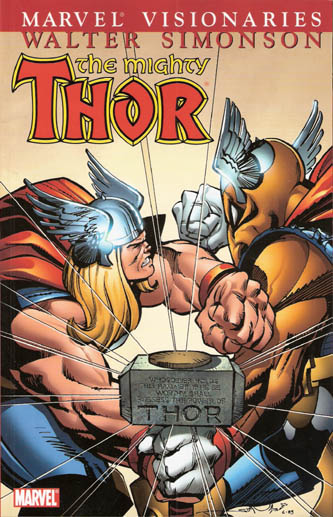
Thor Visionaries: Walter Simonson, v. 1 coverHe’s not the only impressive creation Simonson came up with in v. 1; there’s also Malekith the Accursed, who, if nothing else, has a striking visual. It’s he and the other villains that give Simonson the most room for creativity. He draws and writes an excellent, if somewhat restrained, Loki; his Lorelei looks like the temptress she is. But I’m not sold on Fafnir, who is a dangerously dull for a dragon, or v. 1’s hidden villain, a flaming giant who looks laughable rather than frightening when he’s finally revealed.

It says something about the character of Thor that in what is hailed as the title’s best run, the main character shares the title with a large supporting cast. A large part of v. 1 deals with Baldur coping with his post-traumatic death disorder and Sif wondering what her part in the mythos is now; the villains get a lot of time to plot and scheme, and Simonson isn’t afraid to shunt Thor to the side and give the guardians of the Cask of Ancient Winters center stage for a couple of issues. Thor spends a couple of issues with his mind altered. I think this crystallizes my feelings about v. 1: it’s a large mythological tale without a real center — or perhaps with a big, bland, blond center who is more impressive when he’s off stage.

I can’t help feeling Simonson might have been better off creating his own mythological tales without the baggage of the Marvel Universe tied to his work. In many ways, Simonson’s Thor has a lot in common with Mike Mignola’s Hellboy: mythology heavy, lots of neat-looking monsters, with an ensemble cast, dealing with world-ending threats. But while Mignola’s Hellboy is a strong character, Simonson’s Thor isn’t, even if he gets a new civilian identity.

That’s really the problem, and there’s not a lot Simonson can do about it. He gives Thor small flares of personality when he feels abandoned by his father or when he fights over his hammer (in a spectacularly stupid plot point). But Simonson doesn’t really follow up on that, even though Thor has more than enough daddy issues to keep a series going. Thor doesn’t have a romantic life; he has some interest in Lorelei, but it’s impossible to tell how much. Thor’s character seems based on respect of other heroes. So Simonson has to turn to his supporting cast to keep interest high. It’s a lot like making cauliflower soup; you have to add a lot of other stuff to make it interesting, and after you add enough spices, meat, flavored broths, and salt, it isn’t cauliflower soup any more, and you wonder why you even thought cauliflower soup was a good idea in the first place.

And I will never ask for cauliflower soup, no matter how little it tastes like cauliflower. Even if it’s Asgardian cauliflower, and it’s dressed in a Kirby helmet.

Rating: Thor's hammer Thor's hammer (2 of 5)
Labels: , , , ,

28 February 2009

Batman: Strange Apparitions

Collects: Detective Comics #469-79 (1977-8)

Released: November 1999 (DC)

Format: 176 pages / color / $12.95 / ISBN: 9781563895005

What is this?: A memorable — or so they say — Batman run of the ‘70s.

The culprits: Writers Steven Englehart and Len Wein and pencilers Marshall Rogers and Walt Simonson

Batman: Strange Apparitions is a seemingly random slice of late ‘70s Batman stories — more than a year’s worth of Detective Comics in one volume.

Ostensibly, it’s a showcase of writer Steve Englehart’s Detective run. According to the book’s introduction by Englehart, after he was hired away from Marvel, Englehart had planned to make this run his comics swan song. With penciler Walt Simonson, Englehart planned to tell a story involving Dr. Hugo Strange, Boss Rupert Thorne, and Silver St. Cloud. Simonson bowed out after two issues, so Marshall Rogers was brought in.

Batman: Strange Apparitions coverEnglehart thinks pretty highly of his work, which he says formed a bit of the basis of the first Batman movie. (I don’t see it, even if Vicky Vale is supposed to be a proxy for Silver St. Cloud, but I’ll take his word for it.) But is it really that good?

There are definitely some iconic Batman stories here. The Joker’s battle to patent his Joker Fish (fish chemically treated to have the Joker’s grotesque smile) is one of the great Batman stories, rightly reprinted in “Best of” anthologies and the origin of one of the best Batman: The Animated Series episodes. The battle with Hugo Strange is nothing special, but its aftermath is exciting: Strange, who has discovered Batman’s secret identity, dies rather than give it to Rupert Thorne, then haunts Thorne until he confesses his crimes.

But the Penguin and Dr. Phosphorus stories are Silver Age stories with Bronze Age trappings, and Len Wein’s Clayface III story, which wraps up the collection, could have come a Spider-Man book, with its tragic villain, self-pitying hero, and near empathy for the villain’s plight. Batman’s battle with Deadshot is fun, involving a giant electric typewriter (no manual typewriter in the ‘70s, no no), but most of the story is given over to Bruce Wayne’s romance with Silver St. Cloud.

That romance is the thread that ties the entire volume together. Its believability and impact is what could transform the book from tripe to treasure. Unfortunately, I’m not sure where I stand on the matter. Bruce quickly falls for Silver, and vice versa; her dedication to him helps save him from Hugo Strange. Fine; that makes sense. But in a moment that truly does link Strange Apparitions to Tim Burton’s Batman, Bruce reveals his secret identity after Silver has figured it out. And immediately after, she’s written out. No consequences! No romance! I don’t know if this sort of storyline was common back then, but it’s not the type plotting I expect from a premier title like Detective Comics, although it’s common in consequence-free, continuity-light mini series and annuals.

I’m not entirely convinced by the art, either. Both Rogers and Simonson draw certain characters as dynamic, important, beautiful — Batman and the Joker, for example. They seem almost to be drawn in a house style. The other characters … are not. They seem to be appearing in another book, by other artists. The rest of the art almost seems locked in an even older style. Sometimes everything comes together, atmospheric and beautiful. Other times it looks like a mishmash. There are more of the former than latter, but it doesn’t take many of the latter to spoil the whole bunch.

Also: Why aren’t there any covers? I find this a major problem. At least when the Dark Horse Chronicles of Conan lacked the covers, you know it was probably because of rights issues. Is it some sort of artists’ compensation difficulty that prevented DC from showing the original covers? Did they just run out of room? There are worse sins when reprinting old comics, but this is a quite noticeable one.

I’m not as impressed by this volume as I think I should be. However, there are too few trade paperbacks covering this interesting period, after Batman starts being taken seriously and before Crisis. For that reason, I’m giving Strange Apparitions a bit of a bump on the rating.

Rating: Batman symbol Batman symbol Batman symbol (2.5 of 5)

Labels: , , , , , , ,