Reviews of trade paperbacks of comic books (mostly Marvel), along with a few other semi-relevant comments / reviews.

10 June 2016

Midnighter, v. 1: Out

Collects: Midnighter #1-7 and Convergence: Nightwing / Oracle #2 (2015-6)

Released: February 2016 (DC)

Format: 160 pages / color / $14.99 / ISBN: 9781401259785

What is this?: Midnighter, the gay Batman, has split up from his lover and is trying to find himself. Unfortunately, someone has stolen a bunch of superweapons, and Midnighter has to find them and the culprit.

The culprits: Writer Steve Orlando and artists Aco, Stephen Mooney, and Alec Morgan


I really wanted to be able to recommend Midnighter, v. 1: Out, but I just can’t do it.

Before I read Out, all I knew about Midnighter is that he was, essentially, a gay Batman, originally from the Wildstorm Universe, whose lover was Apollo, a gay Superman. In Out, I quickly learned that second part is out-of-date, as Midnighter dates a string of men. In the second story, I found out Midnighter has a computer in his brain that allows him to see all possible outcomes of a fight, which allows him to choose the path that will lead to victory.
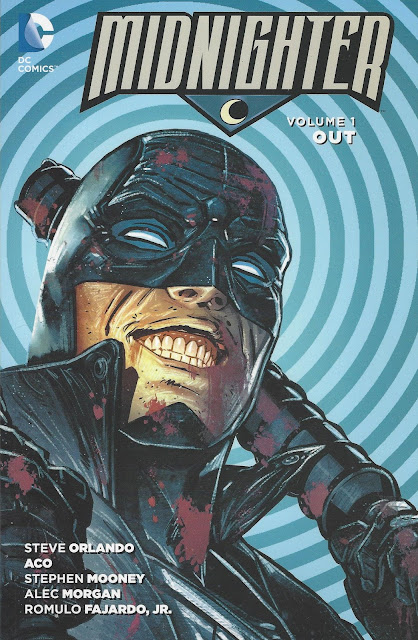
Midnighter, v. 1: Out coverBy the end, other than the reason Midnighter and Apollo broke up, that’s still all I know about Midnighter.

Out’s plot kicks off (in the book’s second story) with the theft of a super-arsenal from the Gardener, who also created Midnighter. Between dates, Midnighter follows the trail of the weapons, trying to find the thief. Writer Steve Orlando and penciler Aco (#1, #3, #6-7, and the story from Convergence) are trying to tell a complex, nuanced story, but their attempts come across as needlessly complex rather than interesting.

The text is littered with plenty of Warren Ellis sci-fi items, which I’m guessing is a relic of Ellis’s role in co-creating the Authority and Midnighter. Some of these terms and descriptions don’t have any logic behind them; for instance, a terrorist group from Modora (which I’m assuming is a country and not an insurance conglomerate or medical NGO) has blasters that kill people with their own anger. The rest could mean anything; the Gardener threatens her attacker with “doubt darts” and “manticore drones,” and items taken from her include the “six killing sounds,” which are rendered in Chinese, and “Holt-Griffin skin,” which is “invisible to technology.” Such vague, sci-fi items are meant to intrigue, but they annoy me instead. If a writer is going to use them, though, he needs to double down and make the text thick with them. Instead, they pop up as the next item to check off on Midnighter’s quest, and that’s not enough to justify their use.

Aco’s style makes it easy to figure out which stories are his and which are fill-ins: all of Aco’s issues have fiddly little blow-up boxes littering the page. The boxes don’t help the reader understand what’s going on, and their tiny size doesn’t actually magnify anything, but they are all over the place, so readers will have to get used to them. Aco’s art is tight and almost admirably miniaturized, but his ability to get a lot of art on a page doesn’t increase the amount of information that is conveyed, as Midnighter’s super-brain allows him to do things the art has trouble showing.

Admittedly, Aco isn’t aided by Orlando’s occasional forays into non-linear storytelling — the transition from #2 to #3, which goes from “now” to “hours earlier” to “later” to “back to now” ten pages later, is needlessly confusing and would be regardless of who was drawing #3. The switch from Alec Morgan (#2) to Aco doesn’t help things, either.

(Also: Would it kill DC to label each issue? I mean, even leaving a small number in one corner of the cover art would help me immensely; it also would have let me understand why what looked like Midnighter #1 was so short. It turns out the story was actually Convergence: Nightwing / Oracle #2, which is listed as part of the contents in the indicia’s tiny print but not on the cover.)

Confusing storytelling and high-sounding but disappointing Macguffins can be forgiven if the character at the center of the story is interesting. Unfortunately, we barely know him. What is it that drives Midnighter? He tells Apollo he’s leaving their relationship to find out who he is, but the reader never discovers what that is, other than a Batman copy with a computer in his brain. What other abilities does he have? He can teleport. Maybe he has superstrength? Maybe not. Maybe he’s just Batman with a fight computer in a brain but fewer detective skills.

Midnighter says he enjoys employing violence against bad people, and he specifically chooses the villains in this book because they robbed his … mentor? of a cache of superweapons. He seems to be irritated by criminals more than outraged. He has a small coterie of friends and a hangout; is this different than his status quo when he was dating Apollo? Midnighter seems to lack complexity; he’s a blank slate that likes to punch people.

What a lot of heterosexual men mean when they leave a relationship to “find themselves” is that they want to sleep with a lot of different women. Midnighter certainly succeeds in the homosexual version of that, sleeping with numerous men in Out. Morally, I don’t have any problem with that, but I am unconvinced that Midnighter’s dating pattern is a wise idea, from a security standpoint — and as it turns out, I’m right. It’s hard to respect Midnighter’s intelligence by the end … or maybe this is just another example of a man thinking too much with his little brain rather than the one in his skull.

The choice of the villain in Out is perfect: Prometheus, a villain who can download (and use) the knowledge and fighting skills of the world’s greatest martial artists. The battle between someone with these skills and someone who can calculate the future, like Midnighter, should be epic, as much a chess match as a physical encounter. Instead, Aco and Orlando give readers a straight slugfest, with two fighters trading bloody punches. The most innovative move shown is Midnighter smacking Prometheus with a poker. What a waste.

Dick Grayson, the original Robin and Nightwing who is now a secret agent, guest stars in #4 and 5. Contrasting Midnighter and Batman would be interesting, but other than Midnighter’s crack that Grayson must be “used to taking orders from a man in black,” the comparisons are all in the reader’s mind. Grayson seems almost to be humoring the ersatz Dark Knight by accompanying Midnighter on his mission; Midnighter handcuffs himself to Grayson because he claims a fight is boring him, but I find it hard to believe the protégée of Batman would remain handcuffed to Midnighter during a fight for any reason other than pity.

I enjoyed a few elements of Out. Midnighter’s glee at discovering he would be fighting Multiplex, a criminal who makes copies of himself, because it would give him so many bodies to beat up was a great character moment, and it’s amusing as well. The same goes for his approval of a fake vampire using insects and rats to fight him (“The vermin thing. Old school. Your respect for obscene tradition does not go unnoticed”). Midnighter’s final words to Apollo in their last argument — “I already know how this fight ends” — echoes his boasting from his physical fights. Those touches show up too seldom to save the book, though.

I have some sympathy with the assertion that a sex-positive comic book has value in and of itself; I also understand the idea that it’s good to show a gay hero who actually dates multiple men. And I admire that the creators of Out had ambitions; aiming high and missing is often better than aiming low and connecting. But the book itself isn’t interesting, and its misses aren’t that entertaining.

Rating: Batman symbol Batman symbol (2 of 5)

Labels: , , , , , , , , , ,

25 March 2016

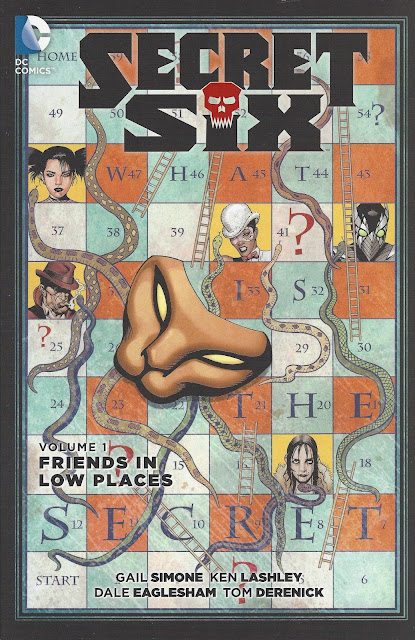
Secret Six, v. 1: Friends in Low Places

Collects: Secret Six v. 3 #1-6 and DC Sneak Peek: Secret Six #1 (2014-5)

Released: February 2016 (DC)

Format: 144 pages / color / $14.99 / ISBN: 9781401254858

What is this?: A new Secret Six! Five criminals and a PI are hunted by the mysterious Mockingbird, who wants some information from him. Who is he, and what does he want?

The culprits: Writer Gail Simone and artists Ken Lashley, Dale Eaglesham, and Tom Derenick


It has to be natural to make comparisons when you’re reading a title that has been recently rebooted, like Secret Six, v. 1: Friends in Low Places.

I’ve read most of writer Gail Simone’s run on Secret Six — the final volume, Caution to the Wind, will come out next month — and it’s hard not to compare Friends to that run. Frankly, it was hard for me not to mix-up the two different versions of the team. I’m not sure whether the source of that disorientation is the reboot or the book itself — but I’m leaning toward Friends.

Secret Six, v. 1: Friends in Low Places coverIn Friends, four villains (Catman; the newest Ventriloquist; Strix, a Talon from the Court of Owls; and new character Porcelain), a superpowered teenager (Black Alice), and a private investigator (Big Shot) are tormented and hunted by Mockingbird. Why? Mockingbird is coy about the reason, imprisoning them and asking, “What is the Secret?” They escape (without answering) and form a team of sorts.

Mockingbird claims to be an arch-criminal, but his plans are haphazard at best. He’s looking for a stolen diamond, but he doesn’t ask about the gem. He’s trying to protect his identity, sure, but he’s dealing with criminals, a teenager, and a private investigator; he’s asking for “the Secret,” yet it’s hard to imagine a more secretive yet stubborn group. Everything is a secret with them. Mockingbird sends a team, led by Scandal Savage, to track and fight the new Six, although it’s unclear what he hopes to achieve. He and Scandal hope the Six will be re-imprisoned, but Mockingbird has a mole in the group, which he uses almost immediately after the fight to draw the team into a … trap, of sorts. (The trap is he threatens to blow everybody up, including his putative fiancée and himself, if he doesn’t get what he wants. I’m not sure why it’s effective.)

It doesn’t help that Scandal’s team doesn’t seem interested in fighting the Six, despite Mockingbird threatening to use hostages against the Scandal. Nor does it help that the team — Scandal, Silver Banshee, and Ragdoll — were all members of the pre-reboot incarnation of the Secret Six. During the entire fight, part of me was bothered that those three were fighting against Catman.

The fight scenes don’t raise the stakes; instead, they seem to lower them. The scrap between the Six and Scandal’s team is frequently amusing, but no one’s heart seems to be in it, and Scandal unilaterally ends the fight by walking away. (She also doesn’t seem interested in the obvious next move of joining forces against Mockingbird.) The final fight between the Six and Mockingbird’s forces is desultory at best; Strix takes out Mockingbird’s men in a few panels, and the rest of the fight is the team reluctantly turning on Mockingbird’s mole despite having more effective options other than fighting among themselves. Perhaps this is intentional; the Six have no tactician, and they’re mostly people whose first and last recourse is fighting. It doesn’t make the book entertaining to read, though.

The art doesn’t help the fight scenes. Ken Lashley’s work on the Six’s escape from Mockingbird in the second issue is a few chaotic panels followed by a declaration of victory, while Tom Derenick’s art for the final fight lacks dynamism. Derenick tries to give a demonstration of Strix’s fighting style on a single page, but the horizontal layout makes the fight into a sidescroller, with that old video-game logic: antagonists come out of nowhere, they could possibly spawn forever, a character might not be something you can fight, and the fight ends arbitrarily. The battle in #3, which takes place in Big Shot’s suburban home, is much better, but it’s played for laughs, and there’s always a sense everything is being held back.

In the first two issues we should ideally be meeting the team and seeing how the members relate to one another. However, those issues feel disorganized; the first issue is mostly about Catman, how he was captured by Mockingbird and how poorly he fares in captivity. (His actions when he meets the rest of the Six in #1 have little to do with how he relates to them later on.) Issue #2 has many flashbacks to Catman’s captivity — no, not this captivity, but the captivity before that, the one we didn’t know had occurred. The double captivity is confusing, and the lack of issue labels doesn’t help; since the book includes a “Sneak Peek” issue, and I assumed one of the first two issues was that issue — something loosely connected to the regular series but that might not match up well to its continuity. Getting captured twice by Mockingbird makes Catman look like a chump, but the focus on Catman in these issues gives the impression Secret Six will be Catman and the Kitties Five, something the rest of Friends doesn’t dispel.

The book does have a lot of things going for it. Simone’s sense of humor is still appealing, and with a few less faults, that humor might have won me over. The other characters are types, but entertaining ones. Big Shot is the straitlaced suburbanite, unwilling to curse (or to have others curse) around ladies. The Ventriloquist is a Norma Desmond-type, believing the spotlight will find her and her dummy, the seemingly sentient Ferdie. Strix is silent, phonetically writing all her communications on a pad of paper and completely unable to guess what is socially acceptable. The “writing on paper” gag becomes impractical many times — who would let her write during combat? — but I’m willing to accept it for now. More concerning is that Strix is identified as a Talon for the Court of Owls, but neither “Talon” nor “Court of Owls” is explained. I know what they are, but a footnote would have been nice. I don’t think DC does footnotes any more, though.

Big Shot’s relationship toward Black Alice quickly becomes paternal. It’s reminiscent of the relationship between Scandal Savage and Bane in the previous volume of Secret Six, but that’s all it is: an echo, a parallel, an allusion. The relationship differs in many important ways: Big Shot and Alice are relatively nice people, which Scandal and Bane were not; Alice is young enough and Big Shot not so controlling that the relationship doesn’t have any creepy overtones; and most importantly, Alice enjoys Big Shot’s protectiveness. Their scenes together are sweet.

Porcelain is an afterthought. We learn the character’s basic powers — making hard matter brittle — and we’re told the character is trans to some degree, shifting from presenting a female to male persona to the world. We never discover if that’s a normal, real-world transition or if it is something in Porcelain’s powers. It hardly matters, since we see Porcelain as male only for a brief moment in issue #3. Unlike the others, we learn little of Porcelain’s personality. In the big fight scene, Porcelain is knocked out between issues #5 and 6, as if either Simone or Derenick had forgotten Porcelain was unaccounted for at the end of #5 but didn’t want to spend the necessary time showing what happened.

As revealed by my comments above, I’m not enamored of the art. Lashley draws the first two issues plus a few pages of the third. His work is atmospheric, but it lacks the detail needed to plant long-term hints; it’s hard to tell, for instance, that the singer on the first page of #1 is the same character who hits Catman with a taser a few pages later. Derenick (parts of #3 and #5, and #6) and Dale Eaglesham (Sneak Peek, #4, and part of #5) have much clearer styles. Their work is complementary, similar enough that I sometimes miss the handoff between them. I enjoy the clear lines and clear action both of them supply, but as I noted before, their fight scenes lack a certain vitality. I can’t decide whether that’s because the fights are written as pro forma, or if the art is the reason the fights seem so lackluster.

Friends is a disappointing book, but it’s not without promise. I’ll probably pick up the next volume, but I may not pre-order it. (I’m assuming the DC Universe didn’t re-reboot before the next six issues were released.)

Rating: Secret Six skull symbol Secret Six skull symbol (2 of 5)

Labels: , , , , , , , , , , , , , ,

18 March 2016

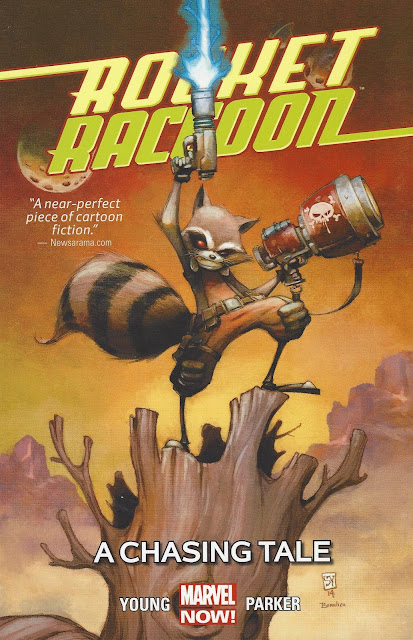
Rocket Raccoon, v. 1: A Chasing Tale

Collects: Rocket Raccoon #1-6 (2014-5)

Released: October 2015 (Marvel)

Format: 136 pages / color / $19.99 / ISBN: 9780785190455

What is this?: Rocket Raccoon of the Guardians of the Galaxy endures space jail and an army of ex-girlfriends while trying to discover what happened to “his people.”

The culprits: Skottie Young, with artist Jake Parker (#5-6)


Since Rocket Raccoon, v. 2: Storytailer will be released next week, I thought I’d look back at Rocket Raccoon, v. 1: A Chasing Tale. Relevance!

For most readers, the book’s appeal lies in Skottie Young’s artwork. Young, who drew #1-4 and wrote the entire book, certainly gives readers hyper-cartoony action and violence, the kind of stuff that wouldn’t be out of place in an old Bugs Bunny cartoon. Not that Young’s style looks anything like old Warner Brothers animation, but it does have the expressiveness, flexibility, and humor of those cartoons.

Rocket Raccoon, v. 1: A Chasing Tale coverYoung’s art often lives up to its reputation for imaginativeness. The prison escape montage is excellent. The sea-creature visuals surrounding Rocket’s accomplice Macho are creative and cohesive; I especially like the fish-like creature who swallows Macho’s ship, then spits it out at the other end of a hyperspace warp. Young sneaks in a few funny Easter eggs as well, like a box marked “John Woo props” in the middle of a gunfight.

Sometimes the art fails to live up to that standard, though. The aliens all look like humanoids, blobs, or animals; I’m not sure what else they can look like (clouds? Mechanical items?), but I feel confident Young could come up with something more unusual if he tried. (The strangest alien in Chasing Tale is Xemnu the Titan, a long-time Hulk villain Young uses in #2.) The ship designs are a bit boring as well. The sound effects Young adds are not as funny as the ones in Hercules — or as funny as Young thinks.

But I am not interested in Rocket Raccoon because of Young’s art. It’s nice to look at, but I’m a fan of the character Rocket — both Bill Mantlo’s original creation, with his anthropomorphic animal friends and stupid Beatles puns, and Dan Abnett and Andy Lanning’s sardonic, violent space warrior. The latter is in Chasing Tale, but the more I learn about him, the less I like him.

Young’s Rocket has a habit of swindling and leaving women he has bedded. He uses the idiotic catchphrase “Murdered you” that Bendis came up with in the new Guardians of the Galaxy series. (It’s possible Young might be using the phrase ironically; that doesn’t make it better.) Rocket learns no lessons from his bad behavior. What’s worse, he spends time angsting about his origins …

Once upon a time, Rocket’s origins were simple. He was an uplifted raccoon, meant to amuse the inmates on Halfworld, a mental asylum planet. When the psychiatric professionals left, Rocket and his animal pals were elevated to caretakers of the Loonies. Halfworld had a lot of uplifted animals, but none of them seemed to be of the same species; given that Rocket (then known as “Rocky”) was in charge of Halfworld, he would have known whether any other raccoons existed. But in Chasing Tale, he’s looking for others like himself (one of whom seems to exist) and Gideon’s Bible, the legendary artifact of Halfworld. What happened to Rocket’s memories of Halfworld? Why doesn’t Rocket know where any his old friends or the Loonies are? Why doesn’t Rocket know why Blackjack O’Hare hates him? (And why does Blackjack say it was over an employment dispute, since the two frequently fought on Halfworld?) Would it have killed editor Sana Amanat — or assistant editor Devin Lewis, who signed the lone footnote in the book — to give us a damn footnote explaining some of this?

The villains in Chasing Tale are all weak or problematic. The women Rocket wronged are both. They are all portrayed as unhinged, as jokes. Their leader tells Rocket that women’s pain isn’t treated as seriously as men’s; she’s right, but saying that doesn’t mitigate Young making light of their pain in Chasing Tale. (I mean, look at that pun in the title!) Rocket ruined their lives, and his only punishment is a few punches that he takes without complaint (and community service). That’s not enough; Rocket not only seduced and left the women, but he took their money, which caused them to lose their social status. Rocket manages to pummel an army of exes, despite their armaments and large ships, and still have something left over for Blackjack.

Every other villain is merely a speedbump for Rocket on the way to the end of the story. Without a clear view of continuity, Blackjack is only an opportunity for Young to draw a murderous bunny, not an opportunity to explore an existing relationship. The rest of Rocket’s antagonists are done away quickly and as a joke — huge person (with or without a gun) threatens Rocket, Rocket thrashes huge person. Ha! Ha?

Groot’s haphazard evolution as a character continues here, with the Guardians of the Galaxy movie providing the impetus for his new directions. In Chasing Tale, Groot can regrow from a splinter. Repeatedly. In a few hours. This ability reduces the stakes to nothing when Groot is in danger. And since when can Rocket (and the other Guardians) understand Groot? I think it’s a poor choice; Rocket’s responses to “I am Groot” aren’t funny enough to justify the change. Groot’s impenetrability was an aspect of his character I appreciated. Issue #5, in which Groot tells a bunch of kids a story, illustrates the superior comedic potential of not being able to understand Groot. The kids’ mystification is great, and the story’s entire dialogue consisting of repeated “I am Groot” communicates that confusion to the reader while the art tells the story.

Young is trying for a lighthearted tone in Chasing Tale, and despite the missteps I mentioned above, often he succeeds. Rocket quoting Earth movies to the space police during an interrogation at the beginning of #2 is amusing, although Young undercuts the joke by explaining it on the next page. The entirety of #5 is hilarious, and I especially enjoyed the Deadpool cameo. The payoff in #6 is a nice touch as well. But sometimes the violence and humor sit uneasily next to each other, especially when Young doesn’t quite nail the joke.

Jake Parker drew #5 and 6, and I prefer his work to Young’s, actually. His work on Groot’s tale in #5 does a better job telling the story than all but a few of the wordless ‘Nuff Said issues Marvel did in 2002. Parker’s art seems more in line with the funny animal aesthetic that covers Rocket’s backstory and the ideas Young’s story undercuts. Parker’s work isn’t as dynamic as Young’s, and it’s not as exaggerated; in fact, Parker looks like he’s strongly influenced by Bill Watterston, who wrote and drew Calvin and Hobbes. This gives Parker’s issues a touch of innocence that works well with Groot’s story in #5 and with Cosmo’s scenes in #6.

Chasing Tale has a lot of energy and a decent amount of humor going for it; if it was a story about a new character, I’d probably enjoy it more. Readers familiar with Rocket from the last few years or only the movie might love it, although that won’t get them past how Young treats Rocket’s exes. Storytailer might make this book better in retrospect by explaining Rocket’s history, but no matter what happens, I can be sure of this: I don’t care if Rocket is the last of his kind.

Rating: Rocket Raccoon symbol Rocket Raccoon symbol (2 of 5)

Labels: , , , , , ,

06 February 2015

Chronicles of Conan, v. 28: Blood and Ice and Other Stories

Collects: Conan the Barbarian #215-23 (1989)

Released: November 2014 (Dark Horse)

Format: 220 pages / color / $19.99 / ISBN: 9781616553746

What is this?: Conan becomes a implacable, unbeatable killing machine as he works his way toward Turan.

The culprits: Charles Santino (writer) and Val Semeiks (co-plotter / artist), with help from Larry Hama, Don Perlin, Michael Fleisher, and Gary Kwapisz


So far this year, I’ve read the first volume of Batman ‘66, Astro City: Life in the Big City, most of Mark Waid’s Daredevil run, the first book of Waid’s Indestructible Hulk, Umbrella Academy, v. 1: Apocalypse Suite, and Fantastic Four, v. 2: Road Trip. So of course the book that I’m going to write about is Chronicles of Conan, v. 28: Blood and Ice and Other Stories.

Chronicles of Conan, v. 28: Blood and Ice and Other Stories coverWhat interests me about Blood and Ice is writer Charles Santino’s run, which stretches from #215 to 220. Santino took over for James Owsley (today known as Christopher Priest), who improved the title immeasurably by giving Conan a supporting cast; if Conan was a static character in the Marvel Comics — and he was — Owsley’s supporting cast was allow to grow, to act in surprising ways, and to die.

It was a welcome change. Before that, Conan had been stuck in endless retreads of one- and two-issue stories where Conan had battled some uncanny threat, been involved in some way with a comely lass, and then moved on to the next uncanny threat / comely lass. It was boring and short sighted.

With Conan having jettisoned the last of his supporting cast at the end of the Owsley run, Santino and co-plotter / artist Val Semeiks embarked on a series of stories unique in the Conan canon: a series of brutal one-issue fights as Conan makes his way to the eastern nation of Turan. Never in the original Robert E. Howard stories, the movies, or Conan the Barbarian has Conan seemed so much of a ‘90s superhero.

The break beginning of this volume is well chosen, although my guess is that it was a fortunate accident. In #214, which is in the previous volume (Chronicles of Conan, v. 27: Sands upon the Earth and Other Stories), Conan is trapped in a mirage city. It’s a story indistinguishable from dozens of others in the Marvel series; a seemingly inescapable trap, a few monsters to bash, a scantily clad maiden hanging around the periphery of the story.

But in #215, the start of Blood and Ice, the story direction changes. Gone are the pretty girls; magic is violently shoved from the plots. In the first story, Conan is captured by Turanians at a desert outpost. Well, “captured” — the soldiers are able to move him along but not subdue him in an attempt to enslave him to work the giant water wheel beneath the outpost. Conan, unbowed, not only kills Turanian soldiers but destroys the water wheel and breaks the Turanian’s slavery. It seems as if most of the slaves die in the carnage as well, but that’s a small matter.

In “Death Pit” — the simple title is a taste of things to come — Conan can’t be beaten, can’t be stopped. He is a force of nature, destroying the works of true villains. The Turanian soldiers — agents of an encroaching imperialistic nation turned slavers to make the machinery of daily life turn fluidly — are more effective as villains than any number of black wizards or monsters; they represent a commonplace sort of injustice, and Conan will not let himself submit to that injustice. In the end, he smashes not only the soldiers but everything they have brought to the outpost.

The following issues show Conan against armies of men who not only cannot defeat him but also cannot bloody him. He destroys a large army of cultists in #216, invading their temple and bulling through their attempts to subdue him; the only beautiful woman is sacrificed by the cult early in the story, and Conan can’t save her. In #217, he’s back to battling a magical guardian in a deserted city, but he’s trapped on a small island in #218 and has to kill a homicidal band of tribesmen to gain their boat and escape. He fights through a Turanian army in #219, escaping by stealing superior horseflesh. Santino finishes his run by showing Conan pursuing a band of gold thieves; they stole what he had his eye on, and so he relentlessly follows them through the snow until they are all finished.

Santino’s Conan shows no cunning and very little guile, which is far from the character that Robert E. Howard created. Santino’s Conan is the greatest swordsman ever, it seems, indomitable and undefeatable — the very epitome of a superhero, except for his massive body count. Santino’s issues are bloody little fables about an unstoppable force, with Conan destroying all who tries to slow him. I’m not sure if these stories are good, but they are fascinating; why had no one done this with Conan before? Was it because this level of violence wasn’t permitted before the late ‘80s? Or was it because even the most mediocre of writers who had written Conan the Barbarian before this understood that that was not truly who Conan was?

Although I’m attributing most of this interpretation of Conan to Santino, Semeiks is listed as co-plotter as well as artist. Semeiks had graduated to co-plotter with Owsley, whose issues were greatly different in tone; unless Semeiks was able to exert considerably more influence on Santino than he was on Owsley, it’s unlikely the new direction was his. Semeiks continued to supply very good art during this time, fluid and action-filled, but it lacks the visceral brutality and blood to back up this version of Conan. It’s probable that editorial prevented Semeiks from drawing that level of brutality, though.

After Santino and Semeiks depart the title, the rest of the volume becomes much more like Conans past. Larry Hama’s #221 is an eerie little story that would not have been out of place in a ‘50s horror comic. Hama writes the story in verse, and his versification detracts from the story’s impact; a story with minimal dialogue / narration would’ve made the story truly memorable instead of an intriguing curio. Don Perlin shows Conan pursued by and confronting his own revenge squad; unsurprisingly, with all the men Conan has hacked to pieces over the years, Conan remembers none of them. The poignant revelation of their pointless attempt at revenge against a man who never hated them and didn’t even recall maiming them is balanced by Conan’s incompetence against a bunch of crippled buffoons. The volume ends with a story by Michael Fleisher, whose Conan is as different from Santino’s as possible: Fleisher’s Conan displays almost preternatural foresight while helping a comely lass recover a religious icon.

I don’t think I can recommend Blood and Ice for Conan fans. Santino’s interpretation of the character is too far off model to be convincing. On the other hand, his protagonist is a force of nature, compelling and readable because of his direct, brutal nature. I think even for a fan of sword-and-sorcery fiction, it is too simplistic, and six issues of it is altogether too much. However, if you can read #215 by itself, give it a try; I found myself reacting more emotionally to Conan’s struggles in that story than I had in total to the 100 issues before it.

Rating: Conan symbol Conan symbol (2 of 5)

Labels: , , , , , , , , ,

30 August 2013

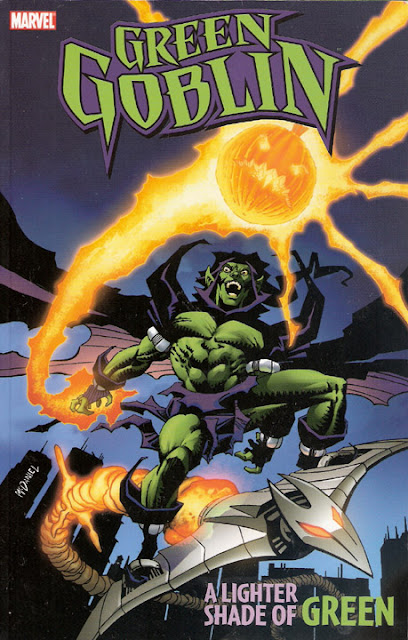
Green Goblin: A Lighter Shade of Green

Collects: Green Goblin #1-13, Web of Spider-Man #125, Spectacular Spider-Man #225, and Amazing Scarlet Spider #2 (1995-6)

Released: August 2011 (Marvel)

Format: pages / color / $39.99 / ISBN: 9780785157571

What is this?: Daily Bugle intern Phil Urich runs across some Green Goblin equipment and tries to decide whether to help himself or others.

The culprits: Writer Tom DeFalco and Terry Kavanagh and artists Scott McDaniel, Joshua Hood, and others


Marvel’s decision to reprint the 1995-6 Green Goblin series in Green Goblin: A Lighter Shade of Green was a curious one. Theoretically, with the Green Goblin being Spider-Man’s archnemesis, a Green Goblin series should have been important. It wasn’t, though; it was a mid-‘90s series about a newspaper intern, Phil Urich, who stumbles across the Osborn Goblin gear. Green Goblin wrapped up just before Onslaught gave Marvel the freedom to do some excellent work with new or lesser-known concepts (Thunderbolts, Deadpool). Neither the writer, Tom DeFalco, nor the main artist, Scott McDaniel, are “hot” or “new” or “critic’s darlings.” As a final nail in the commercial coffin, the character crossed over with the ‘90s Clone Saga.

I suppose Phil becoming the latest Hobgoblin, a recurring villain in Amazing Spider-Man, at the end of 2010 was the impetus for the reprint. Still, that’s a slender thread on which to hang a $40 reprint of a little-remembered, unlamented series like Green Goblin.

Green Goblin: A Lighter Shade of Green coverGreen Goblin is a series that relies heavily its protagonist narrating his thoughts, which is a problem: Phil is a teenager, and when middle-aged white guys write “hip” teenagers, the results always lack verisimilitude. DeFalco seems to have picked up all his teenager dialogue from bad TV shows that were also written by middle-aged white guys. Although Phil does have a distinctive voice, I don’t believe anyone has ever spoken like him in the history of mankind — unless, by chance, some grunting caveman or cavewoman accidentally strung together the same syllables Phil used. I was a teenager in the ‘90s, and I can guarantee none of my friends ever used phrases like “Scarlet really ups the gear” or “she’s mint, sexy, and all that!” I didn’t either — or at least I don’t remember sounding like that. Might explain my social life if I did say those sorts of things. Slammin’!

A second problem with Phil’s narration is that Phil is not an intrinsically likeable person. Phil is one of those slackers DeFalco had heard so much about, a college dropout working as an intern for his uncle, Ben Urich, at the Daily Bugle. Having dropped out of college, Phil doesn’t know what he’s going to do with his life, and when he gets the Green Goblin equipment, he’s not sure how he wants to use it. He doesn’t instinctually aid others, but he usually ends up being helpful. He has vague ideas of gaining fame, acclaim, money, and women, but his plots are badly thought out, and they lack ambition. Also, Phil’s a bit skeevy about the women; he notes when Lynn, the girl he has a crush on, “jiggles into view” and thinks about “all the butter [he] wanted to spread on Lynn.” It’s no surprise that when he gets some money, he spends it on a suit and flowers and expects Lynn to fall into his arms, despite his lack of charm and her general lack of interest in him as anything but a co-worker and source of info.92

DeFalco does a good job choosing sparring partners for Phil to fight, mixing established villains with new ones. Hobgoblin is a no-brainer, considering he was, at the time, the only other living link to the Goblin legacy. Arcade is always a good choice for a beginning hero. Yes, it stretches credibility that Phil would be able to defeat the Rhino early in his career, but in issue #2, the hero needs a victory, and in a battle between two lunkheads, I can buy that the first person with a good idea would win. The new villains are a mixed bag; Angel Face is the most competent and has a real reason to keep after the Green Goblin, and the Steel Slammer has a nice design. Purge, a generic assassin, and Jonathan Gatesworth, a “virtual reality” creator, are forgettable.93

Even beyond DeFalco’s failed attempts to emulate the youth slang of the day, Green Goblin is marked pretty solidly as a ‘90s comic by DeFalco working current events of the comic-book industry into the background. At one point, recurring villain Angel Face robs a tycoon named “Berinutter,” which sounds like DeFalco’s way tweaking the nose of or taking his frustrations out on Isaac Perlmutter, who was chairman at the board at Marvel at the time. DeFalco also makes “Larson Toddsmith” and “Marc Portaccio” the unscrupulous heads of Compuboot, a game company; the names are obvious references to Image Comics founders Erik Larsen, Todd McFarlane, Marc Silvestri, and Whilce Portacio.

Marvel’s financial situation was worsening at the time, and DeFalco has some opinions on how business and creative pursuits should intersect; in #9, he puts these words into a villain’s mouth: “[We] would be in Chapter 11 if not for [our] financial wizardry and … marketing magic! Creativity is fine … in its place … but the business people transform vague ideas into profits!” Later in the issue, he puts the opposite view into Phil’s mousy potential love interest, Meredith Campbell: “Corporations don’t think like us regular folks! No matter how much profit they generate … it’s never enough!” The joke was on DeFalco, though, as Marvel filed for Chapter 11 in December 1996, a few months after Green Goblin was cancelled.

The book includes three Spider-issues. The best is a crossover between Amazing Scarlet Spider #2 and Green Goblin #3, which is part of the Great Game storyline. Phil gets a crush on the amoral Joystick, who fights in the Great Game, an international gladiatorial contest. Joystick is in town to fight the Scarlet Spider, but her plans are loused up by one of her previous victims, El Toro Negro. DeFalco had an excellent chance to contrast the attitudes of the thrill-seeking Joystick and responsible Scarlet Spider, especially since the Scarlet Spider doesn’t have Spider-Man’s cachet as a moral center of the superhuman community. Instead, DeFalco treads too lightly on the question, having Phil reject Spider-Man’s ethos without seeing his own similarities to Joystick.

Web of Spider-Man #125 and Spectacular Spider-Man #225, which immediately follow Green Goblin #1 in this volume, seem like the traditional attempts to boost a new character’s profile with an appearance in a Spider-book. Unfortunately, the two issues serve as poor attempts at promotion, since the Green Goblin in those books little resembled the one who starred in his own book. Web #125, written by Terry Kavanagh, is the worst offender, as Phil’s motivations for being in the Clone-Saga story are weak at best and nonsensical at worst. Spectacular #225 is written by DeFalco, but Phil’s reasons for being out in costume are not in line with his development in his own series; Phil sees himself on a “grim mission” when he hunts down a man setting fire to homeless people, which is quite heroic for someone who hasn’t decided what to do with his new powers. His inexperience does show in his battles with the villain and Spider-Man, though.

DeFalco keeps bringing up Phil’s struggles with his identity: is he a hero or someone who merely exploits his abilities for personal gain? An ambitious man or slacker? Ladies man or creep? Although Phil arrives at the place you expect him to by the series’ end, it is sometimes hard to follow his developmental path. He eventually overcomes his fear of the neighborhood thug, Ricko the Sicko, but he still fears the Hobgoblin’s wrath. He rejects Lynn not because he finds a woman whom he is more compatible with but because he realizes Lynn isn’t that interested in him. His heroism is motivated as much by a desire to impress Lynn as his nascent conscience, despite advice from Daredevil and Scarlet Spider. Only the Onslaught crisis forces him to answer the questions, and then the series ends.

The primary artist for Green Goblin, Scott McDaniel, has a blocky, exaggerated style that works best in the ‘90s. The Green Goblin costume and mask lends itself to exaggerated touches, and I like the Steel Slammer design, but he has a little trouble with Phil’s quieter moments. (McDaniel’s Pittsburgh youth shows up when he has Phil wear a Steelers jacket, even though Phil’s a fan of the New York Smashers.) McDaniel penciled #1-4, 6-7, and 9-10, leaving a lot of space for fill-in artists. Most of these are unremarkable, with the occasional glitch; for example, Keven Kobasic draws Judge Tomb as a tall, powerful young man with single tufts of blond hair on his head and chin in #5, while McDaniel goes the more clichéd route, depicting Tomb as a small, old man with a fringe of white hair on his head in #6.

Hood Green Goblin imageJoshua Hood drew the last three issues. Hood’s distorted, elongated faces are off-putting, making the characters look almost deformed. He draws Angel Face’s scars as far more disgusting than McDaniel did, robbing her of some of her humanity (which DeFalco’s writing doesn’t compensate for). In #12, though, his Sentinels aren’t bad, and the final image from that issue is impressive.

Green Goblin grades out as mediocre — not groundbreaking or very memorable, but it’s not offensive either. Poking around these forgotten corners of the Marvel Universe is always its own reward, but on the other hand, it’s not a reward worth paying $40 for (or $30 new at Amazon). If you are an archaeologist of Marvel or ‘90s pop culture, Green Goblin might be worth it if you can find it at a reasonable price. Otherwise, let it go.

Rating: Spider-Man symbol Spider-Man symbol (2 of 5)

Labels: , , , , , , , ,

29 June 2013

Demon Knights, v. 2: The Avalon Trap

Collects: Demon Knights #0 and 8-12 (2012)

Released: May 2013 (DC)

Format: 144 pages / color / $14.99 / ISBN: 9781401240394

What is this?: Medieval heroes head to Camelot. Camelot? Camelot? Camelot! (It’s only an alternate version.)

The culprits: Writer Paul Cornell and artists Diogenes Neves and Bernard Chang


Following the fantasy protagonists’ defeat of an army in Demon Knights, v. 1: Seven against the Dark, the book’s seven heroes head to Alba Sarum to receive their reward in Demon Knights, v. 2: The Avalon Trap. Well, “reward”: it’s not so much compensation or perquisites as it is another mission. This time, the group is sent to Avalon to rescue the spirit of Merlin, who has been murdered in Alba Sarum.

So: fantasy quest. Writer Paul Cornell gives us Fantasy Quest #28b, the one with a crumbling castle, a trap, and a double cross; the “b” denotes the variant where the characters are given their fondest desires, but it come with a price. In truth, the quest is not as cookie cutter as I’m making it seem, but it does lack heft. The trap is set by the obvious culprit, and the trap itself lacks any subtlety or hint that it is anything but what it is. The double-cross comes from the person Cornell has already told readers is a double-crosser.

Demon Knights, v. 2: The Avalon Trap coverThe plot’s predictability isn’t Avalon Trap’s only weakness, however, and it isn’t even the plot’s only weakness. It story is also slow, with the quest creeping through a landscape filled with giant, distorted animals that are eventually shown to have little relevance to the villain's plan. And then there’s the question of Camelot and King Arthur …

Three of Demon Knights’s protagonists were at Camelot when it fell: Jason Blood (who shares his body with Etrigan the Demon), Madame Xanadu, and Shining Knight. Jason and Xanadu were sweethearts, but they and Shining Knight have no knowledge of each other. To rectify that apparent contradiction, Cornell posits a multiplicity of Camelots and Arthurs. It solves the problem with the Shining Knight neatly, but it robs the fall of Camelot and the death of Arthur — the heart of the Arthurian legend — of some of its narrative heft. What does it matter that those characters’ Camelot fell? Camelot is always falling, Arthur is always dying and returning. Camelot is significant to the world of Demon Knights, but Camelot’s devastation and Arthur’s transformation in issues #9-12 aren’t a tragedy or even especially sad; each fallen Camelot is just a set with different dressing, starring a different actor as Arthur with a slightly different costume.

The ensemble approach to character development Cornell used in Seven Against the Dark is put aside in Avalon Trap in favor of an emphasis on Xanadu and Etrigan. Issue #8 goes into the history of their love triangle with Jason Blood, and #0 follows Etrigan’s rise through the demonic ranks. Given the large cast, concentrating on a few characters seems wise; Xanadu and Jason Blood / Etrigan are the book’s most recognizable characters, so starting with them makes sense. The other characters get only a few chances to shine; Al Jabr is distrustful of Vandal Savage, who gets the best lines (“I will not die so a woman with no face can gain different genitalia!”), and Shining Knight displays some impressive swordwork. Those moments do not dispel the “Etrigan, Madame Xanadu, and Friends” vibe Avalon Trap has, though.

A few notes strike me as false, even after suspending my disbelief. First, the characters use the British insult “swivers” a few times; the word is roughly from the right time, dating back to at least 1440, according to the Oxford English Dictionary. It means “someone given to sexual indulgence.” That doesn’t seem like much of an insult to characters like Etrigan or Vandal Savage, and the term looks self-consciously strange to Americans. Secondly, Alba Sarum is ruled by a pair of princesses who hope to marry each other. While royal lesbians surely existed, by the laws of averages at the very least, the medieval protagonists’ and townsfolk’s acceptance is strange. Stranger still is Xanadu’s thinly veiled plug for gay marriage.

Diogenes Neves provides most of the art, although on more than half his five issues he has to have an assist. Neves differentiates the characters well, and his storytelling is good. He draws some excellent monsters as well. However, the extent of the characters’ transformations in #11 is a bit unclear. Bernard Chang draws #0 and does a very good job as well. If only Marvel had demons as fearsome as the ones Chang draws!

The visuals aren’t enough to save Avalon Trap, though. The setting is disposable, the plot is slight, and most of the cast is underused. The promise of Demon Knight has faded; I don’t know if I’m going to pick up v. 3.

Rating: DC logo DC logo (2 of 5)

Labels: , , , , , , , , , , , , , , , , ,

03 May 2013

Avengers Academy, v. 4: Second Semester

Collects: Avengers Academy #21-8 (2012)

Released: November 2012 (Marvel)

Format: 176 pages / color / $19.99 / ISBN: 9780785152033

What is this?: The Avengers Academy takes on new students, and the new student body has to deal with the X-Men, a Dire Wraith, the Runaways, and former young Initiative members.

The culprits: Writer Christos Gage and artists Sean Chen, Tom Raney, Tom Grummett, and Karl Moline


The first three volumes of Avengers Academy focused on a tight group of six students whom the Avengers suspected might become supervillains because Norman Osborn tortured them. Occasionally an issue’s focus drifted toward the students’ teachers, most notably longtime Avenger Hank Pym, and that was OK too; readers cared about the teachers because of their relationships to these fresh, young characters.

In Avengers Academy, v. 4: Second Semester, the school founded by Hank Pym opened its doors to new students. In theory, introducing new characters to the cast is a good idea, especially after one of the original six students left during Fear Itself: Avengers Academy. However, writer Christos Gage has included every young Marvel character created in the last fifteen years who wasn’t claimed by another book.

Avengers Academy, v. 4: Second Semester coverWell, it seems that way. The new students include Juston Seyfert and his Sentinel, the new Thundra, Ricochet, Whiz Kid, Spider-Girl, Machine Teen, the old Penance, the new Power Man, Butterball, Rocket Racer, even Batwing from Untold Tales of Spider-Man. I’m not sure what character could show “bottom of the barrel” more comprehensively than Batwing, who appeared in four issues of Kurt Busiek’s Untold Tales series, which was set in early Silver Age continuity, and an issue of Avengers: Initiative. We never learn why these characters are at the Academy or anything about them; they exist to fill out the background art.

However, despite the apparent cast of thousands, Gage focuses on three new characters: Lightspeed (Julie Power of Power Pack), X-23 (the female clone of Wolverine), and the newest White Tiger, Ava Ayala (not the old White Tiger, Hector Ayala, or the not old, not new White Tiger, Angela del Toro). Gage has a solid role for Lightspeed (teacher’s assistant), and X-23 is at the Academy to further her socialization. White Tiger, on the other hand, seems to have arrived to hassle Reptil, an original Academy student, about not being active in the Hispanic community.

Ideally, new characters should find a place to nestle in the cast, establishing their own niche or insinuating themselves inside pre-existing relationships to shake things up. Lightspeed is a great addition to the cast, a former team player, and Gage uses her sexual identity to allow her to relate to one of the established students. X-23 doesn’t get much time to show who she is, but Gage allows her and Mettle to discuss what it’s like to be a killer, and she’s tossed unwillingly into a love triangle. White Tiger does get a lot of time on the page, but Gage is less successful with her; she has a tragic origin and a Hispanic identity, but she’s not much more than that — we don’t even learn how she got her mystic amulet from her niece, Angela del Toro.

The team-vs.-team fights don’t help matters. Marvel Comics have had a template embedded into their DNA since Stan Lee crapped out the first superheroes after the Fantastic Four: heroes meet, fight, and then team up vs. the villain. Unfortunately, there are no villains to fight. The students in Second Semester fight the Avengers, X-Men, and Runaways, and somehow they avoid fighting former Initiative recruits when they show up. But there are no villains for them to team up and fight. The brief battles with other heroes wind down with a discussion by calmer heads, but discussions about the reasonableness of the other side’s point of view is not why I read comics. The lack of villains makes the heroes’ squabbles seem inconsequential.

Second Semester has only one fight with a villain. The entire student body battles a Dire Wraith hybrid; with the Wraith’s mind control, it’s a good fight, but one issue with a villain (two, if you count an issue of barely restrained scheming) out of eight is not enough. Gage tries to get the reader interested in the schemes of the future versions of the Academy’s original six students, but I’m not buying it. The future students are trying to bring about their nefarious (or not nefarious) future for mysterious reasons, but I have no criteria to judge that future on. Admittedly, one of the future versions tries to get Avengers Academy students killed, but that’s because the Wraith killed a lot of students in his timeline.

Gage is more successful with character development and humor. The guest stars get most of the good lines, but fortunately, he hasn’t lost his touch with his old characters. Hazmat and Mettle’s relationship progresses along expected lines, but they are sweet together, and the characters’ reasonableness means stupid misunderstandings are stumbling blocks rather than relationship breakers. Striker makes a big revelation, and even though I can see what Gage is aiming at, I’m not convinced previous characterization backs it up. Finesse and Reptil’s relationship is explored in the future but not much in the present, and Finesse finally meets Magneto, the man whose methods she wanted Quicksilver to teach her.

Second Semester has a ridiculous four pencilers for eight issues: Sean Chen (#21-2), Tom Raney (#23), Tom Grummett (#24-6), and Karl Moline (#27-8). I enjoy Chen’s clear, clean art, but Grummett’s is excellent as well; he has to do the bulk of the close-ups on the background characters, and he manages to differentiate them. Moline’s art has a loose, exaggerated style that looks nothing like the others’, and its incongruity makes it look worse than it actually is.

Although I still like the characters, Second Semester has to be considered a step down in quality. The book has too many characters without enough to do, and the plot puts too little external pressure on the characters to make them react in interesting ways. I hope the title will rebound, but since the extra students aren’t going anywhere, I have my doubts.

Rating: Avengers symbol Avengers symbol (2 of 5)

Labels: , , , , , , , , , , , , , ,

05 April 2013

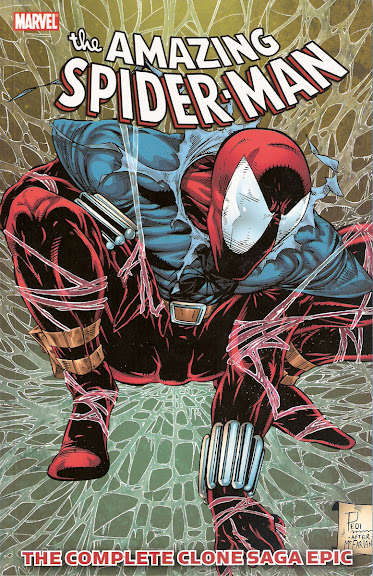
Spider-Man: The Complete Clone Saga Epic, v. 5

Collects: Amazing Spider-Man #405-6, Spectacular Spider-Man #228-9, Web of Spider-Man #128-9, Spider-Man #62-3, Spider-Man Unlimited #10, New Warriors #62-4, Spider-Man Team-Up #1, and backups from Amazing Spider-Man, Spectacular Spider-Man, Spider-Man, Venom, and Web of Spider-Man Super Specials (1995)

Released: January 2011 (Marvel)

Format: 472 pages / color / $39.99 / ISBN: 9780785150091

What is this?: The Clone Saga is wrapped up — ha! — Ben and Peter figure out what to do with their lives.

The culprits: Writers Tom DeFalco, Terry Kavanagh, J.M. DeMatteis, Todd DeZago, Howard Mackie, and Evan Skolnick and artists Patrick Zircher, Sal Buscema, Steven Butler, Gil Kane, and others


Spider-Man: The Complete Clone Saga Epic, Book 5 isn’t great, but I can praise some elements of the book without reservation. More importantly, little in Book 5 inspires the deep loathing the abysmal Book 4 did.

The high point of Book 5 is the five-part story that ran alongside “Planet of the Symbiotes” (reprinted in Book 3) in the Super Specials. Written by Terry Kavanagh, the tale introduces a new hero, Strongarm, who is created by a scientist’s reworking of Dr. Curtis Connors’s research. Strongarm’s story, which — of course — culminates in a battle with the Lizard, Connors’s alter ego, is forgettable, but Strongarm himself has a certain uncomplicated, Boy Scout charm about him. More interesting, though, is the attempt of Spider-clone Ben Reilly to assemble a life: a job, a love interest, a supporting cast. Heck, he even shows a hint of jealousy, and even though jealousy is a negative emotion, any emotion not connected to Peter Parker or clones is welcome. Chronologically, this story should probably have been included before Amazing Spider-Man #400 — it’s hard to believe Ben could get hired for a job without anyone remarking upon his resemblance to a front-page murder suspect — but it’s good to see the Spider-office spend some time on the man who will be Spider-Man for the next year.

Spider-Man: The Complete Clone Saga Epic, Book 5 cover I also like the New Warriors issues in Book 5. The three issues have nothing to do with Spider-Man, and most have little to do with the Scarlet Spider (Ben’s alter ego), but they are a nice, clone-free palate cleanser. Writer Evan Skolnick shows a different side to Ben, who relates to a team — something Spider-Man had not done up to this point — and even takes charge when necessary. The issues also have some intriguing subplots, which — again — have nothing to do with Spiders or clones … unfortunately, this makes it sound as if I’m tired of reading about Spider-Man or the Clone Saga.

Perhaps I am; the other three storylines in Book 5 don’t generate any interest in the clones. In quality, they range from dull (“Exiled” and most of “Greatest Responsibility”) to awful (“Time Bomb”).

The four-part “Exiled” crossover is mystifying, as the four issues have three unrelated stories in them. They are tied together by a subplot: Ben’s decision to leave New York, which he reverses almost immediately. The main stories are random. Web of Spider-Man #128 is a D’Spayre story — a D’Spayre story, for Odin’s sake! D’Spayre feeds on people’s, well, despair, and he’s always beaten when one of his victims overcomes that emotion. Web #128 is no exception. Amazing Spider-Man #405 and Spider-Man #62 shows Ben fighting a new adversary to protect his friend, Dr. Seward Trainer, and Trainer’s data; the B-plot shows some of Ben and Seward’s back story, which might be interesting except for the Clone Saga taint lingering over Seward. And Spider-Man Unlimited #10, the last part of “Exiled,” is a forgettable Vulture story that also has Ben helping Uncle Ben’s friend put his kid into college. Sure, why not?

The first two parts of the three-issue “Greatest Responsibility” are similarly forgettable. The new Dr. Octopus, who is also Trainer’s daughter, is revealed as the mystery villain from the middle of “Exiled,” to the collective yawn of the audience. Her conflict with her father and the Spider-Men features ‘90s conceptions of virtual reality, Trainer in an X-Men-style uniform, and one of the odder father-daughter relationships in comics. These issues aren’t awful, but the plot developments feel forced, and the plot and art are dated.

The final issue of “Greatest Responsibility,” Spectacular Spider-Man #229, is cut above the rest of the crossover, as creator Tom DeFalco, Sal Buscema, and Bill Sienkiewicz step up on what is ostensibly Peter’s last issue as Spider-Man before he is replaced forever. The plot is reminiscent of Amazing Spider-Man #33; since Amazing #33 is one of Spider-Man’s greatest moments, and echoing it to give Peter a sendoff is an excellent idea. Both issues have a battle vs. Dr. Octopus in an underwater base, Spider-Man trapped under broken machinery, and a loved one waiting for Spider-Man to return with medicine. Spider-Man’s escape is appropriately different from Amazing #33, and Spider-Man needing Ben’s assistance can be interpreted many ways. The execution on Spectacular #229 doesn’t do justice to the earlier issue, but the idea is so far ahead of the rest of the book I don’t mind.

Curiously, reprint editor Mike O’Sullivan inserted Spider-Man Team-Up #1 between the second and third chapters of “Greatest Responsibility.” In SMTU #1, Scarlet Spider and the X-Men ally to battle Shinobi Shaw’s Hellfire Club, and like Shinobi Shaw, the issue slips from the memory as soon as it’s out of sight. I don't see the logic of inserting the issue into the middle of a storyline, but I’m of two minds about including the issue at all; I like getting more stories, but SMTU #1 is of such negligible importance to Scarlet Spider and the Clone Saga that it feels like filler.

“Time Bomb” is a two-part story that, like Book 4, seems published solely to tear down Peter Parker. Premonitions in previous books showed Mary Jane, Peter’s wife, being killed by a mysterious assailant; writers DeFalco and Todd DeZago resolve the plot by making Peter, under the Jackal’s post-hypnotic, post-mortem control, the assassin. Scarlet Spider and the New Warriors attempt to stop him, but Mary Jane helps Peter break the Jackal’s control with the power of love — a clichéd ending that makes everyone other than Mary Jane look stupid.

The art suffers this time from a complete lack of the excellent Mark Bagley, although the inclusion of Patrick Zircher’s clean, clear, and exciting art on New Warriors helps make up the deficiency. Buscema and Sienkiewicz continue to contribute their not-so-excellent work on Spectacular Spider-Man, although through Stockholm Syndrome, I’m growing accustomed to them. (Buscema’s finishes of Tod Smith’s work on the Spider-Man Super Special are quite pleasing, reminiscent of Buscema’s earlier work.) Steven Butler’s work is sharp but entirely too over-the-top for me; the first image in Web of Spider-Man #128 is the Black Cat in a pin-up pose, her considerable chest thrust out, in the middle of swinging between buildings, which automatically discredits the artist in my eyes. The remaining pencilers range from good to serviceable in a ‘90s way, with no one so good you wonder what happened to them.

Book 5 is a significant improvement on Book 4, but that’s a backhanded compliment. If Marvel had drawn a line under the Clone Saga after this book and moved on, there would be something good to take away from Book 5 and some optimism for the future. But the Clone Saga will be back, as will Peter Parker, so everything will get churned up again. I can’t rate the mediocre Book 5 lower because of my dread of the future … but I want to.

Rating: Spider-Man symbol Spider-Man symbol
(2 of 5)

Labels: , , , , , , , , , , , , , , ,

15 February 2013

Spider-Man: The Complete Clone Saga Epic, Book 3

Collects: Amazing Spider-Man #400-1, Web of Spider-Man #123-4, Spider-Man #57-8, Spectacular Spider-Man #222-4, Spider-Man Unlimited #9, Amazing Spider-Man Super Special, Web of Spider-Man Super Special, Spider-Man Super Special, Spectacular Spider-Man Super Special, Venom Super Special, and Spider-Man: The Clone Journal (1995)

Released: September 2010 (Marvel)

Format: 464 pages / color / $34.99 / ISBN: 9780785149545

What is this?: Peter Parker deals with a trio of his clones, the police, and a death in the family.

The culprits: Writers Howard Mackie, Tom DeFalco, Terry Kavanagh, J.M. DeMatteis, and David Michelinie and artists Mark Bagley, John Romita Jr., Sal Buscema, Tom Lyle, and Steven Butler


I expected Spider-Man: The Complete Clone Saga Epic, Book 3, to be noticeably worse than Book 2. I was right; it isn’t very good, but fortunately, it’s not an irredeemable pile of crap or evidence the entire Clone Saga is unsalvageable.

Let me start with a positive, a strong positive: After reading Spider-Man: Identity Crisis, I’m struck by how much better the story-level editing is in Book 3; Danny Fingeroth keeps the stories from overlapping or contradicting themselves, even if I don’t care for the story being told. The stable of Spider-writers — Tom DeFalco on Spectacular Spider-Man, Terry Kavanagh on Web of Spider-Man, J.M. DeMatteis on Amazing Spider-Man, and Howard Mackie on Spider-Man — keep their characterizations consistent even as they struggle to move the plot along without revealing anything, because the Clone Saga has months to go yet. I mean, there’s a story here, but it doesn’t address the crossover’s big question: Is Ben or Peter the clone?

Spider-Man: The Complete Clone Saga Epic, Book 3 coverAll that lack of storytelling creates a lot of slow spots. “Players and Pawns,” which starts the collection, is stalling until Amazing Spider-Man #400, which falls in the middle of Book 3. In “Players and Pawns,” a third clone of Peter Parker is released into the wild, and he wanders around a bit, amnesiac; both Peter and Ben reject claims that he is the original Peter Parker. All this sounds important, but of course rejecting proof that could answer the Clone Saga’s central question doesn’t advance the story, and the third clone doesn’t become important until “Mark of Kaine,” which ends Book 3.

The five-part “Planet of the Symbiotes,” which follows “Players and Pawns,” is told in the year’s substitutes for annuals (“Super Specials” for each of the regular Spider-Man titles and Venom). The story, written by David Michelinie, is filler, divorced from continuity, that shouldn’t need five double-sized issues to complete. The story also is an ill fit in this book, part of the era of disposable summer crossovers in annuals. By themselves, the Super Specials might feel like a big event — although I doubt it — but contrasted with other stories in Book 3, which have a relatively grounded attempt at continuity, the story of a race of symbiotes taking over Earth is ridiculous, especially when it’s never mentioned again.

The only issue in Book 3 that’s not a part of a crossover is Amazing Spider-Man #400, and it’s no surprise it’s the highlight of the book; it’s also the only issue in Book 3 I’ll remember. In ASM #400, DeMatteis writes a surprisingly moving story about a death in Peter’s family, giving the characters a sense of closure, while ending the story with a development that opened new story possibilities. (It wasn’t a shock, as it had been teased for quite a while, but I was surprised how much it caught me off guard.) More amazingly, DeMatteis manages five pages without dialogue or narrative captions, which must be a record for him.

It’s a shame he’s teamed on the issue with Mark Bagley, who is miscast at this point in his career on an emotional, conversational issue. But that’s in keeping with the book overall, as the art in Book 3 is undistinguished, at best. The John Buscema (pencils) / Bill Sienkiewicz (inks) combo on Spectacular Spider-Man hurts the eyes; it pains me to say this, given how much I enjoy the work of both. Steven Butler draws pretty but plastic people in Web of Spider-Man; Tom Lyle and John Romita Jr. do unremarkable work on a Spider-Man issue each. The art on the Super Specials are vaguely Image-influenced, except for Darick Robertson’s strong work on the Spectacular Spider-Man Super Special.

The two-part “Aftershocks,” like “Players and Pawns,” plays a waiting game, but it’s a much more tolerable one; it gives everyone a chance to react to the genuinely important changes to the status quo from Amazing Spider-Man #400. Two issues seems about the right amount of time for that — even if it does waste too much time on cosmic-level busybody Judas Traveller and the Jackal chewing the scenery in the Ravencroft Institute.

Then the third clone steps front and center, making the five-part final crossover (“Mark of Kaine”) a chore to read. After the clone remembers who he is, he tries to claim Peter’s life and wife and gets all grabby with Mary Jane. Kaine, having had precognitive flashes of Mary Jane’s death, kidnaps her and plans to keep her stashed in the sewers until … until everything blows over, I guess, which should be when all the clones degenerate. Obviously not the greatest scheme, but no one has accused Kaine of being a great thinker. The hiding doesn’t work, there’s a big, confused brawl, and the newest clone turns out to be a super-secret agent of the Jackal (so secret even the clone didn’t know it) who hideously mutates into someone drawn by Buscema and inked by Sienkiewicz. (He’s supposed be transformed into a monstrosity, and he certainly looks it, but the collaboration between Buscema and Sienkiewicz uglifies everything, so it’s hard to tell how ugly he’s supposed to be.) The story has too many Peters and too little reason to exist; the third clone goes from amnesiac wanderer to paranoid loon to genetic weapon in less time than it takes to whip up a batch of web fluid, but he never finds a moment to be interesting. Peter comes across as short sighted and irritable; only Ben seems reasonable, which wouldn’t have been a good idea if the writers were planning for Peter to remain Spider-Man.

Lyle tries to salvage something in Part 5 of the crossover (Spider-Man Unlimited #9) by writing a story that has nothing to do with the rest of “Mark of Kaine”: the Sinister Six / Seven teams up to deal with Kaine, who has already killed Dr. Octopus and the most recent Kraven. It’s a good idea for a story, one that had to be addressed if the villains were going to keep their credibility. The villains bicker, and the plan isn’t very good — the Hobgoblin has neither the leadership or strategic abilities of Dr. Octopus, which is demonstrated by his giving Mysterio and Shocker (!) handguns — and the trap predictably goes awry. But I enjoyed Lyle’s turn as a writer.

Volume 3 isn’t a disaster; many parts are perfectly cromulent. ASM #400 is excellent, as befits an anniversary issue. But the book is weighed down by “Mark of Kaine” and “Planet of the Symbiotes,” neither of which has a reason to exist, story wise. There’s no reason Book 4 and 5 can’t be worth reading, but you should borrow someone else’s copy of ASM #400 instead of spending time on this.

Rating: Spider-Man symbol Spider-Man symbol (2 of 5)

Labels: , , , , , , , , , , ,

21 December 2012

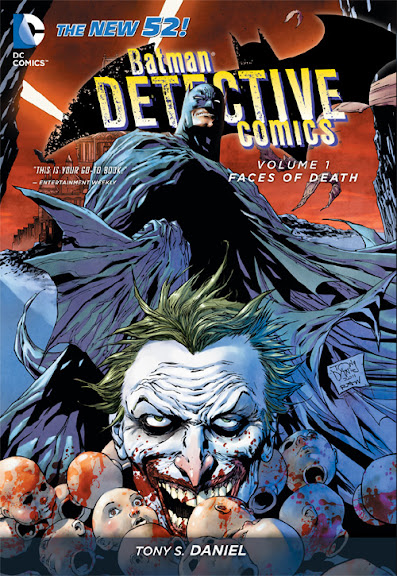
Batman: Detective Comics, v. 1: Faces of Death

Collects: Detective Comics #1-7 (2011-2)

Released: June 2012 (DC)

Format: 176 pages / color / $22.99 / ISBN: 9781401234669

What is this?: The Joker makes his New 52 debut, Batman battles the Dollmaker, and a Gotham heist shockingly has twists and double crosses.

The culprits: Tony S. Daniel


Continuing my brief tour through the New 52 is Batman: Detective Comics, v. 1: Faces of Death. Faces of Death contains two stories, both written and penciled by Tony S. Daniel: four-issue story featuring Joker and the Dollmaker, who cuts up and stitches together pieces of people to make masks and augment thugs, and a three-issue tale involving the Penguin, Batman’s girlfriend (or one of them), and a pair of lovers trying to make the criminal big time.

Of the two, the latter is superior. It’s a heist plot, not overly complicated; the Penguin opens his Iceberg Casino on the same night he cajoles new Gotham villains to deposit their money in his impenetrable vaults, and of course someone tries to rob that vault. As a crime tale, the story works well and has many elements that give it a noir shading without seeming clichéd: desperate criminal lovers in over their heads, a colorful cast, and a villainous plan that makes sense on its first read-through but fits together even better on a second read-through. It’s admirably short — three issues — and although I think it could have been wrapped up in two, the extra issue did allow Daniel to insert subplots and introduce other characters who may be important later.

Batman: Detective Comics, v. 1: Faces of Death coverOn the other hand, the story has extra complications that water down the story, all of them connected with Bruce’s girlfriend, television reporter Charlotte Rivers. Bruce says, “I like this one” in issue #1, which is intended to convey to readers that Charlotte is special but translates as “She’s my girlfriend in this storyline” to anyone who has read more than a handful of Batman stories. And of course liking her didn’t stop him from having sex with Catwoman on a rooftop in Catwoman #1. By the end of #6, though, Batman is willing to jeopardize his secret identity by crying out her name in front of a villain after she has been stabbed. Do I believe Batman cares so much about a woman he has been dating for a short time that he loses his professionalism and jeopardizes his mission? No. No, I don’t.

Some characters are overcomplicated by details that don’t add any emotional weight to the story. Charlotte and one of the robbers are twins who were separated at birth, their father is Gotham’s mayor, and the sisters have a covert but long-running stand-off. It doesn’t add anything to Charlotte or the robber twin’s characters. If Charlotte had discovered the heist because she’s good at her job and hungry for a scoop, she would seem a more impressive reporter; Daniel could have added depth to the robber’s character by giving her some other reason not to kill Charlotte. Their parentage could have been worked into other spots in the story — certainly Bruce Wayne dating the daughter of the mayor is big news, or someone might think it would be a big story if the public knew (it’s not stated whether Mayor Hady’s paternity has been acknowledged). Instead, readers get a complication they’ve seen frequently before.

One odd touch to the villainous twin’s crime spree is the mutilation of one of the victims. All the ones murdered are marked in a signature way, but one in particular is chopped into pieces and stuffed into a trunk full of ice. It seems out of character for such a professional villain, but it does echo the gore seen in the first story …

Which starts as a Joker vs. Batman story but morphs into a horror story, one rather less successful than the heist tale. In issue #1, Batman pursues and ends the Joker’s murder spree, one owing more than a little to The Dark Knight. The issue ends with a new villain, Dollmaker, cutting off the Joker’s face and spiriting him out of Arkham, the implication being that the Joker is either dead (ha!) or has a new face. In #2-4, Batman tracks down the Dollmaker, who cuts people and bodies apart, then puts them back in different configurations. He also has a sideline as an organ harvester.

The problem with the story is that it seems a bit too derivative. Following the Joker’s terrorism in #1, the story has a dead cop used as a decoy, sloppy police work that places cops in the villain’s trap, and corrupt officers. The villain catches Batman but declines to kill him, claiming the villains he is selling Batman to need to see him in action. Jim Gordon is captured, used as bait, and also is not killed, even though there’s no reason to keep him alive. Tried and true tropes, yes, but not exactly a way to distinguish Batman in the New 52. (Daniel does have Batman shrug off an anesthetic’s effect without an antidote or comment — that’s new, but it’s not good.)

From what I can tell, Daniel is writing a slightly different Batman than the other New 52 titles I’ve read. Daniel’s Batman is a humorless dick who is isolated from everyone except Alfred and Gordon. (He’s mostly humorless in Batman and Batman and Robin, but his interactions make him more human.) His dialogue is flat and forgettable. A little violence is necessary when it comes to Batman stories, but Daniel’s Batman seems to relish it a more than other versions: he thrashes one of Dollmaker’s thugs he has captured, trying to beat information out of him, and as a threat, he claims he has “broken” men. He gives Raju, the Penguin’s underling, a swirly, which seems less like a high school prank and more of an unhygienic waterboarding. This Batman is very violent; he may be a torturer. He’s also a two-timer, as I said before, making time with Catwoman as Batman (in other titles) and Charlotte as Bruce. Not very admirable, and I think less of this Batman than other versions.

One of Daniel’s successes is setting up subplots that actually feel like subplots rather than loose ends. Hugh Marder, owner of a tech company Bruce is buying, will eventually be important. Charlotte Rivers obviously has more of a story. Olivia Carr, a girl abducted by / collaborating with the Dollmaker, should show up again, although she might be dropped. Batman learns someone is stealing Wayne technology in the first story, and even though he doesn’t investigate that mystery in the second, it does feel important. An interesting enough backup, drawn by Szymon Kudranski, introduces Hugo Strange and his son in a story about a Catwoman heist. This certainly isn’t the old style of simmering subplots, but it is better than a lot of modern comics.

Daniel’s pencils are a mixed bag. It’s strong in Jim Lee-fu, pretty and bold and big. On the other hand, sometimes it misses on the details: for instance, Raju adds 50 pounds of fat between appearances, Hugh Marder loses 50 pounds of muscle, and a character whom Batman claims has had his tongue removed is shown, mouth open, with his tongue visible. Raju I recognized because he’s the only brown person of note in the story, but I didn’t figure out who Hugh was until the second read-through. (I’m sure the tongue was supposed to be a stump, but it doesn’t come across in the art. Since Daniel is the writer and penciler, it’s not like there’s miscommunication.) There are other strange artistic moments — Alfred’s eyes opening wider than the lifeless, staring eyes of the corpse two panels before, for instance — but you get the point. His designs need work. He never settles on a theme for Dollmaker’s henchmen — Jack in the Box and the monkey with cymbals suggest a toy motif, the naughty nurse for a doctor theme, and the mismatched flesh golems suggest a mad scientist. His new villain designs in the second story are amusing but not that original (except Mr. Combustible, who has a light bulb for a head), but they are probably meant to be throwaways.

Oh, someone should tell colorist Tomeu Morey that not everyone's nose is always a different color than the rest of his or her face.

While Faces of Death is competent and — in the second story, at least — occasionally more, it feels like a joyless exercise in putting out more Batman every month. And I’m not interested in that.

Rating: Batman symbol Batman symbol (2 of 5)

Labels: , , , , , , , , , ,

05 October 2012

Batman and Robin, v. 1: Born to Kill

Collects: Batman and Robin v. 2 #1-8 (2011-2)

Released: July 2012 (DC)

Format: 192 pages / color / $24.99 / ISBN: 9781401234874

What is this?: The New 52 reboot of the adventures of Batman (Bruce Wayne) and Robin (his son, Damian) against a villain from Bruce’s past.

The culprits: Writer Peter J. Tomasi and artist Patrick Gleason


Oh, DC reboots … I never get tired of you. No, wait, that’s not true — I’m sick and tired of them. This is unfortunate, because at the current rate, I expect four or five full or partial reboots before I start collecting my meager Social Security checks.

But approaching senility, I think, will make the reboots more palatable because I will no longer wonder: what do I need to remember? What should I forget? Because rebooted titles never get rid of everything.

Batman and Robin, v. 1: Born to Kill coverTake the New 52’s Batman and Robin, v. 1: Born to Kill. I read Grant Morrison’s entire pre-reboot run on the title; what do I need to remember from it? Did that series even happen? Did Dick Grayson train Damian Wayne at any time? Or did Bruce Wayne’s son immediately begin training with Bruce? What is Bruce’s relationship with Talia, Damian’s mother? We haven’t seen Damian and Bruce interact much, but is Damian’s character the same?

Admittedly, most of those questions aren’t important or are only important when the writer chooses to address them. But their presence is distracting, and I have trouble dismissing them and others out of hand, especially when writer Peter J. Tomasi seems to have changed who Damian is.

Seems to have changed Damian. One can argue he is acting differently in different circumstances. In Morrison’s series, Damian was a brat, supremely confident in his abilities, and annoyingly dismissive of patience and Dick Grayson. In Tomasi’s series, Damian is unintentionally dangerous, cruel, impatient, petulant, and obsessed with Daddy. I do not like Tomasi’s Damian, either on his own or in comparison with Morrison’s Damian. But it may be fair to say I don’t care for Damian when he’s around Bruce Wayne rather than Dick.

The art doesn’t help Tomasi sell his version of Damian. There are a couple of moments in which Patrick Gleason‘s illustrations are supposed to convey some subtlety of Damian’s character, but the art does not do so. In Tomasi’s pitch for the series, included at the end of Born to Kill, it mentions Damian killing a “sick” bat. But in the actual issue, Damian snatches a seemingly healthy bat out of the air and crushes it. This transforms the act from “morally debatable” to “psychopathic.” When Bruce gives Damian a dog after this, it feels less like an act of therapy or socialization than a death sentence for the dog. (Of course it isn’t, which makes Damian’s bat-killing mystifying or irrelevant.)

In another scene, Bruce angrily scatters some of Damian’s drawings. What upsets Bruce is largely unseen — one drawing has Two-Face’s head split by an axe, but there’s no indication of who wielded the axe. (Seriously, the picture is more high-school doodling than disturbing.) The rest the pictures that are visible are innocuous, leaving the question of what upset Bruce so much: that a boy raised by the League of Assassins and sent into the streets every night to punish criminals and psychopaths would draw violent images? I would be shocked if he did not.

But Tomasi is hitting the father / son dynamic heavily. Bruce has been a father before, to Dick (and possibly Jason?), when Dick was about the age Damian is (probably.) Yet he totally mishandles Damian — his behavior would be a mishandling of any child or any Robin. But Bruce reacts differently when Damian is captured than when any other Robin was taken, threatening to kill his captor and losing his cool … I supposed blood really is thicker than formal adoption papers. It makes me think less of Bruce, though. His concern over Damian’s development if he were to disappear is touching, except that he was gone and presumed dead for quite a while, and Dick did a fine job.

As for the plot, Tomasi installs one of perquisites of the reboot: the continuity implant. Bruce and Damian are menaced by Morgan Ducard, a.k.a. Nobody. Morgan is the son of bloodthirsty manhunter Henry Ducard, one of the men who trained Bruce to be Batman. Morgan’s got his own daddy issues, a grudge against Bruce, and a similar mission to Batman’s. Morgan is a vigilante as well, but he kills the criminals he captures, and he derides Batman for being soft on crime by merely imprisoning the punks. So Morgan goes about killing small-time criminals, trying to convince Damian to become his student, and attempting to kill Bruce. This is … so, so dull, especially spread over eight issues. Morgan knows Bruce is Batman, but he doesn’t do anything clever with this knowledge; he goes for the gloating kill after capturing Bruce, then he tries for a garden-variety seduction-by-darkness of Damian.

Tamosi’s dialogue is sometimes tin-eared, especially in battle scenes; when, for instance, Batman and Robin burst in on gunmen, one says, “What the hell?!,” and Batman responds, “Yes, that’s exactly where you are tonight!” That’s awful. Or sometimes the dialogue just feels wrong for the characters: when Nobody is about to kill a human trafficker in a vat of acid, Damian complains Nobody is “dunking him in acid!” (I don’t think the “dunking” is the sticking point.) But Tomasi does get a few moments right, most of them involving Alfred and his parenting suggestions. But Born to Kill doesn’t collect eight issues of Alfred & Robin or Butlering Comics, so that’s cold comfort.

Tomasi also missed on a few names. He uses Henri Ducard — the alias Ra’s al Ghul uses in the movie Batman Begins — for Morgan’s father and Bruce’s former mentor. 66 Is this to suggest Ducard is Ra’s or draw a parallel between them? Probably not, but that’s what I thought of. Morgan’s nom du revanche, Nobody, is clever if you’re Odysseus or an imaginary friend; otherwise, it’s a mistake, as Morgan has a strong sense of self and leaves an unignorable trail of dead and missing in his wake. And as for the Great Dane Bruce buys for Damian — OK, I can see avoiding Ace (the Bat Hound) as being too obvious. But if you’re going to name a Great Dane after a Shakespearean character, I can think of one involved with a bloodbath and having parental issues that fits. Or, if “Hamlet” is too on the nose, why not “Horatio,” which makes a great name for a sounding board? Either is better than “Titus,” which Damian ultimately chooses.

Other than my previous complaints about Gleason, I have few objections to his art. I liked his design of the Russian Batman, even though he is only briefly in the book. Nobody’s design, though, is a generic mishmash: insectoid (apparent multiple eyes) and black, with glove blasters. Perhaps that fits a character “Nobody” better than a truly distinctive design. Gleason’s action scenes are chaotic without devolving into incoherence; although there are some confusing bits, I never lost the thread of the narrative.

Still Gleason’s art isn’t enough to pull Kill past “acceptable.” Is there anything wrong with Kill? No, not in the long run. I’m a little confused why DC started the reboot in this title with such weak fare, and I’m downright bewildered by the positive blurbs on the cover. It’s a slow story and not a very interesting one.

Rating: Batman symbol Batman symbol (2 of 5)

Labels: , , , , , , , , ,