Reviews of trade paperbacks of comic books (mostly Marvel), along with a few other semi-relevant comments / reviews.

28 October 2016

Greenberg the Vampire

Collects: Bizarre Adventures #29 and Marvel Graphic Novel #20 (1981, 1986)

Released: October 2015 (Marvel)

Format: 104 pages / black and white AND color / $15.99 / ISBN: 9780785197911

What is this?: A Jewish novelist deals with life as a vampire.

The culprits: Writer J.M. DeMatteis and artists Steve Leialoha and Mark Badger


Hey, it’s Halloween! Time for something … spooky.

Well, actually, no. Despite featuring an undead protagonist, Greenberg the Vampire is not spooky, and it was not intended to be. But it is a story about vampires, and vampires are Halloween appropriate and notionally scary, so: Let me tell you about Greenberg the Vampire.

Greenberg the Vampire coverOscar Greenberg, a Jewish writer who has been turned into a vampire, has made only two appearances, both of which are reprinted in Greenberg. Despite being a vampire, Greenberg isn’t a brooding creature of the night who preys upon the innocent (or guilty, for that matter); he’s more or less a normal New Yorker. He lives in Manhattan with his nephew, Morrie; he has a girlfriend, Denise Keaton, who accidentally turned him into a vampire. He hangs on to his Jewish identity, although his vampirism puts a damper on any chance that he’d be a practicing Jew. He still visits his mother and his brother. He visits bars and goes to parties.

In Greenberg‘s introduction, writer J.M. DeMatteis says Marvel staffers reacted to his first Greenberg story, in Bizarre Adventures #29, by saying “how funny, how offbeat, how unique it was.” I suppose it was different, although it’s hard to see 35 years into the past and estimate how often vampirism was treated as if it were just another personality trait a nice, normal person could possess. But I don’t get the funny part at all; I never laughed while reading anything in the book.

I wonder if it’s a difference in audience. Marvel staffers were likely to be New Yorkers and at least be familiar with Jewish families, but I have no connection to either. I admit DeMatteis emphasizes Greenberg’s Jewish background without making it distracting or making it seem more exotic than his vampirism. But when it comes down to it, nothing is exotic about Greenberg; DeMatteis has made a Jewish vampire into an almost normal guy, and that makes him less interesting to read about.

Especially since the stories’ plots aren’t strong. In the first story, one plot thread is resolved by a character returning from the dead through no credible or known method; Greenberg and Denise speculate on why the dead woman returned, but even they shrug at their own solution. The other plot thread in Bizarre Adventures involves a vampire hunter who destroys one of Greenberg and Denise’s friends; the vampire hunter’s career ends abruptly when he learns his sister, Denise, is still walking around as a vampire. The idea for the twist ending isn’t bad, but Denise never mentions a brother, and the vampire hunter never mentions a sister who was attacked by vampires. The familial connection — the idea that either of them had a family — is dropped into the story without warning, stopping the story in its tracks.

In the graphic novel, Greenberg and his friends battle a dybbuk and Lilith, the Biblical Adam’s first wife, who later became a demoness; the nature of a dybbuk is never spelled out. Lilith’s lifelong interest in Greenberg is only vaguely explained, and the story’s conflict is resolved via the power of love. I mean that literally: The power of love allows a bullet to strike Lilith, who had been previously immune to firearms.

The graphic novel also revolves around Greenberg’s battle with writer’s block. That’s a clichéd, if understandable, avenue to take with a writer character, although it’s a bit discouraging that DeMatteis used writer’s block in Greenberg’s second (and final) appearance. (DeMatteis and artist Mark Badger do throw in a little sex and semi-naked ladies to spice things up.) I do appreciate DeMatteis using a sample of Greenberg’s awful writing to simultaneously show readers how bad his situation is and to give readers the necessary backstory.

DeMatteis looks almost prescient on one thing, though: Although Greenberg is heterosexual, the Bizarre Adventures story has two homosexual couples, and neither the narration nor the protagonists stigmatize those characters. True, the gay characters are on the fringes of society — one couple is a pair of vampires, and one of the other couple is a cult leader who thinks herself a god. But even in a more mature book, one in which he could get away with someone, such as a villain, demonizing homosexuals, DeMatteis sticks to the course of acknowledging these characters’ sexuality is normal.

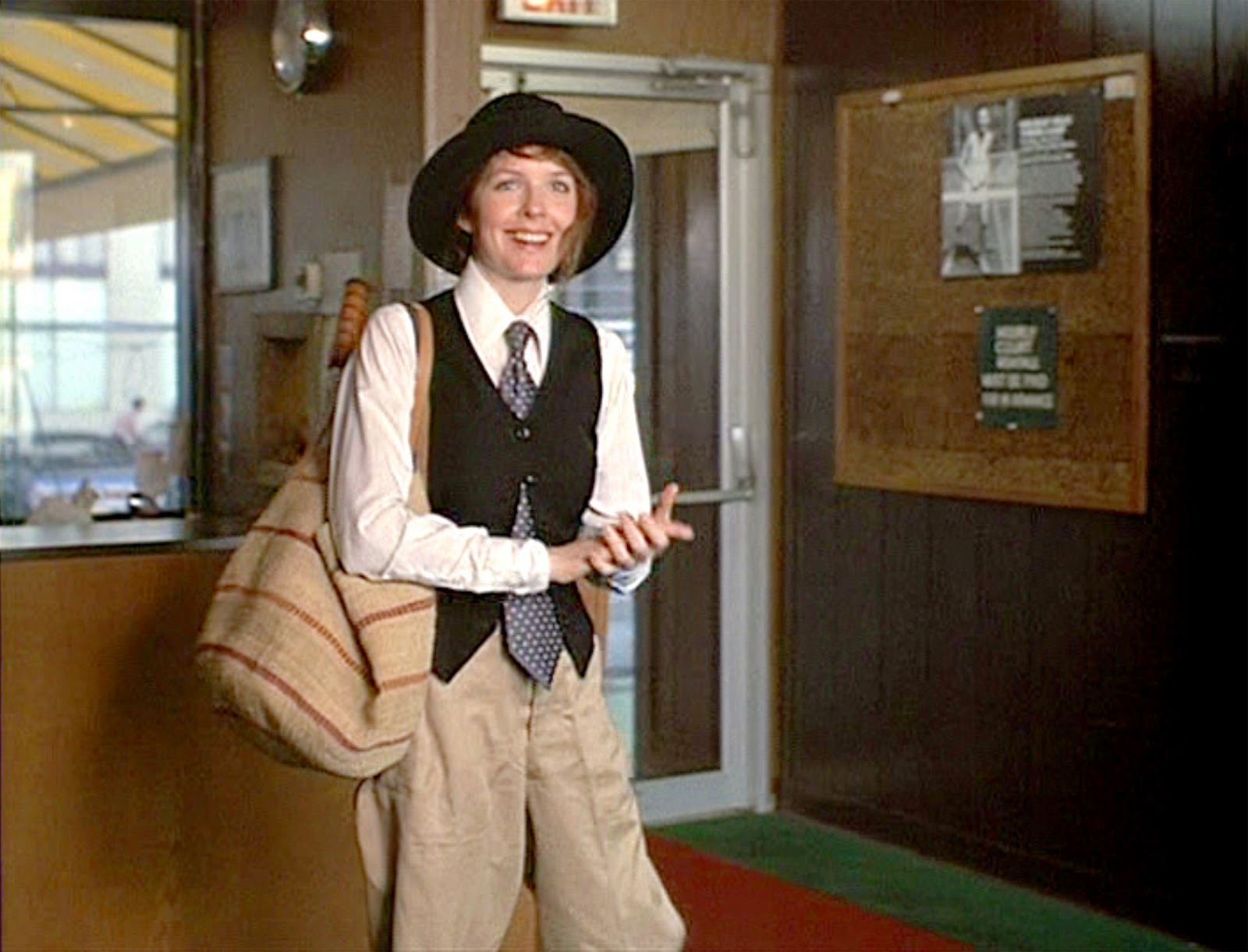
Steve Leialoha’s work in Bizarre Adventures is beautiful and expressive, taking advantage of the strengths of black-and-white art. (He also draws Denise Keaton to look like Diane Keaton, down to the hat, vest, and tie she wears in Annie Hall.) Leialoha’s art is a little stiff occasionally , although he manages to take advantage of the kind of simplicity used by cartoonists at times. Badger’s art on MGN is harsher and more angular; the subtleties of Leialoha’s work is sacrificed for Lilith’s artfully concealed nudity and full-page text pieces. This is understandable, given the change in plot between the stories, and there’s nothing subtle about Lilith’s seduction of Greenberg. Other parts of the story might have benefited from more precision and care, like Greenberg’s shift in emotions once he’s possessed (or influenced — it’s never made clear) by a dybbuk.

I can’t recommend Greenberg, unfortunately. Although it may have been playing around with the borders of what a vampire can be, the book doesn’t have much to it other than that. Neither the story nor the attempts at humor stand up, thirty years later, and the price tag is too high for such a slim, obscure volume.

Rating: Marvel symbol Half Marvel symbol (1.5 of 5)

Labels: , , , , , , , , , , ,

18 March 2016

Rocket Raccoon, v. 1: A Chasing Tale

Collects: Rocket Raccoon #1-6 (2014-5)

Released: October 2015 (Marvel)

Format: 136 pages / color / $19.99 / ISBN: 9780785190455

What is this?: Rocket Raccoon of the Guardians of the Galaxy endures space jail and an army of ex-girlfriends while trying to discover what happened to “his people.”

The culprits: Skottie Young, with artist Jake Parker (#5-6)


Since Rocket Raccoon, v. 2: Storytailer will be released next week, I thought I’d look back at Rocket Raccoon, v. 1: A Chasing Tale. Relevance!

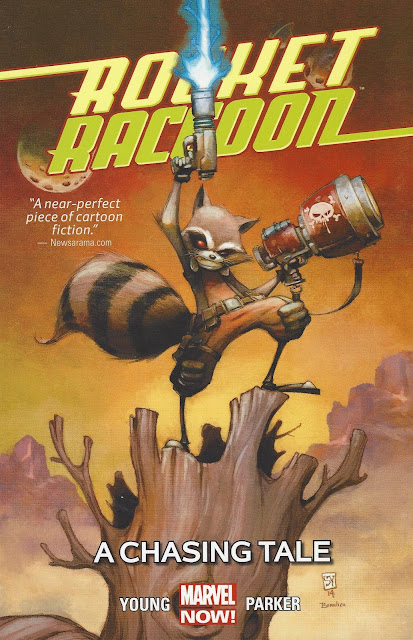
For most readers, the book’s appeal lies in Skottie Young’s artwork. Young, who drew #1-4 and wrote the entire book, certainly gives readers hyper-cartoony action and violence, the kind of stuff that wouldn’t be out of place in an old Bugs Bunny cartoon. Not that Young’s style looks anything like old Warner Brothers animation, but it does have the expressiveness, flexibility, and humor of those cartoons.

Rocket Raccoon, v. 1: A Chasing Tale coverYoung’s art often lives up to its reputation for imaginativeness. The prison escape montage is excellent. The sea-creature visuals surrounding Rocket’s accomplice Macho are creative and cohesive; I especially like the fish-like creature who swallows Macho’s ship, then spits it out at the other end of a hyperspace warp. Young sneaks in a few funny Easter eggs as well, like a box marked “John Woo props” in the middle of a gunfight.

Sometimes the art fails to live up to that standard, though. The aliens all look like humanoids, blobs, or animals; I’m not sure what else they can look like (clouds? Mechanical items?), but I feel confident Young could come up with something more unusual if he tried. (The strangest alien in Chasing Tale is Xemnu the Titan, a long-time Hulk villain Young uses in #2.) The ship designs are a bit boring as well. The sound effects Young adds are not as funny as the ones in Hercules — or as funny as Young thinks.

But I am not interested in Rocket Raccoon because of Young’s art. It’s nice to look at, but I’m a fan of the character Rocket — both Bill Mantlo’s original creation, with his anthropomorphic animal friends and stupid Beatles puns, and Dan Abnett and Andy Lanning’s sardonic, violent space warrior. The latter is in Chasing Tale, but the more I learn about him, the less I like him.

Young’s Rocket has a habit of swindling and leaving women he has bedded. He uses the idiotic catchphrase “Murdered you” that Bendis came up with in the new Guardians of the Galaxy series. (It’s possible Young might be using the phrase ironically; that doesn’t make it better.) Rocket learns no lessons from his bad behavior. What’s worse, he spends time angsting about his origins …

Once upon a time, Rocket’s origins were simple. He was an uplifted raccoon, meant to amuse the inmates on Halfworld, a mental asylum planet. When the psychiatric professionals left, Rocket and his animal pals were elevated to caretakers of the Loonies. Halfworld had a lot of uplifted animals, but none of them seemed to be of the same species; given that Rocket (then known as “Rocky”) was in charge of Halfworld, he would have known whether any other raccoons existed. But in Chasing Tale, he’s looking for others like himself (one of whom seems to exist) and Gideon’s Bible, the legendary artifact of Halfworld. What happened to Rocket’s memories of Halfworld? Why doesn’t Rocket know where any his old friends or the Loonies are? Why doesn’t Rocket know why Blackjack O’Hare hates him? (And why does Blackjack say it was over an employment dispute, since the two frequently fought on Halfworld?) Would it have killed editor Sana Amanat — or assistant editor Devin Lewis, who signed the lone footnote in the book — to give us a damn footnote explaining some of this?

The villains in Chasing Tale are all weak or problematic. The women Rocket wronged are both. They are all portrayed as unhinged, as jokes. Their leader tells Rocket that women’s pain isn’t treated as seriously as men’s; she’s right, but saying that doesn’t mitigate Young making light of their pain in Chasing Tale. (I mean, look at that pun in the title!) Rocket ruined their lives, and his only punishment is a few punches that he takes without complaint (and community service). That’s not enough; Rocket not only seduced and left the women, but he took their money, which caused them to lose their social status. Rocket manages to pummel an army of exes, despite their armaments and large ships, and still have something left over for Blackjack.

Every other villain is merely a speedbump for Rocket on the way to the end of the story. Without a clear view of continuity, Blackjack is only an opportunity for Young to draw a murderous bunny, not an opportunity to explore an existing relationship. The rest of Rocket’s antagonists are done away quickly and as a joke — huge person (with or without a gun) threatens Rocket, Rocket thrashes huge person. Ha! Ha?

Groot’s haphazard evolution as a character continues here, with the Guardians of the Galaxy movie providing the impetus for his new directions. In Chasing Tale, Groot can regrow from a splinter. Repeatedly. In a few hours. This ability reduces the stakes to nothing when Groot is in danger. And since when can Rocket (and the other Guardians) understand Groot? I think it’s a poor choice; Rocket’s responses to “I am Groot” aren’t funny enough to justify the change. Groot’s impenetrability was an aspect of his character I appreciated. Issue #5, in which Groot tells a bunch of kids a story, illustrates the superior comedic potential of not being able to understand Groot. The kids’ mystification is great, and the story’s entire dialogue consisting of repeated “I am Groot” communicates that confusion to the reader while the art tells the story.

Young is trying for a lighthearted tone in Chasing Tale, and despite the missteps I mentioned above, often he succeeds. Rocket quoting Earth movies to the space police during an interrogation at the beginning of #2 is amusing, although Young undercuts the joke by explaining it on the next page. The entirety of #5 is hilarious, and I especially enjoyed the Deadpool cameo. The payoff in #6 is a nice touch as well. But sometimes the violence and humor sit uneasily next to each other, especially when Young doesn’t quite nail the joke.

Jake Parker drew #5 and 6, and I prefer his work to Young’s, actually. His work on Groot’s tale in #5 does a better job telling the story than all but a few of the wordless ‘Nuff Said issues Marvel did in 2002. Parker’s art seems more in line with the funny animal aesthetic that covers Rocket’s backstory and the ideas Young’s story undercuts. Parker’s work isn’t as dynamic as Young’s, and it’s not as exaggerated; in fact, Parker looks like he’s strongly influenced by Bill Watterston, who wrote and drew Calvin and Hobbes. This gives Parker’s issues a touch of innocence that works well with Groot’s story in #5 and with Cosmo’s scenes in #6.

Chasing Tale has a lot of energy and a decent amount of humor going for it; if it was a story about a new character, I’d probably enjoy it more. Readers familiar with Rocket from the last few years or only the movie might love it, although that won’t get them past how Young treats Rocket’s exes. Storytailer might make this book better in retrospect by explaining Rocket’s history, but no matter what happens, I can be sure of this: I don’t care if Rocket is the last of his kind.

Rating: Rocket Raccoon symbol Rocket Raccoon symbol (2 of 5)

Labels: , , , , , ,

19 February 2016

Silk, v. 0: The Life and Times of Cindy Moon

Collects: Silk #1-7 (2015)

Released: October 2015 (Marvel)

Format: 160 pages / color / $19.99 / ISBN: 9780785197041

What is this?: Cindy Moon, recently freed from ten years in a bunker, tries to find her missing family while maintaining the semblance of a personal life (mostly for appearance’s sake, it appears).

The culprits: Writer Robbie Thompson and penciller Stacey Lee


I like Silk, v. 0: The Life and Times of Cindy Moon, but I admit I have a hard time putting my finger on exactly why. It’s only when I compare Silk (alter ego: Cindy Moon) to Spider-Gwen that everything I like is illuminated, and I realize it’s a lot of little elements that add up to an enjoyable book.

Unlike Gwen Stacy in Spider-Gwen, readers get a good idea of who Cindy Moon is and what she does when she’s not a hero. Cindy is confused and angry after spending a decade in isolation. She was bitten by the same radioactive spider as Peter Parker, but she was convinced by Ezekiel Sims, the Amazing Spider-Retcon, to hide herself away to avoid attracting the attention of Morlun, one of the jerks the assembled Spiders-Heroes eventually defeated in Spider-Verse. Ezekiel is gone, killed by Morlun. Cindy resents the sacrifice Ezekiel convinced her to make, and as much as she wishes she could punish him, she needs the information that only he seemed to know: where he hid her family.

Silk, v. 0: The Life and Times of Cindy Moon coverSo despite her cultural knowledge being a decade out of date, Cindy interns at the Fact Channel so she can use its resources to search for her parents. When she isn’t fighting crime or looking for her parents and brother, she spends time with a couple of friends, Rafferty and Lola. She gets guidance from Spider-Man. She finds an archenemy, the Black Cat, and a frequent sparring partner, Dragonclaw, whom she manages to engage as a human being. She even goes on a date with Johnny Storm.

All this makes Silk a well-rounded book, and I suppose that’s what I like about it.

“Well-rounded” sounds like a low bar to hurdle, but it’s not. Likeable protagonists who fight opponents who are both engaging and powerful are difficult to find, but writer Robbie Thompson manages that. (Looking back, I’ve reviewed six straight books that weren’t able to meet that standard.) Given her past, the Black Cat isn’t a black-and-white villain, and she tries to dissuade Silk from opposing her before launching a vendetta against the hero. The Black Cat has become a crimelord, which gives her the resources to be a real challenge to Silk even when Silk has allies. But while the Black Cat schemes, Thompson works in another villain, one who has connections to the Black Cat and to the mystery of Silk’s family. It neatly combines the story threads, and the battle with him is a pleasing way to end the first storyline.

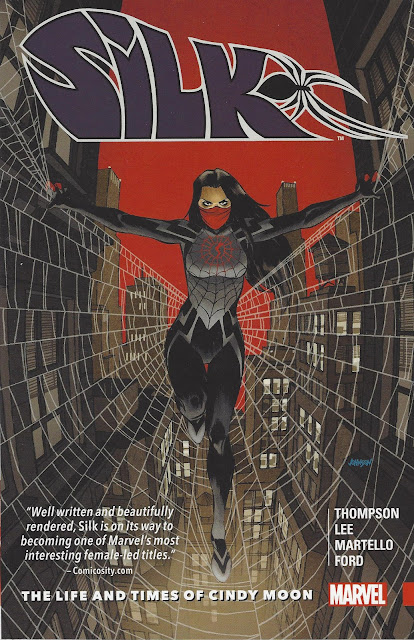
Going back to comparisons with Spider-Gwen: Silk’s costume is immeasurably better. The colors are subdued without being drab, spider-related without being a copy of Spider-Man’s. The subtle spider legs above and below the web pattern on her chest is a great touch. I don’t care for the “S” in the middle of the webs; it looks carelessly written, and it isn’t big enough to be featured in the middle of the costume, but fortunately the “S” rarely shows up in the art. I like the mask that covers the bottom part of her face, which allows artist Stacey Lee to communicate a great deal of emotion through Silk’s eyes.

The mask was already a part of Silk’s costume, so an artist who can draw expressive eyes is a must. Lee, who drew five of the seven issues in Life and Times, is that artist. I’m not usually impressed by manga-influenced artists in superhero books, but Lee is excellent with conversational scenes, and her action work is clear and dynamic. Her Cindy in flashbacks is the picture of wide-eyed innocence and adolescent angst; in the modern day, Cindy retains some of that, but she has gained an angry edge and occasional maturity both in and out of costume.

Besides giving Cindy a couple of friends her own age, Thompson uses J. Jonah Jameson as not only comic relief but as a solid character in his own right. The former mayor works as a talking head at the Fact Channel and still has a hatred for Spider-Man, which somehow doesn’t extend to Silk. (Since Jameson’s hatred has always been irrational, that’s OK.) But in addition to be an angry man who gives Cindy the nickname of “Analog,” he shows he’s a decent human being; when he learns Cindy’s predicament, he offers to help, showing himself to be the stand-up guy he is often said to be as but rarely gets a chance to be.

Silk isn’t a perfect book. No book is, of course, but Thompson never explains the book’s most important question: Why does Cindy dress as Silk and fight crime? Peter Parker has the lesson taught by Uncle Ben, Spider-Gwen has the respect for law and justice that her detective father taught her … but why is Cindy doing this? The flashbacks don’t give any idea that she has a thirst for justice, and being a superhero doesn’t help her find her family.

Thompson is vague about Silk’s previous appearances and powers. Thompson not reminding the reader what she’s done since Peter let her out of the bunker is fine, although I feel like I’m missing some piece of continuity that will make sense of my complaints. As for her powers, she can create her own webs, she has a spider-sense — Silk sense — and can spin clothes out her silk. She has the standard spider-strength and agility, so I guess we’re supposed to guess she has all Spider-Man’s powers with a few more added in. Additionally, she somehow knows Lola is attracted to Rafferty, although that could be because she’s observant instead of being able to detect pheromones.

Some of my complaints are niggling. Cindy’s lack of cultural knowledge is grating and sometimes nonsensical — how does she research at the Fact Channel if she doesn’t know what Google is? The Fantastic Four’s appearance seems gratuitous, and spending an entire issue on it is a waste of time. Her anger when Peter tries to get her help seems out of proportion to the sin. Thompson also doesn’t delineate what Peter and Cindy’s relationship is. He wisely deprecates the creepiest part of Cindy’s origin: that because she and Peter Parker were bitten by the same radioactive spider, each has an almost uncontrollable sexual attraction toward the other. It’s amusing for a few pages, maybe — maybe — but it’s problematic in a larger sense. Peter Parker and Spider-Man are present in Life and Times, but the implication is that their relationship is more mentor / newcomer than sexual or romantic. On the other hand, one or two scenes leave the idea that the two of them could be (or are) more than just similarly themed superheroes.

The book ends with the end of the world in #7, which isn’t a surprise for readers who know Silk and the rest of the Marvel line was interrupted by the Secret Wars crossover that ended the Marvel Universe (briefly). In #7, Silk runs through the city on its final day, trying to reach a destination, but she keeps getting delayed by people who need to be saved. The art from Tana Ford has trouble selling the urgency and action, but despite that, I couldn't guess whether Silk would reach her destination until the last couple of pages. Cindy gets a major win as the world ends; I’m going to be very upset if she’s not allowed to keep that victory when the regular Marvel Universe returns.

I enjoyed Life and Times. I’m looking forward to the next volume, Sinister, which comes out in May. The groundwork laid down in Life and Times will likely make clear which of my complaints are unimportant and what I’m supposed to be paying attention to. On the other hand, Sinister will take place in an all-new, slightly different Marvel Universe, so who knows what the ground rules are?

Rating: Spider-Man symbol Spider-Man symbol Spider-Man symbol Half Spider-Man symbol (3.5 of 5)

Labels: , , , , , , , ,