Reviews of trade paperbacks of comic books (mostly Marvel), along with a few other semi-relevant comments / reviews.

22 April 2016

Rocket Raccoon, v. 2: Storytailer

Collects: Rocket Raccoon #7-11 (2015)

Released: March 2016 (Marvel)

Format: 136 pages / color / $17.99 / ISBN: 9780785191674

What is this?: Rocket and Groot survive a frozen planet with poison wolves, then get a glimpse of the future; Rocket searches for the Halfworld Bible.

The culprits: Writer Skottie Young and artists Jake Parker and Filipe Andrade


You can expect a drop-off in quality when a popular artist stops drawing a title. It’s probably worse when that artist remains as writer.

Such is the case with Rocket Raccoon, v. 2: Storytailer. I have no idea how long Skottie Young planned to remain as writer / artist for the title — and I’m too lazy / disinterested to look it up — but after Rocket Raccoon #4, he gave up the artist part of his job to Jake Parker and Filipe Andrade.

Rocket Raccoon, v. 2: Storytailer coverThe result is a book that is significantly less interesting than what readers expected when they read Young’s Rocket Raccoon #1. The book is competently written — everything makes sense — but the story lacks the extra oomph that Young’s art supplies. The star is not playing to his strengths.

Young is not a polished writer. His plots are serviceable but unremarkable. The dialogue is not crisp or memorable, and I think we can all agree Rocket should never say “stupid fresh,” even if that expression is better than the “murdered you” he was using for a catchphrase. His Rocket makes a lot of references to Earth TV (including the season 6 finale of Buffy the Vampire Slayer) and movies for a space raccoon.

Young has three stories in the five issues of Storytailer: Rocket and Groot surviving on an ice planet for two issues, a glimpse of a possible future where Groot goes crazy, and a two-parter where Rocket finally gets to the bottom of his origins. The future story is pointless, and even Rocket remarks on the clichéd ending. The ice planet story is fine but very forgettable; introducing poisonous dire wolves as a threat to Groot’s survival is a nice complication, but Young is the one who decided Groot would be so hard to kill in the first place, so he doesn’t get any points from me on that score.

Storytailer’s ending is problematic, though. In the final two issues, Rocket gets a lead on the Halfworld Bible (called “Gideon’s Bible” in the original Rocket Raccoon limited series). He finds the bible, and with the help of another uplifted raccoon from Halfworld, he deciphers and reads his own backstory. (Again: why has he forgotten it? A footnote would be nice — I’m looking at you, assistant editors Charles Beacham and Devin Lewis.) Rocket then walks away from all of it — the explanation of his history, Halfworld, his fellow raccoon — because he feels it’s stupid. Which it is, but since I’ve read that story, I know it’s stupid in a daffily charming way. Denigrating the original Rocket Raccoon LS is needlessly insulting; that story, written by Bill Mantlo and drawn by Mike Mignola, hangs together as a memorable four-issue story, which is more than I can say for Young’s run. And if Young was going to make a callback to the original limited series, why didn’t he use a character from that story to help Rocket find the Halfworld Bible? Why invent a new character for Rocket to reject?

As I said in my review of A Chasing Tale, Young’s art is a secondary draw for me, but I felt its absence in Storytailer. Part of the problem with Young’s writing is that he’s writing for artists who aren’t named Skottie Young. Andrade is not up for drawing scenes with all the white figures and backgrounds in #7 and 8, which is a problem since those two issues take place on an ice planet. Andrade’s storytelling gets muddled at times, and it is especially difficult to distinguish what’s going on with all that white. (Maybe colorist Jean-Francois Beaulieu is at fault, although Beaulieu did a fine job in the other issues.) Sometimes Young’s dialogue has to help Andrade out — like when Andrade is supposed to show eggs as big as Volkswagens, but nothing in the art hints at the eggs’ size.

I enjoyed Parker’s Rocket in issues #9-11, and his future Rocket in #9 is nice (although the scar over the eye and small bits missing from the ears is not the most original way to show “grizzled warrior”). But other elements of his art are lacking. A couple of times he’s supposed to depict amazing transforming machines, and the results are underwhelming. Perhaps I’m setting the bar too high, but I think this could be traced back to Young — Young the Writer probably thought those transforming scenes would allow Parker to cut loose and draw something astounding, maybe even Kirby-esque. But Parker is a more intimate artist who excels at characters and expressions, and while his machinery is fine, that’s all it is: fine. The same goes for the scene in which Rocket is fighting his way to a teleporter in #10; this is supposed to be a big set piece, Rocket battling through all the obstacles in his way so he can get to the truth of his existence, but it boils down to a few scattered bodies as the actual moments of violence mostly happen off-page.

Storytailer is worse than A Chasing Tale, although not by much. (Your mileage will vary if Young’s artwork is a major draw for you.) Young trades Tale’s dismissal of women for a dismissal of Rocket’s origins; the former is more troubling in a societal sense, but since Young is working in a larger framework of the Marvel Universe, the latter bothers me more. Take that as you will; I suppose I’m inured to casual sexism in comics. The entire series is disappointing and slightly overblown, and I’m kinda glad Secret Wars ended it.

Rating: Rocket Raccoon symbol Half Rocket Raccoon symbol (1.5 of 5)

Labels: , , , , , , ,

18 March 2016

Rocket Raccoon, v. 1: A Chasing Tale

Collects: Rocket Raccoon #1-6 (2014-5)

Released: October 2015 (Marvel)

Format: 136 pages / color / $19.99 / ISBN: 9780785190455

What is this?: Rocket Raccoon of the Guardians of the Galaxy endures space jail and an army of ex-girlfriends while trying to discover what happened to “his people.”

The culprits: Skottie Young, with artist Jake Parker (#5-6)


Since Rocket Raccoon, v. 2: Storytailer will be released next week, I thought I’d look back at Rocket Raccoon, v. 1: A Chasing Tale. Relevance!

For most readers, the book’s appeal lies in Skottie Young’s artwork. Young, who drew #1-4 and wrote the entire book, certainly gives readers hyper-cartoony action and violence, the kind of stuff that wouldn’t be out of place in an old Bugs Bunny cartoon. Not that Young’s style looks anything like old Warner Brothers animation, but it does have the expressiveness, flexibility, and humor of those cartoons.

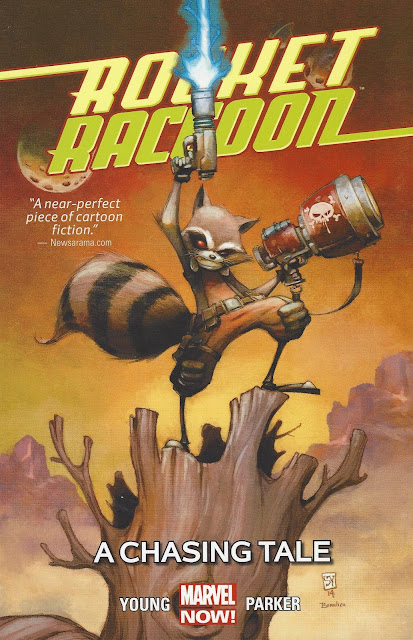
Rocket Raccoon, v. 1: A Chasing Tale coverYoung’s art often lives up to its reputation for imaginativeness. The prison escape montage is excellent. The sea-creature visuals surrounding Rocket’s accomplice Macho are creative and cohesive; I especially like the fish-like creature who swallows Macho’s ship, then spits it out at the other end of a hyperspace warp. Young sneaks in a few funny Easter eggs as well, like a box marked “John Woo props” in the middle of a gunfight.

Sometimes the art fails to live up to that standard, though. The aliens all look like humanoids, blobs, or animals; I’m not sure what else they can look like (clouds? Mechanical items?), but I feel confident Young could come up with something more unusual if he tried. (The strangest alien in Chasing Tale is Xemnu the Titan, a long-time Hulk villain Young uses in #2.) The ship designs are a bit boring as well. The sound effects Young adds are not as funny as the ones in Hercules — or as funny as Young thinks.

But I am not interested in Rocket Raccoon because of Young’s art. It’s nice to look at, but I’m a fan of the character Rocket — both Bill Mantlo’s original creation, with his anthropomorphic animal friends and stupid Beatles puns, and Dan Abnett and Andy Lanning’s sardonic, violent space warrior. The latter is in Chasing Tale, but the more I learn about him, the less I like him.

Young’s Rocket has a habit of swindling and leaving women he has bedded. He uses the idiotic catchphrase “Murdered you” that Bendis came up with in the new Guardians of the Galaxy series. (It’s possible Young might be using the phrase ironically; that doesn’t make it better.) Rocket learns no lessons from his bad behavior. What’s worse, he spends time angsting about his origins …

Once upon a time, Rocket’s origins were simple. He was an uplifted raccoon, meant to amuse the inmates on Halfworld, a mental asylum planet. When the psychiatric professionals left, Rocket and his animal pals were elevated to caretakers of the Loonies. Halfworld had a lot of uplifted animals, but none of them seemed to be of the same species; given that Rocket (then known as “Rocky”) was in charge of Halfworld, he would have known whether any other raccoons existed. But in Chasing Tale, he’s looking for others like himself (one of whom seems to exist) and Gideon’s Bible, the legendary artifact of Halfworld. What happened to Rocket’s memories of Halfworld? Why doesn’t Rocket know where any his old friends or the Loonies are? Why doesn’t Rocket know why Blackjack O’Hare hates him? (And why does Blackjack say it was over an employment dispute, since the two frequently fought on Halfworld?) Would it have killed editor Sana Amanat — or assistant editor Devin Lewis, who signed the lone footnote in the book — to give us a damn footnote explaining some of this?

The villains in Chasing Tale are all weak or problematic. The women Rocket wronged are both. They are all portrayed as unhinged, as jokes. Their leader tells Rocket that women’s pain isn’t treated as seriously as men’s; she’s right, but saying that doesn’t mitigate Young making light of their pain in Chasing Tale. (I mean, look at that pun in the title!) Rocket ruined their lives, and his only punishment is a few punches that he takes without complaint (and community service). That’s not enough; Rocket not only seduced and left the women, but he took their money, which caused them to lose their social status. Rocket manages to pummel an army of exes, despite their armaments and large ships, and still have something left over for Blackjack.

Every other villain is merely a speedbump for Rocket on the way to the end of the story. Without a clear view of continuity, Blackjack is only an opportunity for Young to draw a murderous bunny, not an opportunity to explore an existing relationship. The rest of Rocket’s antagonists are done away quickly and as a joke — huge person (with or without a gun) threatens Rocket, Rocket thrashes huge person. Ha! Ha?

Groot’s haphazard evolution as a character continues here, with the Guardians of the Galaxy movie providing the impetus for his new directions. In Chasing Tale, Groot can regrow from a splinter. Repeatedly. In a few hours. This ability reduces the stakes to nothing when Groot is in danger. And since when can Rocket (and the other Guardians) understand Groot? I think it’s a poor choice; Rocket’s responses to “I am Groot” aren’t funny enough to justify the change. Groot’s impenetrability was an aspect of his character I appreciated. Issue #5, in which Groot tells a bunch of kids a story, illustrates the superior comedic potential of not being able to understand Groot. The kids’ mystification is great, and the story’s entire dialogue consisting of repeated “I am Groot” communicates that confusion to the reader while the art tells the story.

Young is trying for a lighthearted tone in Chasing Tale, and despite the missteps I mentioned above, often he succeeds. Rocket quoting Earth movies to the space police during an interrogation at the beginning of #2 is amusing, although Young undercuts the joke by explaining it on the next page. The entirety of #5 is hilarious, and I especially enjoyed the Deadpool cameo. The payoff in #6 is a nice touch as well. But sometimes the violence and humor sit uneasily next to each other, especially when Young doesn’t quite nail the joke.

Jake Parker drew #5 and 6, and I prefer his work to Young’s, actually. His work on Groot’s tale in #5 does a better job telling the story than all but a few of the wordless ‘Nuff Said issues Marvel did in 2002. Parker’s art seems more in line with the funny animal aesthetic that covers Rocket’s backstory and the ideas Young’s story undercuts. Parker’s work isn’t as dynamic as Young’s, and it’s not as exaggerated; in fact, Parker looks like he’s strongly influenced by Bill Watterston, who wrote and drew Calvin and Hobbes. This gives Parker’s issues a touch of innocence that works well with Groot’s story in #5 and with Cosmo’s scenes in #6.

Chasing Tale has a lot of energy and a decent amount of humor going for it; if it was a story about a new character, I’d probably enjoy it more. Readers familiar with Rocket from the last few years or only the movie might love it, although that won’t get them past how Young treats Rocket’s exes. Storytailer might make this book better in retrospect by explaining Rocket’s history, but no matter what happens, I can be sure of this: I don’t care if Rocket is the last of his kind.

Rating: Rocket Raccoon symbol Rocket Raccoon symbol (2 of 5)

Labels: , , , , , ,