Reviews of trade paperbacks of comic books (mostly Marvel), along with a few other semi-relevant comments / reviews.

04 November 2016

Spider-Man, v. 1: Miles Morales

Collects: Spider-Man v. 2 #1-5 (2016)

Released: September 2016 (Marvel)

Format: 112 pages / color / $15.99 / ISBN: 9780785199618

What is this?: Miles Morales, the Spider-Man of the Ultimate Universe, has to adjust to being a Spider-Man in the regular universe with new villains — in addition to all the problems of being a normal teenage superhero.

The culprits: Writer Brian Michael Bendis and artist Sara Pichelli


I’m not very familiar with writer Brian Michael Bendis’s magnum opus, Ultimate Spider-Man. I read a few of the early trades, killing time when I was bored, but I didn’t fall in love with the character or the universe.

That means I haven’t read any stories featuring the second Ultimate Spider-Man, Miles Morales. I’ve certainly heard of Miles, but other than Fox News-types screaming about “Black Spider-Man,” I didn’t have any information on him going into Spider-Man, v. 1: Miles Morales, which covers Miles’s first series in the main Marvel Universe.

Spider-Man: Miles Morales, v. 1 coverBendis throws the reader into the story immediately, starting with an in media res fight with the demon Blackheart, who has already defeated the Avengers. Before resolving that fight, Bendis then backtracks to a day in the life of Miles Morales, a high-school student who is the new Spider-Man. (He returns to the fight with Blackheart by the end of the issue.) Although the book has no lengthy infodumps, and the recap page is scanty at best, Bendis gradually introduces the information readers need to understand what is going on throughout v. 1. Occasionally, a bit of information will be shoehorned in as if Bendis couldn’t find a way to elegantly introduce it, but overall, the story flows well and didn’t leave me scratching my head.

(As a side note: As well as Bendis does this, I wonder how much my own familiarity with the Marvel Universe and how these stories are supposed to go allows me to follow along with Miles’s story so easily.)

While I am unfamiliar with Miles, I am quite familiar with Bendis. It occurs to me that Bendis is becoming the new Chris Claremont, albeit one who doesn’t let his bondage fantasies play out on comics pages. Like Claremont, Bendis has an authorial voice and narrative tics (danglers and mind control for Claremont, extreme decompression and a fondness for giving favorite — or just single — characters a push in group situations) that may drive off readers who have grown tired of them. (I dropped Powers years ago when I couldn’t take any more of Bendis’s stammered dialogue.) Fortunately, Bendis keeps those problems in check in v. 1; yes, the book sounds like Bendis, and the plot is a little slower than I would like, but the plot moves along and things happen. Bendis does, however, bring in Goldballs, a mutant character Bendis created during his X-Men work; Goldballs is inexplicably popular and immediately finds himself in the thick of the book without working for it.

As I said, v. 1 has action, but I’m not sure I buy it. It’s not the fault of artist Sara Pichelli; her fight scenes are a treat to read, clear and filled with movement. Bendis’s choices, however, don’t make for a compelling whole. The book’s big action piece is Miles’s fight against Blackheart, who has already taken out the Avengers. Without knowing anything about Blackheart, Miles battles the huge demon, even picking up Captain America’s shield during the fight. Symbolically, we know that’s supposed to be important, but Miles does almost nothing with Cap’s shield — he bops Blackheart’s face with the shield a couple of times. Blackheart, for his part, is no match for Miles; he grabs Miles once, but after Miles uses his venom blast, he never touches the teenager again.

What’s the venom blast? Well, with a touch, Miles can make humans feel like they’re having a heart attack. It has an even stronger effect on Blackheart. Miles also appears to become invisible at some point, although he never mentions the power and only uses again it to attempt to fool heat-seeking missiles. Still: Those are some impressive powers that allow Miles to defeat a near-cosmic level threat by himself.

However, Hammerhead and his goons take out Miles by firing a few missiles. Why was Hammerhead after Miles? Because the Black Cat hired him to do so. Why does she want to go after Miles, even though he’s battling Avenger-type threats rather than street-level criminals throughout this book? *shrug* After Miles has been captured, she says she has an instinctual aversion to Spider-Man, any Spider-Man, but seeking out a fight against a superhero isn’t the act of a rational crime boss, which is what Black Cat seeks to be (and is, in Silk).

And then Miles escapes from Hammer head and Black Cat by using some unspecified (and unnamed) power to shatter / repel the chains that bind him. It all feels so … arbitrary. I mean, I know all narrative fiction is arbitrary, and superhero stories even more so, but this seems even more arbitrary than usual.

Other than those unconvincing fights, the main conflicts come between Miles and his grandmother, who is convinced he is on the drugs after his grades slip, and between Miles and his best friend, Ganke, who reveals Miles’s secret identity to Goldballs, on the theory that heroes should share these things. The former is an excellent idea; family is an excellent shaft to mine for teenage hero drama, and grounding someone who can literally punch through walls is a nice irony. Miles’s grandmother toes the lines between an irritating, over-the-top, cartoonish, and out-of-touch old and amusing foil for both Miles and his parents. More often than not, she manages to stay on the right side of that line, but sometimes it’s uncomfortable. (Pichelli draws her as surprisingly young and fashionable granny — too young to have a teenage grandson, unless teen pregnancies run in the family. Which they could!)

Ganke spilling the beans to Goldball is an idiotic betrayal of Miles’s trust. Ganke rationalizes it by saying he wanted to impress a superhero he identified with (both are heavyset or overweight), but it feels contrived — and yes, arbitrary — that Ganke would immediately give up the secret. After trying and failing to connect with Goldballs? Sure, that could make sense. As an opening gambit? No. Is Bendis trying to say Ganke is a horrible friend? Nothing else suggests that. He may be trying to make a point about identity politics and representation, but if he is, it’s simultaneously ham-handed and muddled.

Those sort of representation issues are brought up more ably after Miles’s costume is torn during his fight with Blackheart, revealing that he is a person of color. A vlogger he and Ganke watch is ecstatic about learning the new Spider-Man isn’t another white guy, but Miles rejects her label of the “Black Spider-Man.” First of all, that label doesn’t match his personal identity; he’s only half African-American. Secondly, though, he wants to be known as just plain Spider-Man, which — let’s face it — is an unrealistic expectation as long as Peter Parker is walking around. Maybe there’s more to Miles’s rejection than that, as he stubbornly refuses to see the significance of a Spider-Man who is a person of color. But we don’t see any other components of his reaction in v. 1. I have to wonder, though, how differently this scene would have been written if it had been written by someone whose skin isn’t white.

Pichelli’s art is excellent, and I enjoyed reading her work. Her approach is heavy on double-paged spreads, and although she’s better at alerting the reader to continue from one side of the book to the other than most artists, it still disturbs the reading experience, especially in a book as heavy in conversation scenes as a Bendis comic. Still, Pichelli makes those conversations interesting to look at; she doesn’t reuse headshots over and over. People are moving in those scenes, and their movements feel real. Miles’s face is always in motion as well, although none of his expressions are subtle. Then again, teenagers aren’t subtle, are they?

I am really on the fence about v. 1. I have a feeling Bendis wrote this book as a continuation of his Ultimate Spider-Man book, and if I kept reading the series, then I would get into the rhythm and narrative feel of the book. But reading Bendis has made me leery of putting too much faith into him, so I’m not sure I’m going to pick up the next volume.

Rating: Spider-Man symbol Spider-Man symbol Spider-Man symbol (3 of 5)

Labels: , , , , , , , , , ,

24 June 2016

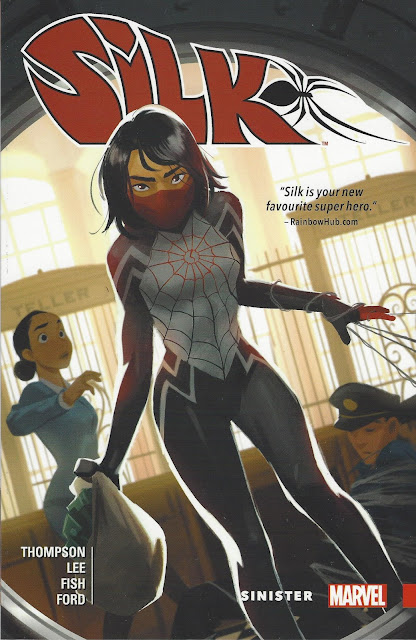
Silk, v. 1: Sinister

Collects: Silk #1-6, story from Amazing Spider-Man v. 4 #1 (2015-6)

Released: April 2016 (Marvel)

Format: 144 pages / color / $19.99 / ISBN: 9780785199571

What is this?: Silk goes undercover for SHIELD inside Black Cat’s organization as the Black Cat accumulates technology and battles against Goblin Nation while she also works for the Fact Channel and looks for her parents.

The culprits: Writer Robbie Thompson and artists Stacey Lee, Tana Ford, and Veronica Fish


I’ve been trying to write this review for a few weeks now, and I just haven’t been able to put my thoughts down. But now that I’ve published my review for Spider-Gwen, v. 1: Greater Power, I feel I have to review the latest title from the other female-led new-character series that came out of Spider-verse: Silk, v. 1: Sinister.

The review hasn’t been hard for me to write because I don’t know what I thought of the book. I enjoyed Sinster, just as I enjoyed the first volume of Silk (confusingly numbered v. 0). Silk is a solid series; it’s a series I’ll continue to read, although I’m not sure I’ll be excited about it.

Silk, v. 1: Sinister coverSilk … I don’t know. Silk has lost its new car smell, but it’s reliable and can still surprise me at times . I expect to have Silk for a long time, and I expect to remain satisfied by it. But it’s a little disconcerting how quickly how quickly it’s gone from invigorating to a solid performer.

Sinister picks up eight months after v. 0. I was concerned Silk would abandon some of the changes made at the end of The Life and Times of Cindy Moon because of Secret Wars, but I needn’t have worried. Cindy Moon has been promoted at the Fact Channel, where she works for the gruff-but-caring J. Jonah Jameson. Cindy is still looking for her parents, but she has found her brother, who’s seeking treatment after his memory loss. Cindy’s heroic identity, Silk, appears to be working for crime boss Black Cat, but that is revealed (in the first issue, so no real spoilers) to be an undercover gig for SHIELD. Since Cindy’s brother was previously affiliated with Goblin Nation, Silk has a vendetta against the green-faced tribe of kids and young punks.

Writer Robbie Thompson has established a status quo that is nearly ideal — a classic Spider-Man status quo without being obvious about it. The balance between Cindy’s personal life and work life and between Silk’s heroism and her selfish desires are fascinating. Cindy is obviously trying to fit too much into her life, but that’s what heroes do, right? And Thompson does as good job of showing that Cindy’s suffering from her attempts to run in four different ways at once; her behavior, her friends’ reactions, and her sessions with her psychiatrist all show someone who is beginning to fray.

The supporting cast is excellent, with Cindy’s work friends serving as a nice counterweight to Silk’s allies and rivals. Jameson’s faith in Silk is as touching as it is surprising. Peter Parker returns to offer his ten cents of advice; a wise choice, as Peter’s appearance serves to link the book’s continuity to the pre-Secret Wars stories and shows why Peter probably won’t be showing up very often going forward. Thompson even uses Killer Shrike, who works for Black Cat. Killer Shrike! Silk also has a mystery ally, Spectro (named only in the sketches at the back of the book), who seems primed to be the Angel to Cindy’s Buffy.

I’m not sure about Spectro; he’s mysterious without having a character. I’m really not sure about using Spider-Woman (Jessica Drew), though. Jessica presents herself as a mentor figure to Silk — they have regular brunches — but Cindy already has more effective adults she can work out her issues with: Mockingbird, who is her SHIELD partner / handler, and her psychiatrist. My resistance to Jessica’s presence may be because the two characters met in the Spider-Verse crossover, and I’m opposed to anything that reminds me of that crossover. It may also be because Jessica serves as mentor to Spider-Gwen, and I think Silk and Spider-Gwen should be differentiated as much as possible. Mostly, though, it’s the redundancy that bothers me.

I like Silk being a superhero who visits a psychiatrist, and every panel with Jessica is one that can’t be used on one of Cindy’s sessions with Dr. Sinclair. In an era in which thought bubbles and narrative text boxes have gone out of style, it’s nice that Thompson has given Cindy someone to whom she can admit her darker thoughts, her true thoughts, without fear of repercussions. (Well, there could be repercussions, but Cindy doesn’t think there will be.) That doesn’t mean she blurts out what she thinks to Dr. Sinclair; she’s still concerned about what her feelings say about her true character, as anyone would be.

I’m not convinced by Black Cat’s full transformation to ultra crime boss. Thompson has set her up as a major crime lord, one who has the resources to create an antidote to the Goblin serum. Even given that Cat has been back to being a criminal for maybe a year, Marvel time, that’s not really believable. The Goblin serum is a hard nut to crack; Spider-Man had a great deal of difficulty doing that. But Black Cat’s scientists — seen only on one page — manage to not only come up with a cure with no side effects but to aerosolize it. I’m not sure how Black Cat, a character who was a lone operator for so long, gets to build an organization like that. I can see her intimidating a small crew, but a large operation … ? Well, I suppose this is a small quibble, and my skepticism might be unfounded. After all, a year seems like a short time to build what Black Cat has, but it’s a long time in the Marvel Universe.

I love Stacey Lee’s art, and I’m sad she doesn’t do more than the first issue (plus the story from ASM). Lee’s art is fluid and clear; she has no trouble making Cindy stereotypically cute while making the Goblin Nation thugs creepy. She even (almost) makes Mockingbird’s mask look normal, which is something that Giuseppe Camuncoli completely failed to do in Spider-Man: Worldwide, v. 1. What causes a goblin glider to fail during Silk’s battle with Goblin Nation could be clearer, though.

Tana Ford’s art doesn’t match the tone Lee established in #1 and in Life and Times. Everyone Ford draws looks disheveled; everything feels unpolished and rough. Her wobbly faces look like their features are all going to start rolling away in opposite directions. (Also, Ford’s Mockingbird at the beginning of #6 looks incredibly like Songbird from Thunderbolts, which caused me to do a double-take.) Ford’s style could work for a different title, but Lee has established Silk’s look as the complete opposite. If I knew Ford was taking the title over full-time, I could get used to that — I’d have to, I suppose — but Ford draws only three issues (#2-3 and #6). Issues #4 and 5 are drawn by Veronica Fish, whose style fits wonderfully with Lee’s.

Silk is a title with a lot to like, although I admit I have to sit down and make myself write my thoughts out for me to really see it all. I have a feeling my enthusiasm for each future volumes will have a lot to do with who the artist is and how much the stories involve other Spider-women.

Rating: Spider-Man symbol Spider-Man symbol Spider-Man symbol Half Spider-Man symbol (3.5 of 5)

Labels: , , , , , , , , , , ,

11 March 2016

Spider-Man Epic Collection, v. 21: The Return of the Sinister Six

Collects: Amazing Spider-Man #334-50 and Spider-Man: Spirits of the Earth GN (1990-1)

Released: February 2016 (Marvel)

Format: 504 pages / color / $39.99 / ISBN: 9780785196914

What is this?: Spider-Man fights the Sinister Six, Chameleon, Dr. Doom, Venom, the Black Tarantula, Boomerang, Rhino, and Scorpion.

The culprits: Writer David Michelinie and artist Erik Larson


Although I would not say Amazing Spider-Man Epic Collection, v. 21: Return of the Sinister Six collects a classic run, I enjoyed reading it a great deal. I liked the book for simple reasons: the stories were relatively well told, from an era before the ‘90s comic-book madness shattered the way comics stories were told, and they were (mostly) new to me.

These stories seem custom-made to kindle the flame of nostalgia within the reader’s breast. Writer David Michelinie cozies up to the past over these issues; almost all the villains he uses are ones who have faced Spider-Man before, in one form or another. He reunites the Sinister Six for the first time since 1964, and he uses a parade of familiar Spidey foes: Chameleon, Scorpion, Rhino, Boomerang, the Black Tarantula … Even Mary Jane’s stalker has stalked her before.

Amazing Spider-Man Epic Collection, v. 21: Return of the Sinister Six coverErik Larsen’s art will make or break the book for most readers. Larsen’s style is reminiscent of Todd McFarlane’s, whom Larsen succeeded on Amazing Spider-Man. Larsen draws similar spaghetti-strand webbing and contorted-yet-graceful poses for Spider-Man. (Well, they contrive to be graceful, but in many of them, Spider-Man is folded up in ways that can’t be comfortable.) He doesn’t quite have McFarlane’s immense capes, although that’s mainly because Spider-Man doesn’t have a cape, and neither do most of his villains. (Dr. Doom has a voluminous cape, but it doesn’t figure into many panels, and besides, it’s Dr. Doom, who can get away with huge capes.)

Larsen’s style is often cartoonish. As I said, his Spider-Man is often contorted in his postures, but other characters get distorted for effect as well. Dr. Octopus’s arms seem to stretch for miles, the equal of Spider-Man’s web lines, although the arms get more tangled. The cartoonishness is a virtue when it comes to Venom, a character who was created by McFarlane to be frightening, not realistic; the strange proportions and distended jaws increase Venom’s alien, fearsome qualities. Usually, Larsen’s exaggerations are a visual quirk, something readers get used to in time. However, it’s always distracting with women, especially Mary Jane. She is a caricature of femininity: perpetually pouty lips, large breasts in tight dresses and tops, long legs in short skirts that accentuate her callipygian form. Making Mary Jane into a super pin-up accentuates the problem that so many editors and readers made about Spider-Man having a supermodel for a wife: If Peter has married a woman so attractive, then he’s less the everyman.

Larsen’s style is not an unusual look for women in comics, but his art emphasizes the negative aspects of the practice. Felicia Hardy, the Black Cat, is Mary Jane’s silver-haired twin, although her lips aren’t so pouty. Since the Black Cat has powers and is a superhero (of sorts), it’s arguable that she should be drawn on a larger-than-life scale — I don’t like the argument, in this case, since most of those exaggerated characteristics are large breasts, big hair, and a shapely lower half, but it is a line of thought. But women other than Mary Jane and Felicia — the Chameleon’s arm candy, Mary Jane’s co-stars on the soap opera she acts in — are drawn similarly, which makes them more dull than titillating.

The plots themselves are simple superhero stories told satisfyingly, for the most part. I don’t fault Michelinie for unoriginality; when he gets his most original, with Dr. Octopus’s ultimate goal for getting the Sinister Six back together, the logic can become tenuous. (Lacing the atmosphere with a cure for cocaine addiction, then expecting addicts to pay to get addicted again? I dunno, man — why not just deal cocaine?) Michelinie seems to pull out the stops for Venom’s two-issue battle with Spider-Man (#346-7), with a fight that has actual tension that’s lacking in the rest of the book. Michelinie always shines with Venom, creating an adversary for Spider-Man who displays an extra level of viciousness and is more than a credible threat for the hero.

The lack of originality in the rest of the book is acceptable, given how badly originality can go awry. (See “Saga, Clone.”) Spider-Man — all superhero comics, really — have succeeded by using and reusing tried and true antagonists, and the villains in this collection are all used in serviceable ways — goons, mostly, giving Spider-Man credible sparring partners while he works out the larger moral implications or plots. There’s nothing earthshattering about these fights; they’re comfort food for a Spider-Man nostalgist.

The Sinister Six’s reunion unfortunately is underwhelming. I can hardly believe no writer had reunited the group since Amazing Spider-Man Annual #1, way back in 1964. (Given how often groups “sinister” groups have formed since 1990, the Sinister Six should have gotten together at least once in the quarter century between Annual #1 and Amazing Spider-Man #337.) The story should have been more momentous; instead, Dr. Octopus spends half the six-issue storyline gathering the team, then another issue prepping for his grand plan. The Six is in action together for only one issue before Dr. Octopus betrays them, and they all go in their separate directions.

Larsen and Michelinie aren’t entirely using old ideas. Cletus Kassidy, the serial killer who becomes Carnage, makes his first appearance here, and the symbiote’s later appearance is teased. Cardiac, a vigilante doctor with a grudge against a chemical company, also debuts in this book. After Michelinie left the book, he gets forgotten, and it’s not hard to see why. His costume and energy blast effect, with their cool blue color schemes and jagged lines reminiscent of a heart monitor, are nice bits of design, and his alter ego as a doctor has some potential. But it doesn’t come together into anything intriguing, here or anywhere else.

I mentioned that even Mary Jane’s stalker was reused, but giving Mary Jane an antagonist she faces by herself is remarkable. Spider-Man’s core supporting cast — Mary Jane; Aunt May and her fiancée, Nathan; Flash and his girlfriend, the Black Cat — each have things to do separate from Spider-Man himself. Michelinie can be faulted for paring down the supporting cast to those characters and those he works with in his grad student lab (those characters aren’t given much room to grow), but at least he doesn’t neglect the important characters.

Michelinie’s Mary Jane is a delight, especially when compared to the problems later writers had with her characterization. She gets her own battles to fight, she has her own career, and she is a supporting spouse to Peter. She argues with him when she thinks he’s wrong, but she’s not petulant about it. Perhaps she too easily gives in to Peter’s rationalizations, but it’s better than creating pointless drama by having her object to everything Peter does.

Charles Vess contributes an original graphic novel to this collection: Spirits of the Earth, which I didn't even know existed before this collection came out. After reading it, I can understand why; the story is slight, and Vess’s art, as pretty as it is at times, can’t compensate. It reads like story written to justify a vacation: an exotic location (the Scottish Highlands) that Spider-Man fits into badly and should blow his secret identity. (In actuality, Vess had visited Scotland frequently.) Tying the story into the wider Marvel Universe by placing the Hellfire Club behind the evil plot mitigates the incongruity of Spider-Man in the Highlands somewhat, but the small concession to the shared MU can’t compensate for the incongruous yet forgettable story.

Return of the Sinister Six is a book for fans of Spider-Man and Erik Larsen. But even general fans of other superhero comics will find parts of the book to enjoy. I doubt anyone would fall in love with Spider-Man or any other member of his cast from this book, but it’s good enough to spend a diverting few hours with.

Rating: Spider-Man symbol Spider-Man symbol Spider-Man symbol Half Spider-Man symbol (3.5 of 5)

Labels: , , , , , , , , , , ,

19 February 2016

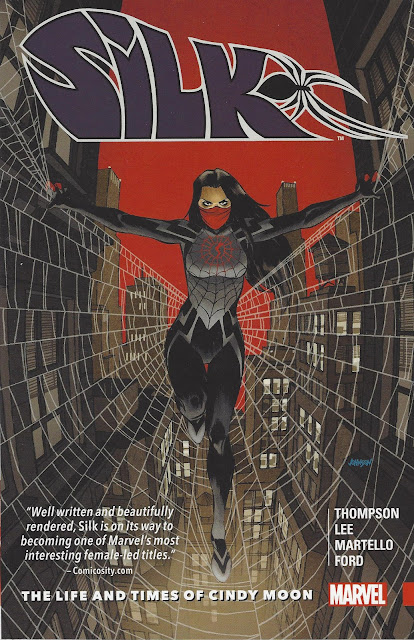
Silk, v. 0: The Life and Times of Cindy Moon

Collects: Silk #1-7 (2015)

Released: October 2015 (Marvel)

Format: 160 pages / color / $19.99 / ISBN: 9780785197041

What is this?: Cindy Moon, recently freed from ten years in a bunker, tries to find her missing family while maintaining the semblance of a personal life (mostly for appearance’s sake, it appears).

The culprits: Writer Robbie Thompson and penciller Stacey Lee


I like Silk, v. 0: The Life and Times of Cindy Moon, but I admit I have a hard time putting my finger on exactly why. It’s only when I compare Silk (alter ego: Cindy Moon) to Spider-Gwen that everything I like is illuminated, and I realize it’s a lot of little elements that add up to an enjoyable book.

Unlike Gwen Stacy in Spider-Gwen, readers get a good idea of who Cindy Moon is and what she does when she’s not a hero. Cindy is confused and angry after spending a decade in isolation. She was bitten by the same radioactive spider as Peter Parker, but she was convinced by Ezekiel Sims, the Amazing Spider-Retcon, to hide herself away to avoid attracting the attention of Morlun, one of the jerks the assembled Spiders-Heroes eventually defeated in Spider-Verse. Ezekiel is gone, killed by Morlun. Cindy resents the sacrifice Ezekiel convinced her to make, and as much as she wishes she could punish him, she needs the information that only he seemed to know: where he hid her family.

Silk, v. 0: The Life and Times of Cindy Moon coverSo despite her cultural knowledge being a decade out of date, Cindy interns at the Fact Channel so she can use its resources to search for her parents. When she isn’t fighting crime or looking for her parents and brother, she spends time with a couple of friends, Rafferty and Lola. She gets guidance from Spider-Man. She finds an archenemy, the Black Cat, and a frequent sparring partner, Dragonclaw, whom she manages to engage as a human being. She even goes on a date with Johnny Storm.

All this makes Silk a well-rounded book, and I suppose that’s what I like about it.

“Well-rounded” sounds like a low bar to hurdle, but it’s not. Likeable protagonists who fight opponents who are both engaging and powerful are difficult to find, but writer Robbie Thompson manages that. (Looking back, I’ve reviewed six straight books that weren’t able to meet that standard.) Given her past, the Black Cat isn’t a black-and-white villain, and she tries to dissuade Silk from opposing her before launching a vendetta against the hero. The Black Cat has become a crimelord, which gives her the resources to be a real challenge to Silk even when Silk has allies. But while the Black Cat schemes, Thompson works in another villain, one who has connections to the Black Cat and to the mystery of Silk’s family. It neatly combines the story threads, and the battle with him is a pleasing way to end the first storyline.

Going back to comparisons with Spider-Gwen: Silk’s costume is immeasurably better. The colors are subdued without being drab, spider-related without being a copy of Spider-Man’s. The subtle spider legs above and below the web pattern on her chest is a great touch. I don’t care for the “S” in the middle of the webs; it looks carelessly written, and it isn’t big enough to be featured in the middle of the costume, but fortunately the “S” rarely shows up in the art. I like the mask that covers the bottom part of her face, which allows artist Stacey Lee to communicate a great deal of emotion through Silk’s eyes.

The mask was already a part of Silk’s costume, so an artist who can draw expressive eyes is a must. Lee, who drew five of the seven issues in Life and Times, is that artist. I’m not usually impressed by manga-influenced artists in superhero books, but Lee is excellent with conversational scenes, and her action work is clear and dynamic. Her Cindy in flashbacks is the picture of wide-eyed innocence and adolescent angst; in the modern day, Cindy retains some of that, but she has gained an angry edge and occasional maturity both in and out of costume.

Besides giving Cindy a couple of friends her own age, Thompson uses J. Jonah Jameson as not only comic relief but as a solid character in his own right. The former mayor works as a talking head at the Fact Channel and still has a hatred for Spider-Man, which somehow doesn’t extend to Silk. (Since Jameson’s hatred has always been irrational, that’s OK.) But in addition to be an angry man who gives Cindy the nickname of “Analog,” he shows he’s a decent human being; when he learns Cindy’s predicament, he offers to help, showing himself to be the stand-up guy he is often said to be as but rarely gets a chance to be.

Silk isn’t a perfect book. No book is, of course, but Thompson never explains the book’s most important question: Why does Cindy dress as Silk and fight crime? Peter Parker has the lesson taught by Uncle Ben, Spider-Gwen has the respect for law and justice that her detective father taught her … but why is Cindy doing this? The flashbacks don’t give any idea that she has a thirst for justice, and being a superhero doesn’t help her find her family.

Thompson is vague about Silk’s previous appearances and powers. Thompson not reminding the reader what she’s done since Peter let her out of the bunker is fine, although I feel like I’m missing some piece of continuity that will make sense of my complaints. As for her powers, she can create her own webs, she has a spider-sense — Silk sense — and can spin clothes out her silk. She has the standard spider-strength and agility, so I guess we’re supposed to guess she has all Spider-Man’s powers with a few more added in. Additionally, she somehow knows Lola is attracted to Rafferty, although that could be because she’s observant instead of being able to detect pheromones.

Some of my complaints are niggling. Cindy’s lack of cultural knowledge is grating and sometimes nonsensical — how does she research at the Fact Channel if she doesn’t know what Google is? The Fantastic Four’s appearance seems gratuitous, and spending an entire issue on it is a waste of time. Her anger when Peter tries to get her help seems out of proportion to the sin. Thompson also doesn’t delineate what Peter and Cindy’s relationship is. He wisely deprecates the creepiest part of Cindy’s origin: that because she and Peter Parker were bitten by the same radioactive spider, each has an almost uncontrollable sexual attraction toward the other. It’s amusing for a few pages, maybe — maybe — but it’s problematic in a larger sense. Peter Parker and Spider-Man are present in Life and Times, but the implication is that their relationship is more mentor / newcomer than sexual or romantic. On the other hand, one or two scenes leave the idea that the two of them could be (or are) more than just similarly themed superheroes.

The book ends with the end of the world in #7, which isn’t a surprise for readers who know Silk and the rest of the Marvel line was interrupted by the Secret Wars crossover that ended the Marvel Universe (briefly). In #7, Silk runs through the city on its final day, trying to reach a destination, but she keeps getting delayed by people who need to be saved. The art from Tana Ford has trouble selling the urgency and action, but despite that, I couldn't guess whether Silk would reach her destination until the last couple of pages. Cindy gets a major win as the world ends; I’m going to be very upset if she’s not allowed to keep that victory when the regular Marvel Universe returns.

I enjoyed Life and Times. I’m looking forward to the next volume, Sinister, which comes out in May. The groundwork laid down in Life and Times will likely make clear which of my complaints are unimportant and what I’m supposed to be paying attention to. On the other hand, Sinister will take place in an all-new, slightly different Marvel Universe, so who knows what the ground rules are?

Rating: Spider-Man symbol Spider-Man symbol Spider-Man symbol Half Spider-Man symbol (3.5 of 5)

Labels: , , , , , , , ,