


Spider-Man Epic Collection, v. 21: The Return of the Sinister Six
Collects: Amazing Spider-Man #334-50 and Spider-Man: Spirits of the Earth GN (1990-1)
Released: February 2016 (Marvel)
Format: 504 pages / color / $39.99 / ISBN: 9780785196914
What is this?: Spider-Man fights the Sinister Six, Chameleon, Dr. Doom, Venom, the Black Tarantula, Boomerang, Rhino, and Scorpion.
The culprits: Writer David Michelinie and artist Erik Larson
Although I would not say Amazing Spider-Man Epic Collection, v. 21: Return of the Sinister Six collects a classic run, I enjoyed reading it a great deal. I liked the book for simple reasons: the stories were relatively well told, from an era before the ‘90s comic-book madness shattered the way comics stories were told, and they were (mostly) new to me.
These stories seem custom-made to kindle the flame of nostalgia within the reader’s breast. Writer David Michelinie cozies up to the past over these issues; almost all the villains he uses are ones who have faced Spider-Man before, in one form or another. He reunites the Sinister Six for the first time since 1964, and he uses a parade of familiar Spidey foes: Chameleon, Scorpion, Rhino, Boomerang, the Black Tarantula … Even Mary Jane’s stalker has stalked her before.
 Erik Larsen’s art will make or break the book for most readers. Larsen’s style is reminiscent of Todd McFarlane’s, whom Larsen succeeded on Amazing Spider-Man. Larsen draws similar spaghetti-strand webbing and contorted-yet-graceful poses for Spider-Man. (Well, they contrive to be graceful, but in many of them, Spider-Man is folded up in ways that can’t be comfortable.) He doesn’t quite have McFarlane’s immense capes, although that’s mainly because Spider-Man doesn’t have a cape, and neither do most of his villains. (Dr. Doom has a voluminous cape, but it doesn’t figure into many panels, and besides, it’s Dr. Doom, who can get away with huge capes.)
Larsen’s style is often cartoonish. As I said, his Spider-Man is often contorted in his postures, but other characters get distorted for effect as well. Dr. Octopus’s arms seem to stretch for miles, the equal of Spider-Man’s web lines, although the arms get more tangled. The cartoonishness is a virtue when it comes to Venom, a character who was created by McFarlane to be frightening, not realistic; the strange proportions and distended jaws increase Venom’s alien, fearsome qualities. Usually, Larsen’s exaggerations are a visual quirk, something readers get used to in time. However, it’s always distracting with women, especially Mary Jane. She is a caricature of femininity: perpetually pouty lips, large breasts in tight dresses and tops, long legs in short skirts that accentuate her callipygian form. Making Mary Jane into a super pin-up accentuates the problem that so many editors and readers made about Spider-Man having a supermodel for a wife: If Peter has married a woman so attractive, then he’s less the everyman.
Larsen’s style is not an unusual look for women in comics, but his art emphasizes the negative aspects of the practice. Felicia Hardy, the Black Cat, is Mary Jane’s silver-haired twin, although her lips aren’t so pouty. Since the Black Cat has powers and is a superhero (of sorts), it’s arguable that she should be drawn on a larger-than-life scale — I don’t like the argument, in this case, since most of those exaggerated characteristics are large breasts, big hair, and a shapely lower half, but it is a line of thought. But women other than Mary Jane and Felicia — the Chameleon’s arm candy, Mary Jane’s co-stars on the soap opera she acts in — are drawn similarly, which makes them more dull than titillating.
The plots themselves are simple superhero stories told satisfyingly, for the most part. I don’t fault Michelinie for unoriginality; when he gets his most original, with Dr. Octopus’s ultimate goal for getting the Sinister Six back together, the logic can become tenuous. (Lacing the atmosphere with a cure for cocaine addiction, then expecting addicts to pay to get addicted again? I dunno, man — why not just deal cocaine?) Michelinie seems to pull out the stops for Venom’s two-issue battle with Spider-Man (#346-7), with a fight that has actual tension that’s lacking in the rest of the book. Michelinie always shines with Venom, creating an adversary for Spider-Man who displays an extra level of viciousness and is more than a credible threat for the hero.
The lack of originality in the rest of the book is acceptable, given how badly originality can go awry. (See “Saga, Clone.”) Spider-Man — all superhero comics, really — have succeeded by using and reusing tried and true antagonists, and the villains in this collection are all used in serviceable ways — goons, mostly, giving Spider-Man credible sparring partners while he works out the larger moral implications or plots. There’s nothing earthshattering about these fights; they’re comfort food for a Spider-Man nostalgist.
The Sinister Six’s reunion unfortunately is underwhelming. I can hardly believe no writer had reunited the group since Amazing Spider-Man Annual #1, way back in 1964. (Given how often groups “sinister” groups have formed since 1990, the Sinister Six should have gotten together at least once in the quarter century between Annual #1 and Amazing Spider-Man #337.) The story should have been more momentous; instead, Dr. Octopus spends half the six-issue storyline gathering the team, then another issue prepping for his grand plan. The Six is in action together for only one issue before Dr. Octopus betrays them, and they all go in their separate directions.
Larsen and Michelinie aren’t entirely using old ideas. Cletus Kassidy, the serial killer who becomes Carnage, makes his first appearance here, and the symbiote’s later appearance is teased. Cardiac, a vigilante doctor with a grudge against a chemical company, also debuts in this book. After Michelinie left the book, he gets forgotten, and it’s not hard to see why. His costume and energy blast effect, with their cool blue color schemes and jagged lines reminiscent of a heart monitor, are nice bits of design, and his alter ego as a doctor has some potential. But it doesn’t come together into anything intriguing, here or anywhere else.
I mentioned that even Mary Jane’s stalker was reused, but giving Mary Jane an antagonist she faces by herself is remarkable. Spider-Man’s core supporting cast — Mary Jane; Aunt May and her fiancée, Nathan; Flash and his girlfriend, the Black Cat — each have things to do separate from Spider-Man himself. Michelinie can be faulted for paring down the supporting cast to those characters and those he works with in his grad student lab (those characters aren’t given much room to grow), but at least he doesn’t neglect the important characters.
Michelinie’s Mary Jane is a delight, especially when compared to the problems later writers had with her characterization. She gets her own battles to fight, she has her own career, and she is a supporting spouse to Peter. She argues with him when she thinks he’s wrong, but she’s not petulant about it. Perhaps she too easily gives in to Peter’s rationalizations, but it’s better than creating pointless drama by having her object to everything Peter does.
Charles Vess contributes an original graphic novel to this collection: Spirits of the Earth, which I didn't even know existed before this collection came out. After reading it, I can understand why; the story is slight, and Vess’s art, as pretty as it is at times, can’t compensate. It reads like story written to justify a vacation: an exotic location (the Scottish Highlands) that Spider-Man fits into badly and should blow his secret identity. (In actuality, Vess had visited Scotland frequently.) Tying the story into the wider Marvel Universe by placing the Hellfire Club behind the evil plot mitigates the incongruity of Spider-Man in the Highlands somewhat, but the small concession to the shared MU can’t compensate for the incongruous yet forgettable story.
Return of the Sinister Six is a book for fans of Spider-Man and Erik Larsen. But even general fans of other superhero comics will find parts of the book to enjoy. I doubt anyone would fall in love with Spider-Man or any other member of his cast from this book, but it’s good enough to spend a diverting few hours with.
Rating:

 (3.5 of 5)
Labels: 2016 February, 3.5, Black Cat, David Michelinie, Dr. Octopus, epic collection, Erik Larsen, Marvel, Mary Jane Watson, Scottish Highlands, Sinister Six, Spider-Man
posted by Raoul | 11:04 PM
|
0 comments

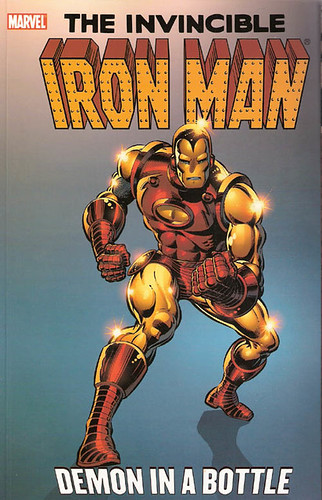 Not as well as Iron Man fans might hope. The story gets its power from the idea: hero as alcoholic. But liquor isn’t Tony’s only enemy; no, he has to battle rival industrialist Justin Hammer. And boy, does Hammer school him.
