Reviews of trade paperbacks of comic books (mostly Marvel), along with a few other semi-relevant comments / reviews.

13 March 2015

Guardians of the Galaxy, v. 1: Cosmic Avengers

Collects: Guardians of the Galaxy #0.1 and 1-3 and Guardians of the Galaxy: Tomorrow’s Avengers #1 (2013)

Released: April 2014 (Marvel)

Format: 144 pages / color / $19.99 / ISBN: 9780785166078

What is this?: The opening arc of Bendis’s run on Guardians of the Galaxy, in which the Guardians have to deal with aliens wanting to interfere with Earth.

The culprits: Writer Brian Michael Bendis and pencilers Steve McNiven and Sara Pichelli


I enjoyed the second volume of the Guardians of the Galaxy series, written by Dan Abnett and Andy Lanning, so I was worried when I heard Brian Michael Bendis was going to write the third volume.

Bendis’s style is vastly different from Abnett and Lanning’s. Abnett and Lanning rely on humor and action-filled plots, while Bendis is known for using naturalistic dialogue to fill his more leisurely paced stories. Unfortunately, Bendis’s dialogue causes many of his characters to sound alike, regardless of how they sounded before he started writing them. When Bendis writes solo titles, the singular Bendis voice is not a big problem, but it’s one of many concerns readers have raised on Bendis’s team books.

For some reason, despite no one particularly caring for Bendis’s work on team books, those books are still immensely popular. There’s a lesson in there somewhere, if anyone has the patience to unravel it.

Guardians of the Galaxy, v. 1: Cosmic Avengers coverBut I kept an open mind when I read Guardians of the Galaxy, v 1: Cosmic Avengers. In Cosmic Avengers, Bendis has chosen to make the central conflict between J’Son (occasionally spelled J-Son), the ruler of the alien Spartax, and his son, Peter Quill, who leads the Guardians under the name Star-Lord. J’Son wants Quill to quit adventuring with his scruffy friends and take his place as crown prince; Quill wants J’Son to butt the hell out of his life. J’Son also maneuvers members of the Galactic Council into putting Earth into quarantine, meaning J’Son is forbidding his son to go back to his home planet. Presumably, this is meant to pressure Quill to take J’Son’s offer.

The Badoon immediately take the quarantine of Earth as an invitation to invade the planet, hoping to conquer it before the other races can react and then presenting the conquest to the others as a fait accompli. (I think; it’s never spelled out why this new galactic policy on Earth makes the planet more vulnerable. The story does not say the Galactic Council has withdrawn longstanding protection of Earth or anything similar.) The Guardians — whose lineup mirrors that of the Guardians of the Galaxy movie: Quill, Gamora, Rocket Raccoon, Groot, and Drax the Destroyer — and Iron Man react, and when the battle is over, the Guardians are the ones who are in trouble.

So Cosmic Avengers has a great deal of action, but it does not have much plot. Each of the three issues from Guardians of the Galaxy collected in the book has two threads: J’Son lecturing someone (Quill or the Galactic Council) and the Guardians fighting someone. In life as well as comics, lectures are generally boring, and Bendis’s trademark dialogue doesn’t help; the action sequences look pretty, but they are uncomplicated: the Guardians see evil, attack evil, quickly win.

Well, the art is pretty, but it’s sometimes confusing. I’m not sure Steve McNiven and Bendis were on the same wavelength at times. Iron Man is introduced in #1 floating in space, in front of a planet that looks like Mars while musing that it’s good that he decided to “go out into the universe.” Mars isn’t far out into the universe, but that’s where Iron Man must be, since he sees the Badoon show up to attack Earth. Mars isn’t always that close to Earth — 140 million miles, on average, 34 million at their closest approach, and 250 million miles away on their farthest — but perhaps it is much closer in the Marvel Universe.

The Guardians arrive soon after. How do the Guardians decide to launch a boarding raid on the Badoon ship? By floating through the vacuum. That suggests neither ship is going very fast, and it gives McNiven a chance to show off their stupid spacesuits, which consists of helmets for Quill and Gamora in addition to normal costumes. During the battle, Rocket laughs at something Groot does … but what is it? McNiven shows Groot tearing through Badoon, but that’s not remarkable. After the Badoon activiate the self-destruct button, Drax rushes back into the ship to rescue Gamora, but the next panel with the two of them show them aboard the Guardians’ ship, without even a suggestion that either was in danger. The disintegrating Badoon ship is then shown almost at Earth — which, again, isn’t that close to Mars.

(As an aside: More worrying is a scene in the next collection, Guardians of the Galaxy, v. 2: Angela. Quill refers to a distressing event that happened while the Guardians were “chasing Badoon,” a lightning-like flash that momentarily disoriented Drax but messed with Quill’s thinking. But Quill experiences nothing like that in any Guardians issue; however, Drax does seem off his game for a moment in #2 after an explosion that seems to be caused by a laser. Was this the incident Quill refers to? Quill doesn’t seem to notice the flash of light then. Or did it come in a crossover appearance?)

Bendis’s dialogue is also problematic. Iron Man, who joins up with the Guardians after the Badoon attack, sounds like a typical Bendis character, and Quill also speaks in that style. Quill is, on the face of it, someone who shouldn’t speak in a naturalistic style; as a charismatic leader of a bunch of ragtag rebels, he should be smooth and quick witted — more Indiana Jones than Woody Allen. Rocket doesn’t sound like a Bendis character, but he does try to make a truly awful catchphrase — “Blam! Murdered you!” — work, and it takes a while before his teammates object to its psychopathic tone.

Sometimes people say something completely out of character. Iron Man has no call to slag on Captain Britain, but when the Badoon attack London, Iron Man says he’s “not really” any good. If anyone should be suspicious of humanity’s potential to screw up the universe, it would be the Supreme Intelligence of the Kree, who awakened the supremely powerful “Destiny force” from Rick Jones, Captain America’s sidekick, during the Kree-Skrull War and Avengers Forever. However, the Supreme Intelligence says J’Son is “overstating [humanity’s] abilities and importance.” Another member of the Galactic Council would be a better choice to say this, unless the Supreme Intelligence is dissembling. Which he might be, although I don’t have enough faith in Bendis to believe that.

(As a second aside: The Galactic Council includes J’Son, the Supreme Intelligence, Emperor Gladiator of the Shi’ar, a Badoon, Freyja the All-Mother of Asgard, Annihilus … and the Brood. The Brood? As a galactic power? I know this lineup was set by Jonathan Hickman in Avengers, but the Marvel Universe must hold a more important race than the Brood. The remnants of the Skrulls? The Galadorians? And Rocket describes the Badoon as a “minor race” in Guardians v. 2 #7. What’s changed since then?)

However, I will say Bendis writes Groot’s dialogue properly. He and Black Bolt might be the only two characters Bendis can’t make sound like the rest of his characters. Bendis does give Groot the ridiculous regeneration ability, as he grows from a sprout to his normal, giant self over just a few pages in #3. I don’t know that it should be remarkable that Groot should return from almost complete dissolution so quickly, but it rankled.

The price of this book is outrageous. Cosmic Avengers is not worth $20. Three issues of the regular series is barely a taste of what’s to come, and the rest of the book is filler. Although it’s possible Bendis might follow up on some of the threads in the four short tales from Guardians of the Galaxy: Tomorrow’s Avengers — he did write them — I wouldn’t bet on it. Star-Lord’s origin in #0.1 is a revamped version of Marvel Preview #4 from 1976, but Bendis’s story covers far less of Quill’s life, smoothing out the improbable elements of his birth while glossing over everything between his mother’s murder and the present in a couple of speech bubbles. The new version does have coherence on its side, but other than a brief scene showing Quill defending a bullied girl, the story could have been summed up by Quill in a few lines: “A space prince knocked up my mom, then Badoon killed her ten years after I was born.”

Done. I’ll take the prorated price of the book from anyone who wants to give it to me.

Price aside, though, Cosmic Avengers is a book for die-hards — Bendis fans, or those who must know what is happening to their favorite Guardians. If you don’t fit into either category, skip this book … and the next one too, since the only important event in that book is the appearance of Angela, which is hardly a universe-shaking happening, no matter what the Watcher tries to tell us.

Rating: Marvel symbol Half Marvel symbol (1.5 of 5)

Labels: , , , , , , , , , , , , , ,

14 February 2015

Jack Kirby and creator credit

Last fall, the heirs of Jack Kirby reached a settlement with Marvel Comics. The terms of the settlement haven’t been announced, at least not that I have seen; it’s probable the settlement included cash for the family and increased recognition for Kirby in the comics and other media in which his co-creations are used.

The recognition is welcome news; the threat of legal action might have been part of the reason Marvel did not include Kirby’s name in many places it should have before. (Another part of the reason — and you can decide what proportion this makes up — is Marvel being stubborn and / or stupid.) The money is also good news for Kirby’s family; Jack Kirby is no longer around to be rewarded, but his family would have benefited if he had received in life the kind of monetary recompense his reputation suggests he deserves, so it makes sense they should receive some reward now.

I have been thinking about my feelings about the case for some time now — probably too long, as the case is passing below the public’s horizon. I admit I was somewhat ambivalent to the Kirby case. I have no idea what his heirs were legally entitled to, and in truth, it seems no one else does either. Decades of copyright decisions suggest the Kirby family would have lost, but given the Supreme Court’s interest, the outcome might — might — have been different this time. I often wondered why I followed the case at all; I have no affection for Kirby’s art, and none of the heirs created anything, making the legal battle one between a corporation fighting for profits vs. a family fighting for a ghost — an imaginary person fighting for money vs. real people fighting for a former person. Neither side appealed to my emotions.

(As an aside: While I don’t care for Kirby’s art, I do respect his place in comic history, and he remains one of the premier — perhaps the premier — imaginations to have ever worked in the comics industry.)

I should be sympathetic to the creative side of any argument, but the heirs’ contention that Kirby co-created Spider-Man, even though the evidence of this is thin at best and evanescent at worst, distressed me. Building the case for Kirby’s greatness shouldn’t mean diluting the credit given to others. Worse, it was Steve Ditko’s creation they tried to horn in on, and Ditko’s legacy is already dimmed by the shadow Kirby cast on Marvel’s Silver Age. I understand this contention was a bargaining chip; when you set out your demands, you always stake out ground as far forward as you can so you can give up some ground and still get what you want. Still, it rankled.

But this did make me wonder if too much stock is placed in the original creators and too little in subsequent creators. We moan and complain when Kirby isn’t acknowledged as a co-creator of certain characters, but when X-Men 2 broadly (but recognizably) adapted parts of Chris Claremont and Brent Anderson’s God Loves, Man Kills and Barry Windsor-Smith’s Weapon X stories, we let that go by. It is enough if Kirby and Stan Lee are recognized as creators of the X-Men. But which comic creators had a greater effect on that movie? I would argue the Claremont, Anderson, and Windsor-Smith did far more to make X-Men 2 the outstanding movie it was than the men who created the X-Men and wrote the title for about two years.

Or to take an example entirely within the realms of comics, we can look at Iron Man. Iron Man was officially created by Kirby, Lee, Larry Lieber (who wrote Iron Man’s first appearance, Tales of Suspense #39), and Don Heck (who drew ToS #39). Lee claimed to have come up with the idea — he always claimed that, even when it might not be true — and according to Heck, Kirby designed the Iron Man armor, while Heck created the look of the other characters, including Tony Stark and Pepper Potts. But the original bulbous Iron Man armor was quickly done away with, and the more streamlined red-and-yellow armor we associate with Iron Man was designed by Ditko in ToS #48. So what did Kirby contribute that made a meaningful impact on the character? Little to none in the art department, it appears, but Ditko’s iconic design doesn’t get any consistent acknowledgement.

Of course, it’s possible Kirby contributed to the idea of Iron Man in the early stages; Kirby’s supporters often point out Lee’s bolts of inspiration were rarely as purely Lee’s as Lee claimed. Also, Kirby isn’t around to say what he did or didn’t do. Given that Kirby was a great idea man, I wouldn’t be surprised if some of his thoughts were incorporated into Iron Man’s origin.

But that brings me back to what I was wondering before. We remember his long run on Fantastic Four (more than 100 issues) and, but Kirby didn’t stick around some of the Silver Age titles he created for very long: only six issues on Hulk, three of the first five issues on Iron Man, seventeen issues on X-Men. Seventeen issues isn’t nothing, but it’s important to note that X-Men was, until the late ‘70s, the biggest failure of Marvel’s Silver Age explosion. The title was cancelled in 1970 and turned into a bi-monthly reprint title until 1975, when Chris Claremont and a long string of talented artists made it into Marvel’s #1 title. How much credit — not in the sense of “created by” but in the sense of making something a success — do Lee and Kirby deserve for pursuing an idea for seventeen issues (21 for Lee) that the market essentially rejected?

Lee and Kirby deserve some credit, yes. But the person who should get the largest thank you at the end of an X-Men movie is Chris Claremont. Even if he didn’t create most of the characters, he’s the person who made many of them — Wolverine, Magneto, Storm — interesting. Without him and his co-creators, no one would want to watch an X-Men movie, let alone five of them.

This brings me to an idea I considered for some time. Since the versions of these characters that are best known are the movie versions, I thought about looking at who created what in the movies. At one point, I thought about trying to find the creator who was most valuable in the sense of box office receipts, but that would involve some arcane breakdowns of credit — what percentage of credit should be given to Wolverine for the X-Men movies’ success vs. Mystique or Magneto? — that was unprofitable.

(Besides, the answer for the entire Marvel Cinematic Universe would almost certainly be Stan Lee.)

Without Jack Kirby, it is somewhere between possible and likely that Marvel wouldn’t have survived the early ‘60s. The characters we know would be greatly different or wouldn’t exist at all. But it’s been 45 years since Kirby left Marvel the first time, which means dozens of other creators have altered, edited, and recreated what the characters and concepts he created. His influence can still be seen in Marvel’s output, both on page and screen, and some of what they publish hasn’t changed much since Kirby put aside his pens.

One of the greatest literary talents of the early 20th century was Thomas Wolfe, who wrote sprawling novels with beautiful prose. I mean really sprawling — the original manuscript of his first novel was more than 1,100. His editor, Maxwell Perkins, cut Look Homeward, Angel considerably and helped make it a success. Does it harm Wolfe’s literary reputation to acknowledge that Perkins’s considerable work made Wolfe’s better? And if acknowledging that sort of collaboration improved a novel, supposedly a solitary effort, how does acknowledging the contributions of others harm the original creators in comics, which often relies on collaboration?

Labels: , , , , , , , , , , , ,

12 May 2010

Iron Man 2 (movie)

I wonder: if Iron Man hadn’t been so good, would Iron Man 2 seem like a better movie?

It’s a moot question; I can’t unsee Iron Man, and I wouldn’t if I could. But without its successful predecessor, audiences might be more forgiving to the sequel’s weaknesses and be more apt to remember the good parts.

Iron Man 2 picks up six months after the first movie, and Iron Man (Robert Downey Jr.) has transformed the world: the presence of Iron Man has caused an unprecedented level of peace around the world, and the only threat is a whining senator Tony Stark can safely tell to kiss his ass — but in a very witty manner, of course. But then a Russian seeking revenge recreates the ARC reactor, which powers the Iron Man armor, and comes looking for revenge on Tony …

With electric whips that can slice through metal. Well, not all of a genius’s plans can be top notch — this one’s a legacy of the comics, and it’s nowhere near as stupid as it sounds (and I know, it sounds pretty stupid). Those whips could be seen as one of the many small flaws in the movie, which include the horrible, horrible quips that fall flat, the insistence of director Jon Favreau for an increased role for actor Jon Favreau (as Happy Hogan, Stark’s chauffeur), the horrible, horrible science, the lack of impact Tony’s illness seems to have, the use of a da Vinci code-style plot device …

Wait, what was I saying? Oh, yes, that those are minor complaints. I almost forgot for a moment. Those really aren’t important compared to two other problems.

The first is the lack of repercussions for Tony Stark’s obvious hubris. He’s created world peace — or so he thinks — he’s on top of the world, and he’s not going to let anyone forget it. Tony is begging — begging — for comeuppance, and to a degree, he richly deserves it.42 He should lose something precious through his arrogance or his drinking or something, but he doesn’t. Not really, anyway — he has a brief argument with his girl Friday, Pepper Potts (Gwyneth Paltrow), but it’s more a tiff than an argument. Even his best friend stealing a suit of armor doesn’t seem to have any consequences. Instead of ruin, Tony’s hubris leads to mild inconvenience.

The second problem is a bit of a surprise. Most superhero sequels experience Multi-Villain Syndrome (MVS), in which multiple villains get crammed into too small of a plot or running time; Spider-Man 3 is a prime example. But Iron Man 2 avoids that, using its two villains to complement each other, just as Batman Begins did. The two villains are both creepy, but in different ways: Anton Vanko (Mickey Rourke) is a dirty, ragged genius focused on revenge, while defense contractor Justin Hammer (Sam Rockwell) is a smarmy, venal capitalist who aids Vanko and screws with forces he doesn’t understand.

No, in this case, the multiple heroes are the problem. James Rhoades (Don Cheadle) gets a pass — the character, if not the actor, was in the first movie — but neither Nick Fury (Samuel L. Jackson) or Natasha Romanov (Scarlett Johansson) add anything. Fury seems to pop up to remind us, “Yes, there will be an Avengers movie soon”; all of his exposition could have been delivered by a generic government stooge. Romanov is there for Tony to leer at and for an action scene almost unrelated to the rest of the movie — and, oh yes, for the audience to leer at Johansson in skin-tight spandex. There’s not much for Jackson to work with; Johansson seems lifeless and mumbling at times.

But that’s dwelling on the negatives, seeing the flaws that weren’t there in the first movie. In truth, a lot of the likeable stuff is still there. Downey is still the witty rich jerk we all secretly want to be — unabashedly cruel toward his enemies, unthinkingly generous toward his friends. Downey plays the role so well Stan Lee and all who followed him might as well have been writing it for him. Stark’s still a genius, and the character’s daddy issues come to the fore — naturally enough, since his mentor, his surrogate father from the first movie, betrayed him. Just like the original, Iron Man 2 is inspired by comics but not slaved to them. The action sequences are great again, and the final battle is better than Iron Man’s listless finale.43 As I said, Justin Hammer and Anton Vanko are excellent villains, credible threats you can really hate, and Rockwell and Rourke do well with their roles.

So there’s a lot to like. It’s just Iron Man 2 doesn’t really add anything any positives that Iron Man didn’t have — except for the awesome suitcase armor — and it accumulates detriments the original managed to sidestep.

Iron Man 2 is a good but not great superhero movie. But I can’t see myself rewatching this one like I can the original.

Rating: Iron Man symbol Iron Man symbol Iron Man symbol Half Iron Man symbol (3.5 of 5)

Labels: , , , , , , , , ,

11 February 2009

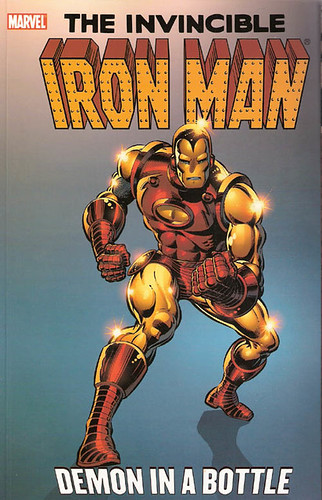
Iron Man: Demon in a Bottle

Collects: Iron Man #120-8 (1979)

Released: 1989, re-released June 2006 (Marvel)

Format: 168 pages / color / $24.99 / ISBN: 9780785120438

What is this?: Iron Man battles Justin Hammer and the bottle.

The culprits: Writer David Michilinie, writer / inker Bob Layton, and pencilers John Romita Jr. and Carmine Infantino

I picked up Iron Man: Demon in a Bottle because it’s a major storyline for a character who doesn’t have very many major storylines. Really, Iron Man has Armor Wars and his various battles with Dr. Doom, and that’s it.

So many fans have been clamoring for Demon in a Bottle to form the nucleus of the next Iron Man film. That’s fine; it’s inevitable it will be used sooner or later in the film series, and it is one of the standout stories for the character. But how does it measure up to the rest of the Marvel Universe and the comics world in general?

 coverNot as well as Iron Man fans might hope. The story gets its power from the idea: hero as alcoholic. But liquor isn’t Tony’s only enemy; no, he has to battle rival industrialist Justin Hammer. And boy, does Hammer school him.

But he’s upstaged by Tony’s personal problems. As a 21st-century reader, Tony’s battle with alcoholism is disappointing at some level. While some children in the ‘70s were probably getting their first glimpse of the damage alcohol could do, even to a great man, alcoholism isn’t as shocking to modern, adult readers. There’s also a risk of insensitivity; judging from Demon, there’s a very fine line between liking to drink and becoming a dysfunctional boozehound. I have a feeling it’s not quite that black and white in real life. Even though I admit writers David Michelinie and Bob Layton don’t have a lot of space to devote to a very real problem, I don’t think it’s developed well enough. I realize that’s subjecting the storyline to a critical viewpoint it was never intended to endure, but given the current demographics of comic-book readers, I think it’s fair to look at Demon from the adult point of view.

The real interesting conflict is between Iron Man and Hammer, who was introduced by Michelinie and Layton in this storyline. Hammer not only crushes Tony’s reputation and drives him to the bottle, he also manages to recruit an army of colorful second-string villains that deserves to be celebrated. I mean, any time you see the Beetle, Leap Frog, Blizzard, Whiplash, and the Constrictor together, that has to bring a smile to your face.

I really enjoyed penciler John Romita Jr.’s work on Demon. I’m a fan of his early work on Uncanny X-Men and Amazing Spider-Man, and his work here is just as excellent as his well-known runs on those titles. Iron Man is sleek, powerful, and always in motion. Even at a young age (he was 23 when this storyline ended), he can handle a crowded fight scene with aplomb. He can even handle subtler emotions. I might not enjoy his work in the ‘90s, but man, he was on top of his game here.

The structure of the storyline shows it obviously isn’t meant to be looked at as we see it today, in TPB form. There’s an issue in the middle of the collection that simply recaps the Iron Man story. It starts with a two-part story with Namor that doesn’t have much to do with the rest of the story, except for Tony’s fondness for martinis and the introduction of Hammer. The tight weaving of the alcoholism and Hammer stories, each of which would be excellent on their own, leaves each of them a little strained for space.

Still, there’s too much good stuff here to deny Demon is worth reading. It’s a product of another time; it’s a portal to a different world. Quibbles aside, it’s an entertaining story, and there are aspirations here to something beyond a good story. I might argue it didn’t quite do the job, but it’s impossible to argue Michelinie, Layton, and Romita Jr. haven’t done something unique here.

Rating: Iron Man helmet Iron Man helmet Iron Man helmet (3 of 5)

Labels: , , , , , ,