Reviews of trade paperbacks of comic books (mostly Marvel), along with a few other semi-relevant comments / reviews.

20 February 2015

The Worst Marvel Crossover of the '90s

Last year, I finished reading The Complete Ben Reilly Epic, Book 6, which meant I had read, from beginning to end, all three of the Unholy Trinity of Bad Marvel ‘90s Crossovers:

• The Clone Saga
• Onslaught
• The Crossing

All three are terrible, terrible stories, produced at about the same time: around 1995 and 1996. That is, all three were churned out after the speculator boom of the early ‘90s and just as Marvel was heading into bankruptcy. (In fact, the Clone Saga ended with issues cover dated December 1996, the month Marvel filed for Chapter 11 protection.)

All three of these crossovers are terrible. Whether they were commercially driven abominations or horrendously misguided attempts to overhaul a line, or both, each had confused storylines and a deleterious effect on a line.

Which, though, was the worst? This is a question that people will argue about; I have a feeling most fans’ answers would depend on which abused character they like the most. Still, I think some characters received a considerably shorter end of the stick than the others. (The Fantastic Four avoided the worst of this, although it should be noted that Atlantis Rising won’t be confused for Shakespeare any time soon.)

Onslaught

Onslaught is the least offensive of these mega-crossovers. For those of you who don’t know, Onslaught was a psionic entity created in Professor Xavier’s mind after he wiped Magneto’s mind. After ominous foreshadowing and the resolution of the long-dangling X-Traitor plot, Onslaught burst forth, took over New York with the help of Sentinels, and … didn’t do much. There was muttering of conquest, but it didn’t go anywhere.

Length: Relatively short. The actual crossover itself is contained in four trade paperbacks, and one of those doesn’t even have any X-Men titles in it. However, if you throw in the lead-up to the actual crossover, you have to include another three trades. The lead up and crossover ate up about fifteen months; the crossover itself blew over in a summer.

Spillover: The actual crossover (and some of its foreshadowing) pulled in quite a few titles, including the Clone Saga (see below). Incredible Hulk, Avengers, Fantastic Four, Iron Man, and Thor all got caught up in the crossover, which is a shame, given that all those series (except Hulk ended when Onslaught did.

Creepy dude moment: When Jean Grey explored Professor Xavier’s thoughts in X-Men #53 and discovered a repressed memory (a flashback to Uncanny X-Men #3) that Xavier had a crush on Jean from the beginning. Not standing so close to him isn’t going to help when he can telepathically crush on her wherever she is.

Damage: To the X-characters, not much. Professor Xavier was shuffled off the page — you know, because of his crimes against humanity and whatnot. The character itself wasn’t damaged too much as what Onslaught did can be considered separate from Xavier. Mutants were hated even more, although that’s par for the course.

The rest of the Marvel Universe was remade by Onslaught (at least for a year). The Avengers and its subsidiary titles were all canceled, as was Fantastic Four; Mark Waid and Ron Garney’s well-received Captain America run was axed in favor of a commercial stunt. FF, Iron Man, Avengers, and Captain America were all leased to Image creators for a year. Rob Liefeld’s Extreme Studios got the latter two, while Jim Lee’s Wildstorm got FF and Iron Man. The titles were rebooted, with almost 35 years of continuity being tossed out for a year. Also: Liefeld drew the weirdest Captain America.

Mitigation: Sales rose on those old titles; all of them, except perhaps Captain America, needed the added attention and sales. More importantly, Onslaught wiped out the damage The Crossing caused, and that’s almost a blessing.

The Clone Saga

Now we’re getting into the heavy hitters. In the Clone Saga — a sequel to a ‘70s story that had to be confusingly retitled The Original Clone Saga — a clone of Peter Parker returns to New York to confront Peter. The clone, who calls himself Ben Reilly, is followed by Kaine, another clone who hates Ben, and the Jackal, who created those two clones plus others … Ben and Peter argue about who’s the clone, Peter steps down as Spider-Man when he loses his powers and has a baby on the way, and then a figure from the past comes to take credit for everything that’s happened in Peter’s life.

Length: Interminable. The crossover ate up two years of the four Spider-titles plus ancillary titles like Spider-Man Unlimited and Spider-Man Team-Up. More than 100 issues were thrown at this story! The creators backtracked, laid false trails, changed their minds (OK, so it was mostly editors and the business people who changed their minds), and generally squandered months and months of Spider-Man stories. The fruit of their labors filled eleven trade paperbacks.

It’s hard to get across how much ink and paper was wasted on the Clone Saga. Spider-Man has always been a character who can support the one-issue story, but combined with many throwaway stories were the idiocy of the Jackal and Spidercide, Gaunt and Seward Trainer, Scrier and Judas Traveler and hosts of other villains who had no purpose other than to look mysterious and prevent any resolution to the story.

And when they went to wrap it up, all it took was a four-issue story. Just one month! Why couldn’t they have done that a year earlier?

Spillover: Relatively little. Spider-Man’s troubles didn’t affect other titles much. The clone, going by the alias of Scarlet Spider, kinda joined the New Warriors, and he appeared as Spider-Man in an issue of Daredevil. The Clone Saga also brushed up against the status quos of Punisher, Green Goblin, and Venom, but no one cared about the Phil Urich Green Goblin at the time, and the Punisher and Venom series are both best forgotten. I mean, the Punisher had a ponytail, and no one wants to acknowledge that.

Really, despite the crossover allegedly being so popular, no one else wanted to touch it.

Creepy dude moment: When Peter smacked his wife. It was portrayed as an accident, Peter lashing out randomly after learning he was a clone, but it happened. One moment of frustration and insanity labeled Ant-Man a wifebeater forever, but the same standard wasn’t applied to Peter hitting Mary Jane. This is for two reasons: a) The storyline in which Ant-Man hit the Wasp was good and not best forgotten, like the Clone Saga, and b) People actually like Spider-Man.

Later, Peter tried to kill Mary Jane, but he was being mind controlled, which is understandable and normal behavior for superheroes.

Damage: After two years, the creators realized how badly the entire idea was, and they tried to put everything back where it was while providing a satisfying conclusion. What they did satisfied few, except in the sense that it allowed everyone to put the clone nonsense behind them and forget about it.

The Clone Saga, in its blind grasping for sense and sensation, committed several sins that should be unforgivable. It brought Norman Osborn back from the dead as the architect of the Clone Saga. It killed Ben despite his potential because he was a loose end and a reminder of the Clone Saga’s sins. It caused Mary Jane and Peter’s daughter to be stillborn, then held out hope that the child was merely kidnapped. It made Peter do bad things to Mary Jane.

It made Peter Parker into a clone for a while, which was stupid. It told us, “Everything you know is wrong.” Everything we knew was published by Marvel Comics, which should have been a tipoff that Marvel’s output was not the most reliable source.

Mitigation: The crossover had many ideas that were worth exploring. Peter having a child and moving on isn’t a bad idea, but there’s no reason he had to be labeled the clone for the idea to work. Kaine wasn’t interesting at the time, but he has been used well in the last few years. Getting rid of Aunt May was long overdue; it allowed Peter to grow some. I even have some sympathy for using Kaine to get rid of some of Spider-Man’s older adversaries, although the new Doctor Octopus didn’t pan out.

Most impressive is Ben Reilly. Seeing a different Peter, one who had been lost for years and coming back to a different Peter who had grown but had also gotten a bit lost, presented the reader with an interesting contrast. (Ben wouldn’t have cut a deal to allow for uneasy coexistence with Venom, but he also might not have given Sandman a chance to reform.) Ben’s existence was wasted, of course — except in the M2 Universe, which picked up on some of these threads in Spider-Girl.

Avengers: The Crossing

Iron Man kills a few women to hide a secret: he’s been working with Kang for years to help Kang, Mantis, and their Chrononauts invade Earth and conquer it using his time-travel powers. Kang does manage to erase Vietnam from almost everyone’s memories, but that’s about as far as his conquest goes.

Length: A little longer than the core Onslaught crossover but much shorter than Onslaught’s foreshadowing. The Crossing took place over half a year, and its contents — a mere 25 issues — were reprinted in a single oversized omnibus. (You can pick up the omnibus for about $30 on Amazon, although two insane people gave the book three-star reviews. Three stars! Why not give the book a whole constellation?)

Spillover: None, as far as I can see. The number of titles involved was admirably restrained: only Avengers, Force Works (formerly Avengers West Coast), Iron Man, and War Machine were involved in the story. Thor and Captain America stayed the hell away from The Crossing, which shows excellent sense.

Creepy dude moment: Everything Iron Man does in this book. In addition to killing three unarmed women (and no men), he blasts Wasp so hard the measures taken to save her life turn her into a wasp-human hybrid. (She seemed fine with that, though.) He kidnaps a couple of other women close to him. I suppose you could make a case that this is the flipside to the charmingly predatory nature of Tony’s normal persona — he uses and seduces women — but this turn has the subtlety of an atom bomb lobbed through a store window.

Damage: Holy God, did this do a number on Iron Man. Iron Man had been corrupted by Kang and was working for him for pretty much the entire Marvel Age of Heroes, although the story gives him no motivation to do so. To protect his secret, Tony declared war on women. And this is the guy upon the Marvel Cinematic Universe was built about a decade later!

Because a series starring a traitorous murderer would have been a problem, Marvel killed off old Tony and replaced him with a teenage version from a different timeline. Teen Tony couldn’t be too different, though, so the fight that introduces him to the main Marvel Universe ends with him suffering heart damage.

The art is inconsistent and usually awful. Instead of giving the secondary titles a sales boost, The Crossing failed War Machine and Force Works so thoroughly they were cancelled two months later. Obscure, best-forgotten continuity is crucial to the story, and readers are expected to remember things like who Yellowjacket II and Gilgamesh are. The story has tons of forgotten and unimportant characters wandering through it; sometimes we’re even supposed to care about them. (The death of Gilgamesh is supposed to be momentous, and the story can’t get that across.) Mantis wanting revenge on the Avengers makes no sense, and Kurt Busiek retconned her (and most of Kang’s soldiers) into Space Phantoms in Avengers Forever. Adult versions of Luna (Quicksilver and Crystal’s daughter) and the Vision and Scarlet Witch’s kids run rampant throughout the story, working for Kang, and no one can figure out who they are. War Machine has a horrifically ugly suit of armor. (I wonder what happened to it …?)

Mitigation: Onslaught / Heroes Reborn and Avengers Forever cleaned up so much of the mess from this crossover that we don’t have to remember it any more. Otherwise, this book had no redeeming features.

Verdict

The Crossing is the worst of these; it’s so bad, the omnibus should be marked as hazardous waste. Still, it doesn’t have much of an effect on modern Marvel continuity. The Clone Saga gave us the returned Green Goblin and Kaine; Onslaught briefly ended decades of continuity in tangentially related titles and really launched the “Professor Xavier is a monster” idea into the wild. Again: The Crossing was published in 1995. Iron Man came out in 2008. In 13 years, the worst storyline in Marvel history was wiped from the timeline as thoroughly as Kang wanted to wipe out the resistance to him.

Labels: , , , , , ,

14 February 2015

Jack Kirby and creator credit

Last fall, the heirs of Jack Kirby reached a settlement with Marvel Comics. The terms of the settlement haven’t been announced, at least not that I have seen; it’s probable the settlement included cash for the family and increased recognition for Kirby in the comics and other media in which his co-creations are used.

The recognition is welcome news; the threat of legal action might have been part of the reason Marvel did not include Kirby’s name in many places it should have before. (Another part of the reason — and you can decide what proportion this makes up — is Marvel being stubborn and / or stupid.) The money is also good news for Kirby’s family; Jack Kirby is no longer around to be rewarded, but his family would have benefited if he had received in life the kind of monetary recompense his reputation suggests he deserves, so it makes sense they should receive some reward now.

I have been thinking about my feelings about the case for some time now — probably too long, as the case is passing below the public’s horizon. I admit I was somewhat ambivalent to the Kirby case. I have no idea what his heirs were legally entitled to, and in truth, it seems no one else does either. Decades of copyright decisions suggest the Kirby family would have lost, but given the Supreme Court’s interest, the outcome might — might — have been different this time. I often wondered why I followed the case at all; I have no affection for Kirby’s art, and none of the heirs created anything, making the legal battle one between a corporation fighting for profits vs. a family fighting for a ghost — an imaginary person fighting for money vs. real people fighting for a former person. Neither side appealed to my emotions.

(As an aside: While I don’t care for Kirby’s art, I do respect his place in comic history, and he remains one of the premier — perhaps the premier — imaginations to have ever worked in the comics industry.)

I should be sympathetic to the creative side of any argument, but the heirs’ contention that Kirby co-created Spider-Man, even though the evidence of this is thin at best and evanescent at worst, distressed me. Building the case for Kirby’s greatness shouldn’t mean diluting the credit given to others. Worse, it was Steve Ditko’s creation they tried to horn in on, and Ditko’s legacy is already dimmed by the shadow Kirby cast on Marvel’s Silver Age. I understand this contention was a bargaining chip; when you set out your demands, you always stake out ground as far forward as you can so you can give up some ground and still get what you want. Still, it rankled.

But this did make me wonder if too much stock is placed in the original creators and too little in subsequent creators. We moan and complain when Kirby isn’t acknowledged as a co-creator of certain characters, but when X-Men 2 broadly (but recognizably) adapted parts of Chris Claremont and Brent Anderson’s God Loves, Man Kills and Barry Windsor-Smith’s Weapon X stories, we let that go by. It is enough if Kirby and Stan Lee are recognized as creators of the X-Men. But which comic creators had a greater effect on that movie? I would argue the Claremont, Anderson, and Windsor-Smith did far more to make X-Men 2 the outstanding movie it was than the men who created the X-Men and wrote the title for about two years.

Or to take an example entirely within the realms of comics, we can look at Iron Man. Iron Man was officially created by Kirby, Lee, Larry Lieber (who wrote Iron Man’s first appearance, Tales of Suspense #39), and Don Heck (who drew ToS #39). Lee claimed to have come up with the idea — he always claimed that, even when it might not be true — and according to Heck, Kirby designed the Iron Man armor, while Heck created the look of the other characters, including Tony Stark and Pepper Potts. But the original bulbous Iron Man armor was quickly done away with, and the more streamlined red-and-yellow armor we associate with Iron Man was designed by Ditko in ToS #48. So what did Kirby contribute that made a meaningful impact on the character? Little to none in the art department, it appears, but Ditko’s iconic design doesn’t get any consistent acknowledgement.

Of course, it’s possible Kirby contributed to the idea of Iron Man in the early stages; Kirby’s supporters often point out Lee’s bolts of inspiration were rarely as purely Lee’s as Lee claimed. Also, Kirby isn’t around to say what he did or didn’t do. Given that Kirby was a great idea man, I wouldn’t be surprised if some of his thoughts were incorporated into Iron Man’s origin.

But that brings me back to what I was wondering before. We remember his long run on Fantastic Four (more than 100 issues) and, but Kirby didn’t stick around some of the Silver Age titles he created for very long: only six issues on Hulk, three of the first five issues on Iron Man, seventeen issues on X-Men. Seventeen issues isn’t nothing, but it’s important to note that X-Men was, until the late ‘70s, the biggest failure of Marvel’s Silver Age explosion. The title was cancelled in 1970 and turned into a bi-monthly reprint title until 1975, when Chris Claremont and a long string of talented artists made it into Marvel’s #1 title. How much credit — not in the sense of “created by” but in the sense of making something a success — do Lee and Kirby deserve for pursuing an idea for seventeen issues (21 for Lee) that the market essentially rejected?

Lee and Kirby deserve some credit, yes. But the person who should get the largest thank you at the end of an X-Men movie is Chris Claremont. Even if he didn’t create most of the characters, he’s the person who made many of them — Wolverine, Magneto, Storm — interesting. Without him and his co-creators, no one would want to watch an X-Men movie, let alone five of them.

This brings me to an idea I considered for some time. Since the versions of these characters that are best known are the movie versions, I thought about looking at who created what in the movies. At one point, I thought about trying to find the creator who was most valuable in the sense of box office receipts, but that would involve some arcane breakdowns of credit — what percentage of credit should be given to Wolverine for the X-Men movies’ success vs. Mystique or Magneto? — that was unprofitable.

(Besides, the answer for the entire Marvel Cinematic Universe would almost certainly be Stan Lee.)

Without Jack Kirby, it is somewhere between possible and likely that Marvel wouldn’t have survived the early ‘60s. The characters we know would be greatly different or wouldn’t exist at all. But it’s been 45 years since Kirby left Marvel the first time, which means dozens of other creators have altered, edited, and recreated what the characters and concepts he created. His influence can still be seen in Marvel’s output, both on page and screen, and some of what they publish hasn’t changed much since Kirby put aside his pens.

One of the greatest literary talents of the early 20th century was Thomas Wolfe, who wrote sprawling novels with beautiful prose. I mean really sprawling — the original manuscript of his first novel was more than 1,100. His editor, Maxwell Perkins, cut Look Homeward, Angel considerably and helped make it a success. Does it harm Wolfe’s literary reputation to acknowledge that Perkins’s considerable work made Wolfe’s better? And if acknowledging that sort of collaboration improved a novel, supposedly a solitary effort, how does acknowledging the contributions of others harm the original creators in comics, which often relies on collaboration?

Labels: , , , , , , , , , , , ,

20 July 2012

X-Men Forever, v. 2: The Secret History of the Sentinels

Collects: X-Men Forever #6-10 (2009)

Released: March 2010 (Marvel)

Format: 120 pages / color / $16.99 / ISBN: 9780785136804

What is this?: Before they bury Wolverine, the X-Men dig deeper into the conspiracy against them and find Sentinels.

The culprits: Writer Chris Claremont and artists Paul Smith and Steve Scott


Whatever goodwill I had for X-Men Forever led me to buy X-Men Forever, v. 2: The Secret History of the Sentinels. After the newness of the concept of writer Chris Claremont’s elaborate What If? series (featuring the X-Men) wore off, what would be left?

The answer — as if you needed to be told — is writer Chris Claremont.

Claremont’s distinctive dialogue and cadences overwhelm everything else in Secret History. If this were a decade ago, when Claremont was returning the X-titles and this might do any good, an intervention would be in order, with his colleagues and editors showing him how his verbal tics and word balloons were hurting those around him. Given that an intervention is out of the question, Claremont needs someone to do something similar to what former Marvel editor Christopher Priest said his assistant, Maddie / Adam Blaustein, did with Peter David — winnow down his excesses while leaving the essential, appealing essence of the writer. Isn’t that what an editor is for? Perhaps not. In any event, it’s not worth the effort now; Claremont is who he is, his work is what it is, and almost everyone knows how he or she feels about that.

X-Men Forever, v. 2: The Secret History of the Sentinels coverFor those of you playing Claremont cliché bingo, using Secret History, I will serve as caller: Baseball. Vintage plane fetishism. X-Men cleaning up the wreckage of one of their fights. Obtrusive military slang. Danger Room malfunction. Bad accent (Gambit only, oddly, even though Nightcrawler and Cannonball are in this book). “Best at what I do” (non-Wolverine division). If you did not win, best of luck next time; I’m sure the “mind control” square on your card is certain to be covered next time.

The story involves the return of the Sentinels, as you would guess form the title. With Nick Fury part of the book’s cast, Claremont makes the dramatic choice to tie the Trask family, who created the Sentinels, to the Nazis. This seems unnecessary but ultimately harmless, but Claremont links a couple of other characters to World War II and the Fury’s old commando group: SHIELD agents Daisy Dugan and Tommy Juniper, the latter explicitly the great-nephew of Howler casualty Junior Juniper. If this were a SHIELD book, these generational links would be a great idea. But this isn’t a SHIELD book; it’s an X-Men book. And the X-Men are firmly tied to the beginning of Marvel’s ten-year (or twelve-year or fifteen-year) timeline. Delving into their past tends to lead into Xavier, Juggernaut, or Magneto stories, areas that have long since been overmined.

On the other hand, the X-Men do have one character with whom the theme of family does work: Cyclops, who ironically started as an orphan. The book’s most affecting scene is its final one, two pages of Cyclops flying to Alaska to visit his grandparents, father, and son in Alaska. Scott reuniting with his son, Nathan, and their interaction feels real and is touching because of that.

That last issue is the best in Secret History. In #10, the X-Men hold a funeral for Wolverine, who died all the way back in #1. It’s not a perfect issue, God knows — unrestrained by action, Claremont's word balloons overrun everything, like a sort of verbal kudzu. But given that the action in the rest of the book is nothing to remember, something different is welcome. The issue gives everyone a chance to take stock and reflect. The New Mutants, Excalibur, Fantastic Four, and an abbreviated Avengers team show up, as do various X-Men hangers-on and ex-X-Men. It feels like an important event without being too clichéd or overwrought; the funeral itself takes only two pages, with Cyclops giving the eulogy.

The rest of the volume is forgettable, at best. Issue #6 is an embarrassment of X-clichés, with the X-Men playing baseball among wreckage in the Danger Room, which as a matter of course malfunctions. The next three issues feature a battle against a Trask and her Sentinels, ending with a particularly anticlimactic fight that Jean Grey ends by throwing a tantrum.

The subplots are ignorable. Claremont tries to interest readers in a conspiracy vs. the X-Men, but it’s not working. “Continuum” is a dull name, there’s no hint of what exactly the group’s agenda or grief with the X-Men is, and revealing one of the conspiracy's heads is the newly introduced mother of another newly introduced character is underwhelming. The flashbacks — Logan teaming up with Fury’s Howling Commandos in World War II and Bolivar Trask showing his family his Sentinel works — are old hat and dull. The only interesting subplot involves the child Storm, who is trying to figure out what she is and where she should go; this actually gives Gambit a bit of relevance, since he serves as Storm’s hedonistic counsel against the moralistic X-Men. Forge and lil’ Storm’s reactions toward each other at Wolverine’s funeral is a nice touch.

The art is fine. Paul Smith draws #6 and #10, and he’s exactly the type of artist you’d expect Marvel to assign to Claremont’s nostalgia title. Smith worked with Claremont on Uncanny X-Men #165-70 and 172-5, including most of the issues from the classic X-Men: From the Ashes storyline. Smith’s art has changed over 30 years, of course, and at times it looks like it’s taken on some characteristics of fellow Claremont collaborator Rick Leonardi’s work. On the other hand, Steve Scott isn’t a classic Marvel artist, and the bulk of his work for the company comes on the Marvel Adventures line. He’s a good choice for that, as his line is clean and his characters are bright and attractive, easy to tell apart. It’s not a distinctive style, though, which might have been what Marvel was aiming for; if you’re reading Claremont in the 21st century, do you really want something to distract you from Claremont’s plot and words? No, you do not; Claremont’s the feature here.

Secret History isn’t bad; its sin is larger. This book is just not that interesting, and the greatest emotion it arouses in me is occasional annoyance. Some will feel the warm flush of nostalgia when they read Secret History, and there’s nothing wrong with that. I’m well insulated against that warmth, however, and I think most readers are as well.

Rating: X-Men symbol Half X-Men symbol (1.5 of 5)

Labels: , , , , , , , , , , , , , ,

27 August 2010

X-Men: Powerless

Collects: Uncanny X-Men #379-80, X-Men #99, Wolverine #149, X-Force #101, and Cable #78 (2000)

Released: July 2010 (Marvel)

Format: 144 pages / color / $16.99 / ISBN: 9780785146773

What is this?: The High Evolutionary, laboring under bad advice, takes away all mutants’ powers.

The culprits: Written by Alan Davis, Joe Pruett, Joseph Harris, and Erik Larsen and drawn by half a dozen artists

X-Men: Powerless exists in an odd cul-de-sac of X-Men history, although no one knew and few guessed that when these issues came out.

Immediately before these issues came out, the X-Men fought their long-prophesied battle with Apocalypse, one that finally resolved the “Twelve” dangler and Cable’s raison d’etre. (That large storyline was collected in X-Men: The Shattering, X-Men vs. Apocalypse, v. 1: The Twelve, and X-Men vs. Apocalypse, v. 2: Ages of Apocalypse.) This was the last hurrah for issues that dwelled on Chris Claremont-era continuity, which was counterintuitive because Claremont himself returned for about a year — an uninspiring, frequently disappointing year. And then we got Grant Morrison’s New X-Men (and Joe Casey’s Uncanny X-Men), which led into the House of M Bend-over,24 and the X-books haven’t been the same since.

X-Men: Powerless coverThese issues don’t feel momentous, however. There is little of the gravity one might expect for a jumping off point, the end of an era. Only Cable seems to have an inkling, with supporting villain / block of stone Ozymandias saying, “A new era approaches — one full of possibilities and potential. No longer are the days yet to come written in stone.” Of course, Cable was often filled with pretentious blather about the future, so this may come under the heading of “blind pig finding an acorn.”

Instead we get a time-killing story of the X-Men and other mutants losing their powers because of the interference of the High Evolutionary, a plot device / easily misled superscientist who wants to save millions of lives by eliminating the possibility of a race war between humans and mutants. He’s being misled by Mr. Sinister, but that’s to be expected. In any event, the crossover shows X-Force and Wolverine dealing with being powerless, while writer Joe Pruett wraps up the consequences from the Apocalypse storyline for Cable. (Cable #79 might have been a better choice for this volume, since Cable doesn’t feel the effects of the plot until the last page of his issue in this collection.) X-Men and Uncanny X-Men introduce and wrap up the storyline in three issues — hardly worth a crossover, really.

The thing is, this idea should be important. The X-Men lose their powers; how do they deal with it? Rogue’s life is completely different, as is Marrow’s and Nightcrawler’s. Colossus and Shadowcat have other lives they can explore, but what is Storm if she doesn’t have her powers or a superpowered team to lead? Is Gambit still charming? These issues are brought up and explained in a few sentences, which is nothing compared to the importance these issues should have. Losing their powers is worse for the X-Men than it is for other superteams; for mutants, their powers are their identity, something they gained when they began to figure themselves out in adolescence. All writers Alan Davis and Terry Kavanagh give us using this life-altering premise is three issues to fill the schedule until Claremont’s return: the setup, the brief exploration of the idea, and the perfunctory fight. Worse yet, we get the first appearance of the Neo, one of the worst parts of Claremont’s second run.

Only Wolverine and X-Force look at what it’s like to be without powers for a mutant. Wolverine doesn’t change what he’s doing, but he’s lost his enhanced senses and healing factor; writer Erik Larsen says Wolverine’s suffering from “adamantium poisoning” to slow him down further, but that doesn’t change Wolverine’s actions. X-Force does a better job, with Joe Harris writing a story in which Tabitha has to deal with the feeling of helplessness coming from being unable to help her former (?) boyfriend when his powers cut off hundreds of feet above the ocean and also counsel a young mutant who has lost his ability to fly and is in denial about what it (and his powers) mean. It’s the only issue in the book that’s really affecting, despite the potential of the idea.

The art is all over the place, with pencils from Tom Raney, Juan Santacruz, Brett Booth, Michael Ryan, Steve Harris, and Graham Nolan. Only Raney does more than one issue, penciling Uncanny X-Men #379-80. Although his work never really resonated with me, Raney is a good artist, one worthy of what was a top-tier title at the time. As for the others … well, if comic art circa 2000 is your cup of meat, you’ll probably find something from the other five artists that is to your tastes. None of them appealed to me, although I have to admit Graham Nolan’s work did seem to fit Wolverine particularly well.

Nothing in this collection is particularly bad, but it is extremely forgettable, so I am still a little confused about why these issues were collected. There’s nothing that really recommends X-Men: Powerless, other than being a relic of a different time — a mutant fly caught in the amber, so to speak. That’s not enough of a recommendation, however. My theory is that someone in Marvel’s reprint department wants to start filling in the issues between X-Men vs. Apocalypse, v. 1 and 2, and the crossover that ended Claremont’s second run, X-Men: Dream's End. Uncanny X-Men #387 and X-Men #107 are already scheduled to be reprinted in Avengers / X-Men: Maximum Security, which is due out November 3. Mark my words: you should start looking for reprints of the rest of Claremont’s frustrating and disappointing run (Uncanny X-Men #381-6 and X-Men #100-6) in 2011.

Rating: Marvel symbolMarvel symbol (2 of 5)

Labels: , , , , , ,

26 February 2010

X-Men Forever, v. 1: Picking Up Where We Left Off

Collects: X-Men Forever #1-5 (2009)

Released: October 2009 (Marvel)

Format: 120 pages / color / $16.99 / ISBN: 9780785136798

What is this?: Chris Claremont writes early ‘90s X-Men two decades later.

The culprits: Writer Chris Claremont and artist Tom Grummett

Marvel has a love / hate relationship with writer Chris Claremont’s relationship with the X-Men.

They have continually touted his work on Uncanny X-Men as a tour de force ever since he left / was forced out. They love to tease his return, that he’s going to take them all back to the glory days of the late ‘80s. They allowed him to return to Wolverine for a few issues in the late ’90s. Then they actually gave him control of Uncanny X-Men and X-Men for a year or so around 2000. Since then, he’s worked on Exiles and various out-of-continuity miniseries — letting him play with knockoff X-Men but making sure none of it matters.

And the latest iteration of that plan is X-Men Forever, v. 1: Picking up Where We Left Off, which is supposed to allow Claremont to write stories as if he never left the X-Men.

X-Men Forever, v. 1: Picking up Where We Left Off coverStill, that rings hollow. The title is false advertising. Aside from the “never standing in the same river twice” school of thought — in this case, never being able to read the same Claremont you grew up with — this doesn’t really follow X-Men #3 / Uncanny X-Men #280, which is where Claremont left. Nightcrawler and Shadowcat are inexplicably back from Excalibur. Jean and Wolverine have some sort of love connection that certainly wasn’t there when Claremont left. SHIELD has wormed its way into the X-Men. As Paul O’Brien and others have pointed out, artist Tom Grummett isn’t the sort of ‘90s / Image artist X-Men would have had back then. And this doesn’t exactly jibe with the hints Claremont has given in interviews about the direction he would have gone in if he had been allowed to continue.

But none of that affects how good this story is — or should affect that. Unfortunately, it does color it a little. Claremont is … well, he is as he is today, which is to say his dialogue sounds like him and not that much like different characters. Even Beast sounds like everyone else. On the other hand, the plotting in this first TPB is nothing like classic Claremont — rapid changes out of nowhere, with seemingly little buildup or warning. That’s a function, in many cases, of the abrupt nature of the mandate — here, pick up a story you started 20 years ago, but remember, we don’t have time for that quick buildup crap — but it still rankles.

It doesn’t surprise me that it took me this long to comment on the actual story. (That’s the way it is with Claremont these days; he comes with so much baggage that the story seems almost secondary.) It starts with a fight with Fabian Cortez, which is a direction that flows from X-Men #3, but that just serves to set up Claremont’s new / old team. Once the story gets going, it’s somewhat enjoyable, with a double agent in the X-Men, a new villainous organization, and a death on the team. I’m not convinced by any of the individual revelations — who dies, who the double agent is, Shadowcat’s new power, why I should care about Sabretooth being blinded when he has a healing factor, etc. Still, it seems like an interesting framework to hang a story on.

As I said, Grummett is nothing like the Jim Lee / Whilce Portacio artists who worked with Claremont at the end of his run. I’m not complaining; I like Grummett’s work, solid as it is. It feels like it has real weight, and it’s very good at telling the story while giving the characters their classic looks. I also have to give credit to colorist Wilfredo Quintana, whose work seems bright enough for the nostalgia without letting it overwhelm the scenes.

There’s a decent amount of promise in the first volume of X-Men Forever, and I think fans who were heartbroken by Claremont’s exit from the X-Men and his successors’ efforts will find a lot to like here. I see it too, but I can’t say that it’s enough to make me want to return to the title. There are too many things that pluck at my mind, drawing me out of the story. Maybe Claremont just needs time to settle down, maybe this is just a bump in the road … but I’m not sure I want to spend another $17 to figure it out.

Rating: X-Men symbol X-Men symbol (2 of 5)

Labels: , , , , , , ,

13 January 2010

X-Men: The Shattering (mini review)

I’ve been struggling with Peter Gross and Mike Carey’s The Unwritten, v. 1: Tommy Taylor and the Bogus Identity. I started the review last Friday, but I still can’t decide what to make of it: the beginning of an exciting metatextual saga or a lot of potential wasted on an overexposed copy of Harry Potter with a penchant for pointing out literary geography? It’ll probably be somewhere in the middle, but to which side of the middle? Find out Freya Day.

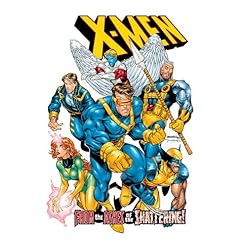
X-Men: The Shattering coverSo, while I figure that one out, I will note that I just read X-Men: The Shattering. This book mainly duplicates the contents of Astonishing X-Men: Deathwish. Aside from the more appropriate name, there are two main differences: one, Shattering costs about $20 more new, and 2) it contains five more issues (X-Men #93-4 and Uncanny X-Men #372-4).

Is it worth the extra Jackson for five issues? No, not really, unless you’re slightly obsessive about your collected editions. (You know who you are.) Admittedly, X-Men #94 is a double issue, and there are a few pages at the end of Shattering from the X-Men 1999 Yearbook. But those pages are low-rent versions of the out-of-context ramblings that made “Stryfe’s Strike File” such a classic back in the early ‘90s. And the extra issues add to the crossover style conflicts, with the high point being Alan Davis (mainly) doing a workmanlike job. Do you get joy from seeing people do workmanlike jobs? I do not either.

On the other hand, the extra story does make the nonsense at the end slightly more comprehensible, and it does water down the bad taste that is Astonishing X-Men #1-3. The first time around, I found Astonishing inoffensive; this time, it was a chore to go through.

So if you need to read this — I don’t know why, maybe it’s an Apocalypse fetish, although that would make me weep — go for Deathwish. The stories haven’t really aged that well in the decade since Deathwish came out, and you can still buy Deathwish new online. (Although the price difference drops to about $10 on Amazon.)

Labels: , , , , , , , ,

19 May 2009

X-Men: Messiah CompleX

Collects: X-Men: Messiah CompleX, Uncanny X-Men #492-4, X-Men # 205-7, New X-Men v. 2 #44-6, and X-Factor #25-7 (2007-8)

Released: October 2008 (Marvel)

Format: 352 pages / color / $29.99 / ISBN: 9780785123200

What is this?: A massive X-Men crossover in which the X-Men, Marauders, Cable, Bishop, and the Purifiers all fight over the first mutant baby born since M-Day.

The culprits: An accomplished crossover crew, including writers Ed Brubaker, Mike Carey, Peter David, Chris Yost, and Craig Kyle and pencilers Billy Tan, Chris Bachalo, Humberto Ramos, and Scot Eaton

I haven’t read much of the X-Men titles since the “House of M” event — haven’t read anything other than X-Factor and Astonishing X-Men, really, since Grant Morrison left New X-Men. (Also: X-Men: Deadly Genesis, which left me less than eager to read anything else with Ed Brubaker’s fingerprints on it.) But my local library’s getting in all sorts of titles, and this gives me a chance to read X-Men: Messiah CompleX and feel like a Usenet dino.

X-Men was better in the old days! Well, I’ve got that out of my system now.

X-Men: Messiah CompleX cover For those of us who have been away, Messiah CompleX (man, do I hate that terminal capital “X”) is not a jumping on point. It sets up plots for the foreseeable future, yes, but it’s an exercise in clearing out the old. If you’re coming in with no knowledge of the X-Men — or if your knowledge is out of date — you’re going to be a little confused. Who are these New X-Men, and what can they do? Why are they so angry? Why do they die so easily? And why was Cable thought dead? Why does Bishop have a superplane? What happened to Cyclops’s father? There really aren’t any footnotes, although some of the information is given in context (eventually) and some of it doesn’t matter. Still, the New X-Men seem bolted onto the crossover awkwardly, and they aren’t very well explained, despite playing an important part in the crossover.

If you’re looking for action, Messiah CompleX has it. A new mutant baby is born —the first since the Scarlet Witch decreed “No more mutants” — and all the groups concerned with mutants want the baby: the X-Men to protect it, Mr. Sinister’s Marauders to control it, the Purifiers to kill it, the intensely stupid “Predator X” to eat it, and Cable to take it to the future. This gives rise to an intense level of action: the fighting is nearly non-stop, with numerous casualties. By the end, there’s a very real possibility the reader will be numb to the carnage; the number of mutants who are dead, dying, or deactivated is astonishing, given the restricted number of mutants at today’s Marvel.

The coordination of the crossover is a cut above what I’m used to; perhaps Marvel learned something about how to make the edges more seamless during the past decade. Writers Ed Brubaker, Peter David, and Mike Carey and New X-Men co-writers Craig Kyle and Chris Yost do an admirable job writing a story in which the chapters and characterizations don’t contradict each other. This is partly because the big revelations from the ancillary titles, X-Factor and New X-Men, largely happen in those titles. Still, everyone seems to do at least a passable job with the other writers’ characters, and that’s a real accomplishment.

I never thought I’d see the day when Chris Bachalo and Humberto Ramos would be penciling half a major X-Men crossover. Both are good artists but decidedly non-standard; I don’t think either is particularly “hot,” the kind of sought-after artist who makes the lists on Wizard. I’m not sure whether this represents a changing aesthetic on the X-titles or if it’s attributable to the X-titles’ loss of prestige over the years.27 As I said, both are decent artists, with Bachalo keeping his more eccentric tics under control this time around. I can’t tell whether Xavier disappearing at the end is an art mistake by Bachalo or a plot point, though. Ramos … Ramos is an artist who divides fans, and with good reason. I think his exaggerated figures are better suited for a more lighthearted title — I think he was a good fit for Paul Jenkins’s Spider-Man work a few years ago — but Messiah CompleX is not lighthearted at all. I believe Ramos can do serious stuff, but there are times his characters look more comically panicked than stressed, and his tough guys (and gals) will never look as tough as a more realistic artist’s.

The other half of the art is from Scot Eaton, who draws Forge as Robert Downey, Jr., and Billy Tan. The contrast between the two halves is extreme. Tan and Eaton draw a shiny, glossy world where everyone is pretty and even the dirt is attractive, and Bachalo and Ramos create a misshapen setting where even the bondage models are strangely offputting. All of them do a good job — well, except perhaps Marc Silvestri, who’s even more pretty and streamlined than Tan or Eaton in the Messiah CompleX one shot and manages to draw Wolverine with a hint of androgyny — but the differences are startling. Personally, for this crossover, I think I prefer Bachalo and Ramos’s side of the divide, since this is a gritty, not pretty, story. This flies in the face of my usual preference for attractive, clean art, but I realize that’s not appropriate for every comic book.

The blurb on the back cover quotes IGN as saying Messiah CompleX is “easily the best X-Men crossover in a decade.” Assuming the quote is in context — and Marvel has a bit of history of using out-of-context quotes — they’re not exactly setting the bar very high, are they? They’re competing against “Endangered Species,” which ran as backups in the books in 2007; “Eve of Destruction,” which led to the Morrison / Casey reign on the X-Titles; “Dream’s End,” the swan song to Chris Claremont redux; the Apocalypse crossovers of 1999; and various late ‘90s forgettables such as “Hunt for Xavier” and “Magneto War” and various two-parters. “Operation: Zero Tolerance” sneaks in as well; “O:ZT” is one of the few major crossovers during that span, and it’s one of the prime reasons the X-titles shied away from the megacrossovers. None of them will ever be held up against “Mutant Massacre” or “Fall of the Mutants” as a high point of the X-Men. Hell, I wouldn’t say any of them were any better than “X-Cutioner’s Song” of ’92-3, although I admit I haven’t read “Endangered Species.”

As a volume, Messiah CompleX is mediocre — it misses the sweet spot between ultraviolence and story development by a decent margin. It does, however, deliver violent action until you can’t stand it no more. As a statement, a manifesto, it’s much better. It puts a violent, definite end to the past and says the future will be different, something at odds with the directionless wandering of the last few years or the warmed-over Claremont that marked the ‘90s. Whether that future will be better (or even readable) remains to be seen.

Rating: X-Men symbol X-Men symbol X-Men symbol (3 of 5)

Labels: , , , , , , , , , , , ,

15 May 2009

X-Men: The Complete Onslaught Epic, Book 1

Collects: X-Men #53-4, Uncanny X-Men #334-5, Fantastic Four #415, Avengers #401, Onslaught: X-Men, Cable #34, and Incredible Hulk #444 (1996)

Released: February 2008 (Marvel)

Format: 256 pages / color / $29.99 / ISBN: 9780785128236

What is this?: Behold my mighty hand! Onslaught’s true name is revealed, and he begins his slow, ponderous march across the Marvel Universe.

The culprits: Too many to name or punish.

X-Men: The Complete Onslaught Epic coverI remember the Onslaught “Epic”; although I did not behold his mighty hand first hand until years later, I watched the story unfold from the safety of Usenet in 1996. There was some excitement at the time, since the identity of the X-Traitor would finally be revealed and a big summer crossover would sprawl before the reading public. I don’t know that anyone was expecting it to be any good, though.

That was fortunate, since the crossover was widely panned at the time. But how does it stack up more than a decade later?

About as badly as you might expect. Wisely, the setup for the Onslaught storyline is omitted in X-Men: The Complete Onslaught Epic, Book 1. It was too large and too confusing; the writers admitted they changed the direction of the storyline and at times were working blind. But it’s helpfully referenced in footnotes (when you can read the footnotes, which are often the same color as the text-box background).

The text balloons! They’re everewhere!The plot has the X-Men discovering the identity of the ultra-powerful psychic entity Onslaught, who happens to be one of their own; once he’s flushed out, Onslaught starts gathering his power by collecting Franklin Richards and brainwashing the Hulk. There’s unrealized menace and handwringing and angst and oh God text balloons everywhere. You might expect better from writer Mark Waid; keep right on expecting, because you’re not going to find it here. Waid wasn’t happy with the direction of the X-books or the freedom he was given; that probably explains the wretched pile of X-cess he and fellow writer Scott Lobdell handed in to editor Bob Harras — or maybe Harras ordered them to give him that. I don’t know.

Here’s what happens over 250+ pages and eight issues (plus a larger special issue):

  • Buildup to the revelation (Onslaught taunts Jean, Juggernaut punchy-punchies his way into the Mansion) (X-Men #53-4 and Uncanny #334)
  • Revelation — which was completely obvious by this time — plus fight (Onslaught: X-Men)
  • Yak with the Avengers, during which nothing happens (Uncanny #335)
  • Cable and a mind-controlled Hulk punch each other (Cable #34 and Incredible Hulk #444)
  • Joseph (who was thought to be Magneto) introduced to the plot, for non-obvious reasons (Avengers #401)
  • Onslaught kidnaps Franklin Richards (Fantastic Four #414)

The pacing is appalling. Interestingly, the ancillary titles actually have a decent pace — well, all right, two issues for a Cable / Hulk fight is excessive, but I’ll blame that on Cable. None of them stand out as particularly good examples of the comic book arts; even Hulk, written by Peter David, is sapped of all its individuality by the crossover. They’re either padded or unremarkable large-scale fight scenes.

Orange milkThe art is all over the place, but fortunately, since it’s the X-titles of the mid-‘90s, Marvel had a lot of their best working on this crossover. The two X-Men issues feature the flashy if a bit underdeveloped early Andy Kubert, while the Uncanny pencils are from the manga-influenced Joe Madureira. These work together about as well as you might expect. Kubert and Dan Green get the important X-Men: Onslaught issue; Green’s work resembled John Romita Jr. at the time, and Green had been an X-Men artist earlier in the decade. Interestingly, there are parts that look like the work of neither, but whyever that is, I’m sure the orange milk isn’t either’s fault.

But with the crossover issues, you have the early Mike Deodato on Avengers, which I didn’t care for, and Carlos Pacheco’s early American work on Fantastic Four. Then to end it you have the pretty-but-stiff Ian Churchill on Cable and the hideously unattractive work of Angel Medina on Incredible Hulk. (Those last two are one hell of a whiplash, I can tell you, since they are linked and back to back in the collection.) It’s a real mishmash with the ancillary issues added in. There’s nothing that can be done about it now, and it doesn’t detract from the readability (except for Medina’s work), but it’s a real range of styles.

Behold my mighty hand!The back cover and indicia claim Book 1 contains Fantastic Four #414 and Avengers #400; it doesn’t. There’s only a page from each of these comics in this book, and it’s deceptive to claim otherwise. (It’s the same practice that allows retailers to claim X-Men Visionaries: Jim Lee TPB has Uncanny X-Men #252, 254, 260-1, 264, 280, and 286 when in fact the book contains only the covers from those issues.) On the other hand, it’s better information than you can get on the Internet. The usually reliable (and invaluable) Unofficial Handbook of Marvel Comics Creators claims X-Force #57 and X-Man #18 are included as well; they are not. Marvel.com makes the same claim, as does Amazon. In fact, wherever you look on the Internet, the listed contents of the four volumes in the series are contradictory or overlapping. (If anyone knows the true contents of these volumes, leave them in the comments.)
Much as you’d expect, the Onslaught crossover is best experienced through Wikipedia. Read X-Men: The Complete Onslaught Epic, Book 1, at your own risk.

Rating: X-Men symbol (1 of 5)

Labels: , , , , , , , ,

20 March 2009

Astonishing X-Men: Deathwish

Collects: X-Men #92 and 95, Astonishing X-Men #1-3, Uncanny X-Men #375 (1999)

Released: October 2000 (Marvel)

Format: 160 pages / color / $15.95 / ISBN: 9780785107545

What is this?: The X-Men shatter, help a child in trouble, learn a shocking secret about Wolverine, and are attacked by Apocalypse’s latest horseman, Death.

The culprits: A crossover crew including writers Alan Davis and Howard Mackie and penciler Brandon Peterson

Astonishing X-Men: Deathwish comes from an early time in the development of Marvel’s graphic novel program. In 2000, the Essentials line was in its infancy, and Marvel was scrambling to put some of its classic storylines into print while also getting “new classics” into circulation. Deathwish belongs to that latter category, as the book was published under the “Marvel’s Finest” banner soon after the floppies were released.

So what we have here is fin de siècle X-Men. All the stuff between Chris Claremont leaving and Grant Morrison arriving should be regarded with suspicion, but writer Alan Davis’s run was a rare bright spot during that time. Unfortunately, we get only glimpses of what he was doing as plotter of X-Men (script by Terry Kavanagh) and writer of Uncanny X-Men.

Astonishing X-Men coverDeathwish runs into the fringes of “The Shattering,” in which the newly returned Xavier seems to be having a mental breakdown. Most of the team says, “Sod it,” and takes a vacation; the rest don’t leave quickly enough and get drawn into the eponymous Astonishing X-Men miniseries. Bad luck for them, then. When Astonishing is over, everybody gets pulled back to hear a couple of shocking secrets, be psychically beaten by Xavier like a rented mule, and then get in a fight with the real villains.

The scene with Xavier spoils the straightforward charm of Davis’s work in Deathwish. X-Men #92, in which Davis and Kavanaugh set up the miniseries, works well, with Davis showing Xavier’s apparent instability and paranoia believably and giving nearly everyone a reason to skedaddle. He portrays the reactions to the death at the end of Astonishing well, and the final big fight is clever enough. But Xavier … to test loyalties, he merges the Danger Room and his psychic abilities to make the X-Men think they’re killing one another. Not satisfied with that, he makes the survivors watch their loved ones die. It is, frankly, a horrifying experience, especially since a teammate had just died in reality, and I’ve never been sure how the psychic test part worked. The worst point is no one calls him on it. It seems out of character that no one except Gambit would complain about him putting the team through a simulation that called for betrayal and death.

Unfortunately, Davis’s work on the X-titles is marred in the reprints by other titles. In this case, it’s with the miniseries Astonishing X-Men, written by Howard Mackie. Nothing puts the fear in an X-fan like realizing they’re reading Mackie’s work, except perhaps the Onslaught crossover. Fortunately, it’s not as bad as Mackie’s reputation might lead one to think.

It’s not great either; it’s a forgettable story, saddled with the Mannites, who are a bunch of childlike ciphers who are supposed to be even mutantier than mutants. The cobbled-together team, which includes the alternate universe X-Man and Cable, works together far more smoothly than it should, and the plot is more overwrought than necessary. The story doesn’t flow all that smoothly, either; there were a few points where I wondered what was going on and how far the two groups of people were from each other and how did they get there, anyway? It’s all just three issues in search of a dramatic revelation, and it delivers that in the end. I won’t spoil it, but it’s better if you just have someone tell you that revelation and skip those three issues.

The art is very good for a crossover, especially Adam Kubert’s issue of Uncanny X-Men. I’ve long been a fan of Kubert, ever since I first saw his work in Wolverine in the early ‘90s. This isn’t as vibrant and sharp as those issues seemed to me, but it’s still quality work. Brandon Peterson does a good job on Astonishing — the art certainly outdoes the writing — and although the style of Bret Boothe, who assists with pencils in #2, is noticeably different, it isn’t jarring, especially by the standards of crossovers. Jeff Johnson and Tom Raney work ably on the X-Men issues.

The book is out of print at the moment, but an expanded version of the title (X-Men: The Shattering) is listed as a future release by Amazon.com. The book hasn’t shown up in Marvel’s solicitations yet (and perhaps never will), but that listing plus the publication of the following Uncanny X-Men / X-Men issues is a small indication these stories will be back in print again.

I can’t particularly recommend Deathwish because the Astonishing X-Men miniseries takes half the book, but with the expanded contents, The Shattering might be worth checking out.

Rating: X-Men symbolX-Men symbol (2 of 5)

Labels: , , , , , , , ,

07 November 2008

X-Men: Deadly Genesis

Collects: X-Men: Deadly Genesis #1-6 (2006)

Released: December 2006 (Marvel)

Format: 200 pages / color / $19.99 / ISBN: 0785118306

What is this?: In this miniseries, the X-Men are under physical and mental assault by a powerful mutant with a mysterious grudge.

The culprits: Written by Ed Brubaker with pencils by Trevor Hairsine

I expected to dislike X-Men: Deadly Genesis intensely, and unsurprisingly, I did. I don’t blame Ed Brubaker’s scripting or Trevor Hairsine’s pencils; Hairsine does an excellent job in this waste of a cause. No, I blame whoever came up with this misconceived project, whether it’s Brubaker or editor Mark Paniccia or someone else farther up the chain of command at Marvel.

The plot reveals that years ago X-Men mentor Professor Xavier sent a heretofore unknown group to the island of Krakoa to rescue the missing X-Men. That group died, and Xavier wiped the memory of that group from everyone’s minds before sending another group — including Storm, Wolverine, Nightcrawler, and Colossus — to rescue the original X-Men. Now a member of that missing team — Vulcan, who is by just by coincidence the brother of first X-Man Cyclops and Havok — has been revived, and he’s tormenting the X-Men to get Xavier to confront him.

X-Men: Deadly Genesis cover This is the worst kind of retcon, one that hits the big three no-nos:
1) Tells you everything you know is wrong, while it
2) Reveals a powerful character (or conspiracy) hidden for years and
3) Radically changes how readers must view a long-term character.

This is pointless. And it doesn’t matter how well the story is told, because the central idea of the story is crap. Thirty years after Giant Size X-Men #1 is a little late to be revising the story, don’t you think? Brubaker’s story takes the fun, light story of the All-New, All-Different X-Men and makes it deadly serious and deadly dull. Xavier’s behavior in Deadly Genesis is near unforgiveable, and it makes a mockery of the idea of the unreliable narrator. Surely something so monstrous would have leaked into one of Xavier’s thought bubbles over the years.

There are essentially no heroes here. By not only sending a group of young mutants to their deaths but also wiping their lives from the record, Brubaker’s Xavier is a poor excuse for a human being, good intentions be damned. Vulcan is a monumental dillweed as well, even needlessly torturing the current X-Men for reasons I can’t fathom. Brubaker wants to make Vulcan look good, so he makes him nigh all-powerful, meaning the X-Men can’t stop him. The X-Men do nothing: not only does Vulcan master them easily, but they can’t find Xavier either. Deadly Genesis is a six-issue exercise in wallowing in misery, because nothing happens except making everyone involved look bad.

It’s even more aggravating when Brubaker pulls down the original plot in order to make the new one look better. Vulcan mocks Cyclops for thinking Krakoa released him in order to gather more mutants, but Krakoa killing Vulcan’s team after losing Cyclops is even less credible. Why not capture them as well? This sniping comes across as petty, and if you can’t play nicely with someone else’s toys, then maybe you shouldn’t be playing with them at all. Maybe Brubaker has a fetish for gratuitous retcons; he did, after all, bring Captain America’s sidekick Bucky back from the dead as the Winter Soldier.

There’s nothing wrong with Vulcan being a Summers brother, although the missing third Summers brother is not a dangling plot that had been crying for resolution. Moira studying and training a group of mutants is interesting as well, although a little difficult to shoehorn into continuity without the mindwipes and whatnot. And the backup with Xavier and Moira offering a young Emma Frost entry into the X-Men is interesting, although Xavier too quickly comes to the conclusion Emma won’t join the X-Men regardless of how he coaxes her.

The plot is my main problem, although not my only one. Marc Silvestri’s covers, especially the ones used for Deadly Genesis’s front and back covers, are irritating. I have no idea why all the characters on the homage to cover of Giant Size X-Men #1 are skeletal; none of them die. The back cover is no better; I had a hell of a time figuring out who Marvel Girl was supposed to be (Marrow and Rogue were my first thoughts), Cyclops is vastly overmuscled, and Wolverine’s face looks decidedly feminine, beard notwithstanding. The backup stories about the forgotten X-Men sent to Krakoa are essentially useless — I don’t care about them, and I have no reason to care about them as they’re not only disposable but already disposed of.

I admit I put a great deal of emphasis on continuity — perhaps too much. But because of the way this book chews up previous stories and characterizations and vomits them into the stewpot that is the Marvel Universe, this book is useless to me. I could sell it, but I got this book cheaply in part because the cover is creased. I don’t want to give it away because I don’t want to inflict it on anyone else.

One last note: the rating for Deadly Genesis is based entirely how much Hairsine’s art lifts this wreck above no value whatsoever.

Rating: Marvel symbol (1 of 5)

Labels: , , , , , ,

03 October 2008

X-Men vs. Apocalypse, v. 1: The Twelve

Collects: Uncanny X-Men #376-7, X-Men #96-7, Cable #73-6, Wolverine #145-7 (1999-2000)

Released: March 2008 (Marvel)

Format: 312 pages / color / $29.99 / ISBN: 9780785122630

When I started buying trade paperbacks in earnest four years ago, I was obsessed with value — how many issues I could get for the dollar. I think X-Men vs. Apocalypse, v. 1: The Twelve would have made me very happy back then, with eleven issues for less than $20 at Amazon. That’s less than I would have paid for the individual issues.

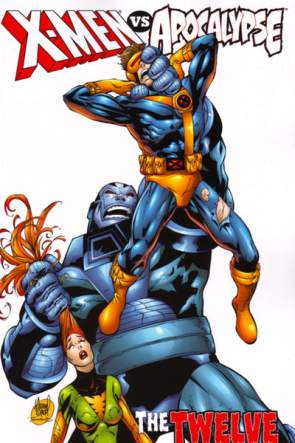
X-Men vs. Apocalypse: The Twelve coverBut Twelve isn’t actually a good deal, and you know why? Because almost two-thirds of the book is useless and irrelevant. If this collection had added the Uncanny X-Men and X-Men issues that preceded the ones included here and dropped Cable and Wolverine, this collection might have been worthwhile. I mean, it’s a simple story: genocidal, idiot-Darwinist Apocalypse and his religious-themed henchmen capture the long-prophesied mutants called the Twelve and try to drain their powers to make Apocalypse all powerful. But no, you’ve got to slog through ancillary stuff to get to the meat.

Wolverine #145-7 is a distraction to the main story, and without earlier stories, the tale of how Apocalypse made him “Death” and how he reclaimed his soul (or some such thing) isn’t important. Everyone at the time knew his turn to the dark side wasn’t going to stick, and everyone knows it eight years later as well. And then Angel, another former “Death,” takes over the Wolverine story with his struggles with what Apocalypse had done to him. No one cares about that; that was resolved years ago. Let it go.

The Cable issues are no treat. They too are irrelevant to the main plot, showing who the new “Pestilence” and “War” are but not much else. It doesn’t take four issues to do that, believe me. Cable #75 takes the cake: Cable, captured by Apocalypse, very briefly escapes and is recaptured; #76 takes place entirely in Cable’s mind and doesn’t move the story forward at all.

(The weirdest part of the Cable issues is that the art is split between enemy of perspective Rob Liefeld (#73 and 75) and Bernard Chang (#74 and 76), presumably because Liefeld needed the break. But Liefeld’s art is actually better. I’m not saying Liefeld is good, but his work has an intensity and seriousness Chang’s cartoony style can’t match. I mean, you have to deal with Liefeld’s weirdly creased faces — everyone’s faces fold inward toward the eyes — and perspective problems and odd feet and … well, you get the idea.)

And the lettering … I never mention lettering, a credit to the many professional, competent, occasionally brilliant people who have lettered comic books over the years. But the lettering in Cable — ascribed to “RS and Comicraft’s Said Temofonte” — is godawful. I’m assuming RS refers to Richard Starkings, and Starkings and Comicraft have done a lot of Marvel’s lettering over the past decade. But man, this painful stuff: an unconventional font that makes it seem Cyclops, Cable, Caliban (a simple-minded, mutated mutant), and Jean Grey all speak in the same tone. … I think this font is my least favorite part of Twelve, and that’s saying something.

The main issues are no picnic either. I know writer Alan Davis is trying hard, but without the proper setup and foreshadowing, the conclusion to Twelve looks slipshod. The four issues of the X-Men / Uncanny X-Men crossover seems to almost be as much about mutant Skrulls as about the X-Men themselves. The X-Men fall into Apocalypse’s clutches without putting up much of a fight, and they escape their prisons to stop by accident, not something they did. (You can argue it was a miscalculation on Apocalypse’s part, but I don’t believe it.) The cast is far too sprawling for a mere four issues, and it doesn’t help that some people pop in solely for the purpose of being used by Apocalypse and pop out for their own stories / plot convenience (Bishop, Mikhail Rasputin).

And the shifts in art styles throughout the books … Davis on X-Men, Roger Cruz and Tom Raney on Uncanny X-Men, Liefeld, Chang … There’s a different penciller on each issue of Wolverine: Leinil Francis Yu, Mike Miller, and Cruz. It’s a mess, and the artistic continuity is nil. Chang’s and Cruz’s exaggerated, cartoony styles contrast with Davis’s elegant pencils and Yu’s gritter realism. Raney’s style works pretty well with Davis’s, and Miller’s work is a good fill-in for Yu, but although Yu and Miller’s work appear in consecutive issues of Wolverine, they’re separated by three issues in Twelve. And then there’s whatever Liefeld does; that doesn’t play well with anyone at this end of the ‘90s.

Twelve could work as it was originally structured in the original core X-Men titles: meandering stories with a bit of foreboding, a bit of Skrulls, and a lot of Apocalypse. (And a goodly amount of Alan Davis.) Instead, with the tie-ins, well …

Sadly, despite knowing better, I’ll probably end up buying X-Men vs. Apocalypse, v. 2.

Rating: X-Men symbol Half X-Men symbol (1.5 of 5)

Labels: , , , , , , , , , , , , , , ,

27 February 2007

Astonishing X-Men, v. 3: Torn

Collects: Astonishing X-Men #13-8 (2006)

Released: January 2007 (Marvel)

Format: 152 pages / color / $14.99 / ISBN: 0785117598

Torn is the third volume of Joss Whedon and John Cassaday’s Astonishing X-Men series, and by this point, I just wish they’d get on with things.

The events in Torn spin out of the dull second volume, Danger, in which Emma Frost appears to be on the path to betraying the X-Men with elements of the former Hellfire Club. Torn is six issues of that group trying to mentally and physically destroy the X-Men. Unfortunately, that seems like two or three issues too many, as much of the plot seems to be marking time so that the storyline can reach a total of six issues. There is, I think, only one or two fights leading into the final issue of the TPB. There’s some conflict, yes, but it goes nowhere.

Astonishing X-Men, v. 3: Torn cover Whedon is drawing heavily on two previous X-Men stories: the Grant Morrison New X-Men plot that had Cassandra Nova turning the X-Men inside out and the classic Dark Phoenix saga by Chris Claremont and John Byrne. Cassandra Nova is not a concept that I particularly felt needed revisiting, especially since she and her Morrison overtones clash horribly with the classic Hellfire Club / Phoenix era aesthetic Whedon is trying to draw on here. But Whedon’s the main plot requires the use mind control on the main characters, and if you’re going to use a psychic villain, Cassandra Nova’s going to be near the top of the list.

There’s no doubt Whedon’s having a lot of fun using mind control on certain characters; Wolverine as a Victorian nancy boy is funny, for instance, and Scott’s insecurities are interesting. Whedon certainly knows how to write dialogue — if more comic book writers could do that, we’d all be happier. But it serves to pad out the book. I can’t help thinking Whedon would be served better by a more assertive and discriminating editor, but who knows? Maybe editor Mike Marts is the man best suited for the job.

In Torn, Whedon lets his love for Kitty Pryde shine through. The Mohs scale does not go high enough to measure the hardon Whedon has for Kitty Pryde. Kitty Pryde is happy! Kitty Pryde is having sex! (Really good, intangibility inducing sex! Even if it is with Colossus!) Kitty Pryde gets to graduate to the Wolverine role in the original Hellfire Club storyline (and in a way fulfill the Phoenix role too).

Cassaday does his usual excellent job on the art, with his somewhat retro designs of some of the characters going quite well with the Dark Phoenix undertones. Cassaday knows what he’s doing; it’s easy to phone in some aspects of mind control stories, but when one of the characters’ mind is mucked about with, Cassaday changes his look as well. Other than Scott and Peter looking a little too similar (and not particularly caring for the design of Danger, the previous arc’s villain), I’m very happy with Cassaday.

The less said of the subplots left over from previous volumes of Astonishing X-Men, the better. Whedon seems to have little facility at creating characters, as none of the villains or heroes he’s created have evinced the slightest interest from me.

Whedon and Cassaday’s tenure on this title — and perhaps the title itself — will probably end after the next volume. Although I feel little reason for optimism, I’ll probably stick it out and read that one as well, both to wrap up my investment in the story and to see Whedon and Cassaday’s strengths again.

Rating: Half X-Men symbol (2.5 of 5)

Labels: , , , , , ,