Reviews of trade paperbacks of comic books (mostly Marvel), along with a few other semi-relevant comments / reviews.

23 August 2013

Spider-Man: The Next Chapter, v. 3

Collects: Amazing Spider-Man v. 2 #13-9, Peter Parker: Spider-Man v. 2 #13-9, Spider-Woman v. 3 #9, and Amazing Spider-Man Annual 2000 (2000)

Released: August 2012 (Marvel)

Format: 400 pages / color / $39.99 / ISBN: 9780785159773

What is this?: Spider-Man loses everything — everything — so he can return to the status quo.

The culprits: Writer Howard Mackie, writer / artist John Byrne, and artists John Romita Jr., Graham Nolan, and others


This is how bad the Clone Saga and its aftermath were: about two years after the Clone Saga ended, Marvel decided the solution to the relative disinterest in Spider-Man was to chop the number of Spider-titles in half, relaunch the survivors (Amazing Spider-Man and Peter Parker: Spider-Man, volumes two), and have Howard Mackie write both.

To the modern reader, safely more than a decade away from that decision, having Howard Mackie writing two Spider-Man books seems insane, as incomprehensible as AOL buying Time-Warner or the Internet bubble on Wall Street. Three years after the 1998 relaunch, Mackie was done with his Spider-Man run — and done at Marvel. His alternate-reality X-title, Mutant X, ended in June 2001, a month after Amazing #29, his final Spider-Man issue. (He was replaced on Peter Parker by Paul Jenkins with #20.) After that: nothing, unless you believe he was X, the anonymous writer of The Brotherhood, which ended in March 2002. The only work Mackie has done for Marvel in the last decade is Spider-Man: The Real Clone Saga, which retold the Clone Saga as Mackie and Tom DeFalco intended. Thank God; that was a story that was screaming to be told. Or maybe the screaming was coming from somewhere else. From me, maybe.

Spider-Man: The Next Chapter, v. 3 coverBut evidently we couldn’t see Mackie’s shortcomings back then: his shoddy characterizations, his inability to see a plot or subplot through, his frequently nonsensical plots. Mackie rose to prominence with the 1990s Ghost Rider relaunch, where the fresh take on Ghost Rider, Image-era art, and grim-and-gritty characters overrode those deficiencies. I can’t speak to the exact quality of his previous Spider-Man work, but his X-Factor run (#115-49) charged headlong into incomprehensibility before everyone agreed the best remaining idea for the title was to throw Havok, the X-Factor’s team leader, into an alternate reality and follow the alternate reality Mackie hadn’t yet messed up.

I chose to start with the third volume of The Next Chapter because I already had the single issues that made up v. 1 and 2. But the choice was serendipitous, as v. 3 begins Marvel’s second, slightly more successful attempt to roll back Spider-Man to his early ‘80s settings. The calamitous Clone Saga had taught Marvel, rightly or wrongly, that Peter could not be replaced, so Marvel tried writing Mary Jane out of the comics instead. In Amazing #13, the first issue of The Next Chapter, v. 3, the passenger jet Mary Jane is traveling on explodes in mid-air.

The decision to kill Spider-Man’s wife was both bold and crassly commercial, which is probably why it appealed to those who signed off on it. It is not so appealing in execution. However, Mackie and Amazing plotter / co-writer John Byrne choose to make Peter not believe Mary Jane is dead, and that’s more interesting than weeping and moaning. His friends see it as denial, but in Spider-Man’s world, the choice is backed by some logic. Aunt May returned from the dead, as did Norman Osborn; Gwen Stacy and the Jackal were cloned. Mary Jane’s survival was possible — and in fact, she was alive, reuniting with Peter in Amazing Spider-Man v. 2 #29, a few months after The Next Chapter, v. 3, ends.

The enjoyability of The Next Chapter, v. 3, is elevated above the material itself because it contains the entire storyline, from the violent act to Peter’s eventual acceptance. Rarely do readers get a complete story when Marvel reprints a consecutive, non-storyline based section of continuity. I doubt Marvel planned the reprints that way, but I’m glad it turned out that way — especially since everything else about the story is abysmal.

Peter claims to want Mary Jane back, but he is ineffectual in his attempts to find her. I know Spider-Man isn’t the world’s greatest detective, but he doesn’t investigate Mary Jane’s alleged death or find any clues. He doesn’t try to find any of her previous stalkers, such as Venom, who might have had a grudge. He doesn’t look into the explosion. His only real investigation into her death is following up on an anonymous tip that MJ was being held in Latveria, where her plane was bound. (Why would anyone have a modeling shoot in Latveria, of all places?) He doesn’t try to find who gave him the Latverian tip or MJ’s crooked manager, who embezzled money from his client and disappeared.

It’s almost as if the reader is supposed to think Peter knows how irrational he’s being but doesn’t want any evidence to prove it. Unfortunately, nothing in the text backs up that reading — except that when Spider-Man is haunted by the deceased Harry Osborn in Amazing Spider-Man Annual 2000, he finds Harry’s return patently ridiculous, despite Harry having been dosed with the same Goblin formula that returned Norman Osborn from the dead.

A big part of the storyline’s failure is that the plot requires us to accept whatever Mackie and Byrne dish out to keep things moving or to stop them from moving. Peter’s costume and spider-shooters are stolen after he is kicked out of a flophouse, but why doesn’t Peter take better care of his Spider-equipment? Is he an idiot? (Probably, since he could have stayed with May or one of his friends, and he has no problem accepting money from her or Robbie Robertson.) Why doesn’t he work harder to find the manager who ruined his life? Why did someone want Peter to investigate in Latveria? Why re-introduce the mystery of the fifth Green Goblin, then pointedly not resolve it? In Annual 2000, why do Scrier Jr.’s gauntlets explode when they touch? What is the point of the gratuitous Marvel: The Lost Generation crossover in Amazing #16, other than to boost one of Byrne’s more forgettable ideas? Why does Venom’s bite have such an effect on Sandman, when Sandman loses mass all the time without any consequences and Venom’s bite never was so toxic before? What could possibly be in the box the airline returns to Peter and May, which convinces them of Mary Jane’s death? The answer to all these questions is You shut up.

Even when Mackie and Byrne have good ideas, their inability to commit to the idea undermines their accomplishments. In Peter Parker #16, Spider-Man runs across a half-dozen new, off-brand villains. The interaction between the villains and Spider-Man promises some laughs, with a subplot thrown into the mix; unfortunately, in less than three pages, they are gone, and Spider-Man thinks, “I feel like I’ve stepped into a Reader’s Digest version of a bad day in the life of Spider-Man.” (In contrast, a new Rocket Racer is given a big build-up, making his ignominious and off-hand defeat worth the time spent on him.) Having someone hunt down the Sinister Six, member by member, is an interesting idea, but we never get a good reason why the culprit decides to do so, or why he interrupts his vendetta halfway through to try to court his ex-wife. The ex-wife’s despair is convincing, but not enough time is invested in her thoughts to make her final fate seem believable. Sandman’s disintegration fuels some interesting stories down the line, but Mackie and Byrne are more interested in teasing a Silver-Age villain’s death than in following up on the implications.

Strangely, part of Mackie’s problem is that he can’t let go of the past. Part of the relaunch’s remit was to quietly forget the stories leading up to it. Mackie couldn’t, of course. In v. 3, he’s still dredging up stories from v. 1 of both titles. The awful crossover with Spider-Woman is saturated by references to the Gathering of Five crossover, which immediately preceded the relaunch. (To be fair, the new Spider-Woman was empowered by the crossover, but the stupid solution to defeating the villain revolves around the Gathering of the Five.) More damning, though, is his inclusion of the fifth Green Goblin, who impersonated the villain after the Clone Saga to clear Norman Osborn’s name. That Green Goblin could have been easily forgotten, but Mackie brings him up without resolving his identity, then offs the poor sap. Peter shakes his head and goes on with his life, rather than caring. In the Annual, Mackie brings up Scrier, a Clone Saga hanger-on, and the deceased Harry Osborn.

The reason why these thoughts and stories are half-formed is to give Mackie and Byrne room to tear Peter Parker’s life down. Mary Jane and her earning power are blown up, putting Spider-Man in the poorhouse. He’s single again, earning basically nothing as a dishwasher, and he has to move in with Randy Robertson to make ends meet. Strangely, the writers and Peter refuse to wallow in the protagonist’s misery. Peter is … not cheerful, but he’s not downbeat either. Partially, that is because he refuses to believe in his wife’s death; part of it is because the stories don’t spend much time on the misery of minimum-wage labor and homelessness.

Not everything is bad. Mackie and Byrne use the supporting cast; even when the supporting characters are at their most cardboard, the writers acknowledge the amount of people who care about Peter and May, which is something other writers have trouble with. Cletus Kasady’s escape from the insane asylum without his symbiote underscores that even without Carnage, Kasady is dangerous. J. Jonah Jameson getting his hands on Peter’s Spider-equipment and stopping the Bugle’s Spider-Man vendetta is interesting, although the former isn’t original. Flash’s gloriously self-aggrandizing pep talk to Peter in Peter Parker #18 is wonderful.

Cadaverous Aunt MayMore importantly, the art is very good. John Byrne, who penciled Amazing #13-8, is not at his peak, but he is more than solid throughout. John Romita Jr.’s work on Peter Parker #14-7 and 19 is very good — and considering that I generally don’t like Romita Jr.’s work, that’s saying something. His Hulk in #14 is hulking and brutish without devolving into cartoonishness, which would have been all wrong for a serious issue about Peter dealing with Mary Jane’s absence. Klaus Janson (Annual) and Lee Weeks (PP #13) are excellent on their single issues as well, with Weeks’s realistic style being an excellent choice for an issue focusing on the depowered Carnage and Janson’s slightly dated look complementing a script that concentrates on characters from Spider-Man’s recent past. On the down side, Erik Larsen’s pencils in Amazing #19 look rushed, with May’s face looking less “old” and more “cadaverous.”

This is the end of Mackie’s stranglehold on Spider-Man. Byrne bowed out with Amazing #18, and Mackie was replaced on Peter Parker after these issues. A new era was coming, and few readers looked back on Next Chapter’s false starts with any fondness. To be fair, in v. 3, the stories (and writers) did exactly what Marvel wanted them to: reboot Peter Parker to his good old days. I don’t think anyone wanted to see it done this badly, though.

Rating: Spider-Man symbol Half Spider-Man symbol (1.5 of 5)

Labels: , , , , , , , , , , ,

25 January 2013

Spider-Man: Identity Crisis

Collects: Sensational Spider-Man #25-6, Amazing Spider-Man #432-3, Peter Parker: Spider-Man #88-9, and Spectacular Spider-Man #254-5 (1998)

Released: May 2012 (Marvel)

Format: 200 pages / color / $24.99 / ISBN: 9780785159704

What is this?: Spider-Man assumes four new identities as he tries to avoid arrest and a bounty on his head.

The culprits: Writers Todd DeZago, Howard Mackie, Tom DeFalco, and J.M. DeMatteis and artists Luke Ross, Todd Wieringo, John Romita Jr., and Joe Bennett


Spider-Man: Identity Crisis is Marvel’s follow up to Spider-Hunt — and by “follow up to,” I mean “Part 2 of,” as Identity Crisis is a continuation of the previous storyline, with an added gimmick.

As Identity Crisis begins, Spider-Man still has a $5 million bounty on his head and is still wanted for murder. To avoid arrest, he takes on four new identities: Hornet (in Sensational Spider-Man), Ricochet (in Amazing Spider-Man), Dusk (in Peter Parker: Spider-Man), and Prodigy (in Spectacular Spider-Man). To aid in the deception, Peter tries to put on different personalities for each costume, with mixed results. Prodigy and Hornet are straitlaced heroes, although Hornet is more inexperienced (and Peter’s slips quickly revealed Hornet is Spider-Man). Ricochet is the closest to the Spider-Man persona, quipping and jumping around like a 5-year-old who has mainlined Pixie Stix, but he is willing to work with criminals. Dusk, a man of mystery, is even shadier, openly consorting with the Trapster.

Spider-Man: Identity Crisis coverThe multiple-identity idea has merit. I’ve always thought Peter should have a road uniform, an identity he dons outside New York to keep people from linking his travel patterns with Spider-Man’s.68 But no matter how good the idea is, two issues per identity and two months overall isn’t enough to explore Peter’s “identity crisis,” and it was never going to last more than the two months. God forbid Peter use the Dusk or Ricochet identities to infiltrate the criminal underworld or Marvel devote one of the Spider titles to Peter donning different identities.69 In any event, Peter blows the Hornet identity and compromises the rest, and in less than a year, the costumes and identities went to new characters who starred in the short-lived Slingers.

Marvel’s inability to capitalize on the gimmick is frustrating — and no matter what writer Todd DeZago says in the included promotional material, Identity Crisis is a gimmick, as Peter never seriously considers exploring the other identities. The bounty / murder investigation plot is largely ignored, and Identity Crisis feels like two months of waiting for everything to wrap up. Spider-Man should use his new identities to avoid bounty hunters and clear his name, but mainly he uses them to tweak Osborn and go about his regular business. As Hornet, he fights the Looter and the Vulture. Ricochet goes after the Black Tarantula’s goons, Bloodscream and Roughhouse. Prodigy rescues a foreign diplomat’s daughter from Jack o’ Lantern and Conundrum, an illusionist. Only as Dusk does Peter do anything related to his current problems: protecting the life of the Trapster, the man who framed him, and trying to tape record a confession. That doesn’t work, but off panel, he convinces Trapster to admit in public what he’s done and clear Spider-Man. Ta-da! That’s heroism!

I don’t really blame the writers — DeZago in Sensational, Tom DeFalco in Amazing, Howard Mackie in Peter Parker, and J.M.DeMatteis in Spectacular — for this lack of narrative drive. Editor Ralph Macchio has to take a good deal of the blame; the books would have improved with a firmer editorial hand or steadier eye. In a minor and yet annoyingly distracting mistake, Mackie and artist John Romita Jr. show Peter accidentally donning pieces of all his different costumes in Peter Parker #91; in Amazing #435, DeFalco and Joe Bennett use essentially the same unfunny gag, mixing and matching the Spider-Man costume with his Ricochet costume. More seriously, Macchio allows each writer to advance subplots, which range from the Scriers, Alison Mongrain, and Kaine’s Grecian holiday in Amazing to Aunt Anna’s secret origins in Spectacular. The former is important to the “Gathering of Five / Final Chapter” storylines that relaunched the Spider-titles six months later, but it made the rest of the subplots irrelevant. Letting subplots continue during an event was a step forward for Marvel, which tried to minimize or excise them from the big X-crossovers of the early ‘90s.

The relaunch was a bit of a relief, though, as it made this book’s difficult continuity irrelevant. Identity Crisis reprints the issues in order of publication, but the story doesn’t make sense in that order — Spectacular #254, for instance, leads directly into #255, but it’s near impossible to order the other issues around them. The editors weren’t considering reprints at the time, but it must have been aggravating to read in 1998.

Macchio also could have mandated a consistent portrayal of Peter’s wife, Mary Jane. Identity Crisis falls between the Clone Saga, the first real salvo in the war vs. Peter and Mary Jane’s marriage, and The Next Chapter, the first time the marriage was done away with, so it’s interesting to see how Mary Jane is characterized. The portrayal varies; Mary Jane ranges from a co-conspirator in the costumed chicanery to a borderline shrew. It’s no surprise the former is more appealing. She designs the costumes (except for the Dusk outfit) and endorses the four-identity plot, but she also complains about the idea and nags her husband about his feelings of responsibility. DeZago plays her as supporting but worried when appropriate; DeFalco’s Mary Jane turns from enthusiastic to nagging on a dime; Mackie goes for nagging first, then to support; DeMatteis’s MJ is a callback to previous times, slightly resenting Peter’s duty but loving him anyway. Part of the various characterizations are because of different contexts, but DeFalco and Mackie seem convinced Mary Jane is a stumbling block for Peter to overcome. (Given what Mackie does to Mary Jane in The Next Chapter, that’s not surprising.)

A Spider-Man crossover in the ‘90s means at least four artists. Mike Wieringo’s work on Sensational is extremely pretty and expressive, easily the best in the collection. Romita’s work on Peter Parker is weak, even by my low expectations for his ‘90s work; for instance, if Norman Osborn didn’t have cornrows, he would be identical to Trapster, according to Romita. Spectacular’s Luke Ross does some nice design work with Conundrum, but he has trouble with subtle expressions (especially during Peter and Anna's talk in #257). Amazing’s Bennett turns in fine work, especially in the Buscema-ish touches on Roughhouse.

The book does have a couple of bewildering visual touches, though. Again, I think Macchio needed to step in and ask a few questions. Delilah, the Rose’s henchwoman, occasionally has a more ornate, larger font within her word balloons, and the font varies in both size and color. The dialogue stands out, but not in a good way; I have no idea what Amazing letterers Kiff Scholl and Richard Starkings are trying to communicate with the font. (Bold text or slightly larger text means a louder volume or emphasis, but this goes well beyond that.) The same goes for the Conundrum’s puzzle-shaped speech boxes in Spectacular; they are visually interesting, but what are Scholl and Starkings saying? I don’t need to be told they’re Conundrum’s dialogue, and I have no idea what a puzzle piece sounds like. The colorist on Amazing, Bob Sharen, makes an odd but Comics-Code inspired choice when the villain Bloodscream makes Delilah “bleed … through her skin!” From the colors, I’d say she bleeds milk from her eyes and A-1 Sauce from her nose.

I’m glad I read Identity Crisis. It completed Spider-Hunt, and it bridged part of a gap in Spider history I wasn’t familiar with. However, it was a stunt, and the actual story is fluff, with no long-lasting consequences or outstanding moments of characterization. Unless you’re a big Spider-fan, you should read the summaries on SpiderFan.org. Yes, DeFalco sets up plots that lead to the relaunch, but these are plots involve the Scriers and Alison Mongrain, which are better summarized than endured.

Rating: Spider-Man symbol Half Spider-Man symbol (1.5 of 5)

Labels: , , , , , , , , , , , , , , , ,

28 September 2012

Spider-Man: Spider-Hunt

Collects: Amazing Spider-Man #432-3, Sensational Spider-Man #25-6, Peter Parker: Spider-Man #88-90, Spectacular Spider-Man #254-6 (1998)

Released: June 2012 (Marvel)

Format: 272 pages / color / $29.99 / ISBN: 9780785160519

What is this?: Spider-Man is hunted for a bounty after being accused of killing a man.

The culprits: Writers Howard Mackie, J.M. DeMatteis, Todd DeZago, and Tom DeFalco and artists John Romita, Jr., Joe Bennett, Tom Lyle, Todd Nauck, and Luke Ross


Spider-Man: Spider-Hunt — as well as Spider-Man: Identity Crisis — came at a strange time for Spider-Man. Between the end of the disastrous Clone Saga but before the almost / soft reboot of the Next Chapter / Chapter One, Marvel had to figure out what to do with Spider-Man. This could not have been an easy task.

For about a year, the Spider office laid low. Aunt May was dead — almost three years dead by the beginning of Spider-Hunt — but that didn’t stop anyone from plugging Mary Jane’s Aunt Anna into a similarly shaped hole. Norman Osborn was back from the dead; obviously, he became Spider-Man’s main adversary, pulling Peter’s strings in costume and at the Daily Bugle, which Osborn has bought into. And Spider-Man kept plugging along.

Spider-Man: Spider-Hunt coverSpider-Hunt was Spider-Man’s first big crossover after the Clone Saga. The idea is a good one: Osborn, at some point before Spider-Hunt begins, has put a bounty of $1 million on Spider-Man’s head, causing Spider-Man to become the target of amateur and professional bounty hunters. The police join in after Spider-Man is framed for killing a low-level street punk. To make sure Peter can’t stay off the streets, Osborn’s grandson is kidnapped by a non-Osborn Green Goblin. None of those three plots needlessly ratchet up the stakes — the bounty is a normal sort of villainous plot, the frame-up seems like something Osborn would try to increase the pressure on Spider-Man, and the kidnapping is an interesting complication. Dirtying Spider-Man’s reputation works because Osborn is trying to become the hero in their fight; he simultaneously works to salvage his own reputation, threatening Ben Urich to make Ben recant the book that accused Osborn of being the Green Goblin.

The execution of these ideas doesn’t deliver, for several reasons, ranging from the mundane to the intrinsic. Most damning is that Spider-Hunt does not contain a complete story. The bounty is issued before Spider-Hunt begins. I don’t have to see that, but some context or footnotes would be nice; from the dialogue of page #1 of the first issue, it sounds like the bounty — and the “spider hunt” — has been going on for some time. How long? I don’t know. I would rather see Osborn issuing the bounty than the second issue in Spider-Hunt, Spectacular Spider-Man #254; the issue has an awful “Spider-Man confronts his personal demons while under the control of the villain” A plot, but unfortunately it has too many important subplots to excise it from the collection.

More damningly, however, Spider-Hunt does not have a resolution for two of the three parts of the setup. The Spider-Hunt continues after the four-part “Spider-Hunt” storyline and ten-part collection ends: Little Normie is rescued by the end, but Spider-Man still has a price on his head and is still suspected of murder. Spider-Man makes almost no attempt to clear himself in Spider-Hunt, except to briefly consult with Arthur Stacy. He makes no attempt to discover who the murdered man was or to use his press contacts to find anything about the killing. Peter complains he’s “not the world’s greatest detective,” but Spider-Man usually blunders in the right direction with some convenient breaking and entering. I understand Spider-Man is being hunted, but there’s nothing preventing Peter from poking around. I understand that a murder mystery might seem a little complex, something to be avoided after the Byzantine twists of the Clone Saga, but Peter acts like an idiot in Spider-Hunt.

Presumably the murder and bounty plots will be wrapped up in Identity Crisis. The last four issues of Spider-Hunt are a trailer for Identity Crisis, with Spider-Man concealing his identity in some way or another in each issue, consulting with Prowler on new costumes, and unveiling two of the four identities he will use in Identity Crisis.

In any event, there’s not much time to wrap up these plots or any of the subplots, such as the identity of the new Green Goblin or how Punisher gets even with Norman Osborn; the subplots were mainly jettisoned by the time of the Howard Mackie-written relaunch that came later in 1998. (It’s hard to believe that many Spider-fans were optimistic about Howard Mackie writing the two surviving Spider-titles, but I remember it clearly on Usenet and the Web at the time. It took about two months for everything to turn to Spider-shit and for Mackie to forget what “simplified” and “not using past continuity” meant. But I digress.) For those of you wondering who Osborn’s successor as Green Goblin is, keep wondering; we’re meant to think it’s former Hobgoblin suspect Flash Thompson, but it’s never confirmed.

The actual Spider-Hunt is disappointing as well. Most of the people chasing Spider-Man are nitwits with guns — some high-tech guns, sure, but mostly just people who are good with guns. There are exceptions; I have a soft spot for husband-and-wife team Aura and Override, not the least because Aura has the sense to wear a wig to conceal her identity. And the three-way shootout at the end of Spider-Hunt, part 1 (Sensational Spider-Man #25), is kind of neat. But even though Joe Bennett isn’t bad, I wish a more action-adept, established artist had drawn that first double issue. (Which is odd, because in general I enjoy looking at Bennett’s clear, clean art more than John Romita, Jr.‘s grittier, faces-as-series-of-planes work.) And there should have been more of these yahoos getting in each other’s way; it happens once more in Peter Parker: Spider-Man #89 and Spectacular Spider-Man #255, but given that two of the parties are organized crime goons and Punisher, the resulting conflicts seem old hat. There should be mutants and old enemies trying for the reward, Spider Slayers and obscure characters from the past and … well, it’s $1 million. Think big. (No, bigger.)

It’s a crossover, so we get divergent art styles — not as variable as usual, though. Romita, who draws all of the Peter Parker: Spider-Man issues and Amazing Spider-Man #432, is as good as usual; I like Bennett, but his work lacks heft. Tom Lyle (Amazing Spider-Man #433) shows promise but has occasional lapses, especially in faces and women’s chestal regions. Todd Nauck’s style in Sensational Spider-Man #26 is off-putting, with occasional disturbing conceptions of human skeletal structure. Luke Ross has a steady and solid hand on Spectacular Spider-Man, but if I ever see Spider-man with his mask but no shirt again, it will be too soon.

There are moments that I really liked Spider-Hunt. Unfortunately, those moments can’t conceal that this is a half a story in many ways — lacking a payoff and lacking full commitment to hits concept. Paired with Identity Crisis, this might be a fine story, worth rescuing from a time I thought Marvel was trying to forget. Without having read Identity Crisis, though … well, my guess is that it’s skippable.

Rating: <Spider-Man symbol
Spider-Man symbol (2 of 5)

Labels: , , , , , , , , , , ,

19 August 2011

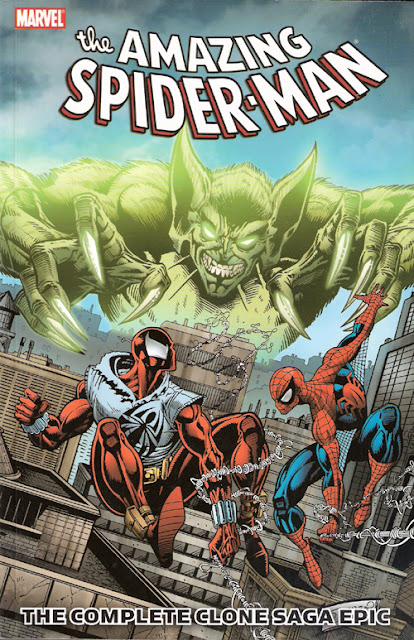
Spider-Man: The Clone Saga Epic, Book 2

Collects: Amazing Spider-Man #395-9, Spectacular Spider-Man #218-21, Spider-Man #54-6, Web of Spider-Man #120-2, Spider-Man: Funeral for an Octopus #1-3, Spider-Man Unlimited #8 (1994-5)

Released: May 2010 (Marvel)

Format: 480 pages / color / $34.99 / ISBN: 9780785143512

What is this?: The Clone Saga’s second installment, in which the story of a Spider-Boy and his clone begins to ramp up.

The culprits: Writers J.M. DeMatteis, Tom DeFalco, Howard Mackie, Tom Brevoort, Todd DeZago, and others and artists Mark Bagley, Sal Buscema, Tom Lyle, Steven Butler, Stewart Johnson, and others

When I reviewed Spider-Man: The Complete Clone Saga Epic, Book 1, I found it occasionally dull but not as dire as the Clone Saga’s reputation would have me believe. Evidently, this is the kind of evaluation that gets me to pick up subsequent volumes of a series.

So … Spider-Man: The Complete Clone Saga Epic, Book 2. We all know the Clone Saga gets bad, eventually … but when? It’s not in Book 2, which is a surprisingly fun read.

Spider-Man: The Complete Clone Saga Epic, v. 2 coverYes, I said “fun.” It’s not a classic, and if you were looking for a Spider-Man story, there are a couple dozen others I would recommend first. But I can’t deny I found the book interesting and sometimes exciting, despite the plot being spoiled long ago.

In Book 2, you can almost see the writers ticking off the boxes as they complete the tasks editors set for them. Wrap up unresolved plots, with Mary Jane and her family and Peter finally defeating his stubborn case of asshattery. Establish Kaine as a bad mamajamma, even if they have to kill some established villains to do so. Show that Peter and Ben Reilly, his clone, can exist in the same storytelling universe with unique roles. Prepare readers that this time, yes, May might actually die. Most importantly, start to lay groundwork for new plots, such as the proliferation and identity of clones and Mary Jane’s medical condition. And yeah, if you can get across a new, non-clone villain like Stunner, good on you.

And the writers — J.M. DeMatteis for Amazing, Tom DeFalco (with some help from Todd DeZago) on Spectacular, Howard Mackie for Spider-Man, and Terry Kavanagh, DeMatteis, and DeZago on Web — do just that. The stories aren’t perfect, but they hit the important points of the overall plot without boring readers too much. And even if some plots drag on too long — Peter trying to beat the Vulture’s poison, DeMatteis trying to end Peter’s idiotic “The Spider” personality by drowning the page in captions — it’s important to remember how collaborative the issues in this book are. Book 2 has 19 issues, and all but four — Spider-Man Unlimited and Funeral for an Octopus #1-3 — are linked in four crossovers (“Web of Death,” “Web of Life,” “Smoke and Mirrors,” and “Back from the Edge”). Think about it: this represents about a quarter of a year’s issues for some titles, and none of their writers get to complete a story without sending it through another writer first. It’s a miracle anyone was able to complete a decent story at all. Spider-title editor Danny Fingeroth deserves a lot of credit for keeping things under control.

The stories get better as the farther the book gets from “The Spider” and DeMatteis’s deconstruction of Peter’s mind at the time (it’s a plot that seems tailor-made for DeMatteis, except that it’s not very good). Peter gets poisoned, which touches off all sorts of wacky hijinks: teaming up with the “new” Daredevil, going to Heaven, having Dr. Octopus aid him. I’m not sure the latter was a good development — Otto’s reasoning is a little clichéd — but at least it’s a different take on the character, one that couldn’t be done now.

My favorite story was Funeral for an Octopus, a miniseries that hearkens back to the Fingeroth-written Deadly Foes of Spider-Man and Lethal Foes of Spider-Man minis from the early ‘90s. Those comics concentrated on Spidey vs. a large number of foes, each of whom had his own motivations for taking part; Funeral, written by Tom Brevoort, has a similar plot. Yes, it’s used to get across how tough the mysterious (and horribly costumed) Kaine is, but on the other hand, one of the Sinister Six does outwit the thug, so that’s something. Plus, at this stage, I don’t mind Kaine getting a push as long as the body count doesn’t get too ridiculous; in Book 2, the death toll is confined to a throwaway villain who really never got started and a major villain (no extra points for guessing who).

The final crossover, though, shows some of the cracks that would eventually cause the whole “epic saga” to crumble. In “Smoke and Mirrors,” Spider-Man and the Scarlet Spider fight the Jackal, who has been resurrected via cloning. The Jackal is served by two of Peter’s altered clones, who strangely look nothing like Peter. For the second and third issues of the three-part crossover, all the Jackal does is hint and lie and tell the two Spiders that each is a clone — or maybe the other is a clone? neither? — while Scrier and Kaine watch. (Somehow, I don’t think Spider-baiting is a spectator sport that will ever catch on, regardless of the crowd it drew this time.) The Jackal does show them what happens to clones in the end (they degenerate into dust quickly), and he puts on a Goth leather trench coat with enough chains to satisfy Ghost Rider, but three issues is a little too much for this. Given that the Clone Saga’s mind-numbing number of clones and the claim that Peter was the clone were major reasons fans soured on this storyline, the Jackal’s wild claims and the hint that there is another clone in the offing (and the presence of Scrier) have to be considered major missteps.

Since Book 2 collects five different Spider-titles, you can take your pick on what flavor of artist you like. Mark Bagley, who drew Amazing at the time, is probably the best-known today; his lithe, athletic Spider-Man is outstanding, although his women tend to be overendowed (staying just short of cheesecake) and his facial expressions uniform. Sal Buscema, the regular artist for Spectacular, is my favorite, but this isn’t his best work; it’s near the end of his career, and his art lacks the tightness it once had (especially when inked by Bill Sienkiewicz). His Kaine looks especially stupid as well, although that’s partially because Kaine’s costume is stupid to begin with. Tom Lyle, the regular Spider-Man artist, is excellent: he’s the best in Book 2 at conveying emotion (and faces in general), although his action shots aren’t as lively as Bagley’s. Stephen Butler (Web) and Stewart Johnson (Funeral) do similarly good work without much of the ‘90s excesses.

I enjoyed Book 2 quite a bit. I mean that statement without qualifications or temporization. That being said, I think this book is probably the high point for the “epic saga.”

Rating: Spider-Man symbol Spider-Man symbol Spider-Man symbol Half Spider-Man symbol (3.5 of 5)

Labels: , , , , , , , , , ,

08 April 2011

Ghost Rider: Danny Ketch Classic, v. 1

Collects: Ghost Rider, v. 2, #1-10 (1990-1)

Released: November 2009 (Marvel)

Format: 264 pages / color / $29.99 / ISBN: 9780785137351

What is this?: A new Ghost Rider, proclaiming himself the Spirit of Vengeance, takes to the streets of New York.

The culprits: Writer Howard Mackie and penciler Javier Saltares

Part the First: Why was this so popular; or, The ‘90s were a weird time

Despite Gambit Classic not being a very good book, I can understand the popularity of the title character — Gambit is a mysterious rogue who appears to be on the side of heroes, appearing in the most popular comic book of the time. He’s anti-authoritarian. He shows himself equal and similar to Marvel’s most popular mutant, Wolverine. I don’t necessarily agree with that popularity now. But the rationalization makes sense.

Ghost Rider, v. 2 … It’s a nice visual. I get that. But the stories that started the series, reprinted in Ghost Rider: Danny Ketch Classic, v. 1, aren’t good. At all. Was it just that we enjoyed unfettered violence against criminals? Or were we looking for something empty of deep thought, a sort of guilty pleasure that wasn’t a pleasure and should have made us feel something deeper than guilt? (A super-guilt, perhaps.) Maybe after a decade out of circulation, the public was in the mood for a new Ghost Rider, someone who aped the outward form of the character without any of the (God help me) depth the Johnny Blaze version had?

I don’t know. I don’t think I’m going to figure it out either.

Part the Second: Howard Mackie; or, The architect of sins

No, I’m not going to think about writer Howard Mackie right now. For all my sins, I don’t deserve that.

Ghost Rider: Danny Katch Classic, v. 1 coverPart the Third: Ghost Rider himself; or, The old hero is a new flame

Who is this Ghost Rider? He’s the Spirit of Vengeance, or so he says. Beyond that? I don’t know. Does he have any connection to the previous Ghost Rider? Not that I can see, and in ten issues, he doesn’t really seem to care that much. He does like vengeance quite a bit, and he’s big on the innocents. He has a “penance stare,” which essentially sears the souls of evildoers. Nothing wrong with that, but everyone uniformly calls it the “penance stare” for some reason, without that name being publicized or, you know, obvious. Perhaps he also likes long walks on the shores of Hell and pina coladas. I don't know.

And what about the new host, Danny Ketch? Who is he? I don’t know much about him, either. You would thing, as the hero, we would get to know him. After ten issues, what we know is:

  1. He is a bike messenger of some sort. I think. When the series started, I thought he was a high schooler, but evidently, he’s 19.
  2. He lives at home, with his mother. She’s not bothered when he mysteriously brings home a motorcycle.
  3. He has a … girlfriend? I think that’s the role Stacy Dolan is supposed to fill, but she doesn’t act affectionately toward Danny, and he doesn’t act like he notices she’s a member of the same species, let alone a female. He certainly gives her no reason to like him, and she doesn’t come across as someone that interested in Danny.

That’s it. Ten issues, and that’s it. Danny has the internal life of a goldfish and a good deal less personality.

Part the Fourth: Villians; or, How to make Ghost Rider look well developed

These are who the Ghost Rider fights: Deathwatch. Blackout. Kingpin. Flag Smasher. Masque. Scarecrow. A serial killer named Zodiac. (Or Zodiak — both spellings are used.) Mr. Hyde. The H.E.A.R.T. Corporation, a group of female mercenaries, for Mephisto’s sake. With the exception of the Kingpin, who was about to fall anyway, to call these villains sad is to demean sadness.

The original adversaries are the worse. The H.E.A.R.T. Corporation is an embarrassment, a team of bad girls without the lack of restraint or T&A to appeal to the audience they were designed for; since they appeared in the early ‘90s rather than the late ‘90s, perhaps they were just ahead of their time. Zodiac is utterly generic, except he was given the name of a real, attention-loving serial killer who murdered five people in the Bay Area twenty years before Ghost Rider and was never caught. Blackout is the real nemesis of Ghost Rider, doing him the most damage, but his ability to shut off the lights and his feral nature don’t really work together as well as they should — instead of being creepy, he’s annoying. Deathwatch is a generic corporate thuglord.

As for the pre-existing characters, the Kingpin comes across as a generic corporate thuglord. The Scarecrow, a minor villain, gets a grim ‘n’ gritty makeover and becomes emblematic of the ranting morons who opposed the more violent comic book heroes of the ’90s. Masque never shows up, having the good sense to stay in a Rob Liefeld book. (Not often you can say that.) Flag Smasher is Flag Smasher; nothing that happens is a discredit to such a goofy villain, and the idea of arming inner city youth to destroy a country isn’t the worst in the world.

I will, through gritted teeth, admit to enjoying Mr. Hyde’s issue. He’s trapped as his alter ego, Calvin Zabo, but he still acts the same way he did when he was Hyde — hitting on waitresses and picking fights with bikers. That goes about as well as expected, and we get the same kind of scenes with him as we usually do with inexperienced heroes: the civilian ID huddling in some corner and hoping, almost praying for the superpowers to kick in. It almost makes me feel sorry for Hyde, and then he starts hurting people, so that goes away. And then Ghost Rider shows up, and I don’t know what the hell to think.

Part the Fifth: Howard Mackie (again); or, If you have nothing nice to say

Howard Mackie has a family and friends who care about him. Presumably, he has parents and children who love him very much. They shouldn’t have to hear about what I think about Howard Mackie. Therefore, I will pass over Mr. Mackie at this time.

Also: Mark Gruenwald seemed to believe in Mackie’s talent. That’s something I have to digest before I say anything about him. On the other hand: Did you know Mackie wrote Ghost Rider for more than 5 ½ years without giving the Ghost Rider an origin? I have trouble believing in 5 ½ years of mindless violence on top of mindless violence, but it actually happened!

Part the Sixth: The art; or, I blame YOU

Danny Ketch has a great art team, with Javier Saltares providing the pencils and Mark Texeira doing the pencils. Saltares and Texeira are the only real draws for this book. Saltares has the sort of look you want for a book like this: gritty yet vivid, exaggerated while maintaining some sort of grounding in the real world. This is exciting art, although it does have its problems; subtle emotion — not that the script seems to deserve or call for it — seems to give Saltares trouble, and there are times when I just can’t figure out what the hell is going on. Like when some street punks squirt a homeless person with a water pistol and her jacket catches fire. What’s in that squirt gun? Or was it supposed to be an accelerant, which was lit on fire by something else? That makes sense, given that the punks later flip lit matches around.

A little off topic there, sorry. I’m not sure how that little thing annoyed me when there was so much out there to … Anyway. Texeira is a great artist, but I don’t know how to evaluate his inking here. Since the art looks generally excellent, I’ll assume he’s a good part of it.

Part the Seventh: Children in jeopardy; or, Is there a subtext in here?

There is a lot of violence against children here. A teenage gang / social club are menaced by the Kingpin and Deathwatch’s goons, and one of them (and Danny’s sister) get stabbed through the chest. Blackout murders an entire family — mother, father, and child. A subplot has Scarecrow murdering children. Flag Smasher arms kids, which necessitates Punisher and Ghost Rider beating some of them up. Zodiac isn’t really bad until he murders a child; the other four people, evidently, were understandable. Masque kidnaps kids for … I say “I don’t understand” a lot, but #8 and #9 are baffling. Why does Masque want kids? Why doesn’t he ever appear? Why do other mutants wander through the issues? Why does X-Factor show up without doing anything? Why is Pixie killed? I don’t know, and I don’t know how I’m supposed to know. Anyway, the kids seem to get the short end of the victim stick here.

About the time Mackie started writing Ghost Rider, he and his wife had their first daughter. Is it the concern of a new parent for his child? Resentment for the loss of youth, taken out on fictional surrogates? Or is violence against children just a topical news trend expressed on the comics page? I don’t know.

Part the Eighth: Howard Mackie (yet again); or, I can’t omit this, nor can I resist

Ghost Rider was Mackie’s first regular writing assignment. It shows. Although the these are recognizably, undeniably comic books in every way that matters, they don’t maintain that coherence once you start looking closely at them — much in the way a pointillist painting only resembles a representational canvas when you look at large parts of it but dissolves into meaningless points of color once you focus in too closely.

The characters are ill defined and raise not one iota of sympathy or even interest in the reader. Their emotional bonds are tenuous at best, dissolving into nothingness at the every panel border. The villains are cardboard at best and seatfillers at worst. The dialogue contains phrases no one has ever said before in the history of this or any other sentient species. The plots are meaningless violence piled upon meaningless violence, with deaths that are occasionally noted before the plot moves on.

Yet this series was popular, and its popularity allowed Mackie to get gigs writing Gambit, various Spider-Man titles, and X-Factor. I blame society, and by society, I mean everybody but me. Surely you need to step up and take responsibility, even though I bought this book and you might not have. Shame on you.

Part the Ninth: The Verdict; or, Good God, don’t buy this

Like many people, I’ve talked about how many comics creators have aped the “mature” approaches of Alan Moore and Frank Miller without understanding the subtleties of what’s they are doing. Danny Ketch Classic is a master class on that idea. The deaths pile up with little emotional weight. There’s nothing here that asks the reader to empathize or engage with the material on the page. Things happen; the Ghost Rider shows up to put an end to them; and then more things happen. It’s a pointless cycle without reason or an end. What is supposed to be the Ghost Rider’s moral gray area turns into a moral vacuum; not only are there no strong moral figures in the book, there’s no real expression of strong moral values.

I really disliked this book. I found it vacuous and bad and … and … agh my head hurts. Danny Ketch Classic is a leading cause of deep hurting.

I guess what I’m trying to say is if you’re looking for Saltares art, buy something else.

Rating: Half Marvel symbol (½ of 5)

Labels: , , , , , , ,

04 March 2011

Gambit Classic, v. 1

Collects: Uncanny X-Men #265-7 and Gambit #1-4 (1990, 1993-4)

Released: April 2009 (Marvel)

Format: 176 pages /color / $24.99 / ISBN: 9780785137290

What is this?: Gambit! Gambit Gambit? Gambit, n’est ce pas! 1990s! Gaaammmmbiiiittt!

The culprits: Writers Chris Claremont and Howard Mackie and artists Lee Weeks, Bill Jaaska, Mike Collins, and Homage Studios

When future generations look back at us and ask us why we thought Gambit was “cool,” we will be forced to answer: It was the ‘90s; you had to have been there. That’s the only response that makes sense. Oh, perhaps we might say something about his anti-authoritarian attitude, about how he metaphorically pulled the whiskers of Xavier and Wolverine and he had a “mysterious” past, but those aren’t real answers. Those are excuses.

Those delving into the subject will not find the answer to that future question in Gambit Classic, v. 1. Unfortunately, Gambit Classic will raise only more questions: What’s with that accent? Why is Storm a child? Why does the first issue in this collection not have Gambit in it at all? Seriously — is that accent a symptom of brain damage? Is the immortal Candra’s support of the useless Thieves and Assassins Guilds evidence of her uselessness, or is her behavior enough of a de facto argument?

Gambit Classic coverBut we must put aside these considerations for the moment. The future, I have been assured by eminent authorities on the subject, will take care of itself, much as I believe those future generations should be allowed to. Let us instead concentrate on the book itself.

Gambit Classic starts at the end of writer Chris Claremont‘s run on Uncanny X-Men, coming during the time when Storm was a child and the X-Men were scattered across the globe, with many of them missing their memories. As most of you who have read Uncanny during that time know, it was not a good period — the 260s of Uncanny were abysmal in quality, but the book was coasting on a wave of popularity. (That wave, I believe, partially answers the hypothetical question at the beginning of the review.) At this point, Claremont was doing issues or short arcs on the various X-Men split up by the Siege Perilous — #259 was about Colossus, #260 featured Dazzler, and #261 pitted Wolverine, Jubilee, and Psylocke against Hardcase and the Harriers. (Forge and Banshee rescued Jean Grey in #262-4.) These issues were about as you would expect: Claremontian dialogue, Image-ish art, plots that seemingly went nowhere. (The team had been split up since #251, and it would not get back together until #270, at the beginning of X-Tinction Agenda.)

Anyway … the former X-Man Storm is a child in Cairo, Ill., where she’d been since #253. Issue #265 provides the background for Gambit’s first appearance — he doesn’t appear in the issue, as I mentioned earlier — as pre-teen Storm steals from the, er, rich in the area. Unfortunately, the Shadow King has taken one of the mansions and turned its occupants into his slaves. Through either laziness or foreshadowing, Claremont doesn’t bother to change much between the Shadow King’s slaves and the mind-controlled Rachel Summers from “Days of Future Past”: both are called “hounds,” and their costumes are extremely similar (skintight with spikes). Perhaps Claremont, having reached the top of the comics world, didn’t feel the need to alter his personal storytelling fetish to suit the norms. Into this weird scene walks Gambit, who wants to steal from same mansion Storm targeted; he helps save Storm from the Shadow King, he helps save Storm from Nanny and the Orphan Maker, and the two escape to New Orleans. This first appearance sets up everything that Gambit is: a trenchcoat, hideous body armor, an accent, a profession, and a propensity to blow things up, mutant-style. Yes, there’s a green glow around his eyes that suggests a psychic power, and the accent is more Claremontian than Cajun, but it’s easy to see what Claremont is going for. (To be fair to him, Claremont’s Gambit dialogue is more than just phonetic mispronunciations and a smattering of high-school French.)

It’s unfortunate for the character that this was his introduction, inserted into this unfortunate storyline. When modern readers think of Claremont’s weaknesses and excesses, this storyline is exactly what they have in mind. The dialogue and narration are stylized to the point of self parody. The mind control plot is Claremont’s go-to storyline, even as it’s bogged down in the remnants of the Siege Perilous / Australian chaos that had been going on far too long. For God’s sake, it has Nanny and the Orphan Maker (not Claremont creations, but right up his alley). In my opinion, this is the absolute nadir of Claremont’s entire run, which would improve immediately after this nonsense was over.

(One final note about the writing: This storyline is set in Cairo, Ill., in part because Storm has mixed it up with her childhood home of Cairo, Egypt. Sure, fine, although the names aren’t even pronounced the same.56 Claremont and his artists seem to think the American Cairo is a large or prosperous town. As someone who grew up in the area,57 I can tell you it isn’t. It’s a poor, small, river town that is occasionally the object or subject of Southern Illinois’s racial tensions. It’s largest population was in 1920, when Cairo had just over 15,000 people. In 1990, it was less than 5,000. Today, Cairo has fewer than 3,000 people, and someone is burning down abandoned buildings for fun. But Claremont’s Cairo has the large, prosperous Mississippi Mall and several mansions full of artwork to rob. According to the art, the mall is huge — a multilevel job that would never have been built in a rural area where land is cheap — and the mansions are opulent and architecturally interesting. I know comics are fantasy, but this seems a rather pointless one.)

When you think of this time in X-Men history, you envision the Image artists working on the title — Jim Lee, Whilce Portacio, Marc Silvestri, etc. However, that’s not what you get here. The late Bill Jaaska drew #265, and Mike Collins was the artist for #266, although Lee is credited as Gambit’s co-creator. Neither is bad — I like Jaaska’s clear, simple artwork quite a bit, more than murky, oversexualized, Image-ish #267 — but both were odd choices for the time. Neither had the prominence of the other artists who worked on Uncanny; neither fit the style of Lee et al. Uncanny #267 is credited to Homage Studios — specifically, Jim Lee and Whilce Portacio along with Scott Williams — and it’s not the best work from Lee or Portacio.

As for the Gambit miniseries, the artwork of Lee Weeks is much more pleasing. It’s not perfect — occasionally the reader is blinded when the flash overcomes substance, and Gambit’s hair is a near impossible cosmetological marvel — but despite those shortcomings, it’s clear, it’s quite pretty, and it tells the story reasonably well.

Although given what the actual story is, telling it clearly can be considered a detriment. Howard Mackie … I have no idea what to say about Mackie that rises above personal attacks. The plot of Gambit involves Gambit’s wife, the immortal mutant Candra, and the guilds of New Orleans. The guilds are incompetent — the Assassins kill one person during the series, someone so obviously fish bait he should have had it tattooed on his face — and the Thieves, despite their “power,” are pushed around by everyone. Rogue, the most powerful character in the book, does nothing. Belladonna, Gambit’s unconscious wife, sleeps in the nude the entire series. (Why?) Candra does nothing but wear an impressively stupid costume, which is a swimsuit with arm-length gloves attached to the top. Her enforcer, the Tithe Collector, would have trouble menacing a fourth-grade class. And Gambit? The most impressive thing he does is to slip out, travel to Paris, and return without Rogue noticing. Well, that’s not true — the most impressive thing he does is to ask Rogue out on a date only moments after his beloved wife awakes, an amnesiac. That’s impressively awful, the kind of behavior that deserves fire ants inside the armor and honey-coated underwear.

If you want a more detailed look at its awfulness, consult David R. Henry‘s review of Gambit #4, “The Moron Game.”

So, if you’ve been paying close attention, you may come to the conclusion that this book is awful. Well, yes, and no. The quality of the book is pretty low — so low, really, I hadn’t planned to write a full-length review — with its highest profile creators doing some of their worst work and Howard Mackie doing his usual job. Still, Weeks’s art is easy on the eyes. More importantly, there is a strong whiff of nostalgia in the pages — nostalgia for a time when Claremont and the X-Men were the biggest thing in comics, nostalgia for youth (for some of us), nostalgia for the simplicity of the age.

It was the ‘90s, after all. You had to have been there.

Rating: X-Men symbol Half X-Men symbol (1.5 of 5)

Labels: , , , , , , , , , , , , ,

18 June 2010

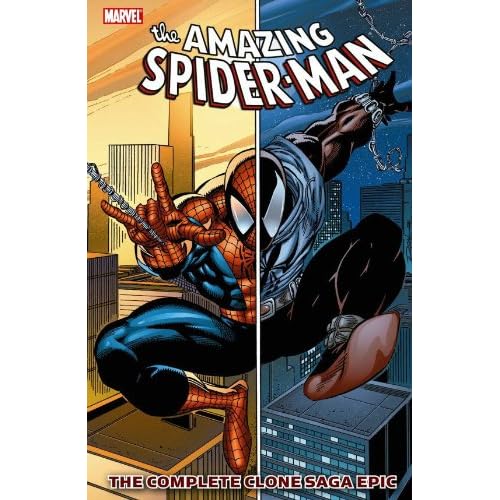
Spider-Man: The Complete Clone Saga Epic, Book 1

Collects: Amazing Spider-Man #394, Spectacular Spider-Man #217, Spider-Man #51-3, Spider-Man Unlimited #7, Web of Spider-Man #117-9, Spider-Man: The Lost Years #1-3 (1994-5)

Released: March 2010 (Marvel)

Format: 424 pages / color / $34.99 / ISBN: 9780785144625

What is this?: Oh, the Clone Saga? You know, the ‘90s? Well, a duplicate Peter Parker, calling himself Ben Reilly, shows up.

The culprits: Many, many people, including writers Tom DeFalco, Howard Mackie, and J.M. DeMatteis and artists John Romita Jr., Steven Butler, Sal Buscema (really?), and Tom Lyle

When I first saw Spider-Man: The Complete Clone Saga Epic, Book 1 in the solicitations, I thought, “Man, what a waste — who’s going to want to buy that?” Because as everyone reading comics in the ‘90s remembers, the Clone Saga was Marvel’s biggest misstep of the decade, and that’s competing against some intensely stiff competition: Onslaught, The Crossing, Marvel’s bankruptcy. … What I’m trying to say is that the ‘90s were a crappy decade for the company, and the Clone Saga was the crap cherry on top of the crap sundae — the crap de resistance, if you will. But Marvel, always trying to put a little polish on that turd, has labeled the story both a “Saga” and an “Epic.”

So of course a few months after its release, I’m reading Book 1 of the Clone Saga. In my defense, I can say it’s a hell of a bargain after an Amazon discount — that’s a lot of story for $23 and change. Of course, it’s the quality of the story that matters.

Spider-Man: The Complete Clone Saga Epic, Book 1 coverTo be fair, the beginning of the Clone Saga was never what was at issue. Marvel has decided to tell the story in the order it takes place in the life of Spider-Man’s clone (Ben Reilly). This is an odd decision but a defensible one; rather than reading the stories as they were originally issued, Marvel is trying to tell a coherent story with the reprint.

That may be trouble later on, but for now, the backup stories telling about the clone’s awakening (from about Amazing Spider-Man #149 or so) are presented at the beginning rather than interspersed among the first real crossover of the Clone Saga. So much to the good; on the other hand, that means the Spider-Man: The Lost Years miniseries is presented next, which was written when the clone thought he was the original Peter Parker. This means there are several confusing references to Ben being the real Spider-Man when the story has him still as the clone (and that’s how he’ll end the Saga). There aren’t any footnotes or explanations, so it seems Marvel will trust everyone to stay calm and carry on.

The story begins in earnest when Peter (and Ben’s) Aunt May has a spell and has to be hospitalized. Ben rushes back to New York, the identical pair clash with each other, they find other enemies to fight. Peter has, at this point in the storyline, become a deranged ass, unhinged by the Chameleon passing a pair of robotic duplicates off as Peter’s dead parents. He calls himself “the Spider,” avoids May and Mary Jane, and generally is unpleasant and violent. (Thankfully, there’s a text page that describes all this.) It’s a great way to make Ben the sympathetic one, as Peter assumes Ben is there to replace him. But at this point these are still supposed to be Peter’s books, so making him unsympathetic is a risk — some would say stupid.

The stories themselves are unremarkable. The backups that introduce the clone, written by J.M. DeMatteis, are forgettable. The “Power and Responsibility” crossover, in which Ben made his debut, features Judas Traveller as the villain — the less said about Traveller, a ‘90s kind of villain with vague mental powers, ambiguous goals, and weird, slightly multicultural minions, the better. The whole Spider-writing staff — Terry Kavanagh, DeMatteis, Howard Mackie, and Tom DeFalco — grabs an issue each; each has done better work elsewhere (well, maybe not Mackie). The story that rounds out the collection has Ben choosing Venom as his first villain to fight, taking offense with Peter’s peace treaty with the villain. The choice is logical, and Mackie and Kavanagh establish Ben as having Peter’s moral code while putting a few new trappings on the character, but the issue is muddled with a second symbiote wandering around and a Bugle reporter trying to ride superheroes to the top of his profession.

The Lost Years miniseries is a bit of a standout, though; a younger Ben finds love in Salt Lake City, managing to eschew full-blown superheroics while still trying to do right. The story is as much about Kaine, another Spider-clone who is embittered by being an earlier, imperfect attempt at cloning; he too thinks he’s found love, only to find it being as imperfect as he is. DeMatteis manages to make parallels between the two clones without bashing the reader over the head and write a decent crime story. As DeMatteis writes in the afterword, the Lost Years setup — essentially Spider-Man stories without the Spider-Man, set around the world — seems like a gold mine of stories.

Kaine by John Romita Jr. in The Lost YearsThe Lost Years is also the winner in the art department. I’m not a big John Romita, Jr. fan, but his work for the miniseries is excellent — it is, by far, my favorite work of his post-‘80s portfolio. Credit has to be given to inker Klaus Janson and colorist Christie Steele; the pair give Romita’s art a gritty, washed-out look appropriate for a crime story set in a rainy city.

The rest of the volume mostly manages to avoid the crossover syndrome, except for “Power and Responsibility.” Still, most of it is forgettable ‘90s art. Exceptions are Sal Buscema, whose work I love dearly but is clearly miscast for this story, and Tom Lyle, who manages to give Ben a lithe and powerful Mark Bagley-esque look in his issues. On the other hand, his original design for Kaine is hideous in a very ‘90s way and in no way captures the menace that Romita gives him in The Lost Years. Liam Sharpe draws an empty-eyed series of backups, but he’s drawing unformed clones, so empty-eyed is appropriate.

Kaine by Tom Lyle in Spider-Man #53Marvel has done some very good things here. The ordering of the issues is probably the best choice, as mentioned. The text page setting up the clone’s introductory crossover is much appreciated. The book also includes numerous fragments from many Spider-titles leading up to the initial crossover in which someone is rushing to New York to see May; Marvel wisely didn’t claim the book reprinted the comics the fragments came from. The afterword from J.M. DeMatteis (reprinted from the 1996 TPB of The Lost Years) is more vital than the usual nattering of a writer or artist; this is a disaster in the making, and it’s useful for readers to get a sense of how things started to fall apart.
I had a thought, while writing this review, that wanting to read this book not out of morbid curiosity or completionism — that you sincerely have a desire to read a Spider-Man story from an era that doesn’t get reprinted much — is a mark of a real Spider-Man fan. Not necessarily a better Spider-Man fan, since “real” fans can also disdain what they are pretty sure is going to be a steaming pile of Rhino scat. But someone could put that forward as part of their Spider-Fan bona fides.

Book 1 isn’t as bad as the Clone Saga is supposed to be. (Is it really that bad? Well, Book 2 is out, Book 3 has been solicited for August, and Book 4 already has a (possibly bogus) page on Amazon. (Reading the description for that last one makes me think that one’s going to be awful — and there will still be about a year of the Clone Saga to reprint. That’s one to send shivers up your spine.) But is Book 1 compelling? As a story, no. As a ‘90s artifact? Probably. As part of the anatomy of a disaster? Oh, yes — such a lackluster start to a major event doesn’t bode well.

Rating: Spider-Man symbol Spider-Man symbol (2 of 5)

Labels: , , , , , , , , , , , , , ,

20 March 2009

Astonishing X-Men: Deathwish

Collects: X-Men #92 and 95, Astonishing X-Men #1-3, Uncanny X-Men #375 (1999)

Released: October 2000 (Marvel)

Format: 160 pages / color / $15.95 / ISBN: 9780785107545

What is this?: The X-Men shatter, help a child in trouble, learn a shocking secret about Wolverine, and are attacked by Apocalypse’s latest horseman, Death.

The culprits: A crossover crew including writers Alan Davis and Howard Mackie and penciler Brandon Peterson

Astonishing X-Men: Deathwish comes from an early time in the development of Marvel’s graphic novel program. In 2000, the Essentials line was in its infancy, and Marvel was scrambling to put some of its classic storylines into print while also getting “new classics” into circulation. Deathwish belongs to that latter category, as the book was published under the “Marvel’s Finest” banner soon after the floppies were released.

So what we have here is fin de siècle X-Men. All the stuff between Chris Claremont leaving and Grant Morrison arriving should be regarded with suspicion, but writer Alan Davis’s run was a rare bright spot during that time. Unfortunately, we get only glimpses of what he was doing as plotter of X-Men (script by Terry Kavanagh) and writer of Uncanny X-Men.

Astonishing X-Men coverDeathwish runs into the fringes of “The Shattering,” in which the newly returned Xavier seems to be having a mental breakdown. Most of the team says, “Sod it,” and takes a vacation; the rest don’t leave quickly enough and get drawn into the eponymous Astonishing X-Men miniseries. Bad luck for them, then. When Astonishing is over, everybody gets pulled back to hear a couple of shocking secrets, be psychically beaten by Xavier like a rented mule, and then get in a fight with the real villains.

The scene with Xavier spoils the straightforward charm of Davis’s work in Deathwish. X-Men #92, in which Davis and Kavanaugh set up the miniseries, works well, with Davis showing Xavier’s apparent instability and paranoia believably and giving nearly everyone a reason to skedaddle. He portrays the reactions to the death at the end of Astonishing well, and the final big fight is clever enough. But Xavier … to test loyalties, he merges the Danger Room and his psychic abilities to make the X-Men think they’re killing one another. Not satisfied with that, he makes the survivors watch their loved ones die. It is, frankly, a horrifying experience, especially since a teammate had just died in reality, and I’ve never been sure how the psychic test part worked. The worst point is no one calls him on it. It seems out of character that no one except Gambit would complain about him putting the team through a simulation that called for betrayal and death.

Unfortunately, Davis’s work on the X-titles is marred in the reprints by other titles. In this case, it’s with the miniseries Astonishing X-Men, written by Howard Mackie. Nothing puts the fear in an X-fan like realizing they’re reading Mackie’s work, except perhaps the Onslaught crossover. Fortunately, it’s not as bad as Mackie’s reputation might lead one to think.

It’s not great either; it’s a forgettable story, saddled with the Mannites, who are a bunch of childlike ciphers who are supposed to be even mutantier than mutants. The cobbled-together team, which includes the alternate universe X-Man and Cable, works together far more smoothly than it should, and the plot is more overwrought than necessary. The story doesn’t flow all that smoothly, either; there were a few points where I wondered what was going on and how far the two groups of people were from each other and how did they get there, anyway? It’s all just three issues in search of a dramatic revelation, and it delivers that in the end. I won’t spoil it, but it’s better if you just have someone tell you that revelation and skip those three issues.

The art is very good for a crossover, especially Adam Kubert’s issue of Uncanny X-Men. I’ve long been a fan of Kubert, ever since I first saw his work in Wolverine in the early ‘90s. This isn’t as vibrant and sharp as those issues seemed to me, but it’s still quality work. Brandon Peterson does a good job on Astonishing — the art certainly outdoes the writing — and although the style of Bret Boothe, who assists with pencils in #2, is noticeably different, it isn’t jarring, especially by the standards of crossovers. Jeff Johnson and Tom Raney work ably on the X-Men issues.

The book is out of print at the moment, but an expanded version of the title (X-Men: The Shattering) is listed as a future release by Amazon.com. The book hasn’t shown up in Marvel’s solicitations yet (and perhaps never will), but that listing plus the publication of the following Uncanny X-Men / X-Men issues is a small indication these stories will be back in print again.

I can’t particularly recommend Deathwish because the Astonishing X-Men miniseries takes half the book, but with the expanded contents, The Shattering might be worth checking out.

Rating: X-Men symbolX-Men symbol (2 of 5)

Labels: , , , , , , , ,