


Spider-Man: Spider-Hunt
Collects: Amazing Spider-Man #432-3, Sensational Spider-Man #25-6, Peter Parker: Spider-Man #88-90, Spectacular Spider-Man #254-6 (1998)
Released: June 2012 (Marvel)
Format: 272 pages / color / $29.99 / ISBN: 9780785160519
What is this?: Spider-Man is hunted for a bounty after being accused of killing a man.
The culprits: Writers Howard Mackie, J.M. DeMatteis, Todd DeZago, and Tom DeFalco and artists John Romita, Jr., Joe Bennett, Tom Lyle, Todd Nauck, and Luke Ross
Spider-Man: Spider-Hunt — as well as Spider-Man: Identity Crisis — came at a strange time for Spider-Man. Between the end of the disastrous Clone Saga but before the almost / soft reboot of the Next Chapter / Chapter One, Marvel had to figure out what to do with Spider-Man. This could not have been an easy task.
For about a year, the Spider office laid low. Aunt May was dead — almost three years dead by the beginning of Spider-Hunt — but that didn’t stop anyone from plugging Mary Jane’s Aunt Anna into a similarly shaped hole. Norman Osborn was back from the dead; obviously, he became Spider-Man’s main adversary, pulling Peter’s strings in costume and at the Daily Bugle, which Osborn has bought into. And Spider-Man kept plugging along.
 Spider-Hunt was Spider-Man’s first big crossover after the Clone Saga. The idea is a good one: Osborn, at some point before Spider-Hunt begins, has put a bounty of $1 million on Spider-Man’s head, causing Spider-Man to become the target of amateur and professional bounty hunters. The police join in after Spider-Man is framed for killing a low-level street punk. To make sure Peter can’t stay off the streets, Osborn’s grandson is kidnapped by a non-Osborn Green Goblin. None of those three plots needlessly ratchet up the stakes — the bounty is a normal sort of villainous plot, the frame-up seems like something Osborn would try to increase the pressure on Spider-Man, and the kidnapping is an interesting complication. Dirtying Spider-Man’s reputation works because Osborn is trying to become the hero in their fight; he simultaneously works to salvage his own reputation, threatening Ben Urich to make Ben recant the book that accused Osborn of being the Green Goblin.
The execution of these ideas doesn’t deliver, for several reasons, ranging from the mundane to the intrinsic. Most damning is that Spider-Hunt does not contain a complete story. The bounty is issued before Spider-Hunt begins. I don’t have to see that, but some context or footnotes would be nice; from the dialogue of page #1 of the first issue, it sounds like the bounty — and the “spider hunt” — has been going on for some time. How long? I don’t know. I would rather see Osborn issuing the bounty than the second issue in Spider-Hunt, Spectacular Spider-Man #254; the issue has an awful “Spider-Man confronts his personal demons while under the control of the villain” A plot, but unfortunately it has too many important subplots to excise it from the collection.
More damningly, however, Spider-Hunt does not have a resolution for two of the three parts of the setup. The Spider-Hunt continues after the four-part “Spider-Hunt” storyline and ten-part collection ends: Little Normie is rescued by the end, but Spider-Man still has a price on his head and is still suspected of murder. Spider-Man makes almost no attempt to clear himself in Spider-Hunt, except to briefly consult with Arthur Stacy. He makes no attempt to discover who the murdered man was or to use his press contacts to find anything about the killing. Peter complains he’s “not the world’s greatest detective,” but Spider-Man usually blunders in the right direction with some convenient breaking and entering. I understand Spider-Man is being hunted, but there’s nothing preventing Peter from poking around. I understand that a murder mystery might seem a little complex, something to be avoided after the Byzantine twists of the Clone Saga, but Peter acts like an idiot in Spider-Hunt.
Presumably the murder and bounty plots will be wrapped up in Identity Crisis. The last four issues of Spider-Hunt are a trailer for Identity Crisis, with Spider-Man concealing his identity in some way or another in each issue, consulting with Prowler on new costumes, and unveiling two of the four identities he will use in Identity Crisis.
In any event, there’s not much time to wrap up these plots or any of the subplots, such as the identity of the new Green Goblin or how Punisher gets even with Norman Osborn; the subplots were mainly jettisoned by the time of the Howard Mackie-written relaunch that came later in 1998. (It’s hard to believe that many Spider-fans were optimistic about Howard Mackie writing the two surviving Spider-titles, but I remember it clearly on Usenet and the Web at the time. It took about two months for everything to turn to Spider-shit and for Mackie to forget what “simplified” and “not using past continuity” meant. But I digress.) For those of you wondering who Osborn’s successor as Green Goblin is, keep wondering; we’re meant to think it’s former Hobgoblin suspect Flash Thompson, but it’s never confirmed.
The actual Spider-Hunt is disappointing as well. Most of the people chasing Spider-Man are nitwits with guns — some high-tech guns, sure, but mostly just people who are good with guns. There are exceptions; I have a soft spot for husband-and-wife team Aura and Override, not the least because Aura has the sense to wear a wig to conceal her identity. And the three-way shootout at the end of Spider-Hunt, part 1 (Sensational Spider-Man #25), is kind of neat. But even though Joe Bennett isn’t bad, I wish a more action-adept, established artist had drawn that first double issue. (Which is odd, because in general I enjoy looking at Bennett’s clear, clean art more than John Romita, Jr.‘s grittier, faces-as-series-of-planes work.) And there should have been more of these yahoos getting in each other’s way; it happens once more in Peter Parker: Spider-Man #89 and Spectacular Spider-Man #255, but given that two of the parties are organized crime goons and Punisher, the resulting conflicts seem old hat. There should be mutants and old enemies trying for the reward, Spider Slayers and obscure characters from the past and … well, it’s $1 million. Think big. (No, bigger.)
It’s a crossover, so we get divergent art styles — not as variable as usual, though. Romita, who draws all of the Peter Parker: Spider-Man issues and Amazing Spider-Man #432, is as good as usual; I like Bennett, but his work lacks heft. Tom Lyle (Amazing Spider-Man #433) shows promise but has occasional lapses, especially in faces and women’s chestal regions. Todd Nauck’s style in Sensational Spider-Man #26 is off-putting, with occasional disturbing conceptions of human skeletal structure. Luke Ross has a steady and solid hand on Spectacular Spider-Man, but if I ever see Spider-man with his mask but no shirt again, it will be too soon.
There are moments that I really liked Spider-Hunt. Unfortunately, those moments can’t conceal that this is a half a story in many ways — lacking a payoff and lacking full commitment to hits concept. Paired with Identity Crisis, this might be a fine story, worth rescuing from a time I thought Marvel was trying to forget. Without having read Identity Crisis, though … well, my guess is that it’s skippable.
Rating: <
 (2 of 5)
Labels: 2, 2012 June, Amazing Spider-Man, Green Goblin, Howard Mackie, John Romita Jr., Marvel, Peter Parker: Spider-Man, Punisher, Sensational Spider-Man, Spectacular Spider-Man, Spider-Man
posted by Raoul | 5:43 PM
|
0 comments

 When I said Lee was the only draw for this book, that wasn’t to slight writer Carl Potts. At the time War Journal started, the first Punisher ongoing was at the end of its first year, so it must have seen like there was a near unlimited field of stories to tell. But from this end of the Punisher’s publication history, the novelty has worn off, and readers have seen some of these stories many times. The opening three-issue story with the Punisher running into the mutual revenge plots of two characters peripherally connected to his family’s murder is the most interesting. The Punisher is shaken from his general certitude about who to blame (and thus kill), and the plot is a good reminder that drugs and organized crime have a longer reach than we sometimes remember. It can be seen as a needless addition to the Punisher’s origin, which was my first reaction, but a tie-in to the Punisher’s origin is a logical start to a new series, and the characters involved can be easily jettisoned without regard to the story’s continuity or consequence. It’s not an epic story, but it was a good choice for the opening of the new series, and it does take the character in an interesting direction (temporarily).
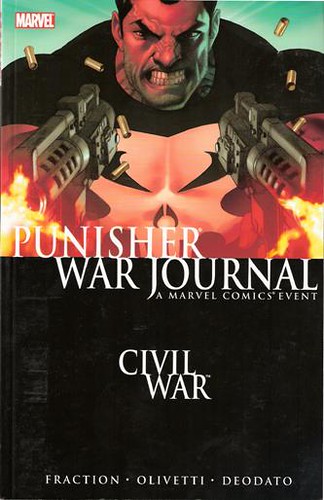 I can see part of it. There are great moments and great lines. Stuart Clarke, a robotocist and Iron Man villain, has a flock of little robot Iron Men whom he alternately terrorizes and orders to do his bidding. A groggy Spider-Man, after he has been saved from the Jester and Jack o’ Lantern (really?) by the Punisher, tells his savior he can’t pay him, and when the Punisher says Spider-Man doesn’t have to pay, Spider-Man says, “Action is my reward too.” And pretty much the entirety of issue #4 — with the exception of the presence of the Prowler and Puma (really?) — is hilarious.
 (1.5 of 5)
 Baron did more than that, though. The Punisher has always been short on recurring characters because the title has always been long on lethality. But Baron pulls together some loose ends and puts them into a four part story (#15-8) in which the Punisher goes of the Kingpin. It’s effective, it puts some emotional impact behind these characters’ fates, and it’s interesting to see those characters again.
 This one’s simple, even by Punisher standards: Wolverine and Punisher find a fabled jungle city where criminals hide from the Punisher. Death and small arms fire (not in that order) ensue.