


Avengers: The Initiative, v. 1: Basic Training
Collects: Avengers: The Intiative #1-6 (2007)
Released: 2007 November (Marvel)
Format: 144 pages / color / $14.99 / ISBN: 9780785125167
What is this?: In the wake of the disaster in Stamford, Conn., the government drafts young superhumans to train them and prevent another “New Warriors” type incident.
The culprits: Writer Dan Slott and artists Stefano Caselli and Steve Uy
I resisted Avengers: The Initiative for a long time. The stupidity of both Civil War and the issues that led up to it, combined with the “draft” of young superhumans, seemed an inexcusably stupid premise for a title. I softened my stance somewhat when House to Astonish praised Initiative and its successor title, Avengers Academy, in its year-end podcast. What finally pushed me to read Avengers: The Initiative, v. 1: Basic Training was that volumes 2 through 4 were available on Edward R. Hamilton. Ironically, although I don’t think I’ll buy those books, I did thoroughly enjoy Basic Training.
 I was worried The Initiative would hew the line, presenting a world in which the government was right, and the New Warriors — rather than the supervillians they fought — were to blame for the explosion that killed 600 people in Stamford, Conn. But I should have had more faith in writer Dan Slott. Basic Training shows us the government, whatever it says it’s interested in, is actually out for power. It might want to train young superheroes; more accurately, it’s interested in inducting and indoctrinating them. Worse, the government shows itself to be dangerously incompetent, with one hero dying in the first issue because of a trainer’s inexcusable stupidity and ignorance.
That’s not an accident — or rather, it is an accident, but it’s not an isolated incident. The government is awful, which is a given any time Henry Peter Gyrich, head stooge of the Commission for Superhuman Affairs, is around. The trainer who gets a recruit killed is not very good, which throws a different angle on the abusive drill sergeant stereotype, especially when that sergeant continually abuses the New Warriors despite several recruits (and one of his colleagues) being former members of that group. His savage beating in #6 is one of the greatest moments of visceral satisfaction I have had in the last few years of reading comics. The lab monkey for the Initiative, Baron Werner Von Blitzschlag, is a literal Nazi, who tells Hank Pym he might be a Nazi, but he was a minor one, and nothing he could do would equal the evil Pym has done. After all, Pym attacked the Avengers with a robot, made a Thor clone that killed Goliath, and created the genocidal Ultron; what Nazi wouldn’t be Pym’s fan? Which raises the unspoken question of why the New Warrior’s one tragic mistake changed the Marvel Universe but Pym creating a robot that destroyed an entire country is swept under the carpet.
The government sends innocent recruits out to kill, unprepared, and are later surprised when the recruits try to do more purely heroic actions rather than work crowd control. War Machine sends an inadequate recruit to take away Spider-Man’s powers. It covers up the death of a recruit, then covers up who beat Gauntlet. Gyrich is uninterested in developing the recruits as people, instead wanting to make them more efficient killing machines. One can say this is a cynical product of our modern age; on the other hand, it’s hard to argue the U.S. government in the Marvel Universe didn’t deserve someone saying how awful it is and how awful the pro-Registration “heroes” are.
These were things that needed to be said about the Marvel Universe, and I thoroughly enjoyed hearing them. Now: is the story that says them any good?
It’s not as good as it could be. It really does feel, at times, like Slott is sacrificing story to make his point. There is a strong core of recruits — Cloud 9, Rage, Hardball, Komodo, and Trauma — and the teachers / administrators of the Initiative have clear, well-defined roles. Each of that core of recruits has his or her own story or subplot, but unfortunately, none of them except Cloud 9 seem to click, either individually or collectively. There is no team here; it makes sense in a military point of view, but it’s a bit harder to get behind as a reader.
Harder still are auxiliary characters who float around on the periphery. I know Thor Girl, Ultragirl, and Slapstick are part of the same group of recruits as the others, but they do so little — nothing, really, until #6 — it’s hard to see why they’re there. Well, that’s not true for Slapstick, although his character design clashes with the others, as it always has. But Thor Girl and (especially) Ultragirl blend into the background of generic blonde so that they’re difficult to differentiate from Cloud 9 … or anyone I’m supposed to know. It’s especially bad in issue #6, when one of the blondes confesses to having an affair with Justice, the counselor for the recruits. I had to look on Wikipedia to find out which one it was, and I can only partially blame fill-in artist Steve Uy — if that character had had more of a presence, the utterly generic look to the character wouldn’t have been such a problem.
Uy’s work is not to my taste, but he only draws #6. He has a thin line and a manga look that I find unattractive and unassertive, and his grasp of features means most of his characters look like they’re related. Regular artist Stefano Caselli is a much stronger artist. Although the fight scenes are a little weaker than I prefer — they seem like a series of unconnected cuts rather than a coherent whole — Caselli’s character design is pretty strong (tending toward varying the character’s t-shirt, though), and he can handle interpersonal scenes without boring the reader.
I won’t lie: if you’re not a fan of young hero books or if you are not prepared to be told how stupid post-Civil War Registration plots were, then you’re not going to like this. I did, though; I liked it quite a bit. Although this is not quite as strong as it could be, it still has plenty of promise, and I will read more of this series.
Rating:  (4 of 5)
Labels: 2007 November, 4, Civil War, Cloud 9, Connecticut, Dan Slott, Gauntlet, Hardball, Henry Gyrich, Initiative, Justice, Komodo, Marvel, Rage, Slapstick, Stefano Caselli, Steve Uy, Trauma, Yellowjacket
posted by Raoul | 10:48 PM
|
0 comments

 Well, no, it wasn’t, but we’re left with the results,
  Exploring Blade’s past does lead to some interesting stories — a meeting with Wolverine, learning of how he became a vampire hunter, his training. (If you’re long-lived in the Marvel Universe, you probably met Wolverine before he became a hero. It’s just the law of averages, really.) In fact, after the first two issues, what with their rampant destruction and Latveria and Doombots, the story settles into an interesting groove.
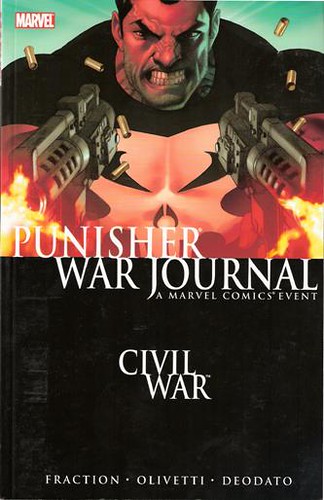 I can see part of it. There are great moments and great lines. Stuart Clarke, a robotocist and Iron Man villain, has a flock of little robot Iron Men whom he alternately terrorizes and orders to do his bidding. A groggy Spider-Man, after he has been saved from the Jester and Jack o’ Lantern (really?) by the Punisher, tells his savior he can’t pay him, and when the Punisher says Spider-Man doesn’t have to pay, Spider-Man says, “Action is my reward too.” And pretty much the entirety of issue #4 — with the exception of the presence of the Prowler and Puma (really?) — is hilarious.
 (1.5 of 5)
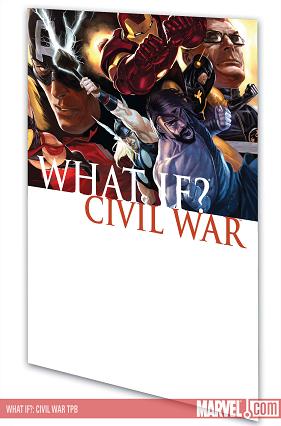 To be fair, I have not read most of the events this book uses as springboards. I didn’t care enough about Civil War, Annihilation, Planet Hulk, or (especially) The Rise and Fall of the Shi’ar Empire to read the originals, but I know enough about them that only Shi’ar Empire was slightly confusing. I have read Spider-Man vs. Wolverine, but that was from the mid ‘80s.