Reviews of trade paperbacks of comic books (mostly Marvel), along with a few other semi-relevant comments / reviews.

04 January 2010

2009: A Musical / Dancing Review

2009 is four days gone now. Good riddance, I say. I don’t think I’ve ever been so glad to see the back of a year as I am for 2009. And I’m not sure why, exactly. Maybe it’s the long-term gloom and doom of financial crises and greed, swine flu, and terrorism. Maybe it’s because I tried to work a home-improvement project into my schedule during December as I was also preparing for Christmas and guests. Maybe I’m just bitter. Maybe it was endless crossovers and events from Marvel and DC …

Yes, that last one sounds appropriate.

But before we give 2009 a final swock to the nuggets, I decided to look through my year’s worth of reading and point out the best of my year. (Yes, I know some — many — of these didn’t come out in 2009. I don’t care. If you want timeliness, go somewhere else.) So here are the top 5s, in Marvel (which is most of what I read) and non-Marvel lists:

Marvel:

5. Guardians of the Galaxy: Legacy (4): Emerging from a crossover I didn’t care about, a bunch of characters I was only vaguely aware of were stuck in a team book that seemed to be heading for permanent crossover events. But somehow the first volume worked, and worked well.

4. Mini Marvels: Secret Invasion (4): The 2009 collection of Chris Giarrusso’s Mini Marvels wasn’t as good as the 2008 version (Rock, Paper, Scissors), but it’s still hilarious. You should all go out and buy the recently released Mini Marvels Ultimate Collection.

3. Hood: Blood from Stones (4): This book, which features the Hood’s origin, showed why Brian Bendis was so eager to use the petty crook turned superpowered antihero. It also showed Bendis didn’t care about what made Blood from Stones so good.

2. Incredible Hulk: Planet Hulk (4.5): A sprawling, over-the-top action movie of a comic, Planet Hulk made the Hulk interesting for the first time since Peter David left. And then Hulk was promptly handed to Jeph Loeb, who gave us Red Hulk. Way to capitalize, Marvel.

1. Age of the Sentry (4.5): Marvel’s answer to DC’s Silver Age Superman nonsense, recounted with a knowing wink and smile — but never to the detriment of the character.

Non-Marvel:

5. RASL: The Drift (4): Jeff Smith’s story about a scientist / thief who penetrates alternate realities has me eager for more. Compare this to Casanova, which also has thievery and alternate realities; Casanova threw so much high concept at the reader I was screaming for it to stop, but RASL’s slow pace has me intrigued. On the other hand, RASL’s publication schedule will mean I’ll probably remain intrigued for quite a while.

4. Promethea: Collected Edition, Book 1 (4.5): Although I wasn’t as excited by the next two volumes of Alan Moore and J.H. Williams III’s coming-of-age / metafiction comic, this one had me eager to read the rest of Sophie Bangs’s adventures.

3. Usagi Yojimbo, v. 23: Bridge of Tears (4.5): I was greatly anticipating the only new Usagi Yojimbo reprints of the year, and Stan Sakai didn’t disappoint. Of course, Sakai and Usagi never disappoint.

2. Tales Designed to Thrizzle, v. 1 (4.5): Michael Kupperman’s absurdist masterpiece nearly snuck by me, but I was glad I found it. Now I too know the majesty that is Snake ‘n’ Bacon.

1. Maus: A Survivor’s Tale: My Father Bleeds History (5): A classic for a reason — Art Spiegelman tells a story of one family’s collision with the Nazis and the Holocaust movingly, using not-so-funny funny animals, without making the protagonists perfect saints.

Honorable mention should go to The Essential Batman Encyclopedia (4.5) by Robert Greenberger as the outstanding comics reference book I read this year. Of course, I only reviewed two reference books, but that shouldn’t take away from the impressiveness of the book.

Reviews will resume on Friday. Here’s hoping 2010 will knock the sour taste 2009 left out of our mouths!

Labels: , , , , , , , , , , , ,

01 July 2009

Incredible Hulk: Planet Hulk

Collects: Incredible Hulk # 92-105, Giant-Size Hulk #1, Amazing Fantasy v. 2 #15 (2006-7)

Released: June 2007 (Marvel)

Format: 416 pages / color / $39.99 / ISBN: 9780785122456

What is this?: Hulk, exiled by not-so-smart guys, smashes a whole new planet.

The culprits: Writer Greg Pak and pencillers Aaron Lopresti and Carlo Pagulayan

I’ve said in other reviews that I am a fan of the Hulk because of his changeability, his not being tied to New York City or the same superhero ethos of his Marvel brethren. The Hulk does stranger things than the other heroes; even Marvel’s scientist-explorers, the Fantastic Four, confront the world through rationality and scientific inquiry. The Hulk has no such schema to help him; he’s just as bewildered wherever he goes, and brother, he sees some bewildering things. It can make even a repetitive Hulk adventure mildly enjoyable.

Then there is Incredible Hulk: Planet Hulk. Hulk has been exiled to another planet by people who should be smarter; unfortunately, he doesn’t end up on the planet he was aimed at, falling instead on Sakaar, a world ruled by a despotic emperor, where gladiatorial combats are a popular entertainment. The Hulk is taken into slavery when he arrives, and of course, after slavery comes the gladiatorial combats.

Incredible Hulk: Planet Hulk coverYou can guess what’s coming next.

Writer Greg Pak guides the Hulk through this alien setting, with the Hulk meeting aliens from all over the Marvel Universe (plus new species). Weird new settings is Hulk’s forte, and certainly, the Hulk is the star of the show. Pak does an excellent job taking him through an emotional range that in earlier incarnations might have been overlooked. But the other aliens in his army — his Warbound — are interesting in their own right, each with their own personality and story. The Hulk swaggers through the story, smashing and creating havoc, but it’s his fellow gladiators who hold the story together.

It’s an amazing story, really: more than a year dedicated to one Hulk story with a large scope, from slavery to revolution to remaking a world. To a certain extent, such a thing couldn’t have been done before. Before Peter David, such extended storylines — more than a year on a single non-Earth planet — would have been a difficult sell (although Bill Mantlo did a long story about a mindless Hulk stranded at the crossworlds of reality, it traveled through several different settings). David’s long run could have had such a story, but David favored humor over the stark, violent world that Planet Hulk embraces. (Not that David couldn’t have done something similar, but it would have been an odd fit.) And the less said of the Bruce Jones run, the better.

Pak has created an entire new world for the Hulk to play in. He uses some of the established parts — the Brood, the Stone Men of Saturn that Thor fought in his origin — but the world of Sakaar is imaginative and detailed, as the appendix describing the history, society, creatures, and technology of Sakaar show. Pak has created a world that is a hodgepodge, and then he and the artists let their imagination go wild.

Both Aaron Lopresti and Carlo Pagulayan are up to the task. They both do excellent work, and their styles mesh well together. I prefer Lopresti’s work by a small margin, but both are imaginative, producing detailed work on one page and sweeping vistas on the next. Marvel scored a coup here, finding not one but two artists who could put into pictures what they and Pak imagined.

It’s hard for me to say how much I like Planet Hulk. Rarely do I read such a large superhero story and find it interesting; even more rarely am I absorbed by it. Planet Hulk is that story. It’s not perfect — the “Mastermind Excello” story at the end is a confusing trailer for the next story, and there are times the plot seems to wallow in misery for the purpose of making the story grittier. But Planet Hulk is among the best of the Hulk stories ever — certainly the best of the last decade, standing alongside the best of David’s run.

Rating: Hulk head Hulk head Hulk head Hulk head Half of a Hulk head (4.5 of 5)

Labels: , , , , , , ,

12 August 2008

What If?: Civil War

Collects: What If?: Civil War, What If?: Planet Hulk, What If?: Annihilation, What If?: Rise and Fall of the Shi'ar Empire, What If?: Spider-Man vs. Wolverine (2007-8)

Released: June 2008 (Marvel)

Format: 168 pages / color / $16.99 / ISBN: 9780785130369

First of all, What If?: Civil War is a misleading title. A more accurate title would be What If?: Recent Events / Crossovers. An even more accurate title would be What If?: We Changed Recent Events to Kill More Heroes.

Second: merely asking What If? isn’t good enough. You have to have an interesting answer.

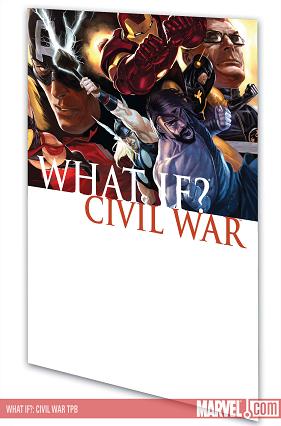
What If?: Civil War cover To be fair, I have not read most of the events this book uses as springboards. I didn’t care enough about Civil War, Annihilation, Planet Hulk, or (especially) The Rise and Fall of the Shi’ar Empire to read the originals, but I know enough about them that only Shi’ar Empire was slightly confusing. I have read Spider-Man vs. Wolverine, but that was from the mid ‘80s.

So I’m not the ideal audience. Still, I’ve read enough comics to know good ones when I’m given one for free, and this isn’t it. (Although it was free. Thanks, Diamond!) The main Civil War and Planet Hulk stories feature one of the most common What If? tropes: one thing changes, everybody dies. The body count in Annihilation is much lower, but so much is crammed into the story that it stops being a story — it’s more a retelling of fictional history. I’m not objective about Shi'ar Empire; the extension of Ed Brubaker’s massive retcon (no, the other one, the one without Bucky) leaves me cold. Suffice to say, there’s a lot of bloodshed in that one, with heroes dying (and Polaris being reduced to a pile of green hair) in a consequence-free environment.

The best of the lot was Spider-Man vs. Wolverine. I don’t believe Spider-Man would drift into the spy world, but at least it’s a full story, a real story, with a beginning, middle, and end. It’s competently told, with recognizeable motivations and characters. It works, in What If? terms, and writers Jeff Parker and Paul Tobin deserve a lot of credit for not succumbing to the temptation to ramp up the body count and change everything.

The backups are also not bad; the Civil War one works for no other reason than it serves as a rebuke to the stupidity of Civil War. Greg Pak — who wrote all the Planet Hulk stories — does well with his two low-key backups. The first has Banner and Hulk squabbling over the peaceful planet the Hulk was supposed to land upon; the second, a one-page joke with Fred Hembeck art, made me chuckle.

As for the whole package, it’s less than the sum of its parts. Different writers, different artists, characterizations (intentionally, to be fair) all over the place … I don’t think this could satisfy the casual reader. I’m not sure a casual reader would even pick this up, though.

Rating: Marvel symbol (1 of 5)

Labels: , , , , , , , , , , ,