Reviews of trade paperbacks of comic books (mostly Marvel), along with a few other semi-relevant comments / reviews.

28 December 2012

Alpha Flight: The Complete Series by Pak and Van Lente

Collects: Alpha Flight #0.1, 1-8 (2011-2)

Released: May 2012 (Marvel)

Format: 208 pages / color / $29.99 / ISBN: 9780785162834

What is this?: The original Alpha Flight team is back, battling a government seemingly gone mad and a traitor from within.

The culprits: Writers Greg Pak and Fred Van Lente and artists Dale Eaglesham and Ben Oliver


I wanted to like Alpha Flight: The Complete Series. I like Alpha Flight, as a team. The writers, Greg Pak and Fred Van Lente, have produced books I’ve liked, such as their Incredible Hercules run. And in this series, Pak and Van Lente reunite Alpha Flight’s classic lineup in its own book for the first time since the John Byrne run.

But it’s tough to recreate greatness a quarter century on. The characters, creators, and readership have all changed. The title changed a great deal after Byrne left, with writers such as Bill Mantlo, James Hudnall, and Simon Furman guiding Alpha Flight for more than 100 issues. After the original series ended, Alpha Flight was relaunched twice: a Steven Seagle / Duncan Rouleau conspiracy story and a critically lambasted Scott Lobdell run. What “Alpha Flight” means changed, so much so we forget the original lineup existed for single issue. Characters have been killed, brought back to life, and killed again. In fact, the last time I checked, everyone starring in this book was dead. Marrina had been dead for decades, killed in Avengers in 1986. Northstar was killed by Wolverine as cheap carnage in 2005’s Enemy of the State. The rest died between panels because Brian Bendis said so.

Alpha Flight: The Complete Greg Pak and Fred Van Lente Series coverUnfortunately, there’s no explanation of how Guardian, Vindicator, Sasquatch, Shaman, or Marrina came back to life. (Puck says he escaped from Hell, which at least acknowledges that he died.) Maybe it has something to do with the Fear Itself crossover, which manifests itself in this book as people running around with anime-sized hammers. A little research reveals the Chaos War storyline allowed the team to return, but The Complete Series doesn’t explain the link or mention either crossover. And even invoking Chaos War doesn’t explain how dead liaison / traitor Gary Cody had time to build a political career. And hey — did you know Guardian and Vindicator had a kid? It’s true! And they lost custody to Heather’s cousin? Also — apparently — true. Is it too much to ask for footnotes so I know Pak and Van Lente have created and what they have been saddled with? I don’t think so. Footnotes are your friend. They’re everyone’s friend, and I missed them very much in The Complete Series.

Pak and Van Lente mix the old with the new, which sounds like a good idea but is troublesome in practice. Alpha Flight’s arbitrariness is the main problem with the series. The characters seem to return from the dead for no reason, their personalities plucked from someplace in their histories. The writers have brought some characters back to their roots, regressing them. Sasquatch flirts with Aurora, who still battles her multiple personalities. Despite years with Alpha Flight and time with the X-Men, Northstar is still not a joiner. Puck is still exuberant, although he’s a bit mad now. Snowbird is still slightly imperious and slightly distant, and Shaman is still Shaman. But Marrina is recast into a violent, moody teenager coming to grips with her alien nature. Sasquatch loses his powers, and when he reacquires them, he has a Hulk-like personality. The Purple Girl has grown into the Purple Woman, taken fashion cues from Carmen Sandiego, and become a terrorist.

This mix of progression and regression is bothersome. Aurora, Northstar, and Sasquatch have lost years of development by returning to their factory-new states. It feels like the writers are casting around for a hook for these characters and settling on what’s been done before. Marrina’s new personality is a distraction. As a new character, she might have been entertaining; however, the contrast with who she was is jarring, especially since readers did not see the transition between personalities. And Shaman and Snowbird are both characters who should have something to say to Guardian about the loss of a child, but neither do; this seems less a lost opportunity and more of Van Lente and Pak casting aside or forgetting who Shaman and Snowbird are.

The villains’ plot — which involves mind control — does not help matters, especially given how extreme some of the actions Vindicator takes while controlled are. Aurora, switching between personalities and loyalties on a whim, exemplifies the lack of a core these characters have. Even the familiar characters feel off. Characters can only be remolded so much before they lose the shapes we liked, and I think that’s the case here.

The plot, which involves a Canadian government being controlled by the Master of the World, doesn’t feel like an Alpha Flight plot. Or — to be more accurate — if feels like a generic superhero plot that was roughly customized for Alpha Flight. The government takeover feels too over the top, with mass arrests of the opposition party and the press stretching credibility. The Master is an excellent choice for a foe, but he rarely feels engaged with the heroes, and his end goal — creating a race of humans who will conquer the universe — is power mad but delightfully without a point. Why conquer the universe? You might as well ask why he’s using a Wendigo as an operative. Because it’s something to do, I suppose; it’s always tough to keep busy when you’re immortal.

I enjoyed Dale Eaglesham’s art. It is attractive, and the characters are expressive without comically mugging. His illustration of the Master’s origins, drawn in a child’s style to convey that it is being told to Vindicator and Guardian’s daughter, is especially endearing. I’m not wild about Marrina’s new and occasionally mutating costume, but it’s not like her old costume — a one-piece swimsuit — was worth saving. I’m less enamored of Ben Oliver’s work on #0.1, although that may be the colorist’s fault — the painted-style colors makes everything look flat.

It’s ironic that Pak and Van Lente’s back-to-basics approach gives Alpha Flight an unsettling unfamiliarity. But the writers’ blithe attempts to take the team back to its beginnings leaves me at a loss; are these the characters I’ve enjoyed reading about? By the end I have to say no, even if they have the same names and appearances.

Rating: Alpha Flight symbol Half Alpha Flight symbol (1.5 of 5)

Labels: , , , , , , , , , ,

25 March 2011

Incredible Hercules, v. 5: The Mighty Thorcules

Collects: Incredible Hercules #132-7 (2009)

Released: April 2010 (Marvel)

Format: 152 pages / color / $14.99 / ISBN: 9780785136774

What is this?: For the good of Asgard, Hercules is asked to impersonate the Mighty Thor; Amadeus Cho, seventh-smartest person on the planet, investigates the mystery of the town of Excello.

The culprits: Writers Greg Pak and Fred van Lente and art by Reilly Brown and Rodney Buchemi

When I started reading Incredible Hercules, Incredible Hercules, v. 5: The Mighty Thorcules was what I was expecting.

Mighty Thorcules is, first and foremost, funny. At times, it’s hilarious, as when Hercules mocks the origin story of Thor or gives Thor a purple nurple (complete with the sound effect “NURP” in purple letters) during their fight. But it also continues the story of boy genius Amadeus Cho, confronting the architects of his woes, coming to grips with his parents’ deaths, and trying to get answers about where his sister is. However, writers Greg Pak and Fred van Lente manage to leaven Cho’s emotional adventure with humor, and there is a serious side to Hercules’s impersonation of Thor.

Incredible Hercules, v. 5: The Mighty Thorcules coverThe issues in Mighty Thorcules alternate between Hercules’s masquerade in Svartalfheim and Cho’s investigations in the soap-company town of Excello, Utah. Hercules’s story is far more enjoyable and lighthearted; with his father Zeus (reverted to a pre-teen appearance and without his memory) in tow and without the wise advice of Cho or Athena, Hercules moves through the plot with his usual straightforward, stupid, lusty verve. He shrugs off his father’s insults as best he can, despite how obvious it is that Zeus prefers the god Hercules impersonates. Zeus’s amnesia and disgust at Hercules’s “ingenious” plans — such as his answering the challenge of three-dimensional chess by simply knocking the board over, rather than actually trying to figure out the answer — allows the boy-god to serve as a comic foil for the Lion of Olympus.

I missed volumes 3 and 4 of Incredible Hercules, but it’s easy to understand the dramatic elements to this humorous story — Hercules’s battle for parental approval. Cho’s story suffers, however, from the lacuna; his quest is interrupted in my mind, and his character development is more dramatically affected. His final confrontation with Dupree and his coming to grips with his parents’ death are sapped of some of their emotional impact because I’ve missed some of the stories. Still, Pak and van Lente can’t be blamed for that, and I had no trouble following the story. The writers can only be concerned with the coherence of each individual story and the emotional impact of total story they have written.

To bring Cho’s story to a head, then, Pak and van Lente have to write the mental confrontation of Cho and Pythagoras Dupree, the six-smartest person in the world, in a way that isn’t dull, and they succeed. They also give artist Rodney Buchemi the opportunity to draw something more interesting than talking heads. Using a role-playing game as a way of expressing the confrontation between Cho and Dupree in the middle of Cho’s story was an excellent idea as well.

(One word about the Mastermind Excello RPG: I could not figure out what the mechanics are for dice rolls. Are you supposed to roll high? Low? Given the artwork, it could be a callback to the charming but confusing mechanics of 1st edition D&D, where the desirable outcome varied depending on the type of roll.)

Whoever is putting in the sound effects for the battle between Hercules and Thor — most likely either van Lente and Pak or letterer Simon Bowland — obviously was having a lot of fun. Besides the purple “NURP” when Herc gives Thor a double tittie twister, Thor’s boot to Herc’s groin is labeled with the sound “NUHHKRACK,” and his follow-up wedgie is labeled “HWWWWEDGIE.” Other sound effects include “SHOKKAKAAAAAN” (thunder); “WHATTAMANNNN,” “THORRRRULZ,” and “BACKATCHA” (Thor’s punches); and “SUKKKAPUNCH,” “GODDATHUNDAAA,” and “GOTCHAGAAAIN” (Hercules’s). The battle is ended when Zeus dispatches Malekith’s minion with a resounding “MALEKRUNCH.”

Each storyline has its own artist. Herc’s story is penciled by Reilly Brown, and I have to say I love his art. Brown is great with comedy; his characters are expressive, with the humorous story allowing each character broad reactions to the situation. His style is clean and extremely attractive — I’ll admit, it’s exactly the comic art style I have a great fondness for. His fight scenes are clear, and the battle between Thor and Hercules is outstanding: he manages to balance the humor with the power the two combatants throw at one another. Buchemi is also very good, and his style, although obviously different from Brown’s, goes well with his fellow artist’s. Buchemi gets the better design challenges, with the bifurcated nature of Dr. Japanazi and his servants and the Boltzmann brains, and he makes them very memorable. The RPG materials he draws also look like old RPGS (mostly by aping 1st edition D&D, as I mentioned), and there are occasional nice details I didn’t pick up on the first time I read Mighty Thorcules (the “0” and “1” on the different halves of Dr. Japanazi’s skull, the dead member of the Junior Genius Brigade from the RPG adventure lying outside Dupree’s real lair). I didn’t like his work as well as Brown’s, however; his art seems less consistent than Brown’s, and when he draws Cho and Dupree as young children, they look roughly the same (other than glasses and a slight difference in hairstyle) despite their different ethnicities.

Mighty Thorcules is an outstanding book, and not only is it worth reading, it was worth reading the first two volumes of Incredible Hercules to get to it. (And now I’m going to have to track down Love and War and Dark Reign; I’m eager to read v. 6, Assault on New Olympus, which was set up in Thorcules by promising a scuffle between Spider-Man and Hercules over Herc’s ex-wife, Hebe.) Mighty Thorcules is even a great value — six issues for $14.99 is a good deal at Marvel these days.

I find it hard to recommend Mighty Thorcules enough.

Rating: Marvel symbol Marvel symbol Marvel symbol Marvel symbol Half Marvel symbol (4.5 of 5)

Labels: , , , , , , , , , , ,

11 March 2011

Incredible Hercules, v. 2: Secret Invasion

Collects: Incredible Hercules #116-20 (2008)

Released: February 2009 (Marvel)

Format: 128 pages / color / $14.99 / ISBN: 9780785128298

What is this?: The gods of the Hu-mans take on the gods of the Skrulls when the Skrulls invade Earth.

The culprits: Writers Greg Pak and Fred van Lente and penciler Rafa Sandoval

I’m not sure why I feel as I do about Incredible Hercules: Secret Invasion: I’m JUST not convinced that it’s a good book.

Like with the previous volume of Incredible Hercules, I want to like Secret Invasion. Writers Greg Pak and Fred van Lente have their protagonists down by now. Boy genius Amadeus Cho and god idiot Hercules make an amusing team, with Hercules getting the best lines this time. Hercules comes into his own this issue, boiling situations down to their simplest form and coming up with pithy analysis: “I punch stuff, and it falls down!” he says at one point. “That’s the only ‘strategy’ I’ve ever needed!”

Incredible Hercules: Secret Invasion coverOf course, that strategy raises an interesting point: Hercules is put in charge of the band of gods that assault the Skrull gods, just as the Skrull invasion begins in earnest on Earth. Why does Athena choose Hercules to lead the rather paltry expedition? It’s never made clear. Perhaps it’s to teach Hercules a lesson, which could be made clear in later volumes of the Incredible Hercules series. But it feels like Herc got the job because he’s the title character. Ajak, an Eternal, points out Hercules’s many flaws as the final battle begins, and he would have made a much better choice. Two other members of the “God Squad” might have been better leaders, but neither the evil Mikaboshi nor the God-Eater could be trusted.

I was happy to see the other member of the team, Snowbird. A longtime member of Alpha Flight, Snowbird doesn’t get many guest appearances these days. But fans of Alpha Flight will be happy to see how she deals the murderer of Alpha Flight, and she does come across as the only member of the God Squad other than Mikaboshi who has a plan other than punching. (Ajak complains about Hercules, but his plan boils down to “use energy beams until it falls down”). The relationship between Snowbird and Hercules takes a surprising and not welcome turn, but the reactions of both heroes is satisfying enough for me to grant them some leeway. Although I must ask: can any female resist Hercules’s masculine wiles? I’m going out on a limb and saying only Athena. And Hera.

I don’t feel like giving any leeway to the phrase “God Squad,” though. It feels too knowing. I’m glad Hercules stopped Cho from using “Godmobile” more than once, though. On the other hand, Cho names his pup “Kirby,” ostensibly a shortening of “Kerberos,” the name of the three-headed dog of Hades. The name makes sense, but does the Marvel Universe need yet another tribute to Jack Kirby? (I know some — many? — readers will say “yes,” which should teach me to ask rhetorical questions.)

For some reason, Cho got on my nerves in Secret Invasion. The cutesy names are just part of it; Cho is completely out of his depth in a world of gods and is often wrong, but he rarely admits it. He never loses his attitude, which is fine — even endearing — when he’s right, but when he’s doing nothing, it’s unlikeable. His most valuable contribution to the expedition, to use his words, is to “do nothing,” which is bizarre; Hercules is a bad leader, so why can’t Cho help him with that?

Perhaps part of the problem is that this is part of the Secret Invasion crossover. There’s nothing Cho can do to sniff out Skrulls, after all. But in a larger sense, the crossover seems to highjack Cho and Hercules’s plotline. It seems random that the Skrull gods would need to be fought — we’ve never seen Earth’s deities battle alien pantheons in other large crossover events, have we? — and stranger that Cho would need to be along. But that does seem to be the best way to tie Hercules and his cast into the crossover, so away they go! Evidently, attendance in this crossover was mandatory. Oh, how I wish Hercules could have gotten out of it with a letter from Asclepius.

The only saving grace I saw in the Secret Invasion crossover is that it allowed the writers to show why Hercules might be reluctant to have a young sidekick. While Hercules was part of the Argo’s journey for the Golden Fleece, his young friend Hylas was kidnapped by a nymph, which caused Hercules to go on a rampage and forget about the quest he was on. Van Lente and Pak keep the mythological references that I enjoyed in Against the World, although they are not integrated into the structure of Secret Invasion as they were previously.

The art by Rafa Sandoval gives me a headache. Not so much for Sandoval’s contributions, really, but because colorist Martegod Gracia gives the book a green-gray tint — Skrull tone, I suppose. It murks up Sandoval’s work, which is unhelpful, and it’s an unpleasant tint to begin with. I like Sandoval’s work during the first three issues, which are mainly talking heads and a few small-scale fights. Unfortunately, the large fights, with the five gods battling against the gods enslaved by the Skrull pantheon, are hard to parse. The coloring really did not help here, as it frequently made it difficult to decipher the details necessary to make out what was going on.

I feel my rating is a little harsh. There really isn’t that much to dislike about this book, but I feel it’s a step back from Against the World. The psychological darkness is dialed back, the fluidity of the plot is sacrificed for a crossover, and the characters include two evil gods and a snarky child. The colors are unattractive, the logic is odd, and I’m sick of Skrulls, who do little in the entire crossover and nothing here.

Rating: Marvel symbol Marvel symbol Half Marvel symbol (2.5 of 5)

Labels: , , , , , , , , , , , ,

25 February 2011

Incredible Hercules, v. 1: Against the World

Collects: Incredible Hulk #112, Incredible Hercules #113-5, and Hulk vs. Hercules: When Titans Collide (2008)

Released: September 2008 (Marvel)

Format: 136 pages / color / $14.99 / ISBN: 9780785125334

What is this?: After helping Hulk during World War Hulk, Hercules and his genius sidekick Amadeus Cho go on the lam from Ares and SHIELD.

The culprits: Writers Greg Pak and Fred van Lente and penciler Khoi Pham

Incredible Hercules is an Internet darling — the kind that reviewers love, but comic book buyers do not. A large measure of credit has to go to the co-writers: Greg Pak and Fred van Lente also pop up in very positive reviews for their work other than Hercules. I myself certainly enjoyed Pak’s Planet Hulk, a sweeping, emotional comic-book epic about the Hulk as a gladiator. I had mixed feelings about the only non-Herc work I’d seen from van Lente, Super-Villain Team-Up: MODOK’s 11, but I have not read his most praised work on Marvel’s all-ages lines.

Although I was unimpressed by the first TPB in this series starring Hercules, Incredible Hercules: World War Hulk, I gave it a pass because it was part of a massive crossover and because van Lente wasn’t involved. I figured Incredible Hercules, v. 1: Against the World was the book I should base my opinion of the series on.

Incredible Hercules: Against the World coverThe good news is there is nothing about Against the World that is as forgettable or regrettable as World War Hulk. Pak and van Lente make Hercules and his sidekick Amadeus Cho into memorable and fun characters. There is a lightness to their dialogue and interaction occasionally cut by the darkness of the characters, giving them some depth. Hercules’s history, both classical and Marvel, are mined to help the story along; Wonder Man and Black Widow get a few good lines as well. And the villain, Ares, got the only laugh-out-loud lines in the book, ranting at and doggedly pursuing Hercules and his sidekick (but mainly Hercules).

Despite the humor, despite the somewhat standard superheroics, Against the World is more morally complicated that standard superhero fare. (Especially if you take it for granted that Iron Man in Civil War was a cryptofascist trampling on basic American rights.) Hercules is a Greek god who doesn’t share exactly the same ethos as modern Americans — or at least he didn’t when he was in the business of myth making. He is, as Ares calls him, the god of bad decisions. He drinks, he sleeps around, and he has a proclivity to rampage blindly. He makes a poor role model, to say the least; if there is a more competent hero to play watchdog, then he can at least be aimed in the right direction. But Herc’s sidekick is Amadeus Cho, the seventh-smartest person on the planet and a teenager. Frequently he’s too smart for his own good, blind to his own irrationalities, such as his unstinting admiration for the Hulk and Hercules and his own vengeful side.

Van Lente and Pak play with Hercules’s classical mindset, using his “mythological” exploits as the basis for Hercules’s hallucinations or as parallels to his modern adventures. I appreciate not only using those stories to fill out the character of Hercules — generally portrayed in the past as a two-dimensional, good-natured brawler — and to give a reason why he uses that name rather than his Greek name, Herakles. But changing the reasoning and chronology of Herakles’s twelfth labor makes me uneasy … yes, it helps make Hercules more morally ambiguous, but if a writer uses the myths selectively (and has Herc equivocate about whether the story he tells is true), then it weakens the totality of the myths. That is, if the reasoning behind why Hercules engages in his labors is flawed, then can we trust the stories of the labors themselves? I don’t like classical literature undermined in this way.

I’m not sold on the art by Khoi Pham, who draws the first four issues. I wanted to say positive things about his work, and I like his overall style. But at some moments in the story, he seems to focus in too far — on a face, on a certain character — and loses the overall storytelling of the scene. The final issue, Hulk vs. Hercules: When Titans Collide, has art from four different pencilers: Pham, Eric Nguyen, Reilly Brown, and Bob Layton. Pham’s work is a brief framing sequence. Nguyen does a five-page sequence that gives the background to the story and looks nothing like the rest of the book; it definitely is reminiscent of Bill Sienkiewicz, although the colors are washed out. Layton’s two pages are of Hercules wrestling the Thing and other Unlimited Class Wrestling Federation contenders in a charity match; I didn’t realize Layton was so closely associated with the UCWF, but perhaps I just wasn’t paying enough attention. The bulk of the issue is by Brown, who draws in a clear, dynamic style.

I wanted to like Against the World more than I did. It has a few jokes, but it’s not often laugh-out-loud funny; it succeeds at amusing. The characters are endearing, except when they show their dark sides. The myths are nicely integrated into the story, except when they hold up a sign that directs the readers’ attention to how they aren’t supposed to be integrated into the story. It’s better than serviceable, better than average. It is frequently, but not always, entertaining. But it if I hadn’t had two other volumes of the series waiting on my bookshelf, I don’t know if I would be reading more.

Rating: Marvel symbol Marvel symbol Marvel symbol Half Marvel symbol (3.5 of 5)

Labels: , , , , , , , , , ,

07 July 2009

Incredible Hulk: Incredible Hercules

Collects: Incredible Hulk #106-11 (2007)

Released: May 2008 (Marvel)

Format: 152 pages / color / $14.99 / ISBN: 9780785129912

What is this?: Amadeus Cho, the seventh-smartest person on the planet, gathers a ragtag bunch to save the Hulk and prove he’s not a killer.

The culprits: Writer Greg Pak and pencilers Gary Frank, Leonard Kirk, and Carlo Pagulayan

The follow-up to Planet Hulk, which ran from Incredible Hulk #92-105, should logically run in Incredible Hulk #106-111. That just makes sense, right? Of course.

But Hulk: The Incredible Hercules, which reprints those issues, is not the logical continuation of the story. No, sir. That story is too big to be continued in Incredible Hulk, instead getting its own miniseries, World War Hulk.

So Incredible Hercules can’t tell the main story. What’s left for it to do? Tell a story in which the Hulk is a secondary character — maybe even tertiary. Bold! Daring! Perhaps incredibly stupid!

Hulk: Incredible Hercules coverThe protagonist is teenager Amadeus Cho, the “seventh smartest person in the world,” who can take out tanks with a pebble. Thanks to a chance meeting with the Hulk before Planet Hulk, Cho is certain the Hulk isn’t a monster; to prove it, he gathers a team including Namora and former Champions Angel and Hercules. They hie themselves to New York to stop Hulk from committing atrocities or maybe verify he isn’t doing so.

Writer Greg Pak has to be certain not to tread on the toes of the main story. He can reference Hulk destroying New York or capturing the heroes who shanghaied him to a gladiator planet or taking out Sentry, but he can’t delve into it as fully as one might want. He has to stay on the periphery of the story. Cho is his vehicle to do this, leading his team to prevent New York from blowing up and convincing the Hulk he’s not a monster. The estimate of Cho’s intelligence seems entirely too low; if he were a supervillain, he would be entirely too effective. Cho’s character is that of an irritant: he’s so smart he thinks he knows better than everyone else, and the most annoying thing is he’s right. It’s fun to watch him run mental rings about Angel; Hercules certainly thinks so too.

The pacing is entirely off. It takes Cho two issues to get to New York and confront Hulk, and the next (#108) is wasted on contrasting the attitudes of Rick Jones and Miek, the Hulk’s first and latest sidekicks. The issue feels like filler, a needless flashback, and it saps the momentum of the story: the conflict has been launched, and then Pak presents readers with two opposing visions of what the Hulk is, a philosophical argument in text boxes. Never mind that neither Rick nor Miek makes an important contribution to Incredible Hercules; their views are put forward as credible and significant. (NOTE: After writing this review, I learned the conflict between these two is important in the main World War Hulk story. Given that I had no idea about the tie-in, I have to feel this element of the story is a failure.)

The second half is divided between saving the collapsing rubble that is New York, Cho arguing with Hulk over the Hulk’s essential nature, and absorbing the spillover from World War Hulk. Either of the first two could have been an effective story, given the space and development afforded by this book. But with three issues to work with, and working with that spillover, there’s not enough room for any of those threads to support significant interest.

So the overall story is weak and disjointed. Does this work to launch the book in its new direction, a Cho / Hercules team up? Yes and no. Cho is definitely developed enough in the book, and although he’s an annoying little know-it-all, I could see him as a sidekick / partner in a book. However, Hercules is just one of his teammates, despite getting cover billing — perhaps the supporting character with the most screen time, but without anything other than a willingness to listen to Cho and an ability to believe the best in Hulk to distinguish him. This book doesn’t make me want to read a Hercules solo book. It doesn’t make me want to read a Cho book, for that matter; he’s just too annoying.

A sign of Incredible Hercules’s second-rate status is in the art: pencils are divvied equally between Gary Frank, Leonard Kirk, and Carlo Pagulayan. Marvel can’t even be bothered to make them in sets of two; Frank has the first two issues, then one by Kirk, two by Pagulayan, then the final issue by Kirk. They’re all good artists with connections to the characters — Pagulayan worked on Planet Hulk, Frank worked on several Incredible Hulk issues during the Peter David run, and Kirk is the definitive modern artist of Namora, given his work on Agents of Atlas. Still, three pencilers in six issues is never a good sign.

Despite the book’s many flaws, I can’t deny there are more than a few fun moments, with Cho’s calm contrasting against the panic of Angel and others. Although I don’t think Hercules is a strong enough character to deserve his name in the title, Pak does seem to have a soft spot for him, giving him the larger-than-life good cheer and brawling nature that has marked his appearances and adding a strong, stubborn streak of loyalty to both Cho and the Hulk.

There are some small gems in here. This story can’t support itself; to be mine those gems, you have to also read World War Hulk.

Rating: Hulk head Hulk head (2 of 5)

Labels: , , , , , , , ,

01 July 2009

Incredible Hulk: Planet Hulk

Collects: Incredible Hulk # 92-105, Giant-Size Hulk #1, Amazing Fantasy v. 2 #15 (2006-7)

Released: June 2007 (Marvel)

Format: 416 pages / color / $39.99 / ISBN: 9780785122456

What is this?: Hulk, exiled by not-so-smart guys, smashes a whole new planet.

The culprits: Writer Greg Pak and pencillers Aaron Lopresti and Carlo Pagulayan

I’ve said in other reviews that I am a fan of the Hulk because of his changeability, his not being tied to New York City or the same superhero ethos of his Marvel brethren. The Hulk does stranger things than the other heroes; even Marvel’s scientist-explorers, the Fantastic Four, confront the world through rationality and scientific inquiry. The Hulk has no such schema to help him; he’s just as bewildered wherever he goes, and brother, he sees some bewildering things. It can make even a repetitive Hulk adventure mildly enjoyable.

Then there is Incredible Hulk: Planet Hulk. Hulk has been exiled to another planet by people who should be smarter; unfortunately, he doesn’t end up on the planet he was aimed at, falling instead on Sakaar, a world ruled by a despotic emperor, where gladiatorial combats are a popular entertainment. The Hulk is taken into slavery when he arrives, and of course, after slavery comes the gladiatorial combats.

Incredible Hulk: Planet Hulk coverYou can guess what’s coming next.

Writer Greg Pak guides the Hulk through this alien setting, with the Hulk meeting aliens from all over the Marvel Universe (plus new species). Weird new settings is Hulk’s forte, and certainly, the Hulk is the star of the show. Pak does an excellent job taking him through an emotional range that in earlier incarnations might have been overlooked. But the other aliens in his army — his Warbound — are interesting in their own right, each with their own personality and story. The Hulk swaggers through the story, smashing and creating havoc, but it’s his fellow gladiators who hold the story together.

It’s an amazing story, really: more than a year dedicated to one Hulk story with a large scope, from slavery to revolution to remaking a world. To a certain extent, such a thing couldn’t have been done before. Before Peter David, such extended storylines — more than a year on a single non-Earth planet — would have been a difficult sell (although Bill Mantlo did a long story about a mindless Hulk stranded at the crossworlds of reality, it traveled through several different settings). David’s long run could have had such a story, but David favored humor over the stark, violent world that Planet Hulk embraces. (Not that David couldn’t have done something similar, but it would have been an odd fit.) And the less said of the Bruce Jones run, the better.

Pak has created an entire new world for the Hulk to play in. He uses some of the established parts — the Brood, the Stone Men of Saturn that Thor fought in his origin — but the world of Sakaar is imaginative and detailed, as the appendix describing the history, society, creatures, and technology of Sakaar show. Pak has created a world that is a hodgepodge, and then he and the artists let their imagination go wild.

Both Aaron Lopresti and Carlo Pagulayan are up to the task. They both do excellent work, and their styles mesh well together. I prefer Lopresti’s work by a small margin, but both are imaginative, producing detailed work on one page and sweeping vistas on the next. Marvel scored a coup here, finding not one but two artists who could put into pictures what they and Pak imagined.

It’s hard for me to say how much I like Planet Hulk. Rarely do I read such a large superhero story and find it interesting; even more rarely am I absorbed by it. Planet Hulk is that story. It’s not perfect — the “Mastermind Excello” story at the end is a confusing trailer for the next story, and there are times the plot seems to wallow in misery for the purpose of making the story grittier. But Planet Hulk is among the best of the Hulk stories ever — certainly the best of the last decade, standing alongside the best of David’s run.

Rating: Hulk head Hulk head Hulk head Hulk head Half of a Hulk head (4.5 of 5)

Labels: , , , , , , ,

12 August 2008

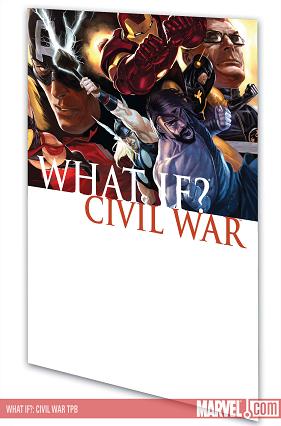
What If?: Civil War

Collects: What If?: Civil War, What If?: Planet Hulk, What If?: Annihilation, What If?: Rise and Fall of the Shi'ar Empire, What If?: Spider-Man vs. Wolverine (2007-8)

Released: June 2008 (Marvel)

Format: 168 pages / color / $16.99 / ISBN: 9780785130369

First of all, What If?: Civil War is a misleading title. A more accurate title would be What If?: Recent Events / Crossovers. An even more accurate title would be What If?: We Changed Recent Events to Kill More Heroes.

Second: merely asking What If? isn’t good enough. You have to have an interesting answer.

What If?: Civil War cover To be fair, I have not read most of the events this book uses as springboards. I didn’t care enough about Civil War, Annihilation, Planet Hulk, or (especially) The Rise and Fall of the Shi’ar Empire to read the originals, but I know enough about them that only Shi’ar Empire was slightly confusing. I have read Spider-Man vs. Wolverine, but that was from the mid ‘80s.

So I’m not the ideal audience. Still, I’ve read enough comics to know good ones when I’m given one for free, and this isn’t it. (Although it was free. Thanks, Diamond!) The main Civil War and Planet Hulk stories feature one of the most common What If? tropes: one thing changes, everybody dies. The body count in Annihilation is much lower, but so much is crammed into the story that it stops being a story — it’s more a retelling of fictional history. I’m not objective about Shi'ar Empire; the extension of Ed Brubaker’s massive retcon (no, the other one, the one without Bucky) leaves me cold. Suffice to say, there’s a lot of bloodshed in that one, with heroes dying (and Polaris being reduced to a pile of green hair) in a consequence-free environment.

The best of the lot was Spider-Man vs. Wolverine. I don’t believe Spider-Man would drift into the spy world, but at least it’s a full story, a real story, with a beginning, middle, and end. It’s competently told, with recognizeable motivations and characters. It works, in What If? terms, and writers Jeff Parker and Paul Tobin deserve a lot of credit for not succumbing to the temptation to ramp up the body count and change everything.

The backups are also not bad; the Civil War one works for no other reason than it serves as a rebuke to the stupidity of Civil War. Greg Pak — who wrote all the Planet Hulk stories — does well with his two low-key backups. The first has Banner and Hulk squabbling over the peaceful planet the Hulk was supposed to land upon; the second, a one-page joke with Fred Hembeck art, made me chuckle.

As for the whole package, it’s less than the sum of its parts. Different writers, different artists, characterizations (intentionally, to be fair) all over the place … I don’t think this could satisfy the casual reader. I’m not sure a casual reader would even pick this up, though.

Rating: Marvel symbol (1 of 5)

Labels: , , , , , , , , , , ,