Reviews of trade paperbacks of comic books (mostly Marvel), along with a few other semi-relevant comments / reviews.

11 March 2011

Incredible Hercules, v. 2: Secret Invasion

Collects: Incredible Hercules #116-20 (2008)

Released: February 2009 (Marvel)

Format: 128 pages / color / $14.99 / ISBN: 9780785128298

What is this?: The gods of the Hu-mans take on the gods of the Skrulls when the Skrulls invade Earth.

The culprits: Writers Greg Pak and Fred van Lente and penciler Rafa Sandoval

I’m not sure why I feel as I do about Incredible Hercules: Secret Invasion: I’m JUST not convinced that it’s a good book.

Like with the previous volume of Incredible Hercules, I want to like Secret Invasion. Writers Greg Pak and Fred van Lente have their protagonists down by now. Boy genius Amadeus Cho and god idiot Hercules make an amusing team, with Hercules getting the best lines this time. Hercules comes into his own this issue, boiling situations down to their simplest form and coming up with pithy analysis: “I punch stuff, and it falls down!” he says at one point. “That’s the only ‘strategy’ I’ve ever needed!”

Incredible Hercules: Secret Invasion coverOf course, that strategy raises an interesting point: Hercules is put in charge of the band of gods that assault the Skrull gods, just as the Skrull invasion begins in earnest on Earth. Why does Athena choose Hercules to lead the rather paltry expedition? It’s never made clear. Perhaps it’s to teach Hercules a lesson, which could be made clear in later volumes of the Incredible Hercules series. But it feels like Herc got the job because he’s the title character. Ajak, an Eternal, points out Hercules’s many flaws as the final battle begins, and he would have made a much better choice. Two other members of the “God Squad” might have been better leaders, but neither the evil Mikaboshi nor the God-Eater could be trusted.

I was happy to see the other member of the team, Snowbird. A longtime member of Alpha Flight, Snowbird doesn’t get many guest appearances these days. But fans of Alpha Flight will be happy to see how she deals the murderer of Alpha Flight, and she does come across as the only member of the God Squad other than Mikaboshi who has a plan other than punching. (Ajak complains about Hercules, but his plan boils down to “use energy beams until it falls down”). The relationship between Snowbird and Hercules takes a surprising and not welcome turn, but the reactions of both heroes is satisfying enough for me to grant them some leeway. Although I must ask: can any female resist Hercules’s masculine wiles? I’m going out on a limb and saying only Athena. And Hera.

I don’t feel like giving any leeway to the phrase “God Squad,” though. It feels too knowing. I’m glad Hercules stopped Cho from using “Godmobile” more than once, though. On the other hand, Cho names his pup “Kirby,” ostensibly a shortening of “Kerberos,” the name of the three-headed dog of Hades. The name makes sense, but does the Marvel Universe need yet another tribute to Jack Kirby? (I know some — many? — readers will say “yes,” which should teach me to ask rhetorical questions.)

For some reason, Cho got on my nerves in Secret Invasion. The cutesy names are just part of it; Cho is completely out of his depth in a world of gods and is often wrong, but he rarely admits it. He never loses his attitude, which is fine — even endearing — when he’s right, but when he’s doing nothing, it’s unlikeable. His most valuable contribution to the expedition, to use his words, is to “do nothing,” which is bizarre; Hercules is a bad leader, so why can’t Cho help him with that?

Perhaps part of the problem is that this is part of the Secret Invasion crossover. There’s nothing Cho can do to sniff out Skrulls, after all. But in a larger sense, the crossover seems to highjack Cho and Hercules’s plotline. It seems random that the Skrull gods would need to be fought — we’ve never seen Earth’s deities battle alien pantheons in other large crossover events, have we? — and stranger that Cho would need to be along. But that does seem to be the best way to tie Hercules and his cast into the crossover, so away they go! Evidently, attendance in this crossover was mandatory. Oh, how I wish Hercules could have gotten out of it with a letter from Asclepius.

The only saving grace I saw in the Secret Invasion crossover is that it allowed the writers to show why Hercules might be reluctant to have a young sidekick. While Hercules was part of the Argo’s journey for the Golden Fleece, his young friend Hylas was kidnapped by a nymph, which caused Hercules to go on a rampage and forget about the quest he was on. Van Lente and Pak keep the mythological references that I enjoyed in Against the World, although they are not integrated into the structure of Secret Invasion as they were previously.

The art by Rafa Sandoval gives me a headache. Not so much for Sandoval’s contributions, really, but because colorist Martegod Gracia gives the book a green-gray tint — Skrull tone, I suppose. It murks up Sandoval’s work, which is unhelpful, and it’s an unpleasant tint to begin with. I like Sandoval’s work during the first three issues, which are mainly talking heads and a few small-scale fights. Unfortunately, the large fights, with the five gods battling against the gods enslaved by the Skrull pantheon, are hard to parse. The coloring really did not help here, as it frequently made it difficult to decipher the details necessary to make out what was going on.

I feel my rating is a little harsh. There really isn’t that much to dislike about this book, but I feel it’s a step back from Against the World. The psychological darkness is dialed back, the fluidity of the plot is sacrificed for a crossover, and the characters include two evil gods and a snarky child. The colors are unattractive, the logic is odd, and I’m sick of Skrulls, who do little in the entire crossover and nothing here.

Rating: Marvel symbol Marvel symbol Half Marvel symbol (2.5 of 5)

Labels: , , , , , , , , , , , ,

22 October 2010

Amazing Spider-Man: Brand New Day, v. 3

Collects: Amazing Spider-Man #559-563 (2008)

Released: February 2009 (Marvel)

Format: 120 pages / color / $14.99 / ISBN: 9780785132424

What is this?: Mary Jane crosses paths with Spider-Man again as Peter deals with the life of the paparazzi; Spider-Man learns about the Bookie.

The culprits: Writers Dan Slott and Bob Gale and pencilers Marcos Martin and Mike McKone

It’s been a year since I’ve read anything from the Spider-reboot, Brand New Day. I hadn’t forgotten about it, but I had put it on the back burner. But I was looking for something to review, and the local university library had Amazing Spider-Man: Brand New Day, v. 3, so here we are.

I enjoyed v. 1, but I felt it was using the reboot to tell stories that wouldn’t have needed such a drastic reboot if the Spider-books hadn’t gone off the rails so badly. I felt v. 2 was a bit of a misstep, focusing on an uninteresting villain and a mystical adventure outside Spider-Man’s bailiwick. Fortunately, v. 3 only makes one of those mistakes.

Amazing Spider-Man: Brand New Day, v. 3 coverThe first arc is written by primary Spider-scribe Dan Slott, and Slott manages to make the best of a story, like One Moment in Time, that had to be told regardless of who wanted to read it. Although the “return” of Mary Jane is ostensibly the big draw in Amazing Spider-Man #559-61, Slott does a good job of making Mary Jane only a peripheral part of the story. There’s not enough room here to do justice to the big emotional payoff we’d expect from the meeting, so Slott is satisfied with letting us know Mary Jane’s status quo. On the other hand, I’m not sure getting across her status quo requires the amount of presence she has in this story. It’s a tricky balance, and although Slott pulls it off as well as I could have expected, I’m not satisfied with MJ’s presence either.

The main focus is an obsessed fan Spidey dubs “Paper Doll,” a two-dimensional stalker who can make her victims two dimensional as well, causing suffocation because of their newly tiny, tiny lungs. There’s not much to Paper Doll except for an set of powers that is underused in comic books, but for a one-off villain, there’s not much more needed. She remains true to her motivation and doesn’t clutter up the plot (she probably should have gone after Peter Parker at some point, though). If there’s use for her in the future, her character can be developed better then. I do call foul on her real name, so subtly revealed I picked it up only on a third read-through: Piper Dali.

What Slott does best is update the mass-media world that employs Peter Parker. It isn’t as a radical (or unlikely) a shift as the Peter-as-Bugle-Webmaster Brian Michael Bendis gave us in Ultimate Spider-Man, but it’s much easier to take. Dexter Bennett, the new publisher of the Bugle, assigns Peter to the celebrity beat, something his Spider-abilities make him supremely suitable for. Of course, best friend Harry Osborne — reasonably a long-term target of paparazzi — isn’t wild about the switch in career, and Aunt May isn’t exactly proud either. Neither is Peter, for that matter, but the paychecks are good.

Spider-Man also fights a Web-savvy villain, Screwball, who translates her villainy into fame via the Internet. Maybe she makes money at it; I dunno. But it makes sense there would be someone like her in Spider-Man’s New York. The writer of the next arc, Bob Gale, also uses the Internet / villainy connection in a way that feels natural.

The second story is a two-parter in which Gale tells the story of the Bookie, the gambler at the Bar with No Name that sets odds for superfights. He’s appeared a couple of times in the Brand New Day setup, and I can’t say that I’ve ever wondered what his story was. Nevertheless, here we have it, and of course it involves bad luck, bad odds, and fixed games.

It’s a shame that Gale’s decided to focus on the Bookie when there’s not much interesting about the character. Gale seems to have a good handle on the villains at the Bar with No Name — the whole scene with Spidey in the Bar is well done, both by Gale and by penciler Mike McKone — and I have a great deal of respect for someone who decides to use the Enforcers out of Spider-Man’s entire rogue’s gallery. (I’m not sure about Ox’s characterization, but I’m not sure he’s been given a personality in almost 50 years of appearances, so I’ll let it slide.) His Spider-dialogue — like Slott’s — is spot-on. But I don’t care about the Bookie or his father or any of his hare-brained schemes, not even when it’s suggested the Bookie could have the answers to clear Spider-Man from the most recent charges of murder that have been leveled against him. Spider-Man is always cleared, more or less, so there’s not much excitement there, and I didn’t get the feeling that whoever is framing Spider-Man is that important. (From things I’ve read online since this came out, I know that might be wrong. But Brand New Day hasn’t convinced me of the culprit’s importance.)

Whatever I think about the plots, the art remains a strength for Brand New Day. The artists in this book have some of the highest quality-to-amount-I-like-their-work ratios other than Frank Quitely. Marcos Martin pencils the first arc, and although I don’t like the way he draws faces and human bodies49, I can’t deny he knows how to make a scene visually interesting. Whether it’s Spider-Man debating with himself over whether to take celebrity pictures or Paper Doll alone with her collection of newspaper clippings, there’s rarely a dull page. I also enjoyed the fight scene in an art gallery, where Martin got to use his art studies to integrate Andy Warhol’s and Roy Lichtenstein’s work into the Marvel Universe — and into a fight scene. I enjoyed McKone’s work more, although I wasn’t quite as impressed with it. Still, the scenes inside the Bar with No Name were fun, as was the rescue on Coney Island.

There’s nothing wrong with the stories in v. 3 — they’re fun, lightweight, refreshingly free from grit or heavy gloom. That’s part of their charm, and that’s a large measure of their problem; there’s no real substance here. No matter how strong the art, no matter how encouraging the new direction, the stories themselves feel like a sweet, frothy dessert with little to sink one’s teeth into. Like the rest of Brand New Day, it’s a strong reboot. The individual appeal of the stories, however, is much less, despite strong writing and penciling.

Rating: Spider-Man symbol Spider-Man symbol Spider-Man symbol (3 of 5)

Labels: , , , , , , , , ,

12 December 2009

Showcase Presents Ambush Bug, v. 1

Collects: DC Comics Presents #52, 59, and 81, Supergirl #16, Action Comics #560, 563, and 565, Ambush Bug #1-4, Ambush Bug Stocking Stuffer #1, Son of Ambush Bug #1-6, Secret Origins #48, Ambush Bug Nothing Special #1 (1982-6, 1990, 1992)

Released: February 2009 (DC)

Format: 480 pages / black and white / $16.99 / ISBN: 9781401221805

What is this?: The adventures of Ambush Bug, a continuity and fourth-panel busting vehicle for humor in the DC universe.

The culprits: Keith Giffen, scripter Robert Loren Fleming, and others

You have to be prepared for Ambush Bug before reading Showcase Presents Ambush Bug, v. 1, I think. God knows DC tries, on the cover copy, to let you know this isn’t going to be a normal superhero story.

But readers can be forgiven if they don’t see exactly what it will become in the first half-dozen or so stories. These are Ambush Bug’s formative days, guest starring in Superman family stories; he starts as a slightly outlandish villain, then suddenly becomes an annoying hero. A decent enough start — one that would, with a considerably different scale and higher body count, be echoed by Deadpool — but nothing that would inspire a long-lasting following.

Showcase Presents Ambush Bug, v. 1 coverAnd then comes the limited series and specials.
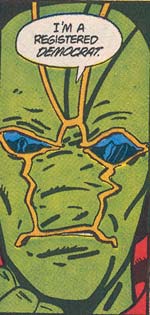
Plotted (and penciled) by Keith Giffen and scripted by Robert Loren Fleming, Ambush Bug eschews plot and embraces wackiness. At its best, this results in solid parodying of the superhero genre and the medium of comic books. The standout issue is Ambush Bug #3, “The Continuity Game,” which relentlessly mocks DC’s lip service to continuity and its more bizarre stories. There is a good deal to laugh about in this part of the book, although the humor dissipates as the book goes on. It’s almost as if Giffen and Fleming are running out of funny ideas — and in the final issue, Ambush Bug Nothing Special #1, the creators joke about getting drunk while trying to pitch ideas to one another. (Nothing Special is a good deal funnier than the second limited series; the time off seemed to help.)

But in that second limited series, Son of Ambush Bug, the ideas get thinner. “The Interferer” is introduced to justify the complete abandonment of plot, but that’s not necessary, and pointing out the lack of plot only serves to make it an annoyance. The jokes start falling flat; the sentient, malevolent sock Argh!yle, the Interferer, and Ambush Bug’s confinements in prison and Hell fall flat as jokes and have no plot to fall back on for usefulness. It would have been better if Son had been the four-issue mini and the original Ambush Bug six, but the issue counts were reversed.

Giffen’s art is superb at getting the jokes across, which should be no surprise to those who have followed his career. His ability to copy other styles when necessary is also excellent; I wished he would have done more stylistic jokes. For some reason, Ambush Bug’s noseless face is occasionally difficult to read in black and white; perhaps it’s the double dose of missing features (nose and color). The few childlike drawings, ostensibly by Giffen’s son Kyle, are charming.

Humor is a dangerous business; even if you make an audience laugh for twenty minutes, you can be perceived as unfunny after one joke bombs spectacularly. There are no bombs, spectacular or otherwise, in Ambush Bug, and the worst that can be said is that it drags occasionally. At its best, it reaches hilarity for a few pages at a time. But without a real plot for a reader to hang his interest on, those dragging moments seem to stretch on and on …

Rating: Ambush Bug head Ambush Bug head Ambush Bug head (3 of 5)

,

Labels: , , , , ,