Reviews of trade paperbacks of comic books (mostly Marvel), along with a few other semi-relevant comments / reviews.

18 February 2011

Blue Beetle, v. 2: Road Trip

Collects: Blue Beetle, v. 2 #7-12 (2006-7)

Released: June 2007 (DC)

Format: 192 pages / color / $12.99 / ISBN: 9781401213619

What is this?: With the aid of Peacemaker and an ever-expanding cast of helpers, Jaime tries to get to the root of what the scarab is.

The culprits: Writers John Rogers and Keith Giffen and artists Cully Hamner, Rafael Albuquerque, and Duncan Rouleau

So: Blue Beetle, v. 1: Shellshocked was a bit of a disappointment. What about Blue Beetle, v. 2: Road Trip?

Well, it certainly corrects what I saw as the most glaring deficiency: relying on continuity without explaining it. In #7, Jaime explains what happened in the time he was missing, from blowing up the Brother Eye satellite (complete with adding Batman’s editorial comments into the story) to crash landing in the Texas desert. It’s a nice little story, with enough jokes and character moments that it won’t annoy people who have read it while still telling the story completely for those unfamiliar with the original.

Blue Beetle, v. 2: Road Trip coverThe next couple of issues involve the backstories of Dan Garrett, the first Blue Beetle, and the current Peacemaker. The former manages to remain interesting, by dint of using the journey to explore the relationship between Jaime and his friend Brenda and between Peacemaker and the Blue Beetle armor. Reusing the mystical baddie with a religious delusion from Shellshocked was a poor choice in that the monster isn’t interesting; on the other hand, it’s the only one of Blue Beetle’s enemies that could be reintroduced to liven up a talking heads issue. Win some, lose some, I suppose. Peacemaker’s story is no great shakes — man of action falls into alien tech, which sounds very Silver Age — but again, the character interactions liven things up, especially when Jaime’s parents have to decide whether he can save lives on a school night.

The best issues in Road Trip are #10-11; Brenda is transported to a world of the New Gods by a mother box. While Brenda has to deal with an alien world with malicious, living teddy bears and a New Gods ripoff of Conan (named “Lonar” — real creative, King Kirby), Jaime has to deal with his secret identity rapidly going down the tubes and figuring out how to rescue his friend. And of course there is the inevitable mistaken identity hero fight; as such things go, this one is above average, with some nice quips by Jaime. It ends with Jaime appreciating the majesty of the big action story — er, I mean outer space — and returning with Brenda before getting answers about his armor from Metron.

The book ends with the scarab’s makers showing up. It isn’t very interesting, but writer John Rogers tries to liven it up with banter. It isn’t wholly convincing, but it could be worse.

For this volume, Rogers writes every issue, but unlike in Shellshocked, he writes some of them alone. Keith Giffen, who co-wrote every issue in Shellshocked, contributes to only three issues: #8-10. His absence or presence doesn’t seem to make a great deal of difference in the quality of the issues, though.

Two of the artists from Shellshocked also contribute to Road Trip. Cully Hamner, who co-created this Blue Beetle, drew issues #7-8, and just as in Shellshocked, he does an adequate job. I think new penciler Rafael Albuquerque outshines him, however; although their styles are quite compatible, Albuquerque’s work on #10-12 is more kinetic, and the design of the little alien teddy bears was cute and menacing while the alien-dissected cow was suitably disgusting. Albuquerque’s art tends toward gritted teeth at all times during fight scenes, and Brenda’s wounds seemed too light, but for the moment, those are small quibbles. Duncan Rouleau is back again, working on #9, and this issue he visually seems the odd one out. Although Albuquerque is more cartoony than Hamner, he’s still much more realistic than Rouleau, who has lips sliding away from people’s faces and pupils disappearing when convenient.

This is a huge step up from Shellshocked. In Road Trip, Jaime is more confident and in control, and although the armor still has a lot of new capabilities, the reader gets the sense it’s because the armor is a technological battle suit. Although I blame DC’s “throw the reader into the middle of things approach,” perhaps it’s another example that superhero movies have taught us: origin stories are boring — we like to see the hero doing things rather than fumbling about and retreading that shared origin story all superheroes seem to have.

It’s a good start for Blue Beetle, although unfortunately, my libraries don’t have any volumes after this. Did I enjoy the story enough to actually pay for the volume 3? I don’t know. Perhaps I’ll have to bug the library’s interlibrary loan department …

Rating: DC logo DC logo DC logo Half DC symbol (3.5 of 5)

Labels: , , , , , , , ,

11 February 2011

Blue Beetle, v. 1: Shellshocked

Collects: Blue Beetle #1-6 (2006)

Released: December 2006 (DC)

Format: 144 pages / color / $12.99 / ISBN: 9781401209650

What is this?: Jaime Reyes deals with his new powers, the consequences of his one-year absence, and supergangs in El Paso.

The culprits: Writers Keith Giffen and John Rogers and arists Cully Hamner, Cynthia Martin, Duncan Rouleau, and Kevin J. West

Last week’s review of X-Men / SWORD: No Time to Breathe has me feeling charitable, so I’ll start my review of Blue Beetle, v. 1: Shellshocked with the positive.

Shellshocked is the beginning of the first series starring the third Blue Beetle. When this series started in 2006, there was a fair amount of controversy about replacing Ted Kord, the second Beetle, so soon after his sudden and senseless death. Happily, the new Beetle doesn’t seem like a cheap gimmick or knockoff of Kord. Jaime Reyes is a teenager who stumbles across the Blue Beetle scarab and gets armor and powers. Jaime has friends and a supportive family before he gains powers and disappears; although there is a slight adjustment period, his supporting cast adjusts relatively quickly to the new situation.

Blue Beetle, v. 1: Shellshocked coverI will give writers Keith Giffen and John Rogers credit for telling a story with a Hispanic protagonist, set far away from New York or Metropolis or Gotham — Shellshocked in that west Texas city of El Paso.55 Each member of the supporting cast has her own distinct role and personality, and the interplay between Jaime’s friends Paco and Brenda is amusing. Really, that’s the highlight of the book: Paco, Brenda, and Jaime talk, if not exactly like young friends, then certainly in the manner of teenagers, playfully insulting and testing each other without going too far. It’s also refreshing to have antagonists who don’t fall into readers’ preconceived notions of their roles; the Posse isn’t a violent gang but a mutual defense society, while La Dama is a gang lord but not a horribly unreasonable or cruel one. I’m not sure why Giffen and Rogers thought a supernatural adversary with a religious hangup would be a good idea, since religion has nothing to do with the book, but at least the monster does fit with the book’s exploration of the scarab’s magic origins.

What’s not positive is the book’s reliance on Infinite Crisis and DC continuity without being willing to explain all of it. The book begins in media res, interspersing scenes from just before Jaime’s disappearance in Infinite Crisis with those from his return one year later. Although it’s easy to keep the two straight, it seems overcomplicated to keep interspersing the two over the first two issues. But there is no footnote to tell the reader that Jaime received his powers and disappeared during the events of Infinite Crisis; if I hadn't known that already, I would have been mystified, since much of Jaime’s origin revolves around that crossover. Giffen and Rogers “cleverly” insert “one year later” into the dialogue at the end of #2, despite it not making much sense.

Rogers and Giffen continually assume the reader knows information that is not in evidence in this book. Shellshocked keeps referencing Booster Gold without explaining who he is or what his connection to the previous Beetle was. Jaime is stalked for a few issues by a mysterious man in ‘40s clothes and a cape; I’m assuming it’s the Phantom Stranger, but it’s never explained who he is or his larger role within the DC Universe. I don’t even think Jaime’s surname is used during the book (although “Reyes Gas and Service” is the name of his father’s garage). It’s frustrating to never know what should be a mystery and what the writers / editor don’t think to tell the readers. It turns out that Green Lantern Guy Gardner’s reaction to the Beetle armor was a plot point; who knew? Certainly not me. If other parts of the story had been better explained, I could have made that determination. Unfortunately, DC seems to have no inclination to explain its continuity to those who aren’t keeping up with it. Honestly, are footnotes that hard?

From there, Jaime has to figure out what his armor does and what his place in his new world is. Giffen and Rogers are more successful with latter. The ability of most of his supporting cast to come to grips with the new status quo is refreshing, freeing Jaime from dealing with the angst that is often the lot of the new superhero. I also appreciate Jaime’s research into the legacy of the Blue Beetle and his outright rejection of Oracle’s invitation into the superhero community. Jaime’s struggles with his armor are less enjoyable; although it adds some drama to the story to make his powers and his ability to call on them undependable, it makes the Beetle armor a bit too simple — by the end, the reader begins to think the armor will have the answer to whatever problem the Beetle is up against. Not quite a deus ex machina; a heros [demigod] ex machina, maybe.

The art doesn’t help matters. Cully Hamner, one of the character’s co-creators, is able to contribute art for only half the issues (#1, 2, and 4). His art is the best in the collection, although the other artists are either well chosen to mesh with his style or are consciously aping it. His work seems richer and more textured than the others, and although it’s not my favorite, it does seem to work for this book — aside from the unimaginative character design for some members of the Posse and a scene where Brenda appears to phase through a pickup.

Irritatingly, Cynthia Martin, who drew #3 and part of #6, can’t seem to get the geography of the Reyeses’ kitchen straight, complete with a table and couch that disappear and shift distractingly. Otherwise, her art is sparser than Hamner’s but in a similar vein, a good fit for a fill-in artist. Kevin J. West adds some pencils for #6, but it’s impossible to tell exactly what is his and what is Martin’s. Duncan Rouleau, the artist for #5, draws a frequently incomprehensible fight scene between the Blue Beetle and a supernatural opponent; figures who are knocked around by blows are represented by rotating them 90 degrees, although it’s often unclear what sent them flying in the first place. Characters occasionally devolve from semi-realistic to cartoon caricatures in a panel or two.

I want to like Shellshocked, as it’s clearly the kind of book the market needs more of — or at least it’s the kind of book a healthier medium would have more of. It has a new, non-white hero (not that new heroes need to be non-white, but some definitely should be). It has a young hero who acts at least somewhat like a teenager and who associates with his peers, even if school is the only teenager thing he’s done. But Shellshocked’s status as an exemplar for a brave new world of comics is shattered by the crippling reliance on DC continuity, the book’s unwillingness to explain things to the reader, and unspectacular art from four artists in six issues.

Rating: DC logo DC logo Half DC symbol (2.5 of 5)

Labels: , , , , , , , , , , ,

12 December 2009

Showcase Presents Ambush Bug, v. 1

Collects: DC Comics Presents #52, 59, and 81, Supergirl #16, Action Comics #560, 563, and 565, Ambush Bug #1-4, Ambush Bug Stocking Stuffer #1, Son of Ambush Bug #1-6, Secret Origins #48, Ambush Bug Nothing Special #1 (1982-6, 1990, 1992)

Released: February 2009 (DC)

Format: 480 pages / black and white / $16.99 / ISBN: 9781401221805

What is this?: The adventures of Ambush Bug, a continuity and fourth-panel busting vehicle for humor in the DC universe.

The culprits: Keith Giffen, scripter Robert Loren Fleming, and others

You have to be prepared for Ambush Bug before reading Showcase Presents Ambush Bug, v. 1, I think. God knows DC tries, on the cover copy, to let you know this isn’t going to be a normal superhero story.

But readers can be forgiven if they don’t see exactly what it will become in the first half-dozen or so stories. These are Ambush Bug’s formative days, guest starring in Superman family stories; he starts as a slightly outlandish villain, then suddenly becomes an annoying hero. A decent enough start — one that would, with a considerably different scale and higher body count, be echoed by Deadpool — but nothing that would inspire a long-lasting following.

Showcase Presents Ambush Bug, v. 1 coverAnd then comes the limited series and specials.
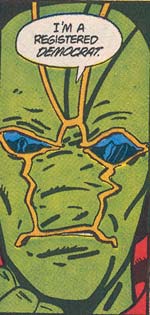
Plotted (and penciled) by Keith Giffen and scripted by Robert Loren Fleming, Ambush Bug eschews plot and embraces wackiness. At its best, this results in solid parodying of the superhero genre and the medium of comic books. The standout issue is Ambush Bug #3, “The Continuity Game,” which relentlessly mocks DC’s lip service to continuity and its more bizarre stories. There is a good deal to laugh about in this part of the book, although the humor dissipates as the book goes on. It’s almost as if Giffen and Fleming are running out of funny ideas — and in the final issue, Ambush Bug Nothing Special #1, the creators joke about getting drunk while trying to pitch ideas to one another. (Nothing Special is a good deal funnier than the second limited series; the time off seemed to help.)

But in that second limited series, Son of Ambush Bug, the ideas get thinner. “The Interferer” is introduced to justify the complete abandonment of plot, but that’s not necessary, and pointing out the lack of plot only serves to make it an annoyance. The jokes start falling flat; the sentient, malevolent sock Argh!yle, the Interferer, and Ambush Bug’s confinements in prison and Hell fall flat as jokes and have no plot to fall back on for usefulness. It would have been better if Son had been the four-issue mini and the original Ambush Bug six, but the issue counts were reversed.

Giffen’s art is superb at getting the jokes across, which should be no surprise to those who have followed his career. His ability to copy other styles when necessary is also excellent; I wished he would have done more stylistic jokes. For some reason, Ambush Bug’s noseless face is occasionally difficult to read in black and white; perhaps it’s the double dose of missing features (nose and color). The few childlike drawings, ostensibly by Giffen’s son Kyle, are charming.

Humor is a dangerous business; even if you make an audience laugh for twenty minutes, you can be perceived as unfunny after one joke bombs spectacularly. There are no bombs, spectacular or otherwise, in Ambush Bug, and the worst that can be said is that it drags occasionally. At its best, it reaches hilarity for a few pages at a time. But without a real plot for a reader to hang his interest on, those dragging moments seem to stretch on and on …

Rating: Ambush Bug head Ambush Bug head Ambush Bug head (3 of 5)

,

Labels: , , , , ,