Reviews of trade paperbacks of comic books (mostly Marvel), along with a few other semi-relevant comments / reviews.

30 April 2016

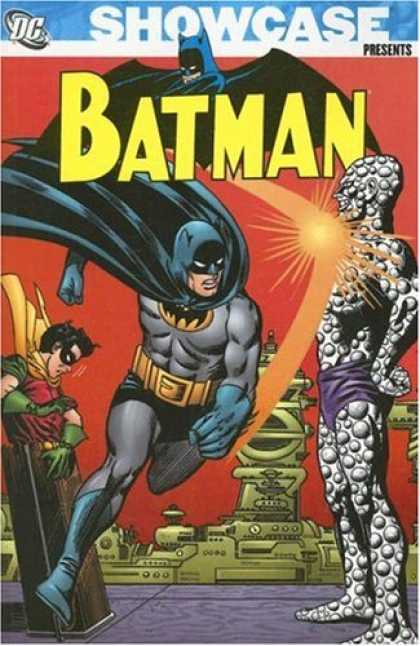
Showcase Presents Batman, v. 6

Collects: Detective Comics #408-26 and Batman #229-44 (1971-2)

Released: January 2016 (DC)

Format: 584 pages / black and white / $19.99 / ISBN: 9781401251536

What is this?: A chunk of early ‘70s Batman stories, mixing the first appearance of Ra’s al-Ghul and the League of Assassins with forgettable stories.

The culprits: Writers Dennis O’Neil, Frank Robbins, and others and pencilers Neal Adams, Bob Brown, Irv Novick, and others


When I reviewed Showcase Presents Batman, v. 5, I said the Bat-titles of the era were on the brink of something exciting. Batman and Detective Comics had shaken off the lingering funk of the Silver Age and were heading toward something much greater. So I was eager to read DC Showcase Presents Batman, v. 6 — well, as eager as a person can get for a book after four years when you thought the book line was cancelled.

And — good news! — v. 6 is better than v. 5. But it’s only an incremental improvement, and the Bat-titles reprinted in this volume still feel like they are poised to become something different, something greater. They just aren’t quite there yet.

Showcase Presents Batman, v. 6 coverYes, the Ra's al Ghul / Legion of Assassins story is sprinkled throughout the volume, but few other members of Batman’s rogue’s gallery appear in the thirty-plus issues. Man-Bat and Two-Face each appear in one issue — with Two-Face beautifully drawn by Neal Adams — but each gets only as many issues as the embarrassing Ten-Eyed Man. Most of the stories are single-issue mysteries, often with a supernatural tinge, that go nowhere.

Those mysteries, whether they have a supernatural element or not, are v. 6’s biggest problem. Some of them (mostly those with occult touches) are set in exotic locations, like Waynemoor Castle in northern England; some of them are set in the gritty streets of Gotham. Unfortunately, whether Batman is taking on circus freaks, hicks, or Shakespearean actors in Gotham or elsewhere, these stories become monotonous. Despite being solidly constructed mysteries, their flaws become more readily apparent than their virtues after the third or fourth in a row. All the ghosts and haunted castles Batman investigates have as much real supernatural content as the average Scooby-Doo episode, which takes some of the suspense out of the story. Issues that try to be socially relevant, dealing with youth gangs and urban crime, devolve into over-the-top action sequences, like when a group of teenagers threaten to blow up an apartment tower to get their demands listened to.

As a side note, O’Neil’s frequent asides asking readers whether they picked up on whatever clues Batman used to solve the crime annoyed me — not because of the device itself but because the clues are so rarely available to the reader. If your mysteries aren’t fair play, you don’t get to taunt readers that they aren’t as smart as the detective.

That being said, the Ra's al Ghul stories are classics for a reason. Beautifully drawn by Adams and full of menace, Ra's is the one villain who seems to worry Batman, the only adversary who requires the World’s Greatest Detective to have long-term plans. Adding a new dimension to the stories is Talia al-Ghul, Ra's’s daughter, a love interest who presents a puzzle Batman can’t solve; despite his undeniable attraction to her, she is the daughter of the Demon as well as being ruthless and a remorseless killer herself. Additionally, these stories knock the Batman canon of this era out of its unmoving, unchanging placidity. Although the League of Assassins stories don’t affect the continuity of the rest of the book, the storyline’s progression gives the book a sense of passing time the stories don’t have otherwise.

Of course, it would be helpful if the cliffhangers in the League of Assassins storyline were followed immediately by their conclusions, but those issues are usually followed by unrelated issues from the other Batman title. I understand chronological order is important, but in a book like this, story coherence is more vital.

The art in v. 6 is outstanding. Adams provides covers for almost all the issues, and he draws about a quarter of the stories. This is Adams’s work at its finest: perhaps not as explosive as his work on X-Men a few years earlier, but each panel is beautiful, fully adapted to Batman’s world of shadows. The concessions he makes to Batman’s more grounded world makes his artwork tighter, more focused. Most of the remaining issues are drawn by Bob Brown and Irv Novick, both of whom worked with Adams on the previous volume. Neither is Adams’s equal, but both are solid artists with outstanding storytelling and an ability to fit the story into a many panel layout.

 coverScattered among the work by Adams, Brown, and Novick, the three issues drawn by writer Frank Robbins stand out, and not in a good way. Robbins is a good artist for a writer, but that’s as far as I’m willing to go. (Robbins was primarily an artist in his career, but he splits the writing chores in v. 6 with O’Neil.) His style has a thick line and lacks the fluidity of the rest of the artists; even if he were a better artist, his work wouldn’t fit in v. 6.

One warning about this book: although it says it contains sixteen issues of Batman, that’s misleading. Two of the issues, #233 and #238, have only the cover reprinted because their contents are reprints. The covers of other issues of Batman and Detective promise back-up stories featuring Batgirl, Robin, or some other hero, but those aren’t included even though at least some of them are original stories.

On average, v. 6’s quality is only incrementally greater than v. 5. However, it contains so many iconic and important moments that it feels a great deal better at times. Nothing in v. 5 compares to shirtless Batman dueling Ra's al-Ghul, the first appearances of Ra's and his daughter, the first time Ra's is resurrected by the Lazarus Pit. I’ve read these issues before, in color, in Batman: Tales of the Demon, which was superior to v. 6 — and not just because Tales of the Demon was in color. Learning the context in which those Ra's stories initially appeared makes them more impressive, since the League of Assassins stories are nothing like the rest of the era. But actually reading those non-Assassin stories makes reading v. 6 feel like a chore at times, a bit of self-education that is unnecessary.

Still: shirtless Batman vs. Ra's al-Ghul. That fight was pretty awesome.

Rating: Batman symbol Batman symbol Batman symbol Batman symbol (4 of 5)

Labels: , , , , , , , , , , ,

11 May 2012

Showcase Presents Batman, v. 5

Collects: Detective Comics #391-407 and Batman #216-227 (1969-70)

Released: December 2011 (DC)

Format: 448 pages / black and white / $19.99 / ISBN: 9781401232368

What is this?: Batman starts swinging into the Bronze Age, packing his sidekick off to college and hitting the mean streets of downtown Gotham.

The culprits: Writers Frank Robbins, Denny O’Neil, and Mike Friedrich and artists Bob Brown, Neal Adams, and Irv Novick


I read Showcase Presents Batman v. 1 and v. 2, but I had to give up reading the series. Unlike some, I have little tolerance for Silver Age stories from the DC Universe; I don’t care that the original writers and artists knew they were creating comics for kids or that the stories were unapologetically goofy. The stories are still goofy, and that does not amuse or entertain me.

So I decided to hop back on bard the Showcase train only when it hit Denny O’Neil Station, which it did in Showcase Presents Batman, v. 5. Not all of these issues are written by O’Neil (his first is Detective Comics #395), and Frank Robbins wrote more, by a 2-to-1 margin. (Mike Friedrich contributed three back-ups.) O’Neil does pen the most lasting contribution to Bat-lore in this volume — the creation of the League of Assassins in Detective Comics #405 — but I was surprised to discover Robbins co-created the Man-Bat (in Detective #400).

Showcase Presents Batman, v. 5 coverO’Neil’s writing … it’s hard to call it “realistic,” but his stories are less prone to the Silver Age flourishes that characterize the previous volumes in the series. O’Neil’s writing will occasionally indulge in asides to the reader, asking if she has spotted the key clue to a mystery, but his stories feel more modern. On the other hand, Robbins opens the volume with “The Girl Most Likely to Be — Batman’s Widow” (Detective #391) and “I Died … a Thousand Deaths!” (Detective #392). Those titles would have fit right into Showcase Presents Batman, v. 1, although the stories aren’t as hokey as their titles (or their punctuation) would lead you to believe. By the end of the volume, O’Neil and Robbins aren’t aping each other’s style, but there isn’t a tonal clash between their stories either — Robbins drifts toward the science-fictional, O’Neil toward the supernatural, but they generally restrict themselves to one major speculative element per issue.

The stories in v. 5 are obviously Batman stories, but they disdain a lot of the Batman trappings. Readers will probably be surprised that none of Batman’s impressive rogue’s gallery makes an appearance in this book. There’s no Joker, no Two-Face, Catwoman, Riddler … Even Robin leaves for college in the fourth story (Detective #393) after seemingly aging three years between issues. Batman abandons Wayne Manor for a downtown penthouse, the flashy Batmobile for a less noticeable muscle car. Bruce Wayne gets involved in victim services, helping those affected by crime with philanthropy and Bat-punches. The only freaks he encounters are Man-Bat (the scientist who turns himself into a man / bat hybrid) and the Man with Ten Eyes (a veteran whose ocular nerves are re-routed through his fingers). Both are good men driven toward bad deeds by madness or false information — very much in the Marvel vein of this time. Batman’s opponents are generally grandiose tugs, blackmailers, kidnappers, and thieves graduating to murder or attempted murder. All these gangsters give the book slight blandness, which makes the occasional note of goofiness a welcome bit of flavor. Had this been another, less-popular hero’s adventures, I doubt the stories here would have saved him from cancellation, let alone have supported two titles.

Still, there are some points of interest, even beyond assassins and Man-Bat appearances. O’Neil uses the ghostly Enemy Ace in Detective #404, which must have thrilled literally tens of readers. The Muertos, an immortal husband-and-wife team of villains, clearly presage O’Neil’s later (and much more important) Ra's al Ghul. Robbins’s most interesting story comes from his twist (ha!) on the “Paul is dead” hoax in Batman #322, in which Batman and Robin try to discover whether Saul Cartwright, a member of the Beatles stand-ins Oliver Twists, is an imposter.

The art in this book is top-notch. Bob Brown provides the art for early issues, and those stories have a stagy, first-generation Silver-Age style to them. But when pencilers Neal Adams and Irv Novick join the art rotation, his style gradually becomes more like theirs. And theirs … there are many valid complaints you can make about the Bronze Age — quality control for story content being foremost — but the emergence of the first generation of artists who were inspired by Kirby and other Silver Age greats make up for all of them. Adams is foremost among this group, and his art is wonderful: shadowy, evocative, action packed, pretty to look at. He also draws the majority of the covers in this book, and it’s jarring to see Silver Age copy on Adams’s more modern, hipper art. I was surprised how good Novick’s work was; not as graceful as Adams’s, but it’s an excellent complement: realistic while still allowing for some stylistic embellishments. He’s not someone who’s going to get much attention — today everyone remembers Adams, but no one talks about Novick — but his work is always enjoyable.

I enjoyed this far more than v. 1 or v. 2. Are these stories great? No; as I said, there is an unavoidable feeling of blandness throughout. Even Man-Bat, who alleviates this feeling in his appearances, is a somewhat bland (and obvious) idea. But given the art, the changes in the status quo, and O’Neil’s assassin stories, I get the feeling this series is on the brink of something exciting.

Rating: Batman symbol Batman symbol Batman symbol (3 of 5)

Labels: , , , , , , , , , , ,

06 May 2011

Reader quiz for Showcase Presents the Justice League of America, v. 1

After reading Showcase Presents Justice League of America, v. 1, I decided to to something different. Here is a quick quiz about the early days of the JLA. If you aren’t familiar with the stories, don’t worry; it isn’t necessary to guess, if you have any familiarity with the Silver Age.

1) The Justice League has been called into action! But where is Superman?

a) The Bottle City of Kandor.

b) Journeying through time.

c) He’s too popular to be seen with the doofuses who make up the JLA.

d) The villain doesn’t have Kryptonite, so the writer has no idea how to make the plot challenging for Superman.

2) Hey! Batman isn’t here either! Why?

a) Stuck in Gotham traffic

b) The Dark Knight refuses day missions.

c) Batman’s much too popular too. He’s hanging out with Superman.

d) The villain has superpowers, so the writer has no idea how to make Batman effective.

3) The villain has set three plots into motions simultaneously. What should the JLA do?

a) Split into teams that complement each other in power level, temperament, and intelligence.

b) Split into teams randomly because, hey, what’s the worst that can happen?

c) Well, if Superman had showed up, the rest of the team could let him take care of all three plots and knock off early for the day.

d) Screw this, I’m tired of doing triple the work for no pay. Let the Avengers handle it.

4) Martian Manhunter: What’s the first power you use?

a) Martian supervision.

b) Super blow.

c) Super suck.

d) Someone flicked their Bic two counties over, and fire robs me of my powers!

5) Aquaman! Summon your:

a) “Finny friends”

b) “Brothers of the sea”

c) “Filthy fetishes”

d) “Aquatic slave labor force”

6) Flash: use your powers to the fullest by:

a) Vibrating your legs to fly.

b) Vibrating your body to match the dimensional vibration of … something something something. Has to do with molecules, I think.

c) Vibrate your arms to blow something away, because the pilot light in a house two miles away has robbed Martian Manhunter of his super blow powers.

d) Vibrate your body to use your amazing plot-convenience powers.

7) Green Lantern! Why aren’t you attacking?

a) The villain is dressed in yellow.

b) The villain is attacking with a yellow beam.

c) The villain is curious (yellow).

d) Hal just ate yellow snow.

8) What will Wonder Woman do?

a) (HINT: It doesn’t matter.)

9) Why was Green Arrow appointed as the first new recruit?

a) Meritorious service as a solo hero.

b) Substitute Batman, so the team would have a useless member when Batman decided he was too popular to show up.

c) Neat accessories, such as the Arrow Plane, Arrow Car, and Arrow Collar.

d) Bows to peer pressure very easily and is also rich.

10) Oh no! It’s Doctor Light! What will he do?

a) Blind you with a flashlight.

b) Make you “taste the rainbow,” if you know what I mean.

c) Knock you silly with hard light, even though “hard light” is impossible.

d) Rape Steve Trevor and kill Carol Ferris.

11) Superman showed up, but he’s been captured! How?

a) Magic.

b) Also magic.

c) Kryptonite.

d) Magic Kryptonite.

e) Yo momma.

12) The villain has captured the JLA! What will happen to them?

a) They’ll be turned to vapor and displayed in bottles.

b) They’ll be sold at an auction, dressed in all-too-revealing French maid costumes. (NOTE: this will require Wonder Woman to wear more clothing.)

c) They’ll be executed gangland style (except Superman, who will be forced to swallow a Kryptonite pill).

d) They’ll be forced to sing in a public venue and be openly mocked by Simon Cowell.

13) Why is “Snapper” Carr always snapping his fingers?

a) It’s how he expresses approval.

b) It’s how he dissipates his immense sexual mojo.

c) It’s an advanced form of echolocation; exposure to radioactive Kryptonite meant for Superman has left him blind.

d) A better question is why Batman hasn’t ripped off his fingers yet.

14) Why is Snapper allowed to hang out with the JLA, anyway?

a) That damn woman libber Wonder Woman refuses to vacuum more than once a week, so someone has to do the housework.

b) Let’s just say he has … interesting pictures of Superman and Martian Manhunter in the JLA locker room.

c) Government quotas — they were forced to take in at least one talentless dork.

d) Batman wanted a new punching bag, and Snapper’s cheaper than Everlast.

Answers will be revealed, in the Latin tradition, on the Greek calends. Until then, you can score your answers yourselves!

Labels: , , ,

12 December 2009

Showcase Presents Ambush Bug, v. 1

Collects: DC Comics Presents #52, 59, and 81, Supergirl #16, Action Comics #560, 563, and 565, Ambush Bug #1-4, Ambush Bug Stocking Stuffer #1, Son of Ambush Bug #1-6, Secret Origins #48, Ambush Bug Nothing Special #1 (1982-6, 1990, 1992)

Released: February 2009 (DC)

Format: 480 pages / black and white / $16.99 / ISBN: 9781401221805

What is this?: The adventures of Ambush Bug, a continuity and fourth-panel busting vehicle for humor in the DC universe.

The culprits: Keith Giffen, scripter Robert Loren Fleming, and others

You have to be prepared for Ambush Bug before reading Showcase Presents Ambush Bug, v. 1, I think. God knows DC tries, on the cover copy, to let you know this isn’t going to be a normal superhero story.

But readers can be forgiven if they don’t see exactly what it will become in the first half-dozen or so stories. These are Ambush Bug’s formative days, guest starring in Superman family stories; he starts as a slightly outlandish villain, then suddenly becomes an annoying hero. A decent enough start — one that would, with a considerably different scale and higher body count, be echoed by Deadpool — but nothing that would inspire a long-lasting following.

Showcase Presents Ambush Bug, v. 1 coverAnd then comes the limited series and specials.
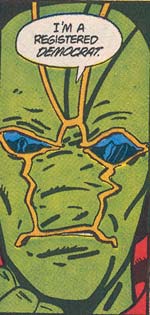
Plotted (and penciled) by Keith Giffen and scripted by Robert Loren Fleming, Ambush Bug eschews plot and embraces wackiness. At its best, this results in solid parodying of the superhero genre and the medium of comic books. The standout issue is Ambush Bug #3, “The Continuity Game,” which relentlessly mocks DC’s lip service to continuity and its more bizarre stories. There is a good deal to laugh about in this part of the book, although the humor dissipates as the book goes on. It’s almost as if Giffen and Fleming are running out of funny ideas — and in the final issue, Ambush Bug Nothing Special #1, the creators joke about getting drunk while trying to pitch ideas to one another. (Nothing Special is a good deal funnier than the second limited series; the time off seemed to help.)

But in that second limited series, Son of Ambush Bug, the ideas get thinner. “The Interferer” is introduced to justify the complete abandonment of plot, but that’s not necessary, and pointing out the lack of plot only serves to make it an annoyance. The jokes start falling flat; the sentient, malevolent sock Argh!yle, the Interferer, and Ambush Bug’s confinements in prison and Hell fall flat as jokes and have no plot to fall back on for usefulness. It would have been better if Son had been the four-issue mini and the original Ambush Bug six, but the issue counts were reversed.

Giffen’s art is superb at getting the jokes across, which should be no surprise to those who have followed his career. His ability to copy other styles when necessary is also excellent; I wished he would have done more stylistic jokes. For some reason, Ambush Bug’s noseless face is occasionally difficult to read in black and white; perhaps it’s the double dose of missing features (nose and color). The few childlike drawings, ostensibly by Giffen’s son Kyle, are charming.

Humor is a dangerous business; even if you make an audience laugh for twenty minutes, you can be perceived as unfunny after one joke bombs spectacularly. There are no bombs, spectacular or otherwise, in Ambush Bug, and the worst that can be said is that it drags occasionally. At its best, it reaches hilarity for a few pages at a time. But without a real plot for a reader to hang his interest on, those dragging moments seem to stretch on and on …

Rating: Ambush Bug head Ambush Bug head Ambush Bug head (3 of 5)

,

Labels: , , , , ,

18 July 2008

Showcase Presents Batman, v. 2

Collects: Detective Comics #343-58 and Batman #175-88 (1965-6)

Released: May 2007 (DC)

Format: 512 pages / black and white / $16.99 / ISBN: 9781401213626

Silver Age DC … I’m not sure why I bother. It’s so bizarre, so nonsensical, it’s as if the writers fed hallucinogens to mentally handicapped kids, then used their ramblings as springboards to write stories.

Actually, that’s not right; that makes the stories seem too interesting. The stories careen between boring and bad pseudoscience, then takes a left turn into camp with Batman #179 and Detective Comics #349, when the “go-go checks” begin. There are two extremes: crappy hoods with weak gimmicks and ludicrous sci-fi gimmicks that detract from the relatively grounded nature of Batman. None of it is particularly interesting.

Showcase Presents Batman, v. 2 cover Few of the iconic Bat villains show up Showcase Presents: Batman, v. 2. In nearly 30 issues, the Joker and Riddler show up once apiece. Poison Ivy makes her debut, with two appearances; the back cover also trumpets Blockbuster’s first appearance as well, which should give you some of the star power involved. A villain called the Outsider, who lurked in the shadows of v. 1, steps into the light and turns Robin into a coffin. Batman defeats him because the Outsider makes his machines too simple.

All the good parts of v. 1 are missing. The Outsider makes only a couple appearances before his secret identity is revealed. The Mystery Analysts of Gotham make only one appearance, which — sadly — is the high point of v. 2, outside of the Poison Ivy stories. Alfred returns from the dead in a spectacularly stupid way.

As I said, maybe it’s just that I don’t get Silver Age DC. They seem to be targeting a younger age than Marvel was going after at the same time, and it shows decades later. But the stories don’t seem to have any spark — except for the exotic temptress Poison Ivy, it’s just a dreary succession of people who Batman and Robin beat up. Without much continuity, the stories are just one damn thing after another.

I can’t recommend the book, and I doubt v. 3’s going to be much better. But it’s Batman — I might still buy it.

Rating: Batman symbol (1 of 5)

Labels: , , , , ,

22 May 2007

Showcase Presents Batman, v. 1

Collects: Detective Comics #327-42, Batman #164-74 (1964-5)

Released: August 2006 (DC)

Format: 552 pages / black and white / $16.99 / ISBN: 1401210864

Batman was one of the most popular characters of the 20th century, and his most recent movie shows he is still popular in the 21st. But the Batman of today — brooding, determined, and above all else serious — is not how he’s always been.

The Batman in DC Showcase Presents Batman, v. 1 is an altogether different sort of Batman. The cover says it was the inspiration for the (‘60s) TV show, but that’s not quite what this Batman is either. This “new look” Batman, revamped under orders of editor Julie Schwartz, isn’t the campy, over-the-top Batman of Adam West. This is simply the Batman of the Silver Age.

Showcase Presents Batman, v. 1 cover The Silver Age. Where sci-fi gadgets were as common as nickels, and only slightly more valuable. A world of superheroes with great power and no fashion sense. Where elaborate plans worked until the heroes made one tiny adjustment … or chanced upon some bit of blind luck. Where all gangsters wore suits and fedoras and had grand ambitions that dwarfed their abilities.

The question is, does this Batman work for modern readers? Not really. Batman and Robin fight few of their traditional adversaries; the Joker shows up twice in this Showcase and the Riddler and Penguin once apiece. Most of the crime is committed by thugs with only one asset: either a gadget or a plan. In this low-powered atmosphere, Batman is relentlessly cheerful, and he and Robin are never injured by the flocks of bullets aimed their way. There are little changes to their status quo in two years of stories.

The tales are vanilla superhero stuff — secret IDs, working with the police, ridiculously slow deathtraps, etc. It’s a pulpy mess, really: science fiction devices with no consequences for society on one side and soft boiled mysteries for Batman on the other. There is little in the way of character development. Alfred is killed early in the volume, but he is replaced by Dick’s Aunt Harriet, whose only purpose is to show up a couple of times a year and make Bruce protective of his secret identity.

The real positives are the Outsider and the Mystery Club. Each gives some continuity to the volume; the Mystery Club is a stable cast of amateur and professional detectives, and the Outsider is a semi-recurring villain with a secret. These manage to raise the level of the stories from inanity to mediocre. But that isn’t enough. Give this one a miss.

Rating: Rating: Half Batman symbol (1.5 of 5)

Labels: , , , , ,

27 July 2006

Showcase Presents Justice League of America, v. 1

Collects: The Brave and the Bold #28-30, Justice League of America #1-16, and Mystery in Space #75 (1960-2)

Released: December 2005 (DC)

Hey, look! A DC book! Now my life is complete.

Well, not really. But that won’t stop me from plowing through DC Showcase Presents: Justice League of America, v. 1.

JLA v. 1 is most interesting as a 500+-page black-and-white historical artifact. The Silver Age of superhero comics started with the first comic in this volume, The Brave and the Bold #28, in which the JLA fights a giant starfish from space. If you were part of the premiere superteam in the DC Universe, you’d probably choose a less laughable beginning, but this is what we’re given. Not an auspicious beginning, to be sure, but every great trend starts somewhere, and this is where the Silver Age began.

Whatever you can about the differences between DC and Marvel today, this book starkly highlights what was so different about those early Marvel comics. In the JLA, there is no bickering between characters, and there’s very little in the way of interesting interaction between the heroes at all. When they have to split up to fight a menace, they do so randomly or on the basis of working with someone they haven’t worked with before. The characters have no personal lives, and the stories are completely about the plot.

And the plots? Silver Age absurdity. Nitwits like Amos Fortune manipulating the heroes’ (and his own) good and bad luck glands. An alien delon (“equivalent to an Earth dictator”) imprisoning the JLA aboard a space galley, complete with oars. Three wizards conquering Camelot in big-finned Cadillacs. The Getaway Mastermind engineering a prison break with a balloon and matchbox he found … plus a shrinking ray he cobbled together in the prison machine shop. (I especially love the breathless scientific asides: “Scientific experiments by Dr. Burr at Yale University have proven that all living things are surrounded by an electrodynamic field of their own making!”)

I’m being a little harsh. There’s a lot of goofy, nonsensical stuff in early Marvel too. But Marvel doesn’t seem to have villains exploiting the heroes’ weakness in every adventure (kryptonite for Superman, the color yellow for Green Lantern, fire for Martian Manhunter), nor did they have their most popular characters, like Batman and Superman, show up for duty only occasionally. (With the New Avengers, I think Wolverine shows up when he wants to. Want to make something of it, bub?)

For the sake of full disclosure, I received this volume free from the DC booth at the annual American Library Association conference in New Orleans. Thanks, DC!

Overall, JLA v. 1 is dull and lacks the spark of Silver Age Marvel.

Rating: (2 of 5)

Labels: , , ,