Reviews of trade paperbacks of comic books (mostly Marvel), along with a few other semi-relevant comments / reviews.

10 June 2016

Midnighter, v. 1: Out

Collects: Midnighter #1-7 and Convergence: Nightwing / Oracle #2 (2015-6)

Released: February 2016 (DC)

Format: 160 pages / color / $14.99 / ISBN: 9781401259785

What is this?: Midnighter, the gay Batman, has split up from his lover and is trying to find himself. Unfortunately, someone has stolen a bunch of superweapons, and Midnighter has to find them and the culprit.

The culprits: Writer Steve Orlando and artists Aco, Stephen Mooney, and Alec Morgan


I really wanted to be able to recommend Midnighter, v. 1: Out, but I just can’t do it.

Before I read Out, all I knew about Midnighter is that he was, essentially, a gay Batman, originally from the Wildstorm Universe, whose lover was Apollo, a gay Superman. In Out, I quickly learned that second part is out-of-date, as Midnighter dates a string of men. In the second story, I found out Midnighter has a computer in his brain that allows him to see all possible outcomes of a fight, which allows him to choose the path that will lead to victory.
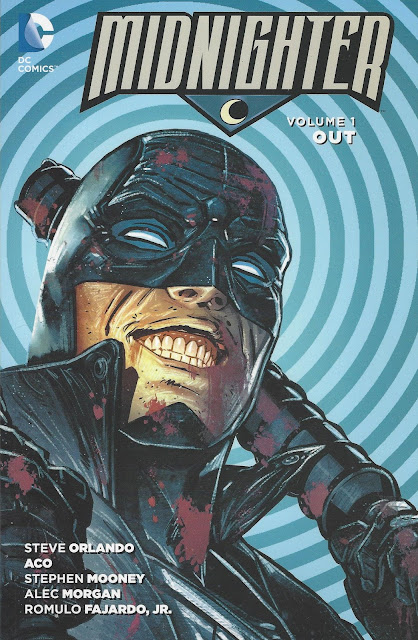
Midnighter, v. 1: Out coverBy the end, other than the reason Midnighter and Apollo broke up, that’s still all I know about Midnighter.

Out’s plot kicks off (in the book’s second story) with the theft of a super-arsenal from the Gardener, who also created Midnighter. Between dates, Midnighter follows the trail of the weapons, trying to find the thief. Writer Steve Orlando and penciler Aco (#1, #3, #6-7, and the story from Convergence) are trying to tell a complex, nuanced story, but their attempts come across as needlessly complex rather than interesting.

The text is littered with plenty of Warren Ellis sci-fi items, which I’m guessing is a relic of Ellis’s role in co-creating the Authority and Midnighter. Some of these terms and descriptions don’t have any logic behind them; for instance, a terrorist group from Modora (which I’m assuming is a country and not an insurance conglomerate or medical NGO) has blasters that kill people with their own anger. The rest could mean anything; the Gardener threatens her attacker with “doubt darts” and “manticore drones,” and items taken from her include the “six killing sounds,” which are rendered in Chinese, and “Holt-Griffin skin,” which is “invisible to technology.” Such vague, sci-fi items are meant to intrigue, but they annoy me instead. If a writer is going to use them, though, he needs to double down and make the text thick with them. Instead, they pop up as the next item to check off on Midnighter’s quest, and that’s not enough to justify their use.

Aco’s style makes it easy to figure out which stories are his and which are fill-ins: all of Aco’s issues have fiddly little blow-up boxes littering the page. The boxes don’t help the reader understand what’s going on, and their tiny size doesn’t actually magnify anything, but they are all over the place, so readers will have to get used to them. Aco’s art is tight and almost admirably miniaturized, but his ability to get a lot of art on a page doesn’t increase the amount of information that is conveyed, as Midnighter’s super-brain allows him to do things the art has trouble showing.

Admittedly, Aco isn’t aided by Orlando’s occasional forays into non-linear storytelling — the transition from #2 to #3, which goes from “now” to “hours earlier” to “later” to “back to now” ten pages later, is needlessly confusing and would be regardless of who was drawing #3. The switch from Alec Morgan (#2) to Aco doesn’t help things, either.

(Also: Would it kill DC to label each issue? I mean, even leaving a small number in one corner of the cover art would help me immensely; it also would have let me understand why what looked like Midnighter #1 was so short. It turns out the story was actually Convergence: Nightwing / Oracle #2, which is listed as part of the contents in the indicia’s tiny print but not on the cover.)

Confusing storytelling and high-sounding but disappointing Macguffins can be forgiven if the character at the center of the story is interesting. Unfortunately, we barely know him. What is it that drives Midnighter? He tells Apollo he’s leaving their relationship to find out who he is, but the reader never discovers what that is, other than a Batman copy with a computer in his brain. What other abilities does he have? He can teleport. Maybe he has superstrength? Maybe not. Maybe he’s just Batman with a fight computer in a brain but fewer detective skills.

Midnighter says he enjoys employing violence against bad people, and he specifically chooses the villains in this book because they robbed his … mentor? of a cache of superweapons. He seems to be irritated by criminals more than outraged. He has a small coterie of friends and a hangout; is this different than his status quo when he was dating Apollo? Midnighter seems to lack complexity; he’s a blank slate that likes to punch people.

What a lot of heterosexual men mean when they leave a relationship to “find themselves” is that they want to sleep with a lot of different women. Midnighter certainly succeeds in the homosexual version of that, sleeping with numerous men in Out. Morally, I don’t have any problem with that, but I am unconvinced that Midnighter’s dating pattern is a wise idea, from a security standpoint — and as it turns out, I’m right. It’s hard to respect Midnighter’s intelligence by the end … or maybe this is just another example of a man thinking too much with his little brain rather than the one in his skull.

The choice of the villain in Out is perfect: Prometheus, a villain who can download (and use) the knowledge and fighting skills of the world’s greatest martial artists. The battle between someone with these skills and someone who can calculate the future, like Midnighter, should be epic, as much a chess match as a physical encounter. Instead, Aco and Orlando give readers a straight slugfest, with two fighters trading bloody punches. The most innovative move shown is Midnighter smacking Prometheus with a poker. What a waste.

Dick Grayson, the original Robin and Nightwing who is now a secret agent, guest stars in #4 and 5. Contrasting Midnighter and Batman would be interesting, but other than Midnighter’s crack that Grayson must be “used to taking orders from a man in black,” the comparisons are all in the reader’s mind. Grayson seems almost to be humoring the ersatz Dark Knight by accompanying Midnighter on his mission; Midnighter handcuffs himself to Grayson because he claims a fight is boring him, but I find it hard to believe the protégée of Batman would remain handcuffed to Midnighter during a fight for any reason other than pity.

I enjoyed a few elements of Out. Midnighter’s glee at discovering he would be fighting Multiplex, a criminal who makes copies of himself, because it would give him so many bodies to beat up was a great character moment, and it’s amusing as well. The same goes for his approval of a fake vampire using insects and rats to fight him (“The vermin thing. Old school. Your respect for obscene tradition does not go unnoticed”). Midnighter’s final words to Apollo in their last argument — “I already know how this fight ends” — echoes his boasting from his physical fights. Those touches show up too seldom to save the book, though.

I have some sympathy with the assertion that a sex-positive comic book has value in and of itself; I also understand the idea that it’s good to show a gay hero who actually dates multiple men. And I admire that the creators of Out had ambitions; aiming high and missing is often better than aiming low and connecting. But the book itself isn’t interesting, and its misses aren’t that entertaining.

Rating: Batman symbol Batman symbol (2 of 5)

Labels: , , , , , , , , , ,

03 June 2016

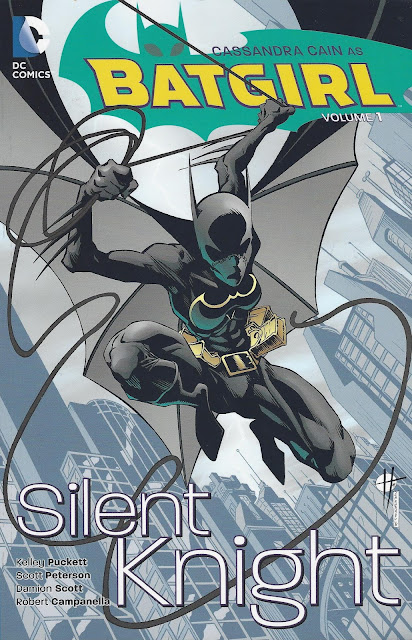
Batgirl, v. 1: Silent Knight

Collects: Batgirl #1-12, Annual #1 (2000-1)

Released: January 2016 (DC)

Format: 328 pages / color / $19.99 / ISBN: 9780785199571

What is this?: Coming out of No Man’s Land, a new Batgirl, able to predict the movement of others, joins Batman’s fight against crime.

The culprits: Writers Kelley Puckett and Scott Peterson and artist Damion Scott (and others)


My interest in the Batman titles waxes and wanes, but I rarely read the second-tier Bat books. For some reason, I made an exception with Batgirl, v. 1: Silent Night, and I’m glad I did.

The Batgirl in this book is Cassandra Cain, a character who debuted in 1999’s No Man’s Land event. Cassandra is the daughter of assassin David Cain, who trained her to fight from nearly birth but neglected language of any kind; as a consequence, the language centers of Cassandra’s brain were entirely dedicated to interpreting body language, which allows her to foresee her opponents’ moves but leaves her with little language ability.

Batgirl coverIn Silent Knight, Batgirl doesn’t have a ready-made archenemy, nor does she acquire one. She beats up on Gotham’s mooks and killers, usually experiencing little trouble. She’s not perfect, however; sometimes, she is injured while fighting crime, and sometimes people she wants to save die.

The lack of an overarching story is for the best, really, as it allows the story to concentrate on Cassandra herself, who is more interesting than a recurring supervillains. The book’s plot is driven by Cassandra’s personal evolution, with Cassandra having to fit into the Bat-family while she changes as a person. Her identity is wrapped up in her fighting ability, and anything that threatens her greatness at that has to be overcome at any cost. She has lived a life insulated from so many things that normal people take for granted; her only real human contact has been the father who expressed his feelings for her through violence. Because of this, she responds to male authority figures, obeying Batman’s commands and even showing concern for him.

The Batman / Batgirl relationship is touching in its way, but it’s also disturbing, given Cassandra’s relationship with her father. Cassandra rejected Cain long before the series, just after he sent her on her first assassination, but she still has feelings for the man who forced her to become a fighting machine. Batman is absurdly concerned that Cassandra might have killed a man when she was a little girl — she wasn’t legally or morally culpable, and she’s certainly repented — and as her surrogate father, he beats the tar out of her biological father because Cain “made her like us.”

(I have to admit: I like Cain, even though he’s despicable. He taunts Batman over his inability to accept Cassandra’s origins, and even hobbled by injuries, he’s resourceful and hard to defeat. His lingering affection over Cassandra — or what he created — is a nice Achilles heel for him as well.)

Cassandra lives with Oracle (Barbara Gordon), the first Batgirl, but despite sharing living space and a codename, Cassandra doesn’t show Barbara the sort of tenderness she does Batman. I’m not sure why this is. The generation gap isn't to blame, since Cassandra doesn’t interact with anyone her age. Is Cassandra rejecting the emotions Barbara exudes when she offers Cassandra help? Or does Barbara’s paralysis distance and reliance on communication her from someone who defines herself by motion? I think it has more to do with the latter than the former, but it’s hard to say.

Silent Knight is a great value: thirteen issues, one of them an annual, for $20. DC has always been better at getting older series like Batgirl reprinted for a reasonable price, but that has sometimes come at the cost of the quality of the physical book. Silent Knight has a higher quality paper and better binding than previous DC offerings, like the reprint of Chase from four years ago. A Marvel trade of this size … well, because I like picking on it, Cage: Second Chances, v. 1 is eight pages shorter and costs $15 more. Also: It’s filled with reprints of issues of Cage, so Silent Knight could have been 300 blank pages and still come out ahead.

On the other hand, the book does have some dead space. The issue that’s part of the Officer Down crossover (#11) feels like it’s acknowledging the event while giving Cassandra something to do with no real consequences; because it doesn’t engage with Barbara’s connection to Commissioner Gordon other than to mention it, the issue seems like a waste. The annual at the end of Silent Knight is filler — Batman and Batgirl in India — although it does show Cassandra watching a movie for the first time.

I’m not overly thrilled about the appearance of Lady Shiva either, but that’s mostly because she and Cassandra are hinted to have a connection because their skin colors are near each other on the color wheel and they have a similar ability. I’m not sure what my feelings will be as their connection is explored, though.

Damion Scott’s art is very, very ‘90s, even though these issues were coming out at the beginning of the 2000s. Scott’s work is sometimes described as being influenced by hip-hop and graffiti, which is fair, but comics readers who remember the ‘90s will see similarities to Joe Madureira’s work, full of thick lines and jutting angles. Scott is from the school of thought that a character’s mask should represent their emotions, so Batgirl’s (and Batman’s) mask have widened eyes, and the sewed-shut mouth of Batgirl’s costume widens and twists as necessary. (That sewed-shut mouth is delightfully creepy, I have to say.) I can’t say I am fond of Scott’s style, but it took no time before I became accustomed to it as the style of Batgirl, just as a quirky authorial voice often becomes part of the background — or even beloved — after you’ve been exposed to it long enough.

What never becomes part of the background is the way Batgirl is sexualized. When drawn in street clothes, Cassandra is a teenage girl of normal proportions, or as close as a comic-book female generally gets. As Batgirl … Batgirl is absurdly busty, and I can’t think of a reason why. Nothing about Cassandra in either persona justifies such objectification, and Scott’s depiction of Cassandra shows he understands normal female proportions. Is it a problem with the prominence of the costume’s logo? I dunno. Whatever the reason, it’s distracting.

Silent Knight is a solid superhero book that doesn’t rely on stunts or cheap traumas to shock readers. It develops a character with an interesting hook by putting her into situations readers are familiar with and seeing what happens. I liked this book so much, in fact, that I’m disappointed now that I didn’t preorder the second volume, To the Death. Guess I’ll have to pick it up after it comes out.

Rating: Batgirl symbol Batgirl symbol Batgirl symbol Batgirl symbol (4 of 5)

Labels: , , , , , , , , ,

30 April 2016

Showcase Presents Batman, v. 6

Collects: Detective Comics #408-26 and Batman #229-44 (1971-2)

Released: January 2016 (DC)

Format: 584 pages / black and white / $19.99 / ISBN: 9781401251536

What is this?: A chunk of early ‘70s Batman stories, mixing the first appearance of Ra’s al-Ghul and the League of Assassins with forgettable stories.

The culprits: Writers Dennis O’Neil, Frank Robbins, and others and pencilers Neal Adams, Bob Brown, Irv Novick, and others


When I reviewed Showcase Presents Batman, v. 5, I said the Bat-titles of the era were on the brink of something exciting. Batman and Detective Comics had shaken off the lingering funk of the Silver Age and were heading toward something much greater. So I was eager to read DC Showcase Presents Batman, v. 6 — well, as eager as a person can get for a book after four years when you thought the book line was cancelled.

And — good news! — v. 6 is better than v. 5. But it’s only an incremental improvement, and the Bat-titles reprinted in this volume still feel like they are poised to become something different, something greater. They just aren’t quite there yet.

Showcase Presents Batman, v. 6 coverYes, the Ra's al Ghul / Legion of Assassins story is sprinkled throughout the volume, but few other members of Batman’s rogue’s gallery appear in the thirty-plus issues. Man-Bat and Two-Face each appear in one issue — with Two-Face beautifully drawn by Neal Adams — but each gets only as many issues as the embarrassing Ten-Eyed Man. Most of the stories are single-issue mysteries, often with a supernatural tinge, that go nowhere.

Those mysteries, whether they have a supernatural element or not, are v. 6’s biggest problem. Some of them (mostly those with occult touches) are set in exotic locations, like Waynemoor Castle in northern England; some of them are set in the gritty streets of Gotham. Unfortunately, whether Batman is taking on circus freaks, hicks, or Shakespearean actors in Gotham or elsewhere, these stories become monotonous. Despite being solidly constructed mysteries, their flaws become more readily apparent than their virtues after the third or fourth in a row. All the ghosts and haunted castles Batman investigates have as much real supernatural content as the average Scooby-Doo episode, which takes some of the suspense out of the story. Issues that try to be socially relevant, dealing with youth gangs and urban crime, devolve into over-the-top action sequences, like when a group of teenagers threaten to blow up an apartment tower to get their demands listened to.

As a side note, O’Neil’s frequent asides asking readers whether they picked up on whatever clues Batman used to solve the crime annoyed me — not because of the device itself but because the clues are so rarely available to the reader. If your mysteries aren’t fair play, you don’t get to taunt readers that they aren’t as smart as the detective.

That being said, the Ra's al Ghul stories are classics for a reason. Beautifully drawn by Adams and full of menace, Ra's is the one villain who seems to worry Batman, the only adversary who requires the World’s Greatest Detective to have long-term plans. Adding a new dimension to the stories is Talia al-Ghul, Ra's’s daughter, a love interest who presents a puzzle Batman can’t solve; despite his undeniable attraction to her, she is the daughter of the Demon as well as being ruthless and a remorseless killer herself. Additionally, these stories knock the Batman canon of this era out of its unmoving, unchanging placidity. Although the League of Assassins stories don’t affect the continuity of the rest of the book, the storyline’s progression gives the book a sense of passing time the stories don’t have otherwise.

Of course, it would be helpful if the cliffhangers in the League of Assassins storyline were followed immediately by their conclusions, but those issues are usually followed by unrelated issues from the other Batman title. I understand chronological order is important, but in a book like this, story coherence is more vital.

The art in v. 6 is outstanding. Adams provides covers for almost all the issues, and he draws about a quarter of the stories. This is Adams’s work at its finest: perhaps not as explosive as his work on X-Men a few years earlier, but each panel is beautiful, fully adapted to Batman’s world of shadows. The concessions he makes to Batman’s more grounded world makes his artwork tighter, more focused. Most of the remaining issues are drawn by Bob Brown and Irv Novick, both of whom worked with Adams on the previous volume. Neither is Adams’s equal, but both are solid artists with outstanding storytelling and an ability to fit the story into a many panel layout.

 coverScattered among the work by Adams, Brown, and Novick, the three issues drawn by writer Frank Robbins stand out, and not in a good way. Robbins is a good artist for a writer, but that’s as far as I’m willing to go. (Robbins was primarily an artist in his career, but he splits the writing chores in v. 6 with O’Neil.) His style has a thick line and lacks the fluidity of the rest of the artists; even if he were a better artist, his work wouldn’t fit in v. 6.

One warning about this book: although it says it contains sixteen issues of Batman, that’s misleading. Two of the issues, #233 and #238, have only the cover reprinted because their contents are reprints. The covers of other issues of Batman and Detective promise back-up stories featuring Batgirl, Robin, or some other hero, but those aren’t included even though at least some of them are original stories.

On average, v. 6’s quality is only incrementally greater than v. 5. However, it contains so many iconic and important moments that it feels a great deal better at times. Nothing in v. 5 compares to shirtless Batman dueling Ra's al-Ghul, the first appearances of Ra's and his daughter, the first time Ra's is resurrected by the Lazarus Pit. I’ve read these issues before, in color, in Batman: Tales of the Demon, which was superior to v. 6 — and not just because Tales of the Demon was in color. Learning the context in which those Ra's stories initially appeared makes them more impressive, since the League of Assassins stories are nothing like the rest of the era. But actually reading those non-Assassin stories makes reading v. 6 feel like a chore at times, a bit of self-education that is unnecessary.

Still: shirtless Batman vs. Ra's al-Ghul. That fight was pretty awesome.

Rating: Batman symbol Batman symbol Batman symbol Batman symbol (4 of 5)

Labels: , , , , , , , , , , ,

21 December 2012

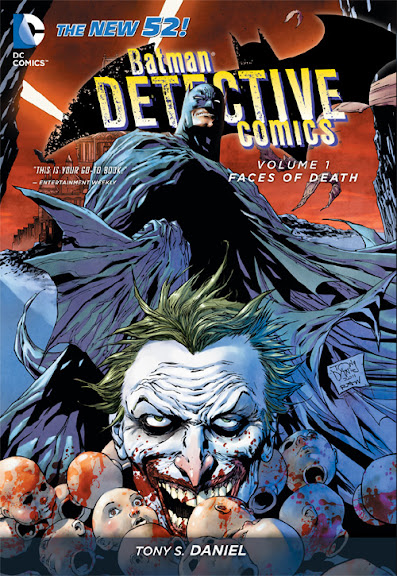
Batman: Detective Comics, v. 1: Faces of Death

Collects: Detective Comics #1-7 (2011-2)

Released: June 2012 (DC)

Format: 176 pages / color / $22.99 / ISBN: 9781401234669

What is this?: The Joker makes his New 52 debut, Batman battles the Dollmaker, and a Gotham heist shockingly has twists and double crosses.

The culprits: Tony S. Daniel


Continuing my brief tour through the New 52 is Batman: Detective Comics, v. 1: Faces of Death. Faces of Death contains two stories, both written and penciled by Tony S. Daniel: four-issue story featuring Joker and the Dollmaker, who cuts up and stitches together pieces of people to make masks and augment thugs, and a three-issue tale involving the Penguin, Batman’s girlfriend (or one of them), and a pair of lovers trying to make the criminal big time.

Of the two, the latter is superior. It’s a heist plot, not overly complicated; the Penguin opens his Iceberg Casino on the same night he cajoles new Gotham villains to deposit their money in his impenetrable vaults, and of course someone tries to rob that vault. As a crime tale, the story works well and has many elements that give it a noir shading without seeming clichéd: desperate criminal lovers in over their heads, a colorful cast, and a villainous plan that makes sense on its first read-through but fits together even better on a second read-through. It’s admirably short — three issues — and although I think it could have been wrapped up in two, the extra issue did allow Daniel to insert subplots and introduce other characters who may be important later.

Batman: Detective Comics, v. 1: Faces of Death coverOn the other hand, the story has extra complications that water down the story, all of them connected with Bruce’s girlfriend, television reporter Charlotte Rivers. Bruce says, “I like this one” in issue #1, which is intended to convey to readers that Charlotte is special but translates as “She’s my girlfriend in this storyline” to anyone who has read more than a handful of Batman stories. And of course liking her didn’t stop him from having sex with Catwoman on a rooftop in Catwoman #1. By the end of #6, though, Batman is willing to jeopardize his secret identity by crying out her name in front of a villain after she has been stabbed. Do I believe Batman cares so much about a woman he has been dating for a short time that he loses his professionalism and jeopardizes his mission? No. No, I don’t.

Some characters are overcomplicated by details that don’t add any emotional weight to the story. Charlotte and one of the robbers are twins who were separated at birth, their father is Gotham’s mayor, and the sisters have a covert but long-running stand-off. It doesn’t add anything to Charlotte or the robber twin’s characters. If Charlotte had discovered the heist because she’s good at her job and hungry for a scoop, she would seem a more impressive reporter; Daniel could have added depth to the robber’s character by giving her some other reason not to kill Charlotte. Their parentage could have been worked into other spots in the story — certainly Bruce Wayne dating the daughter of the mayor is big news, or someone might think it would be a big story if the public knew (it’s not stated whether Mayor Hady’s paternity has been acknowledged). Instead, readers get a complication they’ve seen frequently before.

One odd touch to the villainous twin’s crime spree is the mutilation of one of the victims. All the ones murdered are marked in a signature way, but one in particular is chopped into pieces and stuffed into a trunk full of ice. It seems out of character for such a professional villain, but it does echo the gore seen in the first story …

Which starts as a Joker vs. Batman story but morphs into a horror story, one rather less successful than the heist tale. In issue #1, Batman pursues and ends the Joker’s murder spree, one owing more than a little to The Dark Knight. The issue ends with a new villain, Dollmaker, cutting off the Joker’s face and spiriting him out of Arkham, the implication being that the Joker is either dead (ha!) or has a new face. In #2-4, Batman tracks down the Dollmaker, who cuts people and bodies apart, then puts them back in different configurations. He also has a sideline as an organ harvester.

The problem with the story is that it seems a bit too derivative. Following the Joker’s terrorism in #1, the story has a dead cop used as a decoy, sloppy police work that places cops in the villain’s trap, and corrupt officers. The villain catches Batman but declines to kill him, claiming the villains he is selling Batman to need to see him in action. Jim Gordon is captured, used as bait, and also is not killed, even though there’s no reason to keep him alive. Tried and true tropes, yes, but not exactly a way to distinguish Batman in the New 52. (Daniel does have Batman shrug off an anesthetic’s effect without an antidote or comment — that’s new, but it’s not good.)

From what I can tell, Daniel is writing a slightly different Batman than the other New 52 titles I’ve read. Daniel’s Batman is a humorless dick who is isolated from everyone except Alfred and Gordon. (He’s mostly humorless in Batman and Batman and Robin, but his interactions make him more human.) His dialogue is flat and forgettable. A little violence is necessary when it comes to Batman stories, but Daniel’s Batman seems to relish it a more than other versions: he thrashes one of Dollmaker’s thugs he has captured, trying to beat information out of him, and as a threat, he claims he has “broken” men. He gives Raju, the Penguin’s underling, a swirly, which seems less like a high school prank and more of an unhygienic waterboarding. This Batman is very violent; he may be a torturer. He’s also a two-timer, as I said before, making time with Catwoman as Batman (in other titles) and Charlotte as Bruce. Not very admirable, and I think less of this Batman than other versions.

One of Daniel’s successes is setting up subplots that actually feel like subplots rather than loose ends. Hugh Marder, owner of a tech company Bruce is buying, will eventually be important. Charlotte Rivers obviously has more of a story. Olivia Carr, a girl abducted by / collaborating with the Dollmaker, should show up again, although she might be dropped. Batman learns someone is stealing Wayne technology in the first story, and even though he doesn’t investigate that mystery in the second, it does feel important. An interesting enough backup, drawn by Szymon Kudranski, introduces Hugo Strange and his son in a story about a Catwoman heist. This certainly isn’t the old style of simmering subplots, but it is better than a lot of modern comics.

Daniel’s pencils are a mixed bag. It’s strong in Jim Lee-fu, pretty and bold and big. On the other hand, sometimes it misses on the details: for instance, Raju adds 50 pounds of fat between appearances, Hugh Marder loses 50 pounds of muscle, and a character whom Batman claims has had his tongue removed is shown, mouth open, with his tongue visible. Raju I recognized because he’s the only brown person of note in the story, but I didn’t figure out who Hugh was until the second read-through. (I’m sure the tongue was supposed to be a stump, but it doesn’t come across in the art. Since Daniel is the writer and penciler, it’s not like there’s miscommunication.) There are other strange artistic moments — Alfred’s eyes opening wider than the lifeless, staring eyes of the corpse two panels before, for instance — but you get the point. His designs need work. He never settles on a theme for Dollmaker’s henchmen — Jack in the Box and the monkey with cymbals suggest a toy motif, the naughty nurse for a doctor theme, and the mismatched flesh golems suggest a mad scientist. His new villain designs in the second story are amusing but not that original (except Mr. Combustible, who has a light bulb for a head), but they are probably meant to be throwaways.

Oh, someone should tell colorist Tomeu Morey that not everyone's nose is always a different color than the rest of his or her face.

While Faces of Death is competent and — in the second story, at least — occasionally more, it feels like a joyless exercise in putting out more Batman every month. And I’m not interested in that.

Rating: Batman symbol Batman symbol (2 of 5)

Labels: , , , , , , , , , ,

30 November 2012

Penguin: Pain and Prejudice

Collects: Penguin: Pain and Prejudice #1-5, Batman: Joker’s Asylum: Prejudice #1 (2008, 2011-2)

Released: September 2012 (DC)

Format: 144 pages / color / $14.99 / ISBN: 978-1401237325

What is this?: Gotham City crime lord Penguin battles with the law and Batman in his quest for riches, respect, and love.

The culprits: Writer Gregg Hurwitz and artist Szymon Kudranski, with a backup by Jason Aaron and Jason Pearson


I’m usually a fan of including backup material in collections — not just backup stories, but extra stories related to the main story. They give the buyer a little extra value, they get a forgotten story back in print, or they are interesting in some way: funny, illuminating, poignant. Perhaps it fills in a gap in a story or shows a creator’s early work.

Penguin: Pain and Prejudice collects the New 52’s first limited series; to fill out the collection, DC included Batman: Joker’s Asylum: Penguin #1 at the end (after even the rough sketches by Pain and Prejudice’s artist, Szymon Kudranski). I liked Batman: Joker’s Asylum: Penguin; the problem is that after reading it, it became obvious the main story, written by Gregg Hurwitz, is either too derivative or unconsciously imitative of Joker’s Asylum: Penguin, which was written by Jason Aaron.

Penguin: Pain and Prejudice coverAnd once the reader has made that conclusion, he or she can’t help but notice Aaron wraps up many of the same themes Hurwitz explores, except Aaron does it in a single issue rather than five.

I realize the two stories are not exactly the same. But both stories deal with the Penguin, in his modern form as a rich, powerful crime lord, seeking affection while being unable to restrain the evil impulses that make it impossible for him to be loved. Both stories feature the Penguin being tormented by childhood oppressors and his revenge on them; both stories show the Penguin ruining men completely, without physically harming them.

There are differences. Pain and Prejudice features a plot in which the Penguin battles his father and brother for the affection of his mother, the only person he feels has ever loved him. Hurwitz adds more childhood torments. Batman is a full-fledged antagonist, rather than a natural feature of Gotham appearing in the one-page cameo he receives in Joker’s Asylum: Penguin. Penguin is positioned as a master of robotics and mechanics. Pain and Prejudice’s length allows Hurwitz to show Penguin taking the apart the life of someone who was callous to his mother rather than just describing it.

But these features do not justify the four extra issues.

I understand Pain and Prejudice’s remit was to communicate Penguin’s status quo in the New 52, and elements from Joker’s Asylum: Penguin are part of the rebooted character’s personality. But Joker’s Asylum: Penguin shows these elements could have been shown much more quickly. Aaron doesn’t rely on “crappy childhood” as an excuse for villainy. And the lack of Batman as an antagonist works to Joker’s Asylum: Penguin’s advantage; we don’t have to wonder why Batman can’t stop Penguin (or why he won’t), and we’re allowed to view the Penguin’s actions against a more neutral background.

Hurwitz has Penguin, Batman, and Commissioner Gordon briefly discuss the law protecting certain morally suspect people because of their background or looks, but he doesn’t develop the idea. Although Batman does give some credence to the Penguin’s claims that appearances matter when it comes to who gets arrested, Penguin’s arguments ring hollow, considering how many murders he orders / commits in the book and who he and Batman compare him to: a spoiled pop star, an ecstasy dealer, and a philanthropic heiress getting rich off sweatshops. Penguin is a plague of crime; the other three are morally suspect but hardly Public Enemy #1, and none of them deserve what Penguin does to them.

Hurwitz seems to have trouble with the ending as well. He decides to have the Penguin go off the deep end, ordering more and more brazen robberies and launching robotic attacks; each course is completely out keeping with the rest of the book. This causes the Penguin’s undoing at the hands of Batman, of course. I can see how Hurwitz contrasts the fate of Penguin’s lover with those the Penguin destroyed earlier in the book, but the circular fate of his girlfriend in Joker’s Asylum: Penguin is much more satisfying and more in keeping with Penguin’s MO.

The art in both stories is excellent. Kudranksi’s shaded realism is excellent for a dark crime tale, painting a bleak world for a sadistic crime lord to work his violence upon. His work emphasizes the Penguin's short stature and his inferiority complex (or perhaps his infantilism); we never see his parents’ faces, nor do we see Batman’s. Occasionally the Penguin is depicted as a child when interacting with Batman. I was never quite sure what his robotic bombs were supposed to be doing, though — releasing attack birds? Causing wild birds to attack? It doesn’t help that both plans are stupid. Jason Pearson’s art on Joker’s Asylum: Penguin is much different — a cartoonier style, emphasizing Penguin’s deformities through exaggeration. The lighthearted tone fits most of the story, which focuses much more on romance than Pain and Prejudice. Pearson is still able to pull off the story’s darker parts, though.

So: go get the Batman: Joker’s Asylum: Penguin back issue rather than this collection. Pain and Prejudice is a bit overdramatic, a bit pop psychological — J.M. DeMatteis for the 21st century, perhaps — but it’s not a bad story … my favorite Bat title of the New 52, actually. But it can’t complete with the succinct story in Batman: Joker’s Asylum: Penguin.

Rating: Batman symbol Batman symbol Batman symbol (3 of 5)

Labels: , , , , , , , , ,

21 September 2012

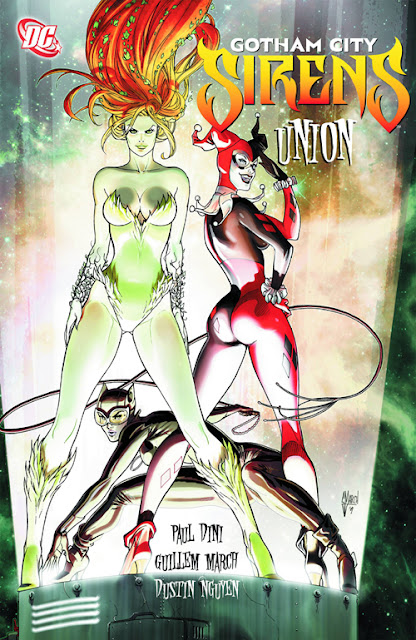
Gotham City Sirens, v. 1: Union

Collects: Gotham City Sirens #1-7 (2009-10)

Released: April 2010 (DC)

Format: 176 pages / color / $19.99 / ISBN: 9781401225704

What is this?: Villainesses Harley Quinn and Poison Ivy move in with Catwoman; wackiness ensues.

The culprits: Writer Paul Dini (and Scott Lobdell) and artist Guillem March (and penciler David Lopez)


Writers and artists are not automatons. Their output varies in quality, quantity, and style, even when conditions seemed close to the ideal. For instance, sometimes when Paul Didn writes about Batman villains Harley Quinn and Poison Ivy, you get Batman: Mad Love, which many readers and critics love. And sometimes you get Gotham City Sirens, v. 1: Union.

Gotham City Sirens is ostensibly a comedy with wacky roommates — Batman villainesses Harley, Ivy, and Catwoman — or perhaps it’s a reality show without cameras. In any event, the three criminals move in together for almost nonexistent reasons and try to live noncriminal lives. Dini’s stories are action-oriented, with very little character development … or motivation, really.

Gotham City Sirens, v. 1: Union coverThere are three interesting moments in Union:

1) The girlfriends of Batman, Catwoman and Talia al-Ghul, once met to figure out how to protect Batman’s secret ID.
2) Harley visits her dysfunctional family.
3) The Riddler, as a private investigator, takes a case.

The last is the best part of Union, taking up most of issue #3. That shouldn’t be a surprise; sometimes, when a creator revisits a character he or she had success with, you do get the same level of quality, and Riddler as a PI was my favorite part of Dini’s Batman: Detective. (Also my favorite thing done with the Riddler ever and my favorite little Batman idea.) Unfortunately for that theory, though, the writer for #3 is Scott Lobdell, but Lobdell does do a good job with Dini’s idea. In #3, Riddler teams up with the replacement Batman to solve some faked suicides; with Dick Grayson as Batman, it’s possible Riddler will outthink him. (Not likely, but possible.) Riddler narrates #3 with good but edged humor, and his rivalry with Batman adds a little spice to the team-up.

But it’s unsurprising that switching to a number of the book’s secondary cast is necessary to get a good story, as Dini seems unable to get much entertainment out of the relatively amiable main trio. Harley and Ivy try to drag Batman’s identity out of Catwoman early on, but after that, the three untrustworthy women are pretty chummy — somehow without even showing a spark of friendship that would make them interesting.

So unless you were hoping to see the return of Gagsworth A. Gagsworthy, the Joker’s Silver Age sidekick, or more of Hush forced to impersonate Bruce Wayne, there’s nothing here … and I wasn’t wanting to see either. I admit, there’s something to be said about contrasting Silver Age Joker with the more modern, psychotic version, but spreading “Gaggy’s” story over two issues is a waste of pages. As for Hush, I found it hard to discern his motivation, other than a near-pathological need to murder. If there was a hint he wanted to use Harley to escape his Bat captors, there might be something interesting.

Pander, young man, panderI wanted to start this review by saying something about breasts and (women’s) butts, but glancing through Union again, I decided artist Guillem March’s work wasn’t as full of cheesecake as I had originally thought. Oh, make no mistake: there’s a lot of art showing how shapely and well endowed Harley Quinn, Poison Ivy, and Catwoman are. But almost all artists draw them like that, and despite some questionable choices (Harley Quinn in Daisy Dukes? Really?), March saves his over-the-top work for Gotham City Sirens covers and one character in #3, an issue in which the three main pin-ups — sorry, characters — are mainly absent; March draws a bookstore clerk in a see-through mesh top, pleated microskirt, visible panties, and torn fishnets. Yes, the bookstore is The Heart of Poe — possibly more Goth-friendly than most — but I know pandering when I see it.

Other than how he draws women’s bodies — not to brush the topic aside — I liked March’s style. I can see the manga influence, especially in certain characters’ faces, but March has a heavier line and less androgyny than most manga I’ve read. The little manga-esque touches — the giant sweat droplets on Hush when he things Harley has found him out or the flower petals drifting past Harley and Hush in an intimate moment — are nicely matched with the book’s light tone. I also liked David Lopez’s fill-in work on #7: it had strong, expressive character work (although sometimes the expressions are a bit broad) and much less exploitative female drawings.

The book’s main appeal is the female form, and Dini doesn’t give a reason for Gotham City Sirens to exist beyond that. I’d buy a Riddler solo book, but given that his PI work seems to have been scrubbed by the New 52, there’s little chance of that. Union is Supervillain Team-Up with T&A, and that’s not worth reading.

Rating: Batman symbol (1 of 5)

Labels: , , , , , , , , , , , ,

13 July 2012

Batman: King Tut's Tomb

Collects: Brave and the Bold #164 and 171, Batman #353, and Batman Confidential #26-8 (1980, 1981, 1982, 2009)

Released: February 2010 (DC)

Format: 128 pages / color / $14.99 / ISBN: 9781401225773

What is this?: King Tut — last seen on Batman ’66 — is unleashed upon Gotham, and three ‘80s issues drawn by Jose Luis Garcia-Lopez are also included.

The culprits: Writers Nunzio DeFelippis, Christina Weir, Gerry Conway, and J.M. DeMatteis and artist Jose Luis Garcia-Lopez


The copy of Batman: King Tut’s Tomb that I have is an odd duck, and I’m not sure how it ended up in my hands.

What I have — and cannot find a record of anywhere online — is a hardback version of King Tut’s Tomb. Not only can I not find a record of the hardback, but I can’t find a reason for it to exist. King Tut’s Tomb reprints a three-issue storyline from Batman Confidential, a second-tier Bat-title from before the New 52 reboot that I was only vaguely aware existed. (In some places on the Web, King Tut’s Tomb is listed as Batman Confidential, v. 6.) Three issues is not enough to fill a hardback (or even a trade paperback), of course, so the book also contains two issues of Brave and the Bold and one issue of Batman from thirty years ago. One has a tenuous plot connection to the main Batman Confidential story; the other two have none. The real connection is that all six issues were penciled by Jose Luis Garcia-Lozpez.

Batman: King Tut’s Tomb coverIs Garcia-Lopez’s reputation strong enough to base an entire book off of? If so, I would expect his name in the title. On the other hand, this is part of the reprint series for Batman Confidential … but the words Batman Confidential show up only in tiny print in the indicia. The relatively obscure stories filling out the book make me think DC’s reprint editors were casting about desperately for something to bring up the page count, but if that’s the case, why reprint a secondary title in hardback when half the book is almost random? I mean — not that I’m complaining — Birds of Preycan’t get a hardcover, and that’s a title with an identity and a fan base.

Oh, well. It’s only slightly less strange if it’s a trade. A corporate decision, most likely, in both senses of the word.

What Birds of Prey did not have, however, was an artist as good as Garcia-Lopez. Thirty years is a long time in the life of an artist, and Garcia-Lopez’s style has definitely shifted. In the ‘80s stories, Garcia-Lopez’s art is very much in the style of Jim Aparo, whom he was filling in for on Brave and the Bold: a lithe but powerful Batman in a world of clear, solid lines. Even in Gotham and outer space, Batman’s world is bright and appealing. Though I have no nostalgia for that era, Garcia-Lopez’s art is comfortingly familiar.

In the Batman Confidential stories, Garcia-Lopez’s pencils are updated, modern — more Jim Lee than Jim Aparo. Batman is muscular and not as flexible, the backgrounds are busier, the cheesecake more plentiful. The panels are larger, with the occasional splash page. There is little to distinguish Garcia-Lopez’s modern style from a dozen others, except that his storytelling is superior. Present or past, there is little doubt what is supposed to be happening in the story. The older layouts, with more panels, are clear, but Garcia-Lopez knows how to tell a story even with the emphasis on flash. It explains why he has been getting work for 30 years.

It’s a shame the stories aren’t better, thought. The eponymous Batman Confidential stories have about two issues worth of interest dropped into three issues. Writers Nunzio DeFilippis and Christina Weir finally bring King Tut, an Egyptological-centered villain, from the ‘60s Batman TV show to the comics, an event that someone was probably waiting for. (Maybe.) It's the standard tale of presumed reincarnation and insane, petty revenges, and it’s not that interesting. But King Tut uses riddles related to the Hymn of Aten (an ancient song dedicated to Aten, an Egyptian god), which leads to the Riddler’s involvement in the case. The interaction between Batman and the Riddler is fun to watch, despite my nagging concern of where this fits in the Riddler’s history, since he was a semi-legitimate PI the last I had seen of him. However, the total of their intelligences is less than the sum of its parts. Riddler blunders into death traps, Batman is forced to rely on Riddler for information the plot would usually require him to remember himself — that sort of thing.

The ‘80s issues are a mixed bag. The two Brave and the Bold stories are quite forgettable, and by next week I’ll probably deny ever having read them. Batman teams with Hawkman in #164 to protect King Tut’s treasures, but aliens steal the entire museum to get back a pair of their artifacts. It’s a wacky, cosmic mix-up with a “cosmic hole” and possessions by alien spirits, but of course writer J.M DeMatteis ends it satisfactorily and forgettably. Writer Gerry Conway uses Professor Carter Nichols and his time-traveling hypnotism to send Batman back to the Civil War in #171, in which he meets a famous Union nurse and Scalphunter. A few moments of visceral satisfaction — Batman reconstructing the jaws of a few Rebels — can’t compensate for how boring the story is, especially since I have no idea why I should care about Scalphunter. (The character is named that only on the cover; in the story, he’s Ke-Woh-No-Tay.)

Conway’s Batman #353 is probably the best single issue in the collection, with Garcia-Lopez’s long-chinned Joker stealing the show. Conway writes the Joker as murderous and egomaniacal, and he almost wins … what more can you ask for in a Joker story? There's a subplot about Boss Rupert Throne getting back into Gotham politics, which was probably very exciting back in 1982 but serves only as a distraction in this collection.

So I still don’t understand why my local library has this in hardback. (Special library edition? There’s no indication that one was published, but who knows.) On its own merits, this isn’t a bad collection, although given the shift in styles, Garcia-Lopez’s art is not strong enough to unify King Tut’s Tomb despite its quality. The stories are mostly mediocre if inoffensive. For all you Jose Luis Garcia-Lopez fans, you’re in luck; for all you fans of Batman Confidential, you kinda get shafted. For the rest of us, this book is a big shrug.

Rating: Batman symbol Batman symbol (2 of 5)

Labels: , , , , , , , , , , , ,

08 June 2012

Batman, v. 1: The Court of Owls

Collects: Batman #1-7 (2011-2)

Released: May 2012 (DC)

Format: 176 pages / color / $24.99 / ISBN: 9781401235413

What is this?: Batman discovers and battles a secret cabal that has been ruling Gotham for centuries.

The culprits: Writer Scott Snyder and artist Greg Capullo


I’ve mostly stayed away from DC’s New 52 because reboots have nothing to offer me without revamping the underlying concepts into something different as well. Oh, I dabbled in the lineup’s new racial and genre diversity — Blue Beetle, Mr. Terrific, All-Star Western, Demon Knights — but mostly the idea of erasing all the old stories for a clean slate bores me. You want a clean slate? Come up with a new idea. Build it from the ground up.

That being said, there are some ways in which a clean slate is better. When I read the pre-reboot Batman: The Black Mirror, I spent an inordinate amount of time deciding whether James Gordon Jr. was a pre-existing character. If the commissioner of Gotham City Police Department had a psychopath for a son, that should be a big deal, one that should be frequently referenced, and it wasn’t. (Answer: Jimmy Junior existed, but not as an adult, and definitely not as a psychopath.) But with the mysterious Court of Owls in the New 52’s Batman, v. 1: The Court of Owls, I don’t have to worry about whether inserting a large-scale, Illuminati-like organization that has been controlling Gotham City for hundreds of years into the story makes any sense. I already know there’s nothing to contradict it in the New 52 continuity.

Batman, v. 1: The Court of Owls coverWriter Scott Snyder spends a great deal of time building the mythology of the Court into the fabric of his new Gotham. It’s the kind of thing that can be done effectively only with a new continuity; dropping yet another secret, powerful organization into the background of the Marvel Universe has been producing yawns since Stan Lee was still a writer, not an actor. And without some knowledge of the universe, the revelation of secrets and hidden powers can fall a little flat. So if you’re going to tell a story like this, the launch of the New 52 was the time to tell it.

Snyder is pitting legends against each other in Court. On one hand, you have Batman, who effectively rules Gotham’s night at the beginning of the story, with his enemies all in Arkham. Bruce Wayne is about to revitalize and rebuild Gotham. He’s pushing the envelope with his electronic toys, which lets him get even farther ahead of crime. He’s secure in who he is both as a leading citizen of Gotham and as a crimefighter. But he’s not exactly a secret or reclusive in either role, although there are allusions to Batman being regarded as a myth in the past. On the other side, Snyder presents the Court of Owls: reclusive, secret, hijacking Bruce’s great great grandfather’s building projects and making over Gotham for their own purposes. All the public knows about the Court is an old nursery rhyme (that doesn’t quite scan). They’re an urban legend, a nice inversion of the Batman legend.

That said, it’s unknown why the Court makes its move at the beginning of Court of Owls; this is a problem with making the Court of Owls the first storyline in Batman’s New 52 run. There’s no buildup or suspense; it has all the emotional setup of a fighting video game: Batman vs. Court of Owls — fight! Is it Bruce Wayne’s revitalization project that causes the Court to send their killer, the Talon, after Bruce? Or is it Batman’s success? Or both? The Court seems to have worked out who Batman and his associates really are, but it’s not spelled out. Snyder also tries to tie the Court into Nightwing’s backstory, which has the emotional impact of a feather duster over the head. Even Nightwing himself points out that he just doesn’t care about how the Court might have intersected his or his family’s long-ago, nebulous past. It doesn’t affect his present or future. If Dick doesn’t care, I don’t either, which makes this detail more annoying than intriguing (especially given how often this sort of thing is done in comics).

I do appreciate Snyder using Nightwing as someone who can talk to Batman, even if Batman doesn’t want to talk. Writers have that option with Alfred as well, but Alfred relates to Bruce, rather than Batman, and often as a father figure; Nightwing can relate to Bruce as a human being or Batman as a fellow crimefighter. I’m not sure what Snyder is saying by having Nightwing being on the correct side whenever the two argue — whether Batman is short sighted or a very flawed detective — or by having Batman backhand Nightwing during an argument (is he being a poor father? Are we supposed to see him as hopelessly violent? Or are we supposed to see Batman pushed to a breaking point?). It’s an unexpected, troubling dynamic between the men, and while some flaws might be good to humanize Batman, striking Nightwing goes a little far.

Snyder introduces a couple of new characters in Court. One is mayoral candidate Lincoln March, who is obviously supposed to be a mirror of Bruce Wayne; the two even look almost identical, although surprisingly March is taller. Like Bruce, March was orphaned at a young age and even has a memory of his mother’s jewelry at the site of her death. Unlike Bruce, though, March is self made. It’s easy to foresee a Two-Face or Black Mask turn for him, or maybe he’s in with the Court. I have no idea what to make of Harper, a bepierced character who aids Batman at a critical moment for a couple of pages. She has wiring and perhaps welding equipment in the back of her Tardis van, and she and Batman know each other. Other than that, she’s not mentioned, and I have no idea what her significance is.

Artist Greg Capullo does an excellent job designing the Court of Owls and its Talons. The Court’s featureless oval masks have just enough detail to suggest “owl” without sacrificing the creepy blankness. The Talons have an overwhelming similarity in color and shape to Batman’s costume, sans cape; they are instantly recognizeable, though, no matter how much they look like an Elsewords (or Earth-3) Batman. I also enjoyed the sequence in issue #5 that follows a disoriented Batman through the Court’s labyrinth; the layout switches to sideways before turning upside-down as things get worse and more confusing for Batman. On the other hand, I’m not sure of Capullo’s sense of scale; judging from the art, March must be twice as tall as Damian Wayne (possible, but barely) and 1.5 times as tall as Time Drake (implausible). And March looks too much like Bruce, no matter how similar they are supposed to be. That aside, I like Capullo’s work — simple without skimping on details and remaining expressive.

Still, I don’t know that I’m much interested in how the story plays out. Visuals aside, the Court of Owls doesn’t have the heft to interest me, and the Talon has — intentionally — little personality. I appreciate Snyder’s ambition in trying to build an organization that can rival the Bat Family. But one Talon — or even a flock of Talons — and their anonymous overlords don’t have that impact.

Rating: Batman symbol Batman symbol Batman symbol (2.5 of 5)

Labels: , , , , , , , ,

11 May 2012

Showcase Presents Batman, v. 5

Collects: Detective Comics #391-407 and Batman #216-227 (1969-70)

Released: December 2011 (DC)

Format: 448 pages / black and white / $19.99 / ISBN: 9781401232368

What is this?: Batman starts swinging into the Bronze Age, packing his sidekick off to college and hitting the mean streets of downtown Gotham.

The culprits: Writers Frank Robbins, Denny O’Neil, and Mike Friedrich and artists Bob Brown, Neal Adams, and Irv Novick


I read Showcase Presents Batman v. 1 and v. 2, but I had to give up reading the series. Unlike some, I have little tolerance for Silver Age stories from the DC Universe; I don’t care that the original writers and artists knew they were creating comics for kids or that the stories were unapologetically goofy. The stories are still goofy, and that does not amuse or entertain me.

So I decided to hop back on bard the Showcase train only when it hit Denny O’Neil Station, which it did in Showcase Presents Batman, v. 5. Not all of these issues are written by O’Neil (his first is Detective Comics #395), and Frank Robbins wrote more, by a 2-to-1 margin. (Mike Friedrich contributed three back-ups.) O’Neil does pen the most lasting contribution to Bat-lore in this volume — the creation of the League of Assassins in Detective Comics #405 — but I was surprised to discover Robbins co-created the Man-Bat (in Detective #400).

Showcase Presents Batman, v. 5 coverO’Neil’s writing … it’s hard to call it “realistic,” but his stories are less prone to the Silver Age flourishes that characterize the previous volumes in the series. O’Neil’s writing will occasionally indulge in asides to the reader, asking if she has spotted the key clue to a mystery, but his stories feel more modern. On the other hand, Robbins opens the volume with “The Girl Most Likely to Be — Batman’s Widow” (Detective #391) and “I Died … a Thousand Deaths!” (Detective #392). Those titles would have fit right into Showcase Presents Batman, v. 1, although the stories aren’t as hokey as their titles (or their punctuation) would lead you to believe. By the end of the volume, O’Neil and Robbins aren’t aping each other’s style, but there isn’t a tonal clash between their stories either — Robbins drifts toward the science-fictional, O’Neil toward the supernatural, but they generally restrict themselves to one major speculative element per issue.

The stories in v. 5 are obviously Batman stories, but they disdain a lot of the Batman trappings. Readers will probably be surprised that none of Batman’s impressive rogue’s gallery makes an appearance in this book. There’s no Joker, no Two-Face, Catwoman, Riddler … Even Robin leaves for college in the fourth story (Detective #393) after seemingly aging three years between issues. Batman abandons Wayne Manor for a downtown penthouse, the flashy Batmobile for a less noticeable muscle car. Bruce Wayne gets involved in victim services, helping those affected by crime with philanthropy and Bat-punches. The only freaks he encounters are Man-Bat (the scientist who turns himself into a man / bat hybrid) and the Man with Ten Eyes (a veteran whose ocular nerves are re-routed through his fingers). Both are good men driven toward bad deeds by madness or false information — very much in the Marvel vein of this time. Batman’s opponents are generally grandiose tugs, blackmailers, kidnappers, and thieves graduating to murder or attempted murder. All these gangsters give the book slight blandness, which makes the occasional note of goofiness a welcome bit of flavor. Had this been another, less-popular hero’s adventures, I doubt the stories here would have saved him from cancellation, let alone have supported two titles.

Still, there are some points of interest, even beyond assassins and Man-Bat appearances. O’Neil uses the ghostly Enemy Ace in Detective #404, which must have thrilled literally tens of readers. The Muertos, an immortal husband-and-wife team of villains, clearly presage O’Neil’s later (and much more important) Ra's al Ghul. Robbins’s most interesting story comes from his twist (ha!) on the “Paul is dead” hoax in Batman #322, in which Batman and Robin try to discover whether Saul Cartwright, a member of the Beatles stand-ins Oliver Twists, is an imposter.

The art in this book is top-notch. Bob Brown provides the art for early issues, and those stories have a stagy, first-generation Silver-Age style to them. But when pencilers Neal Adams and Irv Novick join the art rotation, his style gradually becomes more like theirs. And theirs … there are many valid complaints you can make about the Bronze Age — quality control for story content being foremost — but the emergence of the first generation of artists who were inspired by Kirby and other Silver Age greats make up for all of them. Adams is foremost among this group, and his art is wonderful: shadowy, evocative, action packed, pretty to look at. He also draws the majority of the covers in this book, and it’s jarring to see Silver Age copy on Adams’s more modern, hipper art. I was surprised how good Novick’s work was; not as graceful as Adams’s, but it’s an excellent complement: realistic while still allowing for some stylistic embellishments. He’s not someone who’s going to get much attention — today everyone remembers Adams, but no one talks about Novick — but his work is always enjoyable.

I enjoyed this far more than v. 1 or v. 2. Are these stories great? No; as I said, there is an unavoidable feeling of blandness throughout. Even Man-Bat, who alleviates this feeling in his appearances, is a somewhat bland (and obvious) idea. But given the art, the changes in the status quo, and O’Neil’s assassin stories, I get the feeling this series is on the brink of something exciting.

Rating: Batman symbol Batman symbol Batman symbol (3 of 5)

Labels: , , , , , , , , , , ,

19 February 2012

Chase

Collects: Chase #1-9, 1,000,000, and several Secret Files backups (1998-2002)

Released: December 2011 (DC)

Format: 352 pages / color / $29.99 / ISBN: 9781401232771

What is this?: An agent for the Department of Extranormal Operations deals with the heroes and villains of the DC Universe.

The culprits: Writer Dan Curtis Johnson and artist / co-plotter J.H. Williams III


It’s not often that a penciler gets top billing over a writer on a book. It’s merely a convention that puts the writer first, but it’s a strong one, one that neither publishers nor readers violate without some overriding reason. That being said, there’s a short list of comic book artist who deserves to be listed first, and J.H. Williams III is definitely on that list.

Chase coverSo it’s not entirely surprising that DC chose to put Williams’s name first on the cover of Chase.62 Not on Williams’s later, more acclaimed work such as Batwoman or Promethea, but Chase, a late ‘90s series that followed Cameron Chase, a government agent tasked with keeping tabs on DC’s superhuman community. I have a feeling Williams’s name at the top is more a function of writer Dan Curtis Johnson‘s obscurity compared to Batwoman writer Greg Rucka or Promethea‘s Alan Moore. Yes, Williams is a co-plotter for most of Chase‘s run, but as an artist, he isn’t the J.H. Williams he will become in the 21st century. He even skips most of a couple of flashback issues.

Chase sitting pretty with a pistol in handThat’s not to say that Williams isn’t excellent on Chase His art is strong, well laid out, and clear; he’s already working with non-standard layouts and non-rectangular panels. He manages to draw attractively without making Chase’s world artificially pretty. But that’s it — it’s pretty, not beautiful, and there’s none of the occasionally breathtaking work you find in Batwoman. (Obviously, I’m spoiled by his later work.) He’s working some things out in Chase; you can’t convince me that Williams would draw something like Chase’s clumsy hold on a pistol today. Also, Chase’s sister, Terry, is clearly v. 1.0 of Stacia from Promethea.

It’s not surprising that DC can collect the entire run of Chase in a single paperback volume and still have room left over for tie-in issues. DC’s trades are often excellent values, but Chase lasted only nine issues plus a 1,000,000 issue, which served as the series’s tombstone. That’s an incredibly short run, probably because it featured a new, low-power protagonist — a new female low-power protagonist in the DCU. By some lights, it’s a miracle it got nine issues. That’s not to say Chase deserved only nine issues, though.

In theory — at least for those unversed in comic-book viability — Chase is a good idea for a series. (It actually is a good idea for a TV show, I think.) Chase travels through the DC universe for the Department of Extranormal Operations, giving her the ability interact with almost any hero or villain. Williams and Johnson have her dealing with the Suicide Squad, Rocket Reds, Batman, Teen Titans, Booster Gold, and a couple of Green Lanterns. She has an interesting backstory: a childhood with a father who was a crap superhero, an adulthood career as a private investigator before she joined the DEO. Williams and Johnson delve deep into her past, with two flashback issues featuring her and another PI fighting the Cult of the Broken Circle. Both stories are fun, and I suspect there were a lot more stories of that type that Williams and Johnson could have told, but I’m also sure two flashback issues in the first nine didn’t help sales any. (Nor would the 1,000,000 crossover issue, if it hadn’t been the last issue.) I’m unconvinced that hinting Chase had superhero powers of her own was a good idea, but since the series had no definitive ending, I’ll reserve judgment on that.

I’m also unconvinced that the series had many more interesting stories left. Johnson and Williams told the story of Chase and her sister confronting their father’s secret hero career, and Chase explained what that meant for her own professional career in Chase #8. In one sense, the series could always have become a peripatetic trip through the corners of the DCU, but once Chase confronted her powers and perhaps her freeloading boyfriend, what’s left? I could see this being a 25-issue series, but that probably wasn’t the plan, and it definitely wasn’t what happened.

Chase’s appearances in the included Secret Files issues certainly don’t indicate there was a need for more stories. These backups are interesting if you simply want more Chase and DEO, but there’s no desperate reason for them to exist other than that, except as page filler. The best of the lot was The Joker: Last Laugh Secret Files, in which Chase and another agent, who survived a botched attack on Gorilla Grodd, interview survivors of the Joker’s attacks. The idea is better than the story, which needed more room to breathe but was still worth reading. The rest tend to blend together, an impression that is strengthened by the reprint editor’s refusal to label these Secret File stories. Evidently, some were tied to a specific storyline; adding footnotes or explanatory text would have helped clarify the incident in Kansas that everyone is alluding to but not explaining. A note that is included from the original printing of (what I’m assuming is) DC Universe Secret Files #1 says Chase’s fight with “Buzzword” (again, I’m assuming, as the name is mentioned only tangentially) is shown from Chase’s perspective in DCU Heroes Secret Files #1. However, that issue isn’t included; why is that? (Was it not published? Not very good? Not included for some other reason?)

I can see why this series is beloved by some. It was certainly ahead of its time, both as a precursor of J.H. Williams’s stardom and as a more grounded, broadly focused look at a superhero universe. I enjoyed and would read more, if it existed. That doesn’t mean the series was great, though it does mean it was better than a lot of other series that lived through horrible patches at about the same time. At $30 for more than 300 pages, Chase is certainly worth a look.

Rating: DC logo DC logo DC logo Half DC symbol (3.5 of 5)

Labels: , , , , , , ,

25 December 2010

Batwoman: Elegy

Collects: Detective Comics #854-60 (2009-10)

Released: June 2010 (DC)

Format: 192 pages / color / $24.99 / ISBN: 9781401226923

What is this?: The new Batwoman — how does she work this superhero game? How did she get here? What is that beautiful house? Is she right, or is she wrong?

The culprits: Writer Greg Rucka and artist J.H. Williams III

To me, nothing quite says “the birth of Baby Jesus” like pictures of people being punched and kicked in the face drawn by J.H. Williams III. But perhaps your idea of Christmas is a bit different than mine.

In any event, J.H. Williams week ends with Batwoman: Elegy. Unlike the previous entry, Promthea, Books 3 and 4, little the writer does can overshadow Williams’s distinctive art.

Batwoman: Elegy coverWilliams deserves the accolades he has received for his work on Batwoman. His range is simply astonishing. He shifts his style depending on the situation — superhero battles have are in a different style than Batwoman’s interactions with her father, which are different than her childhood days, which differ from war scenes … and it’s all outstanding. I was convinced there had to be guest artists for some of the issues, since the styles were so different. But it’s only Williams.

The most striking art includes his depictions of Batwoman in her battle vs. the Crime Cult. The layouts are simply unlike anything you see elsewhere, with traditional panel grids frequently forsaken for jagged overlapping pictures that manage to combine the violence of the action as well as play with the nature of time. This art is the prettiest, as well — as much as I like the Mike Allred-style art that depicts Batwoman’s childhood, few readers are going to choose it over that of the main story. Part of the appeal is the stark red and black palette used by colorist Dave Stewart; Stewart avoids muddying Williams’s finished art and manages to give the book a distinct look that readers can absorb without even deciphering the art. But even the other scenes in the book can stand out, as Williams is making choices everywhere in Elegy — in backgrounds, in interweaving symbols into the layout and art — choices that other artists don’t even consider.

Don’t get the idea that Williams is perfect; no artist is. (Even my favorite comic artist, Bill Sienkiewicz, has detractors who make valid complaints about his style.) As I noted in the Promethea review, Williams’s inventive layouts can sometimes be needlessly confusing; there were a half dozen times when I turned the page and wondered whether I had accidentally skipped a page. With Promethea, the overly daring placement of panels can be forgiven, as Moore’s often dry yet still intensely original story cries out for art that is different and inventive. Batwoman, not so much. I also have to fault Williams’s design for the main character a little bit. Starting off Elegy, Batwoman came across as a great design for a villain: that morbidly pale skin, those inhumanly red lips spread in a wide smile … that, coupled with the uncomfortable intimacy between Batwoman and the thug she’s beating up, fits better with someone who’s emulating the Joker than the Bat.

Writer Greg Rucka’s story doesn’t rise to the level of Williams’s art — of course, not very much writing in any medium does. (See: Sturgeon’s Law.) It’s not that Rucka’s story is bad; there’s nothing here that makes me cringe or bores me, and that’s an accomplishment of sorts. But the missing family member who returns from the dead to harass the living and the Alice in Wonderland villain are tired comic book tropes, and like most DC books, Elegy does not care to help you catch up with the continuity the book is based on.

There’s a lot here to like, though, although she does come across as a typical Rucka protagonist: a tough female who can deal out punishment as well as take it. There’s nothing wrong with that, as far as it goes; comics need more characters like that, and Batwoman is different from Rucka’s other characters. She’s a former West Point cadet who was kicked out for her homosexuality; although her stepmother disapproves of her occasionally outré appearance, her father embraces who she is, both in and out of costume, and even supplies, monitors, and advises her.

There’s so much to like I can’t figure out how Rucka makes me so ambivalent about the character. It’s always something with Rucka, and it’s usually something different. I’ve read his Atticus Kodiak novels, and I’ve never actually liked the protagonist or the people he surrounds himself with. I read the Queen and Country novel and was unimpressed with the story. I’ve read other comics of his, and other than Whiteout and Gotham Central, I haven’t cared for them either. In this case, I think it’s the tired family tragedy. The death of her mother and sister at the hands of terrorists doesn’t seem to add depth to the character; that’s just plot trappings that complicate without entertaining or improving the character. Nor does the Crime Bible / prophecy plot add anything, although Rucka’s choice to use that plot in Batwoman’s first lead outing is understandable. Her desire to serve while maintaining the iron core of who she is — unable to compromise on either one — and the sweet relationship she has with her dad are what I want to see more of. The rest … the rest is useless.

Based on Williams’s art, I wish I could give this book my unqualified approval. I can’t, though. I think it’s worth reading, mostly for the art but occasionally for the writing. But I don’t think for a minute that the story will be for all readers, especially those not already familiar with Batwoman’s story. And those who see something unique in Williams’s work will not see much that is different in the writing. Still, Elegy is a solid book.

Rating: Batman symbol Batman symbol Batman symbol Batman symbol (3.5 of 5)

Labels: , , , , , , ,

17 December 2010

Batman & Robin, v. 2: Batman vs. Robin

Collects: Batman & Robin #7-12 (2010)

Released: November 2010 (DC)

Format: 168 pages / color / $24.99 / ISBN: 9781401228330

What is this?: Batman and Robin investigate the true fate of Bruce Wayne.

The culprits: Writer Grant Morrison and pencilers Cameron M. Stewart and Andy Clarke

As the calendar marches toward Christmas, once again, I have decided that nothing says the holiday season like a child in a red-and-green costume punching and stabbing people. Batman and Robin, v. 2: Batman vs. Robin is even more Christmas-y than Batman: Shadows of Gotham, v. 1: Hush Money because it involves awkward family gatherings. Sure, when my family gets together for the season, we generally don’t attempting to murder a step-brother or learn about a clone-brother that will replace a family member in his mother’s, but there’s still the general aura of awkwardness and disapproval that really says, “Season’s greetings.”

Batman & Robin, v. 2: Batman vs. Robin coverI looked at the first issue of Batman & Robin in one of my Quarter Bin reviews, and it was intriguing. Batman & Robin is writer Grant Morrison’s baby, and with him in charge, there’s little chance of it being boring. (Incomprehensible, maybe, but not boring.) That’s a very good thing, because this collection centers around the resurrection of Bruce Wayne — an event that was inevitable as soon as we learned Bruce Wayne was dying, let alone when it was first hinted at in the book. With something as inevitable as Wayne’s return, there’s little joy in the destination, so we have to enjoy the journey, and Morrison does string us along on quite a journey — puzzles in portraits, secret passages, bat demons, architecture and graveyard patterns — as Damian sniffs disdainfully at Tim Drake’s theory of Batman being sent back in time and the da Vinci Code style shenanigans. Morrison adds in a few red herrings in the form of Lazarus Pits and dead clones (hey! it’s comics!).

Fortunately, that’s just the “A” plot — I doubt even Morrison could make that unstoppable plot train interesting if that were the entirety of Batman vs. Robin. Morrison brings in Batwoman for a three-issue arc, tangentially hauling along the plots of the Crime Coven and the prophecies of the Crime Bible. Then, in the second arc, he goes on to include the return of Dr. Hurt and the Black Glove, introduce Oberon Sexton, and show Damian’s battle for independence from his mother. In that second arc, there’s a good mix of subplot types — one leads to a surprising reveal at the end of the book, one is a teaser for future stories, and the other complicates the main story. The latter, Damian vs. his mother, Talia, is my favorite; it’s a nice idea that Talia would use her wayward son as a weapon against the man who she feels isn’t really worthy to wear her dead lover’s costume. I also like the inclusion of Knight and Squire (essentially the British Batman and Robin) in the first arc; the loony Silver-Age background and adversaries — such as Old King Cole, who has mine and chimney-themed henchmen — are a hoot.

The rest of the “B” and subplots are less enjoyable. It’s fortunate that there’s such an easy main plot to hang on to; I can see being easily frustrated or confused by the Black Glove or 99 Fiends or domino references if you weren’t overly familiar with the “Batman: RIP” storyline or the previous Batman & Robin issues. Neither the editors nor Morrison do much to make you familiar with that information either. And then there’s the Crime Bible prophecies and Batwoman; I have no idea what a new reader would make of that — incoherent babble, I suppose. When a true mystery comes along, like the identity of Oberon Sexton, it’s impossible for readers to know whether that’s something they should already be aware of or something to be revealed.

The art for the two arcs in Batman & Robin are divided between two pencilers, Cameron M. Stewart and Andy Clarke. I like Stewart’s art quite a bit, although I admit that’s because it fits in the general smooth, pretty style that I admire the most. He has a lot of funny with the goofy, faux-Silver Age world that is British crime. His action scenes are fluid and easy to follow, and he does a good job with emotion. On the other hand, his style feels a little light for a Batwoman or a resurrection / madness of Bruce Wayne story, dealing with death and revival as it does. (It isn’t all his fault; Morrison doesn’t exactly get across the monumental nature of using the Lazarus Pit to return from the dead, treating it more like a scenery-moving stage direction.) Also, his characters are astonishingly clean and bright, despite fighting coal-themed villains in a coal mine.

Clarke is less my mug of tea and more of a Frank Quitely type, for those readers who are looking for the style of the title’s regular artist. His heavily hatched style would have been more at home in the first arc, as it gives the characters and scenes a sense of texture that would have fit the grubby underground settings. It’s a welcome change, though. On the other hand, his characters have a tendency to look frozen when not actually in action, especially Talia and Alfred.

Batman vs. Robin is a fun book, but it’s not for those who are just looking to pick up a random Batman book — even though I didn’t think as much of it, Hush Money is the book for readers coming back or new to Batman. But if you have a reasonable familiarity with the past five years of DC continuity, have the ability to ignore bits you don’t quite understand, or are looking to get into Bat-Family continuity, then Batman vs. Robin might be right up your alley.

Rating: Batman symbol Batman symbol Batman symbol Batman symbol (3.5 of 5)

Labels: , , , , , , , , , , , , ,