Reviews of trade paperbacks of comic books (mostly Marvel), along with a few other semi-relevant comments / reviews.

21 September 2012

Gotham City Sirens, v. 1: Union

Collects: Gotham City Sirens #1-7 (2009-10)

Released: April 2010 (DC)

Format: 176 pages / color / $19.99 / ISBN: 9781401225704

What is this?: Villainesses Harley Quinn and Poison Ivy move in with Catwoman; wackiness ensues.

The culprits: Writer Paul Dini (and Scott Lobdell) and artist Guillem March (and penciler David Lopez)


Writers and artists are not automatons. Their output varies in quality, quantity, and style, even when conditions seemed close to the ideal. For instance, sometimes when Paul Didn writes about Batman villains Harley Quinn and Poison Ivy, you get Batman: Mad Love, which many readers and critics love. And sometimes you get Gotham City Sirens, v. 1: Union.

Gotham City Sirens is ostensibly a comedy with wacky roommates — Batman villainesses Harley, Ivy, and Catwoman — or perhaps it’s a reality show without cameras. In any event, the three criminals move in together for almost nonexistent reasons and try to live noncriminal lives. Dini’s stories are action-oriented, with very little character development … or motivation, really.
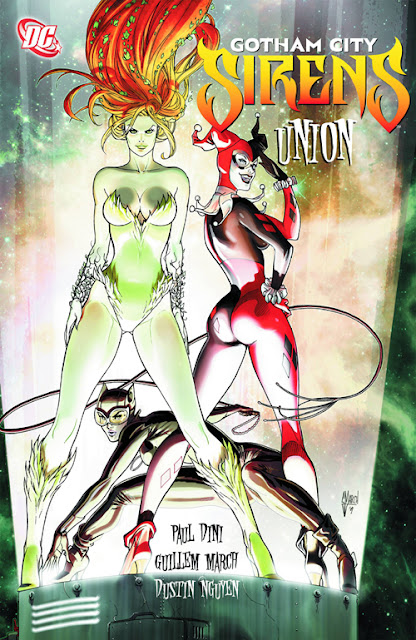
Gotham City Sirens, v. 1: Union coverThere are three interesting moments in Union:

1) The girlfriends of Batman, Catwoman and Talia al-Ghul, once met to figure out how to protect Batman’s secret ID.
2) Harley visits her dysfunctional family.
3) The Riddler, as a private investigator, takes a case.

The last is the best part of Union, taking up most of issue #3. That shouldn’t be a surprise; sometimes, when a creator revisits a character he or she had success with, you do get the same level of quality, and Riddler as a PI was my favorite part of Dini’s Batman: Detective. (Also my favorite thing done with the Riddler ever and my favorite little Batman idea.) Unfortunately for that theory, though, the writer for #3 is Scott Lobdell, but Lobdell does do a good job with Dini’s idea. In #3, Riddler teams up with the replacement Batman to solve some faked suicides; with Dick Grayson as Batman, it’s possible Riddler will outthink him. (Not likely, but possible.) Riddler narrates #3 with good but edged humor, and his rivalry with Batman adds a little spice to the team-up.

But it’s unsurprising that switching to a number of the book’s secondary cast is necessary to get a good story, as Dini seems unable to get much entertainment out of the relatively amiable main trio. Harley and Ivy try to drag Batman’s identity out of Catwoman early on, but after that, the three untrustworthy women are pretty chummy — somehow without even showing a spark of friendship that would make them interesting.

So unless you were hoping to see the return of Gagsworth A. Gagsworthy, the Joker’s Silver Age sidekick, or more of Hush forced to impersonate Bruce Wayne, there’s nothing here … and I wasn’t wanting to see either. I admit, there’s something to be said about contrasting Silver Age Joker with the more modern, psychotic version, but spreading “Gaggy’s” story over two issues is a waste of pages. As for Hush, I found it hard to discern his motivation, other than a near-pathological need to murder. If there was a hint he wanted to use Harley to escape his Bat captors, there might be something interesting.

Pander, young man, panderI wanted to start this review by saying something about breasts and (women’s) butts, but glancing through Union again, I decided artist Guillem March’s work wasn’t as full of cheesecake as I had originally thought. Oh, make no mistake: there’s a lot of art showing how shapely and well endowed Harley Quinn, Poison Ivy, and Catwoman are. But almost all artists draw them like that, and despite some questionable choices (Harley Quinn in Daisy Dukes? Really?), March saves his over-the-top work for Gotham City Sirens covers and one character in #3, an issue in which the three main pin-ups — sorry, characters — are mainly absent; March draws a bookstore clerk in a see-through mesh top, pleated microskirt, visible panties, and torn fishnets. Yes, the bookstore is The Heart of Poe — possibly more Goth-friendly than most — but I know pandering when I see it.

Other than how he draws women’s bodies — not to brush the topic aside — I liked March’s style. I can see the manga influence, especially in certain characters’ faces, but March has a heavier line and less androgyny than most manga I’ve read. The little manga-esque touches — the giant sweat droplets on Hush when he things Harley has found him out or the flower petals drifting past Harley and Hush in an intimate moment — are nicely matched with the book’s light tone. I also liked David Lopez’s fill-in work on #7: it had strong, expressive character work (although sometimes the expressions are a bit broad) and much less exploitative female drawings.

The book’s main appeal is the female form, and Dini doesn’t give a reason for Gotham City Sirens to exist beyond that. I’d buy a Riddler solo book, but given that his PI work seems to have been scrubbed by the New 52, there’s little chance of that. Union is Supervillain Team-Up with T&A, and that’s not worth reading.

Rating: Batman symbol (1 of 5)

Labels: , , , , , , , , , , , ,

15 December 2010

Batman: Streets of Gotham, v. 1: Hush Money

Collects: Detective Comics #852, Batman #685, Batman: Streets of Gotham #1-4 (2009)

Released: May 2010 (DC)

Format: 144 pages / color / $19.99 / ISBN: 9781401227210

What is this?: The villain Hush, who has Bruce Wayne’s face, plots his revenge after Catwoman steals his fortune.

The culprits: Writer Paul Dini and penciler Dustin Ngyuen

It’s nearly Christmas, and nothing says “non-denominational holidays” like Batman. Especially if that Batman started out his career wearing the red-and-green Robin togs.

So we’ll start this week of Batman with Batman: Streets of Gotham, v. 1: Hush Money. The new Batman, Dick Grayson, has hands full with Hush (who looks just like the missing Bruce Wayne) and all the crazies that fill Gotham’s avenues and boulevards. And it doesn’t look like it’s getting any easier for him under writer Paul Dini in the newly launched Batman: Streets of Gotham title.

 Batman: Streets of Gotham, v. 1: Hush Money coverI’ve liked Dini’s work with Batman before, but this felt unfocused. The title and collected material makes readers think this will be a story about — or at least featuring — Hush, but instead, it comes across as just another Batman comic. Although the first third of the book (Batman #685 and Detective Comics #852) is dedicated to setting up Hush’s new status quo, there are several different villains in Hush Money — Mr. Szasz, Firefly, Black Mask, Penguin — and all are working independently of Hush. Even though Hush is lurking as a threat in the background, it rarely feels like he’s putting the heroes in danger.

The multitude of villains is part of what makes Hush Money fall a little short. Dini is using a lot of Gotham villains and Bat-Family characters to populate this book, but rarely does anyone get enough time on the pages to make it appear as if it is any one character’s book — certainly not Batman’s. Because of the lack of other suspects, it has to be Hush’s story, but there are so many subplots and tangents that even that is watered down. It feels as if Dini wants to write about the villains of Gotham, and given the name Streets of Gotham, I wouldn’t be surprised if that were the title’s remit. But this feels like a slice of the new Batman’s week; there’s not enough to tie everything together into a coherent story. Given how abruptly the story cuts off, with Mr. Szasz’s plan not yet revealed and Hush still scheming, I expected the next volume to be a direct continuation (titled something like Hush Money, v. 2), but instead it’s v. 2: Leviathan.

It’s this lack of focus, however, that allows readers to enjoy Dini’s character explorations. As I mentioned, he gets into the head of Hush at the beginning of the story; there’s also a nice moment with the Penguin, and the real-estate broker to Gotham’s psychopaths also gets quite a few pages to explain himself. Dini also has fun with Damian, the new Robin — my favorite moment was when he asked Dick Grayson whether Katana, who had just threatened to kill Hush, was seeing anyone — but occasionally the dialogue feels a bit off. (Damian saying, “We’re screwed”? That doesn’t feel right for the violent and slightly socially awkward Damian.)

I’m not sure what to say about Dustin Nguyen’s art. It’s conveys the story well, but his style occasionally skimps on detail … sometimes that decision allows him to get scenes across with admirable concentration on important details, and sometimes I’m left with the idea that Nguyen really hates drawing faces if there’s more than two characters on a single panel. George Perez would be rolling in his grave, if he were dead — which he isn’t — and if he were a stern authoritarian, which I doubt he is.

Maybe I’m being too hard on Dini and Streets of Gotham. If this story had appeared 20 years ago and I were reading it in single-issue comics, then I would probably be enjoying the tension ramping up, the subplots coming to a head. That feels right; it’s probable this title doesn’t read well in the trade (or hardback, since the trade doesn’t come out until May 2011). On the other hand, there have probably been trades just as unfocused that I’ve given a pass. Why? I can’t put my finger on exactly why I don’t believe what was started in Hush Money won’t be wrapped up on Leviathan. What we have in Hush Money just feels like a tangled ball of yarn rather a Christmas sweater in the making.

Rating: Batman symbol Batman symbol (2 of 5)

Labels: , , , , , , , ,

27 January 2009

Batman: Detective

Collects: Detective Comics #821-6 (2006-7)

Released: March 2007 (DC)

Format: 144 pages / color / $14.99 / ISBN: 9781401212391

What is this?: Batman battles the predators and freaks in Gotham.

The culprits: Writer Paul Dini and pencillers Don Kramer, John H. Williams III, Joe Benitez, and Marcos Marz

I don’t keep up with DC continuity very much, despite a fondness for Batman. The impression I have received, hearing stories of Batman: RIP, the Battle for the Cowl, and Crises of various finalities and finiteness, is that if you aren’t into a DC in a major way, reading bits and pieces is not going to be productive. To be fair, those who don’t read Marvel regularly might get the same idea about its annual mega-crossovers.

But it obviously doesn’t have to be that way. The most popular characters — the evergreen ones, the ones that stay at the top of the comics world for years — don’t need events to drive their sales. Batman, Spider-Man, the Avengers, Superman … the concepts are probably strong enough to support an audience, if the audience gets good stories. Even if those stories are a bit repetitive, they still have appeal; Kurt Busiek’s Untold Tales of Spider-Man didn’t break much new ground from a storytelling standpoint, but they’re entertaining because they simply tell a story about a character we already enjoy.

Batman: Detective coverThat’s what writer Paul Dini does in Batman: Detective. There are no surprising revelations. There are no events. There’s Batman (and Robin) beating the snot out of Gotham’s criminals, (mostly) new and old.

For the most part, the criminals are newcomers or smalltimers who haven’t earned a place in Batman’s rogue’s gallery. Dini still keeps some of those classic villains involved — Poison Ivy is stalked by her victims, the Riddler and Penguin seemingly reform — while telling these detective stories. At times, these stories seem to suffer from the time given to the rogues; the first couple of stories seem a little undeveloped as mysteries, while the Poison Ivy and Joker stories seem to need a little extra development. That doesn’t take away from their enjoyment, but it should cause comment in a book titled Batman: Detective.

Dini, a writer, producer and editor for Batman: The Animated Series, does impressive work with the old villains. The reformations of the Riddler and Penguin make sense, and each works with their characters, if not necessarily with their gimmick. (There are surprisingly few legitimate lines of work for a man with the Penguin’s schtick, unless you count his deformations.) The highlight of the book is the final story, in which the Joker captures Robin and torments him by killing innocent bystanders. I could almost hear Mark Hamill’s voice from the animated series laughing throughout the story.

Despite the multiple artists, the art is of high quality. Don Kramer does half the book and does a great job, although perhaps a little smooth for the gritty nighttime underworld Batman inhabits. Still, he tells the story well. John H. Williams, who drew Detective Comics #821, might have a style better suited for the character, but his work is marred by some monochrome coloring; it’s not as bad as what they tried with Detecive Comics a decade ago, but it doesn’t help. Marcos Marz’s pencils (#825) are given the look of a painted style, which works well for a story featuring the perpetually on fire Dr. Phosphorus — the artistic highlight of a book with consistently good art. That story was written by Royal McGraw, although the story doesn’t match the distinctiveness of the art.

Joe Benitez, who drew #823, is a little cheesecake for my taste, enjoying drawing Ivy as a long-limbed, voluptuous lady. This isn’t unusual in comics, true, but it clashes with the tone of the rest of the TPB, especially a full-page Poison Ivy clad in the remains of an Arkham jumpsuit that has been strategically torn to ribbons without revealing anything that would give the Comics Code a coronary. I can’t deny he draws a good Batman, though I don’t care for his juvenile-looking Robin. (Especially given Kramer’s much more mature and appealing Robin in #826.) In another book, Benitez’s work would go unremarked or draw praise, I must admit.

If you just want a straight Batman story — something in short supply, given the last year or two of Batman under Grant Morrison’s control — this will serve the purpose admirably.

Rating: Batman symbol Batman symbol Batman symbol Batman symbol (3.5 of 5)

Labels: , , , , , , , , , , , ,