Reviews of trade paperbacks of comic books (mostly Marvel), along with a few other semi-relevant comments / reviews.

06 July 2013

X-Men Forever, v. 3: Come to Mother ... Russia! and v. 4: Devil in a White Dress

Collects: X-Men Forever #11-5 (v. 3) and 16-20 and X-Men Forever Annual #1 (v. 4) (2010)

Released: May 2010 (v. 3) and August 2010 (v. 4) (Marvel)

Format: 120 and 152 pages respectively / color / $16.99 each / ISBN: 9780785136811 and 9780785144359

What is this?: Chris Claremont continues to play with his X-Men action figures in his own private sandbox, thank you very much.

The culprits: Writer Chris Claremont and artists Tom Grummett, Graham Nolan, Sana Takeda, and Peter Vale


X-Men Forever, v. 3: Come to Mother … Russia! cover I thought about writing separate reviews for
X-Men Forever, v. 3: Come to Mother...Russia! and X-Men Forever, v. 4: Devil in a White Dress, but I just couldn’t do it. The two books resolved into an undifferentiated mush into my mind, and I didn’t have the patience to repeat my criticisms. The books are largely the same in quality, so instead, I’ll tell you what I liked about Russia and Devil:
  • Colossus and Black Widow have joined the Winter Guard, the Russian national superhero force, in Russia. Since the Soviet Union is not the Evil Empire any more, it makes sense that Russian heroes would return to the Motherland occasionally, and an out-of-continuity series like X-Men Forever is a perfect place to explore that.

  • … hmm …
  • It amuses me that the Amazon listing says Nightcrawler and Rogue head to New Orleans, not Jackson. One Southern city is pretty much like another, right? To be fair, Graham Nolan’s Jackson and Mississippi resembles New Orleans and Louisiana. Also, Amazon listings also have George Lucas’s credits in Chris Claremont’s author biography.
  • Grudgingly, I will admit I liked the idea of the Summerses acting like a real family. I found the execution off, but the idea is good.

X-Men Forever, v. 4: Devil in a White Dress coverAnd what I disliked about Russia and Devil:
  • Claremont dialogue. Good grief. It’s the same phrases and rhythms Claremont has been using for decades. Don’t the X-Men ever use an original turn of phrase? I would speak far less often if I sounded like a Claremont character. I’d be too embarrassed to say much.
  • That cover for Come to Mother … Russia. Who is the Black Widow trying to sex with that pose? Is she trying to seduce me? Am I an enemy agent, whom she will mate with and kill? Oh my god … I am, aren’t I? I knew it! This is the greatest / worst day of my life!
  • Reuse of tired plots. Claremont sends Magik to Limbo again, but this time her journey to the Dark Side is completed — so of course that means “teenaged female in scanty costume.” (Thank Odin it’s not bondage gear.) Rogue and Nightcrawler switch powers, just like Psylocke and Jean Grey did at the beginning of Claremont’s return in X-Men #100. SHIELD once again has to deal with a group of traitors in their ranks.
  • On-the-nose codenames: Black Magik? Firecat? Perfect Storm? Ye gods.
  • Dredging up past “romances.” Kitty and Colossus were done a long time ago — they broke up in Uncanny #183, almost 100 issues before the end of Claremont’s run — and bringing it up again to shoot it down again is pointless. (Besides, their romance was never especially convincing; Kitty was extreme jail bait during their relationship, and the thought that an older, wiser Kitty would want to resume that relationship is a little disturbing.) Black Panther and Storm rekindling their romance is no more believable in X-Men Forever than it was in the X-books’ regular continuity, but thankfully it is over quite a bit more quickly.
  • Stupidity. A relationship between Jean and Beast begins with little warning; after all those years together on the X-Men and X-Factor, it seems like the platonic coating on their relationship should be too thick to penetrate. (Perhaps her attraction to him is based on his body hair: he’s the only one who can compare in that department to the dead Wolverine.) Nightcrawler and Rogue run into a trap in Jackson, not questioning why jetsetting stewardess Amanda Sefton would be in the capital of Mississippi long enough to investigate before blundering in.

So, in short, unless you’re looking for Claremont nostalgia accompanied by art that ranges from *ugh* to uh-cceptable, then don’t waste your time with these books. Discounts on the TPBs drew me into X-Men Forever, but I don’t think I’d read the rest of the series even if the books were free.

Rating: Russia: X-Men symbol Half X-Men symbol (1.5 of 5 )

Devil: X-Men symbol (1 of 5)

Labels: , , , , , , , , , , , ,

19 August 2011

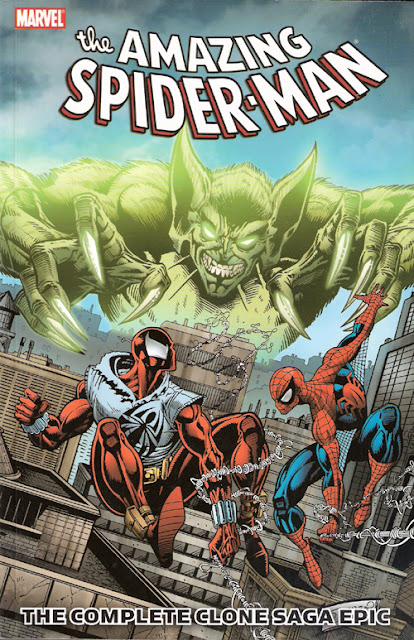
Spider-Man: The Clone Saga Epic, Book 2

Collects: Amazing Spider-Man #395-9, Spectacular Spider-Man #218-21, Spider-Man #54-6, Web of Spider-Man #120-2, Spider-Man: Funeral for an Octopus #1-3, Spider-Man Unlimited #8 (1994-5)

Released: May 2010 (Marvel)

Format: 480 pages / color / $34.99 / ISBN: 9780785143512

What is this?: The Clone Saga’s second installment, in which the story of a Spider-Boy and his clone begins to ramp up.

The culprits: Writers J.M. DeMatteis, Tom DeFalco, Howard Mackie, Tom Brevoort, Todd DeZago, and others and artists Mark Bagley, Sal Buscema, Tom Lyle, Steven Butler, Stewart Johnson, and others

When I reviewed Spider-Man: The Complete Clone Saga Epic, Book 1, I found it occasionally dull but not as dire as the Clone Saga’s reputation would have me believe. Evidently, this is the kind of evaluation that gets me to pick up subsequent volumes of a series.

So … Spider-Man: The Complete Clone Saga Epic, Book 2. We all know the Clone Saga gets bad, eventually … but when? It’s not in Book 2, which is a surprisingly fun read.

Spider-Man: The Complete Clone Saga Epic, v. 2 coverYes, I said “fun.” It’s not a classic, and if you were looking for a Spider-Man story, there are a couple dozen others I would recommend first. But I can’t deny I found the book interesting and sometimes exciting, despite the plot being spoiled long ago.

In Book 2, you can almost see the writers ticking off the boxes as they complete the tasks editors set for them. Wrap up unresolved plots, with Mary Jane and her family and Peter finally defeating his stubborn case of asshattery. Establish Kaine as a bad mamajamma, even if they have to kill some established villains to do so. Show that Peter and Ben Reilly, his clone, can exist in the same storytelling universe with unique roles. Prepare readers that this time, yes, May might actually die. Most importantly, start to lay groundwork for new plots, such as the proliferation and identity of clones and Mary Jane’s medical condition. And yeah, if you can get across a new, non-clone villain like Stunner, good on you.

And the writers — J.M. DeMatteis for Amazing, Tom DeFalco (with some help from Todd DeZago) on Spectacular, Howard Mackie for Spider-Man, and Terry Kavanagh, DeMatteis, and DeZago on Web — do just that. The stories aren’t perfect, but they hit the important points of the overall plot without boring readers too much. And even if some plots drag on too long — Peter trying to beat the Vulture’s poison, DeMatteis trying to end Peter’s idiotic “The Spider” personality by drowning the page in captions — it’s important to remember how collaborative the issues in this book are. Book 2 has 19 issues, and all but four — Spider-Man Unlimited and Funeral for an Octopus #1-3 — are linked in four crossovers (“Web of Death,” “Web of Life,” “Smoke and Mirrors,” and “Back from the Edge”). Think about it: this represents about a quarter of a year’s issues for some titles, and none of their writers get to complete a story without sending it through another writer first. It’s a miracle anyone was able to complete a decent story at all. Spider-title editor Danny Fingeroth deserves a lot of credit for keeping things under control.

The stories get better as the farther the book gets from “The Spider” and DeMatteis’s deconstruction of Peter’s mind at the time (it’s a plot that seems tailor-made for DeMatteis, except that it’s not very good). Peter gets poisoned, which touches off all sorts of wacky hijinks: teaming up with the “new” Daredevil, going to Heaven, having Dr. Octopus aid him. I’m not sure the latter was a good development — Otto’s reasoning is a little clichéd — but at least it’s a different take on the character, one that couldn’t be done now.

My favorite story was Funeral for an Octopus, a miniseries that hearkens back to the Fingeroth-written Deadly Foes of Spider-Man and Lethal Foes of Spider-Man minis from the early ‘90s. Those comics concentrated on Spidey vs. a large number of foes, each of whom had his own motivations for taking part; Funeral, written by Tom Brevoort, has a similar plot. Yes, it’s used to get across how tough the mysterious (and horribly costumed) Kaine is, but on the other hand, one of the Sinister Six does outwit the thug, so that’s something. Plus, at this stage, I don’t mind Kaine getting a push as long as the body count doesn’t get too ridiculous; in Book 2, the death toll is confined to a throwaway villain who really never got started and a major villain (no extra points for guessing who).

The final crossover, though, shows some of the cracks that would eventually cause the whole “epic saga” to crumble. In “Smoke and Mirrors,” Spider-Man and the Scarlet Spider fight the Jackal, who has been resurrected via cloning. The Jackal is served by two of Peter’s altered clones, who strangely look nothing like Peter. For the second and third issues of the three-part crossover, all the Jackal does is hint and lie and tell the two Spiders that each is a clone — or maybe the other is a clone? neither? — while Scrier and Kaine watch. (Somehow, I don’t think Spider-baiting is a spectator sport that will ever catch on, regardless of the crowd it drew this time.) The Jackal does show them what happens to clones in the end (they degenerate into dust quickly), and he puts on a Goth leather trench coat with enough chains to satisfy Ghost Rider, but three issues is a little too much for this. Given that the Clone Saga’s mind-numbing number of clones and the claim that Peter was the clone were major reasons fans soured on this storyline, the Jackal’s wild claims and the hint that there is another clone in the offing (and the presence of Scrier) have to be considered major missteps.

Since Book 2 collects five different Spider-titles, you can take your pick on what flavor of artist you like. Mark Bagley, who drew Amazing at the time, is probably the best-known today; his lithe, athletic Spider-Man is outstanding, although his women tend to be overendowed (staying just short of cheesecake) and his facial expressions uniform. Sal Buscema, the regular artist for Spectacular, is my favorite, but this isn’t his best work; it’s near the end of his career, and his art lacks the tightness it once had (especially when inked by Bill Sienkiewicz). His Kaine looks especially stupid as well, although that’s partially because Kaine’s costume is stupid to begin with. Tom Lyle, the regular Spider-Man artist, is excellent: he’s the best in Book 2 at conveying emotion (and faces in general), although his action shots aren’t as lively as Bagley’s. Stephen Butler (Web) and Stewart Johnson (Funeral) do similarly good work without much of the ‘90s excesses.

I enjoyed Book 2 quite a bit. I mean that statement without qualifications or temporization. That being said, I think this book is probably the high point for the “epic saga.”

Rating: Spider-Man symbol Spider-Man symbol Spider-Man symbol Half Spider-Man symbol (3.5 of 5)

Labels: , , , , , , , , , ,

15 December 2010

Batman: Streets of Gotham, v. 1: Hush Money

Collects: Detective Comics #852, Batman #685, Batman: Streets of Gotham #1-4 (2009)

Released: May 2010 (DC)

Format: 144 pages / color / $19.99 / ISBN: 9781401227210

What is this?: The villain Hush, who has Bruce Wayne’s face, plots his revenge after Catwoman steals his fortune.

The culprits: Writer Paul Dini and penciler Dustin Ngyuen

It’s nearly Christmas, and nothing says “non-denominational holidays” like Batman. Especially if that Batman started out his career wearing the red-and-green Robin togs.

So we’ll start this week of Batman with Batman: Streets of Gotham, v. 1: Hush Money. The new Batman, Dick Grayson, has hands full with Hush (who looks just like the missing Bruce Wayne) and all the crazies that fill Gotham’s avenues and boulevards. And it doesn’t look like it’s getting any easier for him under writer Paul Dini in the newly launched Batman: Streets of Gotham title.

 Batman: Streets of Gotham, v. 1: Hush Money coverI’ve liked Dini’s work with Batman before, but this felt unfocused. The title and collected material makes readers think this will be a story about — or at least featuring — Hush, but instead, it comes across as just another Batman comic. Although the first third of the book (Batman #685 and Detective Comics #852) is dedicated to setting up Hush’s new status quo, there are several different villains in Hush Money — Mr. Szasz, Firefly, Black Mask, Penguin — and all are working independently of Hush. Even though Hush is lurking as a threat in the background, it rarely feels like he’s putting the heroes in danger.

The multitude of villains is part of what makes Hush Money fall a little short. Dini is using a lot of Gotham villains and Bat-Family characters to populate this book, but rarely does anyone get enough time on the pages to make it appear as if it is any one character’s book — certainly not Batman’s. Because of the lack of other suspects, it has to be Hush’s story, but there are so many subplots and tangents that even that is watered down. It feels as if Dini wants to write about the villains of Gotham, and given the name Streets of Gotham, I wouldn’t be surprised if that were the title’s remit. But this feels like a slice of the new Batman’s week; there’s not enough to tie everything together into a coherent story. Given how abruptly the story cuts off, with Mr. Szasz’s plan not yet revealed and Hush still scheming, I expected the next volume to be a direct continuation (titled something like Hush Money, v. 2), but instead it’s v. 2: Leviathan.

It’s this lack of focus, however, that allows readers to enjoy Dini’s character explorations. As I mentioned, he gets into the head of Hush at the beginning of the story; there’s also a nice moment with the Penguin, and the real-estate broker to Gotham’s psychopaths also gets quite a few pages to explain himself. Dini also has fun with Damian, the new Robin — my favorite moment was when he asked Dick Grayson whether Katana, who had just threatened to kill Hush, was seeing anyone — but occasionally the dialogue feels a bit off. (Damian saying, “We’re screwed”? That doesn’t feel right for the violent and slightly socially awkward Damian.)

I’m not sure what to say about Dustin Nguyen’s art. It’s conveys the story well, but his style occasionally skimps on detail … sometimes that decision allows him to get scenes across with admirable concentration on important details, and sometimes I’m left with the idea that Nguyen really hates drawing faces if there’s more than two characters on a single panel. George Perez would be rolling in his grave, if he were dead — which he isn’t — and if he were a stern authoritarian, which I doubt he is.

Maybe I’m being too hard on Dini and Streets of Gotham. If this story had appeared 20 years ago and I were reading it in single-issue comics, then I would probably be enjoying the tension ramping up, the subplots coming to a head. That feels right; it’s probable this title doesn’t read well in the trade (or hardback, since the trade doesn’t come out until May 2011). On the other hand, there have probably been trades just as unfocused that I’ve given a pass. Why? I can’t put my finger on exactly why I don’t believe what was started in Hush Money won’t be wrapped up on Leviathan. What we have in Hush Money just feels like a tangled ball of yarn rather a Christmas sweater in the making.

Rating: Batman symbol Batman symbol (2 of 5)

Labels: , , , , , , , ,