Reviews of trade paperbacks of comic books (mostly Marvel), along with a few other semi-relevant comments / reviews.

14 February 2015

Jack Kirby and creator credit

Last fall, the heirs of Jack Kirby reached a settlement with Marvel Comics. The terms of the settlement haven’t been announced, at least not that I have seen; it’s probable the settlement included cash for the family and increased recognition for Kirby in the comics and other media in which his co-creations are used.

The recognition is welcome news; the threat of legal action might have been part of the reason Marvel did not include Kirby’s name in many places it should have before. (Another part of the reason — and you can decide what proportion this makes up — is Marvel being stubborn and / or stupid.) The money is also good news for Kirby’s family; Jack Kirby is no longer around to be rewarded, but his family would have benefited if he had received in life the kind of monetary recompense his reputation suggests he deserves, so it makes sense they should receive some reward now.

I have been thinking about my feelings about the case for some time now — probably too long, as the case is passing below the public’s horizon. I admit I was somewhat ambivalent to the Kirby case. I have no idea what his heirs were legally entitled to, and in truth, it seems no one else does either. Decades of copyright decisions suggest the Kirby family would have lost, but given the Supreme Court’s interest, the outcome might — might — have been different this time. I often wondered why I followed the case at all; I have no affection for Kirby’s art, and none of the heirs created anything, making the legal battle one between a corporation fighting for profits vs. a family fighting for a ghost — an imaginary person fighting for money vs. real people fighting for a former person. Neither side appealed to my emotions.

(As an aside: While I don’t care for Kirby’s art, I do respect his place in comic history, and he remains one of the premier — perhaps the premier — imaginations to have ever worked in the comics industry.)

I should be sympathetic to the creative side of any argument, but the heirs’ contention that Kirby co-created Spider-Man, even though the evidence of this is thin at best and evanescent at worst, distressed me. Building the case for Kirby’s greatness shouldn’t mean diluting the credit given to others. Worse, it was Steve Ditko’s creation they tried to horn in on, and Ditko’s legacy is already dimmed by the shadow Kirby cast on Marvel’s Silver Age. I understand this contention was a bargaining chip; when you set out your demands, you always stake out ground as far forward as you can so you can give up some ground and still get what you want. Still, it rankled.

But this did make me wonder if too much stock is placed in the original creators and too little in subsequent creators. We moan and complain when Kirby isn’t acknowledged as a co-creator of certain characters, but when X-Men 2 broadly (but recognizably) adapted parts of Chris Claremont and Brent Anderson’s God Loves, Man Kills and Barry Windsor-Smith’s Weapon X stories, we let that go by. It is enough if Kirby and Stan Lee are recognized as creators of the X-Men. But which comic creators had a greater effect on that movie? I would argue the Claremont, Anderson, and Windsor-Smith did far more to make X-Men 2 the outstanding movie it was than the men who created the X-Men and wrote the title for about two years.

Or to take an example entirely within the realms of comics, we can look at Iron Man. Iron Man was officially created by Kirby, Lee, Larry Lieber (who wrote Iron Man’s first appearance, Tales of Suspense #39), and Don Heck (who drew ToS #39). Lee claimed to have come up with the idea — he always claimed that, even when it might not be true — and according to Heck, Kirby designed the Iron Man armor, while Heck created the look of the other characters, including Tony Stark and Pepper Potts. But the original bulbous Iron Man armor was quickly done away with, and the more streamlined red-and-yellow armor we associate with Iron Man was designed by Ditko in ToS #48. So what did Kirby contribute that made a meaningful impact on the character? Little to none in the art department, it appears, but Ditko’s iconic design doesn’t get any consistent acknowledgement.

Of course, it’s possible Kirby contributed to the idea of Iron Man in the early stages; Kirby’s supporters often point out Lee’s bolts of inspiration were rarely as purely Lee’s as Lee claimed. Also, Kirby isn’t around to say what he did or didn’t do. Given that Kirby was a great idea man, I wouldn’t be surprised if some of his thoughts were incorporated into Iron Man’s origin.

But that brings me back to what I was wondering before. We remember his long run on Fantastic Four (more than 100 issues) and, but Kirby didn’t stick around some of the Silver Age titles he created for very long: only six issues on Hulk, three of the first five issues on Iron Man, seventeen issues on X-Men. Seventeen issues isn’t nothing, but it’s important to note that X-Men was, until the late ‘70s, the biggest failure of Marvel’s Silver Age explosion. The title was cancelled in 1970 and turned into a bi-monthly reprint title until 1975, when Chris Claremont and a long string of talented artists made it into Marvel’s #1 title. How much credit — not in the sense of “created by” but in the sense of making something a success — do Lee and Kirby deserve for pursuing an idea for seventeen issues (21 for Lee) that the market essentially rejected?

Lee and Kirby deserve some credit, yes. But the person who should get the largest thank you at the end of an X-Men movie is Chris Claremont. Even if he didn’t create most of the characters, he’s the person who made many of them — Wolverine, Magneto, Storm — interesting. Without him and his co-creators, no one would want to watch an X-Men movie, let alone five of them.

This brings me to an idea I considered for some time. Since the versions of these characters that are best known are the movie versions, I thought about looking at who created what in the movies. At one point, I thought about trying to find the creator who was most valuable in the sense of box office receipts, but that would involve some arcane breakdowns of credit — what percentage of credit should be given to Wolverine for the X-Men movies’ success vs. Mystique or Magneto? — that was unprofitable.

(Besides, the answer for the entire Marvel Cinematic Universe would almost certainly be Stan Lee.)

Without Jack Kirby, it is somewhere between possible and likely that Marvel wouldn’t have survived the early ‘60s. The characters we know would be greatly different or wouldn’t exist at all. But it’s been 45 years since Kirby left Marvel the first time, which means dozens of other creators have altered, edited, and recreated what the characters and concepts he created. His influence can still be seen in Marvel’s output, both on page and screen, and some of what they publish hasn’t changed much since Kirby put aside his pens.

One of the greatest literary talents of the early 20th century was Thomas Wolfe, who wrote sprawling novels with beautiful prose. I mean really sprawling — the original manuscript of his first novel was more than 1,100. His editor, Maxwell Perkins, cut Look Homeward, Angel considerably and helped make it a success. Does it harm Wolfe’s literary reputation to acknowledge that Perkins’s considerable work made Wolfe’s better? And if acknowledging that sort of collaboration improved a novel, supposedly a solitary effort, how does acknowledging the contributions of others harm the original creators in comics, which often relies on collaboration?

Labels: , , , , , , , , , , , ,

06 July 2013

X-Men Forever, v. 3: Come to Mother ... Russia! and v. 4: Devil in a White Dress

Collects: X-Men Forever #11-5 (v. 3) and 16-20 and X-Men Forever Annual #1 (v. 4) (2010)

Released: May 2010 (v. 3) and August 2010 (v. 4) (Marvel)

Format: 120 and 152 pages respectively / color / $16.99 each / ISBN: 9780785136811 and 9780785144359

What is this?: Chris Claremont continues to play with his X-Men action figures in his own private sandbox, thank you very much.

The culprits: Writer Chris Claremont and artists Tom Grummett, Graham Nolan, Sana Takeda, and Peter Vale


X-Men Forever, v. 3: Come to Mother … Russia! cover I thought about writing separate reviews for
X-Men Forever, v. 3: Come to Mother...Russia! and X-Men Forever, v. 4: Devil in a White Dress, but I just couldn’t do it. The two books resolved into an undifferentiated mush into my mind, and I didn’t have the patience to repeat my criticisms. The books are largely the same in quality, so instead, I’ll tell you what I liked about Russia and Devil:
  • Colossus and Black Widow have joined the Winter Guard, the Russian national superhero force, in Russia. Since the Soviet Union is not the Evil Empire any more, it makes sense that Russian heroes would return to the Motherland occasionally, and an out-of-continuity series like X-Men Forever is a perfect place to explore that.

  • … hmm …
  • It amuses me that the Amazon listing says Nightcrawler and Rogue head to New Orleans, not Jackson. One Southern city is pretty much like another, right? To be fair, Graham Nolan’s Jackson and Mississippi resembles New Orleans and Louisiana. Also, Amazon listings also have George Lucas’s credits in Chris Claremont’s author biography.
  • Grudgingly, I will admit I liked the idea of the Summerses acting like a real family. I found the execution off, but the idea is good.

X-Men Forever, v. 4: Devil in a White Dress coverAnd what I disliked about Russia and Devil:
  • Claremont dialogue. Good grief. It’s the same phrases and rhythms Claremont has been using for decades. Don’t the X-Men ever use an original turn of phrase? I would speak far less often if I sounded like a Claremont character. I’d be too embarrassed to say much.
  • That cover for Come to Mother … Russia. Who is the Black Widow trying to sex with that pose? Is she trying to seduce me? Am I an enemy agent, whom she will mate with and kill? Oh my god … I am, aren’t I? I knew it! This is the greatest / worst day of my life!
  • Reuse of tired plots. Claremont sends Magik to Limbo again, but this time her journey to the Dark Side is completed — so of course that means “teenaged female in scanty costume.” (Thank Odin it’s not bondage gear.) Rogue and Nightcrawler switch powers, just like Psylocke and Jean Grey did at the beginning of Claremont’s return in X-Men #100. SHIELD once again has to deal with a group of traitors in their ranks.
  • On-the-nose codenames: Black Magik? Firecat? Perfect Storm? Ye gods.
  • Dredging up past “romances.” Kitty and Colossus were done a long time ago — they broke up in Uncanny #183, almost 100 issues before the end of Claremont’s run — and bringing it up again to shoot it down again is pointless. (Besides, their romance was never especially convincing; Kitty was extreme jail bait during their relationship, and the thought that an older, wiser Kitty would want to resume that relationship is a little disturbing.) Black Panther and Storm rekindling their romance is no more believable in X-Men Forever than it was in the X-books’ regular continuity, but thankfully it is over quite a bit more quickly.
  • Stupidity. A relationship between Jean and Beast begins with little warning; after all those years together on the X-Men and X-Factor, it seems like the platonic coating on their relationship should be too thick to penetrate. (Perhaps her attraction to him is based on his body hair: he’s the only one who can compare in that department to the dead Wolverine.) Nightcrawler and Rogue run into a trap in Jackson, not questioning why jetsetting stewardess Amanda Sefton would be in the capital of Mississippi long enough to investigate before blundering in.

So, in short, unless you’re looking for Claremont nostalgia accompanied by art that ranges from *ugh* to uh-cceptable, then don’t waste your time with these books. Discounts on the TPBs drew me into X-Men Forever, but I don’t think I’d read the rest of the series even if the books were free.

Rating: Russia: X-Men symbol Half X-Men symbol (1.5 of 5 )

Devil: X-Men symbol (1 of 5)

Labels: , , , , , , , , , , , ,

20 July 2012

X-Men Forever, v. 2: The Secret History of the Sentinels

Collects: X-Men Forever #6-10 (2009)

Released: March 2010 (Marvel)

Format: 120 pages / color / $16.99 / ISBN: 9780785136804

What is this?: Before they bury Wolverine, the X-Men dig deeper into the conspiracy against them and find Sentinels.

The culprits: Writer Chris Claremont and artists Paul Smith and Steve Scott


Whatever goodwill I had for X-Men Forever led me to buy X-Men Forever, v. 2: The Secret History of the Sentinels. After the newness of the concept of writer Chris Claremont’s elaborate What If? series (featuring the X-Men) wore off, what would be left?

The answer — as if you needed to be told — is writer Chris Claremont.

Claremont’s distinctive dialogue and cadences overwhelm everything else in Secret History. If this were a decade ago, when Claremont was returning the X-titles and this might do any good, an intervention would be in order, with his colleagues and editors showing him how his verbal tics and word balloons were hurting those around him. Given that an intervention is out of the question, Claremont needs someone to do something similar to what former Marvel editor Christopher Priest said his assistant, Maddie / Adam Blaustein, did with Peter David — winnow down his excesses while leaving the essential, appealing essence of the writer. Isn’t that what an editor is for? Perhaps not. In any event, it’s not worth the effort now; Claremont is who he is, his work is what it is, and almost everyone knows how he or she feels about that.

X-Men Forever, v. 2: The Secret History of the Sentinels coverFor those of you playing Claremont cliché bingo, using Secret History, I will serve as caller: Baseball. Vintage plane fetishism. X-Men cleaning up the wreckage of one of their fights. Obtrusive military slang. Danger Room malfunction. Bad accent (Gambit only, oddly, even though Nightcrawler and Cannonball are in this book). “Best at what I do” (non-Wolverine division). If you did not win, best of luck next time; I’m sure the “mind control” square on your card is certain to be covered next time.

The story involves the return of the Sentinels, as you would guess form the title. With Nick Fury part of the book’s cast, Claremont makes the dramatic choice to tie the Trask family, who created the Sentinels, to the Nazis. This seems unnecessary but ultimately harmless, but Claremont links a couple of other characters to World War II and the Fury’s old commando group: SHIELD agents Daisy Dugan and Tommy Juniper, the latter explicitly the great-nephew of Howler casualty Junior Juniper. If this were a SHIELD book, these generational links would be a great idea. But this isn’t a SHIELD book; it’s an X-Men book. And the X-Men are firmly tied to the beginning of Marvel’s ten-year (or twelve-year or fifteen-year) timeline. Delving into their past tends to lead into Xavier, Juggernaut, or Magneto stories, areas that have long since been overmined.

On the other hand, the X-Men do have one character with whom the theme of family does work: Cyclops, who ironically started as an orphan. The book’s most affecting scene is its final one, two pages of Cyclops flying to Alaska to visit his grandparents, father, and son in Alaska. Scott reuniting with his son, Nathan, and their interaction feels real and is touching because of that.

That last issue is the best in Secret History. In #10, the X-Men hold a funeral for Wolverine, who died all the way back in #1. It’s not a perfect issue, God knows — unrestrained by action, Claremont's word balloons overrun everything, like a sort of verbal kudzu. But given that the action in the rest of the book is nothing to remember, something different is welcome. The issue gives everyone a chance to take stock and reflect. The New Mutants, Excalibur, Fantastic Four, and an abbreviated Avengers team show up, as do various X-Men hangers-on and ex-X-Men. It feels like an important event without being too clichéd or overwrought; the funeral itself takes only two pages, with Cyclops giving the eulogy.

The rest of the volume is forgettable, at best. Issue #6 is an embarrassment of X-clichés, with the X-Men playing baseball among wreckage in the Danger Room, which as a matter of course malfunctions. The next three issues feature a battle against a Trask and her Sentinels, ending with a particularly anticlimactic fight that Jean Grey ends by throwing a tantrum.

The subplots are ignorable. Claremont tries to interest readers in a conspiracy vs. the X-Men, but it’s not working. “Continuum” is a dull name, there’s no hint of what exactly the group’s agenda or grief with the X-Men is, and revealing one of the conspiracy's heads is the newly introduced mother of another newly introduced character is underwhelming. The flashbacks — Logan teaming up with Fury’s Howling Commandos in World War II and Bolivar Trask showing his family his Sentinel works — are old hat and dull. The only interesting subplot involves the child Storm, who is trying to figure out what she is and where she should go; this actually gives Gambit a bit of relevance, since he serves as Storm’s hedonistic counsel against the moralistic X-Men. Forge and lil’ Storm’s reactions toward each other at Wolverine’s funeral is a nice touch.

The art is fine. Paul Smith draws #6 and #10, and he’s exactly the type of artist you’d expect Marvel to assign to Claremont’s nostalgia title. Smith worked with Claremont on Uncanny X-Men #165-70 and 172-5, including most of the issues from the classic X-Men: From the Ashes storyline. Smith’s art has changed over 30 years, of course, and at times it looks like it’s taken on some characteristics of fellow Claremont collaborator Rick Leonardi’s work. On the other hand, Steve Scott isn’t a classic Marvel artist, and the bulk of his work for the company comes on the Marvel Adventures line. He’s a good choice for that, as his line is clean and his characters are bright and attractive, easy to tell apart. It’s not a distinctive style, though, which might have been what Marvel was aiming for; if you’re reading Claremont in the 21st century, do you really want something to distract you from Claremont’s plot and words? No, you do not; Claremont’s the feature here.

Secret History isn’t bad; its sin is larger. This book is just not that interesting, and the greatest emotion it arouses in me is occasional annoyance. Some will feel the warm flush of nostalgia when they read Secret History, and there’s nothing wrong with that. I’m well insulated against that warmth, however, and I think most readers are as well.

Rating: X-Men symbol Half X-Men symbol (1.5 of 5)

Labels: , , , , , , , , , , , , , ,

04 March 2011

Gambit Classic, v. 1

Collects: Uncanny X-Men #265-7 and Gambit #1-4 (1990, 1993-4)

Released: April 2009 (Marvel)

Format: 176 pages /color / $24.99 / ISBN: 9780785137290

What is this?: Gambit! Gambit Gambit? Gambit, n’est ce pas! 1990s! Gaaammmmbiiiittt!

The culprits: Writers Chris Claremont and Howard Mackie and artists Lee Weeks, Bill Jaaska, Mike Collins, and Homage Studios

When future generations look back at us and ask us why we thought Gambit was “cool,” we will be forced to answer: It was the ‘90s; you had to have been there. That’s the only response that makes sense. Oh, perhaps we might say something about his anti-authoritarian attitude, about how he metaphorically pulled the whiskers of Xavier and Wolverine and he had a “mysterious” past, but those aren’t real answers. Those are excuses.

Those delving into the subject will not find the answer to that future question in Gambit Classic, v. 1. Unfortunately, Gambit Classic will raise only more questions: What’s with that accent? Why is Storm a child? Why does the first issue in this collection not have Gambit in it at all? Seriously — is that accent a symptom of brain damage? Is the immortal Candra’s support of the useless Thieves and Assassins Guilds evidence of her uselessness, or is her behavior enough of a de facto argument?

Gambit Classic coverBut we must put aside these considerations for the moment. The future, I have been assured by eminent authorities on the subject, will take care of itself, much as I believe those future generations should be allowed to. Let us instead concentrate on the book itself.

Gambit Classic starts at the end of writer Chris Claremont‘s run on Uncanny X-Men, coming during the time when Storm was a child and the X-Men were scattered across the globe, with many of them missing their memories. As most of you who have read Uncanny during that time know, it was not a good period — the 260s of Uncanny were abysmal in quality, but the book was coasting on a wave of popularity. (That wave, I believe, partially answers the hypothetical question at the beginning of the review.) At this point, Claremont was doing issues or short arcs on the various X-Men split up by the Siege Perilous — #259 was about Colossus, #260 featured Dazzler, and #261 pitted Wolverine, Jubilee, and Psylocke against Hardcase and the Harriers. (Forge and Banshee rescued Jean Grey in #262-4.) These issues were about as you would expect: Claremontian dialogue, Image-ish art, plots that seemingly went nowhere. (The team had been split up since #251, and it would not get back together until #270, at the beginning of X-Tinction Agenda.)

Anyway … the former X-Man Storm is a child in Cairo, Ill., where she’d been since #253. Issue #265 provides the background for Gambit’s first appearance — he doesn’t appear in the issue, as I mentioned earlier — as pre-teen Storm steals from the, er, rich in the area. Unfortunately, the Shadow King has taken one of the mansions and turned its occupants into his slaves. Through either laziness or foreshadowing, Claremont doesn’t bother to change much between the Shadow King’s slaves and the mind-controlled Rachel Summers from “Days of Future Past”: both are called “hounds,” and their costumes are extremely similar (skintight with spikes). Perhaps Claremont, having reached the top of the comics world, didn’t feel the need to alter his personal storytelling fetish to suit the norms. Into this weird scene walks Gambit, who wants to steal from same mansion Storm targeted; he helps save Storm from the Shadow King, he helps save Storm from Nanny and the Orphan Maker, and the two escape to New Orleans. This first appearance sets up everything that Gambit is: a trenchcoat, hideous body armor, an accent, a profession, and a propensity to blow things up, mutant-style. Yes, there’s a green glow around his eyes that suggests a psychic power, and the accent is more Claremontian than Cajun, but it’s easy to see what Claremont is going for. (To be fair to him, Claremont’s Gambit dialogue is more than just phonetic mispronunciations and a smattering of high-school French.)

It’s unfortunate for the character that this was his introduction, inserted into this unfortunate storyline. When modern readers think of Claremont’s weaknesses and excesses, this storyline is exactly what they have in mind. The dialogue and narration are stylized to the point of self parody. The mind control plot is Claremont’s go-to storyline, even as it’s bogged down in the remnants of the Siege Perilous / Australian chaos that had been going on far too long. For God’s sake, it has Nanny and the Orphan Maker (not Claremont creations, but right up his alley). In my opinion, this is the absolute nadir of Claremont’s entire run, which would improve immediately after this nonsense was over.

(One final note about the writing: This storyline is set in Cairo, Ill., in part because Storm has mixed it up with her childhood home of Cairo, Egypt. Sure, fine, although the names aren’t even pronounced the same.56 Claremont and his artists seem to think the American Cairo is a large or prosperous town. As someone who grew up in the area,57 I can tell you it isn’t. It’s a poor, small, river town that is occasionally the object or subject of Southern Illinois’s racial tensions. It’s largest population was in 1920, when Cairo had just over 15,000 people. In 1990, it was less than 5,000. Today, Cairo has fewer than 3,000 people, and someone is burning down abandoned buildings for fun. But Claremont’s Cairo has the large, prosperous Mississippi Mall and several mansions full of artwork to rob. According to the art, the mall is huge — a multilevel job that would never have been built in a rural area where land is cheap — and the mansions are opulent and architecturally interesting. I know comics are fantasy, but this seems a rather pointless one.)

When you think of this time in X-Men history, you envision the Image artists working on the title — Jim Lee, Whilce Portacio, Marc Silvestri, etc. However, that’s not what you get here. The late Bill Jaaska drew #265, and Mike Collins was the artist for #266, although Lee is credited as Gambit’s co-creator. Neither is bad — I like Jaaska’s clear, simple artwork quite a bit, more than murky, oversexualized, Image-ish #267 — but both were odd choices for the time. Neither had the prominence of the other artists who worked on Uncanny; neither fit the style of Lee et al. Uncanny #267 is credited to Homage Studios — specifically, Jim Lee and Whilce Portacio along with Scott Williams — and it’s not the best work from Lee or Portacio.

As for the Gambit miniseries, the artwork of Lee Weeks is much more pleasing. It’s not perfect — occasionally the reader is blinded when the flash overcomes substance, and Gambit’s hair is a near impossible cosmetological marvel — but despite those shortcomings, it’s clear, it’s quite pretty, and it tells the story reasonably well.

Although given what the actual story is, telling it clearly can be considered a detriment. Howard Mackie … I have no idea what to say about Mackie that rises above personal attacks. The plot of Gambit involves Gambit’s wife, the immortal mutant Candra, and the guilds of New Orleans. The guilds are incompetent — the Assassins kill one person during the series, someone so obviously fish bait he should have had it tattooed on his face — and the Thieves, despite their “power,” are pushed around by everyone. Rogue, the most powerful character in the book, does nothing. Belladonna, Gambit’s unconscious wife, sleeps in the nude the entire series. (Why?) Candra does nothing but wear an impressively stupid costume, which is a swimsuit with arm-length gloves attached to the top. Her enforcer, the Tithe Collector, would have trouble menacing a fourth-grade class. And Gambit? The most impressive thing he does is to slip out, travel to Paris, and return without Rogue noticing. Well, that’s not true — the most impressive thing he does is to ask Rogue out on a date only moments after his beloved wife awakes, an amnesiac. That’s impressively awful, the kind of behavior that deserves fire ants inside the armor and honey-coated underwear.

If you want a more detailed look at its awfulness, consult David R. Henry‘s review of Gambit #4, “The Moron Game.”

So, if you’ve been paying close attention, you may come to the conclusion that this book is awful. Well, yes, and no. The quality of the book is pretty low — so low, really, I hadn’t planned to write a full-length review — with its highest profile creators doing some of their worst work and Howard Mackie doing his usual job. Still, Weeks’s art is easy on the eyes. More importantly, there is a strong whiff of nostalgia in the pages — nostalgia for a time when Claremont and the X-Men were the biggest thing in comics, nostalgia for youth (for some of us), nostalgia for the simplicity of the age.

It was the ‘90s, after all. You had to have been there.

Rating: X-Men symbol Half X-Men symbol (1.5 of 5)

Labels: , , , , , , , , , , , , ,

27 August 2010

X-Men: Powerless

Collects: Uncanny X-Men #379-80, X-Men #99, Wolverine #149, X-Force #101, and Cable #78 (2000)

Released: July 2010 (Marvel)

Format: 144 pages / color / $16.99 / ISBN: 9780785146773

What is this?: The High Evolutionary, laboring under bad advice, takes away all mutants’ powers.

The culprits: Written by Alan Davis, Joe Pruett, Joseph Harris, and Erik Larsen and drawn by half a dozen artists

X-Men: Powerless exists in an odd cul-de-sac of X-Men history, although no one knew and few guessed that when these issues came out.

Immediately before these issues came out, the X-Men fought their long-prophesied battle with Apocalypse, one that finally resolved the “Twelve” dangler and Cable’s raison d’etre. (That large storyline was collected in X-Men: The Shattering, X-Men vs. Apocalypse, v. 1: The Twelve, and X-Men vs. Apocalypse, v. 2: Ages of Apocalypse.) This was the last hurrah for issues that dwelled on Chris Claremont-era continuity, which was counterintuitive because Claremont himself returned for about a year — an uninspiring, frequently disappointing year. And then we got Grant Morrison’s New X-Men (and Joe Casey’s Uncanny X-Men), which led into the House of M Bend-over,24 and the X-books haven’t been the same since.

X-Men: Powerless coverThese issues don’t feel momentous, however. There is little of the gravity one might expect for a jumping off point, the end of an era. Only Cable seems to have an inkling, with supporting villain / block of stone Ozymandias saying, “A new era approaches — one full of possibilities and potential. No longer are the days yet to come written in stone.” Of course, Cable was often filled with pretentious blather about the future, so this may come under the heading of “blind pig finding an acorn.”

Instead we get a time-killing story of the X-Men and other mutants losing their powers because of the interference of the High Evolutionary, a plot device / easily misled superscientist who wants to save millions of lives by eliminating the possibility of a race war between humans and mutants. He’s being misled by Mr. Sinister, but that’s to be expected. In any event, the crossover shows X-Force and Wolverine dealing with being powerless, while writer Joe Pruett wraps up the consequences from the Apocalypse storyline for Cable. (Cable #79 might have been a better choice for this volume, since Cable doesn’t feel the effects of the plot until the last page of his issue in this collection.) X-Men and Uncanny X-Men introduce and wrap up the storyline in three issues — hardly worth a crossover, really.

The thing is, this idea should be important. The X-Men lose their powers; how do they deal with it? Rogue’s life is completely different, as is Marrow’s and Nightcrawler’s. Colossus and Shadowcat have other lives they can explore, but what is Storm if she doesn’t have her powers or a superpowered team to lead? Is Gambit still charming? These issues are brought up and explained in a few sentences, which is nothing compared to the importance these issues should have. Losing their powers is worse for the X-Men than it is for other superteams; for mutants, their powers are their identity, something they gained when they began to figure themselves out in adolescence. All writers Alan Davis and Terry Kavanagh give us using this life-altering premise is three issues to fill the schedule until Claremont’s return: the setup, the brief exploration of the idea, and the perfunctory fight. Worse yet, we get the first appearance of the Neo, one of the worst parts of Claremont’s second run.

Only Wolverine and X-Force look at what it’s like to be without powers for a mutant. Wolverine doesn’t change what he’s doing, but he’s lost his enhanced senses and healing factor; writer Erik Larsen says Wolverine’s suffering from “adamantium poisoning” to slow him down further, but that doesn’t change Wolverine’s actions. X-Force does a better job, with Joe Harris writing a story in which Tabitha has to deal with the feeling of helplessness coming from being unable to help her former (?) boyfriend when his powers cut off hundreds of feet above the ocean and also counsel a young mutant who has lost his ability to fly and is in denial about what it (and his powers) mean. It’s the only issue in the book that’s really affecting, despite the potential of the idea.

The art is all over the place, with pencils from Tom Raney, Juan Santacruz, Brett Booth, Michael Ryan, Steve Harris, and Graham Nolan. Only Raney does more than one issue, penciling Uncanny X-Men #379-80. Although his work never really resonated with me, Raney is a good artist, one worthy of what was a top-tier title at the time. As for the others … well, if comic art circa 2000 is your cup of meat, you’ll probably find something from the other five artists that is to your tastes. None of them appealed to me, although I have to admit Graham Nolan’s work did seem to fit Wolverine particularly well.

Nothing in this collection is particularly bad, but it is extremely forgettable, so I am still a little confused about why these issues were collected. There’s nothing that really recommends X-Men: Powerless, other than being a relic of a different time — a mutant fly caught in the amber, so to speak. That’s not enough of a recommendation, however. My theory is that someone in Marvel’s reprint department wants to start filling in the issues between X-Men vs. Apocalypse, v. 1 and 2, and the crossover that ended Claremont’s second run, X-Men: Dream's End. Uncanny X-Men #387 and X-Men #107 are already scheduled to be reprinted in Avengers / X-Men: Maximum Security, which is due out November 3. Mark my words: you should start looking for reprints of the rest of Claremont’s frustrating and disappointing run (Uncanny X-Men #381-6 and X-Men #100-6) in 2011.

Rating: Marvel symbolMarvel symbol (2 of 5)

Labels: , , , , , ,

26 February 2010

X-Men Forever, v. 1: Picking Up Where We Left Off

Collects: X-Men Forever #1-5 (2009)

Released: October 2009 (Marvel)

Format: 120 pages / color / $16.99 / ISBN: 9780785136798

What is this?: Chris Claremont writes early ‘90s X-Men two decades later.

The culprits: Writer Chris Claremont and artist Tom Grummett

Marvel has a love / hate relationship with writer Chris Claremont’s relationship with the X-Men.

They have continually touted his work on Uncanny X-Men as a tour de force ever since he left / was forced out. They love to tease his return, that he’s going to take them all back to the glory days of the late ‘80s. They allowed him to return to Wolverine for a few issues in the late ’90s. Then they actually gave him control of Uncanny X-Men and X-Men for a year or so around 2000. Since then, he’s worked on Exiles and various out-of-continuity miniseries — letting him play with knockoff X-Men but making sure none of it matters.

And the latest iteration of that plan is X-Men Forever, v. 1: Picking up Where We Left Off, which is supposed to allow Claremont to write stories as if he never left the X-Men.

X-Men Forever, v. 1: Picking up Where We Left Off coverStill, that rings hollow. The title is false advertising. Aside from the “never standing in the same river twice” school of thought — in this case, never being able to read the same Claremont you grew up with — this doesn’t really follow X-Men #3 / Uncanny X-Men #280, which is where Claremont left. Nightcrawler and Shadowcat are inexplicably back from Excalibur. Jean and Wolverine have some sort of love connection that certainly wasn’t there when Claremont left. SHIELD has wormed its way into the X-Men. As Paul O’Brien and others have pointed out, artist Tom Grummett isn’t the sort of ‘90s / Image artist X-Men would have had back then. And this doesn’t exactly jibe with the hints Claremont has given in interviews about the direction he would have gone in if he had been allowed to continue.
But none of that affects how good this story is — or should affect that. Unfortunately, it does color it a little. Claremont is … well, he is as he is today, which is to say his dialogue sounds like him and not that much like different characters. Even Beast sounds like everyone else. On the other hand, the plotting in this first TPB is nothing like classic Claremont — rapid changes out of nowhere, with seemingly little buildup or warning. That’s a function, in many cases, of the abrupt nature of the mandate — here, pick up a story you started 20 years ago, but remember, we don’t have time for that quick buildup crap — but it still rankles.

It doesn’t surprise me that it took me this long to comment on the actual story. (That’s the way it is with Claremont these days; he comes with so much baggage that the story seems almost secondary.) It starts with a fight with Fabian Cortez, which is a direction that flows from X-Men #3, but that just serves to set up Claremont’s new / old team. Once the story gets going, it’s somewhat enjoyable, with a double agent in the X-Men, a new villainous organization, and a death on the team. I’m not convinced by any of the individual revelations — who dies, who the double agent is, Shadowcat’s new power, why I should care about Sabretooth being blinded when he has a healing factor, etc. Still, it seems like an interesting framework to hang a story on.

As I said, Grummett is nothing like the Jim Lee / Whilce Portacio artists who worked with Claremont at the end of his run. I’m not complaining; I like Grummett’s work, solid as it is. It feels like it has real weight, and it’s very good at telling the story while giving the characters their classic looks. I also have to give credit to colorist Wilfredo Quintana, whose work seems bright enough for the nostalgia without letting it overwhelm the scenes.

There’s a decent amount of promise in the first volume of X-Men Forever, and I think fans who were heartbroken by Claremont’s exit from the X-Men and his successors’ efforts will find a lot to like here. I see it too, but I can’t say that it’s enough to make me want to return to the title. There are too many things that pluck at my mind, drawing me out of the story. Maybe Claremont just needs time to settle down, maybe this is just a bump in the road … but I’m not sure I want to spend another $17 to figure it out.

Rating: X-Men symbol X-Men symbol (2 of 5)

Labels: , , , , , , ,

28 August 2009

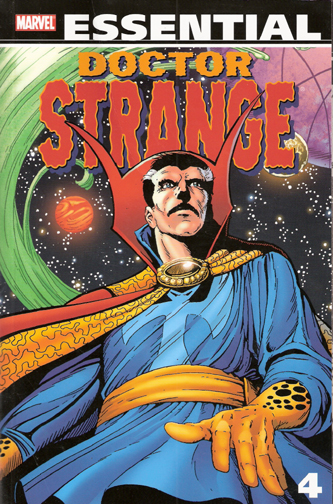
Essential Dr. Strange, v. 4

Collects: Dr. Strange (v. 2) #30-56 (1978-82)

Released: June 2009 (Marvel)

Format: 584 pages / black and white / $19.99 / ISBN: 9780785130628

What is this?: Dr. Strange battles foes old and new and deals with Clea actually getting a personality

The culprits: Writers Roger Stern, Chris Claremont, and others; artists Gene Colan, Marshall Rogers, and others

I expected to be underwhelmed by Essential Doctor Strange, v. 4. I usually am underwhelmed by Dr. Strange stories, despite being a fan of the character. I think most Marvel fans are underwhelmed by Strange; it’s why everyone thinks a Dr. Strange series is a good idea but no one buys them .

But v. 4 surprised me, after a rough start. The book certainly has the pedigree to succeed; Roger Stern, who was at his peak with early ‘80s Marvel, writes most of the book, while Chris Claremont writes eight stories (#38-45) and the included Man-Thing story. Stern feels like the better fit. He’s remembered for writing Spider-Man, who’s a solo hero, like Strange. Claremont is known for his legendary X-Men run, which doesn’t seem to have much in common with Dr. Strange at all. But it’s Claremont, who wrote #38-45, who really gets things going in v. 4.

Essential Dr. Strange, v. 4 coverIt’s through a typical Claremontian concern for female characters. Under Claremont’s pen, Clea, Strange’s lover and disciple, realizes she has learned somewhere between jack and squat from Strange, despite being raised in a more magical dimension. She draws the wrong conclusion from this — that she’s a bad student, rather than Strange being an indifferent-to-incompetent teacher — but at least it breaks the status quo and gives us a reason for Clea’s relative insignificance in magical battles. Claremont also develops Wong a little — well, mainly his forebears, but it’s something.

Claremont also introduces new magical enemies who look like Native Americans and gives Strange a business manager, Sara Wolfe, who’s both a woman AND a Native American. This reminds us that even when Claremont was at the height of his powers, not all his ideas were winners.

Stern gets the beginning (#30-7) and end (#47-56) of the book. His first run is a running battle between Strange and the Dweller in Darkness’s goons, and Strange never does figure out who is behind his assailants. The story ends abruptly, with the Dweller making a unilateral declaration of a nebulous, non-physical victory, as Stern leaves. His exit was probably the reason for the sudden stop — Stern had already switched to plotter (Ralph Macchio scripts) with #33 — but frankly, it had become dull even before then. Stern’s exit was a mercy killing. The only interesting bit is Stern reusing a character from a minor story from an issue of Chamber of Chills, but even that was done haphazardly.

When Stern returns, though, he picks up with Claremont’s disaffected Clea (and drops almost everything else). He introduces a romantic rival for Clea, which finally gives movement to Strange’s static personal life. He also brings back Mordo, one of the go-to villains for strange. Really, Mordo’s just there for credibility; the magician could have been anyone. But Mordo (and eventually Dormammu) lead Strange back through time on a great series of stories (#50-3) that brings in Sgt. Fury and his commandos, Nazis, the Fantastic Four, and Rama-Tut and ends with Clea leaving Strange. Another story has D’Spayre trying to convince Strange he’s a fictional character, even introducing him to Stan Lee and Steve Ditko analogues. In the final issue, Strange plays with former minions of Mordo who thought they were being clever. It’s a strong finish to the book, and it makes me eager for v. 5.

On the other hand, having such expectations of consistent quality is a recipe for disappointment. On the other other hand, the Unofficial Handbook of the Marvel Universe says the next 20 or so issues are Stern teamed up with artists Paul Smith (who did a great job on #54 and 56) and Dan Green with a few others.

Adding even more to the plus side, Stern also has Strange and Clea engage in a rather suggestive “tantric exercise,” which Clea describes as “wonderful” and one she wants to try “more often.” So points to Stern for that. On the other hand, Stern kills a cat. So no perfect score for him either.

The pencils are primarily from Gene Colan and Marshall Rogers. Both are excellent choices. Few artists in Marvel’s stable did shadowy and spooky like Colan, who excelled at it on Tomb of Dracula and Daredevil. (To be fair, Marvel’s bright spandex world didn’t need it so often.) But he does an excellent job here (#36-45, 47), atmospheric and moody and occasionally frightening. His Strange frequently looks a bit too much like his Dracula for my tastes, but they don’t cross over so there’s no confusion, and they’re both imposing, handsome figures, so that’s OK. He uses darkness effectively, so that the reader always suspects something horrible is about to come from the shadows. That expectation is frequently greater than any actual horror inspired by the creatures on the page, but I blame that on the rather plain demons and adversaries Stern and Claremont give him. The black-and-white reproduction doesn’t help him either; with no color to help the shading, his work occasionally looks blotchy.

I am shocked that I enjoy Rogers’s pencils, given how unimpressed I was with his work in Batman: Strange Apparitions. His run (#48-53) is shorter than Colan’s, which is a shame. His style is completely different than Colan’s; while Colan eschews clear lines and his characters look like they can find shadow in a desert at noon, Rogers’s work is clear and bright, even in black and white. His art looks more modern than his contemporaries’, and some of the panels in this look like something that could have been created in the ‘90s, except Marshall has a command of anatomy and exaggerates physical attributes only slightly. Rogers’s Mordo is impressive, full of menace. His work in #53, in which Strange breaks down after Clea announces she’s leaving, is heartbreaking.

I didn’t expect to enjoy Essential Dr. Strange, v. 4. After the first ten issues, I really didn’t, despite the beginning of Colan’s run. But the story grew on me, and the art, more than the writing, won me over. By the end, though, Stern was putting together an impressive run, and I’m looking forward to finding out if he continued it.

Rating: Dr. Strange symbol Dr. Strange symbol Dr. Strange symbol Half Strange symbol

Labels: , , , , , , , ,

31 October 2008

Essential Marvel Horror, v. 1

Collects: Ghost Rider #1-2, Marvel Spotlight #12-24, Son of Satan #1-8, Marvel Two-in-One #14, Marvel Team-Up #32 and 80-1, Vampire Tales #2-3, Haunt of Horror #2 and 4-5, Marvel Premiere #27, Marvel Preview #7 (1973-7, 1979)

Released: November 2006 (Marvel)

Format: 608 pages / black and white / $16.99 / ISBN: 078512196x

Essential Marvel Horror, v. 1 gained its name, I was convinced when it was released, because Marvel was too squeamish to publish Essential Son of Satan (or Children of Satan).18

Marvel Horror features two protagonists: Daimon Hellstrom, Son of Satan, and his sister, Satana. Hellstrom, being a square who sides with “humanity” over “the forces of evil,” gets the bulk of the book, but his darker sister gets her share at the end. Unfortunately, the shift in tone and style between these two is likely to spin the reader’s head around like that girl’s in The Exorcist.

Essential Marvel Horror, v. 1 coverHellstrom is a rarity: an academic hero. (Ray Palmer is a professor; are there other superheroes who work for a university?) In his Marvel Spotlight series, he battles his father’s forces in St. Louis while being affiliated with Gateway University; in his Son of Satan series, he goes to work for the University of the District of Columbia. I prefer the Spotlight issues, written by Steve Gerber; they were consciously superheroic, with Hellstrom fighting a new supernatural menace each month and trying to keep the squares in St. Louis from learning about it. Why St. Louis? I don’t know, but it’s no goofier than fighting demons in New York City.

(Plus, Hellstrom transforms into his demonic alter ego by raising both hands with three fingers pointed upward, making the sign of his demonic trident. Yeah, right — laziest transformation ever.)

The eponymous title, which was mostly written by John Warner, seemed more crowded and more blatantly supernatural, treading ground already trammeled. Thematically, yes, it’s appropriate, but it’s less enjoyable, trying to tread the ground between the superheroes and Marvel horror mags.

And then there are issues of Marvel Team-Up and Marvel Two-in-One, the superheroist of the Marvel superhero comics. Hellstrom got his start in Ghost Rider, which wasn’t a straight superhero comic but was never incredibly far from it.

Gene Colan is perfect for this subject matter; unfortunately, he only does two issues. The other superhero artists … not so much. Not even one of my favorite superhero artists, Sal Buscema, really does the subject justice. On the other hand, they draw demons better than later artists, especially those involved in the Inferno crossover, who believed evil was best represented in Technicolor.

Satana, Daimon’s sister, was featured mainly in Marvel horror magazines. These stand out against the crowd; they are serious, drawn for a mature audience who doesn’t want to see superheroes. The plots are dark, and while they might not match the top of the horror market, they have a unified goal and show us the horror of a child of Satan gone wrong (or right, from Satan’s point of view). Not bound by the Comics Code or its usual kiddie audience, Marvel let the creators have free rein in subject matter and format, occasionally publishing illustrated texts that described Satana’s deeds.

I’m not entirely sure Chris Claremont, who wrote the bulk of the Satana stuff, was the right person for the job, for two reasons. One, his overwrought writing style, which was only beginning here, is more suited to the less serious and self-conscious superhero comics. And two, this is dangerous for him; Claremont loved writing powerful women, and in his later days, became obsessed with certain … well, let’s say tropes, because “fetishes” is a loaded word.

I won’t say the art in these issues are better, but I will say they are striking, while the Comics Code constrained the others so they were quite forgettable. Straying outside their usual bullpen for Satana’s stories, Marvel published contributions from international artists. Their work is moody, dark, vivid even in black and white. These issues really make the volume, and it’s a shame the rest of the book contrasts so sharply with it.

Since it’s Halloween, I’m legally required to answer this question: Is it scary? Well, the Hellstrom parts are decidedly not so. Marvel has neutered most of its dread evil Lords of the Afterlife and all of its demons so superheroes can fight them. The Satana parts? Let’s just say they feel nothing like a superhero story, with a definite sense that evil might win. That’s not enough to rescue the volume as a whole, however.

Rating: Angry pumpkin symbol Angry pumpkin symbol (2 of 5)

Labels: , , , , , , , , , , ,

29 July 2008

Essential Ms. Marvel, v. 1

Collects: Ms. Marvel #1-23, Avengers Annual #10, Marvel Super-Heroes Magazine #10-1 (1977-9, 1981, 1992)

Released: January 2007 (Marvel)

Format: 512 pages / black and white / $16.99 / ISBN: 9780785124993

There’s not much of a way to sugarcoat it; the Essential Ms. Marvel, v. 1 is a collection of ‘70s mediocrity.

I mean that in the best way, of course; it’s not bad enough to offend, nor is it good enough to truly entice. It falls in the same category as the Essential Iron Fist or Essential Nova. The former collection is an apt comparison in more than one way; although Ms. Marvel was created by other hands, Ms. Marvel is the work of Chris Claremont. Like Iron Fist, Claremont rode Ms. Marvel to cancellation at the same time he was making X-Men a sales juggernaut. In fact, his work with Ms. Marvel begins at about the time Iron Fist ends.

Essential Ms. Marvel, v. 1 cover Early Claremont is the main draw here. With eight pencillers in 23 issues, there are frequent changes in art styles, although Jim Mooney provided art for ten issues over a couple of stints. The few guest stars are second tier, and although the established villains in the book are occasionally better than average (MODOK, AIM, Scorpion), there is plenty of dead weight in the form of Grotesk, Tiger Shark, and the Faceless One.9 Just as Ms. Marvel was wrapped up in an Avengers Annual and an issue of X-Men, Claremont wraps up a storyline from the even more obscure Supernatural Thrillers #10-15. (Why, I don’t know.) The new villains are mostly crap: Destructor, the reptilian People, two unidentified aliens. Except …

Except Deathbird and Mystique. Deathbird is an alien cypher working for MODOK, but Mystique is a big player with a mad-on for Ms. Marvel. (Claremont’s predilection for long-dangling plotlines don’t tell us why during Ms. Marvel; in the Marvel Super Heroes Magazine reprinted after the Ms. Marvel issues, Destiny reveals she’s predicted Ms. Marvel will harm Rogue, Mystique’s stepdaughter.) For fans of Mystique, it is interesting to see her humble and obscure beginnings.

Also interesting are the two issues of Marvel Super Heroes Magazine. #10 would have been Ms. Marvel #24; the completed cover for #24 is included. #11 is a condensation of Claremont’s plans for Ms. Marvel’s non-Avengers career before Rogue steals her powers, including scraps with the Brotherhood of Evil Mutants and the Hellfire Club. It’s too condensed to be enjoyable, but it’s good to see Claremont’s intentions, and I appreciate Marvel reprinting the two relatively obscure ‘90s anthology issues. (It has some quintessentially ‘90s art that is a jarring shift, though.) Also included is Avengers Annual #10, famous for Rogue’s debut but included here because it shows Carol dealing with her lost powers and memories and excoriating the Avengers for letting her be mind controlled and abducted by the son of Immortus in Avengers #200 (not included in Essential Ms. Marvel, presumably because of page constraints).

This is Claremont, through and through. A powerful female character, some verbal tics and a great deal of unnecessary verbiage, and several mind control plots. For those who love the Claremont of the ‘70s, this book is well worth your time. For the rest of the world, it’s a bit more missable.

Rating: Marvel symbol Marvel symbol (2 of 5)

Labels: , , , , ,