Reviews of trade paperbacks of comic books (mostly Marvel), along with a few other semi-relevant comments / reviews.

06 July 2013

X-Men Forever, v. 3: Come to Mother ... Russia! and v. 4: Devil in a White Dress

Collects: X-Men Forever #11-5 (v. 3) and 16-20 and X-Men Forever Annual #1 (v. 4) (2010)

Released: May 2010 (v. 3) and August 2010 (v. 4) (Marvel)

Format: 120 and 152 pages respectively / color / $16.99 each / ISBN: 9780785136811 and 9780785144359

What is this?: Chris Claremont continues to play with his X-Men action figures in his own private sandbox, thank you very much.

The culprits: Writer Chris Claremont and artists Tom Grummett, Graham Nolan, Sana Takeda, and Peter Vale


X-Men Forever, v. 3: Come to Mother … Russia! cover I thought about writing separate reviews for
X-Men Forever, v. 3: Come to Mother...Russia! and X-Men Forever, v. 4: Devil in a White Dress, but I just couldn’t do it. The two books resolved into an undifferentiated mush into my mind, and I didn’t have the patience to repeat my criticisms. The books are largely the same in quality, so instead, I’ll tell you what I liked about Russia and Devil:
  • Colossus and Black Widow have joined the Winter Guard, the Russian national superhero force, in Russia. Since the Soviet Union is not the Evil Empire any more, it makes sense that Russian heroes would return to the Motherland occasionally, and an out-of-continuity series like X-Men Forever is a perfect place to explore that.
  • …
  • … hmm …
  • It amuses me that the Amazon listing says Nightcrawler and Rogue head to New Orleans, not Jackson. One Southern city is pretty much like another, right? To be fair, Graham Nolan’s Jackson and Mississippi resembles New Orleans and Louisiana. Also, Amazon listings also have George Lucas’s credits in Chris Claremont’s author biography.
  • Grudgingly, I will admit I liked the idea of the Summerses acting like a real family. I found the execution off, but the idea is good.

X-Men Forever, v. 4: Devil in a White Dress coverAnd what I disliked about Russia and Devil:
  • Claremont dialogue. Good grief. It’s the same phrases and rhythms Claremont has been using for decades. Don’t the X-Men ever use an original turn of phrase? I would speak far less often if I sounded like a Claremont character. I’d be too embarrassed to say much.
  • That cover for Come to Mother … Russia. Who is the Black Widow trying to sex with that pose? Is she trying to seduce me? Am I an enemy agent, whom she will mate with and kill? Oh my god … I am, aren’t I? I knew it! This is the greatest / worst day of my life!
  • Reuse of tired plots. Claremont sends Magik to Limbo again, but this time her journey to the Dark Side is completed — so of course that means “teenaged female in scanty costume.” (Thank Odin it’s not bondage gear.) Rogue and Nightcrawler switch powers, just like Psylocke and Jean Grey did at the beginning of Claremont’s return in X-Men #100. SHIELD once again has to deal with a group of traitors in their ranks.
  • On-the-nose codenames: Black Magik? Firecat? Perfect Storm? Ye gods.
  • Dredging up past “romances.” Kitty and Colossus were done a long time ago — they broke up in Uncanny #183, almost 100 issues before the end of Claremont’s run — and bringing it up again to shoot it down again is pointless. (Besides, their romance was never especially convincing; Kitty was extreme jail bait during their relationship, and the thought that an older, wiser Kitty would want to resume that relationship is a little disturbing.) Black Panther and Storm rekindling their romance is no more believable in X-Men Forever than it was in the X-books’ regular continuity, but thankfully it is over quite a bit more quickly.
  • Stupidity. A relationship between Jean and Beast begins with little warning; after all those years together on the X-Men and X-Factor, it seems like the platonic coating on their relationship should be too thick to penetrate. (Perhaps her attraction to him is based on his body hair: he’s the only one who can compare in that department to the dead Wolverine.) Nightcrawler and Rogue run into a trap in Jackson, not questioning why jetsetting stewardess Amanda Sefton would be in the capital of Mississippi long enough to investigate before blundering in.

So, in short, unless you’re looking for Claremont nostalgia accompanied by art that ranges from *ugh* to uh-cceptable, then don’t waste your time with these books. Discounts on the TPBs drew me into X-Men Forever, but I don’t think I’d read the rest of the series even if the books were free.

Rating: Russia: X-Men symbol Half X-Men symbol (1.5 of 5 )

Devil: X-Men symbol (1 of 5)

Labels: , , , , , , , , , , , ,

21 June 2013

Avengers vs. X-Men: Avengers Academy, v. 5

Collects: Avengers Academy #29-33 (2012)

Released: March 2013 (Marvel)

Format: 112 pages / color / $24.99 / ISBN: 9780785165811

What is this?: While the Avengers and X-Men squabble over the Phoenix Force, Wolverine places his students with Avengers Academy.

The culprits: Writer Christos Gage and artists Tom Grummett and Timothy Green II


In Second Semester, v. 4 of Avengers Academy, I complained of an overly large cast and a lack of action. Avengers vs. X-Men: Avengers Academy, v. 5, does nothing to remedy that.

Avengers Academy’s contribution to the Avengers vs. X-Men crossover is to pit Avengers Academy vs. Cyclops’s students in Avengers Academy #29-31. Well, “vs.” is putting it strongly; the two sides pose and gesture at each other, but just as in Second Semester, calmer heads prevail before things get out of hand … or even before they threaten to get out of hand. Thank Odin! If there had been a fight, something might have happened to the dozen or so new Academy or X-students I don’t care about.

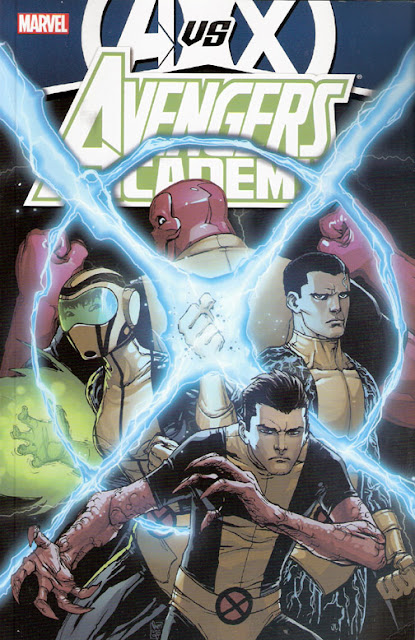
Avengers vs. X-Men: Avengers Academy, v. 5 coverThe main antagonist is Sebastian Shaw, who has lost his memory of his villainous history. He battles his way through the Academy’s teachers and adult guests, taking out Tigra, Madison Jeffries, and a powered-down Hercules. Even that momentary excitement fizzles after a decent start.

Writer Christos Gage and artist Tom Grummett make a few nods to the original Dark Phoenix Saga, which is appropriate since Avengers vs. X-Men was kicked off by the return of the Phoenix Force, and Shaw had a pivotal role in the Dark Phoenix Saga. But after putting Shaw into a sewer, a la Wolverine in Uncanny X-Men #132 — Grummett does a nice homage to the final panel in #132 with a full page-illustration in Academy #29 — there aren’t many other parallels. Shaw does fight his way to the surface, as Wolverine fought his way to where his teammates are held, but it’s a different kind of fight, with Shaw having the guile and subtlety of a rock thrown through a window.

The payoff for the story is supposed to be X-23 making a difficult moral decision and not believing what authority figures tell her, which his fine as far as it goes. But X-23 has not been a part of the cast long enough for her epiphany to be a satisfying payoff for Avengers Academy readers, and her pronouncement is part of the book’s overwhelming and frustrating aura of reasonableness. Gage seems determined to undermine the idea that moral conflicts in comics are thrashed out with fists, segueing conflict from nominal battles to discussions / lectures that avoid violence at all costs.

The final two issues pursue a far more interesting idea than X-Men students throwing angry words at Avengers affiliates. Emma Frost, empowered by a fraction of the Phoenix Force, arrives at the Academy compound to destroy Juston Seyfert’s Sentinel. That’s a plot thread that needed to be explored; when Juston was in his own little corner of the Marvel Universe, his pet Sentinel can function as a faux-Iron Giant, but when they interact with the rest of the MU, which views Sentinels as weapons of genocide, madmen, and governments, the Sentinel seems far less innocent.

Gage tries to frame the Sentinel as a loyal pet, and the effort is partly successful. Juston’s grief at the beating the Sentinel takes is affecting, but Hank Pym’s amazement over the Sentinel overcoming its prime directive — he says it should be impossible — comes across as hollow, considering how often the impossible happens in the Marvel Universe. (Also, if that’s impossible, how did Ultron become what he is? What did Pym make its prime directive?) The Sentinel itself is still the most problematic part of the story; given its still extant anti-mutant programming, the Sentinel at best is a dangerous dog that has been leashed. Sooner or later, that leash won’t be enough, and there will be a tragedy. As clichéd as that sort of story is, the tragedy of the Sentinel attacking mutants might have been a better way to resolve the Sentinel plot, especially given the number of mutants wandering around at the end of Avengers vs. X-Men.

The two stories leave little for the original cast to do. Finesse talks to Quicksilver; one of the X-students’ powers allows Mettle to surf on dry land, making Hazmat, his girlfriend, happy. Whee. As usual, the guest stars get the best lines, and Emma Frost is no exception. Hercules’s dialogue also stands out, making him seem at times both a buffoon and an actual hero.

The price is outrageous: $25 for five issues? In paperback? That’s an insult to the buyer. I could buy the single issues and pay a professional bindery to make them into a hardback book for about the same amount of money. This is probably a cash grab based on the Avengers vs. X-Men name, since the price for Second Semester, the previous volume, was $20 for eight issues, and the next (and final) volume, Final Exams, has six issues and sells for $20.

The artists for this backwater of the crossover don’t interest me much. Grummett does a solid, if unexciting, job. I appreciate his Dark Phoenix reference, but something about his style feels hesitant, as if he doesn’t want to cut loose. Timothy Green II, who draws the two-issue Sentinel story, draws in an exaggerated, manga-influenced style that clashes with the prevailing art style of the series, but I suppose it is appropriate for a giant-robot-vs.-cosmic-powerhouse fight. Not my cup of tea, but it’s fine.

Gage manages some nice jokes with the guest stars, but that’s not enough. Avengers Academy needs more plot, more conflict than Avengers vs. X-Men and Second Semester give. After these last two volumes, it’s hard to argue with Marvel’s decision to cancel the series with Final Exams. Hell, it’s hard to argue Marvel should have given Gage and Co. another arc after Avengers vs. X-Men.

Rating: Avengers symbol  symbol (1.5 of 5)

Labels: , , , , , , , , , , ,

03 May 2013

Avengers Academy, v. 4: Second Semester

Collects: Avengers Academy #21-8 (2012)

Released: November 2012 (Marvel)

Format: 176 pages / color / $19.99 / ISBN: 9780785152033

What is this?: The Avengers Academy takes on new students, and the new student body has to deal with the X-Men, a Dire Wraith, the Runaways, and former young Initiative members.

The culprits: Writer Christos Gage and artists Sean Chen, Tom Raney, Tom Grummett, and Karl Moline


The first three volumes of Avengers Academy focused on a tight group of six students whom the Avengers suspected might become supervillains because Norman Osborn tortured them. Occasionally an issue’s focus drifted toward the students’ teachers, most notably longtime Avenger Hank Pym, and that was OK too; readers cared about the teachers because of their relationships to these fresh, young characters.

In Avengers Academy, v. 4: Second Semester, the school founded by Hank Pym opened its doors to new students. In theory, introducing new characters to the cast is a good idea, especially after one of the original six students left during Fear Itself: Avengers Academy. However, writer Christos Gage has included every young Marvel character created in the last fifteen years who wasn’t claimed by another book.

Avengers Academy, v. 4: Second Semester coverWell, it seems that way. The new students include Juston Seyfert and his Sentinel, the new Thundra, Ricochet, Whiz Kid, Spider-Girl, Machine Teen, the old Penance, the new Power Man, Butterball, Rocket Racer, even Batwing from Untold Tales of Spider-Man. I’m not sure what character could show “bottom of the barrel” more comprehensively than Batwing, who appeared in four issues of Kurt Busiek’s Untold Tales series, which was set in early Silver Age continuity, and an issue of Avengers: Initiative. We never learn why these characters are at the Academy or anything about them; they exist to fill out the background art.

However, despite the apparent cast of thousands, Gage focuses on three new characters: Lightspeed (Julie Power of Power Pack), X-23 (the female clone of Wolverine), and the newest White Tiger, Ava Ayala (not the old White Tiger, Hector Ayala, or the not old, not new White Tiger, Angela del Toro). Gage has a solid role for Lightspeed (teacher’s assistant), and X-23 is at the Academy to further her socialization. White Tiger, on the other hand, seems to have arrived to hassle Reptil, an original Academy student, about not being active in the Hispanic community.

Ideally, new characters should find a place to nestle in the cast, establishing their own niche or insinuating themselves inside pre-existing relationships to shake things up. Lightspeed is a great addition to the cast, a former team player, and Gage uses her sexual identity to allow her to relate to one of the established students. X-23 doesn’t get much time to show who she is, but Gage allows her and Mettle to discuss what it’s like to be a killer, and she’s tossed unwillingly into a love triangle. White Tiger does get a lot of time on the page, but Gage is less successful with her; she has a tragic origin and a Hispanic identity, but she’s not much more than that — we don’t even learn how she got her mystic amulet from her niece, Angela del Toro.

The team-vs.-team fights don’t help matters. Marvel Comics have had a template embedded into their DNA since Stan Lee crapped out the first superheroes after the Fantastic Four: heroes meet, fight, and then team up vs. the villain. Unfortunately, there are no villains to fight. The students in Second Semester fight the Avengers, X-Men, and Runaways, and somehow they avoid fighting former Initiative recruits when they show up. But there are no villains for them to team up and fight. The brief battles with other heroes wind down with a discussion by calmer heads, but discussions about the reasonableness of the other side’s point of view is not why I read comics. The lack of villains makes the heroes’ squabbles seem inconsequential.

Second Semester has only one fight with a villain. The entire student body battles a Dire Wraith hybrid; with the Wraith’s mind control, it’s a good fight, but one issue with a villain (two, if you count an issue of barely restrained scheming) out of eight is not enough. Gage tries to get the reader interested in the schemes of the future versions of the Academy’s original six students, but I’m not buying it. The future students are trying to bring about their nefarious (or not nefarious) future for mysterious reasons, but I have no criteria to judge that future on. Admittedly, one of the future versions tries to get Avengers Academy students killed, but that’s because the Wraith killed a lot of students in his timeline.

Gage is more successful with character development and humor. The guest stars get most of the good lines, but fortunately, he hasn’t lost his touch with his old characters. Hazmat and Mettle’s relationship progresses along expected lines, but they are sweet together, and the characters’ reasonableness means stupid misunderstandings are stumbling blocks rather than relationship breakers. Striker makes a big revelation, and even though I can see what Gage is aiming at, I’m not convinced previous characterization backs it up. Finesse and Reptil’s relationship is explored in the future but not much in the present, and Finesse finally meets Magneto, the man whose methods she wanted Quicksilver to teach her.

Second Semester has a ridiculous four pencilers for eight issues: Sean Chen (#21-2), Tom Raney (#23), Tom Grummett (#24-6), and Karl Moline (#27-8). I enjoy Chen’s clear, clean art, but Grummett’s is excellent as well; he has to do the bulk of the close-ups on the background characters, and he manages to differentiate them. Moline’s art has a loose, exaggerated style that looks nothing like the others’, and its incongruity makes it look worse than it actually is.

Although I still like the characters, Second Semester has to be considered a step down in quality. The book has too many characters without enough to do, and the plot puts too little external pressure on the characters to make them react in interesting ways. I hope the title will rebound, but since the extra students aren’t going anywhere, I have my doubts.

Rating: Avengers symbol Avengers symbol (2 of 5)

Labels: , , , , , , , , , , , , , ,

31 January 2011

Fantastic Four: The Beginning of the End

Collects: Fantastic Four #525-6 and 551-3 (2005, 2008)

Released: April 2008 (Marvel)

Format: 120 pages / color / $12.99 / ISBN: 9780785125549

What is this?: Dr. Doom comes back from the future to tell Reed he’s screwed up the future; Diablo annoys the team with alchemy and dreams.

The culprits: Writers Dwayne McDuffie and Karl Kesel and artists Paul Pelletier and Tom Grummett

Fantastic Four: The Beginning of the End is a substantial improvement on Fantastic Four: The New Fantastic Four. Well, at least writer Dwayne McDuffie’s contribution to the TPB is.

Whereas New Fantastic Four is full of unneeded bombast and incessant events of cosmic import, McDuffie chooses a more quiet plot for the finale of his short run on Fantastic Four. Dr. Doom travels back in time to escape a Reed Richards-dominated future. Of course his objective is to avert that future, but are the things he’s saying about Reed true? Is he really a monster who loses sight of the human costs in his efforts to improve the world?

Fantastic Four: The Beginning of the End coverAt the time Beginning was written, that wasn’t such a far-fetched idea. After the nonsense of Civil War and the Superhuman Registration Act, Reed looked like a borderline Fascist (and we know how much regard Fascists generally have for borders) who believed he had all the answers. His arrogance had split the team, and The New Fantastic Four had only begun the healing. And of course, if a Doom from the future was looking for a time to prey upon the other members’ uncertainty, this was it. It’s a fantastic, intriguing idea for a story, and McDuffie exploits it to its fullest.

Unfortunately, there are a few flaws to the story. The story takes three issues for an argument with occasional punches, and it feels padded. The arrival of the Fantastic Four from the future, while a logical part of the story, puts the kibosh on the story before it has ended; when they arrive, you know all debate is truly finished. I also did not need more dickering about the nature of time travel. A recap would be fine, but I never need to hear that the generally held model of Marvel temporal mechanics is wrong or even more than mildly flawed.

None of these objections take away from my enjoyment of the story, though. That might have been influenced by my desire to believe Doom was correct and Reed was so incredibly wrong.

Writer Karl Kesel’s two-issue “Dream Fever” story from #525-6, which features Diablo as the villain, seems an odd fit here. It’s included, presumably, because they had extra room to fill at the end of McDuffie’s run and it had been collected nowhere else (it originally fit between Mark Waid’s three-year run, ending with #524, and J. Michael Straczynski’s year and a half, which lasted from #527 to Civil War). “It has to fit somewhere” and “We have extra space” makes sense if you’re collecting the issues, but it doesn’t mean I have to like it. It doesn’t fit with McDuffie’s work in tone or continuity; where “The Beginning of the End” is a story that can only take place after the events of Civil War, “Dream Fever” is set well before, with a cheerier team in a story that actually follows up on character development from the Waid run (which I suspect we’ll never hear about again).

“Dream Fever” is a fill-in story that never claims to be more than a fill-in story. It tries to get some mileage out of using dreams to reveal character elements that were rarely or never discussed, and to be fair, Kesel does have some success there. But using dreams in that manner is a frequent prop for real character development, and worse, saying that all the team’s dreams are nightmares, and that having other people’s nightmares rather than your own will kill you … it seems a bit silly. Again, it’s a fill-in two-parter, so wasting effort trying to convince the reader of something that could be glossed over wouldn’t be a wise use of space, but it took away from the peril of the story. Diablo as the villain … well, in this story, he seems more like an opportunist than a credible threat or someone with a strong plan.

What is unusual is that the two essentially randomly packaged together stories both have excellent art. I praised Paul Pelletier’s work from The New Fantastic Four, and his work on “Beginning of the End” is every bit as good. His depiction of Reed’s secret workroom, with notes and equations on every surface, is my favorite visual of the book. Pelletier also gets to design future versions of the team, the Black Panther, and Namor, and although I’m not exactly fond of the changes in facial hair and / or hair length school of aging, I did like his Ben Grimm. Tom Grummett gives the fill-in art for “Dream Fever” and does a likewise impressive job. Although there’s nothing as visually arresting in his work as what Pelletier is given, his artwork is clear and bright, with a good grasp of storytelling.

I find it strange that I would prefer this hodgepodge Fantastic Four book to one that McDuffie wrote by himself. Still, it’s true. I also find it interesting that a Dr. Doom / time travel story would feel less an assertion of self-importance than The New Fantastic Four, but again — true. In any event, it allows McDuffie to end his short run on a high note.

Rating: Fantastic Four symbol Fantastic Four symbol Fantastic Four symbol Half Fantastic Four symbol (3.5 of 5)

Labels: , , , , , , , , ,

26 February 2010

X-Men Forever, v. 1: Picking Up Where We Left Off

Collects: X-Men Forever #1-5 (2009)

Released: October 2009 (Marvel)

Format: 120 pages / color / $16.99 / ISBN: 9780785136798

What is this?: Chris Claremont writes early ‘90s X-Men two decades later.

The culprits: Writer Chris Claremont and artist Tom Grummett

Marvel has a love / hate relationship with writer Chris Claremont’s relationship with the X-Men.

They have continually touted his work on Uncanny X-Men as a tour de force ever since he left / was forced out. They love to tease his return, that he’s going to take them all back to the glory days of the late ‘80s. They allowed him to return to Wolverine for a few issues in the late ’90s. Then they actually gave him control of Uncanny X-Men and X-Men for a year or so around 2000. Since then, he’s worked on Exiles and various out-of-continuity miniseries — letting him play with knockoff X-Men but making sure none of it matters.

And the latest iteration of that plan is X-Men Forever, v. 1: Picking up Where We Left Off, which is supposed to allow Claremont to write stories as if he never left the X-Men.

X-Men Forever, v. 1: Picking up Where We Left Off coverStill, that rings hollow. The title is false advertising. Aside from the “never standing in the same river twice” school of thought — in this case, never being able to read the same Claremont you grew up with — this doesn’t really follow X-Men #3 / Uncanny X-Men #280, which is where Claremont left. Nightcrawler and Shadowcat are inexplicably back from Excalibur. Jean and Wolverine have some sort of love connection that certainly wasn’t there when Claremont left. SHIELD has wormed its way into the X-Men. As Paul O’Brien and others have pointed out, artist Tom Grummett isn’t the sort of ‘90s / Image artist X-Men would have had back then. And this doesn’t exactly jibe with the hints Claremont has given in interviews about the direction he would have gone in if he had been allowed to continue.

But none of that affects how good this story is — or should affect that. Unfortunately, it does color it a little. Claremont is … well, he is as he is today, which is to say his dialogue sounds like him and not that much like different characters. Even Beast sounds like everyone else. On the other hand, the plotting in this first TPB is nothing like classic Claremont — rapid changes out of nowhere, with seemingly little buildup or warning. That’s a function, in many cases, of the abrupt nature of the mandate — here, pick up a story you started 20 years ago, but remember, we don’t have time for that quick buildup crap — but it still rankles.

It doesn’t surprise me that it took me this long to comment on the actual story. (That’s the way it is with Claremont these days; he comes with so much baggage that the story seems almost secondary.) It starts with a fight with Fabian Cortez, which is a direction that flows from X-Men #3, but that just serves to set up Claremont’s new / old team. Once the story gets going, it’s somewhat enjoyable, with a double agent in the X-Men, a new villainous organization, and a death on the team. I’m not convinced by any of the individual revelations — who dies, who the double agent is, Shadowcat’s new power, why I should care about Sabretooth being blinded when he has a healing factor, etc. Still, it seems like an interesting framework to hang a story on.

As I said, Grummett is nothing like the Jim Lee / Whilce Portacio artists who worked with Claremont at the end of his run. I’m not complaining; I like Grummett’s work, solid as it is. It feels like it has real weight, and it’s very good at telling the story while giving the characters their classic looks. I also have to give credit to colorist Wilfredo Quintana, whose work seems bright enough for the nostalgia without letting it overwhelm the scenes.

There’s a decent amount of promise in the first volume of X-Men Forever, and I think fans who were heartbroken by Claremont’s exit from the X-Men and his successors’ efforts will find a lot to like here. I see it too, but I can’t say that it’s enough to make me want to return to the title. There are too many things that pluck at my mind, drawing me out of the story. Maybe Claremont just needs time to settle down, maybe this is just a bump in the road … but I’m not sure I want to spend another $17 to figure it out.

Rating: X-Men symbol X-Men symbol (2 of 5)

Labels: , , , , , , ,

13 June 2006

New Thunderbolts, v. 3: Right of Power

Collects: New Thunderbolts #13-18, Thunderbolts (v. 2) #100 (2005-6)

Released: May 2006 (Marvel)

There was a time, long ago, when Thunderbolts had a plotline you could follow without a set of Cliff Notes and a vodka tonic. I’m not sure when that time was, or when it passed, but I know it existed and doesn’t any more.

Certainly it passed before the title was relaunched as New Thunderbolts. There’s nothing wrong with the new name — well, except the original Thunderbolts weren’t too old, and every book seems to have a “New” in front of it these days — but writer Fabian Nicieza evidently decided that intricate plotting was the secret of success and hied down that road.

It’s … I don’t want to call it “sprawling,” because the next word after that is “epic,” and that’s not right at all. It’s filled with many flailing plots that refuse to come together and instead jut out of the main body of the plot like arrows out of a practice target. But there’s a lot going on in this trade, and there’s little to indicate any of these plotlines are being wrapped up.

The Commission for Superhuman Activities asks the Thunderbolts to humiliate the Avengers, which they do. Then the team has a fight with the new Squadron Sinister, reformed by the Grandmaster. Then there’s the final three issues, which does put an end to Captain Marvel / Photon’s mental problems but leaves other danglers: What will the new Swordsman do? What’s Zemo playing at? And is he playing his new girl? What’s up with Moonstone? What will Speed Demon do now? Will the Thunderbolts’ new member remain?

Plot fodder for future issues, you say? Well, maybe. But two things occur to me:

1) We went down this road with Chris Claremont on Uncanny X-Men, where he spun off new ideas like crazy without ever resolving them. Nicieza has been good about resolving his stories in the past, but you never know …

2) There is a sense that this title is tossed about by the whims of editorial. The Swordsman is a reminder of the crossover with Wolverine that ran straight through the middle of v. 1. “House of M” marred v. 2. Here, the status quo of New Avengers makes up the first third of the story, and Carol Danvers resigns from the Commission on Superhuman Activities — off panel — so that she can have her own series.

Nicieza, aided by artists Tom Grummett and Rick Leonardi, may be doing its best, but this is a very densely plotted series, fully of revelations, double crosses, and scheming Nazis. The title itself seems in very real danger of flying apart when the next crossover comes flying through. Like, oh, say, Civil War …

Grade: C+

Labels: , , , , ,