Reviews of trade paperbacks of comic books (mostly Marvel), along with a few other semi-relevant comments / reviews.

21 June 2013

Avengers vs. X-Men: Avengers Academy, v. 5

Collects: Avengers Academy #29-33 (2012)

Released: March 2013 (Marvel)

Format: 112 pages / color / $24.99 / ISBN: 9780785165811

What is this?: While the Avengers and X-Men squabble over the Phoenix Force, Wolverine places his students with Avengers Academy.

The culprits: Writer Christos Gage and artists Tom Grummett and Timothy Green II


In Second Semester, v. 4 of Avengers Academy, I complained of an overly large cast and a lack of action. Avengers vs. X-Men: Avengers Academy, v. 5, does nothing to remedy that.

Avengers Academy’s contribution to the Avengers vs. X-Men crossover is to pit Avengers Academy vs. Cyclops’s students in Avengers Academy #29-31. Well, “vs.” is putting it strongly; the two sides pose and gesture at each other, but just as in Second Semester, calmer heads prevail before things get out of hand … or even before they threaten to get out of hand. Thank Odin! If there had been a fight, something might have happened to the dozen or so new Academy or X-students I don’t care about.
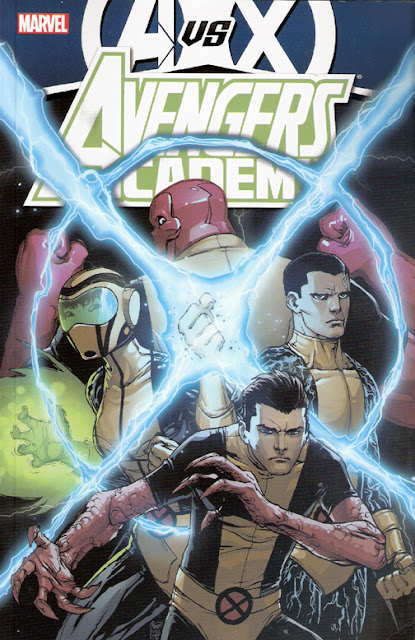
Avengers vs. X-Men: Avengers Academy, v. 5 coverThe main antagonist is Sebastian Shaw, who has lost his memory of his villainous history. He battles his way through the Academy’s teachers and adult guests, taking out Tigra, Madison Jeffries, and a powered-down Hercules. Even that momentary excitement fizzles after a decent start.

Writer Christos Gage and artist Tom Grummett make a few nods to the original Dark Phoenix Saga, which is appropriate since Avengers vs. X-Men was kicked off by the return of the Phoenix Force, and Shaw had a pivotal role in the Dark Phoenix Saga. But after putting Shaw into a sewer, a la Wolverine in Uncanny X-Men #132 — Grummett does a nice homage to the final panel in #132 with a full page-illustration in Academy #29 — there aren’t many other parallels. Shaw does fight his way to the surface, as Wolverine fought his way to where his teammates are held, but it’s a different kind of fight, with Shaw having the guile and subtlety of a rock thrown through a window.

The payoff for the story is supposed to be X-23 making a difficult moral decision and not believing what authority figures tell her, which his fine as far as it goes. But X-23 has not been a part of the cast long enough for her epiphany to be a satisfying payoff for Avengers Academy readers, and her pronouncement is part of the book’s overwhelming and frustrating aura of reasonableness. Gage seems determined to undermine the idea that moral conflicts in comics are thrashed out with fists, segueing conflict from nominal battles to discussions / lectures that avoid violence at all costs.

The final two issues pursue a far more interesting idea than X-Men students throwing angry words at Avengers affiliates. Emma Frost, empowered by a fraction of the Phoenix Force, arrives at the Academy compound to destroy Juston Seyfert’s Sentinel. That’s a plot thread that needed to be explored; when Juston was in his own little corner of the Marvel Universe, his pet Sentinel can function as a faux-Iron Giant, but when they interact with the rest of the MU, which views Sentinels as weapons of genocide, madmen, and governments, the Sentinel seems far less innocent.

Gage tries to frame the Sentinel as a loyal pet, and the effort is partly successful. Juston’s grief at the beating the Sentinel takes is affecting, but Hank Pym’s amazement over the Sentinel overcoming its prime directive — he says it should be impossible — comes across as hollow, considering how often the impossible happens in the Marvel Universe. (Also, if that’s impossible, how did Ultron become what he is? What did Pym make its prime directive?) The Sentinel itself is still the most problematic part of the story; given its still extant anti-mutant programming, the Sentinel at best is a dangerous dog that has been leashed. Sooner or later, that leash won’t be enough, and there will be a tragedy. As clichéd as that sort of story is, the tragedy of the Sentinel attacking mutants might have been a better way to resolve the Sentinel plot, especially given the number of mutants wandering around at the end of Avengers vs. X-Men.

The two stories leave little for the original cast to do. Finesse talks to Quicksilver; one of the X-students’ powers allows Mettle to surf on dry land, making Hazmat, his girlfriend, happy. Whee. As usual, the guest stars get the best lines, and Emma Frost is no exception. Hercules’s dialogue also stands out, making him seem at times both a buffoon and an actual hero.

The price is outrageous: $25 for five issues? In paperback? That’s an insult to the buyer. I could buy the single issues and pay a professional bindery to make them into a hardback book for about the same amount of money. This is probably a cash grab based on the Avengers vs. X-Men name, since the price for Second Semester, the previous volume, was $20 for eight issues, and the next (and final) volume, Final Exams, has six issues and sells for $20.

The artists for this backwater of the crossover don’t interest me much. Grummett does a solid, if unexciting, job. I appreciate his Dark Phoenix reference, but something about his style feels hesitant, as if he doesn’t want to cut loose. Timothy Green II, who draws the two-issue Sentinel story, draws in an exaggerated, manga-influenced style that clashes with the prevailing art style of the series, but I suppose it is appropriate for a giant-robot-vs.-cosmic-powerhouse fight. Not my cup of tea, but it’s fine.

Gage manages some nice jokes with the guest stars, but that’s not enough. Avengers Academy needs more plot, more conflict than Avengers vs. X-Men and Second Semester give. After these last two volumes, it’s hard to argue with Marvel’s decision to cancel the series with Final Exams. Hell, it’s hard to argue Marvel should have given Gage and Co. another arc after Avengers vs. X-Men.

Rating: Avengers symbol  symbol (1.5 of 5)

Labels: , , , , , , , , , , ,

03 May 2013

Avengers Academy, v. 4: Second Semester

Collects: Avengers Academy #21-8 (2012)

Released: November 2012 (Marvel)

Format: 176 pages / color / $19.99 / ISBN: 9780785152033

What is this?: The Avengers Academy takes on new students, and the new student body has to deal with the X-Men, a Dire Wraith, the Runaways, and former young Initiative members.

The culprits: Writer Christos Gage and artists Sean Chen, Tom Raney, Tom Grummett, and Karl Moline


The first three volumes of Avengers Academy focused on a tight group of six students whom the Avengers suspected might become supervillains because Norman Osborn tortured them. Occasionally an issue’s focus drifted toward the students’ teachers, most notably longtime Avenger Hank Pym, and that was OK too; readers cared about the teachers because of their relationships to these fresh, young characters.

In Avengers Academy, v. 4: Second Semester, the school founded by Hank Pym opened its doors to new students. In theory, introducing new characters to the cast is a good idea, especially after one of the original six students left during Fear Itself: Avengers Academy. However, writer Christos Gage has included every young Marvel character created in the last fifteen years who wasn’t claimed by another book.

Avengers Academy, v. 4: Second Semester coverWell, it seems that way. The new students include Juston Seyfert and his Sentinel, the new Thundra, Ricochet, Whiz Kid, Spider-Girl, Machine Teen, the old Penance, the new Power Man, Butterball, Rocket Racer, even Batwing from Untold Tales of Spider-Man. I’m not sure what character could show “bottom of the barrel” more comprehensively than Batwing, who appeared in four issues of Kurt Busiek’s Untold Tales series, which was set in early Silver Age continuity, and an issue of Avengers: Initiative. We never learn why these characters are at the Academy or anything about them; they exist to fill out the background art.

However, despite the apparent cast of thousands, Gage focuses on three new characters: Lightspeed (Julie Power of Power Pack), X-23 (the female clone of Wolverine), and the newest White Tiger, Ava Ayala (not the old White Tiger, Hector Ayala, or the not old, not new White Tiger, Angela del Toro). Gage has a solid role for Lightspeed (teacher’s assistant), and X-23 is at the Academy to further her socialization. White Tiger, on the other hand, seems to have arrived to hassle Reptil, an original Academy student, about not being active in the Hispanic community.

Ideally, new characters should find a place to nestle in the cast, establishing their own niche or insinuating themselves inside pre-existing relationships to shake things up. Lightspeed is a great addition to the cast, a former team player, and Gage uses her sexual identity to allow her to relate to one of the established students. X-23 doesn’t get much time to show who she is, but Gage allows her and Mettle to discuss what it’s like to be a killer, and she’s tossed unwillingly into a love triangle. White Tiger does get a lot of time on the page, but Gage is less successful with her; she has a tragic origin and a Hispanic identity, but she’s not much more than that — we don’t even learn how she got her mystic amulet from her niece, Angela del Toro.

The team-vs.-team fights don’t help matters. Marvel Comics have had a template embedded into their DNA since Stan Lee crapped out the first superheroes after the Fantastic Four: heroes meet, fight, and then team up vs. the villain. Unfortunately, there are no villains to fight. The students in Second Semester fight the Avengers, X-Men, and Runaways, and somehow they avoid fighting former Initiative recruits when they show up. But there are no villains for them to team up and fight. The brief battles with other heroes wind down with a discussion by calmer heads, but discussions about the reasonableness of the other side’s point of view is not why I read comics. The lack of villains makes the heroes’ squabbles seem inconsequential.

Second Semester has only one fight with a villain. The entire student body battles a Dire Wraith hybrid; with the Wraith’s mind control, it’s a good fight, but one issue with a villain (two, if you count an issue of barely restrained scheming) out of eight is not enough. Gage tries to get the reader interested in the schemes of the future versions of the Academy’s original six students, but I’m not buying it. The future students are trying to bring about their nefarious (or not nefarious) future for mysterious reasons, but I have no criteria to judge that future on. Admittedly, one of the future versions tries to get Avengers Academy students killed, but that’s because the Wraith killed a lot of students in his timeline.

Gage is more successful with character development and humor. The guest stars get most of the good lines, but fortunately, he hasn’t lost his touch with his old characters. Hazmat and Mettle’s relationship progresses along expected lines, but they are sweet together, and the characters’ reasonableness means stupid misunderstandings are stumbling blocks rather than relationship breakers. Striker makes a big revelation, and even though I can see what Gage is aiming at, I’m not convinced previous characterization backs it up. Finesse and Reptil’s relationship is explored in the future but not much in the present, and Finesse finally meets Magneto, the man whose methods she wanted Quicksilver to teach her.

Second Semester has a ridiculous four pencilers for eight issues: Sean Chen (#21-2), Tom Raney (#23), Tom Grummett (#24-6), and Karl Moline (#27-8). I enjoy Chen’s clear, clean art, but Grummett’s is excellent as well; he has to do the bulk of the close-ups on the background characters, and he manages to differentiate them. Moline’s art has a loose, exaggerated style that looks nothing like the others’, and its incongruity makes it look worse than it actually is.

Although I still like the characters, Second Semester has to be considered a step down in quality. The book has too many characters without enough to do, and the plot puts too little external pressure on the characters to make them react in interesting ways. I hope the title will rebound, but since the extra students aren’t going anywhere, I have my doubts.

Rating: Avengers symbol Avengers symbol (2 of 5)

Labels: , , , , , , , , , , , , , ,

30 March 2012

Avengers Academy, v. 2: Will We Use This in the Real World?

Collects: Avengers Academy #7-13 (2011)

Released: January 2012 (Marvel)

Format: 168 pages / color / $19.99 / ISBN: 9780785144977

What is this?: The students being trained by the Avengers not to be supervillains start getting some field work.

The culprits: Writer Cristos Gage and artists Mike McKone, Sean Chen, and Tom Raney


As I mentioned in my review of Avengers Academy, v. 1: Permanent Record, Avengers Academy is a series with potential. The problem with potential, of course, is that you have eventually start delivering on it.

Writer Cristos Gage had the luxury of devoting an issue on each of the Academy’s six morally ambiguous and powerful students in v. 1, showing readers each character’s set up and establishing his or her personality. In Avengers Academy, v. 2: Will We Use This in the Real World?, he has to start developing these characters. Which way will they go — toward heroism or toward the dark side? Of course, advancing the characters doesn’t mean showing their final choices immediately; it just means they have to become something more or different than they were.

Avengers Academy, v. 2: Will We Use This in the Real World? coverWell, not really. For characters that are already interesting, such as the amoral and emotionally disconnected Finesse, the only thing Gage needs to do is keep the character interesting; unfortunately, Finesse gets only two character moments in this book, and one of them is fighting Taskmaster. Taskmaster may be Finesse’s father, but their skirmish reveals more about Taskmaster than Finesse.

Other characters don’t get much to do either. Mettle is still a good-natured lug, trapped in an unsightly form, although he’s reaching out more toward Hazmat. Striker is still a self-centered jerk, and one incident shakes his confidence in the value of fame compared the risk involved in heroism. Reptil, the ostensible leader of the group, barely shows up until the end of the volume, when he confronts Finesse and has to decide how much his maturity is worth.

The students who get the most development are Hazmat and Veil. They (and Striker) are partners in crime in avenging the Hood’s attack on Tigra, and they share the blame. They both learn that in the future, they will not be cured (or more accurately, in a possible future, they will not be cured). Credit goes to Gage for addressing the possibility of using nullifier technology to help Hazmat, who gets a day with power-stealing mutant Leech to enjoy the world without her killing powers. She rejects Leech as a long-term therapy, seeing that she would only be using him as a crutch. Veil makes the worst decisions possible, and somehow, she comes out smelling like a rose at the end of it all. Infuriatingly, her teachers smile indulgently rather than punishing her. At least she learns some self-reliance.

The teachers get some screen time as well. Quicksilver is still his acerbic self, and he steals any scene he’s in. Justice exists, and his only real importance comes at the party in #13. Speedball is still the New Warriors martyr, and his cutting in Permanent Record is revealed to be his way of powering up for fights (yeah, right). Hank Pym becomes Giant Man again; it’s never a great sign for Pym’s mental health when he changes names, and it doesn’t help that he highlights his many names and bouts of mental instability in issue #7. On the other hand, Pym and Gage get points for mentioning the Sentry was the least mentally stable Avenger, and Pym’s moment of compassion for Absorbing Man is a nice moment for Pym.

Tigra gets a good deal of attention, although most of it revolves around her dealing with the Hood attacking her in New Avengers #35 (not footnoted), but there’s also a bit of her relationship with Hank Pym and the baby she had with Skrull Hank Pym. (Did you know she had a child? Neither did I, but it was born in Avengers: The Initiative #35. It was never mentioned in Permanent Record, though. You’d think that would be important, even if Tigra is a secondary character in this title.) She seems to be making another attempt at a relationship with Pym, which makes even less sense that it did the first two times. But what is Avengers Academy if not the refuge of heroes who make horrible, horrible choices?

I really didn’t appreciate the use of Korvac as a villain in #11 and 12. He was the antagonist for one of the most lauded Avengers stories of all time (The Korvac Saga), in which he beat a powerhouse lineup of Avengers and was defeated only because he gave up. Using him to give the Avengers Academy students a push doesn’t make the Avengers Academy kids (or their future versions) look tough; it just makes them look as if they found a loophole the defeated Avengers did not. Although in theory defeating Korvac should make the team look impressive, Korvac will return, and if we’re lucky, this story will be referenced. Honestly, I get the feeling this battle will disappear, never to be referenced outside this title again — and that’s not something that should happen with a conflicted, powerful character like Korvac.

The final issue in Real World features a party that includes the Young Allies and some members of The Initiative as guests. In theory, this is an outstanding idea; it increases the dating pool, and gives the characters non-psychopathic colleagues and peers to interact with. On a practical level … I’m not so sure. It does give readers some closure on the Firestar / Justice romance that we’ve needed for a long time, and it allows some romantic subplots to move forward. However, having the students attend the dance in their costumes is an awful choice, emphasizing the artificiality of the setup. What kid would want to go to a dance in their work clothes or form-fitting spandex? If they wanted to conceal their identity, they should have gone with domino masks or some other contrivance.

More importantly, some of the interactions in #13 are predicated upon knowing what happened in the Young Allies / Avengers Academy crossover, Avengers Academy: Arcade: Death Game (also not footnoted). With a name like that, you would think it would have been included in the numbering of Avengers Academy volumes. Unfortunately, it wasn’t, and it doesn’t include any issues of the regular Avengers Academy or Young Allies series; instead, the book has the double-sized Avengers Academy Giant-Size and two reprint issues featuring the villain Arcade. I am not paying $15 to buy that (or even $3 to interlibrary loan it). That’s not Gage’s fault, I suppose, but it does put a slight crimp in my enjoyment.

As for the art in Real World… Oh, Mike McKone. I didn’t care for his work in Permanent Record, and I liked it less in Real World. McKone pencils #8 and 9, and he has the same odd spacing of characters in close ups that make them look as if they are about to kiss, regardless of the emotions between the characters. He has Tigra wearing more to bed (a t-shirt) than she wears in public. The cover for issue #8 (featured on the back cover) features Finesse seemingly leaning backwards to display her breasts; unfortunately, to get that angle, her neck is doing impossible things to put her head forward.

How did Finesse get Taskmaster’s sword? I don’t know.More importantly, his art for the battle between Finesse and Taskmaster is lacking. With two characters who can mimic the fighting style of anyone they see, McKone can do anything, show all sorts of crazy attacks. But what McKone actually shows are the moments between the attacks. Finesse disarms Taskmaster of his sword; how? I don’t know. A panel shows her kicking it, but it’s already out of Taskmaster’s hand by the time that happens. Taskmaster disarms Finesse right back, probably with a shield bash, but it’s hard to reconcile with the panel before it. Taskmaster chokes Finesse with a lariat; how did he get it around her neck? At one point, Taskmaster throws his shield at Finesse … and misses. A man who has copied Captain America, fighting an inexperienced opponent, just misses. That’s a horribly missed opportunity.

On the other hand, I was able to identify minor crimelord the Slug just from McKone’s art. So there is that.

I enjoyed the other artists much more, and I would very much like to see more of them (and less of McKone). Tom Raney penciled #7 and 11-12; he’s been a good artist for quite a while. I liked his work with the size-changing Pym, but his adult Reptil didn’t look old enough — more like a college student with a goatee than a 30-year-old. He really needed to put more work in on the redesigns of the students’ future versions; evidently, all that will change is that the males who can will grow goatees and Hazmat and Finesse will get slight changes to their costumes. Sean Chen was my favorite, as I enjoyed the tight, controlled line of his artwork, and he was able to handle the quiet conversations and crowded party scenes in #13 equally well. I can’t decide whether Hazmat and Leech’s mysteriously unexplained transportation from New York to San Francisco and back in an afternoon is his fault or Gage’s (teleportation? Infinite mansion? Quinjet?).

Gage continues to develop some of the new characters, even if in Real World it’s only Hazmat and Veil. Unfortunately, between Korvac and Finesse’s pointless fight and Tigra’s less than satisfactory moments, there are some questionable plot choices. There is still hope for the future, though.

Rating: Avengers symbol Avengers symbol (2 of 5)

Labels: , , , , , , , , , , , , , , , , ,