Reviews of trade paperbacks of comic books (mostly Marvel), along with a few other semi-relevant comments / reviews.

10 August 2013

Chronicles of Conan, v. 23: Well of Souls and Other Stories

Collects: Conan the Barbarian #174-81 and Conan the Barbarian Annual #10 (1985-6)

Released: March 2013 (Dark Horse)

Format: 232 pages / color / $18.99 / ISBN: 9781616550523

What is this?: Conan, along with a Zingaran captain and a teenage girl, continues looking for a fabulous treasure, but he finds more than he’s looking for.

The culprits: Writer Jim Owsley and artists John Buscema and Ernie Chan


In previous reviews of the Chronicles of Conan series, I have complained about a great many things. The most important, to me, was the series’ lack of supporting characters and ongoing narrative. Every issue was the same: Conan steps into a new situation, starts stabbing people, and walks out the end, often as the only survivor. That narrative doesn’t provide much tension: He has to survive, since he’s the main character.

With Chronicles of Conan, v. 23: Well of Souls and Other Stories, writer Jim Owsley (the future Christopher Priest) has changed that. Conan has a partner, Zingaran captain Delmurio, and a sidekick, Tetra, a lovestruck teenage girl who Conan has taught to be a fearsome warrior. They are on a quest to find treasure — simple enough, but one rarely used for long-form Conan stories.
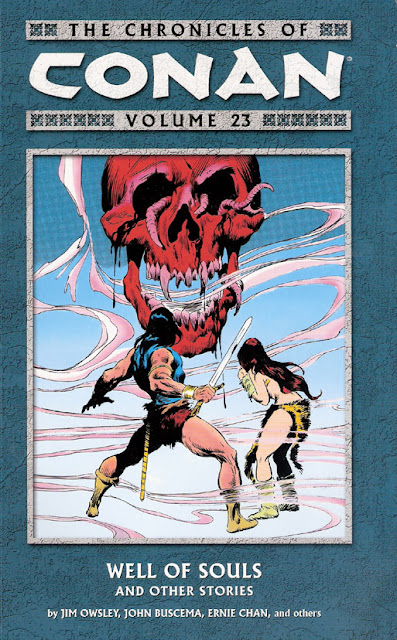
Chronicles of Conan, v. 23: Well of Souls and Other Stories coverWell of Souls isn’t going to convince a reader with no interest in Conan to start reading the series. However, it might lure readers who are interested in the character or concept back to the series by giving them reasons to invest in the title rather than an individual story. The supporting cast is vivid enough to make readers care about them. Delmurio and Tetra have personalities, and readers will most likely have an opinion about them; when they leave Conan’s side, the barbarian picks up a new companion, who will presumably also make readers like or hate him. The extended plot pays off in a not completely unexpected fashion after seven issues (two in the previous volume, Reavers in the Borderland), and a new plotline begins.

It’s a solid foundation for a series. It’s only a baseline, but it saddens me how badly previous volumes miss that mark.

The individual issues are on the whole mildly interesting, elevated by the structure but showing only flashes of excellence. Issue #175, with its war-haunted river town and mysterious boatman, is the most atmospheric and probably the best issue in the collection. Even the less interesting issues have elements that momentarily pique interest; the opening story, which largely revolves around a mob of uninteresting war orphans, has some surprisingly vicious moments and ruminations about the ethics of keeping occupied populations in line that redeems the fleeting romances and undifferentiated crowds.

Despite my faint praise for the individual issues, Owsley has a better handle on Conan’s world than the writers who preceded him. The settings are filled with casual violence and superstitious people who cannot recognize false prophets or true prophecy when it is shouted at them. People die soon after they appear, and they die when it seems like they are going to join the ongoing cast. Owsley gives the protagonist more dimensions than he usually possesses in Marvel comics; the Conan in Well is as brooding, angry, and violent as usual, but the presence of Tetra restrains his lustful side. The narration says he is affected by her resemblance to lost lovers Red Sonja and Bêlit, but it’s clear Conan sees her adoration and reacts to it. Given her youth, he can’t return her affection, and he doesn’t want to reject her outright, so he doesn’t flaunt his sexual preference of other women to her. When her eyes are no longer on the barbarian, Conan goes back to his lecherous ways almost immediately.

Well of Souls has plenty of areas where it could be improved; better choices by editor Larry Hama might have prevented colorist George Roussos from assaulting readers’ eyes with a technicolor Hyborian Age or convinced artist John Buscema to cast aside the teenage Tetra’s furry bikini and loincloth ensemble, even if it is accessorized with green furry boots. (What animal could those boots have come from?) Making the spelling of man-monster Keiv (not “Kiev”) consistent would have helped. Having Owsley restate the overarching plot — on a quest to find treasure, based on a map Conan and Delmurio each have half of — would have been useful as well, since the reader often knows only that the trio are going to some destination. Hama also makes a mistake in issue #176, referring to Conan’s adventure with ex-mercenary Redondo as being in Annual #9 instead of #10. Since Annual #10 is included in Well, that’s not a big problem, but collection editor Chris Warner might have given the story in #176 greater impact by putting Annual #10 before #176. On the other hand, the continuing narrative doesn’t give much room for the annual, so it might not have been feasible.

The ever-reliable John Buscema drew all the issues of the regular series. Buscema was getting near 60 when these issues came out, but his art is as strong and vivid as ever. Owsley’s intense Conan would not work half so well with another artist, as Buscema’s work on the barbarian hero conveys a hardness that has nothing to do with his musculature. Buscema’s penchant for cheesecake — de rigueur for fantasy, I know — gets a little out of hand, as no woman in Well conceals her navel, and Tetra’s outfit is, as described, gratuitous. Frequent Conan inker Ernie Chan penciled the annual and does a good job of it.

The immediate future looks good for the title. The overarcing plot is controlled by a new adversary, not Conan, but the villain looks like he has a plan and is putting it into place. With Owsley remaining on Conan until #213 (another four volumes or so), the stories should retain their barbarousness, and Conan should remain well rounded.

Rating: Conan symbol Conan symbol Conan symbol Half Conan symbol (3.5 of 5)

Labels: , , , , , , , ,

21 June 2013

Avengers vs. X-Men: Avengers Academy, v. 5

Collects: Avengers Academy #29-33 (2012)

Released: March 2013 (Marvel)

Format: 112 pages / color / $24.99 / ISBN: 9780785165811

What is this?: While the Avengers and X-Men squabble over the Phoenix Force, Wolverine places his students with Avengers Academy.

The culprits: Writer Christos Gage and artists Tom Grummett and Timothy Green II


In Second Semester, v. 4 of Avengers Academy, I complained of an overly large cast and a lack of action. Avengers vs. X-Men: Avengers Academy, v. 5, does nothing to remedy that.

Avengers Academy’s contribution to the Avengers vs. X-Men crossover is to pit Avengers Academy vs. Cyclops’s students in Avengers Academy #29-31. Well, “vs.” is putting it strongly; the two sides pose and gesture at each other, but just as in Second Semester, calmer heads prevail before things get out of hand … or even before they threaten to get out of hand. Thank Odin! If there had been a fight, something might have happened to the dozen or so new Academy or X-students I don’t care about.

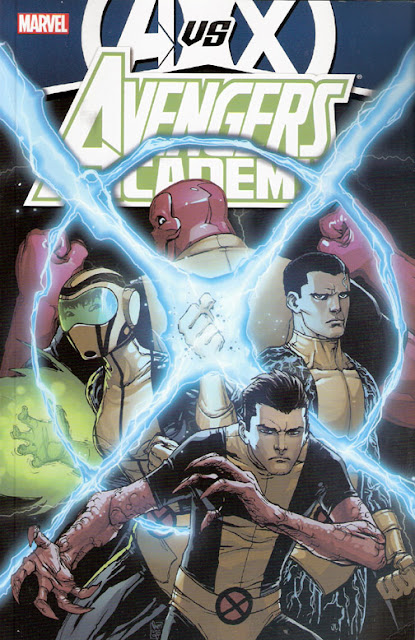
Avengers vs. X-Men: Avengers Academy, v. 5 coverThe main antagonist is Sebastian Shaw, who has lost his memory of his villainous history. He battles his way through the Academy’s teachers and adult guests, taking out Tigra, Madison Jeffries, and a powered-down Hercules. Even that momentary excitement fizzles after a decent start.

Writer Christos Gage and artist Tom Grummett make a few nods to the original Dark Phoenix Saga, which is appropriate since Avengers vs. X-Men was kicked off by the return of the Phoenix Force, and Shaw had a pivotal role in the Dark Phoenix Saga. But after putting Shaw into a sewer, a la Wolverine in Uncanny X-Men #132 — Grummett does a nice homage to the final panel in #132 with a full page-illustration in Academy #29 — there aren’t many other parallels. Shaw does fight his way to the surface, as Wolverine fought his way to where his teammates are held, but it’s a different kind of fight, with Shaw having the guile and subtlety of a rock thrown through a window.

The payoff for the story is supposed to be X-23 making a difficult moral decision and not believing what authority figures tell her, which his fine as far as it goes. But X-23 has not been a part of the cast long enough for her epiphany to be a satisfying payoff for Avengers Academy readers, and her pronouncement is part of the book’s overwhelming and frustrating aura of reasonableness. Gage seems determined to undermine the idea that moral conflicts in comics are thrashed out with fists, segueing conflict from nominal battles to discussions / lectures that avoid violence at all costs.

The final two issues pursue a far more interesting idea than X-Men students throwing angry words at Avengers affiliates. Emma Frost, empowered by a fraction of the Phoenix Force, arrives at the Academy compound to destroy Juston Seyfert’s Sentinel. That’s a plot thread that needed to be explored; when Juston was in his own little corner of the Marvel Universe, his pet Sentinel can function as a faux-Iron Giant, but when they interact with the rest of the MU, which views Sentinels as weapons of genocide, madmen, and governments, the Sentinel seems far less innocent.

Gage tries to frame the Sentinel as a loyal pet, and the effort is partly successful. Juston’s grief at the beating the Sentinel takes is affecting, but Hank Pym’s amazement over the Sentinel overcoming its prime directive — he says it should be impossible — comes across as hollow, considering how often the impossible happens in the Marvel Universe. (Also, if that’s impossible, how did Ultron become what he is? What did Pym make its prime directive?) The Sentinel itself is still the most problematic part of the story; given its still extant anti-mutant programming, the Sentinel at best is a dangerous dog that has been leashed. Sooner or later, that leash won’t be enough, and there will be a tragedy. As clichéd as that sort of story is, the tragedy of the Sentinel attacking mutants might have been a better way to resolve the Sentinel plot, especially given the number of mutants wandering around at the end of Avengers vs. X-Men.

The two stories leave little for the original cast to do. Finesse talks to Quicksilver; one of the X-students’ powers allows Mettle to surf on dry land, making Hazmat, his girlfriend, happy. Whee. As usual, the guest stars get the best lines, and Emma Frost is no exception. Hercules’s dialogue also stands out, making him seem at times both a buffoon and an actual hero.

The price is outrageous: $25 for five issues? In paperback? That’s an insult to the buyer. I could buy the single issues and pay a professional bindery to make them into a hardback book for about the same amount of money. This is probably a cash grab based on the Avengers vs. X-Men name, since the price for Second Semester, the previous volume, was $20 for eight issues, and the next (and final) volume, Final Exams, has six issues and sells for $20.

The artists for this backwater of the crossover don’t interest me much. Grummett does a solid, if unexciting, job. I appreciate his Dark Phoenix reference, but something about his style feels hesitant, as if he doesn’t want to cut loose. Timothy Green II, who draws the two-issue Sentinel story, draws in an exaggerated, manga-influenced style that clashes with the prevailing art style of the series, but I suppose it is appropriate for a giant-robot-vs.-cosmic-powerhouse fight. Not my cup of tea, but it’s fine.

Gage manages some nice jokes with the guest stars, but that’s not enough. Avengers Academy needs more plot, more conflict than Avengers vs. X-Men and Second Semester give. After these last two volumes, it’s hard to argue with Marvel’s decision to cancel the series with Final Exams. Hell, it’s hard to argue Marvel should have given Gage and Co. another arc after Avengers vs. X-Men.

Rating: Avengers symbol  symbol (1.5 of 5)

Labels: , , , , , , , , , , ,

12 April 2013

Hawkeye, v. 1: My Life as a Weapon

Collects: Hawkeye #1-5 and Young Avengers Presents #6 (2008, 2012-3)

Released: March 2013 (Marvel)

Format: 136 pages / color / $16.99 / ISBN: 9780785165620

What is this?: Clint Barton (Hawkeye) and Kate Bishop (Hawkeye) team up to fight crime.

The culprits: Writer Matt Fraction and artists David Aja, Javier Pulido, and Alan Davis


Sometimes you want a break from big, event-driven comics. Something fun, lighthearted, with a lot of action. Hawkeye, v. 1: My Life as a Weapon fits that bill.

In Hawkeye, once and future Hawkeye Clint Barton enlists Kate Bishop, a teenage archer who also goes by Hawkeye, to fight crime. Clint is an amiable, normal guy, except for his facility with arrows: no super-strength, no super-intelligence, no powers, getting into scrapes partially by accident and partially through investigation. Clint’s lack of superpowers and seat-of-the-pants, haphazard superheroic style makes him more human and likeable than many superheroes.

Hawkeye, v. 1: My Life as a Weapon coverWriter Matt Fraction‘s Clint has a great many similarities to the Iron Fist Fraction wrote in the The Immortal Iron Fist. Both are normal humans who have succeeded by extreme dedication to a martial art; both are rich; both are driven by a goofy dedication to morality but not the law; both lead with their chins rather than putting a great deal of thought into planning. Common enough characteristics in comics, I suppose, but somewhat worryingly, the characters have a similar internal voice as well: self-deprecating and humorous, as if to say superheroics aren’t as serious as others make it out to be.

Despite the frequent violence, Fraction maintains a lighthearted tone throughout. Clint’s mockery his own lack of planning and mistakes is a regular feature of his narration. Kate, of course, mocks the older Hawkeye. Rather than provide translation of non-English or garbled dialogue, Fraction fills the speech bubble with Clint’s guesses as to what the language is or what he hears instead of words. Instead of blacking out obscenities or using typographical chicken tracks instead, Fraction substitutes descriptive phrases such as “derogatory patriarchal epithet” and “slang for male genitalia.”

Fraction is not a writer who helps the reader decipher the plot. He’s more concerned with hooking readers with action and intrigue than making the story read smoothly. Present and past are frequently intercut, and Fraction begins the first three issues in media res. (Issues #4 and 5 are told linearly, though, and the result is much more comprehensible.) Fraction does not bother to explain the status quo: why Clint has a boatload of money, why Kate is no longer with the Young Avengers or romantically with former teammate Eli Bradley, whether the injuries Clint suffers at the beginning of #1 are a reference to another story. As to the latter, probably not, but that makes it confusing; why does Fraction bother to inflict such injuries without connecting them or Clint’s recovery to anything else? Footnotes, which might have answered some of these questions, are nonexistent.

Perhaps Fraction will explain these danglers later. If so, they are only a few of the many ideas Fraction teases as being important. Hobo code, an acolyte of Clint’s former teacher, and a mysterious redhead are among the plot points Fraction picks up and puts down again almost as quickly. Admittedly, the redhead is in an entire issue, but she’s enigmatic, around long enough as a character only for a quick hookup — random sex that portrays Clint as dangerous? unpredictable? sexually desirable? And then there’s the weird, squicky sexual tension between Kate and Clint that I hope Fraction drops immediately and never acknowledges again.

David Aja’s art on the first three issues is one of the book’s big draws. Whereas Fraction’s writing sometimes left me scratching my head, Aja’s art is almost always clear. (Sometimes too clear: the book makes a big deal of Avengers not killing, but that’s hard to reconcile with the injuries Kate’s arrows inflict and the havoc Clint’s shots cause.) Aja’s art isn’t the sharp, larger-than-life style that gets a great deal of attention, but it’s great for telling the story and setting the tone. My favorite trick was a series of small headshots of Kate, each with one letter of dialogue beneath it, framing panels of Clint shooting three arrows at once; it shows how quickly Clint can take a difficult — improbable — shot. On a sillier note, I laughed at the drawing of Hawkeye’s face with his traditional headgear (not worn in My Life) Aja uses to conceal Clint’s naked crotch instead of a black dot or blur during a fight scene.

Javier Pulido’s art on #4 and 5 isn’t as evocative or distinctive as Aja’s, but it’s still very good. Pulido’s work is frequently reminiscent of Jack Kirby’s, but it also contains elements Darwyn Cooke’s art as well. Pulido is not as clear as Aja, but he does action scenes well, and his style is well suited for the crime story at the heart of his two issues. Pulido doesn’t make much of the exotic Madripoor setting, but that’s partially because Fraction sets most of the issues indoor.

Young Avengers Presents #6, which is tonally and visually discordant with the rest of the book, is included as the last issue in the collection. The issue is drawn by Alan Davis, and his work looks nothing like Aja’s or Pulido’s: his work is slick, fluid, with characters’ expressions and bodies occasionally exaggerated. Fraction writes the story, but the characters’ roles are completely different: Clint is “dressing like a ninja,” and Kate is trying to determine what she wants her relationship with Eli Bradley to be. The plot doesn’t connect to the rest of the book in any way except to establish the two Hawkeyes know each other. In fact, it raises questions about Kate and Patriot’s relationship and her team affiliation the book does not answer. Perhaps it’s for the best; the final issue in the collection would have been a rotten place to establish the status quo, anyway.

Despite the book’s problems — and there are problems, however much this book has been lavished with praise — it’s inherent likeability makes it worth reading. I’m willing to give Hawkeye a second look, and I’ll be reading Little Hits when it comes out.

Rating: Avengers symbol Avengers symbol Avengers symbol  symbol (3.5 of 5)

Labels: , , , , , , , ,