Reviews of trade paperbacks of comic books (mostly Marvel), along with a few other semi-relevant comments / reviews.

30 September 2016

Conan the Barbarian, v. 32: The Second Coming of Shuma-Gorath and Other Stories

Collects: Conan the Barbarian #250-8 (1991-2)

Released: July 2016 (Dark Horse)

Format: 240 pages / color / $19.99 / ISBN: 9781616558666

What is this?: After losing the princess, Conan is tormented by

The culprits: Writer Roy Thomas and penciler Mike Docherty


In retrospect, it’s obvious Chronicles of Conan, v. 32: The Second Coming of Shuma-Gorath and Other Stories collects stories from a title heading for its end.

Even more than the previous volume, Chronicles of Conan, v. 31: Empire of the Undead and Other Stories, Second Coming uses continuity to give stories more weight and more interest than they would usually have. In fact, Thomas is so invested in using previous Conan stories — usually stories that he himself wrote — that in Conan the Barbarian #254 he completes a Savage Sword of Conan story he wrote in 1979 that never got an ending.

Chronicles of Conan, v. 32: The Second Coming of Shuma-Gorath and Other Stories coverThe continuity Thomas is calling on should be in service of the main story, in which Conan travels back to his home village in Cimmeria to see if it has been destroyed, as he has seen it destroyed in his dreams. Unfortunately, the continuity is of dubious value.

Thomas scatters footnotes throughout the book. Almost every Conan story has some reference to Conan continuity, which, before Thomas took over this time, was rare. But as I said, this is the sign of a title that’s about to wrap things up: As he retraces his path back to Cimmeria, Conan revisits the signposts he encountered when he first journeyed to civilized lands. And that’s a good idea! If the story were more focused, if the overall structure of the Second Coming storyline fit together better, it might work. But it’s hard to see, for instance, how #253 does anything but divert Conan’s journey home momentarily; yes, it reintroduces the wizard Kulan Gath, whom Conan and Elric of Melnibone killed in Conan #15, but surely Thomas could have integrated Gath into the storyline more elegantly, rather than having Conan encounter him while visiting old friends. And why resurrect Kulan Gath at all? He’s not an iconic villain; rather, he’s a magical speedbump in Conan’s early career.

Sometimes these callbacks are necessary; for instance, a brief flashback in #252 to Savage Sword of Conan #2 is used to explain why Conan is no longer a general and secret consort to Yasmela, whom he had been serving since #246. (Both Savage Sword #2 and #248-9 are adaptations of the Robert E. Howard story “Black Colossus,” with SSoC continuing a little farther forward in time.) I’m thankful for the footnotes, even though I’m not sure half these references and flashbacks serve any purpose other than Thomas shouting, “Hey hey hey — these stories are important!” But they aren’t. The purple plague in #255-6 is a distraction easily disposed of, a fillip meant to disguise that the story’s only purpose is to revisit the Lost City of Lanjau from Conan #8. A stopover in Numalia gives Thomas a chance to mention a few characters and places from Conan #7. An old lover (from Conan #48) rescues Conan from the snow and the walking dead in #258; their dead son, who grew to an accelerated adulthood after Conan sired him with an uncanny northern woman, is mentioned, even though he appeared in a non-Thomas story (#145). All these old stories add up to a bunch of distractions bolted onto a plot that needed to be leaner to succeed.

It’s a shame, because the storyline has some entertaining — even chilling — parts. Queen Vammatar of the Hyperboreans, who opposes Conan’s return to Cimmeria, commands the dead and men’s loins; in many ways, she’s the standard sorcerous femme fatale, but Thomas and artist Mike Docherty sell her resurrection power as something truly dangerous and chilling. The creators don’t make the dead as powerful a threat as well as the best zombie tales do, but they can’t, given the Code-approved nature of a serial book. The design of Vammatar’s servitors, the Witchmen of Hyperborea, is almost effective, as their featureless white masks are unnerving, but they seem to be wearing black bodystockings, which makes them look like semi-villainous Mummenschanz.

Cona’s lieutenants, Zula and Red Sonja, exit this story early, having had enough of Conan’s love affairs and desiring more exciting work now that the peace has been won. Thomas evidently agrees with me that Conan works better with a sidekick, though, so he assigns Conan a new one: Hobb of Anuphar, a fat sybarite whose cowardice is supposed to work as comic relief. It doesn’t work, since Hobb’s competence is marginal and his one-note bumbling grows tired quickly. By the end of the story, we don’t know much about Hobb other than he’s Volstagg the Voluminous, except without the charisma or strength.

And we don’t even get the second coming in the title! That doesn’t happen until the next volume, Chronicles of Conan, v. 33: The Mountain Where Crom Dwells and Other Stories. (To be fair, #252-8 are the first seven parts of the Second Coming of Shuma-Gorath storyline.)

Docherty’s art, other than the disappointment of the Witchmen design and the too cartoony skeletal warriors in #255-6, is solid as always. His work looks strongly influenced by John Buscema, although that might be traced to the finishes by long-time Conan inker Ernie Chan. His art is detailed enough to show the rough edges and grime of a time undreamed-of, but it’s never so fussy or confusing that it’s hard to follow. I have gained an appreciation for artists who can draw a clear battle scene, which is a must for Conan; Docherty does a great job with action, and I never have to ask how a character gets from point A to B. If I had to find a flaw with Docherty, other than the occasional design misstep, it would be that his art doesn’t inspire ecstatic praise; he’s solid, not transcendent.

Hoover's cute horrorDale Hoover fills in on #253, and although I’d admire his clean, unfussy work on a number of other titles, it just doesn’t fit with the dirty, blood-stained world of Conan. The depiction of the mutilation of a prince whose life-force was drained, turning his extremities to bone, suffers from being too clean and too neat; the panels have little chance of communicating the horror of seeing someone’s hands and feet reduced to bone. Also, I’m not a fan of the cheesecake design and poses of Imojen, a Kothian rebel leader. Still, his cartoony flashback drawing of the Dweller in the Dark is adorable.

I enjoyed this volume, even if I can see the flaws — the irrelevant fill-in flashback in #251, the Thomas-ian obsession with resurrecting stories and characters that no one finds as interesting as Thomas himself does. But Second Coming does feel like it has a direction and a point, even if that point is to get closer to the end of this series.

Rating: Conan symbol Conan symbol Conan symbol (3 of 5)

Labels: , , , , , , , , , , , , ,

15 July 2016

Chronicles of Conan, v. 31: Empire of the Undead and Other Stories

Collects: Conan the Barbarian #241-9 (1991)

Released: March 2016 (Dark Horse)

Format: 224 pages / color / $19.99 / ISBN: 9781616558659

What is this?: After avoiding a demigod’s son’s revenge plot, Conan and his cohorts join the Khorajan army.

The culprits: Written by Roy Thomas and drawn by Gary Hartle and Mike Docherty


Since the next volume of the Chronicles of Conan — Chronicles of Conan, v. 32: The Second Coming of Shuma-Gorath and Other Stories — is scheduled to come out next week, I thought I’d review the most recent volume as a warm-up.

Is Chronicles of Conan, v. 31: Empire of the Undead and Other Stories better than the preceding volume? Oh, Crom, yes — it would be almost impossible for Roy Thomas, Conan’s first writer, to conceive of anything as dire as The Death of Conan and Other Stories.

Chronicles of Conan, v. 31: Empire of the Undead and Other Stories coverWith that low bar cleared, it’s time to look at whether Empire of the Undead is good. That question is a bit more complicated …

Those who know Thomas by his superhero work probably realize Rascally Roy never met a bit of continuity he didn’t think he could mine for a story. That’s the case with Empire of the Undead, where Thomas follows Michael Higgins’s continuity-ignoring implant with a storyline that brings back old friends and old rivals. Red Sonja returns, but that’s not so unusual: she pops up every now and then. Thomas also reunites the surly Cimmerian with Zula, one of the pirates who sailed with Conan and Bêlit in Conan the Barbarian #84-94 — a deep cut, to be sure.

Zula is a welcome addition — I’ve said before that Conan works better in the long term when he has allies to work with. But the returning villains … I’m not sure. Thomas introduces El-Ron, the son of Zukala, whom Conan fought in #5 and #115 and allied with in #14, and reintroduces the bat-like Afterlings, which appeared in #43, Stygian wizard Shu-Onoru, Zula’s old master who appeared in #85-6, and Stygian prince Katuman, who appeared in Savage Sword of Conan #2 and 3. (Other characters from the past also pop up, but I’m not going to list them all.) Thomas also uses Varnae the Vampire, who has long been established as the most ancient vampire lord in the Marvel Universe, as a villain for the second storyline in Empire.

These villains fall flat, though. The returning characters don’t serve much narrative purpose, as each of them — save for Shu-Onoru, who has a strong connection to Zula — could have been a new character without sacrificing any effect on the plot. Varnae is particularly out of place, as the story he’s in has none of the traditional vampire trappings, and he’s defeated by the clichéd “one thing that can defeat him” — a magic spell that Zula reads, in this case. Also, the Conan editorial staff was lying down on the job; other than Zula, the book contained few footnotes stating which issues these characters came from. Strictly speaking, they aren’t necessary, but it would have been nice to give readers some context.

Despite Thomas’s determination to link everything in his latest run to something he did more than a decade before, the book largely succeeds. The first story, a three-parter called “The Sorcerer and the She-Devil,” is fine, with Red Sonja’s feisty return mostly managing to hide the plot’s unwillingness to let either her or Conan affect it. (Does Thomas have something against Scientology? Naming the villain El-Ron tends suggest he does, but I can’t find anything online about it.) The following two-parter with Varnae the Vampire is notable only for the return of Zula; otherwise, #244 and 245 is a series of fights, usually with the heroes losing, interrupted by monologues.

The book finally gets into gear with #246, when Conan, Sonja, and Zula arrive in besieged Khoraja. Conan begins to ascend the Khorajan military ladder, as he has done in many other cities and states, and helps the Khorajans defeat the desert nomad wizard who threatens the city. Thomas gives the story a little nuance, showing the Khorajans are not completely innocent: their high command is just as stupid as the generals Conan usually serves under, and the city has an oppressed minority that Sonja is ambivalent toward, even when they try to kill her. I also appreciate that Thomas ignores Conan’s final fight with the uncanny leader of the nomads — we all know Conan’s going to win, right? — and instead concentrates on Zula and Sonja’s battle with demonic underlings. I admit laughing out loud when after the battle Sonja and Zula found Conan in post-coital bliss with the Khorajan princess.

Additionally, Thomas gives more depth to Sonja than I anticipated he would. At first, Sonja displays her customary rivalry with Conan, although she lacks the usual camaraderie she usually has with him. (It turns out Sonja was hired to assassinate El-Ron, and Conan kept getting in the way of her plan.) But as the book goes on and she continues to adventure with Conan, her rivalry continues, although Conan is mystified at why she’s so angry about his successes. When Conan quickly becomes a captain in the Khorajan army, Sonja bristles. It’s easy to see why: in Empire, Sonja is every bit the warrior Conan is, but it’s always Conan who gets credit for being the superior warrior. Her resentment cools a bit at the end when Conan, elevated to general, promotes her to captain. Overall, Sonja is more insecure than usual, but I can live with that, given how difficult it must be to live, even for a while, in Conan’s shadow.

Artists Gary Hartle (#241-7) and Mike Docherty (#248-9) are solid artists, and I have no complaints about them. They aren’t superlative stylists like Barry Windsor-Smith or John Buscema, but both know how to draw Conan and his world, telling comprehensible stories. More importantly, in my eyes, they give Sonja more clothing than a chainmail bikini. Hartle’s one-piece swimsuit with lapels and a fur-trimmed cape is only a moderate improvement, but Docherty gets rid of the lapels (and cleavage) as soon as he can, adding leather armor around the neck and shoulders and a loincloth. It’s not practical, but it’s nice to see someone moving her in a more sartorially useful direction.

More amusing than Sonja’s clothing is the contrast between Conan’s interior and cover artists. Hartle and Docherty, as I mentioned, are good, but they never were considered “hot” artists; on the other hand, the covers are contributed by artists who were the most sought-after pencilers of the day. Todd McFarlane, Jim Lee, and Whilce Portacio, a trio that would help found Image Comics the following year, contributed the covers for #241-3, and Art Adams drew #247-9. Those are impressive artists to line up for a title that was aimlessly wasting readers’ time in the previous collection.

No one’s going to pick up Empire if they haven’t been reading Chronicles of Conan for a long time. But if you made it through Death of Conan without your interest in Conan being extinguished, then you might as well pick up Empire, especially since Thomas seems to be adding a little more depth than he has to to the stories.

Rating: Conan symbol Conan symbol Half Conan symbol (2.5 of 5)

Labels: , , , , , , , , , , , , , , , , ,

01 April 2016

Chronicles of Conan, v. 30: The Death of Conan and Other Stories

Collects: Conan the Barbarian #233-40 (1990-1)

Released: December 2015 (Dark Horse)

Format: 200 pages / color / $19.99 / ISBN: 9781616555894

What is this?: The adventures of Teenage Mutant Ninja Conan, his first girlfriend, and his best friend as they are stalked by a sorceress who wants to avert a prophecy.

The culprits: Writer Michael Higgins and pencilers Ron Lim, Gary Hartle, and Rodney Ramos


A collection with a name like Chronicles of Conan, v. 30: The Death of Conan and Other Stories demands an impressive story. The Death of Conan should require a struggle against something huge, perhaps insurmountable — against an unbeatable monster, an undefeatable army, or even a struggle against the greatest enemy of all: fate itself. Ideally, The Death of Conan would feature an older Conan, one who has the maturity to see the stakes of his struggle, perhaps even doubting himself, if only for a moment. In other words, The Death of Conan should be more than just a shock to the reader; it should be a summation or at least an examination of the character.

None of this is true, of course. Chronicles of Conan, v. 30 gets its name from a single story in the collection (issue #238); the other seven issues are the “other stories.” Conan’s brief death is set in motion by a queen who is gone almost as soon as she proclaims Conan as a regicide. Although Conan heroically resists torture before his death, he has no agency beyond gritting his teeth at the lash. Perhaps worst of all, the story does not present an older Conan, whose death might have been presented as an event that will stick.

Chronicles of Conan, v. 30: The Death of Conan and Other Stories coverNo, it’s only teenage Conan. Oh, yeah — these issues are all wasted. In fact, Death shows Conan’s first adventures, an origin story for a character who doesn’t need an origin story. Who’s going to believe a character is going to die in his origin story?

Even when the deceptive “Death” in the title is forgotten, the storyline is problematic. No one ever wanted the stories of Conan’s youth before “The Tower of the Elephant,” a Robert E. Howard short story set when Conan was a young thief. (That story was adapted in Conan the Barbarian #4.) Writer Michael Higgins does incorporate an earlier story Howard alluded to — the raid on Venarium — into Death. In Howard’s version, Conan is a young but fearsome warrior, leading the charge over the fortress’s walls. In Higgins’s version, he’s a young warrior who manages to convince a party of older raiders into waiting until his friend opens the gates from the inside. It’s a small difference, but it weakens Conan; why weaken Conan to build up his friend?

We all know Jorrma, Conan’s first friend, and his first love, Melanie (a Hyborean name if I ever heard one), are going to die. If Higgins is going to waste time with them, he has to go all out: he has to make sure they are as important as they can be, given that Conan never mentions them in the 230 issues leading up to this story. But Higgins doesn’t. His characterization is scant, at best. Melanie could be any bar wench, as she’s blandly accepting of Conan’s demand that she take third place behind his plundering career and Jorrma. Late in the storyline, Higgins hints she might fancy Jorrma instead of Conan, but that hint goes nowhere. Jorrma is used as a tool by Acegra, a witch who has manipulated his and Conan’s families for generations and who killed both men’s parents. Jorrma fears harming his best friend, but he’s jealous of Conan’s relationship with Melanie. He falls in love — love at first sight, a love that requires some psychic manipulation of the young girl — while a captive in Venarium; his love is killed opening the fortress’s gates, and then she is mostly forgotten, as is his mental tampering.

Even Conan doesn’t seem so impressed by Jorrma and Melanie. Conan isn’t broken up by the death of either. By the story’s climax, he’s fed up with Jorrma’s incompetence, which gets them captured more than once, and his betrayals. Perhaps by the end, he realizes he was better off without Jorrma, and top-heavy bar maidens like Melanie are not that uncommon. Or maybe he stoically kept his grief over Melanie to himself, seeking out a succession of bland wenches over the years because they remind him of Melanie.

The one-issue prelude to this storyline, #232, was collected in Chronicles of Conan, v. 29: The Shape in the Shadow. In that story, Conan’s grandfather had a lifelong rivalry with the ancestor of Conan’s future best friend; this eventually deadly rivalry was provoked by Acegra, a Ron Lim-designed sorceress. (I’m a fan of Lim, but if you know his art, you know exactly how this woman looked, and you’ll know it’s a bad fit for Conan.) Acegra drives most of the action in this book, creating pawns to kill Conan and his family. Despite her power, she gets involved in combat only once, and that is to kill Conan’s mother. If she had only killed Conan when he was a baby, then she would have been victorious.

But there was a prophecy. There’s always a prophecy, I suppose; in this case, Acegra and her brother, who is possessed by a demon, have a vision of a 30-year-old Conan standing over their dead bodies. But none of that comes to pass; Conan’s victory comes much earlier and looks nothing like what it did in the vision. Conan doesn’t kill them, either: it’s their catspaw, Jorrma, who slays them.

But that’s just one of the sloppy storytelling problems in Death. Higgins keeps lobbing goons into the story, random soldiers Acegra has implanted with a grudge against Conan and Jorrma. These are supposed to be people Conan and Jorrma have a friendly history with, but readers never see any of them before they begin their grudge matches … I think. It’s hard to tell. Using characters we’ve seen before would make their attacks on Conan more significant. In fact, Higgins could have re-used Dryden, a Cimmerian rival to Conan, or Balthus, a guard who blamed Jorrma for the fall of Venarium. The reappearance of either would have meant something. Instead, all the other non-Conans in the book mean nothing — we have nothing invested in them, and they fail to elicit the slightest emotion for their successes and failures.

The artists are somewhat at fault for my confusion about whether villains have reappeared, although I suppose the number of ways sweaty, disheveled thugs can be drawn is somewhat limited. Lim (#233-5) is a poor match for Conan, with his smooth lines and streamlined designs; the grime and grit of the Hyborean Age can’t stick to his characters. Gary Hartle (#237-40) and Rodney Ramos (#236) are much better matches with the source material, but neither of them are standouts. I can imagine either having a successful run on the title, but being saddled with Higgins’s run is a recipe for forgettability. (Hartle continues with Roy Thomas, who will write Conan until its cancellation, after this arc.)

In #240, the story mercifully ends, with Justin Arthur (Thomas’s pseudonym) wrapping up the story with a climactic battle. Thomas also provides a framing sequence in which King Conan and his wife discuss how much of the story Conan, who was telling the tale to his son, was exaggerating or just lying about. Less obvious ways for a writer to denigrate his predecessor’s work exist, but given how bad Higgins’s run is, I can’t blame Thomas for telling readers to forget about it. I wish I could too.

Rating: Half Conan symbol (0.5 of 5)

Labels: , , , , , , , , , , , ,

06 February 2015

Chronicles of Conan, v. 28: Blood and Ice and Other Stories

Collects: Conan the Barbarian #215-23 (1989)

Released: November 2014 (Dark Horse)

Format: 220 pages / color / $19.99 / ISBN: 9781616553746

What is this?: Conan becomes a implacable, unbeatable killing machine as he works his way toward Turan.

The culprits: Charles Santino (writer) and Val Semeiks (co-plotter / artist), with help from Larry Hama, Don Perlin, Michael Fleisher, and Gary Kwapisz


So far this year, I’ve read the first volume of Batman ‘66, Astro City: Life in the Big City, most of Mark Waid’s Daredevil run, the first book of Waid’s Indestructible Hulk, Umbrella Academy, v. 1: Apocalypse Suite, and Fantastic Four, v. 2: Road Trip. So of course the book that I’m going to write about is Chronicles of Conan, v. 28: Blood and Ice and Other Stories.

Chronicles of Conan, v. 28: Blood and Ice and Other Stories coverWhat interests me about Blood and Ice is writer Charles Santino’s run, which stretches from #215 to 220. Santino took over for James Owsley (today known as Christopher Priest), who improved the title immeasurably by giving Conan a supporting cast; if Conan was a static character in the Marvel Comics — and he was — Owsley’s supporting cast was allow to grow, to act in surprising ways, and to die.

It was a welcome change. Before that, Conan had been stuck in endless retreads of one- and two-issue stories where Conan had battled some uncanny threat, been involved in some way with a comely lass, and then moved on to the next uncanny threat / comely lass. It was boring and short sighted.

With Conan having jettisoned the last of his supporting cast at the end of the Owsley run, Santino and co-plotter / artist Val Semeiks embarked on a series of stories unique in the Conan canon: a series of brutal one-issue fights as Conan makes his way to the eastern nation of Turan. Never in the original Robert E. Howard stories, the movies, or Conan the Barbarian has Conan seemed so much of a ‘90s superhero.

The break beginning of this volume is well chosen, although my guess is that it was a fortunate accident. In #214, which is in the previous volume (Chronicles of Conan, v. 27: Sands upon the Earth and Other Stories), Conan is trapped in a mirage city. It’s a story indistinguishable from dozens of others in the Marvel series; a seemingly inescapable trap, a few monsters to bash, a scantily clad maiden hanging around the periphery of the story.

But in #215, the start of Blood and Ice, the story direction changes. Gone are the pretty girls; magic is violently shoved from the plots. In the first story, Conan is captured by Turanians at a desert outpost. Well, “captured” — the soldiers are able to move him along but not subdue him in an attempt to enslave him to work the giant water wheel beneath the outpost. Conan, unbowed, not only kills Turanian soldiers but destroys the water wheel and breaks the Turanian’s slavery. It seems as if most of the slaves die in the carnage as well, but that’s a small matter.

In “Death Pit” — the simple title is a taste of things to come — Conan can’t be beaten, can’t be stopped. He is a force of nature, destroying the works of true villains. The Turanian soldiers — agents of an encroaching imperialistic nation turned slavers to make the machinery of daily life turn fluidly — are more effective as villains than any number of black wizards or monsters; they represent a commonplace sort of injustice, and Conan will not let himself submit to that injustice. In the end, he smashes not only the soldiers but everything they have brought to the outpost.

The following issues show Conan against armies of men who not only cannot defeat him but also cannot bloody him. He destroys a large army of cultists in #216, invading their temple and bulling through their attempts to subdue him; the only beautiful woman is sacrificed by the cult early in the story, and Conan can’t save her. In #217, he’s back to battling a magical guardian in a deserted city, but he’s trapped on a small island in #218 and has to kill a homicidal band of tribesmen to gain their boat and escape. He fights through a Turanian army in #219, escaping by stealing superior horseflesh. Santino finishes his run by showing Conan pursuing a band of gold thieves; they stole what he had his eye on, and so he relentlessly follows them through the snow until they are all finished.

Santino’s Conan shows no cunning and very little guile, which is far from the character that Robert E. Howard created. Santino’s Conan is the greatest swordsman ever, it seems, indomitable and undefeatable — the very epitome of a superhero, except for his massive body count. Santino’s issues are bloody little fables about an unstoppable force, with Conan destroying all who tries to slow him. I’m not sure if these stories are good, but they are fascinating; why had no one done this with Conan before? Was it because this level of violence wasn’t permitted before the late ‘80s? Or was it because even the most mediocre of writers who had written Conan the Barbarian before this understood that that was not truly who Conan was?

Although I’m attributing most of this interpretation of Conan to Santino, Semeiks is listed as co-plotter as well as artist. Semeiks had graduated to co-plotter with Owsley, whose issues were greatly different in tone; unless Semeiks was able to exert considerably more influence on Santino than he was on Owsley, it’s unlikely the new direction was his. Semeiks continued to supply very good art during this time, fluid and action-filled, but it lacks the visceral brutality and blood to back up this version of Conan. It’s probable that editorial prevented Semeiks from drawing that level of brutality, though.

After Santino and Semeiks depart the title, the rest of the volume becomes much more like Conans past. Larry Hama’s #221 is an eerie little story that would not have been out of place in a ‘50s horror comic. Hama writes the story in verse, and his versification detracts from the story’s impact; a story with minimal dialogue / narration would’ve made the story truly memorable instead of an intriguing curio. Don Perlin shows Conan pursued by and confronting his own revenge squad; unsurprisingly, with all the men Conan has hacked to pieces over the years, Conan remembers none of them. The poignant revelation of their pointless attempt at revenge against a man who never hated them and didn’t even recall maiming them is balanced by Conan’s incompetence against a bunch of crippled buffoons. The volume ends with a story by Michael Fleisher, whose Conan is as different from Santino’s as possible: Fleisher’s Conan displays almost preternatural foresight while helping a comely lass recover a religious icon.

I don’t think I can recommend Blood and Ice for Conan fans. Santino’s interpretation of the character is too far off model to be convincing. On the other hand, his protagonist is a force of nature, compelling and readable because of his direct, brutal nature. I think even for a fan of sword-and-sorcery fiction, it is too simplistic, and six issues of it is altogether too much. However, if you can read #215 by itself, give it a try; I found myself reacting more emotionally to Conan’s struggles in that story than I had in total to the 100 issues before it.

Rating: Conan symbol Conan symbol (2 of 5)

Labels: , , , , , , , , ,

10 August 2013

Chronicles of Conan, v. 23: Well of Souls and Other Stories

Collects: Conan the Barbarian #174-81 and Conan the Barbarian Annual #10 (1985-6)

Released: March 2013 (Dark Horse)

Format: 232 pages / color / $18.99 / ISBN: 9781616550523

What is this?: Conan, along with a Zingaran captain and a teenage girl, continues looking for a fabulous treasure, but he finds more than he’s looking for.

The culprits: Writer Jim Owsley and artists John Buscema and Ernie Chan


In previous reviews of the Chronicles of Conan series, I have complained about a great many things. The most important, to me, was the series’ lack of supporting characters and ongoing narrative. Every issue was the same: Conan steps into a new situation, starts stabbing people, and walks out the end, often as the only survivor. That narrative doesn’t provide much tension: He has to survive, since he’s the main character.

With Chronicles of Conan, v. 23: Well of Souls and Other Stories, writer Jim Owsley (the future Christopher Priest) has changed that. Conan has a partner, Zingaran captain Delmurio, and a sidekick, Tetra, a lovestruck teenage girl who Conan has taught to be a fearsome warrior. They are on a quest to find treasure — simple enough, but one rarely used for long-form Conan stories.

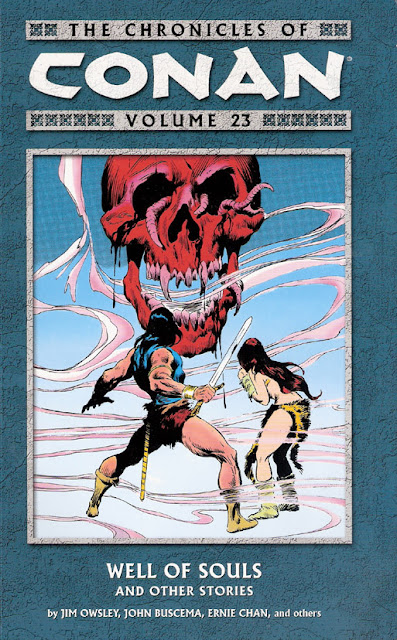
Chronicles of Conan, v. 23: Well of Souls and Other Stories coverWell of Souls isn’t going to convince a reader with no interest in Conan to start reading the series. However, it might lure readers who are interested in the character or concept back to the series by giving them reasons to invest in the title rather than an individual story. The supporting cast is vivid enough to make readers care about them. Delmurio and Tetra have personalities, and readers will most likely have an opinion about them; when they leave Conan’s side, the barbarian picks up a new companion, who will presumably also make readers like or hate him. The extended plot pays off in a not completely unexpected fashion after seven issues (two in the previous volume, Reavers in the Borderland), and a new plotline begins.

It’s a solid foundation for a series. It’s only a baseline, but it saddens me how badly previous volumes miss that mark.

The individual issues are on the whole mildly interesting, elevated by the structure but showing only flashes of excellence. Issue #175, with its war-haunted river town and mysterious boatman, is the most atmospheric and probably the best issue in the collection. Even the less interesting issues have elements that momentarily pique interest; the opening story, which largely revolves around a mob of uninteresting war orphans, has some surprisingly vicious moments and ruminations about the ethics of keeping occupied populations in line that redeems the fleeting romances and undifferentiated crowds.

Despite my faint praise for the individual issues, Owsley has a better handle on Conan’s world than the writers who preceded him. The settings are filled with casual violence and superstitious people who cannot recognize false prophets or true prophecy when it is shouted at them. People die soon after they appear, and they die when it seems like they are going to join the ongoing cast. Owsley gives the protagonist more dimensions than he usually possesses in Marvel comics; the Conan in Well is as brooding, angry, and violent as usual, but the presence of Tetra restrains his lustful side. The narration says he is affected by her resemblance to lost lovers Red Sonja and Bêlit, but it’s clear Conan sees her adoration and reacts to it. Given her youth, he can’t return her affection, and he doesn’t want to reject her outright, so he doesn’t flaunt his sexual preference of other women to her. When her eyes are no longer on the barbarian, Conan goes back to his lecherous ways almost immediately.

Well of Souls has plenty of areas where it could be improved; better choices by editor Larry Hama might have prevented colorist George Roussos from assaulting readers’ eyes with a technicolor Hyborian Age or convinced artist John Buscema to cast aside the teenage Tetra’s furry bikini and loincloth ensemble, even if it is accessorized with green furry boots. (What animal could those boots have come from?) Making the spelling of man-monster Keiv (not “Kiev”) consistent would have helped. Having Owsley restate the overarching plot — on a quest to find treasure, based on a map Conan and Delmurio each have half of — would have been useful as well, since the reader often knows only that the trio are going to some destination. Hama also makes a mistake in issue #176, referring to Conan’s adventure with ex-mercenary Redondo as being in Annual #9 instead of #10. Since Annual #10 is included in Well, that’s not a big problem, but collection editor Chris Warner might have given the story in #176 greater impact by putting Annual #10 before #176. On the other hand, the continuing narrative doesn’t give much room for the annual, so it might not have been feasible.

The ever-reliable John Buscema drew all the issues of the regular series. Buscema was getting near 60 when these issues came out, but his art is as strong and vivid as ever. Owsley’s intense Conan would not work half so well with another artist, as Buscema’s work on the barbarian hero conveys a hardness that has nothing to do with his musculature. Buscema’s penchant for cheesecake — de rigueur for fantasy, I know — gets a little out of hand, as no woman in Well conceals her navel, and Tetra’s outfit is, as described, gratuitous. Frequent Conan inker Ernie Chan penciled the annual and does a good job of it.

The immediate future looks good for the title. The overarcing plot is controlled by a new adversary, not Conan, but the villain looks like he has a plan and is putting it into place. With Owsley remaining on Conan until #213 (another four volumes or so), the stories should retain their barbarousness, and Conan should remain well rounded.

Rating: Conan symbol Conan symbol Conan symbol Half Conan symbol (3.5 of 5)

Labels: , , , , , , , ,

18 January 2013

Chronicles of Conan, v. 22: Reavers in the Borderland and Other Stories

Collects: Conan the Barbarian Annual #8-9 and Conan the Barbarian #168-73 (1983-4, 1985)

Released: June 2012 (Dark Horse)

Format: 224 pages / color / $18.99 / ISBN: 9781595828125

What is this?: Conan joylessly wenches and kills his way through more of the Hyborian Age.

The culprits: Writers Michael Fleisher and Jim Owsley and artists John Buscema, Ernie Chan, and Val Mayerik


Writer Michael Fleisher’s work in Chronicles of Conan, v. 21: Blood of the Titan and Other Stories left me optimistic the quality of the Chronicles of Conan would improve from its consistently forgettable levels. And then The Chronicles of Conan, v. 22: Reavers in the Borderland and Other Stories jammed a broadsword through that optimism.

I wasn’t expecting a return to Roy Thomas levels of quality but something memorable about the stories in Reavers in the Borderland — about any story in Reavers, actually. Introducing Fafnir, a sidekick / partner for the title barbarian, distinguished Blood of the Titan from other books in the series. The rivalry and friendship of the two added a new dimension to Conan’s character, and for once, there was a character in Conan (other than Conan) I gave a damn about.

 cover But Fafnir is dropped from the stories in Reavers, and the series returns to random hack-and-slash action, full of gaudily colored thugs, wizards, and bravos trying to cut Conan down. Fleisher, who wrapped up his two-year run with #171, writes largely forgettable pieces, studded with violence and lady flesh. Fleisher’s stories show little wit and feature no memorable characters. The images parade in front of the eyes and then vanish, leaving as much of an impression upon Conan as they do the reader — that is, none.

In Reavers, Conan saves an old ally from a carnival (?!) sideshow. Conan protects a wench from some of his old enemies, only to find she is more than she seems. A wizard needs help with a demon and a cursed sword; that takes two issues to resolve. Conan appears to die; the reader yawns, not particularly caring how he survives. (Poison coma, if you’re interested. You shouldn’t be, though.)

I almost called Fleisher’s stories continuity-free, but that’s not true; he reuses characters from his run in two of his stories. In #168, Conan chances across Alhambra, the winged woman from #153-4 (The Chronicles of Conan, v. 20: Night of the Wolf and Other Stories), and saves her from the sideshow and her old enemies, the Batmen of Ur-Xanarrh. (He almost burns her and everyone in the carnival to death first, though.) In #171, he fails to protect a girl from the Brotherhood of the Falcon, which he fought in #162 (Blood of the Titan). But Alhambra is just a pretty face (and pair of wings) who doesn’t stick around, and despite “killing” Conan, the Brotherhood of the Falcon is just another group of faceless goons, with little to distinguish them from a random wizard’s henchmen or a corrupt duke’s soldiers. Fafnir, the saving grace of the last volume, does come back briefly in #170, although it’s only to say goodbye.

What Conan needs is a supporting cast, people who stay with him. They don’t have to stay forever; three or four issues would be fine. But Conan needs a contrast in the story, someone to express himself to (even if it’s by not saying anything), or else the book becomes the story of a guy with a sword killing random stuff, with as much character as a video game avatar. Not becomes, I guess — became, and that happened a long time ago.

Jim Owsley (known today as Christopher Priest) starts with #172, and things change for the better. The remaining two stories are to parts of a larger storyline set in the Pictish wilderness. Conan gains a sidekick, a pretty girl — giving artist John Buscema just what he needs: even more opportunities to draw pretty girls — and still has a hapless victim to protect. Owsley writes a more brutish Conan than Fleisher, who has Conan give his horse to a woman who just tried to steal his sword. Owsley’s Conan is plainspeaking and rude, saying hurtful things to people who might not deserve it. It’s a refreshing change; Conan should have some teeth. Issues #182-3 augur well for the future, and many people really like Owsley’s work on Conan.

But I’ve been burned before. The potentially explosive cliffhangers in Blood resolve as damp squibs in Reavers. I thought I had a handle on how the story in #167 would be resolved. I was wrong; I didn’t expect Fleisher to make the bold choice of ignoring the dangling plot altogether. The cliffhanger in Annual #7 seems similarly forgotten, although it was resolved eventually. Not in Conan the Barbarian or a Conan Annual or even Savage Sword of Conan, but in the Conan of the Isles graphic novel, which came out six years after Annual #7. I’m not going to change my rating of Blood, but the lack of payoff in Reavers does devalue the story in Blood.

There are many roles I rarely discuss in my reviews: colorists, editors, letterers … Reavers made me consider the reprint editor, which in this case is Chris Warner. Unfortunately, my attention is not to his benefit. Warner leads off the book with two Conan the Barbarian Annuals (#8 and 9). They were published before the Conan the Barbarian issues in this collection, but since I was looking forward to the continuation of Fafnir’s story, the beginning of this book seemed a poor place to put the annuals. (The wait also made the weak payoff even more disappointing.) Between Fleisher’s and Owsley’s runs would have been a better place, and it’s not like anyone was paying attention to Conan’s chronology at this point.

As for art: Buscema’s in fine form. His work looks better with inks from Bob Camp (#169-70, 172-3) than from Armando Gil (#171) or Buscema himself (#168), though. The final two issues are especially superb and sharp, even if I wish Bucema would get rid of Conan’s blue-sleeveless-tee-and-fur-underwear combo. Ernie Chan draws an action-packed Annual #9, although he can’t quite measure up to Buscema. Val Mayerik supplies the art for Annual #8, and I was too distracted by his tentative inking to say anything about his pencils. (This book is a warning against self-inking, really.)

Maybe my optimism isn’t dead; maybe it will survive the bloody attack that is Reavers in the Borderland. But even if it can survive this crummy book, you should skip Reavers. Reavers has little to recommend it, other than Buscema’s art, and Buscema’s work is in so many better Chronicles. Oh, there might be something to the Owsley run, and if there is, it’s going to annoying to miss the first two issues. Still: do not be tempted to buy this waste of time. It’s not worth it.

Rating: Half Conan symbol (0.5 of 5)

Labels: , , , , , , , , , , ,

15 June 2012

Chronicles of Conan, v. 21: Blood of the Titan and Other Stories

Collects: Conan the Barbarian #160-7, Conan the Barbarian Annual #7 (1982, 1984-5)

Released: August 2011 (Dark Horse)

Format: 200 pages / color / $18.99 / ISBN: 9781595827043

What is this?: More Conan, although this time he starts adventuring with an old comrade long thought dead.

The culprits: Writers Michael Fleisher, Roy Thomas, and Larry Yakata and artists John Buscema


Chronicles of Conan, v. 21: Blood of the Titan and Other Stories coverI’m heading out on vacation, so I’m a little short on time this week. That’s fortunate, because there’s no reason to give a full-length review of Chronicles of Conan, v. 21: Blood of the Titan and Other Stories; most of what I said about v. 20: Night of the Wolf and Other Stories, holds true again. That being said:

— John Buscema is still awesome, even if he still dresses Conan in a blue sleeveless T-shirt and a fur bikini.

— Giving Conan a sidekick — or partner — is a great idea by writer Michael Fleisher. Fafnir, left for dead in Conan the Barbarian #20, reappears in #161 without his left arm. His impetuousness frequently gives the stories an impetus they wouldn’t otherwise have, and he has a character arc — an obvious one, but at least it’s an arc, and it helps get rid of the aimless feeling Conan has had for quite a while.

— A character named “Gurneg” appears in three issues: Conan #160, 161, and 163. It’s a different character each time, and Gurneg always dies. What does Fleisher have against Gurneg? And why, after killing him three times, does he stop killing him?

— A fill-in issue (#164) is dropped into the middle of the Fafnir arc without explanation, which goes about as well as would be expected. Larry Yakata writes a surprisingly hard-hearted, battle-weary Conan that is more in line with creator Robert E. Howard’s barbarian than Marvel writer Roy Thomas’s Code-approved interpretation. Yakata’s Conan is just as stupid as Thomas’s, though.

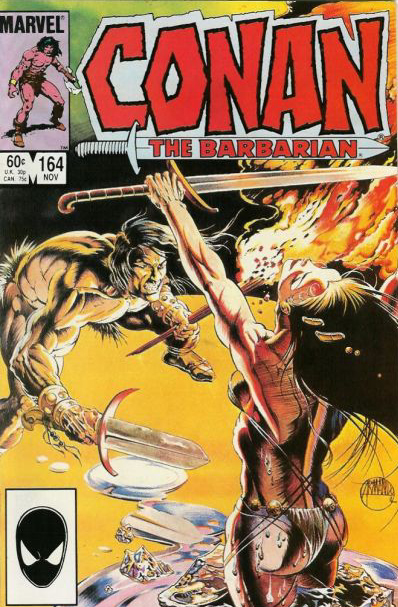
Conan the Barbarian #164 cover— The most interesting part of the fill-in issue is trying to figure out the engineering of the woman on the cover’s top. It’s an exotic design I’ve never seen in the real world, and I’m at a loss for how it could work. At first, I was confused about where the two straps on each side went after crossing her bottom, but I see one strap on each side goes down a leg and presumably is tied around her foot or calf. But then I realized there should be something pulling her top up — looping behind her neck, perhaps? — but there’s no evidence of that. How does it work?

— Ending the book on a cliffhanger — two, actually — is an intriguing idea. It gives readers a reason to return for The Chronicles of Conan, v. 22: Reavers in the Borderland and Other Stories, and it helps distinguish v. 21 from all the other Chronicles of Conan volumes. I think I will know what will happen between Conan, Fafnir, and Noirelle in Conan #168, but I’m not sure.

— Well, I think there are two cliffhangers; Conan the Barbarian Annual #7 ends abruptly, without resolving the plot. There’s no indication of where Thomas’s adaption of L. Sprague de Camp and Lin Carter’s novel Conan of the Isles will be continued. Based on Annual #7, the story probably shouldn’t be continued; the story has 33 pages, but it has only one moment of excitement and is notable only for Buscema’s best artwork in the book.

Rating: Conan symbol Conan symbol Half Conan symbol (2.5 of 5)

Labels: , , , , , , , , , ,

13 February 2012

Chronicles of Conan, v. 20: Night of the Wolf and Other Stories

Collects: Conan the Barbarian #151-9 (1983-4)

Released: December 2010 (Dark Horse)

Format: 200 pages / color / $18.99 / ISBN: 9781595825841

What is this?: Conan stabs his way through another nine issues of his eponymous series.

The culprits: Writer / artist John Buscema and writer Michael Fleischer, with fill-in art from Gary Kwapisz


There’s no doubt the comic book direct market is in trouble. Sales have been declining for years, and unlike at the direct market’s dawn, few titles are guaranteed a continued existence. This is discouraging for those of us who would enjoy long runs for new characters and titles or hope titles that have always been at the fringe of economic viability (Power Man & Iron Fist, Defenders, Alpha Flight, etc.) will get a new ongoing series. The only good news is that almost every current title should have a purpose or a hook.

You don’t see too many zombie titles any more. If you’ve read comics in the late 20th century, you’ve probably come across a zombie title or three. They’re the ones that lurched along, all semblance of life drained away, still repetitively doing all those things it did when it was new and vital. There’s no creative reason to publish these comics: no overarching plots, no exciting young creators looking to work with the character, no groundbreaking creativity. There’s just a semi-loyal audience hanging around, large enough to make money off of. For a Marvel comic, there’s something humorous about this: Marvel zombies helping zombie comics titles survive. A zombie support network, if you will.

Chronicles of Conan, v. 20: Night of the Wolf and Other Stories coverConan the Barbarian was a prime example of a zombie title. After original writer Roy Thomas left, there was a drop-off in the writing quality; few of his successors had a handle on Conan and his world like he did. Truth to tell, even Thomas was having trouble by the end of his long run. The title floundered. So by issue #151 — where Chronicles of Conan v. 20: Night of the Wolf and Other Stories begins — what was the purpose of this title?
The easy answer is that Conan stuck around to give artist John Buscema, often inked by his frequent Conan collaborator Ernie Chan, a place to play. Conan is the title the elder Buscema brother was most associated with, and if he wanted to do the title, why not let him? The art still looks great; there’s no doubt about that. Conan and his enemies are dynamic, active enough to still occasionally surprise the long-term reader with their vividness. Conan himself hasn’t devolved into a copy or parody artistically, although I have my doubts about his blue-sleeveless-tee-tucked-into-furry-bikini ensemble. Still, the monsters are monstrous, and the girls are as gorgeous as ever. And Buscema even started plotting the stories. Giving Buscema a forum for his work and keeping him happy seems a worthy goal, right?

But it’s hard to shake the idea that even the art has lost its freshness. I’ve seen the Conan / pretty girl / evil-wizard / monster set piece before, and if Buscema moves the elements of this stock tale around artfully, he can’t disguise that they are the same elements. I find myself wishing Marvel would have given Buscema a new challenge, something for him to flex his character design and artistic muscles on.

On the other hand, Conan must have sold. So the zombie stays in the publishing schedule.

The writing is a larger problem. Certainly there’s nothing new there. The stories aren’t the worst in the Chronicles of Conan series, but Buscema and Michael Fleischer (writer #151-4, dialogue #155-9) aren’t breaking new ground. There are no overarching plots, no development of Conan’s character (although 21st century readers should know that’s not a priority), and few characters — good or evil — are worth seeing again. Conan’s violent edge has dulled into a paternalistic affability; he’s a nice guy by this collection. A nice guy who guts a few people every issue, but he’s not out to destroy, and he’s not always on the make.

The same elements are used again and again — abducted maiden, lost city under attack (that one’s used twice), evil woman trying to control Conan (again, twice), the perilous inn. Issue #155, in which Conan rescues a grateful toady from a semi-competent wizard, is the best of the lot, and although there are a few attempts at twists (the wolf in #158, the wizard’s identity in #157), the execution produces limp results. (The twist in #158 is spoiled on cover, for instance.) This is partially down to Buscema, who is presumably learning the ropes as a writer; in #156, for instance, the final third of the story is a flashback in which Conan doesn’t appear.

I have to admit I didn’t initially catch that the title of #154 — “The Man-Bats of Ur-Zanarrh!” — was a play on a 1958 Batman story, “Batman — The Superman of Planet-X,” in which Batman encounters the Batman of Zur-En-Arrh, an alien planet. (Not many other people would have caught it had Grant Morrison not resurrected the idea for his recent Batman run.) Clever — but not clever enough to save the story or the book. In any event, when a war between winged humans and bat men on a floating city — a war in which Conan rides a giant dragonfly — seems a little ho-hum, it’s probably time to strike the curtain and call it a day.

There are reasons for zombie titles to exist — or there were, at least. They served as a safe place to launch new creators, such as Frank Miller on Daredevil, and new ideas. They provided a feeling of a shared universe, which was more important then than it is today. These zombie titles also give readers a nice feeling of continuity: there’s Conan on the newsstand; it’s been there for a decade, and it will still be there in another decade.

That last is a luxury the direct market will no longer allow, though, and the other two aren’t relevant to Night of the Wolf. The only reason for Conan to continue throughout the ‘80s was economic. But that’s not really a reason for anyone but Conan diehards to read Night of the Wolf in 2012.

Rating: Conan symbol Conan symbol (2 of 5)

Labels: , , , , , , , ,

30 July 2010

Chronicles of Conan, v. 17: The Creation Quest and Other Stories

Collects: Conan the Barbarian #127-34, Conan Annual #6 (1981-2)

Released: April 2009 (Dark Horse)

Format: 240 pages / color / $17.95 / ISBN: 9781595821775

What is this?: Conan wanders through a world filled with magic, evil men, and scantily clad women.

The culprits: Writers J.M. DeMatteis, Bruce Jones, and Roy Thomas and penciler Gil Kane

The Chronicles of Conan, v. 17: The Creation Quest and Other Stories is significant in a negative way: it’s the first volume of the Chronicles of Conan series without an issue of Conan the Barbarian written by Roy Thomas or dawn by either Barry Windsor-Smith or John Buscema.

Instead, we get J.M. DeMatteis wrapping up his run, which started in v. 15 , Bruce Jones starting his run, which lasts until v. 19, and art by Gil Kane.

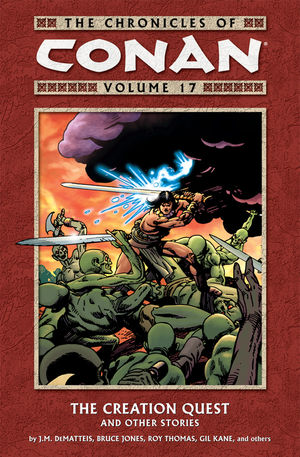
Chronicles of Conan, v. 17: The Creation Quest and Other Stories coverThis lineup does not exactly inspire confidence. DeMatteis’s introduction, in which he says, “I finally realized … the kinds of stories I wanted to tell were best suited to other venues,” doesn’t help matters either, nor does his admission that he was unable to deliver stories that pleased Buscema — they didn’t meet Buscema’s ideal of what Conan stories should have in them. Now, Buscema is just one man, and he didn't own the character, but I think he does have a pretty good handle on what makes Conan tick.
Although he doesn’t contribute to this issue, Buscema’s indictment of DeMatteis’s Conan writing seem to be borne out here. The first issue, #127, feels like a half-baked reversal of Robert E. Howard’s Conan story “The Frost Giant’s Daughter” (adapted in Conan the Barbarian #16); a magic spell animates snow and ice into a magical totem for a village, but the spell has human form, forgets it’s a spell, and escapes to find love with Conan. And it has the dumb name of Xean. I admit, the reversal is nice — the cold woman of snow flees from her protectors and toward Conan — but the idea of the sentient, amnesiac spell is never developed, buried beneath action sequences: Conan fighting a polar bear! Conan fighting Vanirmen (as he did in “Frost Giant’s Daughter”)! Conan fighting Vanirmen again! And then it ends, with a priest telling Conan why the story ends, not that either he or we could have figured it out.

DeMatteis does try a more traditional Conan story in #128-130, a quest story in which Conan must pay an old friend’s ransom with treasures stolen from around the world. It’s a bit lackluster, however; the old friend’s wife teleports Conan into and out of danger, removing a good deal of tension, and the resolution of the story is a superhero cliché transported into Hyboria for the amusement of the locals. The end revelation that the friend, his wife, and their kid are essentially gods doesn’t help either, although it does give Conan a chance to repudiate his friend’s power creep: “I find … I have unleashed yet another god upon a world that has seen too many gods already. … I will long remember what you were — and try to forget what it is you’ve become!” It seems a rare true and original character note for Conan in DeMatteis’s work in this volume that he would distrust a friend, even a childhood one, once he learns the friend is more than human — because he is above the simple pleasures of mankind.

Jones’s work, on the other hand, is in keeping with the spirit of Conan; Buscema would later work with Jones on Conan. Issue #131 is a smart adventure story with a cursed ring, and even though the ending is contrived, it does signal a return back to direct stories with a sharper edge. The next issue’s setup isn’t exactly in keeping with Conan’s usual endeavors — he competes in deadly Olympic-style events to win a valuable sword — but even though Conan doesn’t really think much during the story, it does give him a chance to show his sense of fair play and his appetite for drink. The final two Jones issues are CSI: Hyboria, in which Conan solves the mystery of who cursed the princess, the gypsy’s true identity, and how to save an innocent woman from a death trap. In the latter, Conan’s helped by a bit of deus ex serpentia, but it is Hyboria: gods do occasionally pop out of the woodwork to help. Although you shouldn’t be able to have lunch with them.

When I said Roy Thomas doesn’t write any issues of Conan the Barbarian for this volume, that’s only technically true: Thomas does contribute Conan Annual #6. It’s Thomas nearing the end of his Conan stories, with a padded story that shows it was probably for the best he stopped writing Conan for most of the ‘80s. The story has a normal-length, single-issue kernel at its center: a man thinks he’s a conqueror reincarnated, and megalomania ensues. Thomas adds in giant spiders (who disappear early), a mistress and a wife (not as exciting as they sound), and Technicolor demons, but they all fall flat. With an artist like Buscema or Windsor-Smith going nuts on the art, perhaps it could have been something; instead, the art is drawn and inked by Gil Kane.

Kane was a very good artist who did a lot of superhero work for Marvel and DC; he even did a few fill-ins on Conan the Barbarian for Buscema and Windsor-Smith. Unfortunately, Kane is not Buscema or Windsor-Smith. That’s not a crime on most titles, especially on superhero titles that change artists regularly. But this is Conan; the title had, for more than a decade, been drawn with attention to detail and dynamic characters. Kane falls short on both of these counts. He inks himself on the DeMatteis issues and the annuals and comes across as an unfinished imitation of Windsor-Smith; when inked by others, there’s a marked improvement, although there’s still something lacking. Issue #134 was his last Conan for a while, and I think that was for the best. Like DeMatteis, his best work — which is pretty good — is elsewhere.

I have to give Dark Horse a great deal of credit: they’ve made a reprint series run for twenty volumes (Chronicles of Conan, v. 20: Night of the Wolf and Other Stories, which amusingly features Conan riding a giant dragonfly on the cover, is due out October 13). They don’t skip bad issues; they reprint all the issues they have the rights to without prejudice. The completists in me loves that, but in a practical sense, that means there are the occasional volumes like The Creation Quest. Buscema is back for v. 18 (Isle of the Dead and Other Stories), so anyone reading this volume can write it off as lackluster and buy the next one with optimism.

But for anyone but completists or Bruce Jones fans: skip this volume.

Rating: Conan symbol Half Conan symbol (1.5 of 5)

Labels: , , , , , , , , , ,

22 July 2008

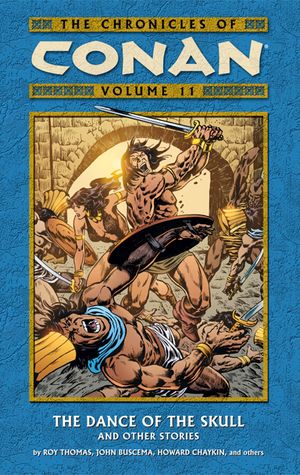
Chronicles of Conan, v. 11: The Dance of the Skull and Other Stories

Collects: Conan the Barbarian #82-90 (1978)

Released: February 2007 (Dark Horse)

Format: 168 pages / color / $16.95 / ISBN: 9781593076368

Dark Horse’s reprints of Marvel’s Conan the Barbarian keeps marching on with v. 11, The The Dance of the Skull and Other Stories.

Like the previous 10 volumes, v. 11 is written by Roy Thomas. The art is by John Buscema (five issues) and Howard Chaykin (three issues), but the strong finishes by Ernie Chan makes guest artist’s Chaykin’s work strongly resembles Buscema’s. Both the writing and art have a certain sameness compared with the previous volumes of Dark Horse’s Conan, and like many reprints of old comic material, the divisions between volumes are somewhat arbitrary. This is a bit of a problem since it prevents the book from having an identity. Why buy this volume over others? I’m not sure I can say.

Chronicles of Conan, v. 11: The Dance of the Skull and Other Stories cover Worse, the story in v. 11 begins in the middle of a storyline — and the storyline is a seemingly interminable pause in the quest of Belit, pirate queen and Conan’s lover, to discover the fate of her father. Conan is sent on several side quests, allowing Thomas to adapt several non-Conan works by Robert E. Howard and giving Conan an opportunity to pick up a sidekick. Well, Zula is more a partner than sidekick, but it’s still Conan’s book.

But it’s good to see another recurring character introduced. This is both because Belit’s subplot is quickly disposed of once Conan catches up to her and because Conan has precious few recurring characters. Zula is not a great character — he’s the last of a tribe of Blacks with a striking Mohawk — but he’s another voice, someone to contradict Conan without being evil, stupid, or petulant. Conan continually fighting mystic threats and winning through luck or bullheadedness needs some breaks.

But the plot’s the difficulty — meandering and unfocussed despite a specific goal, and no amount of princesses in slavery, Zula, or Thoth-Amon will fix that. It’s all very forgettable.

(Oh, and I still miss the original Marvel covers.)

Rating: Conan symbol Conan symbol (2 of 5)

Labels: , , , , , , , ,

11 April 2006

Chronicles of Conan, v. 10: When Giants Walk the Earth and Other Stories

Collects: Conan the Barbarian #72-7 and 79-81 (1977)

Released: March 2006 (Dark Horse)

The Chronicles of Conan are one of the unexpected pleasures of life. Usually, when comic books center around licensed properties, it’s impossible to get them reprinted years later. For instance, the latest Essential Spider-Man had to skip Giant-Sized Spider-Man #3 because it guest starred Doc Savage, who is owned by Conde Nast. The Essential Marvel Two-in-One omitted Marvel Two-in-One #21 for the same reason.

Marvel no longer has the license to publish Conan from Conan Properties, but Dark Horse does. So in addition to publishing a new Conan series, Dark Horse publishes reprints of the classic Conan stories from Marvel. They’ve given readers ten volumes so far, which is wonderful. As a bonus, each volume has writer Roy Thomas’s memories of the issues, revealing behind-the-scenes information and the source of names and plots.

There are slight snags, however. Dark Horse doesn’t have the rights to Red Sonja, a character created by Conan-creator Robert E. Howard in a Crusader story and shoehorned into Conan’s world by Thomas. He was like that; Thomas loved to take Howard’s non-Conan stories, throw them into his Conan-O-Tronic blender with a small pinch of Conan Dust, and make them into Conan comics. In any event, Dynamic Forces holds that license, and they are following Dark Horse’s example by publishing a new series and the original Marvel series. Dynamic Forces is on their second volume of reprints. #78 is left out of v. 10 because the issue itself was a reprint of Savage Sword of Conan #1, a Conan / Red Sonja team up.

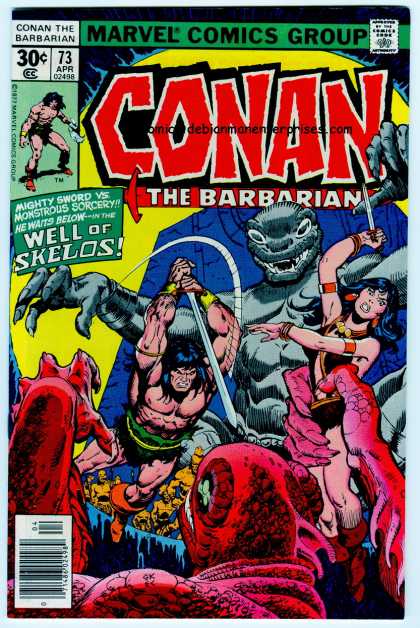
Conan the Barbarian #73 cover The other snag is that Dark Horse can’t reprint the original Marvel covers. For the most part, I haven’t missed them. But this week I was selling the odd comics that were duplicated by the trades I have, and I saw a few of the original covers. I didn’t realize how much the trades of Conan missed the covers until I looked at the original individual issues. There’s something dynamic and exciting about those covers that makes you want to buy them off the rack. I mean, they’re not necessary, but after knowing what they looked like, I definitely felt their absence.

And this volume could have used some appeal. I admit, I am not a fan of the type of story in v. 10; Belit, Conan’s lover and pirate Queen of the Black Coast, goes to the heart of her enemy’s empire to rescue her father, deposed king of a small city-state. But after nine issues, Conan and Belit seem only halfway to their goal, with Conan and Belit being forced to sort out the murderous politics of another city-state. Then Conan gets sent on a pointless errand for that city-state and ends up in a time-lost city founded by Alexander the Great … Thomas’s focus is weak at best here; either he was bored or just had so many ideas at the time he couldn’t wait to insert them. Art is by John Buscema and Howard Chaykin. Those of you who have seen Buscema’s art know whether you like him. Buscema, one of the stalwarts of Marvel (as is his brother, Sal), has a strong, detailed style that fits Conan well, especially with his proclivity to make all the men muscled monstrosities and the women scantily clad. Chaykin’s art was inked to make it look like Buscema’s, so there is little to distinguish the two artists (particularly under Dark Horse’s recoloring of the stories). Dark Horse also gets demerits for not getting the contents right. On both the back cover and on the title page verso, they list #82 as part of the collection. It isn’t. Not only is that deceptive, it's also sloppy quality control. Still, it does little long-term harm ... this time.

If you choose Chronicles of Conan titles to buy on a book-by-book basis, I would recommend skipping this one. I doubt that is the case, though, with most readers getting all of them. Despite the meandering plot, this one is fairly inoffensive.

Grade: C+

Labels: , , , , , , ,