Reviews of trade paperbacks of comic books (mostly Marvel), along with a few other semi-relevant comments / reviews.

01 April 2016

Chronicles of Conan, v. 30: The Death of Conan and Other Stories

Collects: Conan the Barbarian #233-40 (1990-1)

Released: December 2015 (Dark Horse)

Format: 200 pages / color / $19.99 / ISBN: 9781616555894

What is this?: The adventures of Teenage Mutant Ninja Conan, his first girlfriend, and his best friend as they are stalked by a sorceress who wants to avert a prophecy.

The culprits: Writer Michael Higgins and pencilers Ron Lim, Gary Hartle, and Rodney Ramos


A collection with a name like Chronicles of Conan, v. 30: The Death of Conan and Other Stories demands an impressive story. The Death of Conan should require a struggle against something huge, perhaps insurmountable — against an unbeatable monster, an undefeatable army, or even a struggle against the greatest enemy of all: fate itself. Ideally, The Death of Conan would feature an older Conan, one who has the maturity to see the stakes of his struggle, perhaps even doubting himself, if only for a moment. In other words, The Death of Conan should be more than just a shock to the reader; it should be a summation or at least an examination of the character.

None of this is true, of course. Chronicles of Conan, v. 30 gets its name from a single story in the collection (issue #238); the other seven issues are the “other stories.” Conan’s brief death is set in motion by a queen who is gone almost as soon as she proclaims Conan as a regicide. Although Conan heroically resists torture before his death, he has no agency beyond gritting his teeth at the lash. Perhaps worst of all, the story does not present an older Conan, whose death might have been presented as an event that will stick.

Chronicles of Conan, v. 30: The Death of Conan and Other Stories coverNo, it’s only teenage Conan. Oh, yeah — these issues are all wasted. In fact, Death shows Conan’s first adventures, an origin story for a character who doesn’t need an origin story. Who’s going to believe a character is going to die in his origin story?

Even when the deceptive “Death” in the title is forgotten, the storyline is problematic. No one ever wanted the stories of Conan’s youth before “The Tower of the Elephant,” a Robert E. Howard short story set when Conan was a young thief. (That story was adapted in Conan the Barbarian #4.) Writer Michael Higgins does incorporate an earlier story Howard alluded to — the raid on Venarium — into Death. In Howard’s version, Conan is a young but fearsome warrior, leading the charge over the fortress’s walls. In Higgins’s version, he’s a young warrior who manages to convince a party of older raiders into waiting until his friend opens the gates from the inside. It’s a small difference, but it weakens Conan; why weaken Conan to build up his friend?

We all know Jorrma, Conan’s first friend, and his first love, Melanie (a Hyborean name if I ever heard one), are going to die. If Higgins is going to waste time with them, he has to go all out: he has to make sure they are as important as they can be, given that Conan never mentions them in the 230 issues leading up to this story. But Higgins doesn’t. His characterization is scant, at best. Melanie could be any bar wench, as she’s blandly accepting of Conan’s demand that she take third place behind his plundering career and Jorrma. Late in the storyline, Higgins hints she might fancy Jorrma instead of Conan, but that hint goes nowhere. Jorrma is used as a tool by Acegra, a witch who has manipulated his and Conan’s families for generations and who killed both men’s parents. Jorrma fears harming his best friend, but he’s jealous of Conan’s relationship with Melanie. He falls in love — love at first sight, a love that requires some psychic manipulation of the young girl — while a captive in Venarium; his love is killed opening the fortress’s gates, and then she is mostly forgotten, as is his mental tampering.

Even Conan doesn’t seem so impressed by Jorrma and Melanie. Conan isn’t broken up by the death of either. By the story’s climax, he’s fed up with Jorrma’s incompetence, which gets them captured more than once, and his betrayals. Perhaps by the end, he realizes he was better off without Jorrma, and top-heavy bar maidens like Melanie are not that uncommon. Or maybe he stoically kept his grief over Melanie to himself, seeking out a succession of bland wenches over the years because they remind him of Melanie.

The one-issue prelude to this storyline, #232, was collected in Chronicles of Conan, v. 29: The Shape in the Shadow. In that story, Conan’s grandfather had a lifelong rivalry with the ancestor of Conan’s future best friend; this eventually deadly rivalry was provoked by Acegra, a Ron Lim-designed sorceress. (I’m a fan of Lim, but if you know his art, you know exactly how this woman looked, and you’ll know it’s a bad fit for Conan.) Acegra drives most of the action in this book, creating pawns to kill Conan and his family. Despite her power, she gets involved in combat only once, and that is to kill Conan’s mother. If she had only killed Conan when he was a baby, then she would have been victorious.

But there was a prophecy. There’s always a prophecy, I suppose; in this case, Acegra and her brother, who is possessed by a demon, have a vision of a 30-year-old Conan standing over their dead bodies. But none of that comes to pass; Conan’s victory comes much earlier and looks nothing like what it did in the vision. Conan doesn’t kill them, either: it’s their catspaw, Jorrma, who slays them.

But that’s just one of the sloppy storytelling problems in Death. Higgins keeps lobbing goons into the story, random soldiers Acegra has implanted with a grudge against Conan and Jorrma. These are supposed to be people Conan and Jorrma have a friendly history with, but readers never see any of them before they begin their grudge matches … I think. It’s hard to tell. Using characters we’ve seen before would make their attacks on Conan more significant. In fact, Higgins could have re-used Dryden, a Cimmerian rival to Conan, or Balthus, a guard who blamed Jorrma for the fall of Venarium. The reappearance of either would have meant something. Instead, all the other non-Conans in the book mean nothing — we have nothing invested in them, and they fail to elicit the slightest emotion for their successes and failures.

The artists are somewhat at fault for my confusion about whether villains have reappeared, although I suppose the number of ways sweaty, disheveled thugs can be drawn is somewhat limited. Lim (#233-5) is a poor match for Conan, with his smooth lines and streamlined designs; the grime and grit of the Hyborean Age can’t stick to his characters. Gary Hartle (#237-40) and Rodney Ramos (#236) are much better matches with the source material, but neither of them are standouts. I can imagine either having a successful run on the title, but being saddled with Higgins’s run is a recipe for forgettability. (Hartle continues with Roy Thomas, who will write Conan until its cancellation, after this arc.)

In #240, the story mercifully ends, with Justin Arthur (Thomas’s pseudonym) wrapping up the story with a climactic battle. Thomas also provides a framing sequence in which King Conan and his wife discuss how much of the story Conan, who was telling the tale to his son, was exaggerating or just lying about. Less obvious ways for a writer to denigrate his predecessor’s work exist, but given how bad Higgins’s run is, I can’t blame Thomas for telling readers to forget about it. I wish I could too.

Rating: Half Conan symbol (0.5 of 5)

Labels: , , , , , , , , , , , ,

05 February 2016

Spider-Gwen, v. 0: Most Wanted?

Collects: Edge of Spider-Verse #2, Spider-Gwen #1-5 (2014, 2015)

Released: December 2015 (Marvel)

Format: 112 pages / color / $16.99 / ISBN: 9780785197737

What is this?: In a world in which the radioactive spider bit Gwen Stacy instead of Peter Parker, Peter is dead from his own stupidity and Gwen is Spider-Woman.

The culprits: Writer Jason Latour and artist Robbi Rodriguez


When Gwen Stacy first appeared as Spider-Woman in Edge of Spider-Verse #2, I admit I had trouble seeing the appeal. Like the rest of Spider-Verse, a series that traded more on novelty and combinatorix than ideas, Spider-Gwen seemed like a product of trying endless combinations of characters and shades of Peter Parker to see which fit roughly in the ol’ Spider-Shaped Hole.

After a little thought, I did understand why Spider-Gwen might have caught on. Gwen Stacy has been dead so long she feels like a new character; a Gwen designed for the 21st century is far different than the hip / mod woman who died more than 40 years before. She is also the most prominent girlfriend killed to create a plot point or give character development to her boyfriend; flipping the script, so that she is the hero in a world where Peter Parker has died because of Gwen’s heroic identity, is novel, if not the most complex idea. Also, the Gwen Stacy in Spider-Verse wasn’t sexualized in any way. She was a hero who happened to be female — refreshing and sadly unusual.

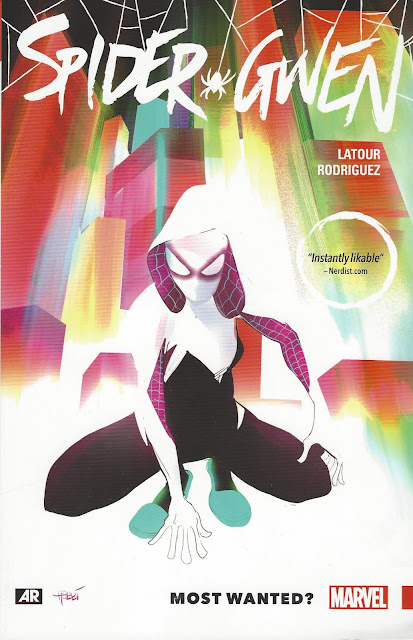
Spider-Gwen, v. 0: Most Wanted? coverSo despite my skepticism, I decided to give Spider-Gwen, v. 0: Most Wanted? a try. My specific reservations may have been misplaced, but I wasn’t wrong to be uncertain about the ongoing title.

Still, the book delivers on distinguishing itself from most mainstream comics. The cast is more gender diverse than most Marvel (or DC) comics; that should be a given in a female-led book, but I suppose nothing’s a given when it comes to women in comics. The book has more racial diversity than most, although Glory Grant, Hobie Brown, and Randy Robertson don’t have many lines. The book also returns other long-dead characters from the grave: Gwen’s father, George Stacy, plus Det. Jean DeWolff and Ben Parker.

The Spectacular Spider-Ham also shows up, as a hallucination offering Gwen advice after a concussion. It’s is a nice callback to the Spider-Verse crossover, but I didn’t particularly care for that storyline. More objectively, although Spider-Ham is amusing, his silliness is completely at odds with the rest of the story and with the seriousness a traumatic brain injury.

The art, though … I may be in the extreme minority on this, but the art makes this book hard to read. Much of this can be traced to the color palette, courtesy of colorist Rico Renzi Pinks and purples and greens and yellows don’t go together, and they give entire pages a nauseating / bruised look. Is the goal to make readers unsettled all the time? The narration doesn’t support this. Plus, green and purple are Marvel’s go-to villain colors. Are we supposed to interpret Spider-Gwen’s dimension as a villainous or anomalous timeline?

Spider-Woman carries some of that purple / pinkish in her costume, which artist Robbi Rodriguez seems to have designed by picking up design elements other heroes have been mocked for, then adding boat shoes. Her hoodie isn’t any better today than Ben Reilly’s was when he was mocked for it during the Clone Saga two decades ago. (Still, you can buy Gwen’s hoodie if you want. I’m not saying you should … and for those who object, saying Ben’s costume had a sleeveless hoodie, well, you can buy a sleeveless Gwen hoodie at the same site.) A character who swings through the night shouldn’t wear white, and Gwen’s choice of that color is just as ridiculous as Moon Knight’s is. Plus, those pink / purple highlights are worse, in their way. I refuse to believe any hero should wear slip-on shoes. The bustier outline on her chest adds a feminine touch to a costume without feminine signifiers, but why would Gwen want to do that? It seems a strange addition to an otherwise progressive title.

But maybe my evaluation of Gwen’s fashion decision-making process is wrong. If so, it’s from lack of evidence: Writer Jason Latour doesn’t give readers much information about Gwen when she’s not wearing her costume. Her father mentions in passing that she’s in college in Edge of Spider-Verse, but we never see that. Most of her free time seems to be taken up not playing drums for Mary Jane Watson’s band, agonizing about being able to be a hero and a drummer at the same time. What does she do with the rest of her time? She visits Ben and May Parker in #4, but it’s clear she hasn’t done that in a while. Does she spend all her time as Spider-Woman? If so, why isn’t she burnt out?

It’s a shame so much time is spent on having Spider-Woman fight all the time; the best part of the book is Gwen relating to the Parkers, who obviously have a great deal of affection for Gwen. May explaining her feelings about Spider-Woman and Ben acting jollily paternal while Gwen wrestles with her guilt is a nuanced moment the book could use a more of. But Gwen doesn’t interact with her supporting cast much — the occasional discussion with Glory and Mary Jane about whether she’s in the band, a conversation or two with her father about her superheroics.

I’m not sure Rodriguez’s art fits the new Spider-Woman. It’s a great fit for rock drummer Gwen Stacy: slightly loose and jangly, slightly disheveled. The rough edges work for the violent police scenes as well. But it doesn’t seem to fit a superheroic story the same way, especially one so brightly (gaudily) colored. Also, Rodriguez’s art sometimes doesn’t quite convey all the information it should. On the nitpicky end, when Spider-Woman fights the Vulture in a hallucinogenic fog during #4, Latour’s dialogue indicates she sees three Vultures, but only two show up on the page. More concerningly, Rodriguez makes all blondes look similar: Gwen, her mother (in pictures), a female graffiti artist. And I’m still not sure what happens to Felicia Hardy at the end of #5; Spider-Woman knocked her out, but did the ninjas who had been attacking her take advantage of that? If they didn’t, why not?

I will admit I thought making the Bodega Bandit, a common thief, look like Hamburgler was amusing without distracting from the story.

Latour leaves most of the background of Gwen’s dimension undetailed, which leaves readers with questions. However, not all the questions are mysteries readers should expect to be patient about; the questions that come to my mind are ones that assume Latour hasn’t thought of the implications of his choices. For instance, in a world without Daredevil and the Fantastic Four (or maybe just without a Thing — Ben Grimm’s a cop), why isn’t a flying guy spewing hallucinogenic gas a bigger deal? What is the connection between Felicia Hardy and the women in the Mary Janes? It doesn’t seem like a French thief / beggar should come into contact with a group of girls from Forest Hills. Why does Spider-Woman think the Vulture believed he is “owed” and “entitled”? His dialogue indicates he wanted respect, although after being ripped off and stepped on by Norman Osborn for years, he is probably entitled to recognition, money, and a fair amount of retribution on Osborn.

And why do Latour and Rodriguez insult Steve Ditko? When Gwen runs across a thinly veiled Ditko’s Mr. A comic in the Vulture’s apartment, she uses graffiti to tell the Vulture, “You read turrible comics.” Why insult another creator’s works — especially when that creator co-created the character you’re writing? It seems incredibly petty. I can see having criticisms of Mr. A’s ideology, but many of Ditko’s creations have lasted more than a half century and might last a half century more. Will Spider-Gwen last that long? Will any of Latour or Rodriguez’s creations? Maybe … but I wouldn’t put a great deal of money on it.

Since part of my criticisms of Spider-Gwen is based on not learning enough about Gwen’s world and character, I’ll give her another chance, partially because popular and critical opinion runs so strongly against me. Spider-Gwen, v. 1: Greater Power will be out in May, and I’ve pre-ordered it. I can’t guarantee an open mind, though; that color scheme has an unsettling effect on my brain.

Rating: Spider-Man symbol Half Spider-Man symbol (1.5 of 5)

Labels: , , , , , , , , ,