Reviews of trade paperbacks of comic books (mostly Marvel), along with a few other semi-relevant comments / reviews.

30 September 2016

Conan the Barbarian, v. 32: The Second Coming of Shuma-Gorath and Other Stories

Collects: Conan the Barbarian #250-8 (1991-2)

Released: July 2016 (Dark Horse)

Format: 240 pages / color / $19.99 / ISBN: 9781616558666

What is this?: After losing the princess, Conan is tormented by

The culprits: Writer Roy Thomas and penciler Mike Docherty


In retrospect, it’s obvious Chronicles of Conan, v. 32: The Second Coming of Shuma-Gorath and Other Stories collects stories from a title heading for its end.

Even more than the previous volume, Chronicles of Conan, v. 31: Empire of the Undead and Other Stories, Second Coming uses continuity to give stories more weight and more interest than they would usually have. In fact, Thomas is so invested in using previous Conan stories — usually stories that he himself wrote — that in Conan the Barbarian #254 he completes a Savage Sword of Conan story he wrote in 1979 that never got an ending.

Chronicles of Conan, v. 32: The Second Coming of Shuma-Gorath and Other Stories coverThe continuity Thomas is calling on should be in service of the main story, in which Conan travels back to his home village in Cimmeria to see if it has been destroyed, as he has seen it destroyed in his dreams. Unfortunately, the continuity is of dubious value.

Thomas scatters footnotes throughout the book. Almost every Conan story has some reference to Conan continuity, which, before Thomas took over this time, was rare. But as I said, this is the sign of a title that’s about to wrap things up: As he retraces his path back to Cimmeria, Conan revisits the signposts he encountered when he first journeyed to civilized lands. And that’s a good idea! If the story were more focused, if the overall structure of the Second Coming storyline fit together better, it might work. But it’s hard to see, for instance, how #253 does anything but divert Conan’s journey home momentarily; yes, it reintroduces the wizard Kulan Gath, whom Conan and Elric of Melnibone killed in Conan #15, but surely Thomas could have integrated Gath into the storyline more elegantly, rather than having Conan encounter him while visiting old friends. And why resurrect Kulan Gath at all? He’s not an iconic villain; rather, he’s a magical speedbump in Conan’s early career.

Sometimes these callbacks are necessary; for instance, a brief flashback in #252 to Savage Sword of Conan #2 is used to explain why Conan is no longer a general and secret consort to Yasmela, whom he had been serving since #246. (Both Savage Sword #2 and #248-9 are adaptations of the Robert E. Howard story “Black Colossus,” with SSoC continuing a little farther forward in time.) I’m thankful for the footnotes, even though I’m not sure half these references and flashbacks serve any purpose other than Thomas shouting, “Hey hey hey — these stories are important!” But they aren’t. The purple plague in #255-6 is a distraction easily disposed of, a fillip meant to disguise that the story’s only purpose is to revisit the Lost City of Lanjau from Conan #8. A stopover in Numalia gives Thomas a chance to mention a few characters and places from Conan #7. An old lover (from Conan #48) rescues Conan from the snow and the walking dead in #258; their dead son, who grew to an accelerated adulthood after Conan sired him with an uncanny northern woman, is mentioned, even though he appeared in a non-Thomas story (#145). All these old stories add up to a bunch of distractions bolted onto a plot that needed to be leaner to succeed.

It’s a shame, because the storyline has some entertaining — even chilling — parts. Queen Vammatar of the Hyperboreans, who opposes Conan’s return to Cimmeria, commands the dead and men’s loins; in many ways, she’s the standard sorcerous femme fatale, but Thomas and artist Mike Docherty sell her resurrection power as something truly dangerous and chilling. The creators don’t make the dead as powerful a threat as well as the best zombie tales do, but they can’t, given the Code-approved nature of a serial book. The design of Vammatar’s servitors, the Witchmen of Hyperborea, is almost effective, as their featureless white masks are unnerving, but they seem to be wearing black bodystockings, which makes them look like semi-villainous Mummenschanz.

Cona’s lieutenants, Zula and Red Sonja, exit this story early, having had enough of Conan’s love affairs and desiring more exciting work now that the peace has been won. Thomas evidently agrees with me that Conan works better with a sidekick, though, so he assigns Conan a new one: Hobb of Anuphar, a fat sybarite whose cowardice is supposed to work as comic relief. It doesn’t work, since Hobb’s competence is marginal and his one-note bumbling grows tired quickly. By the end of the story, we don’t know much about Hobb other than he’s Volstagg the Voluminous, except without the charisma or strength.

And we don’t even get the second coming in the title! That doesn’t happen until the next volume, Chronicles of Conan, v. 33: The Mountain Where Crom Dwells and Other Stories. (To be fair, #252-8 are the first seven parts of the Second Coming of Shuma-Gorath storyline.)

Docherty’s art, other than the disappointment of the Witchmen design and the too cartoony skeletal warriors in #255-6, is solid as always. His work looks strongly influenced by John Buscema, although that might be traced to the finishes by long-time Conan inker Ernie Chan. His art is detailed enough to show the rough edges and grime of a time undreamed-of, but it’s never so fussy or confusing that it’s hard to follow. I have gained an appreciation for artists who can draw a clear battle scene, which is a must for Conan; Docherty does a great job with action, and I never have to ask how a character gets from point A to B. If I had to find a flaw with Docherty, other than the occasional design misstep, it would be that his art doesn’t inspire ecstatic praise; he’s solid, not transcendent.

Hoover's cute horrorDale Hoover fills in on #253, and although I’d admire his clean, unfussy work on a number of other titles, it just doesn’t fit with the dirty, blood-stained world of Conan. The depiction of the mutilation of a prince whose life-force was drained, turning his extremities to bone, suffers from being too clean and too neat; the panels have little chance of communicating the horror of seeing someone’s hands and feet reduced to bone. Also, I’m not a fan of the cheesecake design and poses of Imojen, a Kothian rebel leader. Still, his cartoony flashback drawing of the Dweller in the Dark is adorable.

I enjoyed this volume, even if I can see the flaws — the irrelevant fill-in flashback in #251, the Thomas-ian obsession with resurrecting stories and characters that no one finds as interesting as Thomas himself does. But Second Coming does feel like it has a direction and a point, even if that point is to get closer to the end of this series.

Rating: Conan symbol Conan symbol Conan symbol (3 of 5)

Labels: , , , , , , , , , , , , ,

11 September 2016

The Eltingville Club

Collects: Stories from Instant Piano #1 and 3, Dork #3-4, 6, and 9-10, Wizard #99, Dark Horse Presents v. 2 #12, and Eltingville Club #1-2 (1994-2015)

Released: February 2016 (Dark Horse)

Format: 144 pages / mostly black and white / $19.99 / ISBN: 9781616554156

What is this?: Four devoted, terrible fanboys form a club —probably because no one else will associate with them, as they are horrible human beings.

The culprits: Evan Dorkin


The Eltingville Club is another book I’m reviewing months after it came out — to be clear, many months after it came out, not a few months, as is my custom — because Diamond evidently hates the comic shop I patronize. After giving up on Diamond, I bought Eltingville online.

The Eltingville Club follows the four members of the Eltingville Comic Book, Science-Fiction, Fantasy, Horror, and Role-Playing Club. Bill, Josh, Tony, and Jerry (well, maybe not Jerry) give fandom a bad name. They are thoroughly repugnant people — again, excepting Jerry — who are violent, foul-mouthed, unempathetic, misogynistic, selfish, and probably a few other reprehensible things I can’t think of at the moment. Readers who have spent any time around fandom, online or in person, will find something uncomfortably familiar here.

The Eltingville Club coverIn many ways, the Eltingville stories, which began in the mid-’90s, anticipated the Internet trolls and Internet / fan controversies of the 21st century, and I’m not sure whether that adds an intriguing element to the collection or if it’s just depressing.

Writer / artist Evan Dorkin is a true fan; the depth and breadth of the references made by his characters proves that. But he hasn’t mythologized any of the aspects of fanaticism. Dorkin is unflinching in his examination of all the stupid things fans do: obsess about minutiae, exclude others (especially “cultural immigrants,” as Bill calls them), buy all manner of collectibles, and waste tons of money. It takes a fan to recognize and out such cankers on the face of fandom, and Dorkin finds every hyperconservative flaw and brings them out for examination.

Although the Eltingville Club’s interests largely intersect with those of the book’s readers, we do not sympathize with these jerks, nor are we supposed to. Dorkin does not give us any reason we should like the club members, no redeeming features whatsoever; as a character implies in the final story, it’s hard to believe they even like each other. The more time we spend with them, the more we are sure they are irredeemable. Dorkin’s art — usually black and white, although one story (“They’re Dead, They’re All Messed Up” from Wizard #99) is colored by Dorkin’s wife and collaborator, Sarah Dyer — does not spare the characters either. At times, they seem to be made up entirely of flaws: they are sweaty, pimpled, fat, squinty-eyed, have unruly hair … The simple panels in the book’s first half are dominated by oppressively dark backgrounds. Later, the art lightens up a little, but the overwhelming feeling of darkness remains.

Perhaps the most depressing part of the book is the truly trivial things the club members collect: fast-food toys (and associated licensed soda cups), trading cards sold in Wonder Bread bags, licensed canned food, QVC tchotchkes, crappy toys that can only be acquired with upmty-ump mailed-in UPCs from packaged foods … These aren’t even primary collectibles. They are secondary merchandise, issued by corporations who don’t care about the characters or source material, created only to get people to buy other stuff they don’t need. Yet the Eltingville Club eats it up — literally, in Josh’s case.

Fortunately, the stories themselves are funny; if they weren’t, Eltingville would be insufferable. Fortunately, the characters’ loathsomeness means the physical comedy (usually in the form of assaults) is even funnier than it would be if readers liked the club members. That each character deserves the humiliation and insults they endure gives a pleasing edge of schadenfreude to the cutting remarks, and Bill, Pete, Jerry, and Josh deserve the consequences of their actions: the hallucinations that result when they take Josh’s mother’s medication to stay up to watch the entire Twilight Zone marathon, the destruction of a 12-inch mint-in-package Boba Fett at the end of “Bring Me the Head of Boba Fett,” Josh’s arrest after ripping open bread wrappers to find the Batman Forever card he wants, etc. Sometimes the fat jokes directed at Josh get a little uncomfortable (albeit not as uncomfortable as the casual misogyny), but they are realistic.

As I said, Dorkin is a fan, and Eltingville is filled with nods and references to everything the club follows. The trivia contest in the second story, “Bring Me the Head of Boba Fett,” is filled with a dizzying amount of obscure info, and the characters make frequent (and impressive, to be honest) references to the hobbies they love. The stories themselves echo classic comics; in “This Fan … This Monster,” the first full-page panel of the story copies the first page of Fantastic Four #51, from which the story takes its name. Later in the story, Dorkin’s homage to Amazing Spider-Man #33, complete with Ditko fingers when Bill finally escapes from under a bunch of comics longboxes, is a thing of beauty.

Strangely, the overall storyline is satisfying, and the longer pieces, the ones that are allowed to go beyond a single joke or theme, are the best, going beyond mere jokes and unpleasantness. In those issues, Dorkin piles on more and more awfulness, taking the characters and events beyond reality into a kind of fannish hyperreality. The stories have some continuity, and in keeping with the comics the club enjoys so much, it has a sliding time scale (the kids are teens in stories from 1994 and 2014). The epilogue — appropriately titled “Lo, There Shall Be an Epilogue” — wraps up Eltingville, showing how each turned out as an adult, ten years after the group dissolved. Encouragingly, being in the Eltingville Club does not sentence its members to lifelong misogyny or misanthropy, and some of its members become functional adults. On the other hand, the epilogue shows how hard it is to wash the stink of being such an asshole off; you have to work at it.

And for those of you who wondered what the deal was with the Welcome to Eltingville pilot that aired on Adult Swim: Dorkin has an afterword that gives the entire story.

I thoroughly recommend The Eltingville Club, but some readers might find it less enjoyable than I did — it can be rough reading about such awful people, especially if you have run into them during your trip through fandom. And it’s even worse if you realize you have something in common with them.

Rating: Eltingville symbol Eltingville symbol Eltingville symbol Eltingville symbol Half Eltingville symbol (4.5 of 5)

Labels: , , , , , ,

15 July 2016

Chronicles of Conan, v. 31: Empire of the Undead and Other Stories

Collects: Conan the Barbarian #241-9 (1991)

Released: March 2016 (Dark Horse)

Format: 224 pages / color / $19.99 / ISBN: 9781616558659

What is this?: After avoiding a demigod’s son’s revenge plot, Conan and his cohorts join the Khorajan army.

The culprits: Written by Roy Thomas and drawn by Gary Hartle and Mike Docherty


Since the next volume of the Chronicles of Conan — Chronicles of Conan, v. 32: The Second Coming of Shuma-Gorath and Other Stories — is scheduled to come out next week, I thought I’d review the most recent volume as a warm-up.

Is Chronicles of Conan, v. 31: Empire of the Undead and Other Stories better than the preceding volume? Oh, Crom, yes — it would be almost impossible for Roy Thomas, Conan’s first writer, to conceive of anything as dire as The Death of Conan and Other Stories.

Chronicles of Conan, v. 31: Empire of the Undead and Other Stories coverWith that low bar cleared, it’s time to look at whether Empire of the Undead is good. That question is a bit more complicated …

Those who know Thomas by his superhero work probably realize Rascally Roy never met a bit of continuity he didn’t think he could mine for a story. That’s the case with Empire of the Undead, where Thomas follows Michael Higgins’s continuity-ignoring implant with a storyline that brings back old friends and old rivals. Red Sonja returns, but that’s not so unusual: she pops up every now and then. Thomas also reunites the surly Cimmerian with Zula, one of the pirates who sailed with Conan and Bêlit in Conan the Barbarian #84-94 — a deep cut, to be sure.

Zula is a welcome addition — I’ve said before that Conan works better in the long term when he has allies to work with. But the returning villains … I’m not sure. Thomas introduces El-Ron, the son of Zukala, whom Conan fought in #5 and #115 and allied with in #14, and reintroduces the bat-like Afterlings, which appeared in #43, Stygian wizard Shu-Onoru, Zula’s old master who appeared in #85-6, and Stygian prince Katuman, who appeared in Savage Sword of Conan #2 and 3. (Other characters from the past also pop up, but I’m not going to list them all.) Thomas also uses Varnae the Vampire, who has long been established as the most ancient vampire lord in the Marvel Universe, as a villain for the second storyline in Empire.

These villains fall flat, though. The returning characters don’t serve much narrative purpose, as each of them — save for Shu-Onoru, who has a strong connection to Zula — could have been a new character without sacrificing any effect on the plot. Varnae is particularly out of place, as the story he’s in has none of the traditional vampire trappings, and he’s defeated by the clichéd “one thing that can defeat him” — a magic spell that Zula reads, in this case. Also, the Conan editorial staff was lying down on the job; other than Zula, the book contained few footnotes stating which issues these characters came from. Strictly speaking, they aren’t necessary, but it would have been nice to give readers some context.

Despite Thomas’s determination to link everything in his latest run to something he did more than a decade before, the book largely succeeds. The first story, a three-parter called “The Sorcerer and the She-Devil,” is fine, with Red Sonja’s feisty return mostly managing to hide the plot’s unwillingness to let either her or Conan affect it. (Does Thomas have something against Scientology? Naming the villain El-Ron tends suggest he does, but I can’t find anything online about it.) The following two-parter with Varnae the Vampire is notable only for the return of Zula; otherwise, #244 and 245 is a series of fights, usually with the heroes losing, interrupted by monologues.

The book finally gets into gear with #246, when Conan, Sonja, and Zula arrive in besieged Khoraja. Conan begins to ascend the Khorajan military ladder, as he has done in many other cities and states, and helps the Khorajans defeat the desert nomad wizard who threatens the city. Thomas gives the story a little nuance, showing the Khorajans are not completely innocent: their high command is just as stupid as the generals Conan usually serves under, and the city has an oppressed minority that Sonja is ambivalent toward, even when they try to kill her. I also appreciate that Thomas ignores Conan’s final fight with the uncanny leader of the nomads — we all know Conan’s going to win, right? — and instead concentrates on Zula and Sonja’s battle with demonic underlings. I admit laughing out loud when after the battle Sonja and Zula found Conan in post-coital bliss with the Khorajan princess.

Additionally, Thomas gives more depth to Sonja than I anticipated he would. At first, Sonja displays her customary rivalry with Conan, although she lacks the usual camaraderie she usually has with him. (It turns out Sonja was hired to assassinate El-Ron, and Conan kept getting in the way of her plan.) But as the book goes on and she continues to adventure with Conan, her rivalry continues, although Conan is mystified at why she’s so angry about his successes. When Conan quickly becomes a captain in the Khorajan army, Sonja bristles. It’s easy to see why: in Empire, Sonja is every bit the warrior Conan is, but it’s always Conan who gets credit for being the superior warrior. Her resentment cools a bit at the end when Conan, elevated to general, promotes her to captain. Overall, Sonja is more insecure than usual, but I can live with that, given how difficult it must be to live, even for a while, in Conan’s shadow.

Artists Gary Hartle (#241-7) and Mike Docherty (#248-9) are solid artists, and I have no complaints about them. They aren’t superlative stylists like Barry Windsor-Smith or John Buscema, but both know how to draw Conan and his world, telling comprehensible stories. More importantly, in my eyes, they give Sonja more clothing than a chainmail bikini. Hartle’s one-piece swimsuit with lapels and a fur-trimmed cape is only a moderate improvement, but Docherty gets rid of the lapels (and cleavage) as soon as he can, adding leather armor around the neck and shoulders and a loincloth. It’s not practical, but it’s nice to see someone moving her in a more sartorially useful direction.

More amusing than Sonja’s clothing is the contrast between Conan’s interior and cover artists. Hartle and Docherty, as I mentioned, are good, but they never were considered “hot” artists; on the other hand, the covers are contributed by artists who were the most sought-after pencilers of the day. Todd McFarlane, Jim Lee, and Whilce Portacio, a trio that would help found Image Comics the following year, contributed the covers for #241-3, and Art Adams drew #247-9. Those are impressive artists to line up for a title that was aimlessly wasting readers’ time in the previous collection.

No one’s going to pick up Empire if they haven’t been reading Chronicles of Conan for a long time. But if you made it through Death of Conan without your interest in Conan being extinguished, then you might as well pick up Empire, especially since Thomas seems to be adding a little more depth than he has to to the stories.

Rating: Conan symbol Conan symbol Half Conan symbol (2.5 of 5)

Labels: , , , , , , , , , , , , , , , , ,

01 April 2016

Chronicles of Conan, v. 30: The Death of Conan and Other Stories

Collects: Conan the Barbarian #233-40 (1990-1)

Released: December 2015 (Dark Horse)

Format: 200 pages / color / $19.99 / ISBN: 9781616555894

What is this?: The adventures of Teenage Mutant Ninja Conan, his first girlfriend, and his best friend as they are stalked by a sorceress who wants to avert a prophecy.

The culprits: Writer Michael Higgins and pencilers Ron Lim, Gary Hartle, and Rodney Ramos


A collection with a name like Chronicles of Conan, v. 30: The Death of Conan and Other Stories demands an impressive story. The Death of Conan should require a struggle against something huge, perhaps insurmountable — against an unbeatable monster, an undefeatable army, or even a struggle against the greatest enemy of all: fate itself. Ideally, The Death of Conan would feature an older Conan, one who has the maturity to see the stakes of his struggle, perhaps even doubting himself, if only for a moment. In other words, The Death of Conan should be more than just a shock to the reader; it should be a summation or at least an examination of the character.

None of this is true, of course. Chronicles of Conan, v. 30 gets its name from a single story in the collection (issue #238); the other seven issues are the “other stories.” Conan’s brief death is set in motion by a queen who is gone almost as soon as she proclaims Conan as a regicide. Although Conan heroically resists torture before his death, he has no agency beyond gritting his teeth at the lash. Perhaps worst of all, the story does not present an older Conan, whose death might have been presented as an event that will stick.

Chronicles of Conan, v. 30: The Death of Conan and Other Stories coverNo, it’s only teenage Conan. Oh, yeah — these issues are all wasted. In fact, Death shows Conan’s first adventures, an origin story for a character who doesn’t need an origin story. Who’s going to believe a character is going to die in his origin story?

Even when the deceptive “Death” in the title is forgotten, the storyline is problematic. No one ever wanted the stories of Conan’s youth before “The Tower of the Elephant,” a Robert E. Howard short story set when Conan was a young thief. (That story was adapted in Conan the Barbarian #4.) Writer Michael Higgins does incorporate an earlier story Howard alluded to — the raid on Venarium — into Death. In Howard’s version, Conan is a young but fearsome warrior, leading the charge over the fortress’s walls. In Higgins’s version, he’s a young warrior who manages to convince a party of older raiders into waiting until his friend opens the gates from the inside. It’s a small difference, but it weakens Conan; why weaken Conan to build up his friend?

We all know Jorrma, Conan’s first friend, and his first love, Melanie (a Hyborean name if I ever heard one), are going to die. If Higgins is going to waste time with them, he has to go all out: he has to make sure they are as important as they can be, given that Conan never mentions them in the 230 issues leading up to this story. But Higgins doesn’t. His characterization is scant, at best. Melanie could be any bar wench, as she’s blandly accepting of Conan’s demand that she take third place behind his plundering career and Jorrma. Late in the storyline, Higgins hints she might fancy Jorrma instead of Conan, but that hint goes nowhere. Jorrma is used as a tool by Acegra, a witch who has manipulated his and Conan’s families for generations and who killed both men’s parents. Jorrma fears harming his best friend, but he’s jealous of Conan’s relationship with Melanie. He falls in love — love at first sight, a love that requires some psychic manipulation of the young girl — while a captive in Venarium; his love is killed opening the fortress’s gates, and then she is mostly forgotten, as is his mental tampering.

Even Conan doesn’t seem so impressed by Jorrma and Melanie. Conan isn’t broken up by the death of either. By the story’s climax, he’s fed up with Jorrma’s incompetence, which gets them captured more than once, and his betrayals. Perhaps by the end, he realizes he was better off without Jorrma, and top-heavy bar maidens like Melanie are not that uncommon. Or maybe he stoically kept his grief over Melanie to himself, seeking out a succession of bland wenches over the years because they remind him of Melanie.

The one-issue prelude to this storyline, #232, was collected in Chronicles of Conan, v. 29: The Shape in the Shadow. In that story, Conan’s grandfather had a lifelong rivalry with the ancestor of Conan’s future best friend; this eventually deadly rivalry was provoked by Acegra, a Ron Lim-designed sorceress. (I’m a fan of Lim, but if you know his art, you know exactly how this woman looked, and you’ll know it’s a bad fit for Conan.) Acegra drives most of the action in this book, creating pawns to kill Conan and his family. Despite her power, she gets involved in combat only once, and that is to kill Conan’s mother. If she had only killed Conan when he was a baby, then she would have been victorious.

But there was a prophecy. There’s always a prophecy, I suppose; in this case, Acegra and her brother, who is possessed by a demon, have a vision of a 30-year-old Conan standing over their dead bodies. But none of that comes to pass; Conan’s victory comes much earlier and looks nothing like what it did in the vision. Conan doesn’t kill them, either: it’s their catspaw, Jorrma, who slays them.

But that’s just one of the sloppy storytelling problems in Death. Higgins keeps lobbing goons into the story, random soldiers Acegra has implanted with a grudge against Conan and Jorrma. These are supposed to be people Conan and Jorrma have a friendly history with, but readers never see any of them before they begin their grudge matches … I think. It’s hard to tell. Using characters we’ve seen before would make their attacks on Conan more significant. In fact, Higgins could have re-used Dryden, a Cimmerian rival to Conan, or Balthus, a guard who blamed Jorrma for the fall of Venarium. The reappearance of either would have meant something. Instead, all the other non-Conans in the book mean nothing — we have nothing invested in them, and they fail to elicit the slightest emotion for their successes and failures.

The artists are somewhat at fault for my confusion about whether villains have reappeared, although I suppose the number of ways sweaty, disheveled thugs can be drawn is somewhat limited. Lim (#233-5) is a poor match for Conan, with his smooth lines and streamlined designs; the grime and grit of the Hyborean Age can’t stick to his characters. Gary Hartle (#237-40) and Rodney Ramos (#236) are much better matches with the source material, but neither of them are standouts. I can imagine either having a successful run on the title, but being saddled with Higgins’s run is a recipe for forgettability. (Hartle continues with Roy Thomas, who will write Conan until its cancellation, after this arc.)

In #240, the story mercifully ends, with Justin Arthur (Thomas’s pseudonym) wrapping up the story with a climactic battle. Thomas also provides a framing sequence in which King Conan and his wife discuss how much of the story Conan, who was telling the tale to his son, was exaggerating or just lying about. Less obvious ways for a writer to denigrate his predecessor’s work exist, but given how bad Higgins’s run is, I can’t blame Thomas for telling readers to forget about it. I wish I could too.

Rating: Half Conan symbol (0.5 of 5)

Labels: , , , , , , , , , , , ,

28 February 2015

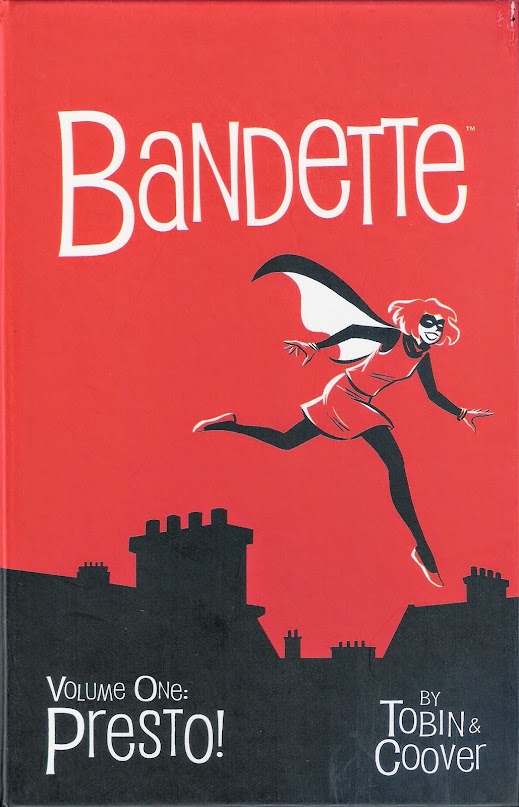
Bandette, v. 1: Presto!

Collects: Bandette #1-5 ()

Released: November 2013 (Dark Horse/ original comics from Monkeybrain)

Format: 144 pages / color / $14.99 / ISBN: 9781616552794

What is this?: With the help of her gang of urchins, Bandette, a young woman in sorta-France, is the world’s greatest thief — or just about.

The culprits: Written by Paul Tobin and drawn by Colleen Coover


The word to remember for Bandette, v. 1: Presto!, is “charming.”

The protagonist, a young woman whose nom du crime is Bandette, is charming. The stilted dialogue, which suggests a not-quite-fluid translation from French, is charming. The plots, which don’t take themselves seriously, are charming. Her moral standing — a master thief who sometimes aids the side of good but is not above helping herself to other people’s loot — is charming. Bandette’s personal credo — “Presto!” — is charming in its simplicity. Colleen Coover’s art, which tells the story admirably without worrying overly much about realism, is charming.

Bandette, v. 1: Presto! coverAt this stage in the review, you’ll know if this book is for you. Many people will have already written off Bandette as sickly sweet. That is not the case, though. Coover and writer Paul Tobin skirt that pitfall as deftly as is possible, keeping Bandette carefree and lighthearted without being cloying; the protagonist is confident and sure of her abilities in a way that allows her to remain unconcerned yet exhilarated in the face of assassins and bank robbers.

Bandette lives in a world that resembles but is not quite our own. It is a European world, full of dashing, daring thieves and international crime gangs and signs in French. Bandette makes allusions to European comics: the Chocobolik candy bar is a reference to Diabolik, the anti-hero thief from Italian comics; Inspector Belgique looks like he could have stepped out of Tintin; and at one point Bandette is pursued by the villainous motorcycle riders from the “Take on Me” video (by the Norwegian band A-ha). It’s likely I’m missing other references. Still, there are jarring notes; French urchins would hardly be likely to play baseball on the streets of any French city, for example.

Coover’s art is excellent, conveying the book’s light-hearted tone as well as the dialogue and plot does. Coover’s Bandette is acrobatic and graceful, almost always in motion, and unmistakably youthful. Although the style looks cartoony, Coover manages subtlety throughout the book — in the backgrounds, in the details, and even right in front of the readers’ eyes. (In two different scenes, Bandette and her chief rival, Monsieur, pick the other’s pocket; the thefts are obvious because that is what we expect stylish thieves do to one another, but Coover actually draws both thefts — details I missed on my first reading.)

The only criticism I have of Presto! is that the volume feels slight. When I stop to consider whether it is, I realize Presto! is a good value: a $15 hardback, 144 pages in color, collecting five (online) issues. No, the amount of content is fine; the amount of story is the problem. In Presto!, Bandette rights a wrong by stealing stolen artwork, stops a bank robbery, is targeted by an international crime syndicate, and agrees to “the great thieving race” with her greatest larcenous rival. That summary contains a great deal of action, but Presto! doesn’t leave the reader with that impression. The international crime syndicate makes one attempt on Bandette’s life, although future attempts are promised. The robbery and the larcenous justice are brief episodes meant to show Bandette’s character, supporting cast, and world. The volume ends as soon as the great thieving race is agreed to.

Perhaps, though, the story is cut at that point to leave the reader wanting more. I know it worked with me. I hope the second volume, Stealers Keepers!, will provide more of a complete story, although for another $15 for the other part of a single story, Bandette looks like less of a bargain.

The final 40-plus pages in Presto! fall into the category of “extras.” Tobin’s eight “Urchin Stories,” showing Bandette’s allies, are illustrated by as many different artists; Steve Lieber’s art for the Inspector Belgique story stands out by being reminiscent of Coover’s work without being a slavish imitation. After the eight short illustrated stories is Tobin’s prose piece featuring Daniel, one of Bandette’s urchins. This is the best of the extras; the story tells how Daniel met Bandette, fell in love with her (although he’d never admit it), and aided her on another adventure. The extras are rounded out by pages detailing the process of creating Bandette; Coover’s explanation of how she creates the art is much longer than Tobin’s script pages.

Presto!, then, is a charming, airy pastry rather than a substantial meal. But that is nothing to be ashamed of; we all need filling meals, but we still crave those pastries. In fact, we can never get enough.

Rating: Dark Horse symbol Dark Horse symbol Dark Horse symbol Dark Horse symbol (4 of 5)

Labels: , , , , , , ,

10 August 2013

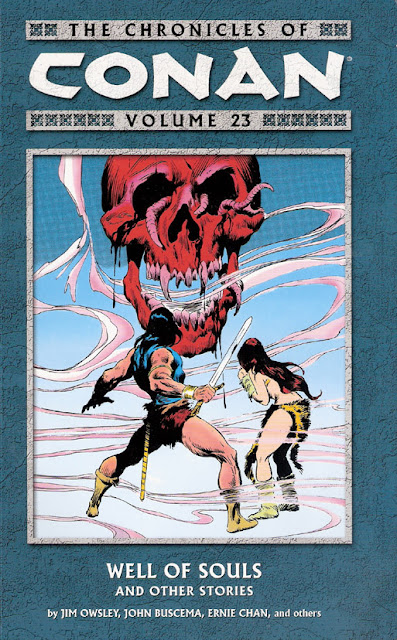
Chronicles of Conan, v. 23: Well of Souls and Other Stories

Collects: Conan the Barbarian #174-81 and Conan the Barbarian Annual #10 (1985-6)

Released: March 2013 (Dark Horse)

Format: 232 pages / color / $18.99 / ISBN: 9781616550523

What is this?: Conan, along with a Zingaran captain and a teenage girl, continues looking for a fabulous treasure, but he finds more than he’s looking for.

The culprits: Writer Jim Owsley and artists John Buscema and Ernie Chan


In previous reviews of the Chronicles of Conan series, I have complained about a great many things. The most important, to me, was the series’ lack of supporting characters and ongoing narrative. Every issue was the same: Conan steps into a new situation, starts stabbing people, and walks out the end, often as the only survivor. That narrative doesn’t provide much tension: He has to survive, since he’s the main character.

With Chronicles of Conan, v. 23: Well of Souls and Other Stories, writer Jim Owsley (the future Christopher Priest) has changed that. Conan has a partner, Zingaran captain Delmurio, and a sidekick, Tetra, a lovestruck teenage girl who Conan has taught to be a fearsome warrior. They are on a quest to find treasure — simple enough, but one rarely used for long-form Conan stories.

Chronicles of Conan, v. 23: Well of Souls and Other Stories coverWell of Souls isn’t going to convince a reader with no interest in Conan to start reading the series. However, it might lure readers who are interested in the character or concept back to the series by giving them reasons to invest in the title rather than an individual story. The supporting cast is vivid enough to make readers care about them. Delmurio and Tetra have personalities, and readers will most likely have an opinion about them; when they leave Conan’s side, the barbarian picks up a new companion, who will presumably also make readers like or hate him. The extended plot pays off in a not completely unexpected fashion after seven issues (two in the previous volume, Reavers in the Borderland), and a new plotline begins.

It’s a solid foundation for a series. It’s only a baseline, but it saddens me how badly previous volumes miss that mark.

The individual issues are on the whole mildly interesting, elevated by the structure but showing only flashes of excellence. Issue #175, with its war-haunted river town and mysterious boatman, is the most atmospheric and probably the best issue in the collection. Even the less interesting issues have elements that momentarily pique interest; the opening story, which largely revolves around a mob of uninteresting war orphans, has some surprisingly vicious moments and ruminations about the ethics of keeping occupied populations in line that redeems the fleeting romances and undifferentiated crowds.

Despite my faint praise for the individual issues, Owsley has a better handle on Conan’s world than the writers who preceded him. The settings are filled with casual violence and superstitious people who cannot recognize false prophets or true prophecy when it is shouted at them. People die soon after they appear, and they die when it seems like they are going to join the ongoing cast. Owsley gives the protagonist more dimensions than he usually possesses in Marvel comics; the Conan in Well is as brooding, angry, and violent as usual, but the presence of Tetra restrains his lustful side. The narration says he is affected by her resemblance to lost lovers Red Sonja and Bêlit, but it’s clear Conan sees her adoration and reacts to it. Given her youth, he can’t return her affection, and he doesn’t want to reject her outright, so he doesn’t flaunt his sexual preference of other women to her. When her eyes are no longer on the barbarian, Conan goes back to his lecherous ways almost immediately.

Well of Souls has plenty of areas where it could be improved; better choices by editor Larry Hama might have prevented colorist George Roussos from assaulting readers’ eyes with a technicolor Hyborian Age or convinced artist John Buscema to cast aside the teenage Tetra’s furry bikini and loincloth ensemble, even if it is accessorized with green furry boots. (What animal could those boots have come from?) Making the spelling of man-monster Keiv (not “Kiev”) consistent would have helped. Having Owsley restate the overarching plot — on a quest to find treasure, based on a map Conan and Delmurio each have half of — would have been useful as well, since the reader often knows only that the trio are going to some destination. Hama also makes a mistake in issue #176, referring to Conan’s adventure with ex-mercenary Redondo as being in Annual #9 instead of #10. Since Annual #10 is included in Well, that’s not a big problem, but collection editor Chris Warner might have given the story in #176 greater impact by putting Annual #10 before #176. On the other hand, the continuing narrative doesn’t give much room for the annual, so it might not have been feasible.

The ever-reliable John Buscema drew all the issues of the regular series. Buscema was getting near 60 when these issues came out, but his art is as strong and vivid as ever. Owsley’s intense Conan would not work half so well with another artist, as Buscema’s work on the barbarian hero conveys a hardness that has nothing to do with his musculature. Buscema’s penchant for cheesecake — de rigueur for fantasy, I know — gets a little out of hand, as no woman in Well conceals her navel, and Tetra’s outfit is, as described, gratuitous. Frequent Conan inker Ernie Chan penciled the annual and does a good job of it.

The immediate future looks good for the title. The overarcing plot is controlled by a new adversary, not Conan, but the villain looks like he has a plan and is putting it into place. With Owsley remaining on Conan until #213 (another four volumes or so), the stories should retain their barbarousness, and Conan should remain well rounded.

Rating: Conan symbol Conan symbol Conan symbol Half Conan symbol (3.5 of 5)

Labels: , , , , , , , ,

18 January 2013

Chronicles of Conan, v. 22: Reavers in the Borderland and Other Stories

Collects: Conan the Barbarian Annual #8-9 and Conan the Barbarian #168-73 (1983-4, 1985)

Released: June 2012 (Dark Horse)

Format: 224 pages / color / $18.99 / ISBN: 9781595828125

What is this?: Conan joylessly wenches and kills his way through more of the Hyborian Age.

The culprits: Writers Michael Fleisher and Jim Owsley and artists John Buscema, Ernie Chan, and Val Mayerik


Writer Michael Fleisher’s work in Chronicles of Conan, v. 21: Blood of the Titan and Other Stories left me optimistic the quality of the Chronicles of Conan would improve from its consistently forgettable levels. And then The Chronicles of Conan, v. 22: Reavers in the Borderland and Other Stories jammed a broadsword through that optimism.

I wasn’t expecting a return to Roy Thomas levels of quality but something memorable about the stories in Reavers in the Borderland — about any story in Reavers, actually. Introducing Fafnir, a sidekick / partner for the title barbarian, distinguished Blood of the Titan from other books in the series. The rivalry and friendship of the two added a new dimension to Conan’s character, and for once, there was a character in Conan (other than Conan) I gave a damn about.

 cover But Fafnir is dropped from the stories in Reavers, and the series returns to random hack-and-slash action, full of gaudily colored thugs, wizards, and bravos trying to cut Conan down. Fleisher, who wrapped up his two-year run with #171, writes largely forgettable pieces, studded with violence and lady flesh. Fleisher’s stories show little wit and feature no memorable characters. The images parade in front of the eyes and then vanish, leaving as much of an impression upon Conan as they do the reader — that is, none.

In Reavers, Conan saves an old ally from a carnival (?!) sideshow. Conan protects a wench from some of his old enemies, only to find she is more than she seems. A wizard needs help with a demon and a cursed sword; that takes two issues to resolve. Conan appears to die; the reader yawns, not particularly caring how he survives. (Poison coma, if you’re interested. You shouldn’t be, though.)

I almost called Fleisher’s stories continuity-free, but that’s not true; he reuses characters from his run in two of his stories. In #168, Conan chances across Alhambra, the winged woman from #153-4 (The Chronicles of Conan, v. 20: Night of the Wolf and Other Stories), and saves her from the sideshow and her old enemies, the Batmen of Ur-Xanarrh. (He almost burns her and everyone in the carnival to death first, though.) In #171, he fails to protect a girl from the Brotherhood of the Falcon, which he fought in #162 (Blood of the Titan). But Alhambra is just a pretty face (and pair of wings) who doesn’t stick around, and despite “killing” Conan, the Brotherhood of the Falcon is just another group of faceless goons, with little to distinguish them from a random wizard’s henchmen or a corrupt duke’s soldiers. Fafnir, the saving grace of the last volume, does come back briefly in #170, although it’s only to say goodbye.

What Conan needs is a supporting cast, people who stay with him. They don’t have to stay forever; three or four issues would be fine. But Conan needs a contrast in the story, someone to express himself to (even if it’s by not saying anything), or else the book becomes the story of a guy with a sword killing random stuff, with as much character as a video game avatar. Not becomes, I guess — became, and that happened a long time ago.

Jim Owsley (known today as Christopher Priest) starts with #172, and things change for the better. The remaining two stories are to parts of a larger storyline set in the Pictish wilderness. Conan gains a sidekick, a pretty girl — giving artist John Buscema just what he needs: even more opportunities to draw pretty girls — and still has a hapless victim to protect. Owsley writes a more brutish Conan than Fleisher, who has Conan give his horse to a woman who just tried to steal his sword. Owsley’s Conan is plainspeaking and rude, saying hurtful things to people who might not deserve it. It’s a refreshing change; Conan should have some teeth. Issues #182-3 augur well for the future, and many people really like Owsley’s work on Conan.

But I’ve been burned before. The potentially explosive cliffhangers in Blood resolve as damp squibs in Reavers. I thought I had a handle on how the story in #167 would be resolved. I was wrong; I didn’t expect Fleisher to make the bold choice of ignoring the dangling plot altogether. The cliffhanger in Annual #7 seems similarly forgotten, although it was resolved eventually. Not in Conan the Barbarian or a Conan Annual or even Savage Sword of Conan, but in the Conan of the Isles graphic novel, which came out six years after Annual #7. I’m not going to change my rating of Blood, but the lack of payoff in Reavers does devalue the story in Blood.

There are many roles I rarely discuss in my reviews: colorists, editors, letterers … Reavers made me consider the reprint editor, which in this case is Chris Warner. Unfortunately, my attention is not to his benefit. Warner leads off the book with two Conan the Barbarian Annuals (#8 and 9). They were published before the Conan the Barbarian issues in this collection, but since I was looking forward to the continuation of Fafnir’s story, the beginning of this book seemed a poor place to put the annuals. (The wait also made the weak payoff even more disappointing.) Between Fleisher’s and Owsley’s runs would have been a better place, and it’s not like anyone was paying attention to Conan’s chronology at this point.

As for art: Buscema’s in fine form. His work looks better with inks from Bob Camp (#169-70, 172-3) than from Armando Gil (#171) or Buscema himself (#168), though. The final two issues are especially superb and sharp, even if I wish Bucema would get rid of Conan’s blue-sleeveless-tee-and-fur-underwear combo. Ernie Chan draws an action-packed Annual #9, although he can’t quite measure up to Buscema. Val Mayerik supplies the art for Annual #8, and I was too distracted by his tentative inking to say anything about his pencils. (This book is a warning against self-inking, really.)

Maybe my optimism isn’t dead; maybe it will survive the bloody attack that is Reavers in the Borderland. But even if it can survive this crummy book, you should skip Reavers. Reavers has little to recommend it, other than Buscema’s art, and Buscema’s work is in so many better Chronicles. Oh, there might be something to the Owsley run, and if there is, it’s going to annoying to miss the first two issues. Still: do not be tempted to buy this waste of time. It’s not worth it.

Rating: Half Conan symbol (0.5 of 5)

Labels: , , , , , , , , , , ,

16 November 2012

The Helm, v. 1

Collects: The Helm #1-4 (2008)

Released: April 2009 (Dark Horse)

Format: 104 pages / color / $14.99 / ISBN: 9781595822611

What is this?: A young loser, going nowhere in life, finds an artifact that gives him magical powers … but the artifact isn’t very fond of him.

The culprits: Writer Jim Hardison and artist Bart Sears


I did not know The Helm existed until I spotted it on a library shelf. But I thought the concept — a loser is chosen to possess a magical, intelligent helm, which hates him — might be amusing, so I gave it a shot.

First off: do not be afraid of this book because it has art by Bart Sears. His work on The Helm is nothing like the freakish drawings he contributed to Captain America and the Falcon, v. 1: Two Americas. Whether Sears has improved or his inker (Randy Elliott) has exerted more influence, I do not know. But the art is much improved, and it communicates the major story beats. It gets across that the hero, Matt Blurdy, is a tubby klutz with a soul patch. The action scenes are simply choreographed — so simple there is actually no choreography — leaving little room for confusion.

 coverSo far, so good.

Writer Jim Hardison has the difficult task of showing Matt is a loser without making him so contemptible or pathetic the reader dislikes him. In #1, Hardison looks like he’s going too far; within the first two pages, Matt is reduced to a blubbering wreck by his girlfriend breaking up with him (and enumerating good reasons to do so as she does) and being fired from his job as a video-store clerk. He then encounters the Helm, stealing it from a garage sale and speeding away on his moped. After that, the Helm takes up the litany of Matt’s shortcomings.

Watching Matt, it’s hard to deny he’s a bit pathetic. It’s not his weight, lack of career, or fantasy / sci-fi hobbies that make him so pitiable. Rather, he is a loser, in a literal sense; until halfway through the book, we never see him succeed or take joy in anything but what he does with the Helm, and most of his adventures with the Helm turn out badly. It’s obviously not Matt who makes himself likeable; he’s slovenly, he lives in his mother’s basement, and his dialogue is alternately whining and grandiose. Footnotes in the sand: 67 Oddly, the Helm’s haranguing makes Matt sympathetic. However out of shape and unprepared he is, the reader sees the Helm as being unreasonable about the situation. Matt may be fat and incompetent with a sword, but he’s obviously trying and strangely successful.

The Helm, although a bully, is the highlight of this book. His insults are frequently funny, even if it’s only because they contain outdated words (“ninnyhammer,” “addlepate,” “slubberdegullion”). The helm crowned a long line of heroic champions and has been out of circulation for a while, so it is out of date with modern mores and culture. Hardison exploits this, having the Helm warn a scream queen about the villain during a horror movie, ask why the castaways didn’t kill Gilligan (“I would kill Gilligan”), and calling Matt’s ex, Jill, all sorts of outdated names for a woman who engages in extra-marital sex (causing Matt to defend her by saying, “Jill’s not actually that big a strumpet”). The humor is the best part of the book, and the limited series’ four-issue run means it doesn’t get stretched too thin.

The same goes for the plot, fortunately. It’s a by-the-numbers evil-is-rising, must-prepare story, and four issues is all it could support. Some details distinguish The Helm from similar plots, but the story contains nothing too surprising. Halfway through, readers will probably be able to guess how the story will end.

Jill is a bit of a problem for readers. As female leads often are, she is a status symbol rather than a character, a goal rather than someone who makes her own choices. Jill had good reasons for dropping Matt, but after he starts jogging and trying to eat better, she is all over him again. Of course when he becomes secretly cool, she totally wants to sex him. That’s just how stories like these work. The story suggests that it’s not only Matt’s self-improvement but also his new assertiveness that reawakens her attraction, but that assertiveness is mainly expressed through insulting miscommunication: he’s backtalking the Helm, and she thinks he’s telling her to shut up, stop, or go away. Jill’s attraction to Matt’s verbal abuse and aloofness is troubling. She could do so much better than Matt, even after he becomes a mystic warrior. I don’t want to overanalyze something ingrained into popular culture and used in a book that doesn’t take itself seriously, but Jill’s decisions upset some readers.

Still, The Helm was surprisingly amusing. I don’t think it could support a sequel, but by itself, it was enjoyable.

Rating: Dark Horse symbol Dark Horse symbol Dark Horse symbol Half Dark Horse symbol (3.5 of 5)

Labels: , , , , , ,

15 June 2012

Chronicles of Conan, v. 21: Blood of the Titan and Other Stories

Collects: Conan the Barbarian #160-7, Conan the Barbarian Annual #7 (1982, 1984-5)

Released: August 2011 (Dark Horse)

Format: 200 pages / color / $18.99 / ISBN: 9781595827043

What is this?: More Conan, although this time he starts adventuring with an old comrade long thought dead.

The culprits: Writers Michael Fleisher, Roy Thomas, and Larry Yakata and artists John Buscema


Chronicles of Conan, v. 21: Blood of the Titan and Other Stories coverI’m heading out on vacation, so I’m a little short on time this week. That’s fortunate, because there’s no reason to give a full-length review of Chronicles of Conan, v. 21: Blood of the Titan and Other Stories; most of what I said about v. 20: Night of the Wolf and Other Stories, holds true again. That being said:

— John Buscema is still awesome, even if he still dresses Conan in a blue sleeveless T-shirt and a fur bikini.

— Giving Conan a sidekick — or partner — is a great idea by writer Michael Fleisher. Fafnir, left for dead in Conan the Barbarian #20, reappears in #161 without his left arm. His impetuousness frequently gives the stories an impetus they wouldn’t otherwise have, and he has a character arc — an obvious one, but at least it’s an arc, and it helps get rid of the aimless feeling Conan has had for quite a while.

— A character named “Gurneg” appears in three issues: Conan #160, 161, and 163. It’s a different character each time, and Gurneg always dies. What does Fleisher have against Gurneg? And why, after killing him three times, does he stop killing him?

— A fill-in issue (#164) is dropped into the middle of the Fafnir arc without explanation, which goes about as well as would be expected. Larry Yakata writes a surprisingly hard-hearted, battle-weary Conan that is more in line with creator Robert E. Howard’s barbarian than Marvel writer Roy Thomas’s Code-approved interpretation. Yakata’s Conan is just as stupid as Thomas’s, though.

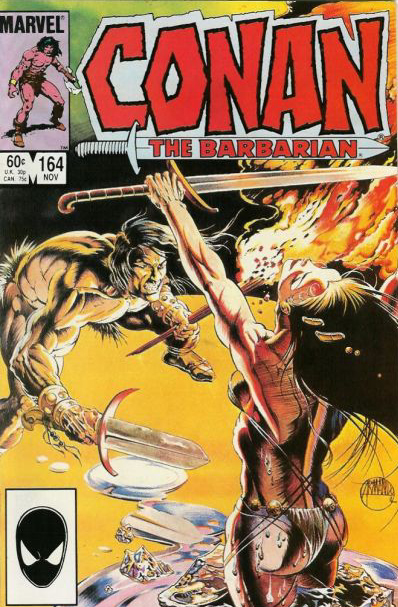
Conan the Barbarian #164 cover— The most interesting part of the fill-in issue is trying to figure out the engineering of the woman on the cover’s top. It’s an exotic design I’ve never seen in the real world, and I’m at a loss for how it could work. At first, I was confused about where the two straps on each side went after crossing her bottom, but I see one strap on each side goes down a leg and presumably is tied around her foot or calf. But then I realized there should be something pulling her top up — looping behind her neck, perhaps? — but there’s no evidence of that. How does it work?

— Ending the book on a cliffhanger — two, actually — is an intriguing idea. It gives readers a reason to return for The Chronicles of Conan, v. 22: Reavers in the Borderland and Other Stories, and it helps distinguish v. 21 from all the other Chronicles of Conan volumes. I think I will know what will happen between Conan, Fafnir, and Noirelle in Conan #168, but I’m not sure.

— Well, I think there are two cliffhangers; Conan the Barbarian Annual #7 ends abruptly, without resolving the plot. There’s no indication of where Thomas’s adaption of L. Sprague de Camp and Lin Carter’s novel Conan of the Isles will be continued. Based on Annual #7, the story probably shouldn’t be continued; the story has 33 pages, but it has only one moment of excitement and is notable only for Buscema’s best artwork in the book.

Rating: Conan symbol Conan symbol Half Conan symbol (2.5 of 5)

Labels: , , , , , , , , , ,

13 February 2012

Chronicles of Conan, v. 20: Night of the Wolf and Other Stories

Collects: Conan the Barbarian #151-9 (1983-4)

Released: December 2010 (Dark Horse)

Format: 200 pages / color / $18.99 / ISBN: 9781595825841

What is this?: Conan stabs his way through another nine issues of his eponymous series.

The culprits: Writer / artist John Buscema and writer Michael Fleischer, with fill-in art from Gary Kwapisz


There’s no doubt the comic book direct market is in trouble. Sales have been declining for years, and unlike at the direct market’s dawn, few titles are guaranteed a continued existence. This is discouraging for those of us who would enjoy long runs for new characters and titles or hope titles that have always been at the fringe of economic viability (Power Man & Iron Fist, Defenders, Alpha Flight, etc.) will get a new ongoing series. The only good news is that almost every current title should have a purpose or a hook.

You don’t see too many zombie titles any more. If you’ve read comics in the late 20th century, you’ve probably come across a zombie title or three. They’re the ones that lurched along, all semblance of life drained away, still repetitively doing all those things it did when it was new and vital. There’s no creative reason to publish these comics: no overarching plots, no exciting young creators looking to work with the character, no groundbreaking creativity. There’s just a semi-loyal audience hanging around, large enough to make money off of. For a Marvel comic, there’s something humorous about this: Marvel zombies helping zombie comics titles survive. A zombie support network, if you will.

Chronicles of Conan, v. 20: Night of the Wolf and Other Stories coverConan the Barbarian was a prime example of a zombie title. After original writer Roy Thomas left, there was a drop-off in the writing quality; few of his successors had a handle on Conan and his world like he did. Truth to tell, even Thomas was having trouble by the end of his long run. The title floundered. So by issue #151 — where Chronicles of Conan v. 20: Night of the Wolf and Other Stories begins — what was the purpose of this title?
The easy answer is that Conan stuck around to give artist John Buscema, often inked by his frequent Conan collaborator Ernie Chan, a place to play. Conan is the title the elder Buscema brother was most associated with, and if he wanted to do the title, why not let him? The art still looks great; there’s no doubt about that. Conan and his enemies are dynamic, active enough to still occasionally surprise the long-term reader with their vividness. Conan himself hasn’t devolved into a copy or parody artistically, although I have my doubts about his blue-sleeveless-tee-tucked-into-furry-bikini ensemble. Still, the monsters are monstrous, and the girls are as gorgeous as ever. And Buscema even started plotting the stories. Giving Buscema a forum for his work and keeping him happy seems a worthy goal, right?

But it’s hard to shake the idea that even the art has lost its freshness. I’ve seen the Conan / pretty girl / evil-wizard / monster set piece before, and if Buscema moves the elements of this stock tale around artfully, he can’t disguise that they are the same elements. I find myself wishing Marvel would have given Buscema a new challenge, something for him to flex his character design and artistic muscles on.

On the other hand, Conan must have sold. So the zombie stays in the publishing schedule.

The writing is a larger problem. Certainly there’s nothing new there. The stories aren’t the worst in the Chronicles of Conan series, but Buscema and Michael Fleischer (writer #151-4, dialogue #155-9) aren’t breaking new ground. There are no overarching plots, no development of Conan’s character (although 21st century readers should know that’s not a priority), and few characters — good or evil — are worth seeing again. Conan’s violent edge has dulled into a paternalistic affability; he’s a nice guy by this collection. A nice guy who guts a few people every issue, but he’s not out to destroy, and he’s not always on the make.

The same elements are used again and again — abducted maiden, lost city under attack (that one’s used twice), evil woman trying to control Conan (again, twice), the perilous inn. Issue #155, in which Conan rescues a grateful toady from a semi-competent wizard, is the best of the lot, and although there are a few attempts at twists (the wolf in #158, the wizard’s identity in #157), the execution produces limp results. (The twist in #158 is spoiled on cover, for instance.) This is partially down to Buscema, who is presumably learning the ropes as a writer; in #156, for instance, the final third of the story is a flashback in which Conan doesn’t appear.

I have to admit I didn’t initially catch that the title of #154 — “The Man-Bats of Ur-Zanarrh!” — was a play on a 1958 Batman story, “Batman — The Superman of Planet-X,” in which Batman encounters the Batman of Zur-En-Arrh, an alien planet. (Not many other people would have caught it had Grant Morrison not resurrected the idea for his recent Batman run.) Clever — but not clever enough to save the story or the book. In any event, when a war between winged humans and bat men on a floating city — a war in which Conan rides a giant dragonfly — seems a little ho-hum, it’s probably time to strike the curtain and call it a day.

There are reasons for zombie titles to exist — or there were, at least. They served as a safe place to launch new creators, such as Frank Miller on Daredevil, and new ideas. They provided a feeling of a shared universe, which was more important then than it is today. These zombie titles also give readers a nice feeling of continuity: there’s Conan on the newsstand; it’s been there for a decade, and it will still be there in another decade.

That last is a luxury the direct market will no longer allow, though, and the other two aren’t relevant to Night of the Wolf. The only reason for Conan to continue throughout the ‘80s was economic. But that’s not really a reason for anyone but Conan diehards to read Night of the Wolf in 2012.

Rating: Conan symbol Conan symbol (2 of 5)

Labels: , , , , , , , ,

05 August 2011

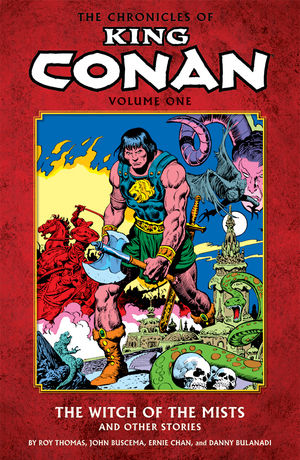
Chronicles of King Conan, v. 1: The Witch of the Mists and Other Stories

Collects: King Conan #1-5 (1980-1)

Released: August 2010 (Dark Horse)

Format: 192 pages / color / $18.99 / ISBN: 9781593074777

What is this?: Conan the barbarian is now the older Conan the king.

The culprits: Writer Roy Thomas and artist John Buscema

As we grow older, we learn things about ourselves. That we have an unexpected talent for cooking, perhaps, or that we’re never going to make it as a major-league shortstop, or if nothing else, that our abilities peak at some point during our youth, and only hard work will keep them from deteriorating in an alarming fashion. It’s a hard lesson to learn but a necessary one as we make the transition from youth to maturity.

In The Chronicles of King Conan, v. 1: The Witch of the Mists and Other Stories, however, writer Roy Thomas informs us that Conan never has to learn that lesson. He will always be at the top of his game, and he never truly reaches that mental maturity. Readers have been following Conan for 80 years — about 50 by the time the issues collected in King Conan came out — and in that time, the barbarian hero has changed little. You might expect that becoming king, with the responsibilities that entails, would change mighty Conan.

Chronicles of King Conan, v. 1: The Witch of the Mists and Other Stories coverYou would be wrong. Conan the King is the exact same character as Conan the Barbarian. True, Conan has an army behind him, and he has a son, but it has remarkably little effect on his behavior. And Thomas should know; forty years after Conan the Barbarian #1, v. 1, and Thomas is still the definitive Conan comic book writer.

King Conan begins with Conan’s son, Prince Conn, being kidnapped by a Hyperborean witch; King Conan decides to rescue his son alone. Fine; I understand that. But after the rescue and a battle in Zingara, Conan decides to take the fight and his army to Stygia, where Thoth-Amon, the architect of the kidnapping and unrest in Zingara, is hiding. That makes a modicum of sense, although Conan has always shown that a lone hero is better than an army when it comes to defeating wizards and monsters.

But Conan goes himself, and he takes along his heir, Conn. This, of course, is idiotic, as a non-dynastic king like Conan should return home to find his throne occupied and his wife (at best) exiled. Instead, Conan follows Thoth-Amon to the ends of the earth, heading farther and farther from his kingdom, each mile being one more he’ll have to travel on the way back. This is the way of the American action hero, I realize, to take care of such things by himself, but it’s not one of that archetype’s more endearing attributes. There is no cunning to this Conan, and less intelligence. He has no real plan, blundering farther and farther south and endangering his son and his men. I think the idea is that Conan is a pre-historic Alexander, putting the world under his boot, but there’s nothing to support that idea other than Conan’s continuing but illogical success and an inexhaustible supply of willing soldiers.

Conan, as a king, should be confronted with different problems than when he was an adventurer. But there’s no statecraft here or even large-scale battles, no intrigues or imperial entanglements. For some reason, no one engages his army or presents any challenge to them other than their intended adversaries; the countries he invades to fight these wizards don’t protest at all. Why should they? It’s Conan! There are a surfeit of wizards to kill, strange places to visit, usurpers to depose, and monsters to fight — just like before. Such a static world for a character like Conan.

Part of the problem is Thomas’s mania for adapting stories. Issues #1-4 are adapted from stories by L. Sprague de Camp and Lin Carter: “The Witch of the Mists,” “The Black Sphinx of Nebthu,” “Red Moon of Zembabwei,” and “Shadows in the Skull,” which were originally published in the ‘70s and collected in Conan of Aquilonia. Issue #5 starts retelling 1957’s Conan the Avenger, by Björn Nyberg and de Camp, in flashback. It seems odd that Thomas would let other authors choose his opening arc, especially an arc so problematic as those in Conan the Aquilonia. That’s not to say Thomas slavishly followed the original stories or that adapting stories is a bad idea; for instance, Thomas’s creation of Red Sonja was a result of adapting a non-Conan story by Robert E. Howard, “The Shadow of the Vulture.” And I understand that those four stories had the setup that Thomas wanted to start with. But I think using those stories at a later point would have been a better idea.

There are two redeeming points to King Conan. One is the book shows the maturation of Conn. His father is an impossible role model to live up to, but he tries anyway. He kills his first man in this book, and he gets a glimpse of true evil in Thoth-Amon. If Conan had sent Conn on a military campaign while Conan stayed at home, to get the boy some seasoning, this might have been a fascinating story, although it would have made it into Conan: The Next Generation. (Not that I would have minded.) The idea of telling the story of this prince maturing into a man is a good one; it’s just not what the book is about.

The second highlight is John Buscema’s art. Thomas is Conan’s definitive writer, and Buscema is one of the two most celebrated Conan artists. His Conan is much the same as it was in Conan the Barbarian — he has crow’s feet, and his hair is grayer, but he’s still strong as ever. His Conn is more realistic, strong for a teenager but obviously not Conan. Since the material is much the same as Conan the Barbarian, he gets to draw monsters and wizards and … well, not many scantily clad women, but there are some. Fans of Buscema’s Conan work will likely not be disappointed.

But they won’t be surprised, either. And that’s the problem with King Conan. Despite the change in premise, there is little to discover that you can’t find in Dark Horse’s Chronicles of Conan series.

Rating: Conan symbol Half Conan symbol (1.5 of 5)

Labels: , , , , , , , ,

03 May 2011

Dark Horse, IDW, and Image July 2011 solicitations (collected editions)

Hey, Image’s solicits are on time this month! In honor of its timeliness, let’s get the show on the road:

Will buy:

Nothing this month. Sorry, independents! Might buy eventually:

  • Chew, v. 4: Flambé: I’ve read v. 1, and I frequently consider picking the series back up. I haven’t done so yet, but with this price point, it’s only a matter of time. ($12.99; Image)
  • Scud, the Disposable Assassin: The Whole Shebang!: This is a series I’ve heard about almost since it first came out in the mid-‘90s. With the whole series in one volume, I might have to give it a look. ($29.99; Image)
Might buy if the price is right:

  • Green River Killer: A True Detective Story (hardcover): I am a sucker for true crime, and I’m familiar with the Green River Killer, having read Anne Rule’s Green River, Running Red. I might be interested enough to pick this up to get another perspective on the serial killer. ($24.99; Dark Horse)
  • Parker: The Martini Edition (hardcover): Darwyn Cooke writing and drawing a noir adaptation is always worth a look. Not worth $75, but it is two of Cooke’s Parker tales in one volume. ($75, ISBN: 978-1-60010-980-5; IDW)
The Rest:

  • Angel Omnibus, v. 2 ($24.99, ISBN: 978-1-60010-968-3; IDW)
  • Angel: The Covers (hardcover): No. ($19.99, ISBN: 978-1-60010-969-0; IDW)
  • Archie: Americana, v. 2: The ’50s (hardcover): The gradual evolution of Archie Comics’s art style continues; the jokes remain the same. ($24.99, ISBN: 978-1-60010-945-4; IDW)
  • Bomb Queen: Gang Bang: Tasteful, as Bomb Queen always is. ($14.99; Image)
  • 'Breed, v. 2: The Book of Ecclesiastes ($17.99; Image)
  • Chimichanga (hardcover): One of two Dark Horse collected editions this month. This one, written and drawn by The Goon’s Eric Powell, is about a bearded girl at a circus who trades for an egg that hatches the Chimichanga. Despite the rumors, the book is not going to be a free giveaway at Taco Bell. ($14.99; Dark Horse)
  • Classic G.I. Joe, v. 12 ($24.99, ISBN: 978-1-60010-972-0; IDW)
  • Classic Next Men, v. 1: IDW started John Byrne’s new Next Men last month, and they reprinted the original #1 last ($24.99, ISBN: 978-1-60010-971-3; IDW)
  • Dave Stevens: The Complete Sketchbook Collection (hardcover): If you like your girls pretty but fictional, Stevens is the man for you. Or at least one of the men for you. ($50; ISBN: 978-1-61377-037-5; IDW)
  • Death Valley ($17.99; ISBN: 978-1-60010-973-7; IDW)
  • Doctor Who II, v. 1: The Ripper: I watch the Doctor Who TV series, but I have no interest in original comic book stories, no matter what the plot. When the TV show is generally outrageous anyway, what’s the incentive to read a story in a spin-off medium? ($19.99, ISBN: 978-1-60010-974-4; IDW)
  • Edge of Doom ($19.99, ISBN: 978-1-60010-927-0; IDW)
  • Elephantmen, v. 2: Fatal Diseases – Revised Edition: I have heard good things about this book, but this solicitation — full of pachyderm puns — makes it seem intolerable. ($24.99; Image)
  • Fallen Angel: Return of the Son: Despite what you might think, this has nothing to do with the Whedon vampire Angel. ($17.99, ISBN: 978-1-60010-975-1; IDW)
  • From Bloom County to Mars: The Imagination of Berkeley Breathed ($20, ISBN: 978-1-61377-008-5; IDW)
  • G.I. Joe: A Real American Hero, v. 2 ($19.99, ISBN: 978-1-60010-941-6; IDW)
  • Haunt: The Immortal Edition, v. 1 (hardcover; $34.99; Image)
  • Infestation, v. 1: You can hire Dan Abnett and Andy Lanning to write this, but it doesn’t make a zombie crossover involving Star Trek, G.I. Joe, and Ghostbusters any less silly. ($19.99, ISBN: 978-1-60010-977-5; IDW)
  • Iron Siege: Nazis and monsters — but I repeat myself — are two horrible tastes that do absolutely nothing for me when put together. ($17.99, ISBN: 978-1-60010-979-9; IDW)
  • Locke & Key: Crown of Shadows: Joe Hill, the writer of this series, is Stephen King’s son. I didn’t know that until last night. How could I not have know that? ($19.99, ISBN: 978-1-60010-953-9; IDW)
  • Marineman: A Matter of Life and Depth ($17.99; Image)
  • Meta 4: The Complete Series (digest): The story is full of symbols, but the title goes for a cheap, text-speak pun. The contradiction is obvious. ($14.99; Image)
  • Rip Kirby, v. 4 (hardcover): The final volume in IDW’s collection of a comic strip I’ve never heard of. Comic historians, this one’s for you. ($49.99, ISBN: 978-1-60010-989-8; IDW)
  • Spawn: New Beginnings: A new Spawn! I … I don’t care. And I’m sure my personal yawn is echoed by most comics fans. ($14.99; Image)
  • Spinecrawler ($17.99, ISBN: 978-1-60010-987-4; IDW)
  • Strange Girl Omnibus (hardcover; $59.99; Image)
  • The Darkness Compendium, v. 2 (hardcover): There are people out there who will pay $100 for a Darkness collection. Well, I assume there are. I haven’t met them. ($99.99; Image)
  • Transformers, v. 3 ($19.99; ISBN: 978-1-60010-981-2; IDW)
  • Turf (hardcover): BBC presenter Jonathan Ross’s story of Prohibition-era gangsters, vampires, and aliens. Reports I have heard ranged from fun romp to confusing mishmash. ($39.99; Image)
  • Twisted Savage Dragon Funnies ($18.99; Image)
  • Walter Simonson’s Thor: Artist’s Edition (hardcover): I do not share the general enthusiasm for Simonson’s Thor, but for people who do, this might be a fascinating look at the run. Or it might be an overpriced coffee table book. Who knows? ($75, ISBN: 978-1-61377-038-2; IDW)
  • Witchblade: Redemption, v. 3: It is 2011, and Witchblade is still being published. Hooray! ($19.99; Image)

Labels: , , , , ,

05 April 2011

Dark Horse and IDW June 2011 solicitations (collected editions)

Will be picking up: Nothing. Sorry, IDW and Dark Horse! It’s not your fault I have provincial tastes!

Might pick up eventually:

  • Dungeons & Dragons, v. 1: Shadowplague (hardcover): Comic adaptations of D&D are generally, well, crap. (Sorry, DC and everyone who worked on their ‘90s D&D comics!) Still, the idea of fantasy comics is a worthwhile one, as the various Conan comics point out and CrossGen noticed. So I might manage to pick this one up eventually and see if it’s a good story or if it’s awkwardly adapted game mechanics and traditions. ($24.99, 9781600109225; IDW)

Might pick up if the price is right:

  • Billy the Kid’s Old Timey Oddities and the Ghastly Fiend of London, v. 2 ($15.99; Dark Horse)
  • Next Men, v. 1 (hardcover): This is the new series rather than a reprint of the series in the ‘90s. For those of us who didn’t read the original, IDW is also reprinting Next Men, v. 1, #1 for $1 under their 100 Penny Press banner. ($21.99, 9781600109249; IDW)

Competing 1940s Archie collections!:

  • Archie Archives, v. 2 (hardcover) ($49.99; Dark Horse)
  • Archie: Americana, v. 1: The '40s (hardcover): Which to choose? The IDW book is a compilation of two “Best of the Forties” books, according to the solicitations, and the Dark Horse book reprints material in chronological order. For the casual Archie enthusiast — and you know who you are; yes, you, sir, in the back of the Nebraska — Americana is probably the best idea, but the hard-core Archie fan (the ones who like their malteds double strong) will look forward to the Archives. ($24.99; 9781600109317; IDW)

Manga:

  • Drifters, v. 1 ($$12.99; Dark Horse)
  • Eden: It’s an Endless World!, v. 13 ($12.99; Dark Horse)
  • Gantz, v. 18 ($12.99; Dark Horse)
  • Oh My Goddess!, v. 39 ($10.99; Dark Horse)

The Rest:

  • 30 Days of Night Prestige Edition: For those who want prestige in their horror comics. ($50, 9781600109560; IDW)
  • Angel, v. 3: The Wolf, the Ram, and the Heart ($24.99, 9781600109447; IDW)
  • B.P.R.D.: Hell on Earth, v. 1: New World: Tough to go wrong with Guy Davis art — I mean, if you can’t have Mignola, Davis would be in my top three choices — but for some reason I resist the BPRD books. Perhaps I’m recalling gradually getting sucked into auxiliary X-titles in ‘90s and transferring the dislike to all spinoff titles. ($19.99; Dark Horse)
  • Boris Karloff Tales of Mystery Archives, v. 6 (hardcover) ($49.99; Dark Horse)
  • Caniff ($49.99, 9781600109201; IDW)
  • Danger Girl Campbell Sketchbook (hardcover): There are people out there that still want this? Really? When did the last Danger Girl come out? (*checks notes*) OK, a mini in 2007, but J. Scott Campbell hasn’t drawn the book since a one-shot in 2004, and he hasn’t worked on more than Danger Girl issue in a year since last century. And why isn’t this coming out from Wildstorm / DC or Image, which are the companies that published Danger Girl in the first place? ($19.99; 9781600109218; IDW)
  • Deadworld Classics, v. 2 ($24.99, 9781600109256; IDW)
  • Flash Gordon Comic Book Archives, v. 4 (hardcover) ($49.99; Dark Horse)
  • G.I. Joe: Cobra, v. 4: Death of Cobra Commander ($17.99, 9781600109881; IDW)
  • Jericho: Season Three: Somewhere there is a Venn diagram that shows the overlap between Jericho fans and comic book readers, and I suspect that overlap is pretty tiny. ($19.99, 9781600109393; IDW)
  • Jurassic Park: The Devils in the Desert: I realize IDW is making a John Byrne push this month, but this is the best Byrne property it could find? ($17.99, 9781600109232; IDW)
  • Little Lulu, v. 28: The Prize Winner and Other Stories: Twenty-eight volumes of Little Lulu? Huh. ($14.99; Dark Horse)
  • Locke & Key, v. 4: Keys to the Kingdom (hardcover) ($24.99, 9781600108860; IDW)
  • Something Monstrous! ($17.99, 9781600109287; IDW)
  • Space Family Robinson Archives, v. 1 (hardcover): Collecting issues from Gold Key Comics … of an idea more famously adapted as Lost in Space. I ask this sarcastically sometimes, but I truly wonder who the audience for this collection is: comics historians? Nostalgic 40- or 50-somethings? Is this a lost gem that I just don’t know about? ($49.99; Dark Horse)
  • Star Wars Omnibus: A Long Time Ago..., v. 4: I’m not interested in this, but I have to admit, $25 for eighteen full-color issues is an excellent deal, even when you take the non-standard size into account. ($24.99; Dark Horse)
  • Star Wars: Knight Errant—Aflame ($17.99; Dark Horse)
  • Suicide Forest: Not to be confused with IDW’s Suicide Girls series. This sounds more like an American attempt at J-horror. ($17.99, 9781600109478; IDW)
  • Transformers Classics, v. 1 ($24.99, 9781600109355; IDW)
  • Transformers Prime, v. 3 ($7.99, 9781600109607; IDW)
  • Transformers: The Complete All Hail Megatron (hardcover) ($75, 9781600109553; IDW)

Labels: , , , ,