Reviews of trade paperbacks of comic books (mostly Marvel), along with a few other semi-relevant comments / reviews.

10 August 2013

Chronicles of Conan, v. 23: Well of Souls and Other Stories

Collects: Conan the Barbarian #174-81 and Conan the Barbarian Annual #10 (1985-6)

Released: March 2013 (Dark Horse)

Format: 232 pages / color / $18.99 / ISBN: 9781616550523

What is this?: Conan, along with a Zingaran captain and a teenage girl, continues looking for a fabulous treasure, but he finds more than he’s looking for.

The culprits: Writer Jim Owsley and artists John Buscema and Ernie Chan


In previous reviews of the Chronicles of Conan series, I have complained about a great many things. The most important, to me, was the series’ lack of supporting characters and ongoing narrative. Every issue was the same: Conan steps into a new situation, starts stabbing people, and walks out the end, often as the only survivor. That narrative doesn’t provide much tension: He has to survive, since he’s the main character.

With Chronicles of Conan, v. 23: Well of Souls and Other Stories, writer Jim Owsley (the future Christopher Priest) has changed that. Conan has a partner, Zingaran captain Delmurio, and a sidekick, Tetra, a lovestruck teenage girl who Conan has taught to be a fearsome warrior. They are on a quest to find treasure — simple enough, but one rarely used for long-form Conan stories.
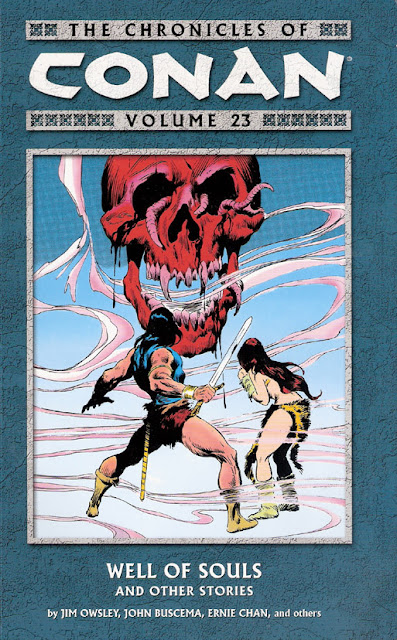
Chronicles of Conan, v. 23: Well of Souls and Other Stories coverWell of Souls isn’t going to convince a reader with no interest in Conan to start reading the series. However, it might lure readers who are interested in the character or concept back to the series by giving them reasons to invest in the title rather than an individual story. The supporting cast is vivid enough to make readers care about them. Delmurio and Tetra have personalities, and readers will most likely have an opinion about them; when they leave Conan’s side, the barbarian picks up a new companion, who will presumably also make readers like or hate him. The extended plot pays off in a not completely unexpected fashion after seven issues (two in the previous volume, Reavers in the Borderland), and a new plotline begins.

It’s a solid foundation for a series. It’s only a baseline, but it saddens me how badly previous volumes miss that mark.

The individual issues are on the whole mildly interesting, elevated by the structure but showing only flashes of excellence. Issue #175, with its war-haunted river town and mysterious boatman, is the most atmospheric and probably the best issue in the collection. Even the less interesting issues have elements that momentarily pique interest; the opening story, which largely revolves around a mob of uninteresting war orphans, has some surprisingly vicious moments and ruminations about the ethics of keeping occupied populations in line that redeems the fleeting romances and undifferentiated crowds.

Despite my faint praise for the individual issues, Owsley has a better handle on Conan’s world than the writers who preceded him. The settings are filled with casual violence and superstitious people who cannot recognize false prophets or true prophecy when it is shouted at them. People die soon after they appear, and they die when it seems like they are going to join the ongoing cast. Owsley gives the protagonist more dimensions than he usually possesses in Marvel comics; the Conan in Well is as brooding, angry, and violent as usual, but the presence of Tetra restrains his lustful side. The narration says he is affected by her resemblance to lost lovers Red Sonja and Bêlit, but it’s clear Conan sees her adoration and reacts to it. Given her youth, he can’t return her affection, and he doesn’t want to reject her outright, so he doesn’t flaunt his sexual preference of other women to her. When her eyes are no longer on the barbarian, Conan goes back to his lecherous ways almost immediately.

Well of Souls has plenty of areas where it could be improved; better choices by editor Larry Hama might have prevented colorist George Roussos from assaulting readers’ eyes with a technicolor Hyborian Age or convinced artist John Buscema to cast aside the teenage Tetra’s furry bikini and loincloth ensemble, even if it is accessorized with green furry boots. (What animal could those boots have come from?) Making the spelling of man-monster Keiv (not “Kiev”) consistent would have helped. Having Owsley restate the overarching plot — on a quest to find treasure, based on a map Conan and Delmurio each have half of — would have been useful as well, since the reader often knows only that the trio are going to some destination. Hama also makes a mistake in issue #176, referring to Conan’s adventure with ex-mercenary Redondo as being in Annual #9 instead of #10. Since Annual #10 is included in Well, that’s not a big problem, but collection editor Chris Warner might have given the story in #176 greater impact by putting Annual #10 before #176. On the other hand, the continuing narrative doesn’t give much room for the annual, so it might not have been feasible.

The ever-reliable John Buscema drew all the issues of the regular series. Buscema was getting near 60 when these issues came out, but his art is as strong and vivid as ever. Owsley’s intense Conan would not work half so well with another artist, as Buscema’s work on the barbarian hero conveys a hardness that has nothing to do with his musculature. Buscema’s penchant for cheesecake — de rigueur for fantasy, I know — gets a little out of hand, as no woman in Well conceals her navel, and Tetra’s outfit is, as described, gratuitous. Frequent Conan inker Ernie Chan penciled the annual and does a good job of it.

The immediate future looks good for the title. The overarcing plot is controlled by a new adversary, not Conan, but the villain looks like he has a plan and is putting it into place. With Owsley remaining on Conan until #213 (another four volumes or so), the stories should retain their barbarousness, and Conan should remain well rounded.

Rating: Conan symbol Conan symbol Conan symbol Half Conan symbol (3.5 of 5)

Labels: , , , , , , , ,

18 January 2013

Chronicles of Conan, v. 22: Reavers in the Borderland and Other Stories

Collects: Conan the Barbarian Annual #8-9 and Conan the Barbarian #168-73 (1983-4, 1985)

Released: June 2012 (Dark Horse)

Format: 224 pages / color / $18.99 / ISBN: 9781595828125

What is this?: Conan joylessly wenches and kills his way through more of the Hyborian Age.

The culprits: Writers Michael Fleisher and Jim Owsley and artists John Buscema, Ernie Chan, and Val Mayerik


Writer Michael Fleisher’s work in Chronicles of Conan, v. 21: Blood of the Titan and Other Stories left me optimistic the quality of the Chronicles of Conan would improve from its consistently forgettable levels. And then The Chronicles of Conan, v. 22: Reavers in the Borderland and Other Stories jammed a broadsword through that optimism.

I wasn’t expecting a return to Roy Thomas levels of quality but something memorable about the stories in Reavers in the Borderland — about any story in Reavers, actually. Introducing Fafnir, a sidekick / partner for the title barbarian, distinguished Blood of the Titan from other books in the series. The rivalry and friendship of the two added a new dimension to Conan’s character, and for once, there was a character in Conan (other than Conan) I gave a damn about.

 cover But Fafnir is dropped from the stories in Reavers, and the series returns to random hack-and-slash action, full of gaudily colored thugs, wizards, and bravos trying to cut Conan down. Fleisher, who wrapped up his two-year run with #171, writes largely forgettable pieces, studded with violence and lady flesh. Fleisher’s stories show little wit and feature no memorable characters. The images parade in front of the eyes and then vanish, leaving as much of an impression upon Conan as they do the reader — that is, none.

In Reavers, Conan saves an old ally from a carnival (?!) sideshow. Conan protects a wench from some of his old enemies, only to find she is more than she seems. A wizard needs help with a demon and a cursed sword; that takes two issues to resolve. Conan appears to die; the reader yawns, not particularly caring how he survives. (Poison coma, if you’re interested. You shouldn’t be, though.)

I almost called Fleisher’s stories continuity-free, but that’s not true; he reuses characters from his run in two of his stories. In #168, Conan chances across Alhambra, the winged woman from #153-4 (The Chronicles of Conan, v. 20: Night of the Wolf and Other Stories), and saves her from the sideshow and her old enemies, the Batmen of Ur-Xanarrh. (He almost burns her and everyone in the carnival to death first, though.) In #171, he fails to protect a girl from the Brotherhood of the Falcon, which he fought in #162 (Blood of the Titan). But Alhambra is just a pretty face (and pair of wings) who doesn’t stick around, and despite “killing” Conan, the Brotherhood of the Falcon is just another group of faceless goons, with little to distinguish them from a random wizard’s henchmen or a corrupt duke’s soldiers. Fafnir, the saving grace of the last volume, does come back briefly in #170, although it’s only to say goodbye.

What Conan needs is a supporting cast, people who stay with him. They don’t have to stay forever; three or four issues would be fine. But Conan needs a contrast in the story, someone to express himself to (even if it’s by not saying anything), or else the book becomes the story of a guy with a sword killing random stuff, with as much character as a video game avatar. Not becomes, I guess — became, and that happened a long time ago.

Jim Owsley (known today as Christopher Priest) starts with #172, and things change for the better. The remaining two stories are to parts of a larger storyline set in the Pictish wilderness. Conan gains a sidekick, a pretty girl — giving artist John Buscema just what he needs: even more opportunities to draw pretty girls — and still has a hapless victim to protect. Owsley writes a more brutish Conan than Fleisher, who has Conan give his horse to a woman who just tried to steal his sword. Owsley’s Conan is plainspeaking and rude, saying hurtful things to people who might not deserve it. It’s a refreshing change; Conan should have some teeth. Issues #182-3 augur well for the future, and many people really like Owsley’s work on Conan.

But I’ve been burned before. The potentially explosive cliffhangers in Blood resolve as damp squibs in Reavers. I thought I had a handle on how the story in #167 would be resolved. I was wrong; I didn’t expect Fleisher to make the bold choice of ignoring the dangling plot altogether. The cliffhanger in Annual #7 seems similarly forgotten, although it was resolved eventually. Not in Conan the Barbarian or a Conan Annual or even Savage Sword of Conan, but in the Conan of the Isles graphic novel, which came out six years after Annual #7. I’m not going to change my rating of Blood, but the lack of payoff in Reavers does devalue the story in Blood.

There are many roles I rarely discuss in my reviews: colorists, editors, letterers … Reavers made me consider the reprint editor, which in this case is Chris Warner. Unfortunately, my attention is not to his benefit. Warner leads off the book with two Conan the Barbarian Annuals (#8 and 9). They were published before the Conan the Barbarian issues in this collection, but since I was looking forward to the continuation of Fafnir’s story, the beginning of this book seemed a poor place to put the annuals. (The wait also made the weak payoff even more disappointing.) Between Fleisher’s and Owsley’s runs would have been a better place, and it’s not like anyone was paying attention to Conan’s chronology at this point.

As for art: Buscema’s in fine form. His work looks better with inks from Bob Camp (#169-70, 172-3) than from Armando Gil (#171) or Buscema himself (#168), though. The final two issues are especially superb and sharp, even if I wish Bucema would get rid of Conan’s blue-sleeveless-tee-and-fur-underwear combo. Ernie Chan draws an action-packed Annual #9, although he can’t quite measure up to Buscema. Val Mayerik supplies the art for Annual #8, and I was too distracted by his tentative inking to say anything about his pencils. (This book is a warning against self-inking, really.)

Maybe my optimism isn’t dead; maybe it will survive the bloody attack that is Reavers in the Borderland. But even if it can survive this crummy book, you should skip Reavers. Reavers has little to recommend it, other than Buscema’s art, and Buscema’s work is in so many better Chronicles. Oh, there might be something to the Owsley run, and if there is, it’s going to annoying to miss the first two issues. Still: do not be tempted to buy this waste of time. It’s not worth it.

Rating: Half Conan symbol (0.5 of 5)

Labels: , , , , , , , , , , ,

15 June 2012

Chronicles of Conan, v. 21: Blood of the Titan and Other Stories

Collects: Conan the Barbarian #160-7, Conan the Barbarian Annual #7 (1982, 1984-5)

Released: August 2011 (Dark Horse)

Format: 200 pages / color / $18.99 / ISBN: 9781595827043

What is this?: More Conan, although this time he starts adventuring with an old comrade long thought dead.

The culprits: Writers Michael Fleisher, Roy Thomas, and Larry Yakata and artists John Buscema


Chronicles of Conan, v. 21: Blood of the Titan and Other Stories coverI’m heading out on vacation, so I’m a little short on time this week. That’s fortunate, because there’s no reason to give a full-length review of Chronicles of Conan, v. 21: Blood of the Titan and Other Stories; most of what I said about v. 20: Night of the Wolf and Other Stories, holds true again. That being said:

John Buscema is still awesome, even if he still dresses Conan in a blue sleeveless T-shirt and a fur bikini.

— Giving Conan a sidekick — or partner — is a great idea by writer Michael Fleisher. Fafnir, left for dead in Conan the Barbarian #20, reappears in #161 without his left arm. His impetuousness frequently gives the stories an impetus they wouldn’t otherwise have, and he has a character arc — an obvious one, but at least it’s an arc, and it helps get rid of the aimless feeling Conan has had for quite a while.

— A character named “Gurneg” appears in three issues: Conan #160, 161, and 163. It’s a different character each time, and Gurneg always dies. What does Fleisher have against Gurneg? And why, after killing him three times, does he stop killing him?

— A fill-in issue (#164) is dropped into the middle of the Fafnir arc without explanation, which goes about as well as would be expected. Larry Yakata writes a surprisingly hard-hearted, battle-weary Conan that is more in line with creator Robert E. Howard’s barbarian than Marvel writer Roy Thomas’s Code-approved interpretation. Yakata’s Conan is just as stupid as Thomas’s, though.

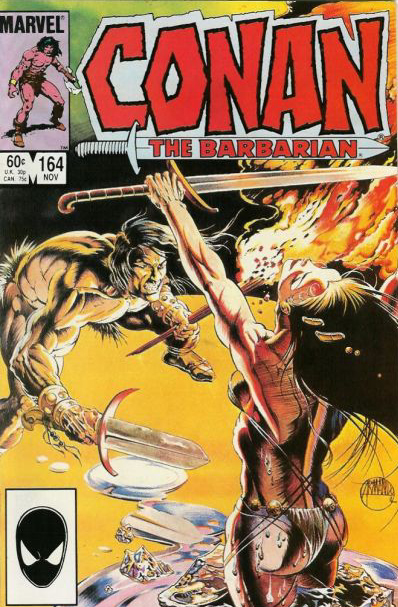
Conan the Barbarian #164 cover— The most interesting part of the fill-in issue is trying to figure out the engineering of the woman on the cover’s top. It’s an exotic design I’ve never seen in the real world, and I’m at a loss for how it could work. At first, I was confused about where the two straps on each side went after crossing her bottom, but I see one strap on each side goes down a leg and presumably is tied around her foot or calf. But then I realized there should be something pulling her top up — looping behind her neck, perhaps? — but there’s no evidence of that. How does it work?

— Ending the book on a cliffhanger — two, actually — is an intriguing idea. It gives readers a reason to return for The Chronicles of Conan, v. 22: Reavers in the Borderland and Other Stories, and it helps distinguish v. 21 from all the other Chronicles of Conan volumes. I think I will know what will happen between Conan, Fafnir, and Noirelle in Conan #168, but I’m not sure.

— Well, I think there are two cliffhangers; Conan the Barbarian Annual #7 ends abruptly, without resolving the plot. There’s no indication of where Thomas’s adaption of L. Sprague de Camp and Lin Carter’s novel Conan of the Isles will be continued. Based on Annual #7, the story probably shouldn’t be continued; the story has 33 pages, but it has only one moment of excitement and is notable only for Buscema’s best artwork in the book.

Rating: Conan symbol Conan symbol Half Conan symbol (2.5 of 5)

Labels: , , , , , , , , , ,

13 February 2012

Chronicles of Conan, v. 20: Night of the Wolf and Other Stories

Collects: Conan the Barbarian #151-9 (1983-4)

Released: December 2010 (Dark Horse)

Format: 200 pages / color / $18.99 / ISBN: 9781595825841

What is this?: Conan stabs his way through another nine issues of his eponymous series.

The culprits: Writer / artist John Buscema and writer Michael Fleischer, with fill-in art from Gary Kwapisz


There’s no doubt the comic book direct market is in trouble. Sales have been declining for years, and unlike at the direct market’s dawn, few titles are guaranteed a continued existence. This is discouraging for those of us who would enjoy long runs for new characters and titles or hope titles that have always been at the fringe of economic viability (Power Man & Iron Fist, Defenders, Alpha Flight, etc.) will get a new ongoing series. The only good news is that almost every current title should have a purpose or a hook.

You don’t see too many zombie titles any more. If you’ve read comics in the late 20th century, you’ve probably come across a zombie title or three. They’re the ones that lurched along, all semblance of life drained away, still repetitively doing all those things it did when it was new and vital. There’s no creative reason to publish these comics: no overarching plots, no exciting young creators looking to work with the character, no groundbreaking creativity. There’s just a semi-loyal audience hanging around, large enough to make money off of. For a Marvel comic, there’s something humorous about this: Marvel zombies helping zombie comics titles survive. A zombie support network, if you will.

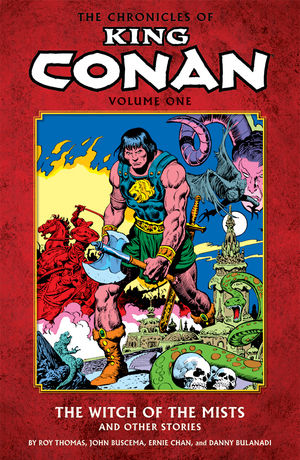
Chronicles of Conan, v. 20: Night of the Wolf and Other Stories coverConan the Barbarian was a prime example of a zombie title. After original writer Roy Thomas left, there was a drop-off in the writing quality; few of his successors had a handle on Conan and his world like he did. Truth to tell, even Thomas was having trouble by the end of his long run. The title floundered. So by issue #151 — where Chronicles of Conan v. 20: Night of the Wolf and Other Stories begins — what was the purpose of this title?
The easy answer is that Conan stuck around to give artist John Buscema, often inked by his frequent Conan collaborator Ernie Chan, a place to play. Conan is the title the elder Buscema brother was most associated with, and if he wanted to do the title, why not let him? The art still looks great; there’s no doubt about that. Conan and his enemies are dynamic, active enough to still occasionally surprise the long-term reader with their vividness. Conan himself hasn’t devolved into a copy or parody artistically, although I have my doubts about his blue-sleeveless-tee-tucked-into-furry-bikini ensemble. Still, the monsters are monstrous, and the girls are as gorgeous as ever. And Buscema even started plotting the stories. Giving Buscema a forum for his work and keeping him happy seems a worthy goal, right?

But it’s hard to shake the idea that even the art has lost its freshness. I’ve seen the Conan / pretty girl / evil-wizard / monster set piece before, and if Buscema moves the elements of this stock tale around artfully, he can’t disguise that they are the same elements. I find myself wishing Marvel would have given Buscema a new challenge, something for him to flex his character design and artistic muscles on.

On the other hand, Conan must have sold. So the zombie stays in the publishing schedule.

The writing is a larger problem. Certainly there’s nothing new there. The stories aren’t the worst in the Chronicles of Conan series, but Buscema and Michael Fleischer (writer #151-4, dialogue #155-9) aren’t breaking new ground. There are no overarching plots, no development of Conan’s character (although 21st century readers should know that’s not a priority), and few characters — good or evil — are worth seeing again. Conan’s violent edge has dulled into a paternalistic affability; he’s a nice guy by this collection. A nice guy who guts a few people every issue, but he’s not out to destroy, and he’s not always on the make.

The same elements are used again and again — abducted maiden, lost city under attack (that one’s used twice), evil woman trying to control Conan (again, twice), the perilous inn. Issue #155, in which Conan rescues a grateful toady from a semi-competent wizard, is the best of the lot, and although there are a few attempts at twists (the wolf in #158, the wizard’s identity in #157), the execution produces limp results. (The twist in #158 is spoiled on cover, for instance.) This is partially down to Buscema, who is presumably learning the ropes as a writer; in #156, for instance, the final third of the story is a flashback in which Conan doesn’t appear.

I have to admit I didn’t initially catch that the title of #154 — “The Man-Bats of Ur-Zanarrh!” — was a play on a 1958 Batman story, “Batman — The Superman of Planet-X,” in which Batman encounters the Batman of Zur-En-Arrh, an alien planet. (Not many other people would have caught it had Grant Morrison not resurrected the idea for his recent Batman run.) Clever — but not clever enough to save the story or the book. In any event, when a war between winged humans and bat men on a floating city — a war in which Conan rides a giant dragonfly — seems a little ho-hum, it’s probably time to strike the curtain and call it a day.

There are reasons for zombie titles to exist — or there were, at least. They served as a safe place to launch new creators, such as Frank Miller on Daredevil, and new ideas. They provided a feeling of a shared universe, which was more important then than it is today. These zombie titles also give readers a nice feeling of continuity: there’s Conan on the newsstand; it’s been there for a decade, and it will still be there in another decade.

That last is a luxury the direct market will no longer allow, though, and the other two aren’t relevant to Night of the Wolf. The only reason for Conan to continue throughout the ‘80s was economic. But that’s not really a reason for anyone but Conan diehards to read Night of the Wolf in 2012.

Rating: Conan symbol Conan symbol (2 of 5)

Labels: , , , , , , , ,

05 August 2011

Chronicles of King Conan, v. 1: The Witch of the Mists and Other Stories

Collects: King Conan #1-5 (1980-1)

Released: August 2010 (Dark Horse)

Format: 192 pages / color / $18.99 / ISBN: 9781593074777

What is this?: Conan the barbarian is now the older Conan the king.

The culprits: Writer Roy Thomas and artist John Buscema

As we grow older, we learn things about ourselves. That we have an unexpected talent for cooking, perhaps, or that we’re never going to make it as a major-league shortstop, or if nothing else, that our abilities peak at some point during our youth, and only hard work will keep them from deteriorating in an alarming fashion. It’s a hard lesson to learn but a necessary one as we make the transition from youth to maturity.

In The Chronicles of King Conan, v. 1: The Witch of the Mists and Other Stories, however, writer Roy Thomas informs us that Conan never has to learn that lesson. He will always be at the top of his game, and he never truly reaches that mental maturity. Readers have been following Conan for 80 years — about 50 by the time the issues collected in King Conan came out — and in that time, the barbarian hero has changed little. You might expect that becoming king, with the responsibilities that entails, would change mighty Conan.

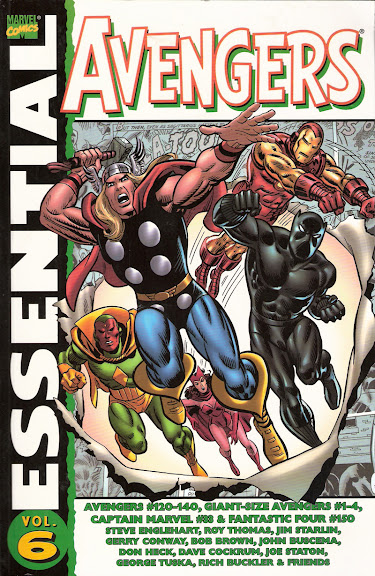
Chronicles of King Conan, v. 1: The Witch of the Mists and Other Stories coverYou would be wrong. Conan the King is the exact same character as Conan the Barbarian. True, Conan has an army behind him, and he has a son, but it has remarkably little effect on his behavior. And Thomas should know; forty years after Conan the Barbarian #1, v. 1, and Thomas is still the definitive Conan comic book writer.
King Conan begins with Conan’s son, Prince Conn, being kidnapped by a Hyperborean witch; King Conan decides to rescue his son alone. Fine; I understand that. But after the rescue and a battle in Zingara, Conan decides to take the fight and his army to Stygia, where Thoth-Amon, the architect of the kidnapping and unrest in Zingara, is hiding. That makes a modicum of sense, although Conan has always shown that a lone hero is better than an army when it comes to defeating wizards and monsters.

But Conan goes himself, and he takes along his heir, Conn. This, of course, is idiotic, as a non-dynastic king like Conan should return home to find his throne occupied and his wife (at best) exiled. Instead, Conan follows Thoth-Amon to the ends of the earth, heading farther and farther from his kingdom, each mile being one more he’ll have to travel on the way back. This is the way of the American action hero, I realize, to take care of such things by himself, but it’s not one of that archetype’s more endearing attributes. There is no cunning to this Conan, and less intelligence. He has no real plan, blundering farther and farther south and endangering his son and his men. I think the idea is that Conan is a pre-historic Alexander, putting the world under his boot, but there’s nothing to support that idea other than Conan’s continuing but illogical success and an inexhaustible supply of willing soldiers.

Conan, as a king, should be confronted with different problems than when he was an adventurer. But there’s no statecraft here or even large-scale battles, no intrigues or imperial entanglements. For some reason, no one engages his army or presents any challenge to them other than their intended adversaries; the countries he invades to fight these wizards don’t protest at all. Why should they? It’s Conan! There are a surfeit of wizards to kill, strange places to visit, usurpers to depose, and monsters to fight — just like before. Such a static world for a character like Conan.

Part of the problem is Thomas’s mania for adapting stories. Issues #1-4 are adapted from stories by L. Sprague de Camp and Lin Carter: “The Witch of the Mists,” “The Black Sphinx of Nebthu,” “Red Moon of Zembabwei,” and “Shadows in the Skull,” which were originally published in the ‘70s and collected in Conan of Aquilonia. Issue #5 starts retelling 1957’s Conan the Avenger, by Björn Nyberg and de Camp, in flashback. It seems odd that Thomas would let other authors choose his opening arc, especially an arc so problematic as those in Conan the Aquilonia. That’s not to say Thomas slavishly followed the original stories or that adapting stories is a bad idea; for instance, Thomas’s creation of Red Sonja was a result of adapting a non-Conan story by Robert E. Howard, “The Shadow of the Vulture.” And I understand that those four stories had the setup that Thomas wanted to start with. But I think using those stories at a later point would have been a better idea.

There are two redeeming points to King Conan. One is the book shows the maturation of Conn. His father is an impossible role model to live up to, but he tries anyway. He kills his first man in this book, and he gets a glimpse of true evil in Thoth-Amon. If Conan had sent Conn on a military campaign while Conan stayed at home, to get the boy some seasoning, this might have been a fascinating story, although it would have made it into Conan: The Next Generation. (Not that I would have minded.) The idea of telling the story of this prince maturing into a man is a good one; it’s just not what the book is about.

The second highlight is John Buscema’s art. Thomas is Conan’s definitive writer, and Buscema is one of the two most celebrated Conan artists. His Conan is much the same as it was in Conan the Barbarian — he has crow’s feet, and his hair is grayer, but he’s still strong as ever. His Conn is more realistic, strong for a teenager but obviously not Conan. Since the material is much the same as Conan the Barbarian, he gets to draw monsters and wizards and … well, not many scantily clad women, but there are some. Fans of Buscema’s Conan work will likely not be disappointed.

But they won’t be surprised, either. And that’s the problem with King Conan. Despite the change in premise, there is little to discover that you can’t find in Dark Horse’s Chronicles of Conan series.

Rating: Conan symbol Half Conan symbol (1.5 of 5)

Labels: , , , , , , , ,

18 March 2011

Essential Avengers, v. 6

Collects: Avengers #120-40, Giant-Size Avengers #1-4, Captain Marvel #33, and Fantastic Four #150 (1974-5)

Released: February 2008 (Marvel)

Format: 576 pages / black and white / $19.99 / ISBN: 9780785130581

What is this?: Kang tries to decide who the Celestial Madonna is; Mantis, the Vision, and the Scarlet Witch learn their origins; Zodiac and Thanos attack.

The culprits: Writer Steve Engelhart (with help from Roy Thomas and Gerry Conway) and art by Sal and John Buscema, Bob Brown, George Tuska, Rich Buckler, Don Heck, Dave Cockrum, and Tom Sutton

Having bought GIT Corp’s DVD-Roms of several Marvel series — Fantastic Four, Uncanny X-Men, Captain America, Amazing Spider-Man — I don’t have much use for Essentials featuring these characters. Which is fortunate, because Marvel seems like it isn’t all that interested in putting out new Essentials.

Unfortunately, these DVD collections, which have more than 40 years of comics and annuals, have one major flaw: they don’t include the Giant-Size series Marvel put out in the ‘70s. Now, I’ve read most of the Giant-Size Spider-Man, and there’s nothing that essential in them (although they can be enjoyable). And all you really miss in the Giant-Size Fantastic Four is Madrox the Multiple Man’s origin in #4. Fortunately, Giant-Size X-Men #1, which has the debut of the All-New, All-Different X-Men and is probably the most important Giant-Size issue, is included with the X-Men DVD-Rom. But the Giant-Size Avengers are important too, and they are left out of 40 Years of the Avengers.

Essential Avengers, v. 6 coverSo I purchased Essential Avengers, v. 6, which included all four issues of Giant-Size Avengers. Avengers, v. 6, also has another distinction among Essentials that makes it, if not unique, then very unusual: the issues collected in this book make up one storyline. That is, Essential Avengers, v. 6, makes an acceptable alternative to the Celestial Madonna Saga trade paperback, and it gives almost a year’s worth of issues that precede Celestial Madonna and a half year’s worth that follow the storyline. For these extra issues, you sacrifice color, but that’s a small price to pay.

One would expect a story that features the “Celestial Madonna” to have a long-lasting effect on the Marvel Universe — or at least the Avengers. But the most important event is the marriage of the Scarlet Witch and Vision; admittedly, that’s a pretty important moment, but neither of them are the Celestial Madonna. That honor goes to Mantis, a Vietnamese orphan who is trained by pacifist Kree monks after her uncle kills her mother and blinds her father. As with most storylines that revolve around the birth of a child unconceived, there has been little to no payoff from Mantis’s role. Mostly, the Celestial Madonna story is a time war vs. Kang, who returns again and again to kidnap Mantis and mate with her.

Oh, Kang. It doesn’t take much to get bored with Kang in this volume, despite writer Steve Englehart’s efforts. Why? Because Kang is the master of time, and his answer on how to use this temporal advantage is to steal dead heroes and villains out of the time stream and bring them to Limbo. Why use dead people? Who knows? Since he gains mental control of his new warriors, he could choose anyone — he could even steal future or past versions of the Avengers out of the time stream, which would at least make it an even fight. But no, he decides to create his Legion of the Unliving, none of whom, strangely, had died in their personal timelines yet. Kang’s other gambit include superrobots, Avenger-powered superrobots, and invading the present from several different points of his personal timeline simultaneously. This last is, at least, a good use of his advantages, but since his other versions seemed to have invaded from his Girl Scout days, anyone can beat them.

Once you get past a baby that won’t be born until after the book ends and a Kang who literally cannot even beat himself in a fight (and how could he, since he was outnumbered by himself two to one?), what do you have? Well, Giant-Size Avengers #4 has one of the oddest endings of any Avengers story outside Avengers #200: a half-Vietnamese, half-German girl who always talks of herself in the third person marries an alien tree who’s taking the form of her dead boyfriend, which takes her into space and will later impregnate her with the universal Messiah. Meanwhile, in the background, a mutant marries an android in a double marriage ceremony officiated by the future version of the supervillain the team just defeated (who also does not seem to have any real credentials that would allow him to perform marriages).

I wish I could say there were other parts of the story that rose to those heights, but that’s it — it’s hard to get that strange consistently, but other than the Legion of the Unliving, Essential Avengers doesn’t consistently rise to any notable level of insanity, nor does it get that exciting. “Celestial Madonna” is not exactly a disappointment, but it’s not a seminal Avengers story, despite its memorable name. The romantic tangle between Vision, Scarlet Witch, Swordsman, and Mantis is predictably resolved. This volume is also notable for the beginning of Vision’s confusing backstory; his body is that of the World War II android the Human Torch, a revelation that utterly fails to be interesting. The Scarlet Witch has an odd subplot with developing her “magical powers.” The Avengers have no problem operating in South Vietnam, which is a bit disorienting, but the issue was published just before North Vietnam won the war and unified the country under Communist rule.

The material that precedes the Celestial Madonna story is interesting as a snapshot of early Bronze-Age Avengers. The stories feature Zodiac, the revelation of who the parents of the Scarlet Witch and Quicksilver are (later revealed as false), the marriage of Quicksilver and the Inhuman Crystal, and the bizarre beginning of the Scarlet Witch’s training in witchcraft by Agatha Harkess (based, apparently, solely on the Scarlet Witch’s name). A battle with Thanos is a distraction —Captain Marvel #33 includes literally three pages of dense recap on Thanos’s history, which isn’t conducive to narrative flow — that comes to nothing, especially since it doesn’t end Thanos’s story as definitively as it pretends. And what comes after the Celestial Madonna heads into space is interesting as well; the introduction of new members Beast and Moondragon gives the team exciting new dynamics, despite the return of the slappingest, insanest Avenger, Hank Pym.

The art in Essential Avengers, v. 6, is top notch. The Buscema brothers provide the plurality of the art, with Sal penciling more than his brother John. Other pencilers include George Tuska, Dave Cockrum, Bob Brown, Don Heck, Rich Buckler, and Tom Sutton — a distinguished roster that needs no praise from me, however much it deserves it.

Despite the many interesting parts of Essential Avengers, v. 6, I think the main appeal is getting all four Giant-Size Avengers issues in one volume. There are other attractions — and I have to emphasize, the book is drawn by a lot of great artists who do not clash in style — but Marvel’s Giant-Size line is sadly neglected in reprint form. Englehart fans will find much to enjoy, as will those who like comic-book weddings — three in one volume, none of whom are married today!

Oh, and those who enjoy the thought of alien plants having consensual sex with human women will also find this appealing. You know who you are.

Rating:  symbol  symbol  symbol  symbol (3.5 of 5)

Labels: , , , , , , , , , , , , , , , ,

07 August 2010

Essential Tomb of Dracula, v. 4

Collects: Stories from Tomb of Dracula Magazine #2-6 and Dracula Lives! #1-13 and Frankenstein’s Monster #7-9 (1973-5, 1979-80)

Released: March 2005 (Marvel)

Format: 576 pages / black and white / $16.99 / ISBN: 9780785117094

What is this?: A chronological retelling of Dracula’s life, from Marvel’s pre-1980 stories (except Tomb of Dracula)

The culprits: Too many to list; includes Marv Wolfman, Mike Friedrich, John Buscema, Gene Colan, and Gerry Conway

The release of Essential Tomb of Dracula, v. 4, was a bit of a surprise, given that the previous three volumes had completely collected the comic book series. But Marvel still had some vampire material lying around — mostly from black and white magazines it published in the ‘70s — so they bundled those stories together into another, presumably final, volume.

One aspect of v. 4 that sets it apart from other Essentials is that rather than reprinting the stories in the order they were published, Marvel ordered them by when they occurred in the life of Dracula, the central character. After reading through the stories, this is not only the better way to organize the stories but really the only way; Dracula Lives, for instance, published stories of Dracula’s past as one feature and a continuing serial of his present as another in the same issue. To publish those in periodical order would have split the present-day stories, ruining the flow.

Essential Tomb of Dracula, v. 4, coverOrdering the stories this way works best if there is a narrative flow to them. Other than that present day feature, however, there is none. Worse yet, there seems to be no real plan behind Dracula’s reign of Euroterror. Dracula attacks and attacks and attacks; occasionally, he is attacked. Despite his claims to nobility and character, Dracula is constantly at the mercy of his animal nature. However, Dracula never seems to own up to this, and there is really no one to call him on it. Worse, there seems to be no consequence to the stories. New vampires are created and disappear before the next story. Dracula is staked and returns to unlife for the next tale.

After going through Dracula’s first few centuries, it’s easy to feel there’s no point to his stories — it’s just rehashing the same plot points over and over. There are few horror-comic plot twists or really cruel endings for Dracula’s victims, as if the writers feared making Dracula too awful.

Then there are the slips on vampire lore. Chirping about continuity problems on most comics can be seen as nitpicking, but the weaknesses and restrictions on Dracula and other vampires are part of popular culture. Does Dracula need to be invited inside a home? Sometimes, but not always. How long does it take for a vampire to rise from the grave? Everyone, including Dracula, says three days, but frequently they arise the next night. How effective are crosses — can Dracula attack someone with a cross, or does he need to have a proxy attack? Sources vary. Running water poses no problems; occasionally, no thought is given to the coffin filled with earth Dracula needs to rest in. How much power does daylight have — does it destroy a vampire, like decapitation, or does it merely immobilize the vampire, like a stake? Dunno. And this is putting aside things like Dracula not using his hypnotism or turning into mist or other errors in tactics.

But I don’t want to dwell on the negative, because I’m a negative person and have truly impressive negative dwelling skills. “Bounty for a Vampire,” by Tony Isabella and Tony DeZuniga, is an effective and nuanced Weird Western from Dracula Lives #13, with a former marshal who has seen weird things hunting vampires in Transylvania. Peter Gillis and John Buscema’s story of a ballet dancer who loses her humanity and empathy (“Pavanne from an Undead Princess,” Tomb of Dracula Magazine #5) is the most moving story in the collection. “A Death in the Chapel” from Dracula Lives #6 features the final combat of Dracula and Father Montesi, the discoverer of the vampire-destroying Montesi Formula. The continuity and continuing stories in Frankenstein’s Monster #7-9 (by Mike Friedrich and Buscema) and the modern tales in Dracula Lives! was a welcome respite from the episodic stories that dominate the collection. And although the story in “The Pit of Death” by Doug Moench and DeZuniga (Dracula Lives #10-1) didn’t make much of an impression on me, the protagonist’s revenge on Dracula was nicely innovative.

Also, Marvel does include some supplementary material to the collection. There is a prose recap of Dracula’s history near the beginning of v. 4, and there is an extensive cover and promotional image gallery near the end. Gene Colan’s original pencils from unused pages of Tomb of Dracula #70-2, which were collapsed into #70 when the title was canceled, are included for those who wondered how the story might have ended up had Colan and Wolfman been allowed a little more space for the stories.

The art, overall, is uneven, but Dracula art from Colan is always welcome. Colan contributed seven stories that appear in the collection, most of them in the book’s second half, and they are uniformly highlights — shadowy, evocative, with a Dracula who is simultaneously bestial and suave. Buscema drew the three issues of Frankenstein’s Monster, and although those issues are not going to go down as his greatest, they are John Buscema drawing Dracula, Frankenstein’s Monster, and shapely gypsy women, and there’s nothing wrong with that; his pencils on other stories in the collection, such as “Death Vow” (inks by Klaus Janson) from Tomb of Dracula Magazine #4, are more impressive, evocative and as shadowy as Colan’s work. Other artists who manage to convey more than a modicum of horror or menace include DeZuniga and Vicente Alcazar in “Here Comes the Death Man” in Dracula Lives #7.

Still, those enjoyable parts can’t really save the book. There’s a lot of repetition and stories that just aren’t worth the time. Also, the reproduction on v. 4 is strangely murky, making it difficult to read. I would have thought that since the original material was originally from black-and-white magazines, that wouldn’t have been a problem, but I was wrong.

The question you have to ask yourself is: how much do you want Gene Colan and John Buscema stories? If the answer is a lot … well, you might want to buy the original magazines. But if that isn’t an option and you still want to see them and are willing to wade through a lot of forgettable Marvel vampire stories, buy this book. Otherwise … borrow it from a vampire fanatic and skim it.

Rating: Marvel symbol Half Marvel symbol (1.5 of 5)

Labels: , , , , , , , , , , , , , ,

13 February 2009

Essential Silver Surfer, v. 1

Collects: Silver Surfer (v. 1) #1-18, back up from Fantastic Four Annual #5 (1967-70)

Released: 1998 (Marvel)

Format: 528 pages / black and white / $16.99 / ISBN: 9780785120087

What is this?: After Galactus imprisons him on Earth, the Silver Surfer tries to escape to get home to his love.

The culprits: Writer Stan Lee and pencilers John Buscema and Jack Kirby

I’ve never found the Silver Surfer all that interesting.

Noble? Yes. Powerful? One of the heavyweight heroes of the Marvel Universe (and Heroclix). But he has the personality of a head of cauliflower. He started his existence as a plot device, and he hasn’t advanced much since then.

Essential Silver Surfer, v. 1, does not do much to change my opinion of the Sentinel of the Skyways.

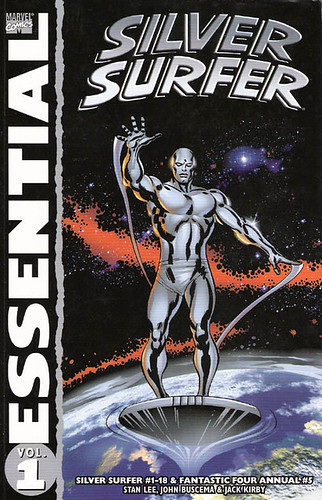
Essential Silver Surfer, v. 1 coverThe Surfer was a personal favorite of co-creators Stan Lee and Jack Kirby, with Stan jealously guarding the Surfer. When he finally relented and decided to have a Surfer ongoing series, he pulled rank and wrote the series himself, assigning John Buscema penciling duties. Kirby was, understandably, a little miffed. This is very nearly the last interesting thing to happen with Silver Surfer, v. 1.
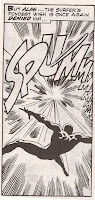
Lee used Silver Surfer as his platform for social idealism, and like most soapboxes, it is inherently uninteresting. Stupidity and silly misunderstandings abound, and the Surfer is repeatedly used as a pawn. The plots are simple and formulaic. There is a lot of bizarre pairings in this volume — the Silver Surfer vs. Mephisto (essentially the Devil), vs. the Flying Dutchman, vs. the most recent Baron Frankenstein, vs. an incompetent witches’ coven. But instead of being examples of those moments readers smile and think, “Only in comics!” these are dull confrontations of cardboard villains (except Mephisto) with elaborate costuming.

It is entirely possible, I think, to sum up a Silver Surfer plot by using the following, mixed and matched as necessary:

    *SPUMMM!* The Silver Surfer hits an invisible space wall
  1. I must escape Earth!
  2. I must see my true love, Shalla Bal!
  3. When will you humans give up your violence?
  4. I must help the humans! (Usually immediately after the preceding line.)
  5. I won’t give up my soul, Mephisto!
  6. *smack!* (This is the sound of the Silver Surfer colliding with Galactus’s invisible barrier, which keeps him from leaving Earth.)
You may think I’m joking about that last one, but the Surfer, time and again, in ignorance and in frustration, literally beats his head against that barrier. If you had a dollar for every time it happens in this book, you could probably pick up the Essential Silver Surfer for free. I had to pay a bit more for it, but not much more.

On the positive side, the book does feature the creation of Mephisto, who is at least an interesting enemy for the Surfer — the Devil vs. alien was probably an original pairing at the time. I’d be lying if the Surfer doesn’t grow as a character; his naiveté is completely worn away by the end of the book, although that doesn’t mean he can’t be fooled for plot purposes. I also admire Buscema’s beautiful art, smooth and sleek while suggesting the immense power at the same time. He can also capture the absurdity of the Surfer’s attempts to blend in with human society.

Kirby arrives the issue before cancellation to ugly everybody up. I’ve never been a fan of Kirby’s art, and compared to Buscema’s work, his Surfer (and everyone else) looks squat and homely. The true shame is that Kirby, one of the few people who could match Lee for imagination, would have been a perfect fit as writer — if there is one thing you could never call Kirby, it’s boring. (Or formulaic, although that’s a second thing you couldn’t call him.) Kirby left for DC soon after his work on Silver Surfer #18, where he created the Fourth World.

Essential Silver Surfer ranges from the boring to the absurd, and even the absurd doesn’t provoke laughter — or any reaction at all, really. The first five issues, which are all double sized, are nearly impossible to choke down. It gets easier after that, but Essential Silver Surfer never gets better than bland.

Rating: Silver Surfer head (1 of 5)

Labels: , , , , ,

20 January 2009

Savage Sword of Conan, v. 1

Collects: Selections from Savage Tales #1-5 and Savage Sword of Conan #1-10 (1971-6)

Released: December 2007 (Dark Horse)

Format: 542 pages / black and white / $17.95 / ISBN: 9781593078386

What is this?: Reprints from 1970s Marvel black-and-white Conan magazines.

The culprits: Writer Roy Thomas and a cast of artists, notably Barry Windsor-Smith and John Buscema.

Dark Horse made its second foray into the Conan reprint market at the end of 2007 with The Savage Sword of Conan, v. 1.

This series is as different as two Marvel series featuring the same title character can be. Savage Sword is a black and white, “Essential” type phonebook, while the Chronicles of Conan are full-color trade paperbacks. The two titles being reprinted differed vastly, as well; Chronicles reproduces Conan the Barbarian, a standard comic book. Savage Sword, unsurprisingly, reprints The Savage Sword of Conan, a black-and-white magazine that ran at the same time. Because of rights issues, Chronicles doesn’t include the original covers. Savage Sword does.

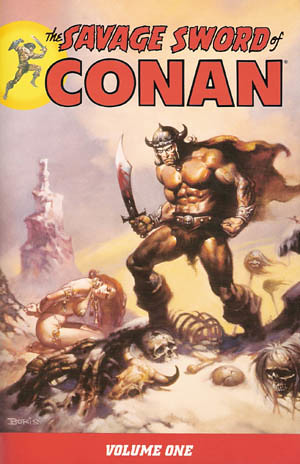
Savage Sword of Conan coverAdmittedly, Conan is the same character in each. This leads to the question, Which is superior?

Both are written by Roy Thomas, so that’s a wash. There are more adaptations of Conan creator Robert E. Howard’s original stories in Savage Sword, it seems, than any two volumes of Chronicles. That makes sense; there was more room for large-scale adaptations in Sword, which was a larger, more expensive format than Conan. Sword’s first volume has adaptations of “The Frost Giant’s Daughter,” “Red Nails,” “Black Colossus,” “Iron Shadows in the Moon,” “A Witch Shall Be Born,” and the last two chapters of the adaptation of the only Conan novel, “The Hour of the Dragon.”

But “The Hour of the Dragon” highlights Savage Sword’s main drawbacks: continuity. In “Dragon’s” case, the first four parts of the adaptation aren’t included because they were originally printed in Giant-Size Conan #1-4 (1974-5), and the Giant-Size line isn’t reprinted consistently in licensed ventures anyway (the GIT Corp. DVD-ROMs omitted them, although probably for different reasons). This is a major flaw, especially since there isn’t an explanatory note about the missing chapters; I spent 15 minutes looking for the rest of the story before discovering the reason online.

A less worrying — but more consistent — part of that drawback is Savage Sword is not a single narrative. Those used to Chronicles or Marvel’s Essentials might expect Savage Sword to have the thread of a story throughout it. It does not. It hops from one story to another, usually with little regard to the narrative of Conan’s life as a whole. There are exceptions, especially in the original sequels to “A Witch Is Born” and “Black Colossus.” It’s another sacrifice to the freedom necessary for the long adaptations, and in theory it allows Thomas to include Conan stories that are simply good. On a practical level, it allows the reader to easily differentiate between Howard’s stories and Thomas’s own contributions to the canon; with the exception of “The Forever Phial,” a neat little story from the point of view of a doomed wizard that includes Barry Windsor-Smith-like art from Tim Conrad, and “The Citadel at the Center of Time,” a jumping off point for a couple of issues of What If?, most of them are easily forgotten, especially without the lattice of an ongoing story to affix them to.

However, it is the art where Savage Sword shines. Conan artists supreme Windsor-Smith and John Buscema are featured in this volume, with Buscema providing most of the art. Smith’s adaptation of “Red Nails” burns itself into the brain. Buscema’s “A Witch Is Born” allows Buscema to play with light and dark in a truly striking way. The truth is these adaptations give the artists a chance to play with some of the greatest Conan imagery, and they take full advantage. Windsor-Smith and Buscema have rarely looked so good, with the lack of color emphasizing their work rather than diminishing it. And there are more than 500 pages of this beautiful work.

The completist might be disappointed by Savage Sword. Some issues of Savage Sword of Conan are completely reprinted. Others have stories featuring other characters dropped, either because of issues of rights (Red Sonja) or interest (King Kull). Other stories are dropped for reasons I can’t determine.

Conan fans would likely choose Savage Sword over the Chronicles, I believe, while comic fans who like Conan might choose Chronicles but get a great deal of enjoyment out of Savage Sword. I can say, without hesitation, that Savage Sword is the better of the two, in my opinion, and it’s well worth your time.

Rating: Conan face Conan face Conan face Conan face (4 of 5)

Labels: , , , , , , ,

22 July 2008

Chronicles of Conan, v. 11: The Dance of the Skull and Other Stories

Collects: Conan the Barbarian #82-90 (1978)

Released: February 2007 (Dark Horse)

Format: 168 pages / color / $16.95 / ISBN: 9781593076368

Dark Horse’s reprints of Marvel’s Conan the Barbarian keeps marching on with v. 11, The The Dance of the Skull and Other Stories.

Like the previous 10 volumes, v. 11 is written by Roy Thomas. The art is by John Buscema (five issues) and Howard Chaykin (three issues), but the strong finishes by Ernie Chan makes guest artist’s Chaykin’s work strongly resembles Buscema’s. Both the writing and art have a certain sameness compared with the previous volumes of Dark Horse’s Conan, and like many reprints of old comic material, the divisions between volumes are somewhat arbitrary. This is a bit of a problem since it prevents the book from having an identity. Why buy this volume over others? I’m not sure I can say.

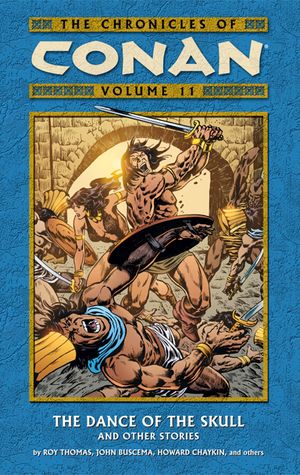
Chronicles of Conan, v. 11: The Dance of the Skull and Other Stories cover Worse, the story in v. 11 begins in the middle of a storyline — and the storyline is a seemingly interminable pause in the quest of Belit, pirate queen and Conan’s lover, to discover the fate of her father. Conan is sent on several side quests, allowing Thomas to adapt several non-Conan works by Robert E. Howard and giving Conan an opportunity to pick up a sidekick. Well, Zula is more a partner than sidekick, but it’s still Conan’s book.

But it’s good to see another recurring character introduced. This is both because Belit’s subplot is quickly disposed of once Conan catches up to her and because Conan has precious few recurring characters. Zula is not a great character — he’s the last of a tribe of Blacks with a striking Mohawk — but he’s another voice, someone to contradict Conan without being evil, stupid, or petulant. Conan continually fighting mystic threats and winning through luck or bullheadedness needs some breaks.

But the plot’s the difficulty — meandering and unfocussed despite a specific goal, and no amount of princesses in slavery, Zula, or Thoth-Amon will fix that. It’s all very forgettable.

(Oh, and I still miss the original Marvel covers.)

Rating: Conan symbol Conan symbol (2 of 5)

Labels: , , , , , , , ,

05 September 2006

Essential Savage She-Hulk, v. 1

Collects: Savage She-Hulk #1-25 (1980-2)

Released: June 2006 (Marvel)

Format: 552 pages / black and white / $16.99 / ISBN: 0785123350

In the annals of Marvel, She-Hulk seems underappreciated. For a character who has been both an Avenger and a member of the Fantastic Four as well as having four solo series, rarely does anyone talk about the character. Sure, the second series, by John Byrne, is remember for being a humor series that broth the fourth wall and not much else, despite running X issues. The third and fourth series, written by Dan Slott are critically acclaimed but low sellers. And I don’t think I’ve ever heard anyone talk about the first series, Savage She-Hulk.
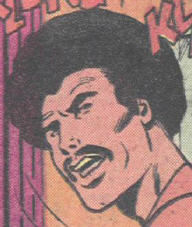
Well, there’s a reason for that.

All 25 issues of Savage She-Hulk are collected in the Essential Savage She-Hulk, v. 1, which should satisfy anyone’s curiosity about the series. She-Hulk was created by Stan Lee and John Buscema, making her one of Lee’s last creations at Marvel.6 After the first issue, David Anthony Kraft and Mike Vosburg took over. Both do a workmanlike job, but there’s just no spark or life in the book.

The character of She-Hulk has several problems. A female derivative of an already established male character, She-Hulk was created for trademark protection — that is, to head off someone else using the name. She-Hulk reuses the Hulk’s schtick (savage persona hidden in shy personality) without the extreme violence, conflict, or scope of the Hulk. The latter is one of the biggest disappointments to me; I always like the Hulk’s aimless wandering, as if no place was big enough to hold him except the Earth itself, and that only barely. She-Hulk is tied to LA like Philip Marlowe.

The Essential Savage She-Hulk also lacks decent villains. The highs profile villain — actual villain, not just sparring partner — is Gemini, a member of the Zodiac. There are plenty of guest stars — Iron Man, Man Wolf, Man-Thing, Hellcat, Morbius, and Bruce Banner — but there are no threats the reader of the early ‘80s would deem credible (or anyone the modern reader would deem credible either). The back cover mentions that She-Hulk encounters Man Wolf, Man-Thing, and the Man-Elephant — and those are highlights. The villains aren’t even goofy enough to be endearing; Man-Elephant, for example, is just a guy who thinks elephant shaped armor (with weapons) is a reasonable idea to fight crime, but when he’s told his actions are irresponsible vigilantism, he agrees and quits wearing the armor.

She-Hulk’s main opponents are the Mob, which makes a lot of sense for She-Hulk’s altar ego, Jen Walters, but not so much for She-Hulk herself. She smashes whatever morons get in her way, and the bosses often try stupid super-science to stop her. They fail. What they really need is a better hiding place, not Iron Man’s castoff armor. She-Hulk’s lack of credible rogue’s gallery is used for laughs in the second issue of Slott’s She-Hulk series: when pressed for the names of those who would hurt her in her human form, She-Hulk comes up with Man-Elephant, Ultima, and Titania (twice).

The supporting cast is dull, dreadfully dull. Jen engages in the most tepid love triangle in Marvel’s history, with Jen between a Man-Thing castoff (loser Richard Rory) and the med student next door (“Zapper” Ridge). Neither has much of a personality. For some reason, Jen prefers Rory, while She-Hulk’s likes to jump Zapper’s bones. But Zapper has a Magnum moustache and an impressive ‘fro, so he gets the girl in the end.

Jen’s dad, LA County Sheriff Morris Walters, is a jerk; he won’t talk to his daughter about a bounced check, deciding to disown her instead. When her defense of Michael Morbius (“the Living Vampire”) leads to his conviction on involuntary manslaughter charges instead of first-degree murder, he acts as if Jen killed Morbius’s victims himself, saying he wishes she’d never have been born. Rounding off the cast is male chauvinist DA “Buck” Buckowsky, who eggs on the woman’s libber and generally is an ass.

There are altogether too many cheesecake shots of the She-Hulk. Whenever Jen transforms into She-Hulk, her dress is strategically torn in order to titillate; that’s artistic license, sure, but it’s always torn in the same way. I’m not saying Vosburg has an Amazon fetish, since Buscema drew the first issue and give the heroine a cheesecake design and a few “sexy” poses. But there are entirely too many panels where a green-skinned giant is meant to be an object of desire. I can’t decide whether the effect is better or worse in black and white.

This book is just below mediocre, but it isn’t bad enough to excite exceptional interest (like Street Poet Ray).

Rating: (1.5 of 5)

Labels: , , , , , , , , ,

16 July 2006

Essential Nova, v. 1

Collects: Nova #1-25, Amazing Spider-Man #171, and Marvel Two-in-One Annual #3 (1976-9)

Released: March 2006 (Marvel)

The character of Nova has been described — or derided — as “Peter Parker as Green Lantern.” That’s not exactly fair: Nova actually does very little in outer space, as Green Lantern does, and he’s not as likeable as Peter Parker.

That being said, his origin is the Green Lantern’s, with an alien policeman giving high-school student Richard Rider his powers as he dies. And just like Peter Parker, Richard has to balance school, family, a social life, and his new heroic life as Nova. Unfortunately for Richard, he’s a dud at school, his family is mostly uninteresting (although nowhere near as annoying as Aunt May in early Spider-Man), his friends are weird, and his girlfriend is no Gwen Stacy or Mary Jane. (Or even Betty Brant, as far as that goes.)

Nova is typical Marvel ‘70s output — solid superhero stories. Although these feel right to me, many readers who do not get the warm fuzzies while contemplating post-Stan Lee and pre-Jim Shooter Marvel may find this book dull. Writer Marv Wolfman does all he can, twisting and turning the plot with as many behind-the-scenes masterminds as he thinks he can get away with: the Sphinx, the Corruptor and the Inner Circle, the Yellow Claw, Dr. Sun. The Sphinx is the only one that can be used without laughter or disgust today (although I like Dr. Sun, a villain of the brain-in-a-jar variety).

But it’s the other villains and heroes that Nova runs into that make this book for me. I have no idea why, but villains like Diamondhead and heroes like the Crimebuster, the Comet, and Powerhouse just seem right. They’re lightweights, sure, but they seem of the Marvel Universe without needing to intrude into other titles. You can well imagine a Crimebuster in Marvel New York without Spider-Man ever having run into him. I suppose what I’m saying is that Wolfman and his artists invented the perfect superpowered second stringers for what ended up as a dead-end book.

The switch from artist John Buscema to Carmen Infantino after #14 was disappointing. Buscema has a lighter pencil and a much cleaner line that works better than Infantino’s work in black and white. Also, the Buscema brothers’ work seems to exemplify ‘70s Marvel to me.

It’s also disappointing that Marvel couldn’t include Fantastic Four #206 and #208-9, an outer-space epic against the Skrulls that wrapped up the stories of Nova and the Sphinx. It’s understandable, given that there isn’t room for those stories; the book is already crammed full, with 26 regular-sized issues and an annual. However, given my druthers, I would rather have had a scaled-down Fantastic Four #206 that had the Nova-related story and #208-9. I’m not sure that would have fit, but it would have been a more satisfying inclusion than the Marvel Two-in-One Annual that featured Nova and the Thing fighting generic outer-space despots.

Overall, though, this was mostly fun, even if it is mediocre. Wolfman manages to wring a good deal of fun out of a character whose origins aren't the most creative.

Grade: C

Labels: , , , , ,

11 April 2006

Chronicles of Conan, v. 10: When Giants Walk the Earth and Other Stories

Collects: Conan the Barbarian #72-7 and 79-81 (1977)

Released: March 2006 (Dark Horse)

The Chronicles of Conan are one of the unexpected pleasures of life. Usually, when comic books center around licensed properties, it’s impossible to get them reprinted years later. For instance, the latest Essential Spider-Man had to skip Giant-Sized Spider-Man #3 because it guest starred Doc Savage, who is owned by Conde Nast. The Essential Marvel Two-in-One omitted Marvel Two-in-One #21 for the same reason.

Marvel no longer has the license to publish Conan from Conan Properties, but Dark Horse does. So in addition to publishing a new Conan series, Dark Horse publishes reprints of the classic Conan stories from Marvel. They’ve given readers ten volumes so far, which is wonderful. As a bonus, each volume has writer Roy Thomas’s memories of the issues, revealing behind-the-scenes information and the source of names and plots.

There are slight snags, however. Dark Horse doesn’t have the rights to Red Sonja, a character created by Conan-creator Robert E. Howard in a Crusader story and shoehorned into Conan’s world by Thomas. He was like that; Thomas loved to take Howard’s non-Conan stories, throw them into his Conan-O-Tronic blender with a small pinch of Conan Dust, and make them into Conan comics. In any event, Dynamic Forces holds that license, and they are following Dark Horse’s example by publishing a new series and the original Marvel series. Dynamic Forces is on their second volume of reprints. #78 is left out of v. 10 because the issue itself was a reprint of Savage Sword of Conan #1, a Conan / Red Sonja team up.

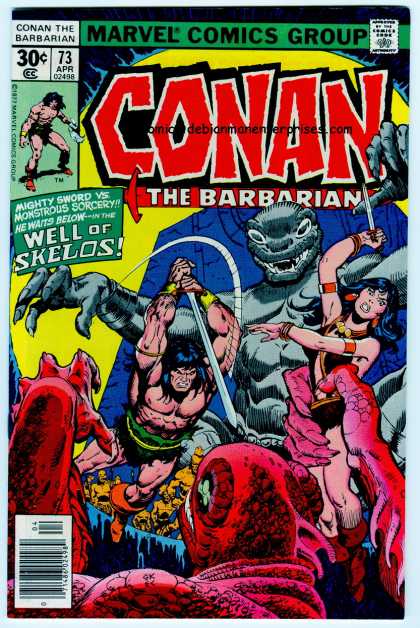
Conan the Barbarian #73 cover The other snag is that Dark Horse can’t reprint the original Marvel covers. For the most part, I haven’t missed them. But this week I was selling the odd comics that were duplicated by the trades I have, and I saw a few of the original covers. I didn’t realize how much the trades of Conan missed the covers until I looked at the original individual issues. There’s something dynamic and exciting about those covers that makes you want to buy them off the rack. I mean, they’re not necessary, but after knowing what they looked like, I definitely felt their absence.

And this volume could have used some appeal. I admit, I am not a fan of the type of story in v. 10; Belit, Conan’s lover and pirate Queen of the Black Coast, goes to the heart of her enemy’s empire to rescue her father, deposed king of a small city-state. But after nine issues, Conan and Belit seem only halfway to their goal, with Conan and Belit being forced to sort out the murderous politics of another city-state. Then Conan gets sent on a pointless errand for that city-state and ends up in a time-lost city founded by Alexander the Great … Thomas’s focus is weak at best here; either he was bored or just had so many ideas at the time he couldn’t wait to insert them. Art is by John Buscema and Howard Chaykin. Those of you who have seen Buscema’s art know whether you like him. Buscema, one of the stalwarts of Marvel (as is his brother, Sal), has a strong, detailed style that fits Conan well, especially with his proclivity to make all the men muscled monstrosities and the women scantily clad. Chaykin’s art was inked to make it look like Buscema’s, so there is little to distinguish the two artists (particularly under Dark Horse’s recoloring of the stories). Dark Horse also gets demerits for not getting the contents right. On both the back cover and on the title page verso, they list #82 as part of the collection. It isn’t. Not only is that deceptive, it's also sloppy quality control. Still, it does little long-term harm ... this time.

If you choose Chronicles of Conan titles to buy on a book-by-book basis, I would recommend skipping this one. I doubt that is the case, though, with most readers getting all of them. Despite the meandering plot, this one is fairly inoffensive.

Grade: C+

Labels: , , , , , , ,