Reviews of trade paperbacks of comic books (mostly Marvel), along with a few other semi-relevant comments / reviews.

07 August 2010

Essential Tomb of Dracula, v. 4

Collects: Stories from Tomb of Dracula Magazine #2-6 and Dracula Lives! #1-13 and Frankenstein’s Monster #7-9 (1973-5, 1979-80)

Released: March 2005 (Marvel)

Format: 576 pages / black and white / $16.99 / ISBN: 9780785117094

What is this?: A chronological retelling of Dracula’s life, from Marvel’s pre-1980 stories (except Tomb of Dracula)

The culprits: Too many to list; includes Marv Wolfman, Mike Friedrich, John Buscema, Gene Colan, and Gerry Conway

The release of Essential Tomb of Dracula, v. 4, was a bit of a surprise, given that the previous three volumes had completely collected the comic book series. But Marvel still had some vampire material lying around — mostly from black and white magazines it published in the ‘70s — so they bundled those stories together into another, presumably final, volume.

One aspect of v. 4 that sets it apart from other Essentials is that rather than reprinting the stories in the order they were published, Marvel ordered them by when they occurred in the life of Dracula, the central character. After reading through the stories, this is not only the better way to organize the stories but really the only way; Dracula Lives, for instance, published stories of Dracula’s past as one feature and a continuing serial of his present as another in the same issue. To publish those in periodical order would have split the present-day stories, ruining the flow.

Essential Tomb of Dracula, v. 4, coverOrdering the stories this way works best if there is a narrative flow to them. Other than that present day feature, however, there is none. Worse yet, there seems to be no real plan behind Dracula’s reign of Euroterror. Dracula attacks and attacks and attacks; occasionally, he is attacked. Despite his claims to nobility and character, Dracula is constantly at the mercy of his animal nature. However, Dracula never seems to own up to this, and there is really no one to call him on it. Worse, there seems to be no consequence to the stories. New vampires are created and disappear before the next story. Dracula is staked and returns to unlife for the next tale.

After going through Dracula’s first few centuries, it’s easy to feel there’s no point to his stories — it’s just rehashing the same plot points over and over. There are few horror-comic plot twists or really cruel endings for Dracula’s victims, as if the writers feared making Dracula too awful.

Then there are the slips on vampire lore. Chirping about continuity problems on most comics can be seen as nitpicking, but the weaknesses and restrictions on Dracula and other vampires are part of popular culture. Does Dracula need to be invited inside a home? Sometimes, but not always. How long does it take for a vampire to rise from the grave? Everyone, including Dracula, says three days, but frequently they arise the next night. How effective are crosses — can Dracula attack someone with a cross, or does he need to have a proxy attack? Sources vary. Running water poses no problems; occasionally, no thought is given to the coffin filled with earth Dracula needs to rest in. How much power does daylight have — does it destroy a vampire, like decapitation, or does it merely immobilize the vampire, like a stake? Dunno. And this is putting aside things like Dracula not using his hypnotism or turning into mist or other errors in tactics.

But I don’t want to dwell on the negative, because I’m a negative person and have truly impressive negative dwelling skills. “Bounty for a Vampire,” by Tony Isabella and Tony DeZuniga, is an effective and nuanced Weird Western from Dracula Lives #13, with a former marshal who has seen weird things hunting vampires in Transylvania. Peter Gillis and John Buscema’s story of a ballet dancer who loses her humanity and empathy (“Pavanne from an Undead Princess,” Tomb of Dracula Magazine #5) is the most moving story in the collection. “A Death in the Chapel” from Dracula Lives #6 features the final combat of Dracula and Father Montesi, the discoverer of the vampire-destroying Montesi Formula. The continuity and continuing stories in Frankenstein’s Monster #7-9 (by Mike Friedrich and Buscema) and the modern tales in Dracula Lives! was a welcome respite from the episodic stories that dominate the collection. And although the story in “The Pit of Death” by Doug Moench and DeZuniga (Dracula Lives #10-1) didn’t make much of an impression on me, the protagonist’s revenge on Dracula was nicely innovative.

Also, Marvel does include some supplementary material to the collection. There is a prose recap of Dracula’s history near the beginning of v. 4, and there is an extensive cover and promotional image gallery near the end. Gene Colan’s original pencils from unused pages of Tomb of Dracula #70-2, which were collapsed into #70 when the title was canceled, are included for those who wondered how the story might have ended up had Colan and Wolfman been allowed a little more space for the stories.

The art, overall, is uneven, but Dracula art from Colan is always welcome. Colan contributed seven stories that appear in the collection, most of them in the book’s second half, and they are uniformly highlights — shadowy, evocative, with a Dracula who is simultaneously bestial and suave. Buscema drew the three issues of Frankenstein’s Monster, and although those issues are not going to go down as his greatest, they are John Buscema drawing Dracula, Frankenstein’s Monster, and shapely gypsy women, and there’s nothing wrong with that; his pencils on other stories in the collection, such as “Death Vow” (inks by Klaus Janson) from Tomb of Dracula Magazine #4, are more impressive, evocative and as shadowy as Colan’s work. Other artists who manage to convey more than a modicum of horror or menace include DeZuniga and Vicente Alcazar in “Here Comes the Death Man” in Dracula Lives #7.

Still, those enjoyable parts can’t really save the book. There’s a lot of repetition and stories that just aren’t worth the time. Also, the reproduction on v. 4 is strangely murky, making it difficult to read. I would have thought that since the original material was originally from black-and-white magazines, that wouldn’t have been a problem, but I was wrong.

The question you have to ask yourself is: how much do you want Gene Colan and John Buscema stories? If the answer is a lot … well, you might want to buy the original magazines. But if that isn’t an option and you still want to see them and are willing to wade through a lot of forgettable Marvel vampire stories, buy this book. Otherwise … borrow it from a vampire fanatic and skim it.

Rating: Marvel symbol Half Marvel symbol (1.5 of 5)

Labels: , , , , , , , , , , , , , ,

02 July 2010

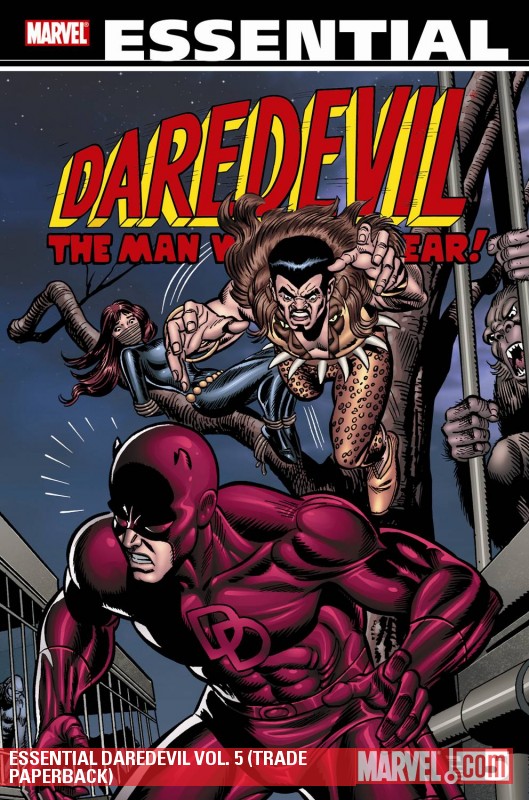
Essential Daredevil, v. 5

Collects: Daredevil #102-25, Marvel Two-in-One #3 (1973-5)

Released: February 2010 (Marvel)

Format: 496 pages / black and white / $19.99 / ISBN: 9780785144540

What is this?: Daredevil loves and loses the Black Widow and battles Hydra, Thanos’s goons, Mandrill, and a few others

The culprits: Writers Steve Gerber, Chris Claremont, Tony Isabella, and Marv Wolfman; pencilers Don Heck, Bob Brown, and Gene Colan, with some others

Essential Daredevil, v. 5, comes from a sort of forgotten era in Daredevil’s career. Daredevil has a lot of forgotten eras; everything between Stan Lee’s last Silver Age issue of Daredevil and Frank Miller’s first issue is generally unremembered, as is most of what falls between Ann Nocenti’s “Typhoid Mary” storyline and the Kevin Smith late ‘90s reboot. For the most part, forgetting is the best course of action for those issues.

However, that’s not true of v. 5 — this stuff deserves to be remembered. That may, in part, be because there’s more continuity of creators than usual for an early Bronze Age Essential. The book has a long run from writer Steve Gerber and penciler Bob Brown, and writer Tony Isabella and penciler / inker Don Heck have shorter runs.

Essential Daredevil 5 coverAs you might expect from Gerber’s involvement, this isn’t Daredevil’s usual kind of stories, resembling neither what came before or after. He’s in San Francisco, playing Marvel Team-Up with the Black Widow; both changes were set up by Gerry Conway in the previous Essential Daredevil. But Gerber takes that and runs with it, having Daredevil battle large crises by himself. Daredevil fights the minions of Thanos, and Gerber puts Moondragon (who introduces herself as “Madame MacEvil”) and Angar the Screamer to good use. He uses two of my favorite characters, Mandrill and Nekra — they’re both goofy and menacing, especially Mandrill’s telepathic control of women. Gerber’s not afraid to have Daredevil lose fights, as the Beetle beats him and Kraven the Hunter defeats both him and the Black Widow. He shows an occasional flair for the Black Widow’s dialogue, especially when she snarks with society ladies in #104. And there’s something charming about having the Owl try to steal Daredevil’s brain.

Although some of the pieces of Gerber’s run are fascinating, the overall picture feels warped. There’s no denying that Thanos, Captain Marvel, and Moondragon are poor fits for Daredevil, and Mandrill’s nationwide revolution doesn’t quite work as a Daredevil story. Shanna the She-Devil and her story don’t exactly feel at home either, and meeting Man-Thing in his swamp really feels like something Spider-Man or the Thing would do rather than Daredevil. Perhaps most damningly, Gerber draws a hamfisted line under Black Widow and Daredevil’s relationship — Moondragon as a romantic foil for the Black Widow? Really? — as well as the entire San Francisco experiment.

Isabella’s five-issue run is more tightly focused, and it holds together much better. It involves Daredevil, the Black Widow, and SHIELD vs. Hydra, with the life of Foggy Nelson at stake. I’m a sucker for a good Hydra story, and this one is just that — a good Hydra story, rather than a great one. It has Silvermane and his son trying to guide the Hydra to a new resurgence, backed by several second-string villains — El Jaguar, Man-Killer, Mentallo, Blackwing. It’s a good idea, with the ousted Maggia leader presumably having the organizational capability to mold a splinter of Hydra into something more, and I wouldn’t mind seeing that sort of plot again.45

The art is especially solid for the Bronze Age but not spectacular, except for isolated issues. Heck doesn’t get as much respect as some of his Silver Age contemporaries at Marvel. But he does an excellent job here in his five issues as penciler (he also inked some issues); he’s outstanding in the non-action scenes, with extremely expressive faces. His action scenes can be a little stiff, however. Brown is the real surprise. I’d never heard of him before — or maybe I didn’t remember him. His action scenes are a real step up from Heck, and even if he isn’t quite the equal of Sal Buscema (who drew the Marvel Two-in-One issue included) or Gene Colan (who did a couple of Daredevil issues), he’s still pretty impressive. He can get across emotion through the faces and bodies of the characters as well as Heck, although sometimes his conceptions of the characters — especially Black Widow — seem a little off compared to Heck. Then again, Heck did co-create the Black Widow, so he’s got a slight advantage here.

There are more than a few things that aren’t quite right about Essential Daredevil, v. 5. But that’s what happens when a writer tries hard to do different things with a title — big things, in the case of Gerber. Sometimes it doesn’t quite work, but that doesn’t mean it’s not worth reading. It’s different from just about everything else with Daredevil in it, which isn’t nothing.

Rating: Marvel symbol Marvel symbol Marvel symbol Half Marvel symbol

Labels: , , , , , , , , , , ,

01 August 2006

Champions Classic, v. 1

Collects: Champions #1-11 (1975-7)

Released: June 2006 (Marvel)

Because you didn’t demand it, Marvel released the Champions in the 1970s. It was sort of the rock supergroup concept applied to superheroes: recognizeable heroes at loose ends tossed together to see what happens.

Just like with supergroups, the musicians aren’t usually the best, but they are credible. So in Champions Classic, v. 1, we get the Angel and Iceman at loose ends (they don’t like the All-New, All-Different X-Men all that much), occasional active Avengers Black Widow and Hercules, and relatively new hero Ghost Rider. I know what you’re saying to yourself: They put those people on a team? Yes. Yes, they did, and it worked about as well as you might expect.

The character concepts are almost completely incompatible, and all the characters have in common is that they are in Los Angeles. Ghost Rider fits with supernatural tales, Angel and Iceman to mutant rights, the Widow to espionage, and Hercules … well, he’s just larger than life. Despite the writers’ attempts, only Hercules strengths come across. The Widow doesn’t get to spy much, nor does she lead well; Angel doesn’t seem a very good business and is unable to keep the team focused on the raison d’etre he established; Ghost Rider is about as otherworldly as a club to the face; and Iceman doesn’t do much but complain that he’s leaving (until a pretty face comes along).

These problems aren’t insurmountable; they can be used as excellent plot devices. But by the time you get to #11, it’s difficult to think these are plots rather than just inherent difficulties with the team.

Just look at the cover: Herc in his gaudy leather and loincloth ensemble, Angel in his gaudy and Godawful costume, Iceman in his ice form, Ghost Rider in his leathers and motorcycle, and the Black Widow in her slinky black stealth suit. You can find two of these heroes that visually go together with no problem, but linking three is difficult, and five is impossible.

Tony Isabella and Bill Mantlo try their best, heaven knows. They give each hero a plot suited to their expertise: an Olympian plot for Herc in #1-3, a businessman goes bad in #5-6, a Russian four-parter for the Widow and her handler / trainer / sidekick Ivan in #7-10, and Wild West action vs. shadows for Ghost Rider in #11. But the rest of the Champions seem out of place in Herc’s and the Widow’s stories, and no one shines in the other two. It just doesn’t work.

The best storyline is that of Rampage, a genius inventor whose business is about to go bankrupt. The inventor dons the Rampage armor and tries to steal the money to get his business out of hock: sort of an evil Tony Stark. The team works well, the villain has a simple motivation and a reason for fighting the team as a whole, and his arc comes to an end satisfactorily. But there’s little satisfaction to be found elsewhere.

The writing seems to get a spark when Mantlo takes over for Isabella in #8. There seems to be an energy and a plan that had been absent in the first issues, but that could be just because I don’t see what’s coming up. Don Heck draws the first six issues, but it’s not his best work — too scratchy and shadowed for the brightly lit tales, and his line looks a little ragged compared to his best work. That could be the inker’s fault, and in any event Heck is still strong in storytelling and action, but it was a slight relief to my line when George Tuska (#7) and Bob Hall (#8-10). John Byrne, at the top of his game, is a treat in #11.

I’m not sure it’s the artists’ faults, but the costumes are pure ‘70s. The Olympian gods seem colorblind. The Black Widow wears a purple checked skirt over her suit in #1, an ensemble I have never seen before and hope never to see again. And then there’s the Angel’s monstrosity; Rampage destroys it in #8, earning my gratitude. (Also, there’s a scene where Hercules runs through the defense of UCLA’s football team, colored by someone who has never seen their uniforms.)

Now, I have to admit: If there’s a second volume, I will probably pick it up. The final page of v. 1 has the Stilt-Man announcing he’s about to become the Master of the World. If that ain’t a hook, I don’t know what is. (Besides, the team falls apart in v. 2, and that’s believable.)

Rating: (2 of 5)

Labels: , , , , , , , , ,