Reviews of trade paperbacks of comic books (mostly Marvel), along with a few other semi-relevant comments / reviews.

02 July 2010

Essential Daredevil, v. 5

Collects: Daredevil #102-25, Marvel Two-in-One #3 (1973-5)

Released: February 2010 (Marvel)

Format: 496 pages / black and white / $19.99 / ISBN: 9780785144540

What is this?: Daredevil loves and loses the Black Widow and battles Hydra, Thanos’s goons, Mandrill, and a few others

The culprits: Writers Steve Gerber, Chris Claremont, Tony Isabella, and Marv Wolfman; pencilers Don Heck, Bob Brown, and Gene Colan, with some others

Essential Daredevil, v. 5, comes from a sort of forgotten era in Daredevil’s career. Daredevil has a lot of forgotten eras; everything between Stan Lee’s last Silver Age issue of Daredevil and Frank Miller’s first issue is generally unremembered, as is most of what falls between Ann Nocenti’s “Typhoid Mary” storyline and the Kevin Smith late ‘90s reboot. For the most part, forgetting is the best course of action for those issues.

However, that’s not true of v. 5 — this stuff deserves to be remembered. That may, in part, be because there’s more continuity of creators than usual for an early Bronze Age Essential. The book has a long run from writer Steve Gerber and penciler Bob Brown, and writer Tony Isabella and penciler / inker Don Heck have shorter runs.
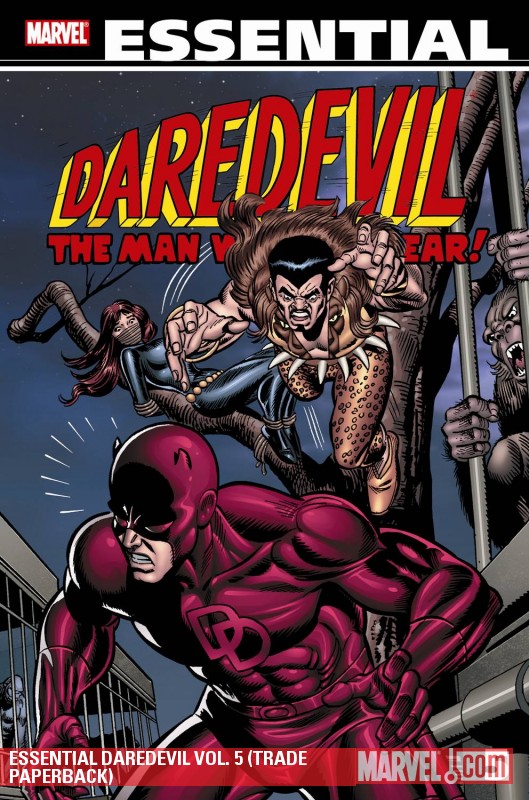
Essential Daredevil 5 coverAs you might expect from Gerber’s involvement, this isn’t Daredevil’s usual kind of stories, resembling neither what came before or after. He’s in San Francisco, playing Marvel Team-Up with the Black Widow; both changes were set up by Gerry Conway in the previous Essential Daredevil. But Gerber takes that and runs with it, having Daredevil battle large crises by himself. Daredevil fights the minions of Thanos, and Gerber puts Moondragon (who introduces herself as “Madame MacEvil”) and Angar the Screamer to good use. He uses two of my favorite characters, Mandrill and Nekra — they’re both goofy and menacing, especially Mandrill’s telepathic control of women. Gerber’s not afraid to have Daredevil lose fights, as the Beetle beats him and Kraven the Hunter defeats both him and the Black Widow. He shows an occasional flair for the Black Widow’s dialogue, especially when she snarks with society ladies in #104. And there’s something charming about having the Owl try to steal Daredevil’s brain.

Although some of the pieces of Gerber’s run are fascinating, the overall picture feels warped. There’s no denying that Thanos, Captain Marvel, and Moondragon are poor fits for Daredevil, and Mandrill’s nationwide revolution doesn’t quite work as a Daredevil story. Shanna the She-Devil and her story don’t exactly feel at home either, and meeting Man-Thing in his swamp really feels like something Spider-Man or the Thing would do rather than Daredevil. Perhaps most damningly, Gerber draws a hamfisted line under Black Widow and Daredevil’s relationship — Moondragon as a romantic foil for the Black Widow? Really? — as well as the entire San Francisco experiment.

Isabella’s five-issue run is more tightly focused, and it holds together much better. It involves Daredevil, the Black Widow, and SHIELD vs. Hydra, with the life of Foggy Nelson at stake. I’m a sucker for a good Hydra story, and this one is just that — a good Hydra story, rather than a great one. It has Silvermane and his son trying to guide the Hydra to a new resurgence, backed by several second-string villains — El Jaguar, Man-Killer, Mentallo, Blackwing. It’s a good idea, with the ousted Maggia leader presumably having the organizational capability to mold a splinter of Hydra into something more, and I wouldn’t mind seeing that sort of plot again.45

The art is especially solid for the Bronze Age but not spectacular, except for isolated issues. Heck doesn’t get as much respect as some of his Silver Age contemporaries at Marvel. But he does an excellent job here in his five issues as penciler (he also inked some issues); he’s outstanding in the non-action scenes, with extremely expressive faces. His action scenes can be a little stiff, however. Brown is the real surprise. I’d never heard of him before — or maybe I didn’t remember him. His action scenes are a real step up from Heck, and even if he isn’t quite the equal of Sal Buscema (who drew the Marvel Two-in-One issue included) or Gene Colan (who did a couple of Daredevil issues), he’s still pretty impressive. He can get across emotion through the faces and bodies of the characters as well as Heck, although sometimes his conceptions of the characters — especially Black Widow — seem a little off compared to Heck. Then again, Heck did co-create the Black Widow, so he’s got a slight advantage here.

There are more than a few things that aren’t quite right about Essential Daredevil, v. 5. But that’s what happens when a writer tries hard to do different things with a title — big things, in the case of Gerber. Sometimes it doesn’t quite work, but that doesn’t mean it’s not worth reading. It’s different from just about everything else with Daredevil in it, which isn’t nothing.

Rating: Marvel symbol Marvel symbol Marvel symbol Half Marvel symbol

Labels: , , , , , , , , , , ,

04 August 2009

Daredevil, v. 13: The Murdock Papers

Collects: Daredevil #76-81 (2005-6)

Released: March 2006 (Marvel)

Format: 152 pages / color / $14.99 / ISBN: 9780785118107

What is this?: Bendis and Maleev end their run on Daredevil as Matt tries to stay out of prison.

The culprits: Writer Brian Michael Bendis and artist Alex Maleev

Writer Brian Michael Bendis and artist Alex Maleev began their run on Daredevil with (v. 2) #26, and with a couple of exceptions (Bendis worked with fill-in artists on #38-40, and #50-4 was David Mack writing and drawing an Echo story), they continued on the title together until #81, more than four years together. It is a run of impressive length — if not always impressive quality — for a 21st-century comic from the Big Two.

Daredevil, v. 13: The Murdock Papers ends that run, an end that was too long in coming. But that isn’t The Murdock Paper’s fault.

Daredevil, v. 13: The Murdock Papers coverBendis finishes on a strong note. The story, in which the Kingpin tries to trade his freedom for evidence that will put Murdock in prison, allows Bendis to pull in the most important Daredevil supporting characters for his final ride. The Black Widow, Elektra, and the new White Tiger try to help Daredevil escape; Foggy foggies his way through the chaos; Phil Urich is the observer and reporter as always; and the Kingpin and Bullseye try to finish Daredevil off in their own ways. Matt’s estranged wife shows up to, uh, watch the chaos unfold. Bendis shows, if nothing else, he knows how to end the story he put into motion, and it ends the only way it could.

The fights are good, with plenty of violence and action. The characters, for the most part, get used well; Elektra’s return is a welcome sight, as is the Black Widow’s and Milla’s. I was glad Matt reconciled with his wife; leaving her as a loose end would have been an egregious error by Bendis. On the other hand, the verbal abuse hurled at Elektra is unwarranted, and the new White Tiger gets short shrift. The story has a growing sense of inevitability as it approaches the end, and a momentary dream sequence, as Matt ponders escaping the courthouse, is a nice surprise that underscores why the story can’t go that way.

The logical underpinnings of the story, though. … In The Murdock Papers, it is clearer than ever that Bendis is a writer, not a lawyer; if he played a lawyer on TV, I’d be tempted to ask for his disbarment. The Kingpin’s big plan is to prove Daredevil / Matt was near the site where the alleged evidence against Matt was stored, but that doesn’t prove obstruction of justice, as he and the Feds allege; any lawyer could argue coincidence or that Daredevil, as a hero, was there to preserve the evidence from the supervillains running around. The Feds giving the Kingpin immunity is stupid, and the legal loophole the Owl and the Feds use to circumvent that agreement is unconvincing. (Surely the Kingpin’s lawyers are better than that?) Singling out Daredevil for punishment is stupid, an obvious witch hunt that would prejudice the government’s case in court given the status of other vigilante superheroes. I’m relatively sure a federal agent can’t be fired as easily as Agent Del Toro was. Phil Urich’s refusal to protect his sources is asinine, to say the least; J. Jonah Jameson, frankly, should fire him for rolling over to the feds over the threat for being “lock[ed] … up for the whole day!!” (A whole day? Horrors!) If I thought Bendis’s Urich was the real Urich, I’d be upset that a good journalist was acting like a reporter for a high-school reporter. Probably a Skrull, though.

Maleev’s art isn’t quite up to his par. It’s still good on the aggregate, but Elektra seems to elude him; Maleev seems to have the idea that her face is a plastic mask, unmovable, and he can’t give her costume the reality that other artists have. (Admittedly, it is a unrealistic costume, but the other weird costumes look normal.) In fact, every time Elektra enters a fight, the action becomes stiff and posed. In the rest of the volume, though, Maleev’s work looks exactly like it always does: excellent.

This story should have been written three volumes earlier; Bendis said, in the afterword, that it ended the way it had to, but he didn’t want to saddle the next writer with a setup he didn’t want, and until he found a successor who wanted that ending, it was difficult for him to finish his Daredevil work. Still, it ends well. Despite its flaws, The Murdock Papers puts a nice capstone on one of the great Daredevil runs.

Rating: Marvel symbol Marvel symbol Marvel symbol (3 of 5)

Labels: , , , , , ,

20 February 2007

Champions Classic, v. 2

Collects: Champions #12-7, Iron Man Annual #4, Avengers #163, Super-Villain Team-Up #14, Spectacular Spider-Man #17-8 (1977-8)

Released: January 2006 (Marvel)

Format: 214 pages / color / $19.99 / ISBN: 078512098X

My wife will often point out that many titles in Marvel’s Essential line are not, by any means of the imagination, essential. Essential Ghost Rider, v. 1, is her prime example, at least until she sees me reading v. 2.

Another line of Marvel TPBs that generates the occasional misnomer is the Classics line, which reprints older Marvel titles in full color. While some might argue the forthcoming Alpha Flight Classic is a prime example of misleading advertising, I must protest on two counts: one, that Alpha Flight is a prime example of Marvel being the shizzle in the ‘80s, and two, the worst example of “Classic” is clearly the Champions (Classic). Which is, surprisingly, on its second volume.

Champions Classic v. 2 cover The first volume of Champions (Classic!) ended with the Stilt-Man fighting Black Goliath. Where I’m from, that spells awesome, but unfortunately, the Stilt-Man can’t even last one issue in the second volume. He’s barely even a distraction, and the Champions can’t even be bothered to take him out — he’s beaten up by third-stringer Black Goliath. (Such is Stilt-Man’s lot in life.)

The Champions aren’t that impressive a team. Sure, they have Hercules and Ghost Rider, but they have a pair of castoff X-Men (Iceman and Angel) and are led by the non-powered Black Widow. Yes, I know there are some Avengers teams these guys could have taken, but once the villain has tricked Hercules, there’s not much opposition there. Plus there’s little reason for them to stay together; what do the five of them have in common? They are as far away from the common man they are supposed to protect as Hercules is from sobriety or Iceman is from being interesting. (If you think I’m being harsh, let me remind you Iceman’s an accountant when he isn’t a hero.)

Although the first volume of Champions (Classic?) was plagued by the original run’s tendency to switch creators, the second has at least half the problem solved. The underrated Bill Mantlo is the writer for most of v. 2, even writing the crossover issues (except for Avengers #163, which was written by Jim Shooter). The art gets off to a roaring start as well, with John Byrne drawing #12-15. This won’t work won’t be featured in his obituary, but it’s solid enough, drawn back when Byrne was working second-string titles like Champions and Iron Fist and turning in work far exceeding the title’s worth. There’s something about his Darkstar that seems to epitomize this — she’s a minor character marked indelibly with his style, which elevates her just a little.

The rest of the art is provided by industry stalwarts: George Tuska pencils the Iron Man Annual and Avengers as well as the final issue of the Champions, Bob Hall does the Supervillain Team-Up / Champions crossover, and one of my favorites, Sal Buscema finishes the team off in a two parter in Spectacular Spider-Man.

Yet despite some very solid talent, this book never clicks. You can’t blame the crossovers because of the continuity of the creators. I hate to blame Mantlo, but you look at the book, and all the bad ink seems to lead back to him. The two-part story against Swarm, the sentient communal bee colony merged with a Nazi war criminal, is the only effective story in the book. The Iron Man Annual is a bland battle against faceless thugs, despite the presence of MODOK. (If you can’t make MODOK creepy and / or memorable, you’re doing something wrong.) The Dr. Doom / Magneto battle in Supervillain Team-Up and Champions #16 is fondly remembered in some quarters, but it is superceded by the better Emperor Doom graphic novel, and in any event, the ending doesn’t make sense. (Not to mention it has very little to do with the Champions, who are mind controlled while they’re in the story.)

The rest of the stories are forgettable. Not bad … just forgettable. The team doesn’t even get a decent sendoff; they disband off-panel after Champions #17, so Angel has to tell Peter Parker how it happens in Spectacular Spider-Man. Was cancellation a surprise? It certainly seems that way, but you’d think the writing would be on the wall. On the other hand, there was certainly a lot of guest appearances late in the title’s run, so maybe the creative team hoped that would float the title along a little farther.

Maybe it isn’t really Mantlo’s fault. Maybe it’s just time catching up with a very bad idea.

The Champions were anything but classic. The stories in Champions (Classic*) are anything but memorable.

Rating: (2 of 5)

Labels: , , , , , , , , , , ,

01 August 2006

Champions Classic, v. 1

Collects: Champions #1-11 (1975-7)

Released: June 2006 (Marvel)

Because you didn’t demand it, Marvel released the Champions in the 1970s. It was sort of the rock supergroup concept applied to superheroes: recognizeable heroes at loose ends tossed together to see what happens.

Just like with supergroups, the musicians aren’t usually the best, but they are credible. So in Champions Classic, v. 1, we get the Angel and Iceman at loose ends (they don’t like the All-New, All-Different X-Men all that much), occasional active Avengers Black Widow and Hercules, and relatively new hero Ghost Rider. I know what you’re saying to yourself: They put those people on a team? Yes. Yes, they did, and it worked about as well as you might expect.

The character concepts are almost completely incompatible, and all the characters have in common is that they are in Los Angeles. Ghost Rider fits with supernatural tales, Angel and Iceman to mutant rights, the Widow to espionage, and Hercules … well, he’s just larger than life. Despite the writers’ attempts, only Hercules strengths come across. The Widow doesn’t get to spy much, nor does she lead well; Angel doesn’t seem a very good business and is unable to keep the team focused on the raison d’etre he established; Ghost Rider is about as otherworldly as a club to the face; and Iceman doesn’t do much but complain that he’s leaving (until a pretty face comes along).

These problems aren’t insurmountable; they can be used as excellent plot devices. But by the time you get to #11, it’s difficult to think these are plots rather than just inherent difficulties with the team.

Just look at the cover: Herc in his gaudy leather and loincloth ensemble, Angel in his gaudy and Godawful costume, Iceman in his ice form, Ghost Rider in his leathers and motorcycle, and the Black Widow in her slinky black stealth suit. You can find two of these heroes that visually go together with no problem, but linking three is difficult, and five is impossible.

Tony Isabella and Bill Mantlo try their best, heaven knows. They give each hero a plot suited to their expertise: an Olympian plot for Herc in #1-3, a businessman goes bad in #5-6, a Russian four-parter for the Widow and her handler / trainer / sidekick Ivan in #7-10, and Wild West action vs. shadows for Ghost Rider in #11. But the rest of the Champions seem out of place in Herc’s and the Widow’s stories, and no one shines in the other two. It just doesn’t work.

The best storyline is that of Rampage, a genius inventor whose business is about to go bankrupt. The inventor dons the Rampage armor and tries to steal the money to get his business out of hock: sort of an evil Tony Stark. The team works well, the villain has a simple motivation and a reason for fighting the team as a whole, and his arc comes to an end satisfactorily. But there’s little satisfaction to be found elsewhere.

The writing seems to get a spark when Mantlo takes over for Isabella in #8. There seems to be an energy and a plan that had been absent in the first issues, but that could be just because I don’t see what’s coming up. Don Heck draws the first six issues, but it’s not his best work — too scratchy and shadowed for the brightly lit tales, and his line looks a little ragged compared to his best work. That could be the inker’s fault, and in any event Heck is still strong in storytelling and action, but it was a slight relief to my line when George Tuska (#7) and Bob Hall (#8-10). John Byrne, at the top of his game, is a treat in #11.

I’m not sure it’s the artists’ faults, but the costumes are pure ‘70s. The Olympian gods seem colorblind. The Black Widow wears a purple checked skirt over her suit in #1, an ensemble I have never seen before and hope never to see again. And then there’s the Angel’s monstrosity; Rampage destroys it in #8, earning my gratitude. (Also, there’s a scene where Hercules runs through the defense of UCLA’s football team, colored by someone who has never seen their uniforms.)

Now, I have to admit: If there’s a second volume, I will probably pick it up. The final page of v. 1 has the Stilt-Man announcing he’s about to become the Master of the World. If that ain’t a hook, I don’t know what is. (Besides, the team falls apart in v. 2, and that’s believable.)

Rating: (2 of 5)

Labels: , , , , , , , , ,