Reviews of trade paperbacks of comic books (mostly Marvel), along with a few other semi-relevant comments / reviews.

02 July 2010

Essential Daredevil, v. 5

Collects: Daredevil #102-25, Marvel Two-in-One #3 (1973-5)

Released: February 2010 (Marvel)

Format: 496 pages / black and white / $19.99 / ISBN: 9780785144540

What is this?: Daredevil loves and loses the Black Widow and battles Hydra, Thanos’s goons, Mandrill, and a few others

The culprits: Writers Steve Gerber, Chris Claremont, Tony Isabella, and Marv Wolfman; pencilers Don Heck, Bob Brown, and Gene Colan, with some others

Essential Daredevil, v. 5, comes from a sort of forgotten era in Daredevil’s career. Daredevil has a lot of forgotten eras; everything between Stan Lee’s last Silver Age issue of Daredevil and Frank Miller’s first issue is generally unremembered, as is most of what falls between Ann Nocenti’s “Typhoid Mary” storyline and the Kevin Smith late ‘90s reboot. For the most part, forgetting is the best course of action for those issues.

However, that’s not true of v. 5 — this stuff deserves to be remembered. That may, in part, be because there’s more continuity of creators than usual for an early Bronze Age Essential. The book has a long run from writer Steve Gerber and penciler Bob Brown, and writer Tony Isabella and penciler / inker Don Heck have shorter runs.
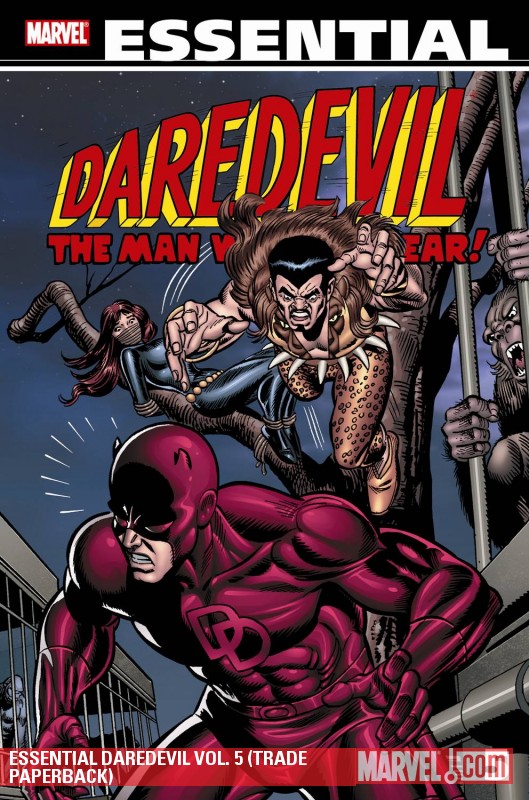
Essential Daredevil 5 coverAs you might expect from Gerber’s involvement, this isn’t Daredevil’s usual kind of stories, resembling neither what came before or after. He’s in San Francisco, playing Marvel Team-Up with the Black Widow; both changes were set up by Gerry Conway in the previous Essential Daredevil. But Gerber takes that and runs with it, having Daredevil battle large crises by himself. Daredevil fights the minions of Thanos, and Gerber puts Moondragon (who introduces herself as “Madame MacEvil”) and Angar the Screamer to good use. He uses two of my favorite characters, Mandrill and Nekra — they’re both goofy and menacing, especially Mandrill’s telepathic control of women. Gerber’s not afraid to have Daredevil lose fights, as the Beetle beats him and Kraven the Hunter defeats both him and the Black Widow. He shows an occasional flair for the Black Widow’s dialogue, especially when she snarks with society ladies in #104. And there’s something charming about having the Owl try to steal Daredevil’s brain.

Although some of the pieces of Gerber’s run are fascinating, the overall picture feels warped. There’s no denying that Thanos, Captain Marvel, and Moondragon are poor fits for Daredevil, and Mandrill’s nationwide revolution doesn’t quite work as a Daredevil story. Shanna the She-Devil and her story don’t exactly feel at home either, and meeting Man-Thing in his swamp really feels like something Spider-Man or the Thing would do rather than Daredevil. Perhaps most damningly, Gerber draws a hamfisted line under Black Widow and Daredevil’s relationship — Moondragon as a romantic foil for the Black Widow? Really? — as well as the entire San Francisco experiment.

Isabella’s five-issue run is more tightly focused, and it holds together much better. It involves Daredevil, the Black Widow, and SHIELD vs. Hydra, with the life of Foggy Nelson at stake. I’m a sucker for a good Hydra story, and this one is just that — a good Hydra story, rather than a great one. It has Silvermane and his son trying to guide the Hydra to a new resurgence, backed by several second-string villains — El Jaguar, Man-Killer, Mentallo, Blackwing. It’s a good idea, with the ousted Maggia leader presumably having the organizational capability to mold a splinter of Hydra into something more, and I wouldn’t mind seeing that sort of plot again.45

The art is especially solid for the Bronze Age but not spectacular, except for isolated issues. Heck doesn’t get as much respect as some of his Silver Age contemporaries at Marvel. But he does an excellent job here in his five issues as penciler (he also inked some issues); he’s outstanding in the non-action scenes, with extremely expressive faces. His action scenes can be a little stiff, however. Brown is the real surprise. I’d never heard of him before — or maybe I didn’t remember him. His action scenes are a real step up from Heck, and even if he isn’t quite the equal of Sal Buscema (who drew the Marvel Two-in-One issue included) or Gene Colan (who did a couple of Daredevil issues), he’s still pretty impressive. He can get across emotion through the faces and bodies of the characters as well as Heck, although sometimes his conceptions of the characters — especially Black Widow — seem a little off compared to Heck. Then again, Heck did co-create the Black Widow, so he’s got a slight advantage here.

There are more than a few things that aren’t quite right about Essential Daredevil, v. 5. But that’s what happens when a writer tries hard to do different things with a title — big things, in the case of Gerber. Sometimes it doesn’t quite work, but that doesn’t mean it’s not worth reading. It’s different from just about everything else with Daredevil in it, which isn’t nothing.

Rating: Marvel symbol Marvel symbol Marvel symbol Half Marvel symbol

Labels: , , , , , , , , , , ,

19 March 2010

Daredevil: Lone Stranger

Collects: Daredevil #265-273 (1989)

Released: February 2010 (Marvel)

Format: 216 pages / color / $24.99 / ISBN: 9780785144526

What is this?: Reeling from Inferno and Typhoid Mary’s manipulations, Daredevil wanders, exploring his heroic motivations.

The culprits: Writer Ann Nocenti and penciler John Romita Jr.

Sorry this wasn’t up earlier — taxes must be done at some point. It’s the law, after all. So in that spirit, today I’m looking at Daredevil: Lone Stranger, which stars the only lawyer comics readers like.38 Fortunately, it’s a little more interesting than preparing taxes.

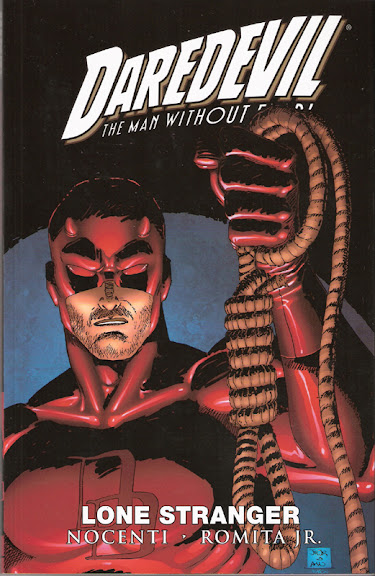
Daredevil: Lone Stranger coverOn the other hand, there’s nothing in here like the rush of seeing your refund grow (or what you owe go down). It starts out with Inferno and deals with literal demons, Mephisto the most prominent. If you are a connoisseur of the weird and outlandish bits of the Marvel Universe, I’ll say this book has a scene with Daredevil kissing Mephisto and be done with it.39 Neither Inferno, in which machines come alive and start eating people in New York because of off-screen demonic activity, nor Mephisto appeal to me, especially in the adventures of such a street-level hero as Daredevil. (Would you have guessed that superdemon and Ghost Rider villain Blackheart made his first appearance in Daredevil #270? I wouldn’t have, and I’m not sure I will even after reading it.) The supernatural villains don’t quite fit with his milieu, especially since Lone Stranger is just coming off the very grounded, very emotionally charged Typhoid Mary storyline.
That Typhoid storyline is relevant; all that emotion has left Daredevil, and now he’s trying to keep from getting involved. He fails, of course, and his denial of his heroic background gives his adventures in this book an aimless feeling. He wanders into towns, sets things right, and then is off again. There’s almost a Western feel to the book, which makes “Lone Stranger” appropriate. Still, even though we see signs of Daredevil emerging from his heroic stupor at the end of the book, there’s a listless core to writer Ann Nocenti’s work in this one.

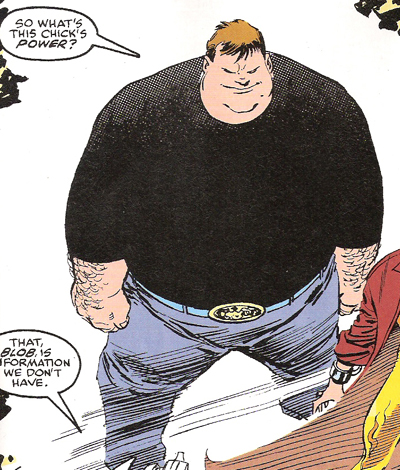
The battle against Pyro and the Blob of Freedom Force in #269, for instance, should be more fun or more dramatic, but because the characters lack any energy, it doesn’t make a lot of sense. Why doesn’t their teleporter stick around to help them capture the renegade mutant? Why do they fold so quickly? Why don’t they, you know, show some effort? Why don’t they keep looking for the mutant? Why is Pyro English? Daredevil is uninterested in the legal and moral questions of government mutants hunting down other mutants, and both he and Nocenti seem to be marking time (or serving time) in crossovers from more popular franchises (Spider-Man shows up randomly in #270) until something more interesting comes along.

Once Daredevil picks a fight — with a drug dealer and government stooge against his idealist daughter — things pick up. Nocenti’s never the subtlest of writer, and she makes her point in broad strokes, lumping drug running with the military-industrial complex, human experimentation and brainwashing with inhumane factory farming. I don’t agree with all of her politics, but it’s fun to see Daredevil against some truly villainous villains. It gives Daredevil a direction and someone to protect. (My favorite part involves the man who has developed a Stepford-wife laboratory beneath his factory farm; when pigs start breaking their legs on the grates meant to slough away their excrement under their pens, he orders his geneticists to design a pig without legs.) Still, by the time this storyline starts, two-thirds of the book has gone by, and a seemingly unrelated Inhumans subplot from Nocenti's Inhumans graphic novel takes up space in two issues of this storyline.

Daredevil: Lone Stranger coverPencils are provided by John Romita, Jr. I really shouldn’t have to say more, except that he’s between his ‘80s Spider-Man / X-Men Marvel house style and the more angular and distinct ‘90s / 21st century style that made him a top artist. This is a good blend of the two, actually. He uses a lot of the shading and crosshatching that marked his later style while still being able to draw a smoother, cleaner figure (like Spider-Man or Pyro) in the midst of the rest of the art. (I really like his all-curved-line Blob — probably my favorite version of the character, although as you might guess, I haven’t really been keeping track.) His Pyro does look a lot like Daredevil — similar masks, and in a fire it’s hard to tell the difference in their color schemes — and I’ve never for the style of drawing demons that he uses here. But those are minor nitpicks, and the demons are mainly Marvel house style (scaly, spiky plates, limited color palette), anyway.

(As a final note, I’d like to give Marvel credit for finally adding page numbers to their TPBs. Thank you. Now, was that so hard?)

This one is just too slow and flat for me. However, Daredevil kissing Mephisto? That does raise it above the bottom of the barrel. (How did Nocenti ever sneak that past the CCA and Marvel?)

Rating: Marvel symbol Half Marvel symbol (1.5 of 5)

Labels: , , , , , , ,

04 August 2009

Daredevil, v. 13: The Murdock Papers

Collects: Daredevil #76-81 (2005-6)

Released: March 2006 (Marvel)

Format: 152 pages / color / $14.99 / ISBN: 9780785118107

What is this?: Bendis and Maleev end their run on Daredevil as Matt tries to stay out of prison.

The culprits: Writer Brian Michael Bendis and artist Alex Maleev

Writer Brian Michael Bendis and artist Alex Maleev began their run on Daredevil with (v. 2) #26, and with a couple of exceptions (Bendis worked with fill-in artists on #38-40, and #50-4 was David Mack writing and drawing an Echo story), they continued on the title together until #81, more than four years together. It is a run of impressive length — if not always impressive quality — for a 21st-century comic from the Big Two.

Daredevil, v. 13: The Murdock Papers ends that run, an end that was too long in coming. But that isn’t The Murdock Paper’s fault.

Daredevil, v. 13: The Murdock Papers coverBendis finishes on a strong note. The story, in which the Kingpin tries to trade his freedom for evidence that will put Murdock in prison, allows Bendis to pull in the most important Daredevil supporting characters for his final ride. The Black Widow, Elektra, and the new White Tiger try to help Daredevil escape; Foggy foggies his way through the chaos; Phil Urich is the observer and reporter as always; and the Kingpin and Bullseye try to finish Daredevil off in their own ways. Matt’s estranged wife shows up to, uh, watch the chaos unfold. Bendis shows, if nothing else, he knows how to end the story he put into motion, and it ends the only way it could.

The fights are good, with plenty of violence and action. The characters, for the most part, get used well; Elektra’s return is a welcome sight, as is the Black Widow’s and Milla’s. I was glad Matt reconciled with his wife; leaving her as a loose end would have been an egregious error by Bendis. On the other hand, the verbal abuse hurled at Elektra is unwarranted, and the new White Tiger gets short shrift. The story has a growing sense of inevitability as it approaches the end, and a momentary dream sequence, as Matt ponders escaping the courthouse, is a nice surprise that underscores why the story can’t go that way.

The logical underpinnings of the story, though. … In The Murdock Papers, it is clearer than ever that Bendis is a writer, not a lawyer; if he played a lawyer on TV, I’d be tempted to ask for his disbarment. The Kingpin’s big plan is to prove Daredevil / Matt was near the site where the alleged evidence against Matt was stored, but that doesn’t prove obstruction of justice, as he and the Feds allege; any lawyer could argue coincidence or that Daredevil, as a hero, was there to preserve the evidence from the supervillains running around. The Feds giving the Kingpin immunity is stupid, and the legal loophole the Owl and the Feds use to circumvent that agreement is unconvincing. (Surely the Kingpin’s lawyers are better than that?) Singling out Daredevil for punishment is stupid, an obvious witch hunt that would prejudice the government’s case in court given the status of other vigilante superheroes. I’m relatively sure a federal agent can’t be fired as easily as Agent Del Toro was. Phil Urich’s refusal to protect his sources is asinine, to say the least; J. Jonah Jameson, frankly, should fire him for rolling over to the feds over the threat for being “lock[ed] … up for the whole day!!” (A whole day? Horrors!) If I thought Bendis’s Urich was the real Urich, I’d be upset that a good journalist was acting like a reporter for a high-school reporter. Probably a Skrull, though.

Maleev’s art isn’t quite up to his par. It’s still good on the aggregate, but Elektra seems to elude him; Maleev seems to have the idea that her face is a plastic mask, unmovable, and he can’t give her costume the reality that other artists have. (Admittedly, it is a unrealistic costume, but the other weird costumes look normal.) In fact, every time Elektra enters a fight, the action becomes stiff and posed. In the rest of the volume, though, Maleev’s work looks exactly like it always does: excellent.

This story should have been written three volumes earlier; Bendis said, in the afterword, that it ended the way it had to, but he didn’t want to saddle the next writer with a setup he didn’t want, and until he found a successor who wanted that ending, it was difficult for him to finish his Daredevil work. Still, it ends well. Despite its flaws, The Murdock Papers puts a nice capstone on one of the great Daredevil runs.

Rating: Marvel symbol Marvel symbol Marvel symbol (3 of 5)

Labels: , , , , , ,

17 June 2009

Daredevil, v. 5 (hardcover)

Collects: Daredevil v. 2 #66-75 (2004-5)

Released: June 2006 (Marvel)

Format: 256 pages / color / $29.99 / ISBN: 9780785121107 (hardcover)

What is this?: A hardback that collects two Daredevil arcs: “Golden Age,” which features the return of the old Kingpin, and “Decalogue,” in which a bunch of New Yorkers talk about how Daredevil and supervillains entwined their lives.

The culprits: Writer Brian Michael Bendis and artist Alex Maleev

I started buying collected editions of books just as the third Daredevil hardcover came out. Armed with money to start building a TPB collection, I jumped all over those three and the fourth when it came out the next year. It was good stuff, too: Kevin Smith, Joe Quesada, and David Mack in the first volume, followed by writer Brian Michael Bendis and artist Alex Maleev’s long run in the following volumes.

Bendis turned Daredevil’s life upside down by outing him to the press while making sure nothing could ever be proven. Bendis used this to take Daredevil’s life down predictable and unpredictable paths. It was fun, but by the end of the fourth volume, I was beginning to wonder how long Bendis could continue to dance between the raindrops. Not long, I figured, and that, along with the high price of the hardcovers (even with a discount, it would take up half my monthly budget) kept me from v. 5. But after a few years, you can sometimes find things cheaper …

Daredevil, v. 5 hardcoverSo you have Daredevil, v. 5 (hardcover), which contains two storylines: “Golden Age” and “Decalogue.” There is a vast difference in quality between them, but they both feature the same chatty, “naturalistic” Bendis style of dialogue and pacing. Some people love it, and some hate it; you know which category you fit into.

“Golden Age” inserts a previous kingpin into Marvel continuity, Alexander Bont. Preceding Wilson Fisk,31Bont was ousted by the FBI and Daredevil at the beginning of the Silver Age. He used Gladiator, a costumed criminal who later went straight, as his failed instrument of revenge. Now, an old man, he’s released from prison, but now he knows exactly who to blame: Matt Murdock.32 Blackmailing the reformed Gladiator and using MGH, he seeks his revenge: blood and humiliation.

It’s an interesting story; I have to give Bendis that. The story shifts from the ‘40s to the ‘60s (Golden Age to Silver Age) to the present. But although the time shifts allow Maleev to show off, I’m not sure what they add. Bont gained criminal prestige in the ‘40s by having (a little) audacity and pulling the trigger of a gun; he was a licentious old man in the ‘60s. These are not exactly revelations. These scenes feel like padding for what should be a two-issue story.

Not helping things is Angela del Toro, the FBI agent assigned to the Daredevil case. She’s inherited the Jade Tiger amulets that allowed her uncle to be the White Tiger. She comes to Matt in a horrible conflict of interest to ask what makes someone become a hero. Matt responds in the jerkiest way possible — he’s even a bigger jerk than if he told her to buzz off. The subplot seems tacked on as a trailer for the White Tiger miniseries, especially since nothing is mentioned of Agent del Toro in the next storyline, “Decalogue.”

But we can be happy for Ms. del Toro, because “Decalogue” is a talky mess. The only thing worse than a bunch of Catholics33 sitting in a church basement yakking about Daredevil is each of them telling the story about how a demon baby touched their lives. Did you know Daredevil functions better without supernatural elements?34 Sure you did. But Bendis didn’t. Still, he takes five issues to tell this story, although admittedly he doesn’t introduce the demon baby until the third. The preceding two issues are a “touched by a Daredevil” special episode and a criminal tale. One might make a change of pace between storylines; two, during a storyline, tries the patience. Overall, “Decalogue” is confusing and dull. And set in a church basement, where confusion and dullness spend their summers.

And that’s not even taking into account that Matt all but admits he’s Daredevil to a basement full of strangers. He claims he never said he was, but he ventures far past the point of plausible deniability. That clinches a crap rating for “Decalogue.”

Thank God for Maleev. His work is well fitted to the character, and I think he goes into the conversation of best Daredevil artists of all time, along with Frank Miller and Gene Colan.35 I don’t think he’d win, but he’s still excellent. In this collection, he gets to pitch his art as black-and-white Golden Age stuff (disclaimer: his art looks like nothing from the Golden Age) and as pantoned Silver Age material (it does look like some of the Silver Age). His work reminds me of series of stills, even at it’s most kinetic; that’s not a complaint, just an observation on stylistic choice. There are, however, many double-paged spreads that are just talking heads; it’s unnecessary and confusing, but given the prevalence of the practice in Powers, I can blame that on Bendis too. My only real complaint about the art, other than some odd color choices in “Decalogue,” is the lack of blood in a suicide scene; a character is supposed to have slit her wrists and gouged out her eyes, yet it’s impossible to see the character, in a wide shot, has anything wrong with her (the head is averted). Could be a coloring problem, but there doesn’t look like there’s anything in the pencils to indicate a large, seeping crimson pool.

This is a frustrating book. It goes steadily downhill, from a promising beginning to an ending that nosedives into the dungheap. Without Maleev as a saving grace, this book would hardly be worth picking up, even if you were picking it up to throw into the recycling bin.

Rating: Marvel symbol Half Marvel symbol (1.5 of 5)

Labels: , , , ,

08 May 2006

Daredevil, v. 8: Echo: Vision Quest

Collects: Daredevil #51-5 (2003-4)

Released: March 2004 (Marvel)

Vision Quest is much like a vapid blonde: extremely beautiful but not worth spending time with. As long as you can look and not get bogged down with her words, you’re all right.

Even in an era of decompressed storytelling, it’s amazing David Mack is able to pack so little into five issues. Let’s look at what happens in each issue:

#51: Recaps Daredevil #9-15. #52: Our surrogate heroine Maya talks briefly with her old fling Daredevil, who’s found a new girlfriend, then goes to see the Kingpin. #53: Maya talks briefly with the Kingpin, then goes on a vision quest. #54: Brief fight. Maya thinks Wolverine is her spirit guide, although it’s news to Wolverine. #55: Wolverine tells Maya a short parable. Maya decides to become a storyteller.

If you were told this might read better in the trade, you’ve been deceived. It doesn’t. Every time I turned the page, I waited for the story to advance, and generally, it didn’t. This story is so padded it should be printed on goose down. I can imagine Stan Lee writing this story, but I have no idea what he’d do with the extra five pages in the first issue.

You have to cut Mack some slack for the space necessary for his art style, but this is ridiculous. On the other hand, the art is worth cutting some slack. While reading this, I feel like I’m looking at art — real art, the kind you look at in a museum, and whenever someone asks you your opinion of it, you have to make something up rather than feel shallow and say, “Pretty.”

Grade: C

Labels: , , ,